
Y’know… that could probably be an entire series of entries on its own. I’ve only played Mystery Dungeon: Blue Rescue Team, but I enjoyed it. I thought it was a good game. It has its flaws, but I think there are probably a few things the main series could stand to take from it in terms of both gameplay and storytelling. As for your last question… can the answer be “yes” to both? Obviously the setting is wildly incompatible with the main games, the anime and most of the other spin-offs in a number of fairly blatant ways, and I don’t think there’s really any point in debating that, but I think that the actions and personalities of the Pokémon characters in the Mystery Dungeon series can probably be taken as exemplary of the way the designers of those games saw the various species in question, any specific abilities demonstrated by Pokémon in those games are as likely as not to be ‘canonical,’ and the roles played by the various legendary Pokémon make at least as much sense as their equivalents in the franchise’s other incarnations. Perhaps the events of this series could be interpreted as a legend or fable told within the context of the world we know from the main series or the anime? *shrug* I suppose ‘non-canon’ is a legitimate label to apply, but it really seems rather too dismissive a term for my taste.
Author: pokemaniacchris
I saw someone make a comment on one of your posts that sparked my interest. What exactly do you think a “type” is. In reference to pokemon AND moves (i mean like, why is flash cannon steel?)
…damnit; I was hoping no-one would ask that.
Okay. So. What the hell is a type, anyway? This is… tricky. Let’s look at a couple of Flying-types to illustrate some of the problems here. Dodrio is a Flying Pokémon because he has birdlike physiology, even though he can’t actually fly, while Drifblim is a Flying Pokémon because he can fly, despite having nothing in common with Dodrio, physiologically speaking. They share the properties we associate with the Flying type, though – weaknesses to cold and electrical damage, for example. What this suggests is that types are actually just a set of categories created and defined by humans, and used to describe the sets of strengths and vulnerabilities Pokémon possess in battle. That is, Dodrio and Drifblim are both considered Flying-types because they have those common strengths and vulnerabilities – even though they have them for completely different reasons. What’s a little awkward about this is that the system is so perfect. With few exceptions – namely, those Pokémon with abilities like Levitate and Thick Fat that alter their defensive capabilities with respect to specific elements – the strengths and weaknesses of all the Pokémon that are known to exist fit perfectly into the type system. It is possible, for instance, to make complicated predictive statements like “any Pokémon that resists both Lava Plume and Dragon Rush will cease to resit one or both of them after exposed to either Gastro Acid or Worry Seed.” With our privileged out-of-universe knowledge, we can predict with quite a high degree of confidence that a statement like this will always be true, even though there may be many Pokémon in the universe that we don’t know about yet. What this suggests is that type is (or describes) real properties which can be objectively measured, and which are common to all Pokémon of a given type.
So which is it?
I think we can probably agree that a shared type does not necessarily imply shared ancestry – that is, there is no ‘common ancestor’ of all Dark Pokémon, for instance; Absol and Mandibuzz are more closely related to other Pokémon in the Field and Flying egg groups, respectively, than they are to each other. Eevee, I think, has to be the clincher to this, since she demonstrates conclusively that there can be a Fire Pokémon (Flareon) who is much more closely related to a Water Pokémon (Vaporeon) than to any other Fire-type. It follows, therefore, that any traits which members of a single type have in common are the result of convergent evolution (like bats, birds and butterflies, they have physiological traits or abilities that are outwardly similar and serve common purposes, but actually function differently at their most basic level). This is less true for some types than for others – for instance, Bug, Dragon, Flying and Grass all map quite closely onto corresponding egg groups, so one imagines that for many of them, their shared traits actually do indicate shared ancestry, but these types are exceptions (as is proven by the outliers within those types, like Flygon, who is a Dragon Pokémon, but is a member of the Bug egg group and not the Dragon egg group). This seems to provide more support to the idea that ‘type’ is actually a human idea used purely to describe the way a Pokémon fights.
I am rather inclined, at this point, to suggest that type is a human construct that doesn’t necessarily have any impact on the way Pokémon live their lives in the wild but is a useful way of simplifying the complex web of interactions between various powers and abilities that make one Pokémon more effective against another but less effective against a third. That still leaves us with the question of why Dodrio and Drifblim share so many apparent tactical strengths and vulnerabilities when they seem to have nothing in common, and for that I have only the unconvincing answer of “coincidence.” In the case of the more supernatural elements, like Psychic and Ghost, you could easily argue that two Pokémon from the same type have independently evolved to draw power from a common source, and that the nature of these sources inherently renders attacks and protections drawing upon one of them more or less effective against those that draw upon another. This works as a general explanation to the extent that all Pokémon are in some sense magical (I think you would be hard-pressed to find one that has no access to any supernatural powers at all) however it seems awfully like simply giving up on the question, and it is besides much less convincing for the more mundane types, especially Normal, which is defined mainly by its lack of any unifying characteristics. At present, though, I’m afraid I’m unable to give any fuller answer.
Do you have a crush on Espeon?
…I’m… gonna need someone to explain this to me.
If you could describe each generation set of games with one word each, what would they be? Remakes are optional depending on how you interpret the question, as well as Black 2 and White 2 for similar reasons.
What an odd question.
Hmm.
Red/Blue/Yellow: Imagination.
Gold/Silver/Crystal: Mystery.
Ruby/Sapphire/Emerald: Discovery.
Diamond/Pearl/Platinum: Ambition.
Black/White: Truth.
I haven’t played Black 2 or White 2 yet, so I’ll have to defer an answer on those two.
I’ll leave you to speculate on why I chose those words. :-p
Hello, I’m a BIG fan of your blog. I love it. Anyways, I’ve been contemplating about Pokemon fans wanting a game with all of the regions in it. Though it sounds pretty cool, would this be too much? What’s your opinion on it?
Hmm. Well, simply put, it would be a massive project. The sheer scale of it would make it utterly different to everything Pokémon has done before, as well as extremely difficult, and would necessitate throwing out a lot of the established gameplay and storyline conventions. As cool as it would be, I think that such a mammoth project would be impractical for a cartridge game, and that the details would suffer as the designers attempted to cram everything in. Now, for something like an MMORPG, it might be more practical, but to my knowledge Game Freak have never expressed any interest in MMO Pokémon (besides, I just plain don’t like MMORPGs). Maybe for a strategy game it could work? But no, for a traditional Pokémon game, I just don’t see it happening, and I think the attempt would likely be ruinous.
Umbreon
 Dark is a strange type. Dark Pokémon aren’t necessarily connected with darkness or the night at all, although many of them do prefer the dark. ‘Dark type’ is actually a somewhat imprecise translation of the Japanese term literally meaning ‘evil type,’ but that just throws up more questions – whole species of Pokémon that are just ‘evil’? That can’t be right, can it? Dark Pokémon are associated with evil, and also with trickery, and often with fear, but they aren’t necessarily evil themselves; they’re part of that old stereotype of the ‘misunderstood brooding dark hero.’ Dark Pokémon may well work towards good, but they can and will lie, cheat and steal to do so, and they will not on any account fight fair, because the ends justify the means.
Umbreon is one of the game’s oldest Dark-types, and naturally he grabs this concept with both hands. Umbreon is a badass, but in a very different way to Jolteon: dark and dangerous, but in an understated, subtle way. The yellow-on-black of his ring markings is bold, like the light of the moon against the black of the night sky, but minimalistic. This is not a Pokémon who goes in for glorious battle and flashy displays of power; this is a Pokémon who gets things done quickly, quietly and, if at all possible, without ever being seen. He’s noted for his poisonous sweat (oddly, Umbreon doesn’t naturally have any Poison attacks – maybe Game Freak always anticipated that everyone would teach him Toxic?) and for his supernatural ability to cause fear in others when the rings on his body glow in the moonlight. An ambush hunter, he prefers to move around at night, when he can remain hidden and wait for his prey to present a vulnerability. Umbreon seems to be empowered somehow by exposure to moonlight (hence his in-game ability to heal himself with Moonlight, a move analogous to Espeon’s signature Morning Sun but shared originally by Clefairy and Oddish) but the exact nature of his powers seems to be mysterious. The result of all this is that Umbreon’s particular brand of charm falls somewhere between Jolteon and Espeon, based on a combination of decisive power and elusive mystique, exactly the combination that captured the imagination of Karen, leader of the Johto Elite Four, all those years ago. Personally Espeon is still my favourite, but I can definitely see Umbreon’s appeal too.
As I’ve been looking at Eevee’s evolutions so far, I’ve been interpreting them with a view to understanding the environments that might have caused Eevee to develop all of these forms in the first place. In Espeon’s case I concluded, based on the stimulus that triggers her evolution and the nature of her powers, that she represents a form of Eevee specially adapted to domestication, and particularly to the defence of settled communities. Now, Umbreon evolves from Eevee in more or less the same way as Espeon – by forming a particularly close bond with his trainer – except that Eevee can become Espeon during the day and Umbreon during the night. Logically, one assumes that partnership with humans had some hand in the development of Umbreon as a species as well, but why the split between the two? I think the answer is in what it means to be a Dark-type. Espeon is all about community and empathy; she developed her psychic powers to defend homes and families. Umbreon, by contrast, is all about solitude and individualism – this species evolved at the same time and for similar reasons, but for different purposes. Espeon is a protector, active during the day, staying close to the settlement and looking after the old and the very young as they go about their domestic work. By contrast Umbreon, a strain devoted to survival, efficiency, stealth and cunning, developed out of the Eevee who partnered with hunters and scouts whose tasks were related to the night – although they do live in settled villages, they fulfil their most important roles beyond the community’s borders. This is where Umbreon’s whole attitude and demeanour come from. The quintessential Dark-types, they do their work out in the wilderness where they have no-one to rely on but their human partners, and where no-one else will rely on them, hence the ‘ends justify the means’ approach they take to combat. They work for the good of their communities, but out on the frontiers they have no time for rules.
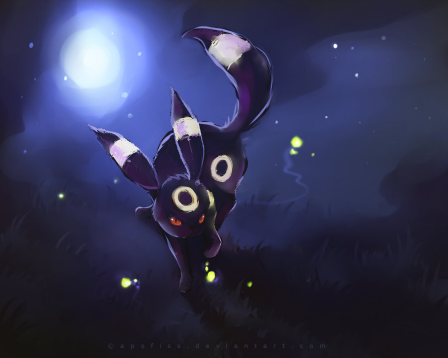
Where his brothers and sisters tend to combine powerful support skills with dangerous attack options, Umbreon is instead a totally defence-focused Pokémon. He’s slow, his attacks are weak, and like all the others, his movepool is limited, but for all-around defensive ability, Umbreon is difficult to beat. Back in the heady days of Gold and Silver, an Umbreon with Rest or Moonlight and some nasty trick like Charm or Confuse Ray was nigh indestructible, free to fling Toxic around and then wait patiently for everything to die. That was really all you needed to do with him (aside from keep him away from Poison- or Steel-types, obviously), although, like most of Eevee’s other evolved forms, Umbreon had a nifty trick to use with Baton Pass: Mean Look. Mean Look traps an opposing Pokémon in play until Umbreon switches out or faints – wonderful if it’s something Umbreon can handle. If not, though, Baton Pass will take Umbreon out of play and replace it with another Pokémon who can deal with the victim… and keep the trap effect, which would be ended if Umbreon were to switch out normally. This would eventually become Umbreon’s main tactic. He gained Taunt and Wish in Ruby and Sapphire, which were useful toys for ruining other support Pokémon and keeping his teammates healthy, respectively, and the addition of physical Dark attacks in Diamond and Pearl made it possible to use Umbreon as a slow physical tank with Curse (Payback, which is more powerful when the user moves after its opponent, is noteworthy – if you’re using Curse, you’ll be slower than anything else around anyway). The combination of Mean Look and Baton Pass was his big trick, though; it’s a difficult strategy to pull off, but succeeding at it would almost certainly doom at least one opposing Pokémon, trapped in play against a Pokémon of your choice, and Umbreon is tough enough that he could and did make it work.
And then they took it off him.
For reasons that escape me, Mean Look was removed from the list of effects that can be transferred by Baton Pass in Black and White. It couldn’t have been for thematic reasons, since there’s never been any real logic to what gets transferred and what doesn’t (and how is Baton Pass imagined to work, anyway?). Could it have been for balance reasons? Well, only a handful of Pokémon could ever do this anyway. Absol was terrible at it, and murdering things with Swords Dance is a much better use of her time. Smeargle, likewise, had better things to do unless you wanted to put him into a Baton Pass chain, and even then he has more important moves. Essentially, the only things that changing the mechanics of Mean Look did were stealing Umbreon’s favourite specialty tactic and finally eradicating the only reason ever to use Ariados (who used Spider Web in place of Mean Look). Since it is an inescapable truth that no-one in the world has ever actually used Ariados anyway, I am forced to conclude that Game Freak just woke up one morning and decided they hated Umbreon. It’s just such a bizarre thing to change, when there are so many other inane things that they insist on keeping the same.
Okay; rant over.
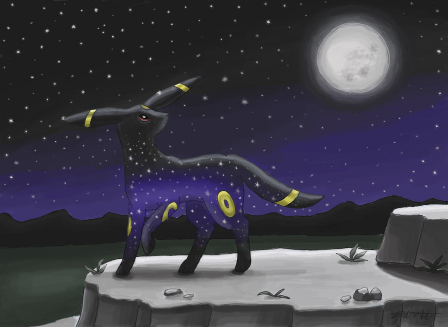
Don’t get me wrong. Umbreon is still a wonderful defensive Pokémon – in fact, he’s the toughest Dark-type in the game; only Mandibuzz is comparable, and Umbreon leaves her in the dust for special defence. His Wishes aren’t as potent as Vaporeon’s, but he’s still a decent Pokémon to put on healing duty, and he can threaten to put things to sleep with Yawn. Curse remains an option too if you want a more aggressive Umbreon, and it looks like Black and White 2 have given him Foul Play, a powerful Dark attack that circumvents Umbreon’s poor attack stat by allowing him to use his opponent’s instead. His abilities are fairly plain, as abilities go; Synchronise is nice to have but not particularly useful, as for Espeon, but unlike Espeon his Dream World ability is garbage – Inner Focus? Immunity to flinching? I guess if you really hate Togekiss or Jirachi… but Togekiss will just smack Umbreon in the face with a super-effective Aura Sphere, and Jirachi is immune to Toxic, which means Umbreon can’t actually hurt her anyway. This is, essentially, the crux of the matter for Umbreon: passing Mean Look was easily the most threatening thing he could do; now anything immune to poison just doesn’t care about him anymore. Steel-types in particular, who resist Dark attacks, no longer have any reason to pay attention to Umbreon. They can just get along with their own thing, and Umbreon will have no choice but to flee, maybe dropping a Wish on the way out if he’s lucky. Vaporeon, by way of contrast, is much harder to block completely; sure, Water-types will largely ignore her main attacks, but thanks to Water Absorb and her good special defence, she’ll ignore them right back!
In spite of my rant, I really do think that Umbreon works. He’s sleek but bold, not quite like any of the others, and as such he appeals to, once again, a different segment of people. His total defence focus is different as well, not just from his brothers and sisters but from the stereotypes of his element as a whole. I just have to slam the mechanical change to Mean Look one more time because it actually reduces diversity and uniqueness instead of increasing it by eliminating a previously difficult but powerful and interesting tactic; I just find it fundamentally absurd on grounds of design philosophy. Umbreon is far from ruined, though; if you need a bulky Dark-type, there’s none better.
You’ll most probably cover this in your wrap-up for the Eeveelutions, but because the focus is now on adapting to the environment I see it unlikely that, for example, a bug evolution would occur because it would require a mammal being in a position where it thinks “Screw it, I’mma just be an insect now.” Just realised this wasn’t a question but yeah, I’ll be patiently waiting for that specific entry :3
That is definitely something for the wrap-up entry, but I hadn’t thought of that particular way of looking at it. I’ll certainly look at it now, though, so thanks!
Espeon
 In Red and Blue, Eevee was unique, the only Pokémon in the game with a branching evolution. The introduction of some of Gold and Silver’s new Pokémon, like Slowking, changed that – several others could now evolve in multiple different ways. Tyrogue even had a three-way split, into Hitmonchan, Hitmonlee and Hitmontop. Clearly this would not do, so Gold and Silver also added two more members to Eevee’s family; if she couldn’t be the only Pokémon with multiple evolutions, she could still have more than anyone else. Thus we have Espeon and Umbreon, the evolutions connected with the day and the night – and for today, it falls to us to look at Espeon.
Much as Vaporeon, Jolteon and Flareon each play to a different set of aesthetic preferences, Espeon tries for another still different look; with her aloof, alien countenance, forked tail and intense, flashing eyes, Espeon’s air is one of mysterious, otherworldly power – appropriately enough for a Psychic-type. Espeon is unusual for a Psychic Pokémon in that her most famous ability doesn’t actually result from psychic power at all; she can predict the immediate future with an uncanny degree of accuracy – everything from weather patterns to an opponent’s movements – but does it by reading subtle changes in air currents with her fine, sensitive hairs. I almost suspect this is meant to make us ask whether all psychic power in the Pokémon universe actually has a more mundane explanation… but, then, we’re also told explicitly that Espeon does use “psycho-power” and she has the standard set of telekinetic and telepathic abilities available to all Psychic-types, so maybe I’m giving Game Freak too much credit here. Like many Psychic Pokémon, Espeon is particularly associated with loyalty towards and protection of worthy trainers, which makes sense given the way she evolves. Oddly, she’s also connected with the sun and daylight – oddly, because she has few powers related to it. I imagine this was intended to set her up as an opposite to Umbreon, who is strongly linked with the moon and the night, and I suppose Psychic is the closest thing Pokémon has to a ‘light’ or ‘holy’ type, but I can’t help but think that this could have been done better if Espeon had been created later in the series’ life. She does have Morning Sun as a signature move, and she can learn Sunny Day (along with just about every Pokémon in the game except for Water-types) but doesn’t get much benefit from it; surely it would make sense for her to learn Solarbeam, at least? I don’t know; if I were designing Espeon today I would probably do her totally differently to emphasise the solar aspect, but I guess given the tools that were available in Gold and Silver (no abilities, fewer weather-related effects) what we have is fine.

Gold and Silver are the games that introduced the idea that Eevee’s branching evolution is a result of adaptation to multiple different environments, so it’s odd that the two evolutions introduced in that very generation, Espeon and Umbreon, are the hardest to connect with any particular ecosystem. A possible clue, though, is the stimulus that triggers Espeon’s evolution – close friendship with a trainer – and the suggestion from Ruby and Sapphire that “this Pokémon developed its precognitive powers to protect its trainer from harm.” I suspect that Espeon arose fairly recently (in terms of evolutionary biology), after humans and Pokémon first began working together, and represents the result of a strain of Eevee who became adapted to domestication, the eventual descendents of the first groups of Jolteon and Flareon who took human partners. She has telepathic abilities to allow her to sense the orders of her human trainers, and can predict the future to intercept attacks before they happen. Furthermore, unlike the raw elemental forces wielded by Flareon, Vaporeon and Jolteon, Espeon’s telekinetic attacks are very unlikely to cause ‘friendly fire’ problems; she’s not going to hurt anything she doesn’t fully intend to hurt, making it safer to use her strongest powers around groups of people. Furthermore, I’d suggest that Espeon isn’t a hunter – early domesticated Pokémon, one assumes, would have been involved with hunting like the first domesticated dogs, but a more predatory type like Jolteon seems better suited to that. I think Espeon may be a Pokémon dedicated to the defence of the settled communities that developed later in humanity’s history, which makes some thematic sense given the connection between Psychic-types and more ‘evolved’ or ‘civilised’ states of mind. The other forms are older, and joined with humanity out of convenience; Espeon actually developed with us, changing as we did.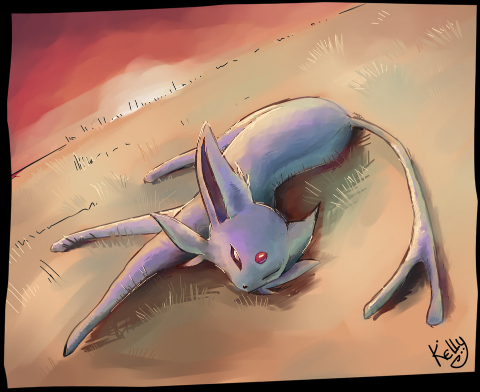
When you want to fight with Espeon, many of the same issues arise as we encountered with Vaporeon, Jolteon and Flareon. Espeon has extremely good special attack and speed, which ideally make her a sweeper of some kind, but her special movepool is less than stellar – in Gold and Silver, it was pretty much Psychic, Bite, and Zap Cannon. Her signature move, Morning Sun, provides her with healing, but frankly Espeon is much too frail to be worrying about that. I guess Charm might help her survive a hit or two. Like her brothers and sisters, she can learn Baton Pass as an Eevee, but Gold and Silver didn’t really give her anything to do with it. Ruby and Sapphire changed that. Espeon only gained three things of value in Ruby and Sapphire: Reflect, Light Screen, and Calm Mind. Reflect and Light Screen are great, but nothing to make a fuss about – Calm Mind, which increases both special attack and special defence, is what gives Espeon her niche. Very few Pokémon could learn both Calm Mind and Baton Pass, and Espeon was (indeed, still is) the best of them; her own ability as a special attacker remained limited, but helping others to set up was another story. Diamond and Pearl didn’t much change what Espeon was good at – like many Pokémon, she gained a lot of new attacks, notably Shadow Ball, Grass Knot and, in Platinum, Signal Beam, but, while useful, these new moves aren’t powerful enough to dramatically change her game. Meanwhile, the conversion of Pursuit, along with every other existing Dark-type move, into a physical attack spelled disaster for many Psychic Pokémon whose defensive skills were far weaker on the physical side, including Espeon. For a while there, things looked grim… until Black and White gave Espeon one last trick, the best of all.

The thing about Espeon’s ability, Synchronise, is that while it’s nice to have, it doesn’t really have great strategic implications. If Espeon is poisoned, burned or paralysed by another Pokémon that is vulnerable to the same condition, she causes her attacker to suffer from the same effect. This is a useful defence against a specific kind of attack, but it doesn’t help Espeon much; she’s still poisoned, paralysed or burned as well. Her Dream World ability is something else. Espeon’s Dream World ability is Magic Bounce, a truly absurd power shared only by Xatu, which effectively gives her a permanent Magic Coat – all incoming status moves (basically anything that harms a Pokémon without actually damaging it, from String Shot and Worry Seed to Stealth Rock and Dark Void) are reflected back upon their user. This makes Espeon an utter nightmare for support Pokémon, since she can potentially ruin them just by switching in if you time it right; some moves, like Hypnosis, will potentially take a Pokémon out of the game if you reflect them back. The fact that Magic Bounce also renders Espeon herself immune to all these techniques is nothing to sniff at either. The other thing worth noting is that Espeon also gets a couple of new Psychic attacks for variety – Psyshock is a special attack that does physical damage, allowing Espeon and other Psychic Pokémon to break powerful special walls (i.e. Blissey), while Stored Power, an attack that does more damage for every buff affecting Espeon, synergises well with her normal role of Calm Mind passing. Espeon doesn’t really ‘do’ sweeping – her stats look right for it, but her real talents lie elsewhere. As support Pokémon go, she’s pretty top-notch; kept away from high-powered physical attackers and partnered with your own special sweepers who need a bit more oomph, Espeon is sure to reward you.
As I believe I’ve mentioned, Espeon is actually my favourite Eevee form. This isn’t because of any particular excellence of design, though; it’s just personal preference. I feel Espeon is, all around, reasonably well done, and Game Freak have actually built on her skillset over time to make up for her initial weaknesses – admittedly, this is probably by sheer coincidence, but don’t look a gift horse in the mouth (well… unless a Greek warlord is giving it to you). Aside from the recent addition of that absurd Magic Bounce ability (which probably makes her the most powerful member of the family), there’s nothing about Espeon to get really excited over, either mechanically or thematically, but there’s nothing especially wrong with her either, and she has a solid, legitimate place of her own amongst Eevee’s varied evolutions.
I don’t know, moves like Simple Beam, Reflect Type, Shell Smash, the abilities Scrappy, Tinted Lens, Klutz…
Sorry, when I said “more specific” I meant with regards to what I would actually talk about (should have been more clear there). I honestly don’t think they’re all that interesting except with reference to the Pokémon that use them. Again, it’s something I could easily devote one or two entries to, but I think I would very quickly run out of things to say if I tried to devote a whole series to it.
There are still 10 possible types for new Eeveelutions. Which would you most like to see and why?
Just posting this to let you know that I have, in fact, seen your question – I’ll discuss this, among other things, in the final ‘wrap-up’ entry of the current series, after Glaceon.

