Salandit and Salazzle

Screen Shot 2018-06-26 at 12.27.53 AM.png
Salandit

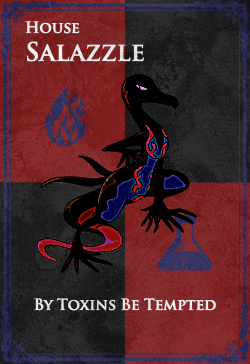
I think it’s time to explore some of the more hostile reaches of Alola, with the volcano-dwelling salamander Pokémon, Salandit and Salazzle. Salandit and Salazzle could be based on any of several things, or a mix of all of them, or none of them. Physically they resemble fire belly newts (genus Cynops), a group of newt species native to Japan and southern and eastern China (in the strictest scientific sense, newts are a branch of the salamander family and, compared to other salamanders, remain more aquatic even after leaving their tadpole stage; the words are often used interchangeably though). Fire belly newts are so called for their black colouring with bright red or yellow flame-like markings, which warn predators that they are poisonous and unsafe to eat – so we have a ready-made fusion of the Fire and Poison elements right there. Salamanders also have a very long history of being associated with fire, with stories that they bathe in flames going back at least as far as Aristotle. We could almost stop at that – Salandit and Salazzle are fire salamanders that breathe fire, and they’d hardly be the first Pokémon to come out of “real animal + appropriate-sounding elemental powers” (*cough*Beartic*cough*). But no; there’s more to these crafty amphibians, and as so often in Alola, we can look for answers in the real archipelago of Hawai’i. Continue reading “Salandit and Salazzle”

Mareanie and Toxapex

Screen Shot 2018-06-17 at 9.29.40 PM.png
Mareanie

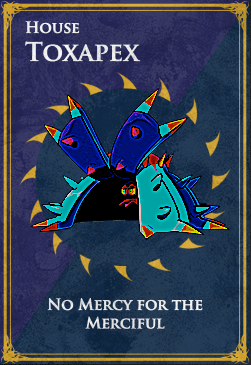
Today we’ll be looking at some of Alola’s more passive-aggressive denizens, the Brutal Star Pokémon, Mareanie and Toxapex. Their physical designs are a little bit cryptic – Mareanie looks like a sort of spikey anemone, while Toxapex… Toxapex resembles nothing so much as a cancerous uvula glued to the inside of a dilapidated sea mine, with her twelve arms locking together to form an impenetrable dome that protects against not only predators but the force of waves, tides and ocean storms. In appearance, probably the closest animal to Toxapex would be something like a sea urchin, so bristling with spikes that its real body is essentially invisible, and probably not what you’re most worried about anyway. But it’s from their place in Alola’s ecology – specifically their relationship with one particular Pokémon, Corsola – that makes it clear that they’re probably supposed to be based on the dreaded crown-of-thorns starfish, Acanthaster planci, an unusual many-armed, spiny starfish found throughout much of the Pacific ocean.  Continue reading “Mareanie and Toxapex”

Squidward Tentacles asks:

I’d tell you a random fact about fish, but I work with them every day. I hate them. I hate working at the Krusty Krab. I hate the nautical nonsense of a ninny that flips burgers right behind me every day.

Good day sir! I SAID good day!

Mmm.  I sympathise.  Unfortunately fish are often very stupid, and sponges, I’ve heard, are worse (though strangely proficient in fine dining and breathing).  Crabs, however, are the highest form of life in the universe, as demonstrated by the fact that evolution keeps trying to turn other animals into crabs, and you should feel honoured to work for one.  If you need something to take your mind off your coworker’s ceaseless blithering, try Jim the Editor’s randomised Kingslocke playthrough of Fire Red, now returning after an unfortunate but necessary hiatus to focus on work – or try out the rules yourself, and let me know how it goes!

Fomantis and Lurantis

Screen Shot 2018-05-27 at 11.49.05 PM
Fomantis

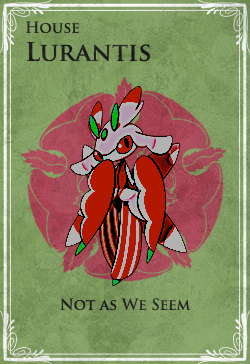
Today we’re talking about Fomantis and Lurantis, the “Sickle Grass Pokémon” and “Bloom Sickle Pokémon,” a pair of deceptive Grass-types that take on the appearance of insects, their names evoking the words “faux” and “lure.” According to the Pokédex, Lurantis is often called “the most glamorous Grass Pokémon,” which… well, I think Roserade, Lilligant, Virizion and fellow Alolan Grass-type Tsareena are all going to want a word with you about that one, Lurantis, but for now we’ll agree that you’re top 5 material. Let’s take a closer look. Continue reading “Fomantis and Lurantis”

Anonymous asks:

This doesn’t have anything to do with pokemon, but I was wondering if you might have any thoughts with your Archaeology background: In a lot of stuff written about Greco-Roman mythology I’ve read, Hectate is called a goddess of witchcraft and Circe a witch, and there’s probably other examples I don’t know of. However, I’m not really sure what being a witch would mean outside of the context of Christianity or modern pop-culture. Was this just something that was added in by much later writers?

Well, what is a witch, exactly?  Ugly old woman, warty nose, pointy hat, flies around on broomsticks, brews potions in cauldrons, turns people into newts, weighs the same as a duck, that sort of thing?  Circe, Hecate and Medea aren’t witches in that sense, no; they predate that stereotype of what a “witch” is by a good couple of millennia.  Continue reading “Anonymous asks:”

RandomAccess64 asks:

I personally always liked the fan Pokémon concept of basing a poison/ice type after a cold, with a counterpart poison/fire type after a fever.

And Anonymous asks:

When I think Ice/Poison, my mind first goes to pollution. Some sort of frozen sludge monster, perhaps, or a rotting corpse trapped under a layer of permafrost, its putrescence leaking into the surrounding environment.

Some interesting ideas!  The cold/fever one could definitely be played with in some neat ways… maybe as alternate forms of a single Pokémon, even?  If it’s a disease-based Pokémon, it might need to spread illnesses in order to keep itself healthy, which could make training one a challenge.  The rotting corpse might be pushing it for a Pokémon game – I don’t know if Game Freak would go for that one – but the sludge monster idea sort of makes me want to see a Polar Muk regional variant.

Anonymous asks:

This isn’t a question but I wish I had you as a history teacher when I was in school – history was always my weakest subject and I genuinely enjoy the way you explain things, it actually helps me understand without zoning out!

Sorry for leaving this one languishing in the inbox for so long.  And thank you!  That really means a lot, as someone who, uh… actually does have to teach history sometimes, to students who are often less than enthusiastic at the prospect.