Passimian

250px-766Passimian.png
Passimian

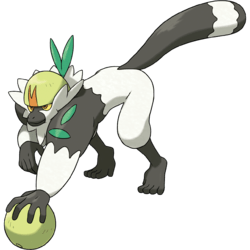
Today we’ll be following up Oranguru by looking at his opposite number. Oranguru is only available on the Moon and Ultra Moon versions of the game; in the same part of Alola, the Lush Jungle of Akala Island, the Sun and Ultra Sun versions instead get Passimian. They’re opposites in some fairly obvious and superficial ways – both are based on primates, but Oranguru is an intelligent Psychic-type while Passimian is a physically powerful Fighting-type, a classic brains-and-brawn pair, and in battle, Oranguru amplifies his partner’s powers while Passimian uses his partner’s powers to make himself stronger. There’s more going on here, though – a lot more, to be honest, than I realised when I first met either of them. Continue reading “Passimian”
Oranguru

250px-765Oranguru.png
Oranguru

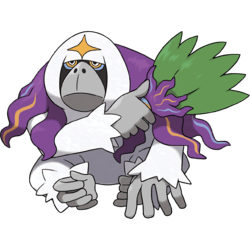
Making strange arguments and dubious assertions about Pokémon lore is an important branch of my schtick. Normally this comes up in questions addressed to this blog, or in whatever mad articles I decide to write in between generational Pokémon reviews, or occasionally in my musings on playthroughs of new games. It’s relatively unusual for a routine Pokémon review to provoke me to a really energetic bit of wild speculation. Luckily(?), however, today we have just the Pokémon to set me off: Oranguru. Continue reading “Oranguru”

Wimpod and Golisopod

250px-767Wimpod.png
Wimpod

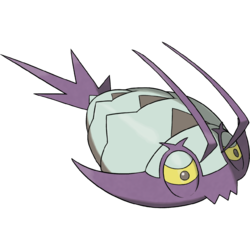
One of Pokémon’s grand traditions is Pokémon who are very difficult to train on account of their weakness, but evolve into very high-statted and powerful beasts. Magikarp is the classic example, practically unable to fight at all, with Feebas following very closely in the same mould. Larvesta and Noibat are better able to fend for themselves but take a very long time to evolve and are pretty pathetic until they do. It’s one of the most powerful expressions of Pokémon’s theme of nurturing leading to growth. Alola’s most traditional contribution to the list is really Cosmog, who is even worse than Magikarp until he suddenly isn’t, but we can also count the Turn Tail Pokémon, Wimpod, and its fearsome evolution Golisopod.

Continue reading “Wimpod and Golisopod”

Comfey

250px-764Comfey.png
Comfey

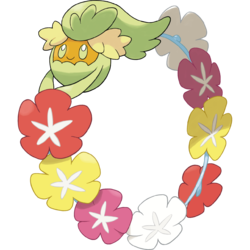
One of the most recognisable symbols of Hawaiian culture is the lei – a garland of flowers, worn around the neck on special occasions. If you’ve ever been to Hawai‘i, you might have been presented with one of these at some point; tourists love receiving lei, and Hawai‘i loves tourists. You can also see them in the stereotypical image of a traditional Hawaiian hula dancer. Lei are so well known as a distinctive element of Hawaiian ceremony and celebration that, really, it would be almost impossible for our Hawai‘i-inspired Pokémon region not to have a Pokémon that referenced them somehow. Enter: Comfey, the Posy Picker Pokémon. Continue reading “Comfey”

Bounsweet, Steenee and Tsareena

250px-761Bounsweet.png
Bounsweet

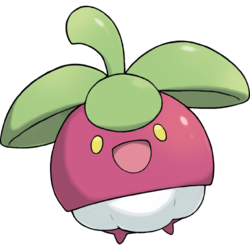
There are a lot of Grass Pokémon out there – it’s currently the fourth most common type in Pokémon, with almost one hundred representatives. It’s slightly curious, then, that there are so few Pokémon based on fruit. Tropius sort of counts, with fruit dangling off his neck, and Cherubi shifts into cherry blossom upon evolving, which has its own cultural significance in Japan, so arguably the only Pokémon wholeheartedly based on fruit are Ferroseed and Ferrothorn – assuming you do in fact classify the durian as a fruit and not as a sort of spiteful biological land mine. It’s possible that fruit Pokémon make Game Freak nervous since they draw attention to the old “do we eat Pokémon?” dilemma, but that doesn’t seem to stop them from cranking out mushrooms, or harvesting cast-off Crabrawler claws – or, for that matter, creating Swirlix and Vanillite. In any case, it’s time to break out your recipe books, because our next potentially edible Pokémon is here: Bounsweet, and her evolved forms Steenee and Tsareena. Continue reading “Bounsweet, Steenee and Tsareena”

Pyukumuku

Today’s Pokémon is the weird spiky loofah that lives behind Kahuna Hala’s toilet-

wait

Today’s bathing accoutrement is the weird spiky Pokémon that-

okay, let me start again

Today’s Pokémon is the weird spiky sex toy that lives behind-

no, that’s even worse

Look, we’re talking about Pyukumuku, okay

250px-771Pyukumuku.png
Pyukumuku

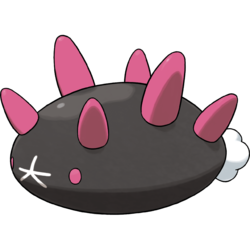
On account of its willingness to sit placidly between its trainer and certain death, Pyukumuku… is just barely a Pokémon, despite clearly being more closely related to the exfoliating bath sponge. It is, everyone is pretty much agreed, based on a sea cucumber. Sea cucumbers are soft-bodied echinoderms, distantly related to starfish and sea urchins. They’re essentially long, squishy tubes, with a mouth at one end and a multi-purpose respiratory/reproductive/excretory hole at the other. This is a body setup that makes for a pretty passive lifestyle. Continue reading “Pyukumuku”

Sandygast and Palossand

250px-769Sandygast.png
Sandygast

Before we begin, I want to point out, for the benefit of people who might not usually pay attention to this kind of thing, that Palossand has one of the best French names I’ve ever seen for a Pokémon: Trépassable. It’s a portmanteau of trépas, demise, and sable, sand, but it also sounds like très passable – “good enough,” which is a phrase that everyone who has ever built a sandcastle has uttered at least once.

Anyway. Haunted sandcastles!

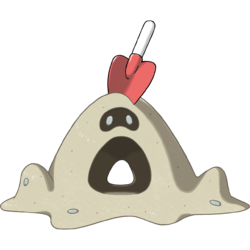
Haunted castles make perfect sense to anyone with even a vague familiarity with 19th century gothic horror or its 20th century cinematic inheritors. Beginning with Horace Walpole’s 1764 novel The Castle of Otranto, any gothic horror worth the name has a menacing castle on a windswept crag in the middle of a dark forest in Molvania or some similarly dismal place, and said castle is regularly infested with a range of “local colour” including but not limited to bats, vampires, mad scientists, werewolves and, of course, ghosts. Ghosts and castles go hand in hand right down to contemporary fiction, with the entertaining spiritual population of Hogwarts in the Harry Potter series, and ghosts in the haunting business are commonly depicted as pursuing “unfinished business” or grudges left over from their lives. But a haunted sandcastle might be something of a new one… Continue reading “Sandygast and Palossand”

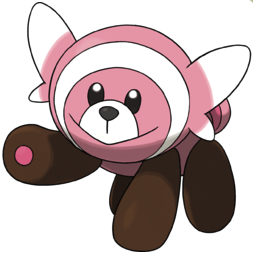
Stufful and Bewear

Screen Shot 2018-07-18 at 11.18.59 PM.png
Stufful

Let’s start with some simple, direct Pokédex quotes about Bewear.


“Many trainers,” Moon version tells us, “have left this world after their spines were squashed by its hug.”

well.

Just in case we hadn’t gotten the message, Ultra Sun clarifies that after you’ve been faced with a Bewear intimidation display “life is over for anyone who doesn’t run away as fast as possible.”

So… yeah. Continue reading “Stufful and Bewear”

Salandit and Salazzle

Screen Shot 2018-06-26 at 12.27.53 AM.png
Salandit

I think it’s time to explore some of the more hostile reaches of Alola, with the volcano-dwelling salamander Pokémon, Salandit and Salazzle. Salandit and Salazzle could be based on any of several things, or a mix of all of them, or none of them. Physically they resemble fire belly newts (genus Cynops), a group of newt species native to Japan and southern and eastern China (in the strictest scientific sense, newts are a branch of the salamander family and, compared to other salamanders, remain more aquatic even after leaving their tadpole stage; the words are often used interchangeably though). Fire belly newts are so called for their black colouring with bright red or yellow flame-like markings, which warn predators that they are poisonous and unsafe to eat – so we have a ready-made fusion of the Fire and Poison elements right there. Salamanders also have a very long history of being associated with fire, with stories that they bathe in flames going back at least as far as Aristotle. We could almost stop at that – Salandit and Salazzle are fire salamanders that breathe fire, and they’d hardly be the first Pokémon to come out of “real animal + appropriate-sounding elemental powers” (*cough*Beartic*cough*). But no; there’s more to these crafty amphibians, and as so often in Alola, we can look for answers in the real archipelago of Hawai’i. Continue reading “Salandit and Salazzle”

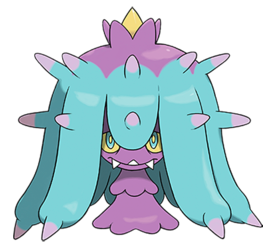
Mareanie and Toxapex

Screen Shot 2018-06-17 at 9.29.40 PM.png
Mareanie

Today we’ll be looking at some of Alola’s more passive-aggressive denizens, the Brutal Star Pokémon, Mareanie and Toxapex. Their physical designs are a little bit cryptic – Mareanie looks like a sort of spikey anemone, while Toxapex… Toxapex resembles nothing so much as a cancerous uvula glued to the inside of a dilapidated sea mine, with her twelve arms locking together to form an impenetrable dome that protects against not only predators but the force of waves, tides and ocean storms. In appearance, probably the closest animal to Toxapex would be something like a sea urchin, so bristling with spikes that its real body is essentially invisible, and probably not what you’re most worried about anyway. But it’s from their place in Alola’s ecology – specifically their relationship with one particular Pokémon, Corsola – that makes it clear that they’re probably supposed to be based on the dreaded crown-of-thorns starfish, Acanthaster planci, an unusual many-armed, spiny starfish found throughout much of the Pacific ocean.  Continue reading “Mareanie and Toxapex”