(Inspired by these)



One lunatic's love-hate relationship with the Pokémon franchise, and his addled musings on its rights, wrongs, ins and outs. Come one, come all, and indulge my delusions of grandeur as I inflict my opinions on anyone within shouting distance.
I’m a TA for a first year Greek history class this semester, and a little while ago we had our students write some short essays comparing the movie 300 to a historical account of the battle of Thermopylae – namely, book 7 of Herodotus’ Histories. Now, I personally think that calling 300 a good movie is something of a stretch, but it’s definitely an interesting movie, in terms of its relationship with the historical sources it draws upon. When the subject of comparing the two comes up, what you normally get – and what the vast majority of our students gave us – is a list of places where the movie does something that isn’t attested in the sources, followed by a vague judgement about whether it comes “close enough” to be considered “historically accurate.” And I think this is sort of missing the point, because I seriously doubt historical accuracy was 300’s top priority, and I seriously doubt that people went to see 300 because they thought it would be historically accurate. There’s enough in that film for you to see that its creators (including the author of the original graphic novel) have obviously read ancient sources for Thermopylae and the Spartans (well, English translations of them, anyway) – quite closely, in fact; loads of the movie’s best lines are actually quotations from Herodotus and Plutarch. If they had wanted to correct any of the “inaccuracies” my students identified, they almost certainly could have. So let’s talk about why they didn’t.
Continue reading “Let Me Tell You About 300”Alright, internet, I just finished writing a goddamn master’s thesis and I am gonna learn you some things that I only just got done learning myself about the chemistry of ancient Roman glass. No, it has nothing to do with Pokémon, but it’s happening whether you like it or not, so buckle the f@&k up, kids.
Continue reading “Roman Glass”You like adventure time?
Never seen it.
Do androids dream of electric sheep?
It’s kind of an odd question to ask, really, because who the f&$% dreams about sheep? Well… except, like… sheep farmers. We count sheep before we fall asleep; we don’t dream about the damn things. What kind of lame-ass android is so myopic that it can’t think of anything better to dream about than a sheep? Although… I guess it is an electric sheep, which implies that the android is a Pokémon fan, so at least it’s got that going for it.
If nothing happens, just assume I’ve died. It’s possible I’m dead already and just haven’t stopped writing yet. I may be becoming a sort of lich-like entity, in which case I look forward to the vast magical powers that will surely be mine when the transformation is complete.
…by a bunch of, like, 14-year-olds, no less, and in broad daylight. Thankfully I lost only my glasses (of which I have spares) and was rescued by passers-by who drove me home. Jaw aches a bit from being punched repeatedly, but it’s been a couple of hours and I’m pretty sure I’m not seriously hurt. Could have gone a lot worse, all things considered. Nonetheless, next entry will be delayed as I plan to spend the next day or two doing absolutely nothing.
The premise of this blog is taking quotes from pop culture and tweaking them slightly so that they apply to characters from Homer’s Iliad (recently expanded to anything ‘classical’). It amuses me. You should totally follow it. Y’know, if you’re a classicist. The following is something that I actually wrote months ago and had hanging around uselessly until I discovered “OMG there is a Tumblr blog that is literally all about doing this.”
H’okay, so, here’s the Aegean. S’chilling. ”Dang, that is a sweet sea,” you might say. WRONG! All right; ruling out the Hittites invading, a huge barbarian horde becoming crashed into us, the gods leaving, and Thera exploding, we’re definitely all going to stab each other. H’okay. So basically we’ve got Troy, Crete, Lydia, Egypt, Ethiopia, Thrace, the Amazons and us with demigods. We’ve got about twenty-six hundred more than anybody else… whatever. H’anyway. One day we decides those Trojan sons of a bitches are going down, so we launch a thousand ships at Troy. While they’re on their way, Troy is like “shit, shit, who the fuck brought Helen here?” “Oh well, Hector will save us!” Then Helen is like “shit, Paris, that’s my husband; he’s coming! Fire our shit!” ”But I’m tired.” ”Well… have a nap. THEN FIRE YOUR ARROWS!” Meanwhile, Italy is over there like “mamma mia, WTF?” Lydia, Ethiopia and the Amazons send their guys, so now we’ve got heroes charging everywhere, passing each other. Achilles is like “PATROCLUS, NOOOOOOOOO!” Then Hector’s like “well, I’m dead. Better get on with it.” So now Greece is like “fuck, we’re dumbasses,” Philoctetes is like “wait, what the hell did I miss?” Italy is still like “mamma mia, WTF?” China is laughing at us, and some huge barbarian horde is like “well, fuck that.” So. Now we’ve got the fall of Troy. Everyone’s dead, except Aeneas, and he’s like “mamma mia, WTF?” And they’ll be in charge one day. Fucking Romans. But, assuming we don’t all stab each other, us Ithacans just have to work out Ithaca drifting away from the rest of Greece. To go hang with Scheria. Cyprus can come too.
– like, Homer or someone
Which is a reference to this, if you don’t recognise it.
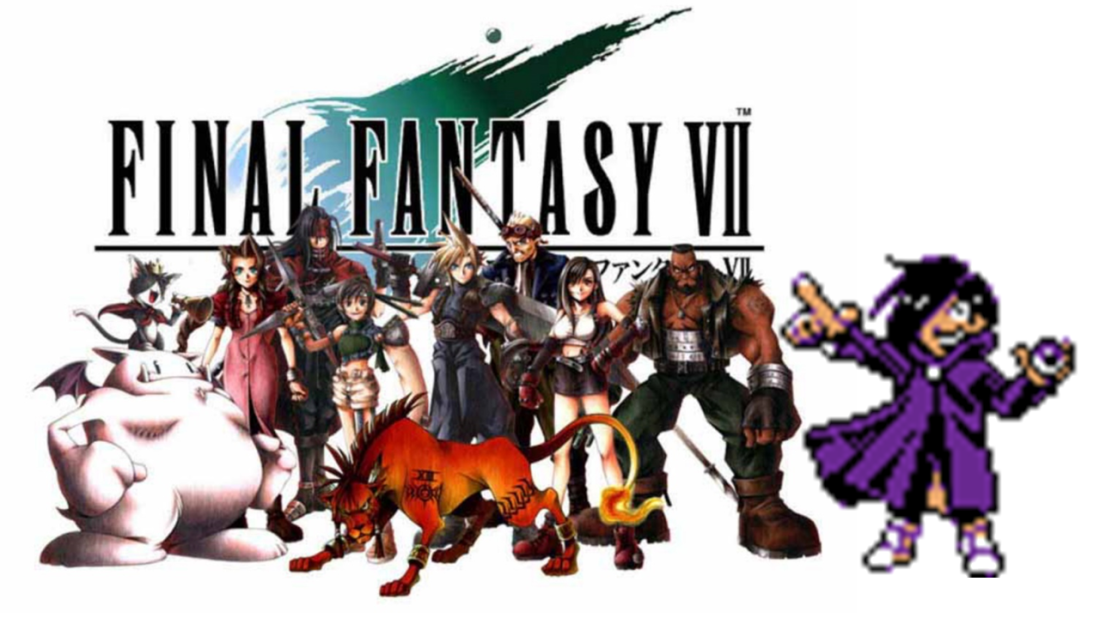
Basically all that’s left to cover now is the final boss sequence – there’s a big cave full of monsters to go through, but nothing of tremendous interest happens during that, so I’ll just cut to the chase. Cloud and his party reach the bottom of the old Jenova impact crater, which is now open to the lifestream beneath the planet’s surface. They fight Jenova herself, who is… anticlimactic, to be honest; she’s mostly just a great big sack of HP with a couple of slappy tentacles. I’m still not totally sure I ‘get’ Jenova. She’s some sort of alien, she created a plague that wiped out the Cetra, one assumes she’s quite intelligent, and this whole thing has been about her cells, which have been implanted into various humans like Sephiroth and Cloud as part of genetic experiments, trying to reassemble themselves… but what exactly does that have to do with what Sephiroth is now up to? Has he subordinated Jenova to the demands of his own power trip? If so, how? Or is Jenova just a destroyer by nature, and totally on board with anything that causes more death?
Anyway, once Jenova’s dead, it’s down into the lifestream to fight Sephiroth, who promptly turns into some kind of… giant floaty angel statue thing which has to be fought with two parties at once: one group to attack his left side and breach his defences, so Cloud’s group on the right can destroy his ‘core,’ which otherwise gives him sufficient healing power to recover from just about anything you throw at him. A bit of a pain, but throw all your summons at him and he’ll drop. And then turn into a radiant seraph-like creature with even greater powers. Joy. In this form, Sephiroth has a number of nasty abilities; he can shield himself from both physical and magic damage, he can attack with his one black wing, he can dispel your beneficial magic, he can blast you with magical energy, and he can turn your party members into frogs… but certainly the most devastating is his special attack, which is to blow up the sun. He can do this more than once, which makes me wonder how many solar systems this planet is part of. Equally, it makes me wonder why he didn’t do that earlier. It seems like a much more efficient way of traumatising the planet, and also probably not vulnerable to interference from Holy. He’s certainly happy to get rid of Cloud by blowing up suns left and right; it seems like it would make a useful all-purpose solution. Neighbour’s dog digging holes in your yard? Blow up the sun; that’ll teach ‘im.
Once Sephiroth falls and the party is about to leave, Cloud’s soul unexpectedly leaves his body and backflips into the lifestream for one final round against Sephiroth, but this seems to be unloseable; Cloud just kicks the cr@p out of him, then has a vision of Aeris before waking up – now certain that he’ll be able to meet her again in the promised land (I’m… still pretty sure the promised land is a Cetra metaphor for death, but whatever floats his boat, I guess). The party zeppelins out on the edge of a huge explosion as the power of Aeris’ final spell, Holy, is released at last. So, that should stop the meteor, right? Well… no. No, apparently not. It’s too close. Its proximity is already tearing the city of Midgar apart, and the Holy pulse only makes things worse, whipping up a vortex of doom across the entire massive city. Nice going, Aeris. GREAT plan. Just GREAT. At this point, countless tendrils of green light – the power of the lifestream – burst out of the ground from all across the landscape and converge on Midgar. For a moment, we see Aeris’ face, surrounded by the green light of the lifestream. And… then the credits roll.
…so what happened?
After the credits finish, there’s a short scene depicting Red XIII five hundred years later, along with two children (I guess he wasn’t quite the last of the last of his kind…) running through a canyon and cresting a ridge to see Midgar on the other side. The city is in ruins, but it’s been overgrown by beautiful, thriving jungle.
Hmm. Well, Sephiroth explained earlier that when the planet is wounded it uses the lifestream to heal itself. That was the whole purpose of his plan, except that he was supposed to be at the epicentre to absorb the energy. I guess that’s exactly what we saw happening. It sort of seems like the whole ‘Holy’ thing was kind of a bust, because in the end it only caused more damage instead of stopping the meteor, so I guess that was a terrible plan after all, Aeris, but at least we killed Sephiroth and prevented him from following through with his plan to take control of the lifestream. And anyway it’s all good because Aeris is… in the lifestream now. Possibly… directing it. Um… Aeris…? Did you… get yourself killed on purpose so that you could reach the ‘promised land’ first and do what he was trying to? Because if Aeris is seriously going to tell me that traumatising poor Cloud by being brutally murdered right in front of him was all part of the plan, then so help me, I- I-
…I really have to congratulate her. Sephiroth struck her down, and she became more powerful than he could possibly imagine (well, okay, that’s going a bit far; Sephiroth has an unusually vibrant imagination when it comes to power, but you take my meaning), because she just ‘got’ the whole ‘lifestream’ thing about ten times better than him. Go Aeris.
Speaking of Aeris, a couple of people have been wanting me to watch the Game Theory video on her death, which I have now done. I gotta say… I am extremely sceptical. Jim described it as “a waste of internet” and not “worth the megabytes taken to download it, let alone the time [we’ll] never get back,” and I don’t think I’d go that far, but I sort of have a hard time going along with it. In case you’re not in a position to watch the video, the argument is as follows: Aeris did not die when Sephiroth stabbed her in the Cetra shrine, but collapsed and went into shock when his sword severed her spinal cord, dying only as a result of Cloud’s touching but misguided water burial. The evidence presented is that Aeris does not visibly bleed when skewered (suggesting that the sword blow miraculously missed all her major blood vessels and internal organs) and that her body sinks like a stone when Cloud releases it (dead bodies are usually more buoyant than living ones). The video does anticipate the obvious counterargument to the absence of blood (i.e. the developers thought it would be too graphic and avoided it) by noting two prominent and deliberate uses of blood in other parts of the game (namely, the aftermath of the slaughter in the Shinra building, and streaked all over Sephiroth’s face after his final dream-duel with Cloud in the lifestream). I think there’s actually an even more obvious reason they forgot, though: the blood in the examples given by Game Theory is not moving; it’s texture, whereas blood spilling from Aeris’ perforated torso would necessarily have to be in motion. Flowing liquids are notoriously difficult to model in computer animation, and this game was made over a decade ago. Based on what I’ve seen of Final Fantasy VII’s graphical capabilities, I don’t think the game designers could have shown Aeris bleeding in a realistic manner even if they’d wanted to; in fact, I think any attempt would have appeared almost comical and seriously detracted from the gravity of the scene – as good a reason as any not to do it. For the water burial likewise, there is a perfectly good reason for Aeris’ body to sink: because it looks right. There are only so many ways to get rid of a dead body. Cloud could have buried Aeris, or cremated her, but somehow I just don’t think that seeing Cloud dig a grave for Aeris, or seeing her body burn, would have produced the same effect of serenity as seeing her body sink slowly into the clear water, with her hair fanning out around her. The water burial also fits with the marine motifs of the City of the Ancients (I still have no idea why the City of the Ancients has a marine theme, but given that it does…). In short, there are perfectly compelling artistic reasons for the anomalies noticed by Game Theory, and I think these are much more likely to have been on the developers’ minds than obscure anatomical trivia. I just don’t buy it.
Anyway, the game.
So, I liked this game. It was fun. And stuff.
For me, it wasn’t a big turning point in how I view games or anything, though perhaps it might have had a greater impact on me if I had played it in the 90’s when it was first released. The plot is intricate (at times a little too intricate for my taste, to be honest, and I feel like there are still loose ends there – which I guess is the reason this game has a movie sequel, Advent Children… which I guess I should watch… later…), the characters are compelling (even Cait Sith has his moments, I feel – though I think I’m in the minority on that one), and as I’ve said before this game has a really good handle on atmosphere; the music does a great job of backing up the action, there are a good number of very powerful moments in the story, and the game milks the extremely basic character models for all the expressiveness they can muster and then some. I mean… I certainly can’t say there’s nothing I would have done differently, but in terms of story and atmosphere it’s undoubtedly well put-together. I’m kind of neither here nor there about the battle system. Although it produces some interesting tactical considerations, I’m not a huge fan of the materia system, partly because it makes switching party members such a pain, but also because it makes it rather difficult to see what each character actually brings to the table in terms of skills and abilities. The characters have different stats, sure, which makes some better at certain roles than others, but even Barret and Tifa aren’t that bad at magic, even Aeris and Cait Sith aren’t that bad at hitting stuff, and most of the other characters are pretty competent at both. That just leaves their limit break powers, the vast majority of which are pretty straightforward: Aeris’ limit breaks heal and protect the party while Vincent’s allow him to transform into various horrifying monsters, but aside from them, most of everyone else’s skills basically amount to “I hit the monster lots of times really hard.” Of course, for most of the game, that’s all you really need – I thought Pokémon was generally pretty easy, but Final Fantasy VII was a walk in the park up until the last four or five boss battles, when things rather suddenly became much more interesting (and apparently my party was dramatically under-levelled compared to Jim’s normal experience of this game because I spent very little time training, finishing with no-one above level 60 except for Cloud). Is that a bad thing? I’m not really sure.
In short? I guess I have mixed feelings about this game. I can see why it’s considered a classic, though. It got a lot of things right – and, well, compare it to what Pokémon was doing in the same year. Obviously comparing gameplay and mechanical complexity isn’t entirely fair because the demands of their respective consoles are very different, and I’d still side with Pokémon on creature design and diversity, but in terms of story and characterisation… well, Yellow version made some important advances on its predecessors, but was still kinda ‘meh.’ I mean, Final Fantasy’s going to have to do a lot more than that to convert this Pokémaniac, but I’m still glad I played this game, I think. Beats the $#!t out of doing actual WORK, anyway…
Cloud and Red XIII drag the party back to Red’s hometown, Cosmo Canyon, to get advice on the whole “obliterative meteoric cataclysm” thing from his human grandfather, Borgenhorgen. Badenhoffen. Whatever. He feeds them a spiel about having to remember where they’ve been in order to figure out where to go next, or something like that, and they all just start thinking about poor dead Aeris, which is kind of a downer for everyone concerned (‘cept for Bosenhugen; I’m not sure he ever actually met her, so he just keeps doing his creepy “hoo hoo hoo!” laugh). It occurs to Cloud, though, that maybe Aeris actually had some kind of plan. That… huh. Y’know, I suppose if she had some kind of Cetra ace up her sleeve, that would explain why she was willing to go and face down Sephiroth alone… I mean, it was still dumb; there’s no reason she couldn’t have taken a few people with her and left Cloud behind, but if she legitimately had good reason to think she could end it right there, I can sort of understand wanting to keep her friends out of danger (well, except for Yuffie; I think Yuffie should be kept in as much danger as possible). Binglehopper suggests he accompany the party to the place of Aeris’ death and see if they can find any clues as to what her plan was, so it’s time to hit the road again.
Back in the City of the Ancients… well, the entrance to the hidden shrine where Aeris actually kicked the bucket is blocked by some kind of oversized ornamental clownfish (seriously, what is with the marine motifs in this place?), but Buglehorken does discover that Aeris’ plan was to use an artefact known as the White Materia to access the ultimate form of white magic, Holy (the opposite to Meteor, Sephiroth’s ultimate black magic), a spell which is said to wipe out everything that threatens the planet. Cloud, justifiably, finds this definition concerningly vague, but Borkahoogen insists it’ll work out fine. For a given value of “fine.” And “work.” They discover that Aeris has actually cast the spell already (so there’s no need to go and find the White Materia, which was in her possession when she died), but Sephiroth is blocking it from taking effect somehow. Remove Sephiroth from the equation in time, and Holy will take out the meteor. You know, I think this is the first time in this entire game we’ve actually had a plan! YES!
Things are… disrupted a little… when one of the Weapon-monsters, Diamond Weapon, decides to attack Midgar, the capital city of the world or whatever. Luckily, the Turkish electricity board have taken the giant cannon they used to destroy the first Weapon, moved it to Midgar and reconfigured it to run on pure life force, making it pretty much one step down from the Death Star as far as mass-mudering potential goes, but it’s not quite operational just yet (wait… how exactly did they move this thing to begin with? It’s bigger than a skyscraper and clearly not built to move under its own power; did they… like, roll it to Midgar, or…?). Cait Sith alerts the team to what’s going on, and actually gets a really awesome bit of dialogue where he calls Barrett out for only caring about his daughter’s safety and not being bothered with innocent people who just happen to live in Midgar or work for the evil power company (the kind of innocent people who were written off as collateral damage by Barrett’s eco-terrorists at the beginning of the story). Y’know, I initially found Cait Sith kinda boring, and then he was a massive douchebag by betraying the party to the Turkish police, but in spite of everything, he’s really growing on me. Even if he is a fortune-telling robot cat.
Cloud and the others go down and fight Diamond Weapon, keeping him busy long enough for the giant cannon (which, for some reason quite beyond my comprehension, is now called the ‘sister ray’) to fire. Before the beam actually hits him, Diamond Weapon fires off a massive barrage of sparkly things. End result: both Diamond Weapon and Midgar are wrecked, and Sephiroth’s great big energy shield, hundreds of kilometres further north and directly behind Diamond Weapon, takes a hit from the giant laser and collapses. Whoo! Let’s go stab him!
Only… the giant laser isn’t shutting down like it should. Actually it’s drawing even more power for another shot. It’s drawing levels of energy that are in fact hugely dangerous to the city. Um. It seems Hojo, the mad scientist, has decided that he can use the cannon to feed power to Sephiroth. Cait Sith convinces the party to enter Midgar and stop him from blowing up the city in the process. When we reach the giant laser to stop him, Hojo reveals that the reason he’s doing this is because he is, in fact, Sephiroth’s biological father. Wait, I thought Sephiroth was… like, a clone or something, with a surrogate human mother (Vincent’s ex-girlfriend) but no father… no, actually, Hojo used cell samples from Jenova to mutate his own child. Okay, I guess he thought he was making some kind of hybrid Cetra, which isn’t so bad, but still… WOW. Just… WOW, Hojo. Dad of the year. Seriously. And then once he’s finished explaining all of this he turns into a twisted purple fungus monster thing and tries to kill us. And then turns into some kind of sleek, colourful, flying humanoid tadpole and keeps trying to kill us. So, uh… good to see the gene therapy’s working out there, Hojo.
Hojo, after Diamond Weapon, is probably only the second fight in this game I’ve really had to think about, in terms of picking the right spells to use and managing my party’s actions and such. To be honest, there are moments when it sort of feels like most of the actual gameplay in Final Fantasy VII is really just a run-up to the ridiculously powerful optional bonus bosses, Ruby Weapon and Emerald Weapon, and everything else is deliberately a little on the easy side so it doesn’t get in the way of the story. I’m not sure how I feel about that.
Anyway, with all this happily resolved… well, okay, ‘happily’ is a bit of a stretch, but resolved, at any rate… there’s only one thing to do: go shank Sephiroth! (Okay, this being a Final Fantasy game there’s actually loads of stuff left to do but most of it I don’t find all that interesting).
 Pokémaniacal