I was thinking about how many competitive battlers breed many pokemon eggs in order to get the right nature that fits the pokemon they’re trying to get. That got me to thinking, what if each pokemon could learn different moves depending on the nature they had, each with their own specialties that helps them compensate for the difficulties they’d otherwise have? I think it would be a great way to make each pokemon unique and gifted like the living creatures they’re advertised as.

Hrm.

Do you mean, like, if each nature had a list of moves that was available to all Pokémon with that nature, or if each nature had just one signature move that was only available to Pokémon with that nature, or if each possible combination of Pokémon and nature had a bonus move?  All three would be… problematic, put it that way.  The last would be awesome but would require an absolutely ridiculous investment of time on the part of the designers.  The first two could help, but I’m not sure how you’d work them.  For a lot of Pokémon it just isn’t going to make a difference.  Consider Rhyperior – Rhyperior actually has a pretty awesome special movepool already, but that doesn’t really tempt people to keep a Modest Rhyperior, or use its special attacks over its physical ones.  What could you possibly give to, say, an Adamant Alakazam that will make those extra points of attack more useful than the lost points of special attack?  And if you do find something that makes a difference, wouldn’t it be far more powerful in the hands of an Adamant Dragonite or Scizor?  On the other hand, if you’re giving your Adamant Alakazam something that makes its special attacks more useful to compensate for the penalty (and, again, I’m really not sure what this could be)… isn’t that just a roundabout way of making natures count for less?  Why not just remove natures entirely, or remove their effects on stats?

In short… I approve of the direction here, but I think it would take a truly monumental amount of work to make it produce the right sort of effect.

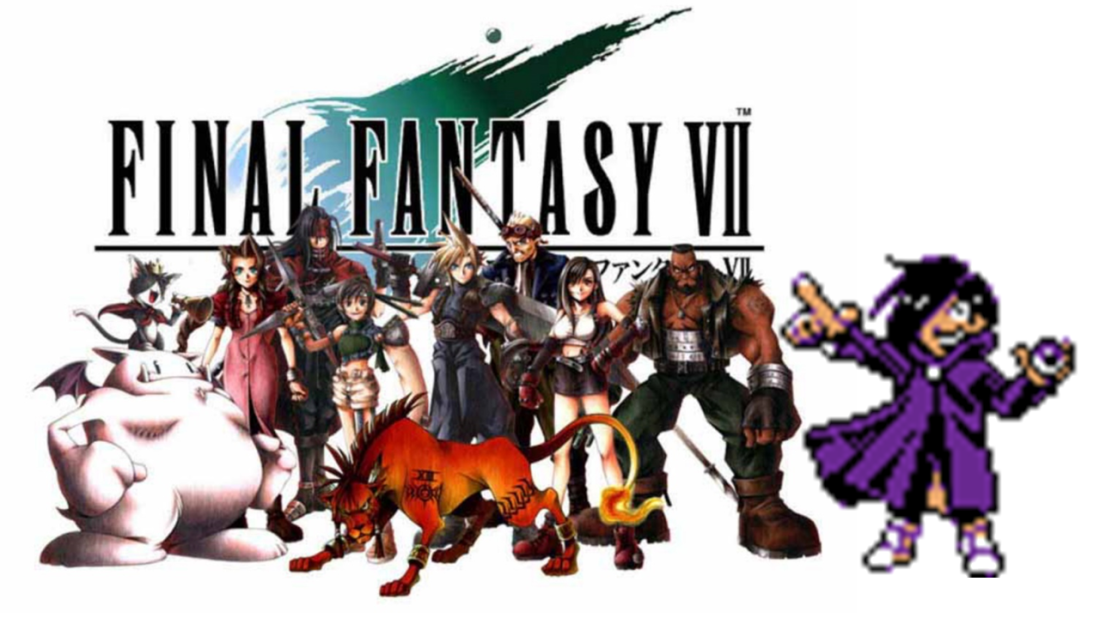
Final Fantasy VII: Entry 7

Well, Aeris is dead.

I realise I should probably be more emotional about this, but I think the fact that I knew it was coming dampened the impact a little.  I can imagine that for Jim, playing this game when it first came out at the ripe old age of 8 (what kind of sick mind does that to an eight-year-old?  Hell, what kind of sick mind does that to my eight-year-old best friend?), it was probably a pretty nasty shock.

What happens, in short, is that Cloud and the others arrive at the City of the Ancients (which seems to have a very pronounced marine theme for some reason; I didn’t think the Cetra were an aquatic race…) and find Aeris praying alone in an underwater sanctuary.  Apparently under Sephiroth’s influence, Cloud draws his sword and, slowly but surely, struggling every step of the way, raises it over his head, ready to slice Aeris in two.  This, I think, is about as close as I got to the shock someone playing this game sans spoilers would have experienced because, although I’ve known from the start that Aeris’ life had a use-by date, I didn’t think the game would be cruel enough to make the player push the button.  That was… well, honestly a little sickening.  I briefly contemplated just turning the game off.  In the end, though, Cloud snaps out of it, and instead Sephiroth drops out of nowhere and skewers her.  As I said, probably quite a nasty shock for someone who doesn’t know it’s coming, especially after Cloud has just come to his senses and you think it’s safe.

After Aeris’ death, Cloud vows revenge, and the party continues following Sephiroth north, past another town (where we learn some interesting things about Aeris’ mother, Ifalna) and eventually to a crater in the middle of an ancient glacier where Sephiroth’s black-robed mind-slaves are gathering for the ’re-union.’  Cloud fights Sephiroth again and takes back the Black Materia, gives it to Barrett for safe keeping, and heads further in to settle things once and for all.  Meanwhile, Rufus Shinra arrives at the head of the Turkish air force, believing that the materia-rich crater is the ‘Promised Land’ he has been searching for this whole time.  This… is where things start to get a little bit screwy.

Backing up a bit.  Ifalna left a few video recordings behind – interviews between her and a scientist studying the history of the Cetra.  This man is Professor Gast, the former Turkish head of science, and apparently Aeris’ father (!!), who sacrificed himself to help Ifalna escape the Turkish police with their daughter.  The substance of what she says is as follows: two thousand years ago, the planet was struck by an object falling from the sky (the last time Meteor was cast…?) – the impact crater is where we are now.  The local Cetra clan attempted to help the planet heal itself, but they were deceived by the thing that fell from the sky: Jenova, who approached them in the guise of a Cetra and infected them with some kind of plague that drove them mad.  Jenova destroyed all the Cetra clans in the same way, though a few survivors eventually defeated her.  The planet itself had also been concocting some way of fighting back – a huge, powerful monster called simply ‘Weapon’ – but by the time it was grown, Jenova had already been subdued, so Weapon now sleeps in the impact crater along with Jenova’s remains… and Sephiroth.

Yeah, Sephiroth’s been here the whole time.  In fact, as far as I can make out, he’s been here ever since he was supposedly killed five years ago.  The Sephiroth we’ve been seeing, and chasing, and fighting, who killed Aeris, is… I guess a figment of Cloud’s overly active imagination?  The real one is sealed in some kind of crystal at the centre of the crater.  However, after he ‘died,’ Hojo tried to clone him, with mixed results – hence all the black-robed men with numbers tattooed on their faces… and hence Cloud.  Yeah, Cloud is actually a clone of Sephiroth… somehow.  Apparently the boy Tifa grew up with, who came back home five years ago and fought Sephiroth then, is a completely different person.  Cloud, being a clone of Sephiroth, who is a clone of Jenova, was able to insert himself into her memories, without even realising it himself (kind of like how Jenova was able to appear to the ancient Cetra as members of their families).  He, and all of the other clones, are drawn to “reunion” at the crater – they all contain cells from Jenova, who wants to reassemble herself.  How exactly this fits into Sephiroth’s whole “nuke the planet so I can take control of the lifestream” plan, I have no idea.  In fact, in the midst of all these revelations, I still don’t think we know what Jenova actually wants, or even whether ‘want’ is an applicable verb here, for that matter.  Is it just in her nature to destroy things?

Anyway, while Cloud and Tifa are learning all these things, an image of Tifa, another of Sephiroth’s illusions, appears to Barrett outside, telling him Cloud is in trouble and he needs to come and help right away.  Once Barrett arrives, Cloud asks him for the Black Materia, which he obligingly hands over, and Cloud promptly gives it to the real Sephiroth, suspended in his stasis crystal thingy.  All hell breaks loose.  Sephiroth brings down the whole structure of the crater, forcing everyone except Cloud to evacuate on Rufus’ airship, creates a magical barrier around his sanctum, and begins casting Meteor.  The monster Weapon wakes up (Ifalna only mentioned one of these things, but I think I counted at least four leaving the crater – only one seems to be relevant right now, though) and, apparently heedless of its function to destroy Jenova, starts destroying everything but Jenova.  This is where we stand now: Rufus Shinra, the evil power company, and the Turkish air force are trying to save the world from Weapon; Barrett and Tifa are prisoners on his airship, and are about to be executed as scapegoats for the whole ‘end of the world’ thing… oh, yeah, and Sephiroth is bringing an enormous flaming hunk of rock down upon the planet.

In short: it’s time to put on your war face, b!tches.

To be totally honest, the whole Cloud/Sephiroth thing is still making my head spin a little, but I think it may have some very worrying implications.  If Sephiroth’s been up north in the Jenova crater the whole time, it seems like the Sephiroth we’ve been seeing is basically in Cloud’s head – only everyone else can see him too.  Of course… as a descendent of Jenova, Cloud can alter people’s perceptions, without even necessarily realising that he’s doing it.  He caused Tifa to recognise him as her childhood friend (who looked completely different, by the way), and inserted himself into all her memories.  So maybe everything ‘Sephiroth’ has been doing this whole time is the work of the shuffling, mumbling clones… along with Cloud himself.  What I’m getting at here is that it’s possible Cloud never actually gave the Black Materia to Sephiroth at the Temple of the Ancients at all, but was just subconsciously creating a narrative that would justify his drive to travel north so he could bring the Black Materia to the real Sephiroth at the crater.  And, even worse… I think it’s possible Cloud actually did kill Aeris.

Final Fantasy VII: Entry 6

Where I left off, the party had just remembered that they were supposed to be looking for Sephiroth, who is supposedly heading for a place called the Temple of the Ancients.  Questioning random members of the citizenry reveals that this temple is ‘way down south’ and cannot be entered without a special keystone – and, as luck would have it, we also happen to bump into the random weaponsmith who just sold this thing to, of all people, the owner of the exorbitantly pricey Golden Saucer amusement park, who even agrees to loan it to Cloud in exchange for a brief stint in his arena.  Everything’s going according to plan!  Now all we have to do is keep Sephiroth from getting his grubby mitts on this thing- and I guess maybe check out the temple too, just to be safe.  The party chills for a while at the Golden Saucer’s haunted house, which doubles as a hotel, and Tifa drags Cloud out on a date, although I don’t think he ever quite realises that it is a date.  He’s just… not a subtle person (as his taste in mêlée weaponry makes abundantly clear).

At this point, Cait Sith steals the keystone, hands it over to the Turkish police, and reveals that he’s been working for the evil power company all along, and GOD DAMN IT I knew it was a bad idea to trust a fortune-telling robot cat with a pet marshmallow demon but I just had to let myself be won over by his… his… I don’t know, I guess his blatant disregard for reality?  And after pulling that $#!t, he then has the gall to ask that Cloud let him stick around like nothing had ever happened!  Unfortunately, he has apparently taken Barrett’s daughter prisoner somehow (damnit, you had ONE JOB, Elmyria!), and his body is only a remote-controlled toy anyway (he’s really a power company employee, plugged into some sort of remote interface at their headquarters), so Cloud and Tifa reluctantly agree to let him stay rather than just filleting him on the spot as any reasonable person would.

Okay.  New plan.  We’re going to the Temple of the Ancients to fight the Turkish police.  Cait Sith, for his part, is totally okay with this and even gives us the co-ordinates to the temple.  Once we get there, it turns out that the Turkish police not only stole the keystone, they also failed to keep Sephiroth out of the temple after opening the damn thing.  Nice going, boys.  Good job.  It’s not even like he’s that tough; one good stab and he just turns into a twenty-foot-tall alien angel monster, and we all know how to deal with those, right?  Anyway.  The moment Aeris gets near the temple, she starts hearing the voices of a group of Cetra who refused to rejoin the lifestream when they died, who give her pointers on getting through the temple, and also show us a vision of Sephiroth in a room with a striking mural of a large group of people watching a meteor fall from the sky.  When we find the room, Sephiroth isn’t there, but it doesn’t take him long to put in an appearance and, like all good supervillains should, explain his diabolical plan: acquire the ultimate destruction spell, Meteor (a ‘calamity from the skies’… hmm…), from the Black Materia inside the temple, then use Meteor to cause such massive, horrific trauma to the planet that it will divert a significant portion of the lifestream to the epicentre of the blast in order to heal itself.  Sephiroth will then use the knowledge he has already gained from the temple to absorb all that power and become, for all intents and purposes, a god.  Honestly this sounds like a terrible plan and, if not for the part about “massive, horrific trauma to the planet,” I’d buy a truckload of popcorn, tell him to follow his dreams, and settle in to watch the show, ’cause I figure there’s better than even odds the lifestream will either take control of him somehow or just blow him up.  It’s almost a shame we can’t afford to let him try.  Oh well.

Anyway, Sephiroth messes with Cloud’s brain briefly and then vanishes.  Aeris learns from the Cetra spirits that, actually, the Black Materia Sephiroth is looking for is the temple itself, which can be magically shrunk down to a nice convenient size by solving a puzzle model – but this can only be done from the inside, crushing whoever gets stuck with that job.  Luckily, Cait Sith has a suggestion – he’ll do it!  His body’s only a toy anyway.  Before the others leave, he says farewell to the party by offering to read someone’s fortune, and Aeris asks him to check her romantic compatibility with Cloud (apparently, they’re astonishingly perfect for each other) – while Tifa is standing right there.  Dick move, Aeris.  Seriously, dick move.  Cait Sith gets a nice scene in the temple core where he talks about how he’s happy that he gets to be a hero, and how there are lots of toys like him, but there’s only one of him, and anyway even if he’s going to die it was worth it to make Aeris smile, and y’know what?  This would be really touching if not for the fact that the bastard comes straight back in an identical new body about five minutes later.

So we get the Black Materia… and Sephiroth shows up again, mind-rapes Cloud into handing it over, and leaves.

…y’know, I’m starting to think everyone in this party is going to betray everyone else at least once by the end of the game.

Cloud has a total breakdown and goes to sleep for about a week, waking up with a profound sense of total worthlessness, and contemplating abandoning the whole fight, since he clearly can’t let his teammates rely on him against Sephiroth.  Tifa and Barrett convince him that it’s no biggie; they can always smack him upside the head and sort him out later if he flips again.  There are bigger problems, though.  While Cloud is sleeping, he sees Aeris in a dream, explaining to him something she has evidently told the party as well: Sephiroth is going to a place on the northern continent called the City of the Ancients to cast Meteor, and Aeris wants Cloud to just sit back, take some Cloud-time, and let her handle Sephiroth.  Alone.

Wait, what?  No.  Aeris, no; that is a terrible idea.  Do you remember what happened the last time you left the party without taking any materia, Miss Quarterstaff-and-a-pink-dress?  I can understand wanting to leave Cloud behind; he’s just not in a good place at the moment, even if he is the best fighter in the group.  You don’t need to leave everyone else behind to guard him,though!  Even if you don’t want anyone else to get hurt, what did we just learn about Cait Sith?  It’s okay if he dies.  He doesn’t mind.  By the way, as long as we’re on this train of thought, it’s also okay if Yuffie dies.  She f#$%ing deserves it.  I’m pretty sure with Cloud out of commission you’re pretty much the de facto protagonist anyway; no-one’s going to question you if you just want to lead the whole party in there.  There’s no reason this has to be a…

…suicide mission.

…c^@p I just figured out how Aeris dies LET’S HAUL ASS, PEOPLE!

Look at the pretties!

So apparently Adam of Bolt-Beam fame was sufficiently inspired by my recent broad descriptions of a pair of legendary Bug Pokémon based on Aesop’s fable of the ant and the grasshopper that he went and drew these delightful things!

The industrious legendary ant Pokémon who taught humans farming, co-operation, construction, and most of all the simple virtue of good, honest labour.  She didn’t come out looking all that much like an ant, in the end, but I’m okay with this – and you can still see the inspiration in a number of places, like the six legs, the clear head/thorax/abdomen distinction, and the mandible-like protrusions on the head.  I think what I like most is the simultaneously ‘rocky’ and ‘muscly’ appearance of her features.  My head is calling this Pokémon ‘Myrmindure,’ from the Greek word μύρμηξ (myrmex), ant, and the English word endure, though I’m not sure I’m entirely happy with that.  She’s probably Bug/Rock, like if Shuckle learned to drive a bulldozer.

This one is the refined legendary grasshopper Pokémon who, like Meloetta, was once a great teacher of song and dance, along with all other forms of art and culture – essentially, his sphere is the love of all things beautiful.  I’ve got to say, I love the harp design built into his wings, and the rather frail, wispy appearance he has next to his counterpart.  The curls remind me almost of scrips of paper.  I don’t think I’m 100% sold on that moustache, but it’s not too egregious.  Adam drew this one with Bug/Fairy in mind, and although I haven’t yet formed any opinion on what exactly ‘Fairy’ means as a type, I’m happy to go with that.  His name, at the moment anyway, is Cicantor, from cicada (ancient taxonomy is notoriously vague, so the exact species of the insect in the fable is open to interpretation) and the Latin word cantor, singer.

Have you ever watched Game Theory on YouTube? It’s a really educational and interesting series! They’ve done more episodes on Pokémon than any other video game, and their latest episode is about “How Pidgey “Proves” Darwinian Evolution”. Since we all know how much you like to rant about that (i.e. real-world evolution being a thing in Pokémon), what are your thoughts on their, well, theory? (also, they have a video on FFVII, if you’re interested, but you might wanna watch it after you finish…)

I can’t say I have seen it before, but I like it.  I’m actually not totally convinced by their arguments, but I approve of what they’re doing here, not just for being the same kind of thing as what I do, but for providing an example of “let’s look at the evidence for evolution!” for their viewers, which I can only regard as a positive thing.  Their analysis of the different types of bird Pokémon is also admirably creative and consistent.  Having said that…

I actually think it’s pretty clear from a number of Pokédex entries that Game Freak assume something like Darwinian evolution is happening in the Pokémon world – the only ones I can think of off the top of my head are the entries for Kabutops, which make statements like “It was apparently evolving from being a water dweller to living on land as evident from changes in its gills and legs,“ and ”It is thought that this Pokémon came onto land because its prey adapted to life on land.“  For that matter, the mere fact of the existence of fossil Pokémon is telling – in the 19th century, the rapid advancement of palaeontology was one of the major contributing factors to the development of evolutionary theory since, if species can become extinct, there must be some way of replacing them.

However, I don’t think that this, or any of the evidence Game Theory presents, necessarily proves Darwinian evolution – that is, descent with modification mediated by natural selection.  True, that’s one possible explanation, and I would be very surprised if natural selection had no influence on the Pokémon world, but a lot of the evidence we’ve seen could also be consistent with Lamarckian evolution.  Jean-Baptiste Lamarck, a biologist of the same era as Charles Darwin, believed that evolution was driven by the inheritance of acquired characteristics – that is, that traits an organism develops during its own lifetime can be passed to its offspring (work out, and your kids will have bigger muscles, basically).  And the thing is, we actually know that this is true for Pokémon, because they can inherit TM moves.  Again, I’m sure natural selection does play a part, but I also think there’s more to it (incidentally, even in the real world, where we’ve known that natural selection is the main driver of evolution for a long time, modern understanding of epigenetics is starting to indicate that Lamarck may actually have had a point too).

The other thing that I can’t let pass is Mew, because I actually think that the Pokédex and its in-universe authors are just plain wrong about her, for reasons that I don’t think anyone else has picked up on.  Mew is thought to be the common ancestor of all Pokémon, because she possesses the complete genetic codes of every known species (this being the reason for her supreme versatility) – but under modern evolutionary theory this is not something we should expect a common ancestor to have.  Think about it.  In the real world, evolutionary theory predicts the existence of a common ancestor of all life, way back in the Precambrian eon – an incredibly basic single-celled being that can’t even be called a ‘bacterium’ because it’s even less complex than that.  The traits on which natural selection operates are not assumed to exist from the beginning; they arise over time from random mutations.  Mew expects us to believe that not one new biological trait has ever arisen in the history of the evolution of Pokémon.  If anything, her existence is a strong argument against Darwinian evolution in the Pokémon world.

Hello, here is my 2nd question from the first one I told you about that site. A person did a nuzlocke called Pokémon Unchained. The person said this, “I read Pokémon Black/White as an allegory for antebellum US south. In a sense, a way to explore ‘How did people rationalize slavery?’ Well, in these games, they are rationalizing the enslavement and fighting of Pokémon, in a contemporary world where, at least in the US, dog fighting is illegal.” Sorry for double questions.

I don’t think there was actually a question in there, per se, but I’ll run with it anyway.

Here’s the story: http://pokemonunchained.tumblr.com/.  It sort of trails off around the Dragonspiral Tower, but it’s worth a read.

It makes me distinctly uncomfortable, which shows that it is succeeding in its aims.  One bristles at the substitution of ‘slave’ for ‘Pokémon’ and ‘master’ for ‘trainer’ – the instinct is to shout out “it’s not the same thing, damnit!”, especially for someone like me who has put so much thought into how and why it’s not the same thing – but of course impugning Pokémon is not the point; it’s a thought experiment, and one for which Pokémon is extremely well-suited.  An allegorical reading of Pokémon can give insight into the mind of an American slave owner and help understand why they felt willing to fight and die to protect a ‘way of life’ that now seems obviously corrupt and horrific to us.  To the mindset of an early 19th century white slave owner, it was all too easy to list ways in which blacks were supposedly better off in servitude to whites, which is what made the ideology so pervasive and enduring.  Morbid, perhaps, but useful.

Having said that, I feel that if one reads Pokémon the way I do, the differences are too numerous and too obvious to be worth listing.  I think it also bears pointing out that much of this narrative’s strength is drawn from the volatile and fatal nature of battle under the Nuzlocke rules (which, of course, have no counterpart in any official depiction).  It wouldn’t really have the same punch if the ‘slaves’ actually were happy and healthy, would it?  I also can’t help but wonder whether the story ends at the point it does because the author couldn’t think of a way of rewriting N’s attunement to Zekrom that fit with the slavery analogy (although perhaps I am giving her too little credit).

I have read your ethics on pokemon training and I say great work. Although I like to show you this site. It would be nice if you read 4 pages on it (last one is all jokes) and see if you have any more additional opinions of your or on theirs. It is called Ethics of Pokémon Capture and its in Pokémon Tabletop Adventures site. (Its half dead from what I see). If you choose to answer, do not be afraid to be thoroughly detailed or not. Thanks.

I believe you are referring to this forum thread? http://forums.pokemontabletop.com/topic/9803938/1/

Some interesting thoughts.  I agree with the member who weighs in on the fourth page, SeaSee, pointing out that, in fact, Pokémon in the anime (which, let’s face it, has to be the main source for this kind of background stuff, since the games just don’t care much about worldbuilding) can actually leave their Pokéballs without being called and generally seem to be at least partially aware the world around them while inside, which I think seriously challenges a lot of the assumptions that people tend to make about how this stuff works.  I think most of the other conversants here are missing that.  A lot of the time Pokémon break out of their Pokéballs for comedic effect, most notably Jessie’s Wobuffet and Misty’s Psyduck, so I can understand taking it with a grain of salt, but there are important serious examples too – the one that most readily comes to mind for me is when Ash’s Pokémon refuse to let him shiver through a blizzard alone in Snow Way Out.  I would add to this the practice of keeping Pokémon in cages, as Team Rocket often do in both the games and anime – if Pokéballs really do have the kind of power often attributed to them, it seems to me that cages are an insecure and costly waste of space.  Several of the forum members in this discussion characterise Pokémon training as slavery, but I feel it clearly involves a lot more give-and-take than that.  Then again, when the games finally did weigh in on the discussion, as another member points out, it was with the Shadow Triad’s comment in Black and White 2 that Pokémon in Pokéballs are ‘fated’ to obey, and N’s subsequent call for a world without Pokéballs (this was all after I wrote my article on the subject, of course).  I think the current position of the games, then – which may change in a few days with the release of X and Y! – is that Pokéballs are a problem, but the institution of Pokémon training itself is not.  I don’t think Pokéballs do ‘brainwash’ Pokémon in any consistent or measurable sense, and as you know from my ethics article I don’t think Pokémon can even be captured at all unless they are fundamentally accepting of the concept of partnership with humans.  However, I am coming to suspect that Pokéballs do change the symbolism of the relationship and thus damage the way both sides view it, and also give the human side a greater degree of control in terms of transport and the administration of medical care.  The invention of Pokéballs has changed the way both sides view what’s going on – and not for the better.

One more point.  Member Esprit15 noted the likelihood that different species of Pokémon likely do not view capture in precisely the same way.  This, I think, is something very important to keep in mind.  The games, the anime and the fans all have a tendency to think in terms of a simplified dichotomy between humans on one side and Pokémon on the other, because it’s easier for us to deal with the issues in those terms.  That means, however, that we are putting one species on one side of the relationship and seven hundred-odd species on the other, and stubbornly treating it as monolithic.  I’m not certain this is wise.  I do not hold with those who say that many Pokémon are of only animal intelligence and can be viewed as being in the same position as pets in the real world (I think that almost all Pokémon are of at least near-human intelligence, although the waters are muddied by the fact that there are different kinds of intelligence to consider – logical and emotional, as well as more abstract things like creativity and leadership), but I do believe that different species understand life, family, society and battle in different ways, and that the assumption that capture and training affect all of them in the same way is not necessarily a sound one.

I’ll tackle your next question later.

Interlude: Final Fantasy VII

So, I’m not totally sure exactly how long it will be before I can actually play X or Y (could easily be a few weeks).  In the meantime… Final Fantasy VII, which Jim has been telling me for a long time that I must play, is on sale for $6 on Steam this weekend.

On the theory that writing something is better than writing nothing, let’s see what happens.

Jim says it’s among the most perfect games ever, and that I’ll laugh, I’ll cry, and it’ll change my life.  I’m a little vague on what the game is about – I think the main characters are terrorists, and the bad guys are an evil power company?  And I know that Aeris dies, although I’m not exactly sure who Aeris is, which I think is rather the reverse of the way one is normally supposed to approach this story.  Nonetheless, I shall press on.

These are going to be more reaction pieces than my usual polished commentary, but I’m sure I’ll be able to work in some analysis somewhere.  Think of it as a stylistic experiment on my part.