
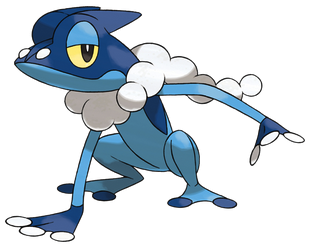
My unfathomable whims have decreed that it’s time to wrap up the Kalos starters. The third and last is the Kalosian Water-type starter Pokémon, Froakie, a little blue frog with a good head for deception and evasion. His second form, Frogadier, also happens to have one of the most fun English names to say of the entire sixth generation, energetically tripping off the tongue in the same way as Octillery or Galvantula. As for the fully adult ninja frog… well, at some point, quite early on, I realised that the pink scarf thing around Greninja’s neck is probably his long froggy tongue, and ever since then I’ve been so weirded out by it that I can never quite accept him without doing a nervous double take. I’m now forced, whenever I see him, to contemplate the mental image of my own tongue stretched out to twenty times its normal length and wrapped a couple of times around my neck. I can see what it adds to the design; ninja are regularly portrayed with masks or headbands that leave strips of cloth fluttering free, and the tongue allows Greninja to mimic that appearance, while also providing a visually striking colour contrast between its bright pink and the deep blue of his body. Hell, if my tongue went that well with my outfit, maybe I would wear it as a scarf. Anyway. Past Water starters have generally been bulky Pokémon with a ‘tough guy’ aesthetic, so Froakie’s very different take on the type is a welcome bit of diversity, and also establishes him as a very different Pokémon from either Chespin or Fennekin. Let’s take a closer look.

These Pokémon are ninja frogs. Frogs and ninja are connected in a variety of modern fiction, apparently because of one very famous ninja hero from Japanese folktale, Jiraiya, who was the subject of a classic Japanese novel of the 19th century (which, as is the way of such things, was only loosely based on a wide variety of different version of older tales). Jiraiya seems to have had a thing for frogs and toads; he supposedly had the power to transform into a toad, and is often depicted riding a giant magical toad whom he saved from a marauding serpent. Snakes as villains seem to be a unifying thread of the Jiraiya tradition. In fact, one sequence in the 19th century novel even describes a rock-paper-scissors relationship – almost exactly like the one that exists between trios of starter Pokémon – between Jiraiya’s frog powers, the snake powers of the story’s villain Orochimaru (which are apparently strong against frog and toad magic), and the slug and snail powers of Jiraiya’s love interest Tsunate (which can overcome snake magic, for reasons which I imagine made perfect sense at the time). Or something. Look, I haven’t actually read it; I just looked for summaries on the internet. What do you people want from me? The fact that Froakie, Greninja and Frogadier seem to be referencing Jiraiya makes me wonder whether there’s any significance to the presence, in the previous starter trio, of a snake Pokémon whose powers can defeat theirs – Serperior. Obviously Serperior wasn’t designed with such a relationship in mind, but maybe Greninja’s creators got a kick out of it – and if they did, they would probably also have noted that there are slug and snail Pokémon in the game as well, and that these Pokémon, although not actually starters, are Fire-types. Although it’s rather a stretch to think that they planned it this way, Greninja, as well as being a starter, actually completes a weird little cross-generational trio of his own.
Anyway, that’s why ninja frogs are a thing.
A Water-type ninja as one of the sixth generation starters is also an interesting choice following the Water-type samurai we got in Unova, Samurott, given that samurai and ninja tend to be set up as opposites in popular culture – samurai are seen as large, powerful warriors, devoted to honour and often more than a little flamboyant, while ninja are depicted as stealthy, agile, deliberately understated, and perhaps more unscrupulous. Water seems like it should be a natural element for that kind of Pokémon; it’s changeable, being the only substance in nature that exists on Earth as a solid, a liquid, and a gas, it flows around obstacles as easily as smashing through them (as Misty explains at length to a rival Fire trainer in the anime episode Some Like it Hot), and it is regularly associated with subtlety and deception. The mutable nature of water is particularly evident in Greninja’s signature move, Water Shuriken, which magically compresses water into sharp-edged discs that slice through his enemies’ flesh with pinpoint accuracy. Bulky, powerful Water Pokémon that draw on the unparalleled fury of a stormy sea are common, but ones focussing on the constantly shifting, intangible nature of water are few and far between; the only ones I can think of are Golduck, Vaporeon and possibly Starmie and Jellicent. Not that this is necessarily a bad thing, but I find it surprising that Water Pokémon like Greninja aren’t more common, and the contrast between Greninja and Samurott almost seems to draw attention to it.
Chesnaught and Delphox are both perfectly competent, as starters normally are, but Greninja has hit the jackpot. He seems made to be a mixed attacker, employing both physical and special attacks to confound heavy wall Pokémon who focus on only one side of their defences, although his movepool pushes him much more towards a special focus. His special attack is great, his attack isn’t far behind, and he’s so fast that he can probably afford not to invest the greatest possible effort in speed, leaving more to divide between his attack stats if you want to pick up one or two of his physical moves. His need for heavy speed training is further diminished by Water Shuriken, which gives him access to a fairly strong physical priority attack. Because Water Shuriken is a multi-hit attack, its power fluctuates a great deal; it will sometimes be weaker than Aqua Jet, though not by much, and it will usually be stronger, sometimes by quite a lot. The truly lovely thing about Greninja isn’t his stats, though; it’s his hidden ability. Chesnaught and Delphox have pretty neat hidden abilities, but Greninja’s blows both out of the water. It’s called Protean, an English adjective derived from the name of shapeshifting Greek ocean god Proteus, and it automatically changes his type to match that of any move he’s about to use. Effectively, Greninja gets STAB (Same-Type Attack Bonus, +50% damage) on everything and, thanks to his excellent speed, can sometimes shift his type to gain resistance or immunity to incoming attacks, hopefully keeping his lacklustre defences from having their full impact – but bear in mind that he’ll always have his native Water/Dark typing when he switches in; Pokémon with actual resistances or immunities are safer. Basically, it’s like Kecleon’s Colour Change, only it’s actually useful (and, indeed, Kecleon now shares Protean as his Dream World ability and gets to suck a little bit less). Of course, life’s a bit grim if you want to use the Froakie you got from Professor Sycamore, whose ability will be Torrent, but hey, no-one ever said Pokémon was fair.
Protean Greninja can use both physical and special attacks of any type with roughly equal competence, though his physical movepool leaves much to be desired (maybe future games will change that). Surf, Hydro Pump, Dark Pulse, Ice Beam and Extrasensory form the core of his offensive capability. Grass Knot punishes other Water types, provided they belong to high weight classes, although be careful they don’t return fire with Ice Beam after you become a Grass-type. Hidden Power deserves special mention on Greninja because of the way it can be used to exploit Protean; if you want Greninja to be able to shift his type to resist, say, Dragon attacks, which would otherwise be impossible since he doesn’t learn any Fairy or Steel attacks, you can try to trade or breed for a Greninja with Hidden Power: Fairy and net him a quasi-immunity [EDIT: I HAVE MISLED YOU; Hidden Power cannot take a Fairy type, probably because that would have meant reassigning all the other types to different personality values and therefore screwing up Pokémon with Hidden Power transferred from older games]. Water Shuriken and Power-Up Punch are the high points of his physical movepool – trying to use a pure physical Greninja is a bad idea since his physical moves just aren’t very powerful, but Power-Up Punch will spell doom for any Blissey who thinks she can take you, and again, Water Shuriken is on average pretty powerful for a priority attack. U-Turn is worth it whether you’re training his attack stat or not, because free switches are always welcome. Acrobatics is difficult to use at the moment because Flying Gems don’t exist on X and Y and it’s depressingly weak if you can’t reliably use up Greninja’s item, but when Game Freak gets around to introducing gems in the sixth generation, it could be interesting. Rock Slide and Night Slash are there, but just not powerful enough to be worth it.
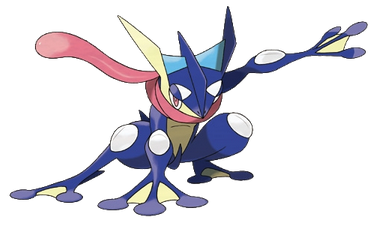
Support duty almost seems like a waste of Greninja’s amazing offensive potential, but he has a couple of very helpful support moves – most importantly, Spikes and Toxic Spikes; one or both could find its way onto a moveset to amplify his own and other Pokémon’s offensive potential. He also gets Taunt and has the speed to use it effectively, anticipating and cancelling support moves coming from defensive Pokémon. There’s a second signature move that deserves a mention, if only to explain why it shouldn’t be used – Mat Block, which references the ninja technique of blocking a thrown weapon by flipping up one of the woven straw mats used as flooring in traditional Japanese houses. Mat Block is only useful in double or triple battles, where it acts as a sort of mass Protect attack, guarding all of your active Pokémon from damage… with three important flaws: 1) it doesn’t have priority, so anything that outruns Greninja can bypass it, 2) it doesn’t block status moves, so stuff like Thunder Wave and Will’o’Wisp can bypass it, and most importantly 3) like Fake Out, it can only be used on the first turn after Greninja enters play, something the move’s description conveniently neglects to mention and leaves players to discover for themselves. Don’t worry, Chesnaught and Delphox – Greninja may have two signature moves to your one, but the second is nothing to be jealous of.
Before we wrap up today, I promised I’d talk at some point about the starters as a group, and in particular about the warrior/spellcaster/rogue interpretation that has become so popular: the idea that Chesnaught, Delphox and Greninja are based on a trio of common roles or classes from role-playing games. Chesnaught is the warrior, fighter, knight or whatever; Delphox is the wizard, sorcerer, or black mage, and Greninja is the thief, rogue or assassin. Strength, magic, and skill, the classic three fantasy RPG archetypes. You can divide some other starter trios along similar lines – Venusaur, Charizard and Blastoise, for example, could be parsed as spellcaster, rogue/scout/fast warrior (remembering that Charizard originally had only average special attack in Red and Blue) and knight/paladin/bulky warrior; Meganium, Typhlosion and Feraligatr work as white mage, black mage and warrior. For that reason, and also because the Pokémon community is often overeager to construct patterns out of things (says the guy who writes character studies and lengthy speculative discussions of this stuff), I was a little sceptical of the idea at first, though in the end the set of human-influenced designs – knight, witch and ninja – make this way of looking at things particularly appropriate to the sixth generation, and it’s entirely plausible that RPG classes were, if not the creators’ starting point, at least an influence. To me, all of this is just one example of a general principle of designing starter trios: the starter Pokémon occupies a place of special importance as your partner and as the first point of contact most players have with the game, so it’s vital that everyone (or at least as many people as possible) be able to find one that appeals to them. To that end, it’s sensible to have starter trios with strongly contrasting aesthetics, fighting styles and personalities. Sceptile, Infernape and Greninja, for example, would make a poor starter trio because they’re all different takes on the same idea – a fast, active warrior-type. They continue to be nicely designed Pokémon in themselves, and nothing can diminish their individual appeal, but they don’t provide the same breadth of choice. Some people would love all three, others wouldn’t like any of them. A trio of Torterra, Emboar and Swampert would be similarly ill-conceived. The existence of fighter/magic-user/rogue as a recognisable trope has its roots in the same basic concept; RPG players want to be able to play a hero whose powers have particular appeal to them. People like choice; it’s really pretty simple. They also like not to be penalised for their choices, which is where the notion of game balance comes into it, but that’s another topic entirely.
I quite like this Pokémon, in spite of his alarming combined approach to fashion and oral hygiene. Frogadier makes the cute-to-badass transition remarkably smoothly in comparison to what most starters manage, and the ninja frog thing is a bit weird if you’re not in on the joke, as it were, but was very interesting to learn about. As for his battle capabilities… well, Protean is a game-changer, there’s no other way to describe it. Expect Greninja to make a serious impact on any battle he sticks his aqueous ninja stars into.

 Pokémaniacal