 Dark is a strange type. Dark Pokémon aren’t necessarily connected with darkness or the night at all, although many of them do prefer the dark. ‘Dark type’ is actually a somewhat imprecise translation of the Japanese term literally meaning ‘evil type,’ but that just throws up more questions – whole species of Pokémon that are just ‘evil’? That can’t be right, can it? Dark Pokémon are associated with evil, and also with trickery, and often with fear, but they aren’t necessarily evil themselves; they’re part of that old stereotype of the ‘misunderstood brooding dark hero.’ Dark Pokémon may well work towards good, but they can and will lie, cheat and steal to do so, and they will not on any account fight fair, because the ends justify the means.
Umbreon is one of the game’s oldest Dark-types, and naturally he grabs this concept with both hands. Umbreon is a badass, but in a very different way to Jolteon: dark and dangerous, but in an understated, subtle way. The yellow-on-black of his ring markings is bold, like the light of the moon against the black of the night sky, but minimalistic. This is not a Pokémon who goes in for glorious battle and flashy displays of power; this is a Pokémon who gets things done quickly, quietly and, if at all possible, without ever being seen. He’s noted for his poisonous sweat (oddly, Umbreon doesn’t naturally have any Poison attacks – maybe Game Freak always anticipated that everyone would teach him Toxic?) and for his supernatural ability to cause fear in others when the rings on his body glow in the moonlight. An ambush hunter, he prefers to move around at night, when he can remain hidden and wait for his prey to present a vulnerability. Umbreon seems to be empowered somehow by exposure to moonlight (hence his in-game ability to heal himself with Moonlight, a move analogous to Espeon’s signature Morning Sun but shared originally by Clefairy and Oddish) but the exact nature of his powers seems to be mysterious. The result of all this is that Umbreon’s particular brand of charm falls somewhere between Jolteon and Espeon, based on a combination of decisive power and elusive mystique, exactly the combination that captured the imagination of Karen, leader of the Johto Elite Four, all those years ago. Personally Espeon is still my favourite, but I can definitely see Umbreon’s appeal too.
As I’ve been looking at Eevee’s evolutions so far, I’ve been interpreting them with a view to understanding the environments that might have caused Eevee to develop all of these forms in the first place. In Espeon’s case I concluded, based on the stimulus that triggers her evolution and the nature of her powers, that she represents a form of Eevee specially adapted to domestication, and particularly to the defence of settled communities. Now, Umbreon evolves from Eevee in more or less the same way as Espeon – by forming a particularly close bond with his trainer – except that Eevee can become Espeon during the day and Umbreon during the night. Logically, one assumes that partnership with humans had some hand in the development of Umbreon as a species as well, but why the split between the two? I think the answer is in what it means to be a Dark-type. Espeon is all about community and empathy; she developed her psychic powers to defend homes and families. Umbreon, by contrast, is all about solitude and individualism – this species evolved at the same time and for similar reasons, but for different purposes. Espeon is a protector, active during the day, staying close to the settlement and looking after the old and the very young as they go about their domestic work. By contrast Umbreon, a strain devoted to survival, efficiency, stealth and cunning, developed out of the Eevee who partnered with hunters and scouts whose tasks were related to the night – although they do live in settled villages, they fulfil their most important roles beyond the community’s borders. This is where Umbreon’s whole attitude and demeanour come from. The quintessential Dark-types, they do their work out in the wilderness where they have no-one to rely on but their human partners, and where no-one else will rely on them, hence the ‘ends justify the means’ approach they take to combat. They work for the good of their communities, but out on the frontiers they have no time for rules.
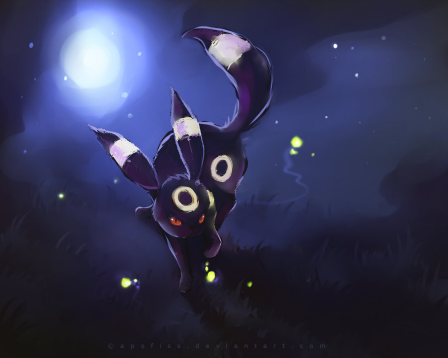
Where his brothers and sisters tend to combine powerful support skills with dangerous attack options, Umbreon is instead a totally defence-focused Pokémon. He’s slow, his attacks are weak, and like all the others, his movepool is limited, but for all-around defensive ability, Umbreon is difficult to beat. Back in the heady days of Gold and Silver, an Umbreon with Rest or Moonlight and some nasty trick like Charm or Confuse Ray was nigh indestructible, free to fling Toxic around and then wait patiently for everything to die. That was really all you needed to do with him (aside from keep him away from Poison- or Steel-types, obviously), although, like most of Eevee’s other evolved forms, Umbreon had a nifty trick to use with Baton Pass: Mean Look. Mean Look traps an opposing Pokémon in play until Umbreon switches out or faints – wonderful if it’s something Umbreon can handle. If not, though, Baton Pass will take Umbreon out of play and replace it with another Pokémon who can deal with the victim… and keep the trap effect, which would be ended if Umbreon were to switch out normally. This would eventually become Umbreon’s main tactic. He gained Taunt and Wish in Ruby and Sapphire, which were useful toys for ruining other support Pokémon and keeping his teammates healthy, respectively, and the addition of physical Dark attacks in Diamond and Pearl made it possible to use Umbreon as a slow physical tank with Curse (Payback, which is more powerful when the user moves after its opponent, is noteworthy – if you’re using Curse, you’ll be slower than anything else around anyway). The combination of Mean Look and Baton Pass was his big trick, though; it’s a difficult strategy to pull off, but succeeding at it would almost certainly doom at least one opposing Pokémon, trapped in play against a Pokémon of your choice, and Umbreon is tough enough that he could and did make it work.
And then they took it off him.
For reasons that escape me, Mean Look was removed from the list of effects that can be transferred by Baton Pass in Black and White. It couldn’t have been for thematic reasons, since there’s never been any real logic to what gets transferred and what doesn’t (and how is Baton Pass imagined to work, anyway?). Could it have been for balance reasons? Well, only a handful of Pokémon could ever do this anyway. Absol was terrible at it, and murdering things with Swords Dance is a much better use of her time. Smeargle, likewise, had better things to do unless you wanted to put him into a Baton Pass chain, and even then he has more important moves. Essentially, the only things that changing the mechanics of Mean Look did were stealing Umbreon’s favourite specialty tactic and finally eradicating the only reason ever to use Ariados (who used Spider Web in place of Mean Look). Since it is an inescapable truth that no-one in the world has ever actually used Ariados anyway, I am forced to conclude that Game Freak just woke up one morning and decided they hated Umbreon. It’s just such a bizarre thing to change, when there are so many other inane things that they insist on keeping the same.
Okay; rant over.
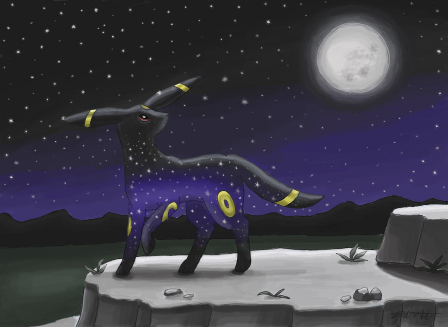
Don’t get me wrong. Umbreon is still a wonderful defensive Pokémon – in fact, he’s the toughest Dark-type in the game; only Mandibuzz is comparable, and Umbreon leaves her in the dust for special defence. His Wishes aren’t as potent as Vaporeon’s, but he’s still a decent Pokémon to put on healing duty, and he can threaten to put things to sleep with Yawn. Curse remains an option too if you want a more aggressive Umbreon, and it looks like Black and White 2 have given him Foul Play, a powerful Dark attack that circumvents Umbreon’s poor attack stat by allowing him to use his opponent’s instead. His abilities are fairly plain, as abilities go; Synchronise is nice to have but not particularly useful, as for Espeon, but unlike Espeon his Dream World ability is garbage – Inner Focus? Immunity to flinching? I guess if you really hate Togekiss or Jirachi… but Togekiss will just smack Umbreon in the face with a super-effective Aura Sphere, and Jirachi is immune to Toxic, which means Umbreon can’t actually hurt her anyway. This is, essentially, the crux of the matter for Umbreon: passing Mean Look was easily the most threatening thing he could do; now anything immune to poison just doesn’t care about him anymore. Steel-types in particular, who resist Dark attacks, no longer have any reason to pay attention to Umbreon. They can just get along with their own thing, and Umbreon will have no choice but to flee, maybe dropping a Wish on the way out if he’s lucky. Vaporeon, by way of contrast, is much harder to block completely; sure, Water-types will largely ignore her main attacks, but thanks to Water Absorb and her good special defence, she’ll ignore them right back!
In spite of my rant, I really do think that Umbreon works. He’s sleek but bold, not quite like any of the others, and as such he appeals to, once again, a different segment of people. His total defence focus is different as well, not just from his brothers and sisters but from the stereotypes of his element as a whole. I just have to slam the mechanical change to Mean Look one more time because it actually reduces diversity and uniqueness instead of increasing it by eliminating a previously difficult but powerful and interesting tactic; I just find it fundamentally absurd on grounds of design philosophy. Umbreon is far from ruined, though; if you need a bulky Dark-type, there’s none better.

 Pokémaniacal