Of all the ailments like burn, freeze or poison and including ones like confusion, infatuation or curse… if you could get rid of one you think doesn’t quite contribute well to the gameplay or the concept of Pokemon; alternatively, if you had to make a new ailment, even if you don’t think its necessary, what kind of ailment would you add?

Hmm… I sort of feel like regular poison is sufficiently underwhelming to consider taking out or reworking completely.  It’s strictly inferior to the burn status, and arguably helps the affected Pokémon as much as it hurts in some cases by making it immune to more dangerous conditions like sleep or paralysis.  It’s also kind of a slap in the face to the poor Poison-types, who don’t have much else going for them, that most of their attacks are associated with this condition that doesn’t actually help the user much.  Just give all poison the Toxic effect.  Not sure about what to do with the attacks that currently cause severe poisoning.  Maybe have them cause poison as well as something else nasty on top of that, like confusion?  Freezing is also sort of pointless the way the game is now – no attack has more than a 10% chance to cause the effect, and when it does come up, it sometimes wears off before even a single turn has passed, having no actual impact on the battle.  Why even bother with it?

As for adding something (since I am apparently being required to)… dunno.  A lot of games have blindness and deafness as status conditions; blindness would basically just be an accuracy reduction, which is something we have already, but maybe Pokémon could be temporarily deafened by exposure to attacks like Hyper Voice?  Deafened Pokémon would be at risk of mishearing their trainer’s instructions and using the wrong attacks until they were recalled to rest.  Basically the condition would cause Pokémon to ‘disobey’ (if a Pokémon is already disobedient, well, now it has an excuse…).

Interesting questions you’ve getting last 2 weeks or so. Here I will throw in one myself. Suppose one day you wake up and you suddenly see a pokemon (of your own choice) what you do? how you react? how would you introduce him into this totally different life. etc etc

What, you mean, like, in the real world?

Um… hmm… well, I suppose my immediate reaction would be to wonder where the hell it came from and whether there were any more.  Those things could wreck havoc on just about any real-world ecosystem if they were able to establish a breeding population.  There’s sort of a worrying tension between reporting it to the authorities so they can take action (which would probably involve quarantining the poor thing and possibly killing it) and keeping it secret (which would be hugely irresponsible and risk catastrophic ecological damage if there are any more that I don’t know about).  In any case, I certainly can’t let it wander about unsupervised.

Anyway…

Probably the first thing to do is figure out what it can and can’t eat (assuming it needs to eat, which for some Pokémon is not necessarily a given).  Most Pokémon probably have fairly high energy requirements, so I’d have to buy a lot more fruit or meat, depending on what kind of diet it naturally has.  Best to set aside a few days to experiment with that and figure out what’s palatable.  Also gotta figure out what it would do during the day while I’m busy; there’s a big park near my apartment that I walk past every day, and it could hang out there, under strict instructions to go nowhere else in the city, at least not at first.  Probably want to stay with it the first couple of days and make sure it knows to treat humans in this world with extreme caution.  Beyond that… hard to say.  It’s difficult to know what to do with someone who’s been dumped in a totally foreign world.  Whatever personal goals a Pokémon might have had are probably not going to be relevant or achievable here, which is unfortunate, to say the least.  Depending on the species it might be okay with just having food and a place to sleep, but some might need to find a way to contribute to the lives of others to be happy.

How do you cite your academic papers? MLA format? APA? (Just a curious random question about your academic profession)

Well, I haven’t actually had a paper published yet (I’m still a student), and when I do I’ll probably have to think harder about that than I’ve bothered to in the past.  Most academic journals have a preferred format, so it’s sort of up to them and not the individual researcher.  Honestly, thinking about different referencing styles just annoys me.  As long as an author gives all the details necessary for readers to track down the source of the information themselves (including page numbers, which some irritating reference styles don’t give), anything else is just being snooty, as far as I’m concerned.

If the Pokémon franchise were to receive a major overhaul, would you enjoy seeing it become less ‘haxxy’? i.e. a lot of random game mechanics would be changed or removed such as for confusion, sleep duration, random effects on moves, or–my favority–a complete removal of the Accuracy stat for moves? Instead of Accuracy I think PP should be replaced with a gauge that has maybe 20 PP in total, and every move costs a certain amount to perform. This can keep moves balanced. What do you think?

Dunno.  I actually like having a certain amount of luck involved, because it means you have to be able to think on your feet and deal with stuff that, through no fault of your own, just doesn’t go your way.  There’s also a few Pokémon that can make a strategy of it by manipulating luck – I’m thinking of the Serene Grace Pokémon – and it might be interesting to have more Pokémon that play with luck in different ways.  Obviously how beneficial these things can be is a matter of degree, though, because most people agree that stuff like Double Team, Brightpowder, one-shot moves and the Moody ability are just a pain – at some point it stops being about calculated risks and starts being about random long shots.  So I don’t know.  Constant sleep duration seems reasonable enough (and could open up a different way of balancing various sleep moves – some might last longer than others).  Confusion I’m in two minds about because, although it’s annoying (which I think is its purpose), it doesn’t get used very much because it’s actually just not consistent enough to be effective – honestly, I could get behind either removing it completely or making it stronger.  I’m not sure what your PP suggestion has to do with accuracy or randomness, I’m afraid…

If you watched the death battle Royale between Venasaur, Blastoise, and Charizard, do you think their analysis was just? If you didn’t watch it, should be on youtube, just search death battle pokemon battle royale.

Do I have to?  Oh, all right; let’s see…

Here’s the link: http://www.youtube.com/watch?v=pcUSRT7CFPs

I suppose I would question the usefulness of the conditions they’re analysing.  I mean… a wild Venusaur, Charizard and Blastoise randomly meeting up in the wilderness for a free-for-all?  Why would that ever happen?  In practice Pokémon trainers normally care about the role a Pokémon can play within a team, typically for a single battle format.  I’m not especially surprised by the result – as they say, it’s very difficult for an untrained Venusaur to come up with anything that will stop a Charizard because of the double type advantage, while Blastoise is in a very strong position against the other two by having natural access to weather manipulation, which seriously weakens Charizard and blocks out Venusaur’s Synthesis and Solarbeam attacks.  However, I think I would find the analysis more convincing if they didn’t gloss over exactly how they came up with their results in about 30 seconds towards the end.

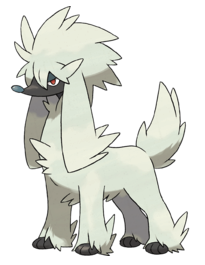
Furfrou

Official art by Ken Sugimori of the trashy, pedestrian 'Natural' Furfrou.  Some people just have no class at all.

I have a long history of bitter feuds with gimmick Pokémon – Pokémon apparently designed to show off some manner of unique mechanic.  This is not because I have problems with the gimmicks themselves; things like Spinda’s seven zillion and one unique spot patterns or Chatot’s ability to interact with the DS’s microphone (an ability now obsolete, incidentally) certainly add something to those Pokémon.  The trouble is that often the designers appear to think that one gimmick is all it takes to produce a finished design and that these unique Pokémon don’t deserve anything else, with two results: 1) their combat abilities generally border on ‘completely unsalvageable’ and 2) the gimmicks are often the only interesting thing about them.  It is therefore with no small amount of trepidation that I go into my analysis of Furfrou, the show poodle Pokémon, whose main distinguishing feature is his broad selection of fur trims, which can be styled in Lumiose City’s fantastically popular Friseur Furfrou salon.  Is that all there is to Furfrou?  Is it worth the attention Kalos gives it?  Can we find anything else to like about him?  Will I make it through this entry without suffering an aneurysm?  Tune in to find out… right now!

For the people of Kalos, and of Lumiose City in particular, owning a stunningly coiffed Furfrou is among the most vital aspects of the elusive and wondrous state of being that is True Stylishness.  Lumiopolitans (for so I have arbitrarily chosen to call them) are ardent connoisseurs of style in all its manifestations – stylish dress, stylish battling, stylish transportation, stylish personal grooming, even stylish diet – and there is no other channel by which their respect and adoration may be more quickly won or lost.  The exquisitely stylish tourist can expect to be admitted to exclusive establishments and offered choice discounts; the unkempt hitchhiker… can not.  One of the qualifications for the life of style is having a well-groomed Furfrou, and one of that life’s benefits is access to ever more exclusive and extravagant cuts and dyes: an ordinary customer will be offered only the frightfully plebeian ‘Star,’ ‘Diamond’ and ‘Heart’ trims, while those who have demonstrated their superior taste can request ‘Pharaoh,’ ‘Kabuki,’ or ‘La Reine;’ the truly elegant, as a badge of their absolute class, can have their Furfrou done in the coveted ‘Matron,’ ‘Dandy’ and ‘Debutante’ styles – these last three appear to have had the fur on their heads somehow pressed into a variety of crisply-outlined hat shapes.  It goes without saying that trainers sporting lesser Furfrou trims should be regarded with haughty disdain, reserving true respect for those whose Furfrou are maintained in the highest of styles.  Take careful note, however: be cautious when dealing with the trainer of a ‘Natural’ Furfrou.  Such a person may be an utterly philistine no-hoper who wouldn’t know stylishness if it walked up and offered them a designer handbag, or they may be may be an ultra-classy fashion ninja making a richly satirical comment on the nature of mainstream Kalosian style that operates five or six degrees of irony beyond anything you can even comprehend, much less mimic (much like Jim the Editor’s appreciation of certain rap artists).  Be sure to observe carefully the shape and tint of the individual’s sunglasses before jumping to any conclusions.

 The more socially acceptable Heart (pink), Diamond (orange) and Star (blue) Furfrou trims.  I suppose these are okay.So, as you might have guessed, what persuades me to tolerate Furfrou’s gimmick – even though all nine styles look utterly ridiculous – is that it makes a lot of sense in the context of Kalos’ broader themes.  It’s silly and pretentious, just like the Kalosians; Furfrou, unlike Spinda and Chatot (to stick with the examples I used earlier), is a part of the underlying atmosphere of the region in which X and Y take place.  They’re the French, turned up to eleven; of course they have an otherwise-useless Pokémon based on a poodle whose complicated fur styles act as an esoteric status symbol for his fashion-conscious trainers.  It would almost be unrealistic to expect them not to.  Furfrou himself is not all that interesting, particularly when you consider that his most unique power is apparently the ability to sit still and be groomed by human hairdressers in a variety of increasingly frivolous ways – I think that needs to be put out there.  Kalos’ cultural obsession with him, though, is at least amusing, and apparently goes back centuries, since Furfrou were traditionally used as the bodyguards of the Kalosian monarchy.  Honestly I have trouble imagining any of the available styles as appropriately imposing royal bodyguard attire (well, except maybe the Pharaoh…) and am compelled to wonder whether Pyroar might have been a more appropriate choice, though perhaps ancient Furfrou trims were a little more imposing.  I think this is probably a reference to Louis XVI, the king who was deposed by the French revolution, who had a particular fondness for poodles and is actually credited with responsibility for the creation of the first miniature breeds.  He is unlikely to have used them as bodyguards, although I confess that the mental image of the King of France staring down the Third Estate from behind the protection of a pair of savagely yipping miniature show poodles does fill me with a curious shade of joy.  I can find little to like about Furfrou as a Pokémon; he’s really rather generic.  He makes a neat cultural fixture though.
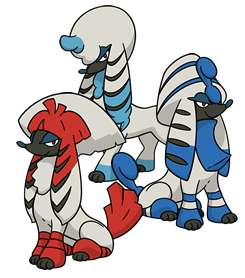
 The elegant and sophisticated La Reine (pale blue), Kabuki (red) and Pharaoh (deep blue) Furfrou styles.  Can you feel the waves of envy washing over you as you behold their beauteous forms?

Despite much anticipation and speculation by players prior to the games’ release, Furfrou’s various trims have no effect whatsoever on his battle qualities: all Furfrou are pretty much the same (in spite of the Pokedex’s groundless assertion that Furfrou become more agile when their fur is kept trimmed).  This is rather a shame, because Furfrou could do with some extra tricks, as we’ll see.  As a Normal-type, he fights an uphill battle for relevance; having only one weakness is nice, but one immunity and no resistances isn’t exactly ideal for a defensive Pokémon, which is what Furfrou tries to be.  This might have made a sensible effect for different trims, actually; give each style one or two associated resistances (or even immunities) to bulk out his somewhat lacklustre resistance profile and allow players to tailor their Furfrou (literally) to the needs of their teams.  Jim wants to give Furfrou a ‘Hair Strike’ (like an Air Strike but with hair… or something) attack that shakes off a cloud of loose hairs, which then turn rigid and fly at the target like Jolteon’s Pin Missiles; different coat styles would give the attack different elemental properties.  Because of Furfrou’s support predilections, I’m more inclined to want something in the fashion of Secret Power, with constant type and damage but variable secondary effects.  Anyway.  As it is, Furfrou’s principle assets are high speed, good special defence, and a lovely ability – Fur Coat – that roughly doubles his normally weak defence (just watch out for Mold Breaker Pokémon like Haxorus, who will shred Furfrou’s luxuriant coat like tissue paper… I mean, Haxorus can also do that by, y’know, being Haxorus, but you get the idea).  Furfrou’s physical attack stat is passable but no more, so ideally you’re going to need to find one or two solid support options to mix in if you want Furfrou to contribute.

Furfrou’s staple attack will probably be the Normal type’s universal go-to, Return, unless you want to try to flinch-spam stuff to death with Headbutt and Thunder Wave.  Sucker Punch is good for getting the drop on really fast Pokémon, and also gives Furfrou something to do against Ghosts, though it can be a trifle inconsistent since it will only work against opponents who are about to use direct attacks.  Electric damage is useful but Wild Charge, with its unwelcome recoil, is not a great attack; probably a better option is U-Turn, eternally valuable more for the free switch it entails than for the actual damage it does.  Furfrou doesn’t get a lot of support options, but considering that his greatest strength is not dying, we should take a look.  He’s one of the few Pokémon with access to Cotton Guard, the most powerful physical defence buff in the game, so if you want to really work with that ability and turn him into a total brick wall, you have the option – it’s not a brilliant option, mind you, since a great physical wall ideally should be able to switch into physical attacks at will, but if you have the opportunity to set up, Furfrou will be damn hard to take down (unless, y’know, something wildly implausible like a critical hit happens).  Packing Toxic to capitalise on that survivability might be your best option for actually hurting things – alternatively, carry Thunder Wave to sting the special attackers who will inevitably switch in to bypass Furfrou’s monstrous physical defence.  The trouble is that Furfrou doesn’t have any rapid healing moves, so any damage he takes tends to stick.  A Rest/Sleep Talk set could be interesting, though status moves tend not to mesh well with those.  If you have someone else to set up Stealth Rock and the like on Furfrou’s behalf, Sleep Talk would allow Furfrou to bypass the negative priority of Roar and use his high speed to shuffle opposing Pokémon through your entry hazards without giving them a chance for reprisal.  It’s a bit of a ridiculous strategy, is complicated by the fact that Furfrou’s not that fast, and isn’t even a terribly unusual thing to be able to do, but I’m running out of ideas here (and, in fairness, few Pokémon as fast as Furfrou can match his toughness).  If you’re feeling particularly brazen you could even try Swagger and trust in Furfrou’s ridiculous hair to protect you from any boosted attacks that get through the confusion effect.  This is not a good idea, but again, I’m short of them at the moment.

 The divinely fantastical Debutante (cream), Dandy (green) and Matron (purple) styles.  Their trainers must be at the very cutting edge of fashion; I am practically orgasmic just being in the presence of such radiant class!  Oh.  Um... hang on... gotta go get some paper towels...

Furfrou’s special movepool is actually a lot more appealing than his physical movepool, but he just doesn’t have the stats to back it up.  A Charge Beam set, including Surf, Dark Pulse and Grass Knot, would allow him to boost up to potentially viable levels and would certainly bring a surprise factor to the battle, but his initial special attacking power is just so lacklustre that it’s hard to see why you’d bother, and it’s also unfortunate that Furfrou has no strong Normal-type special attacks.  Snarl is an odd choice, but will lower the target’s special attack as well as doing Dark damage, and might be a good way to take special attackers by surprise if they switch in on you.  That’s… honestly about it; I think I’ve covered practically every useful thing Furfrou can do.  For a Normal-type, his movepool is almost obscenely small.  Perhaps move tutors in the next sixth-generation game will give him a new set of tricks, but I’m not holding my breath…

So that’s Furfrou – a Pokémon who tells us more about Kalos than he does about himself.  As walking, breathing accessories go, Furfrou isn’t bad, but he suffers from a severe lack of ability to… like… do things, and that comes through when you try to use him in battle.  I have trouble understanding why any self-respecting monarch would pick Furfrou, of all Pokémon, as a bodyguard (other than having a totally unashamed preference for style over function, which… in fairness is probably exactly what the reason was), and that’s a problem here.  What makes this Pokémon suited for that, either in the past or today?  Does their plethora of classy trims have any connection with this ancient role?  Do I even care?  No.  No I do not.  Next!

What would you suspect the affects of attract being used on a human would be?

…when did I become the guy the internet asks about this kind of $#!t?  I am seriously questioning the life choices that have brought me to this point.

You know, I have absolutely no idea.  Should probably start with reference to this: http://pokemaniacal.tumblr.com/post/74976019208/your-latest-answer-especially-by-your-last-sentence
Anyway… well, Attract is limited by gender, but not by reproductive compatibility, which suggests that it is capable of affecting Pokémon, who, under normal circumstances, would never find the user… well, ‘attractive’ (since, in most individuals of most species, attractiveness is based on a subjective judgement of suitability as a mate).  That being the case, it’s not immediately obvious how the technique actually works, though it seems like it must primarily involve emotional manipulation and romantic infatuation rather than straightforward sexual attraction or arousal (which in any case could get… problematic… if a smaller and physically weaker Pokémon used Attract on a much more powerful one… let’s not think about that for too long).  Pokémon in the anime under the effects of Attract tend to be portrayed as highly irrational and motivated primarily by a desire to please the user of the technique and win his or her approval and admiration, irrespective of how courtship actually works in the target’s species.  All the move’s flavour implies a romantic dimension to the effect, but it seems like a fairly superficial one.  I suppose what it seems to do is cause the target to see the user as a perfect specimen of the opposite gender, so exquisite that normal courtship behaviour seems utterly futile in the presence of such a paragon, causing the target to resort to uncharacteristic and generally ineffectual attempts to win the user’s affection through ingratiating flattery and self-abasement.

As for what it would do to a human… I suppose it depends largely on what you understand Pokémon ‘gender’ to mean, which is something I’ve tried very hard in the past to make as complicated as possible.  If Pokémon ‘gender’ and human ‘gender’ work on basically the same principles, then I suppose it could bring about the same irrational desire to win that Pokémon’s admiration.  If the human is a trainer, they might become obsessed with convincing the Pokémon to join their team.  If, on the other hand, Pokémon gender is something completely alien to us, as I suggested in that tract of rambling nonsense, it could very easily do nothing whatsoever.

If you’re wondering whether it would evoke… inappropriate thoughts… well, I think that’s probably best left to writers of a certain kind of fan fiction, don’t you?

The Etruscans

So I have just finished working on a long essay about gender roles in an ancient Italian people, the Etruscans.  They have been occupying my brain almost totally, which is why I have not written much about Pokémon this week.  Come and listen to me babble; you will learn a great many things, some of which may even be true.

So these people lived mainly in northern Italy, in the region now known as Tuscany.  Their civilisation predates the glory days of Rome; they were most powerful between the 7th and 4th centuries BC, after which the Romans began to eclipse and dominate them.  The Greeks called them the Tyrrhenoi, they probably called themselves the Rasna or Rasenna, but we know them mostly by their Latin name: Etrusci, or Tusci.  They had writing, and probably literature, which we no longer possess; only inscriptions remain, for the most part.  They had their own language, which we sort-of understand, and which does not seem to be related to any of the other languages spoken in ancient Italy – it doesn’t even seem to be from the Indo-European family at all, but has a closer affinity to the Semitic languages of the Near East.  They were probably, like the Greeks, a vague coalition of autonomous city-states who would band together against common threats but otherwise did their own thing.  The later Romans believed that the Etruscans had taught them everything they knew about irrigation, sanitation and construction, and also that people of Etruscan descent (they remained an important ethnic minority in Roman Italy long after losing their independence) were especially suited to being diviners and seers.  Two of Rome’s last three semi-mythical kings were thought to have been Etruscan, and a lot of people think that their reign reflects a memory of a real period of Etruscan dominance over the Latins (the ethnic group that includes the Romans).  Most of our ‘historical’ information about the Etruscans comes from Roman writers some three hundred years removed from the decline of Etruscan civilisation, or from Greeks talking sh*t about them.  The fourth Emperor of Rome, Claudius, who was a historian, wrote a long and detailed history of the Etruscans called the Tyrrhenica, based (apparently) on the Etruscans’ own historical literature. That’s gone; we don’t have that.  Would’ve been really nice, but no.  We also don’t have much archaeological information about their towns, because most of them have Roman and modern towns on top of them, which makes it hard to dig (although there are one or two sites now that people are starting to open up).  There are a few important religious sites that have been studied carefully, but mostly, what we know about the Etruscans comes from their graves and tombs.  Hooray for grave robbing.

What I have to deal with this week is that Etruscan women seem to have been treated in a much more egalitarian fashion than their Roman or Greek counterparts.  A lot of wall paintings in tombs show scenes of parties or banquets (they were a cheery bunch), and from this it looks like aristocratic women attended parties with their husbands and engaged in the merriment and conversation to a degree that would have been scandalous in Rome or Athens.  In fact, it looks like the Romans and Greeks did find it scandalous, since the descriptions we have of Etruscan women portray them as licentious sex-crazed hussies with no self-control – the natural reaction of a strongly patriarchal society to meeting a civilisation that allows women to, like, leave the house.  For a while there were people who though that the Etruscans were a matriarchal society, that women ruled their civilisation either alongside the men or above them entirely, and I don’t think anyone really believes that anymore because Etruscan men who had held political office in life regularly record that fact in funerary inscriptions, and there’s no evidence of women doing that (to be honest, the whole idea of an Etruscan matriarchy only had any traction in the 20th century for political reasons, not because it made sense).  Also their iconography seems to show that the same division of labour that was traditional throughout the ancient Mediterranean also prevailed in Etruria – women are depicted running the domestic sphere, and particularly seem to be associated with spinning and weaving, while men are more often portrayed as warriors.  Anthropologically the division kind of makes good sense; it’s easier for a community to recover from most of the men being killed than from most of the women being killed (just in terms of how many babies one man can produce versus how many one woman can produce), so it’s not smart to risk your women in battle.  It’s not so much that the roles given to Etruscan women are different compared to women elsewhere, it’s more that they enjoy greater prominence while fulfilling them.  Clever people whose business it is to know these things, like Larissa Bonfante, now tend to say that the contrast we’re actually seeing is between Roman or Athenian civilisation that values the adult male citizen as the basic unit of society (with everything else being under the power of one adult male or another) and Etruscan civilisation that values the married couple as the basic unit, because a lot of their art gives primacy to the pairing of male and female.  They seem a lot more comfortable than the Athenians, for instance, with the idea of female nudity (which for a long time the Greeks only allow for goddesses), as well as with sexually explicit art featuring a man and a woman (most Athenian art of that kind involves two men).  Other art stresses the male and female contributions to important processes like the manufacturing of textiles; there’s a famous relief carving that shows men herding goats, collecting their wool, gathering and dividing it in the centre of the town, and women spinning, weaving and dyeing the wool.  Finally, we know from inscriptions that while Roman women tended to be known only by their family names, Etruscan women were known by their first names as well, and where Greeks and Romans would identify themselves by their fathers’ names, Etruscans would give the names of both of their parents (“Lucius Fabius, son of Marcus” or “Fabia, daughter of Marcus” vs. “Aranth Saties, son of Larth, born of Thanchvil” or “Rauntha Saties, daughter of Larth, born of Thanchvil”).  The underlying ideology seems to be that men and women are different but equal (or should be).

And then there’s the goddamn Tomb of the Embroiderer.

The Tomb of the Embroiderer was discovered at the cemetery site of Tarquinia last September.  It was reported, amidst great fanfare and sensation, that it was the tomb of a great Etruscan warrior prince – we knew this because, in addition to the various rich grave goods the body had a spear with it – and his wife (who had a jewellery box and was lying on a smaller, less prominent burial slab than her husband).  Trouble is, when the osteologists did their thing, it turned out that the body with the spear was a woman, and the body with the jewellery box was a man.  Now, the media reactions are interesting.  Once the body’s sex was identified, the Italian news reports, for the most part, stopped focusing on the spear, which sometimes isn’t even mentioned, and started focusing on another artefact found with the body – a cylindrical bronze box believed to be a sort of embroidery kit (X-rays determined that it held sewing needles) – and the tomb started being called the Tomb of the Embroiderer.  Hmm.  The English news reports portray this as a comical mistake on the part of the archaeologists (headlines often contain the word “oops”).  In part they have a point, because it is entirely reasonable to remind everyone that you can’t necessarily know the sex of a burial from grave goods – people used to think you could, until that idea was completely exploded by Anna-Maria Bietti Sestieri at Osteria dell’Osa in the 90’s, but even though we now know that it’s sometimes misleading, people still do it.  On the other hand, the director of this dig, Alessandro Mandolesi, is one of the good ones – sure, he gave the media a preliminary interpretation that the body with the spear was male, but he also got his osteologists to check it!  People have also lambasted Mandolesi for reinterpreting the spear as “a symbol of unity between the two deceased” and effectively denying that the spear is really hers (we seem interpret the same artefact differently depending on whether it’s associated with a man or a woman).  It’s worth remembering, though, that no-one has yet said a single word in a professional, academic context – the excavation has not been published; interpretation is still in progress.  Everything we’ve heard comes through the snippets that the Italian media have chosen to publish.  Never take media quotations of archaeologists at face value.

So what does all that mean, anyway?  We know that Etruscan women can be buried with weapons.  If you say the words ‘female warrior’ you will be laughed at, and not without reason, because one way in which Etruscan art does follow the rest of the Mediterranean is that warriors are always men.  I don’t want to say that it never happened, but I think we can certainly say that female warriors were never considered important or valuable in their culture.  That’s not the only reason a person could be buried with a weapon, though.  Etruscan men often seem to have been buried with useless ceremonial weapons or with more weapons than they could use, which demonstrates that these things can have symbolic character, and there’s no reason they couldn’t have the same symbolic properties for women – representing power, wealth and status.  What does that mean for this particular woman?  No idea.  Maybe she was a priestess, or even some kind of magistrate?  It’s hard to say, because we have so little explicit information about how this society worked.  Later on, in the 4th century, men brag about the political positions they’ve held in their epitaphs, but we never see women do that.  Whether they could own land is another question that we need to find ways of getting at; I suspect they could, but I don’t know what would prove it.  It doesn’t seem like this is a society where women could do all the things men could do, but they certainly seem to have been a lot freer than Greek women.  Probably.  We think.

So yeah.  I’ll get back to writing stuff you actually want to hear about now.

Okay. So with all this about capturing and consent. Or has me thinking; What if the original pokeballs were created by pokemon? And later refined by humans for mass production? We know That pokeballs started as apricot balls first but, Idk… Help?

You know, I actually have a pet idea about this that I’ve been nursing for a while.

The first Pokéballs were made from Apricorns, yeah?  This is apparently a traditional art that goes back several generations, maybe centuries.  Certainly mass-produced Pokéballs are relatively recent – they’ve come about only in Drayden’s lifetime – and reliant on advanced technology (which is unlikely ever to be explained).  So what makes the first Pokéballs work?  ’Mysterious energy’ seems like it would be the default cop-out answer.  The thing is… an Apricorn is a berry.  And we already know a way to draw out the ‘mysterious energy’ of a berry: the Natural Gift attack.    There’s no data in the game for what happens when you use Natural Gift with an Apricorn, but it stands to reason that it would do something – given what we know about Apricorns, could that something be dematerialising a Pokémon temporarily?  Of course, berries aren’t particularly robust – imagine trying to hold a Pokémon in swirly-energy-thingy form inside a great big acorn.  Unless they’ve been specially prepared and reinforced by a craftsman like Kurt, they probably wear out very quickly and have to be replaced every few weeks.  So yeah, not by Pokémon necessarily, but I think the first Pokéballs were almost certainly created by a co-operative effort.

What do you think about this idea I have about butterfly and moth Pokemon? First I’d mash them into one evolution, Caterpie into Butterfree during the day, and Venomoth during the night. I’d change them the Bug/Psychic and Bug/Dark respectively, then give them different forms based on what region they’re found in. Hoenn Butterfree is Bug/Fire with a sun motif, and Venomoth is Bug/Water with an ocean motif, in Kalos Bug/Fairy and Bug/Ghost… they’d have signature abilities that change also.

What is the logic behind the form changes?  I mean, sure, there’s nothing wrong with the idea, and it gives Butterfree and Venomoth something neat to do (poor Venonat, though… is it actually necessary to merge the evolutionary lines?  What aim does that serve?), but it needs some flavour stuff behind it and not just game mechanics.  We’ve seen Pokémon that have different appearances in different parts of the world before – Shellos/Gastrodon and Vivillon – but they don’t have this variation in their powers.  What is it about Butterfree and Venomoth that makes them so adaptable?

I can’t help but wonder whether the effort is misplaced…  Beautifly, Dustox, Mothim and Vivillon need upgraded powers way more than Butterfree (who has Compoundeyes Sleep Powder) and Venomoth (who has Quiver Dance, Baton Pass, and Tinted Lens).