I may be totally wrong here but in the last post you were asking why Giovanni would want a gym and the financial side of it. What if the gym’s are somewhat akin to the games in that if a challenger loses they have to pay out? I know (or at least think?) that it is never really mentioned in the anime, but what if the same rules applied? This could explain why the Cerulean gym needs the ‘shows’ to generate funds (because without Misty they obviously aren’t that competent)? Just a thought

That’s a very good point… it goes both ways, of course – the Gym Leaders would have to pay out if they lose – but the Cerulean Gym example does support that.  We see Ash lose Gym battles, and he never pays up, but Ash’s financial situation is vague at the best of times anyway.  I guess it depends on how tough you think Gym Leaders are supposed to be: we know from context that they’re meant to be tough but beatable, but do we imagine that they lose about a third of their matches?  Or more like one tenth?  They would have to win many more matches than they lost in order to pay even for simple things like maintenance (and Blaine manages to keep his Gym – which undoubtedly has ridiculous maintenance costs – despite spurning weak challengers).  We also have to question the amount paid by a defeated trainer – in the games, this varies according to the level of your strongest Pokémon and the number of Badges you have. Does this seem realistic, or would there be a standard wager that amateur trainers can easily afford?

Honestly the whole economic situation of the trainer lifestyle is totally opaque to me.  Paying out to a trainer who beats you is only going to move money around between them, presumably they have to buy food, and it seems clear that you don’t have to be rich to be a full-time trainer, so obviously they must be making money somewhere, but they don’t really produce anything, so who’s paying them?

Anime Time: Episode 63

The Battle of the Badge

Okay!  Last badge!  We are PSYCHED!  GO ASH!  WHOOHOO!

So, Ash, Misty, Brock and Pikachu enter Viridian City.  Misty remarks that it’s been a whole year since they were last there, which I mention because it’s one of the few instances in the series where we get actual references to time passing – this particular one tells me that Ash probably has his twelfth birthday while preparing for the Pokémon League, since he’s only a few weeks shy of eleven when he leaves Pallet Town, and is the basis for my estimate that the kids travel for about five days between episodes (obviously there’s some variation – for instance, no time at all passes between Riddle Me This and Volcanic Panic – but assuming their ‘adventures’ are mixed fairly evenly with their ‘down time,’ it should be about five days on average).

Well, I thought it was interesting.

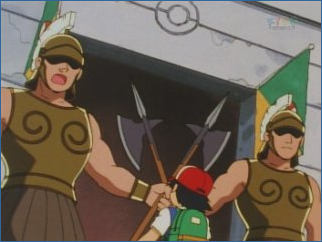
 I've decided that Giovanni has decorated his Gym and door guards in a vaguely classical style because he's (presumably) of Italian descent, but doesn't know enough about the Roman army to make his soldiers actually look authentic.

Anyway, when Ash is about to walk up to the Viridian Gym, he’s interrupted by his dear sweet archenemy, Gary Oak.  Gary actually has ten badges already; he’s just going after an eleventh for bragging rights (another telling little detail: there are at least twelve official Gyms in Kanto, since we know Gary never won a Volcano Badge either).  Gary waltzes past Ash, throws a few choice insults his way, and struts up to the door guards, who are inexplicably decked out in the kind of Greco-Roman mish-mash that makes classicists like me cry ourselves to sleep – bronze breastplate, leather skirt, etc – but armed with halberds, of all things, which are blatantly Renaissance weapons (I promise that this will be my last barely-relevant tangent for this- oh, who am I kidding?).  These imposing fellows let Gary in, but refuse to admit Ash, declaring that only one challenger at a time may enter… so we follow Gary for a while instead.  The Viridian Gym Leader turns out to be Giovanni, the mysterious Boss of Team Rocket (what a twist!) though this is lost on Gary, who doesn’t know him.  He overpowers Giovanni’s Golem with his Nidoking, and boils a Kingler with his Arcanine’s Fire Spin, prompting Giovanni to test out his newest and most powerful Pokémon, whom Gary’s Pokédex is unable to identify.  He even invites Gary to use both Arcanine and Nidoking together to fight the armoured monstrosity, but both are paralysed by its mysterious powers and flung roughly against the wall of the Gym.  Then, just for fun, Giovanni has his Pokémon incapacitate Gary and his cheerleaders before leaving to take care of other business.

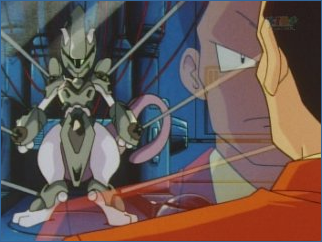
 Mewtwo in his badass armour.  I'm not even totally sure what this is for; he certainly doesn't need it for protection.  I think Giovanni claims that it helps Mewtwo to control his powers.

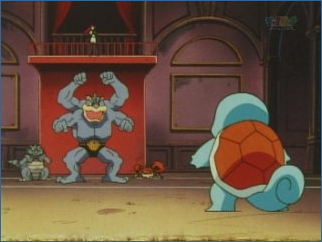
Meanwhile, Togepi has gotten lost and been carried halfway across the city by a wild Fearow.  Misty, of course, searches everywhere in panic, but Team Rocket find Togepi first.  Jessie suffers great personal injury trying to grab Togepi as she wanders across a plank suspended between two tall buildings, but manages to secure her.  Overjoyed at finally having stolen a rare Pokémon, she, James and Meowth go in person to present their spoils to Giovanni, who stares blankly at Togepi and asks “what… exactly does this Pokémon do?”  Jessie, James and Meowth confer, and realise that they have absolutely no idea what powers Togepi possesses, if any, and Jessie answers “it… would certainly make a handsome paperweight!”  Giovanni is about to eviscerate them for their incompetence, but is notified of an emergency and has to hurry away to fetch his super-Pokémon.  For lack of anyone more capable, he instructs Jessie and James to man the Gym and tosses them three Pokéballs before exiting.  Togepi, who has wandered off in the meantime, finds her way to the front doors of the Gym, where the kids have met up again after completing their search.  They hear her voice and haul the doors open to find Togepi, safe and unharmed… and Gary and his cheerleading squad, unconscious and scattered around the arena.  As Ash tries to learn from Gary what happened to him, Jessie and James appear, declare that they are now the Gym Leaders, and challenge Ash to a battle.  Just to make things more interesting, Meowth has rigged special trainer boxes that transmit the pain felt by the battling Pokémon to their trainers, reducing Ash to crippling agony when Jessie’s borrowed Machamp pummels his Squirtle into submission, and her Kingler shrugs off Bulbasaur’s attacks.  When he calls Pidgeotto, however, and hits Jessie’s Rhydon with a mighty Double Edge, Jessie realises that her box has the same set-up as Ash’s.  Gary snatches the control remote from Meowth to keep him from turning off Jessie’s box, so she panics and calls Arbok and Weezing into the fight as well.  Ash objects to her using five Pokémon at once and has Pikachu join the others and blast them with his best Thunderbolt.  Giovanni’s Pokémon flee the arena and, while Jessie, James and Meowth flail uselessly, Togepi finds Meowth’s remote and starts playing with it.  Jessie’s trainer box explodes and flings Team Rocket out of the Gym, dropping an Earth Badge on the way.  Well… Ash never even met the Gym Leader… and his challenge was marked by flagrant rule violations on both sides… and no-one ever actually conferred the Earth Badge on him… but what the hell, a Badge is a Badge, right?

 ...is it just me, or is Jessie's Machamp kinda TOWERING OVER her Rhydon?  I'm pretty sure Machamp are roughly human-sized, but Jessie would barely come up to his waist... then again, I wouldn't put it past Giovanni to load 'em up on steroids...

It turns out Giovanni was the Viridian Gym Leader all along!  I realise this is probably old news to almost everyone reading this, since he’s the Leader in all the games set in Kanto as well but, of course, I find this really interesting.  In the games, Gym Leaders tend to be portrayed as pillars of the community, and this tends to hold true for later seasons of the anime as well, but in the Indigo series things are often much weirder – most notably for Sabrina, Koga and Blaine.  Giovanni adds another bizarre perspective to things: this Gym Leader is a mob boss.  I think it’s fair to assume that the Pokémon League either doesn’t know about what he does in his spare time or doesn’t care… and which option you think is more likely says a lot about what you think of the Pokémon League.  If they don’t know, then this adds support to my overall impression that there is fairly little League oversight in the way Gyms are run.  One also has to wonder whether the League might be dangerously incompetent.  True, Giovanni is a criminal mastermind and probably very good at covering his tracks but, on the other hand, he is at the head of an organisation that often works in direct opposition to the Pokémon League and regularly tramples on every value they stand for.  If the body responsible for the regulation of Pokémon training can’t sniff out the head honcho of a crime syndicate devoted to the abuse and exploitation of Pokémon within its own ranks, something has got to be badly wrong here.  The alternative possibility – that the Pokémon League knows exactly what Giovanni is up to and just doesn’t care – is even more frightening, possibly implying that significant factions of the League’s management are in Team Rocket’s pocket.  I think some combination of the two is probably in play: many overworked League officials are willing to get lazy with their background checks, or keep inspectors out of the Viridian Gym’s private areas, in exchange for a little ‘incentive.’  After all, plenty of Gym Leaders are eccentric – he probably just has a few little projects going in the basement that he doesn’t want to be public knowledge.  Can’t do any harm to let that slide, right?

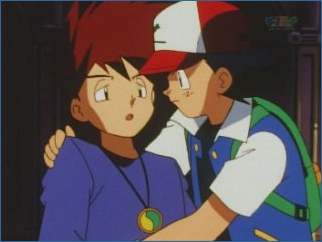
 "Ohmygod Gary!  Here, let me hold you..."

The next big question is one that Misty actually raises in the episode itself: why would Team Rocket want to own a Gym anyway?  Jessie responds haughtily that she wouldn’t understand; Team Rocket’s plans are too far-reaching and intricate for the likes of them (which, Meowth explains, means that she doesn’t know either).  It is difficult to imagine that Giovanni could actually steal Pokémon from challengers without blowing his cover – moreover, he had ample opportunity to take Gary’s Arcanine and Nidoking (who had, remember, just defeated two of Giovanni’s own Pokémon) but chose not to, so it certainly doesn’t seem like that’s his game here.  The obvious motive is money; Showdown in Dark City implies that official Pokémon Gyms can expect to be profitable, since that’s the Yas and Kas leaders’ primary reason for wanting official status.  Then again, some Gyms (notably Cerulean and Celadon) run separate businesses too; as a result I’m very unsure as to whether most Pokémon Gyms are funded by League grants or by their Leaders’ own personal wealth (and I quietly suspect that Giovanni created the Viridian Gym in the first place, sinking a significant portion of his ill-gotten fortune into setting it up).  The simplest argument, though, is that if the Viridian Gym existed for anything so transparently mercenary as direct profit, Jessie would know about it; there’s simply no reason for her not to.  Having a respectable public persona, too, seems like an obvious benefit, but one which Giovanni doesn’t choose to take advantage of.  It seems likely that owning an official Pokémon Gym simply gives Giovanni space to do various illegal things in secret, a place to keep Mewtwo under wraps, for instance, and work on upgrades to his cybernetic armour (taking challenges, of course, provides him with opportunities to test Mewtwo’s strength, though this is probably not routine business).  We also see that he has a number of caged Pokémon in there (incidentally, the fact that anyone would ever bother to put a Pokémon in a cage suggests quite strongly that Pokéballs just won’t cut it – they apparently wouldn’t be effective at restraining Pokémon that really want to break free).  Paradoxically, the best way to keep this stuff out of the League’s sight is by doing it right under their noses, in an official Pokémon Gym.  It seems reasonable to imagine, further, that Gym Leader status is an asset in itself; Giovanni could probably expect to be consulted about policy decisions and notified in advance of any important developments in League business, information he might be able to use to Team Rocket’s advantage.  Finally, I wouldn’t be at all surprised if Giovanni simply enjoyed taking challenges.  He does genuinely seem pleased by Gary’s strength, and it’s a basic truism of the series that powerful trainers seek powerful opponents; running the Gym might actually be something of a hobby for him, which would imply a whole slew of interesting twists on his characterisation.

 I wish we got to see more of Giovanni; the other Gym Leaders are all interesting, but his particular situation, I think, is the one with the most potential for elaboration.  If nothing else, it would be fantastic to have more evidence for how he treats his role as a Gym Leader (perhaps fairly casually, if he’s willing to let the notoriously incompetent Jessie, James and Meowth stand in for him – but, then again, whatever emergency he needed to deal with, it apparently required both his own personal attention and Mewtwo’s, so it’s clearly not an ordinary day for him).  The bare facts of his situation themselves, though, are more than enough for me to play with; we can learn a few rather worrying things about the Pokémon League from this episode, and this has to impact on the way we view them elsewhere in the series.

That’s the last I’m doing on Anime Time for a little while – now, there’s one more week to go of the Pokémon Power Bracket, so I’ll do another entry on that and then, I think, wrap it up with a sort of retrospective on legendary Pokémon in general.  After that… I think I need another break, but we’ll talk more about that as it comes.

The Pokémon Power Bracket – Semi Final

http://www.pokemon.com/powerbracket

So, what I didn’t anticipate when I started doing this was that I would wind up talking about a lot of the same Pokémon over and over again.  I am getting to the point where I have, quite honestly, said most of what I care to say about Celebi, Mew, Rayquaza and Mewtwo.  If you’ve been reading this so far, you all know that I’m edgy about time travel but much less bothered by Celebi than I am by Dialga, you all know that I think Mew’s backstory is blatantly contradicted all over the place, you all know that I think Mewtwo’s angst is all about stuff that shouldn’t matter in-universe anyway, and you all know that I think Rayquaza deserves to die in a fire for replacing the climax of Emerald version with a massive deus ex machina.  You can almost certainly guess for yourselves by now which way I’m going to vote in the two semi-final matchups.

This is why, instead of discussing what these Pokémon are like and which ones I prefer and what my reasons are, I’m going to do what I do best and MAKE STUFF UP!

Celebi vs. Mew


So, here is what we all know about Celebi.  She is a time-traveller, supposedly from the future, who brings life and light to forests (she is particularly associated with the Ilex Forest in southern Johto), and appears only in times of peace.  Stories say that she occasionally leaves mysterious eggs from another time in the deepest parts of the woods, and that “so long as Celebi appears, a bright and shining future awaits us.”  My take on Celebi – which may or may not have any relation to what Game Freak actually had in mind – is that she is the ultimate self-fulfilling prophecy: a paradox being with the power to engineer the circumstances of her own birth at the end of time.  Celebi brings back Pokémon eggs from the future in order to seed the world with the genes and species that will one day give rise to her own ancestors, while protecting and nurturing the forest ecosystems that will allow them to thrive.  One such egg is her own, brought from the future and hidden deep within the Ilex Forest, which will one day be the place of her birth, and sustained through its millennia-long gestation by the vibrant energy of the entire living forest.  Celebi dances through history in intricately choreographed steps, using her formidable psychic abilities to influence events, pushing war and industry away from her precious homeland while gently nudging the people of Johto towards veneration of nature.  Occasionally she comes into contact with humans directly; occasionally she even decides she admires them and submits to capture, staying with them for years or even decades, learning to see the world through their eyes, until they either part ways with her or die, and she loops back on herself to continue her work.  Far in the future, perhaps helped along by human genetic manipulation, a species of Pokémon will evolve that possesses an unusually intuitive sense of time, able to pick out the paths of causality and predict future events with a precision that would leave the dim-witted Psychic Pokémon of our era wide-eyed with amazement.  Eventually they will develop the ability to make tiny hops through time, a few seconds forward to avoid an attack, or backward to undo a mistake.  Under their descendant’s guidance, their powers will grow more phenomenal with every generation, ultimately giving rise to the impossible: the final prodigy who will take her own egg and travel back in time to ensure the sequence of events that led to the creation of her own species.  That is the “bright and shining future” Celebi promises: the only possible version of history that culminates with the birth of the immortal guardian of the forest, who will always lead humanity into harmony with nature.


If Celebi is the end, Mew, of course, is the beginning.  Most famous for being Mewtwo’s ‘mother,’ Mew is a mysterious Psychic Pokémon from South America, who was for a long time believed to be extinct, or simply nonexistent.  It turned out, of course, that Mew not only did exist but possessed something akin to a genetic library of all other Pokémon species, an asset which gives her access to all of their powers.  The scientists of the Pokémon world began to theorise that Mew was the common ancestor of all Pokémon, in flagrant defiance of the way evolution actually works (see this entry).  We, of course, also know that Arceus was the first Pokémon and not Mew, and that his first creations were Dialga, Palkia and Giratina, followed by Uxie, Mesprit and Azelf.  Moreover, we know that many Pokémon are unequivocally not descended from Mew, or from any other Pokémon: Grimer comes to mind.  Given these facts, here’s my take on Mew.  I believe I’ve mentioned before that I think of Mew as the first living thing created after Uxie, Mesprit and Azelf; her claim to fame, therefore, is that she is the first living thing with a complete soul: knowledge, emotion, and will.  As for Mew’s ‘genetic library,’ my immediate thought is that she must have been ‘programmed’ in advance with the DNA of every species of Pokémon ordained by Arceus.  I’m pretty sure that’s not what anyone ever had in mind, though, either for Mew or for Arceus; I am quite convinced that evolution (in the real-world sense) is supposed to be a thing in the Pokémon world.  I want to define, then, a very different role for Mew: she really is a genetic library.  Her special power – and, indeed, her duty – is to copy and absorb the genetic information of all Pokémon she encounters, building up a ‘library’ of gene sequences that, between them, record the form, traits and powers of every species that has ever existed (of course she was found in the jungles of South America – she would linger in places of the greatest biodiversity).  She can use this borrowed DNA as a blueprint to Transform into any Pokémon she has observed, or learn techniques from every element.  Further, she was gifted by Arceus with incredible defensive powers, including invisibility and her signature telekinetic shield bubble, ensuring that her precious genetic library will be preserved for all eternity.  As long as Mew exists in the world, extinction will never be forever; she can Transform into every Pokémon that is or was, using all their abilities, and from her genes any of those Pokémon could be resurrected.  She is the holy grail of evolutionary biology, and the scribe who documents for Arceus the history of the world he set in motion.

Rayquaza vs. Mewtwo


Oh, yes… Rayquaza… my old enemy.  What do we know about him?  Well, he lives high above the clouds in the ozone layer, where he flies forever, feeding on water vapour and other rarefied substances.  Because Rayquaza lives so high above the earth, his existence was totally unknown until he descended during the events of Emerald version.  Even the myths of Groudon and Kyogre’s first battle seem to have forgotten him, mentioning only the Red and Blue Orbs that calmed the titans.  However, he is in fact the only one who can calm them once they start fighting.  Alone, either Pokémon can be pacified by the matching Orb (or awakened by the opposite Orb) but once their attention is fixed on each other, neither Orb helps.  My version, then… Rayquaza was set to act as the guardian of the sky, to protect the world from any threats from outer space – meteors, for instance (as in Mystery Dungeon), or flares of cosmic radiation – but also to guard the sky against threats from below.  Kyogre and Groudon were made to sculpt the surface of the earth and will awaken every century or so, independently of each other, to shake things up a little before returning to sleep.  For both of them to wake up at the same time is much rarer, and will lead to a catastrophic battle; their instincts drive them to make the world around them resemble themselves, and they will sense  each other’s opposite powers as threats.  They will fight on and on, their clashing weather manipulation powers creating storms and cyclones that grow more powerful the longer they stay awake.  Eventually – after weeks, months or even years – the chaos will disturb Rayquaza’s domain in the stratosphere, causing him to descend and nullify their weather powers with his Air Lock aura.  With their powers dampened, Groudon and Kyogre simply cease to view each other as threats and return to their slumber in their own time.  The Orbs were created by an ancient civilisation with Rayquaza’s assistance, after the survivors of an earlier cataclysm witnessed him calming the titans.  They are similar to Arceus’ plates, in that each embodies and reflects the power of an element in its most passive form.  The proximity of the appropriate Orb allows Kyogre and Groudon to feel at peace, as though surrounded by boundless ocean or land, and renders them gentle.  Once the Orbs began to be used to control the titans, it could be ensured that they would never be awake at the same time.  Rayquaza no longer needed to calm them, and retreated into the stratosphere.  The sky dragon faded from legend, and eventually the purpose of the Orbs was forgotten too… until Maxie and Archie, misunderstanding the stories that the Orbs were used to “control” the titans, used them to awaken Groudon and Kyogre.  Feeling as though surrounded by powers opposite to their own, both Pokémon lashed out… and you all know the rest of the story.


Mewtwo, of course, is Mew’s ‘child,’ created from Mew’s DNA by human scientists including Blaine and Mr. Fuji using advanced genetic manipulation techniques with the aim of building the ultimate fighting Pokémon.  Unfortunately, Mewtwo rebelled against his creators, destroyed the old laboratory on Cinnabar Island where he was born, and escaped.  He is now considered to be the most savage and violent of all Pokémon.  Journals found in the burnt-out Cinnabar mansion suggest that Mew gave birth to Mewtwo, which doesn’t seem to fit the image found elsewhere of Mewtwo being grown in a tube.  Also, the games do not support the story given by the movie that Giovanni and Team Rocket were backing the scientists who created Mewtwo (though they don’t necessarily contradict it either).  So, what do I make of all this?  Well, the first thing that strikes me as unusual is that Mewtwo was supposedly a genetically ‘upgraded’ version of Mew… whose DNA already contains the genes of all other Pokémon.  What could the scientists possibly add to that?  I can think of two answers.  The first possibility is that Mewtwo is part human, which would have interesting implications for the way humans view Pokémon: apparently, when told to create the ultimate Pokémon, they do it by adding human DNA.  The other possibility – the one I’m actually going to run with – is that they didn’t actually add anything at all, but created Mewtwo by shaving off most of what they considered “junk DNA” – the genes of all the other, less combat-ready Pokémon assimilated by Mew over the years, as well as the regulatory genes that allow Mew to do her thing in the first place.  Mew reproduces by parthenogenesis (‘virgin birth’), passing on all the DNA she has ever collected to her child to ensure that her work need not by interrupted by such trivialities as age and death.  When the scientists who had discovered her began to tamper with the embryo’s DNA, however, her body detected the changes, decided that it had made some kind of mistake, and jettisoned Mewtwo prematurely in order to try again later, forcing the scientists to incubate him in his tube (this may well have happened several times, each time resulting in an unviable embryo, before Mewtwo was successfully incubated).  As a result, Mewtwo is missing huge amounts of the DNA Mew collected, but still retains many of the instincts that allow her to fulfil her purpose.  He knows that something is badly wrong with him, and that despite his awesome powers he is fundamentally incomplete, but he cannot understand why, and could not correct the problem if he did.  No wonder his mental health leaves something to be desired.

Feel free to let my heavily embellished versions of events sway your votes, or not, as the whim strikes you.  Me, I’m just trying to make sense of what I’ve got and establish a nice, internally consistent version of the setting.  I hope I’ve managed to avoid contradicting myself so far…

Anime Time: Episode 62

Clefairy Tales

This episode is… tricky.

By “tricky” I mean that I’m not sure whether it’s the worst episode ever… or what the whole series should have been like.

I’ll… I’ll just give you the plot, shall I?

 ...I'm so sorry; I just couldn't resist.

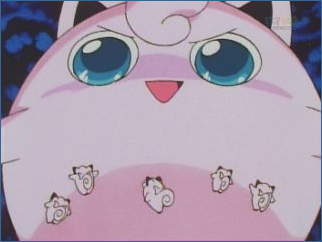
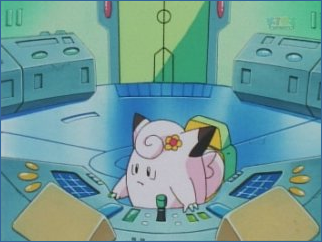
So, they episode opens on Jigglypuff, who is strolling around the woods one night, singing to herself, leaving behind a trail of comatose forest Pokémon, with doodles all over their faces… but it’s not just the forest Pokémon that are being affected by her song.  A machine part falls from the sky and lands on her head, and she looks up to see a large yellow sphere hurtle through the sky and crash nearby in the woods.  Jigglypuff goes to investigate, and encounters a large group of Clefairy piling out of the sphere…

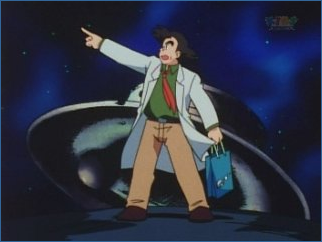
A few days later, as Ash, Misty, Brock and Pikachu relax outside an ice-cream parlour, a Clefairy approaches their table and starts doing the sort of cutesy things Clefairy are known for.  Misty declares that she must have this Clefairy, but the Pokémon isn’t interested in fighting, and bounces off, with the kids in hot pursuit.  Eventually, she slips away from them, and they return in defeat, only to find that their backpacks – and their ice-cream – have been stolen!  They go to the police station to report the theft to Officer Jenny #442, and quickly learn that they aren’t the only victims: dozens of people are lined up outside the station, complaining of increasingly bizarre thefts.  A bike horn, the buttons from a coat, the candles from a birthday cake… Misty wonders out loud who’d steal rubbish like this, and immediately gets an answer.  “ALIENS.”  The speaker is a scientist – and I use the term loosely – named Oswald, an enthusiastic conspiracy theorist whose self-proclaimed mission is to expose the hidden truths that the government doesn’t want people to know.  Oswald posits that these miscellaneous items are being purloined by Aliens for Alien Reasons, and produces a scrapbook filled with the standard blurry photographs normally used as evidence for this sort of thing.  The chef whose candles were stolen points to one picture and says that he recognises it, prompting Oswald to ask, hysterically, where he saw it and when, and whether the aliens took him aboard to probe him (no, I’m serious).  The chef stammers out that he saw the spacecraft over the forest three nights ago… which is just when the thefts began.  Oswald triumphantly joins the group and leads Ash and friends through town, sweeping the area with a bleeping ‘scanner.’

 THE TRUTH IS OUT THERE!  Screenshots from filb.de/anime.

Then a pair of silver-skinned aliens land their spaceship in front of the group, calmly walk out, pick up Pikachu, and leave again.  Ash, apparently, is as dazed as I am by the way this episode is going and just blinks as they kidnap his best friend.  As the ship takes off, the kids notice that it’s being held up by a crane cable, and Ash sends Pidgeotto to snap it.  The aliens, who have stuffed Pikachu into a shockproof glass case, turn out to be Team Rocket in costume, and it looks like they’re ready to have their standard crushing defeat inflicted upon them, but instead something quite different happens.  A Clefairy appears, closely followed by an extremely irate Jigglypuff.  Oswald’s scanner starts making louder bleeping noises, and he declares that “according to my scanner, Clefairy is an alien!”  In fact, “Jigglypuff is also an alien!”  When Misty questions the scanner’s integrity, it indicates that she is also an alien, so she knocks it out of Oswald’s hand in irritation.  Meanwhile, the Clefairy steals Pikachu’s case and flees, casting a Light Screen to block Team Rocket’s pursuit before disappearing down a manhole.  Jigglypuff follows, bringing the team with her.  The manhole leads them into an underground hangar, where the Clefairy seem to have repaired their ship by cannibalising items stolen from the townsfolk, and constructed a massive rocket booster to relaunch it – and they’re going to use Pikachu to power the blasted thing.  Ash and Misty run to save Pikachu, Brock leaves to find reinforcements, and Oswald decides to stow away on the ship.  When they find Pikachu, still locked up, several Clefairy appear to guard him, but Jigglypuff bitchslaps them into submission before stalking off.  While Ash and Misty try to release Pikachu, Oswald and Jigglypuff find the bridge, where Jigglypuff furiously attacks the Clefairy captain.  Oswald starts playing with the controls and snaps the main joystick – Jigglypuff’s black marker, which she uses as a prop while singing due to its vague resemblance to a microphone.  Jigglypuff immediately grabs it and bursts into song, putting everyone on the ship to sleep, then leaves just before the launch countdown completes.  A machine whacks Pikachu with a hammer, prompting him to pour out electricity into the ship’s systems and begin the launch.

 YOU HAVE ANGERED JIGGLYPUFF, FOOLISH MORTALS.

Up above, Officer Jenny asks Brock “do you really expect me to believe a bunch of Clefairy stole those things to make a spaceship?”  Right on cue, a huge section of the road retracts to form a launch ramp and the spaceship blasts off into the sky, leaving a trail of random stolen objects behind it.

This… this may well be my favourite scene of the whole series so far.

Pikachu’s electricity overwhelms the ship’s power core and his glass cage shatters.  As Ash and Misty wake up, the spacecraft begins to lean and wobble in its flight, so they quickly find their stuff and attempt to leave.  Bulbasaur, impressively, manages to snare a nearby skyscraper with his Vine Whips and swing them all onto the roof, more or less unharmed, as the spaceship passes it.  From the roof, Ash and Misty watch the ship sail off into the sky and reflect on what has been just about the most bizarre day of their lives as trainers.

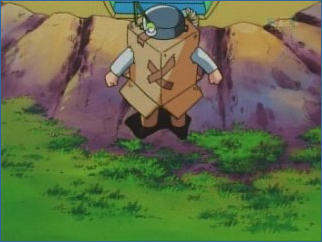
Some hours later, the Clefairy ship crashes again near a lake.  As a crowd of people gathers around to see what’s going on, Oswald emerges, wearing a makeshift cardboard space suit and asking, in a muffled and heavily accented voice, “is this the planet of the Clefairy?”  Behind him, the Clefairy crew spill out of the ship to begin their crime spree anew…

I don’t know what the writers were on when they did this one, but I want some.

 I wonder how long it takes him to realise he's not on another planet?  Hours?  Days?

Clefairy are weird, weird Pokémon.  With few exceptions, they don’t have much contact with people, suggesting that most of them don’t really buy into the idea of the implied partnership with humanity which I am convinced is the basis of the way most Pokémon relate to us.  That could be indicative of a number of things, up to and including an entirely independent civilisation with its own culture and morality.  The anime really likes the “Clefairy are from space” angle, which I think was only a fairly minor detail in the games – some dude suggests that Clefairy might be from space because of their connection with the Moon Stone – but does seem to have been at least in the back of the designers’ minds from the beginning.  Whereas Clefairy and the Moon Stone suggested that they arrived on Earth riding a meteorite, however, Clefairy Tales has them piloting an honest-to-goodness spaceship.  One might initially assume that it wasn’t originally theirs, that they stole it from someone else, but they’re shown to be able to repair the damn thing using an incredibly eclectic array of parts pilfered from random townspeople, so clearly they know its technology inside out – and the thing only failed to fly in the end because Jigglypuff put the crew to sleep and Oswald sabotaged the controls.  This isn’t just intelligence; this is technological genius.  Coupled with the belief – which, if you accept my theories, is typical of Pokémon – that human ideas about morality are exactly that, human ideas… and we have a largely amoral (though not malicious) race of highly intelligent, technologically advanced Pokémon with formidable magic and, just for fun, the ability to use Metronome.  It’s a recipe for total chaos.  Quite honestly, I think these Clefairy would make fantastic recurring villains, partly because of the fact that they’re not really villainous, just genius kleptomaniacs with mysterious goals.  Figuring out where they’re from and what they’re up to could be a fascinating storyline in itself.

 "Visit Earth, they said; observe the fascinating local culture, they said... silly backwards little planet; remind me to nuke the place from orbit..."

Funnily enough, I don’t think it’s ever actually proven in the anime that the Clefairy come from outer space.  Everything seems to imply it, Seymour in Clefairy and the Moon Stone believes that all Pokémon came from space originally, and Oswald assumes that the Clefairy in Clefairy Tales are attempting to return to their homeworld.  On the other hand, though… there are plenty of Clefairy on Earth who apparently do not have spacecraft or other advanced technology, but simply worship meteorites and draw power from cosmic phenomena.  Their presence draws me toward one of two explanations.  The Clefairy may have been stranded on Earth somehow, losing most of their technology, so that some of them ‘went native’ and fully committed themselves to staying here, while others devote all their time and energy to rebuilding from scratch the starships they will need to return home (of which the ship from Clefairy Tales is perhaps only an early prototype).  Alternatively, the Clefairy may have been from Earth all along – again, there’s no proof that they aren’t – and simply developing a space program of their own in the same way as humanity did, their zeal further increased by their strange affinity for the cosmos.  As for where and how… well, they manage to construct an underground hangar in the middle of a city (and get their crashed ship inside, unseen) in the space of three days; I can only imagine what they could do out in the wilderness with several months to work with.  One final point I want to address briefly is that there are no Clefable in this group at all; not even the leader has evolved.  This implies that they do not have – and may never have had – ready access to Moon Stones.  I’m not sure that this necessarily favours one of my explanations over the other, although it does seem to suggest that the Clefairy in Kanto are divided into distinct groups, and that trade and exchange between these groups is not without restrictions.  If I were in a particularly speculative mood (which, let’s face it, is pretty much my baseline) I might even suggest a division into ‘religious’ and ‘scientific’ factions: one group focussed on community, tradition, and ritual, who use their Moon Stones to enhance their magical abilities through evolution, and another group focussed on exploration, discovery, and technology, who devote their energies to building spacecraft (or repairing them, depending on your interpretation).

This episode, like A Chansey Operation, is utterly crazy.  It’s not totally inconsistent with the rest of the series, which is extremely light-hearted, but it was clearly written with a rather different tone in mind.  I can only imagine how differently Pokémon – both the anime and the whole franchise – might have developed if the entire series had been so wholeheartedly zany.  As matters stand, though, I can’t help but love this episode for providing me with so much material that is so fun to work into the other details of the setting.  Perhaps in that respect it’s good that it stands out the way it does.

Anime Time: Episodes 60-61

Beach Blank-Out Blastoise – The Misty Mermaid

 Teenage Mutant Ninja Turtles, eat your hearts out.  Screenshots from filb.de/anime.

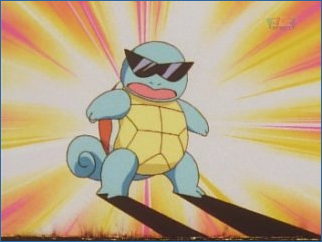
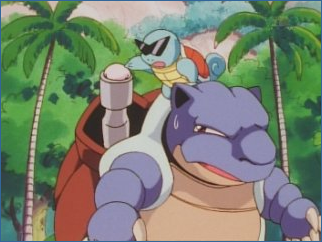
With Ash’s Volcano Badge in hand at last, it’s time to leave Cinnabar Island… but our hapless heroes are about to miss the last boat of the day!  As they run for the ferry terminal, a Wartortle appears out of nowhere and crashes into them, knocking everyone to the ground.  Pikachu calls on Squirtle to interpret, who immediately decides that this is an emergency worthy of BADASS SHADES, and leaps into the ocean with the Wartortle.  The kids steal a motorboat and follow.  They soon reach an island, with a beach filled with snoring Squirtle and Wartortle, and a single Blastoise.  Brock is excited by the possibility that they have found the mysterious breeding grounds of the turtle Pokémon, but there’s something off about the scene.  When Ash and Squirtle run up to Blastoise, they fall asleep too, so Pikachu attempts his universal solution – electrocute everything – and wakes up Ash, Squirtle, and most of the wild turtle Pokémon.  When Ash has recovered, he claims to have heard music echoing within Blastoise’s shell.  Misty, true to form, decides that whatever’s going on here, getting mixed up in it is more trouble than it’s worth, and suggests they leave, but Ash and Brock want to figure out what’s going on.  They establish, through conversation with all the Squirtle and Wartortle, that Blastoise fell asleep while swimming a few days ago, and was dragged back to shore by the others, who all fell asleep too once they reached the island, except for the one Wartortle who went to Cinnabar Island to find help.  Brock examines Blastoise with a stethoscope, but the huge turtle Pokémon wakes up during the process, stretches his arms, swivels his cannons… and finds that he has a blockage stuck in his right cannon.  A round, squishy, pink blockage that begins singing when he tries to dislodge it.  Everyone falls asleep again under Jigglypuff’s spell, and Team Rocket show up to try and snatch Blastoise with their Gyarados submarine’s grabbing arm.  When the turtles wake up and find Blastoise gone, Ash’s Squirtle assumes command using his BADASS SHADES and rallies his brothers.  Meanwhile, Team Rocket fall asleep themselves, and their sub sinks.  The turtle Pokémon retrieve it, along with Blastoise, allowing Ash and Misty to resuscitate James and Meowth, who are grateful, and Jessie, who screams “they’re our mortal enemies; how DARE you be grateful they saved our lives!?”  Team Rocket promptly hop back into their submarine, which rolls onto the beach and starts grabbing for Pokémon.  The Wartortle can’t stop it, but Pikachu and Squirtle together manage to extract Jigglypuff and awaken Blastoise, who has the strength and firepower to grapple with the submarine and blast it away.  Squirtle even manages to rescue Jigglypuff, who winds up on the submarine somehow.  Peace is restored in the turtle kingdom, and the kids go on their merry way.

 How has it escaped Kanto's government that a Jigglypuff in the wrong place at the wrong time could doom entire ecosystems?  This one very nearly deprived the region's primary Wartortle colony of their leader.

So, not for the first time, we see in this episode that evolved Pokémon are considered the natural rulers of their species: Blastoise is the oldest and the strongest of the turtle Pokémon on the island, and probably the most knowledgeable and experienced.  There is no shortage of reasons he should be in charge, really, and it mirrors what we see in plenty of other episodes… so why do I even care?  Well, Ash’s Squirtle is neither old nor powerful… more knowledgeable than the rest, maybe, but Wartortle are supposed to live for hundreds of years, so who knows?  When Squirtle marshals the other turtle Pokémon to go after the submarine, they obey instantly and cooperatively, treating him without question as a commander.  Misty and Brock seem to think it’s his BADASS SHADES, and, well, I guess that’s not impossible, but I think it’s giving them too little credit; I’m pretty sure Pokémon are consistently portrayed as being more sensible than that.  What Squirtle does have is experience of the wider world, something the other turtle Pokémon probably lack since their community is implied to be fairly insular, as well as powerful allies with a wide range of capabilities (he’s also familiar with their enemies).  If nothing else, the turtle Pokémon recognise that humans are very useful friends to have; as a result, they will readily accept a human-trained Pokémon as a leader because Squirtle is likely to have experience thinking on his feet and dealing with unusual situations, and because he can keep things going smoothly with Ash and the others, whose assistance might be important.  This brings us back, in the end, to the BADASS SHADES: a human item, and an outward symbol of Squirtle’s experiences in and ties to the human world.  As far as insignias of rank go, they’re an unusual choice, but I think they represent what it is about Ash’s Squirtle that really makes the other Squirtle and Wartortle accept him as a leader so unquestioningly.  My mind wanders back to that one strange line from Ash’s Pokédex in the first episode: “wild Pokémon are often jealous of human-trained Pokémon.”  I’m gradually beginning to believe this statement is actually false, or at least oversimplified, and possibly even propagandistic (but that’s another entry entirely).  Pokémon and humans are both stronger together; this has been the franchise’s stance from day one, and echoes through its every iteration – games, anime, manga, whatever – and wild Pokémon do recognise that.  They don’t necessarily want to be partnered themselves, but many of them will still treat human-trained Pokémon with a certain respect, and may defer to their experience in crisis situations.

Moving on…

 The Magical Mermaid relaxes in her lagoon.

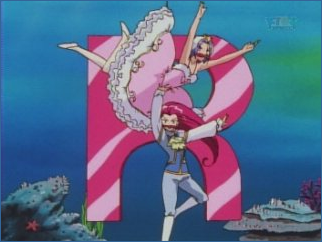
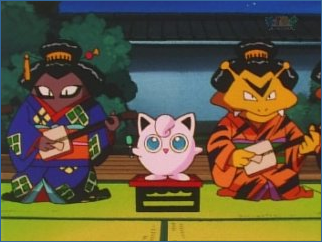
As Ash, Misty, Brock and Pikachu strike out for Viridian City, Misty realises that her Horsea isn’t getting enough freedom and exercise (something which never seems to be a problem for Goldeen – I’m pretty sure Misty’s Horsea is just a bit frail and sickly), so the kids decide it might be a good idea to visit Misty’s sisters in Cerulean City and let Horsea relax in the huge pool at the Gym for a few days.  When they reach Cerulean City, they learn that the Gym is advertising a new ballet, featuring a talented water dancer returning to Cerulean after a long absence.  Misty soon learns, to her shock, that she is this legendary ballerina.  Lily, Violet and Daisy explain that their traditional shows haven’t been pulling the crowds like they used to lately, so they’ve decided to spice things up by writing a water ballet to be performed underwater!  Tomorrow!  Please help us, Misty, or the Cerulean Gym will be ruined!  Misty will play the ballet’s star, the Magical Mermaid; Lily and Violet will be the evil pirates who intrude on her peaceful lagoon, and Daisy will play the handsome prince who arrives at the climax to save the day… and clearly the sisters do need Misty as the Gym is ludicrously short-staffed – they aren’t just the actresses; they run everything at these shows, ticket sales and all.  The ballet is performed in an enormous glass tank filled with water.  Misty, as a budding Water Pokémon Master, can hold her breath for a crazily long time, and the show is structured to give her moments out of sight of the audience to use her underwater breathing apparatus.  The show goes well initially, with Misty’s underwater dance holding the crowds enthralled, but when Lily and Violet are cued to enter, two quite different pirates appear, wearing… interesting… costumes: who else but Team Rocket?  Their motto is a huge hit with the crowd, who think it’s all part of the show.  Ash and Brock maintain the illusion by taking Daisy’s cue to leap into the pool to help.  Weezing floats harmlessly to the surface, but Arbok proves to be quite an impressive fighter underwater, and manages to corner Starmie, Seaking and Squirtle.  The sisters’ much-ridiculed Seel, however, saves the day, outmanoeuvring Arbok and hammering it with an Aurora Beam before evolving into Dewgong and deep-freezing the lot of them.  The kids haul all the Water Pokémon onto a platform in the centre of the pool so Pikachu can blast Team Rocket with impunity in a grand finale that makes the show a huge success, revitalising the Cerulean Gym’s business overnight.  In thanks for her part in saving the Gym, Misty’s sisters confiscate her Horsea and Starmie so that they’ll have enough Pokémon to keep performing the show.  Truly, their gratitude is an example to us all.

 ...you quickly learn to stop questioning it.

Every time I see these three I wonder how the hell they can possibly be allowed to run a Pokémon Gym.  They’re clearly more concerned with ticket sales than with challenges, and regard their Gym’s fate as resting on the success of their next water ballet, not on their ability to train Pokémon and instruct other trainers in doing the same.  The Misty Mermaid does go out of its way to point out that they are decent Water Pokémon specialists – when Seaking and Horsea initially attempt to tag-team Arbok, and Seaking lands a nasty Horn Attack, Ash comments on its skill, to which Misty responds “thank my sisters; they trained it.”  However, when push comes to shove, much of the effectiveness of the climax, and of Seel’s evolution into Dewgong, is drawn from the fact that Lily, Violet and Daisy have completely and blatantly failed to comprehend Seel’s potential, ever since they declined Ash’s challenge in the Waterflowers of Cerulean City on the grounds that Seel wasn’t strong enough to be worth trying (Seaking, who seems to be their star battler, had been injured in a previous battle with one of Ash’s Pallet Town rivals).  They do little, if anything, to earn our respect, and serve mainly to demonstrate that some Gyms are indeed more challenging than others.  They’re also making me change my mind again on a question that has me go back and forth repeatedly; whether Pokémon Gyms enjoy any sort of league funding.  Like Erika, the Sensational Sisters seem to run a successful business; then again, their Gym is unusually lavish – hardly as expensive to build and maintain as Blaine’s, but the start-up capital for their huge aquarium, water fields, and auditorium must have come from somewhere.  My working theory is that the sisters inherited the Cerulean Gym from their infinitely more capable parents, and the Pokémon League would rather allow their incompetent but largely self-sufficient Gym to continue as it is than attempt to revoke its official status and replace it with a more efficiently-led one.  This, I am convinced, would be a long and difficult process, possibly with nasty effects on the League’s internal politics, and would eventually result in a Gym that didn’t cover nearly as much of its own funding.  For aspiring Water Pokémon trainers looking for a place to practice, just having a large purpose-built pool is probably far more important than having competent instructors anyway, so the League may be happy to let the sisters maintain a fairly hands-off approach to running the place and concentrate on their water ballets.

So, my theme for these two episodes was that they are both about Water Pokémon.  Yep.  Totally planned it that way and didn’t just stick them together because I had other plans for the episodes on either side.  Um.  So there are only two episodes left in this block, and they’re both getting entries of their own.  The last one is the Viridian Gym episode.  The other one is… interesting.  See you next time.

The Pokémon Power Bracket – Quarter Final

http://www.pokemon.com/powerbracket

Okay; things are heating up.  We’ve only got eight of these damn things left, and if I know me like I think I know me, I’m bitter, jaded and cynical enough to come up with good reasons to hate all eight of them, so let’s see which ones I hate the least!

Celebi vs. Darkrai


I’ve been largely positive about Celebi so far, while expressing a more neutral view of Darkrai.  To make things fair, and also more interesting, I think it would be best now for me to talk about the problems Celebi causes: namely, the problems inherent to time travel powers.  Very few authors can pull off a time travel plot without stumbling at least once and creating a situation that contradicts either itself or the established ‘rules.’  Writing a good time travel plot takes a great deal of forethought and tremendous attention to detail.

I will remind you that this is Nintendo we are talking about.

Celebi is far less blatantly ridiculous than Dialga, Palkia and Arceus, and can’t just rewrite the universe on a whim the way they can, but with the ability to move through time at will, one imagines she could alter history quite significantly if she had a mind to.  Since time travel is a natural ability of hers, she can probably avoid, instinctively, most of the pitfalls that fill time travel stories about humans (such as ‘whoops, I just prevented my grandparents from meeting,’ ‘whoops, killing Hitler just made everything worse,’ and the ever-popular ‘whoops, I stepped on a butterfly and caused the extinction of humanity’).  One also presumes that, as a legendary Psychic Pokémon, she is at least as intelligent as a human, possibly much more.  What’s more, her stated raison d’être is to ‘watch over the forest from across time,’ which seems like it can only mean adjusting historical events in order to protect and preserve forest ecosystems.  The very existence of a creature with powers like this fundamentally changes the way the whole setting has to be viewed, especially since the relationship between nature and civilisation is one of Pokémon’s most important themes, and it only becomes worse if we contemplate the possibility of Celebi using her powers on behalf of her trainer (see this recent entry for my reasons for not being too bothered about this sort of thing).

Now, I must be able to think of something positive to say about Darkrai… surely… I’ve mentioned that I disagree with the route Game Freak have chosen to take with his characterisation – and really, of all the legendary Pokémon they could have picked to cast actual doubt on the in-universe depictions of his powers and nature, did they have to pick the one whose powers don’t have massive implications for the integrity of the entire setting?  There are good things to say about Darkrai, though.  His relationship with Cresselia – ‘the disease and the cure,’ so to speak – is interesting, as is the way he deliberately stays close to her home so that her powers can counteract his own.  The whole idea of a Pokémon capable of trapping people in nightmares is chilling and evocative as well, although I don’t think Darkrai’s concept actually necessitates that he be a legendary Pokémon.  Despite everything I’ve said already, though, I honestly like Celebi better.  My main problem with her is that I don’t believe the creators have actually thought through the full implications of the abilities they’ve given her, which is sort of nothing new – and unlike Arceus, who just gives me a headache, I actually like the idea of thinking that through myself.

My vote goes to CELEBI!

Mewtwo vs. Giratina


Mewtwo and Giratina?  Looks like it’s time for a good old-fashioned angst-off.

Mewtwo’s angst comes from being designed as the ultimate fighting machine, using the heavily augmented genetic code of Mew, the legendary firstborn Pokémon, but raised without love or compassion.  Giratina’s angst comes from being banished by his creator to a demented shadow world where he lives his life in solitude, looking back at the world he was cast from.  Mewtwo’s story seems to be largely about the dangers of playing god (although, as I’ve already complained, Mewtwo’s creation used science that was fundamentally similar to that involved in the resurrection of fossil Pokémon, and possibly designed by the same people), and the series’ general stance seems to be that, although his creation was a mistake, he still has all the basic rights of a living creature now that we’ve got him, and is to be pitied for his painful birth and upbringing.  Giratina, by contrast, is implied to have deserved everything he got – he was “banished for his violence,” presumably by the creator god of the Pokémon universe, Arceus (who is, if nothing else, very concerned with justice).  Then again, Giratina’s position as protector the Distortion World seems, to judge from the climax of Platinum version, to be quite important to the stability of the cosmos, as the Distortion World serves to anchor our world and work against major shifts in reality.  Furthermore, Giratina is in fact free to leave the Distortion World by taking on an altered form.  I suspect there’s a lot we haven’t been told about Giratina, and for once it seems like the myths aren’t necessarily intended to represent the truth of things.  The whole ‘antimatter’ spin Game Freak put on Giratina is interesting and fits with both the space/time idea Dialga and Palkia already had going, as well as with the nature of Giratina’s apparent role, although I still think I preferred things as they were in Diamond and Pearl, where Giratina is basically implied to rule the land of the dead, and remain convinced that the ‘antimatter’ thing was a quiet retcon.  While Giratina is big on fundamental nature-of-the-universe stuff, Mewtwo is more about smaller-scale ethical questions, which I personally find more interesting, and which I honestly think Pokémon as a whole is better-suited to dealing with.  In his original context in Red and Blue, he was also interesting for being an apparently blatant contradiction of the maxim that there is no “strongest Pokémon” – even Articuno, Zapdos and Moltres could be beaten by specific opponents, but there was no Pokémon that could take Mewtwo one-on-one, full stop, arguably not even Mew.  As Mewtwo was, in-universe, created specifically to fill this position, he directly references the enormous clusterf*ck that is Pokémon’s game balance in a way that subsequent legendary Pokémon don’t, actually encouraging us to think about ideas of fairness for ourselves.

Honestly?  I actually think both of these are decent.  I’m okay with either one getting through to the semi-finals.

Mew vs. Groudon


I think we’ve established by now that I have problems with both of these, but am fairly lenient towards Mew in general because of her lack of apocalypse-bringing lunacy and probably more likely to be well-disposed towards her than towards Groudon.  I would like to comment, though, on something they have in common: both Mew and Groudon are paired with other legendary Pokémon who significantly overshadow them.  Mew is insanely versatile, but the fact is that there is very little she can do that Mewtwo does not do better, thanks to his ludicrous stats (she is marginally tougher than him, and can use Baton Pass, but most of the roles in which she would hope to excel are better filled by Mewtwo – even, arguably, some of her possible support roles).  This is probably intentional, given Mewtwo’s background as an engineered ‘super-Mew’ of sorts, but I think that whether it supports or hinders their flavour is questionable, since much of the point of Mewtwo’s backstory is that the scientists who created him ultimately failed in a number of respects, creating a savage creature with no kindness or mercy.  I can’t help but feel that it would be better if Mewtwo’s superiority were less clear-cut.  For Groudon, of course, it’s all much worse.  Groudon and Kyogre are clearly intended to be equal and opposite.  They are rivals who battled for millennia without a victor appearing, their feud tearing the surface of the earth as they boiled oceans and drowned continents.  One on one, it probably comes down to who moves first (even though, in principle, Water beats Ground) but in fact Kyogre is demonstrably better in a number of respects.  Groudon enjoys little synergy with his own weather effect – his primary attack, Earthquake, receives no benefit from sunlight; for boosted Fire attacks, he must choose between Fire Blast, which works with his lower special attack stat, and the relatively weak Fire Punch; Solarbeam, coming from Groudon, is just a bad joke.  Kyogre, on the other hand, can pull off the most powerful attack in the entire game with a rain-boosted Water Spout, and enjoys the benefit of accurate Thunder.  Furthermore, although their weather abilities make them both good Pokémon to build teams around, rain is, broadly speaking, a more powerful weather effect than sun, and tends to benefit more powerful Pokémon.  I find it amusing that, when Game Freak try to create legendary Pokémon to serve as evenly-matched rivals (Groudon/Kyogre, Reshiram/Zekrom), they manage, apparently by accident, to make one significantly stronger, while creating much more balanced pairs when the Pokémon aren’t necessarily meant to be opposed at all (Lugia/Ho-oh, Dialga/Palkia).  I’m not even sure any of this affects my vote much.  If you’ve been following my previous entries you’ll know my thoughts on both of these two, and as you’ve probably guessed…

My vote goes to MEW!

Rayquaza vs. Lugia


Urgh.  Haven’t these two plagued me enough yet?

Although remarkably different in battle – Rayquaza is an all-offensive destroyer-type Pokémon, while Lugia is one of the most absurdly resilient Pokémon in the game – these two are actually very similar Pokémon conceptually.  Both are extremely reclusive, spending most of their time in remote areas – Lugia deep beneath the ocean, Rayquaza high above the clouds – and as a result are so rarely seen that their very existence is difficult to prove.  Both are also thought of as balancing influences; Rayquaza keeps balance between Kyogre and Groudon, while Lugia is portrayed as a mediator between the legendary birds in the Power of One.  Lugia uses a mystical calming song, while Rayquaza’s power to end Groudon and Kyogre’s feud is a little vaguer but presumably has something to do with his Air Lock ability, which nullifies their power to control the weather in the area around him.  In fact, the similarities don’t end there… both conflicts – the one between Kyogre and Groudon in Emerald, and the one between Articuno, Zapdos and Moltres in the Power of One – involve disruption of the earth’s climate when forces normally in balance attempt to conquer each other and gain power.  Both imbalances are caused by a villain attempting to capture one of the legendary Pokémon in question without understanding their importance to the balance of nature.  Both plots involve magical glass orbs tied to the energies of the warring Pokémon that supposedly have the power to calm them.

Hmm.

Y’know what?  I’m starting to think Game Freak were just recycling the plot of the Power of One when they wrote Ruby, Sapphire and Emerald.  The difference is that – and yes, it is always going to come back to this when I talk about Rayquaza – in the movie, Lugia couldn’t do it without help.  Alone against Articuno, Zapdos and Moltres, he puts up a good fight but can’t overpower all of them at once.  Ash, along with Melody from Shamouti Island, is the one who really saves the day – although Lugia provides them with some much-needed muscle.  Lugia is vitally important in solving the crisis, but can’t do it alone.  In Emerald, the player’s agency in ending the battle between Groudon and Kyogre is nothing more than going to get Rayquaza; once he arrives on the scene, the plot is essentially over.  It is now my contention that Emerald not only ripped off the plot of the earlier movie, but did so poorly, and with blatant disregard for Pokémon’s long-standing emphasis on partnership and co-operation.

So, yeah.  No surprises here.

My vote goes to LUGIA!

Any plans to review the Elite 4’s and Gym leaders of the games in a similar manner to how you reviewd the champions? (obviously not individually, that would take forever)!

Well, I might… with a few exceptions, though, those guys don’t get enough characterisation to be particularly interesting, so if I did, I would probably focus on quite different ideas – changing notions of what Gym Leaders and the Elite Four represent as the games develop, that sort of thing.  I’m not totally sure there’s actually enough there to make a whole series of entries out of it, but I guess it might be worth a try.

Anime Time: Episodes 58 and 59

Riddle Me This – Volcanic Panic

Ash’s location: Cinnabar Island!  FINALLY!

 "...so what you're saying is, no-one owns the Gym now?" "Ash, no." "Aw; you guys both had Gyms, why can't I have one?" Screenshots from filb.de/anime.

So, having spent a good four months wandering aimlessly since earning his Soul Badge, Ash is on the ferry to Cinnabar Island at last.  Only… Gary Oak is on the ferry too, and he has some bad news for Ash: the island is nothing but a tourist trap; there’s no Pokémon Gym there at all!  Gary turns out to be right; the island is swarming with tourists – even the famous Cinnabar Pokémon Lab has become a tourist attraction.  When they wonder what makes Cinnabar Island so popular, a long-haired hippy asks them “what do tourists think is hot… and cool?”  Misty realises that he means the island’s volcanic hot springs.  Ash then asks him about the Cinnabar Gym Leader, Blaine, and receives another riddle, “[Blaine’s] Gym is right where you put your glasses,” which Misty again answers: in front of their eyes.  Cinnabar Gym is a burnt-out ruin, abandoned by Blaine when he got tired of battling hobbyists.  The hippy advises the kids just to enjoy their stay, gives them a business card for the “Big Riddle Inn,” and vanishes into the crowd.  The card displays another riddle – “if you look near the swing, you’ll see my hands – or at least my face.”  When Ash, Misty and Brock find that every hotel on the island is booked up for months, they stop to rest in a playground and think about the riddle, where Misty, looking past the swings, sees the hands and face of a clock – the clocktower of the Big Riddle, where the hippy gives them free rooms for a night just for managing to find the place.  That night, he gets an urgent call from the Pokémon Lab, which is being attacked by Team Rocket.  Ash and the others, naturally, save the day, so the innkeeper rewards them with yet another riddle: “Blaine built a Gym the tourists never see; it’s in the place where a fire-fighter could never win.”  The next day, as the kids bathe in the hot springs, Togepi accidentally finds and triggers a secret door that leads them into the magma chamber of the Cinnabar volcano, where they find the innkeeper.  “It’s not a hat,” he tells them, “but it keeps your head dry – if you wear it, it’s only because you already lost it.”  The hippy innkeeper was Blaine all along, wearing a wig, and his new Pokémon Gym is suspended over a bubbling lava pit.  He accepts Ash’s challenge with a powerful Ninetales, who roasts Squirtle with her Fire Spin, then switches to a Rhydon to counter Ash’s Charizard… who promptly gets bored, leaves the ring, and falls asleep.  Pikachu, infamously, manages to circumvent Rhydon’s immunity to electrical attacks by aiming for his metal horn, but is thoroughly outmatched when Blaine summons his signature Pokémon, Magmar, who can block electricity with a shield of superheated air.  Riddle Me This ends with Pikachu backed up against the edge of the arena, about to be struck by Magmar’s Fire Blast.

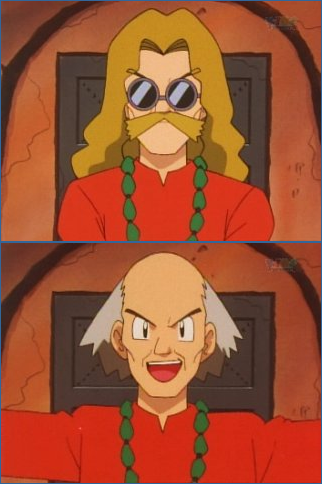
 "Oh, the... the wig is a disguise?  We, uh... we thought you were just bald..."

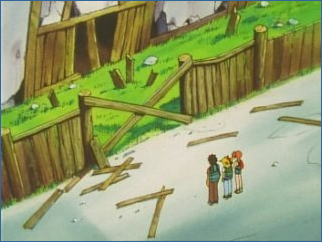
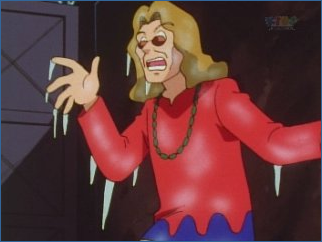
Pikachu survives, of course, clinging to the edge of the arena platform with his back scorched by the Fire Blast.  At Brock’s urging, Ash surrenders to keep Pikachu safe.  Blaine approves of Ash’s choice, noting that “if [he] had been foolish enough to continue the match, [he] definitely would have been disqualified as a Pokémon trainer,” but seems reluctant to offer Ash any hope of a future rematch.  Ash and his friends return to the Big Riddle Inn, where Ash spends the next day musing on how he can overpower Blaine’s Magmar.  Meanwhile Team Rocket, being Team Rocket, decide to infiltrate the volcano, armed with freeze-blasters to defeat Magmar.  The blasters work… for about five seconds.  When Magmar melts his way free, Meowth panics and orders Jessie and James to freeze blast the whole magma chamber.  The rapid temperature change cracks the rock walls, and the melting ice creates a blast of steam that launches Team Rocket out of the magma chamber, leaving Ash, Misty, Brock and Blaine to deal with the rapidly destabilising volcano.  Blaine orders Magmar to start piling up boulders to patch the cracks and stem the lava flows, but he can’t do enough alone.  Ash calls on Charizard, who is sufficiently impressed by Magmar to help out.  Brock gets Onix and Geodude to help too, while Squirtle and Staryu keep everyone cool, and together they manage to prevent an eruption.  Magmar and Charizard give each other a smile, but are clearly eager to battle to test each other’s strength, and Blaine decides to allow Ash a rematch (many Gym Leaders would probably just give Ash a badge outright, but Blaine has high standards).  Charizard and Magmar are evenly matched as far as firepower goes, and Magmar eventually drags Charizard down into the lava pit to try and win an advantage, but Charizard breaks free, carries Magmar high into the air, and hurls him back down with a Seismic Toss.  Ash is overjoyed that Charizard is on his side again, but Charizard quickly puts an end to that delusion by Flamethrowering Ash in the face for interrupting his victory dance.  Ash collects his Volcano Badge from Blaine (the third and final Kanto badge he will earn by winning a legitimate battle) and wonders where to go for his final challenge.  Misty and Brock suggest returning to Viridian City, and the team sets off once more.

 "Ice, in a volcano?  That's freezer burn!" ...I'm not making that one up; he actually says that.

Can we just take a moment to appreciate the fact that Blaine burnt down his own Pokémon Gym, because he had better things to do with his time than battle tourists, and built a new one in the heart of a volcano?  The man is an incredible mad genius!  (Incidentally, if there is ever a live action Pokémon movie, I want Christopher Lloyd to play Blaine.)  Of course, because this is one of my Anime Time entries, and because my Anime Time entries are all about analysing a children’s cartoon to a far deeper extent than the creators ever imagined, let’s take this opportunity to expand my developing thesis on the role of Pokémon Gyms in society.

We’ve already seen with Sabrina and Koga that a Gym Leader’s responsibilities to the Pokémon League are extremely hazily defined and probably impossible to enforce.  Blaine’s case makes me wonder whether he’s answerable to anyone at all.  Gary Oak claims that there hasn’t been a Pokémon Gym on Cinnabar Island “since [his] grandfather’s days as a trainer,” which is probably an exaggeration since I doubt Blaine is much older than Professor Oak, but it’s clear that the Cinnabar Gym has been out of the public eye for years, if not decades.  Blaine’s Volcano Badge is still recognised as legitimate by the Pokémon League, though, and no-one calls Ash out for trying to qualify with a Badge from a Gym that closed before he was born.  Nor has anyone attempted to set up a new Cinnabar Gym in Blaine’s absence.  The innkeeper of the Big Riddle is also the first person to get a call when the Cinnabar Lab is attacked by Team Rocket.  Clearly enough people are in on Blaine’s secret that he can continue to act as Cinnabar’s official Gym Leader, no questions asked, but not so many that his activities can become more than a vague rumour.  This isn’t quite as strange as Koga’s situation; Blaine’s presence almost certainly does benefit Cinnabar Island during emergencies.  However, it seems like taking challenges – which, in theory, is an official Gym’s primary role – is a relatively minor part of Blaine’s life.  He appears extremely disdainful of weak challengers; we know that he closed the original Cinnabar Gym because he was tired of battling tourists, and unlike Brock, Lt. Surge, and even Sabrina, he is extremely reticent to offer Ash a rematch until Ash has helped him prevent a disaster.  Blaine battles whom he wants, when he wants, probably handing out fewer Badges than any other Kanto Gym Leader, and it’s possible that the only people he ever invites to battle him are trainers he’s vetted personally using his innkeeper persona.  At the beginning of Riddle Me This, it’s Blaine who chooses to speak to Ash – I suspect he’s checking him out, even then, evaluating his worth as a challenger.

 This shot has nothing to do with the plot whatsoever.  I just think it's hilarious.

The Pokémon League, evidently, doesn’t care.  The fact that Blaine even bothered to build a new Gym implies that he does take challenges from time to time; Ash can’t be the first person ever to present a Volcano Badge to the Indigo Plateau, so someone at the top must know about him, and whoever does know is apparently totally happy with one of Kanto’s official Pokémon Gyms being a hidden volcanic death-trap that is closed to the public except by special invitation.  Blaine hates tourists and refuses to battle any, but surely any visiting trainer is by definition a ‘tourist,’ and surely his job is to battle all comers?  Even most islanders don’t know about the Gym, so he isn’t helping to educate local trainers either, but surely that’s part of his job too?  If Blaine gets any sort of League funding, he doesn’t seem to be earning it, but that secret volcano base wouldn’t have paid for itself (I suppose he could have claimed insurance on the original Gym, but it seems to be common knowledge that Blaine himself burned the place down, so I sort of doubt it).  Either Blaine is independently a millionaire (unlikely) or he receives some sort of no-strings-attached grant from the Pokémon League just for being an official Gym Leader.  The Dark City episode shows that there is a fair amount of League oversight in the process of establishing an official Gym.  However, I suspect that once a Gym has that magic League authorisation, it’s not all that easy to revoke it (if nothing else, it would be difficult to deal with trainers who’d defeated the Gym in question).  I would further speculate that, when the Pokémon League was originally formed, the first Gym Leaders were all those trainers who were so powerful that their opinions and philosophies couldn’t be ignored – the League began, essentially, as a partnership between them.  Although the organisation has undoubtedly evolved since then, its core institutions have probably not changed all that radically – so, if my current train of thought is accurate, when Blaine became a Gym Leader he may have gained the right to access and allocate a small but significant portion of the Indigo League’s resources and income at his own discretion.  Depending on exactly how we imagine that Pokémon training, as a discipline, is viewed, this right may well be inalienable – to use a real-world analogy, you can fire a professor, but revoking his PhD isn’t so straightforward; perhaps ‘Gym Leader’ is simply something that Blaine is, whether the League likes it or not.

I realise I’m beginning to make stuff up now, but I simply can’t leave Blaine’s autonomy unexplained.  He does hardly anything a Gym Leader is expected to do, yet he is inexplicably still a Gym Leader.  Much as for Koga and Sabrina, I have to assume there is some way of accounting for this.  I cannot presume to know whether I’m right, but hopefully my theories are, at least, entertaining.

What, what the hell? “Please note: none of the art on this blog is mine, because my art is banned in most nations ever since an unfortunate study linked it to psychopathy in minors.” What is this?

A joke.  If you take everything I say seriously, you’re liable to end up lost in a twisted nightmare world, where your only companions will be the ghosts of anger and sorrow, and your only escape the sweet eternity of death.

(This, incidentally, may or may not be a joke; I refuse to accept responsibility for your fate)

The Pokémon Power Bracket – Round 2b

I can’t believe Phione got voted out!  This is SO UNFAIR!

Hmph.  Whatever.  I suppose I’d better make the best of it…

Deoxys vs. Mew


Mew and Deoxys both have interesting implications for the question of what a ‘Pokémon’ actually is, which contradict each other in places…

Mew is – and always has been – held up as the ancestor of all Pokémon (or, if you accept my interpretation, the ancestor of all Pokémon except the ones who feature in the Sinnoh creation myth).  This theory is based on the belief that “[Mew’s] DNA is said to contain the genetic codes of all Pokémon,” which is not how genetics and evolution work.  Like, at all Evolution is ‘descent with modification’ – that is, organisms gain new features that are distinct from those of their ancestors.  As you follow the family tree backwards, you should start seeing Pokémon that have fewer and fewer of those distinguishing traits, becoming more and more similar, until you’re left with the basic genes common to all Pokémon, where we should expect to find Mew.  I can think of two ways Mew could possibly have anything like a complete genetic library of all Pokémon: either she is not their common ancestor but their common descendent, the end result of millions of years of crossbreeding between formerly distinct Pokémon species (which probably requires us to assume that she is from the future), or she was the seed from which Arceus intended all the extant species of Pokémon to spring, and was given all the necessary genetic material in advance (which I suppose finally answers that question: no, Pokémon don’t ‘evolve’ in the traditional sense; every species was planned from the start and programmed into Mew’s DNA).  I’m pretty sure neither of these is actually what Mew’s designers had in mind.

Then, of course, we get Deoxys, who is a shapeshifting psychic virus from outer space, and blithely turns the whole thing on its head.

Deoxys resulted from a mutation in a virus from space that was struck by a laser beam, which… well, okay, first of all, that is not how mutation works either, but there’s something else I’m much more interested in.  Deoxys demonstrably is not descended from Mew.  It is more closely related to the common cold than it is to Pikachu.  It’s debateable whether viruses are technically even ‘living things’ at all (to my knowledge, viruses do not respire); Deoxys clearly seems to have moved beyond that, but it must deserve, at the very least, its own taxonomic domain.  So why, in the name of all that is good and holy, is it considered a Pokémon?  Any traits it has in common with other Pokémon are plainly coincidental and not the result of shared descent, so calling Deoxys a Pokémon makes no more sense than calling a hornet a bird simply because it happens to fly.  The only objective defining factor I can think of is that Deoxys, like all other Pokémon, can be captured in a Pokéball… so is that what makes it a Pokémon?  The way it happens to interact with a particular piece of human technology?  That seems like a rather arbitrary definition.  Then again, perhaps I’m going about this the wrong way… what I’ve been saying about Mew seems to suggest a radically different set of founding principles for evolution in the Pokémon universe, so…

…phylogenetics…Jean-Baptiste Lamarck…finches and fruit flies…Archaea, Bacteria, Eukarya…William bloody Paley’s watch…

…mmm?  What?

Vote?

CAN’T YOU SEE I HAVE FAR MORE IMPORTANT THINGS ON MY MIND?!

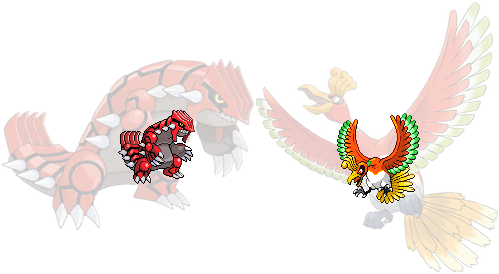
Ho-oh vs. Groudon
 

I am running out of things to complain about.

Let’s recall my last words on these two.  Ho-oh I like because she’s one of the only unambiguously benevolent legendary Pokémon, which I think is a necessary role one of them should fill, and also because of her part in the origin story of the Johto beast trio, which is one of my favourite Pokémon legends because – in my opinion, anyway – it doesn’t get too crazy, like the Sinnoh stories where Dialga and Palkia’s souls are tied to the physical properties of the universe itself, but there’s an actual story to it, unlike for Articuno, Zapdos, and Moltres, who are just really mysterious and enigmatic.  Honestly, of all the legendary Pokémon remaining in the top 16, I think Ho-oh is the one who comes closest to getting that balance right (if you’re interested, I also think that Thundurus, Tornadus and Landorus, who aren’t in this tournament, do quite well).  The only real downside to Ho-oh, for me, is that she gets a little bit one-dimensional with the life-light-and-happiness theme.  This, actually, is one point on which I think Groudon and Kyogre are relatively strong; when we meet them in Ruby and Sapphire, we experience their full potential for destruction, but – as their Pokédex entries very deliberately point out, and as Team Aqua and Team Magma never stop telling us – they have tremendous creative potential as well.  Groudon, for instance, is remembered in myth for saving people from catastrophic floods, and, of course, humanity could not have come to exist in the Pokémon world without the creator of the continents.  Groudon’s dual characterisation helps to hammer home the essential message of the plot of Ruby and Sapphire: that ‘nature’ isn’t a single force but a complex balance of conflicting impulses held in a delicate equilibrium, each of which can be beneficial in its proper place, but harmful when thrown out of balance.  This is all great stuff, and it’s the reason I do like Kyogre and Groudon.  Their weakness in my eyes is their position on the slippery slope that led to capturing the creator of the universe in a tiny plastic ball.  Groudon and Kyogre escalated the events of the plot of Ruby and Sapphire to near-apocalyptic proportions, threatening to parch or drown the whole world, respectively.  Try as I may, I cannot accept that it makes sense for a ten-year-old kid to be in control of this kind of power.  Ho-oh and Lugia straddle the boundary a little – Lugia can create storms that last for weeks, and Ho-oh raised the dead (once) – but building and sinking continents is something else entirely.  The closest I can get to making sense of any of this is through a statement Cyrus makes in Diamond and Pearl, which seems to imply that legendary Pokémon captured in Pokéballs lose many of the more cosmic aspects of their power.  Why?  We don’t know.  What effect does this have on the delicate balance between the earth and the sea?  We sure as hell don’t care!

My vote goes to HO-OH!

Latias vs. Lugia


I like Latias.  I do.  I really, honestly do.

I just don’t think there’s anything ‘legendary’ about her at all.

When I covered Latios, I mentioned a list of the characteristics he and his sister share that don’t, in themselves, imply or necessitate ‘legendary’ status, so I won’t do that again.  I’ll just point out that they are explicitly herd animals, which seems at odds with both the norm for legendary Pokémon (who are solitary and often implied to be unique, although for some this is contentious) and their own portrayal in Ruby, Sapphire and Emerald, where a single Latias or Latios wanders Hoenn alone.  No explanation has yet been offered for the fact that these social Pokémon are only ever encountered alone, and I doubt one ever will be.  Against this, Latias has a number of interesting powers, including the ability to render herself invisible by bending light, as well as an odd but inventive physical design.  Add just a little bit of detail about the relationship between Latias and Latios, who are imagined to be females and males of the same species, and I think you’d have a really excellent design… it’s just not a design for a legendary Pokémon.  Lugia, of course, is as legendary as you get.  Rumour and folktale connects Lugia with the terrible storms that are created by the flapping of his great wings, so it’s odd that dragging Lugia up from beneath the Whirl Islands doesn’t cause the same kind of catastrophe as awakening Kyogre does in Sapphire.  It’s easier to accept, though, for two reasons; first, no-one has ever claimed Lugia can actually sink continents; second, we never actually see Lugia cause storms of the magnitude we hear about, which makes it easier to chalk it up to exaggeration in the stories (we experience Kyogre and Groudon’s powers firsthand, and all the characters involved with that part of the story take the myths absolutely seriously; there’s much less room for interpretation).  Lugia does begin to slide in the direction of ‘this Pokémon is a cosmic lynchpin which MUST NOT BE CAPTURED UNDER ANY CIRCUMSTANCES’ in the Power of One, where his role is actually to calm and contain storms, as in his Pokédex entry for Crystal version.  My eventual conclusion has been that Lugia’s actual ecological role is a bit more complicated than we’re told and probably involves both causing storms and quieting them to manage the development of ocean ecosystems in his territory, and that although he certainly could cause one of those mythic forty-day storms we’ve heard about if he really wanted to, it would take a lot more exertion than simply flapping his wings.  I’m worried that I may be getting to the point where I’m judging my interpretation of Lugia more so than what we’re actually shown, simply because what we’re shown isn’t totally consistent.  However, my issues with Latias stand, so I’m fairly comfortable siding with him against her.

My vote goes to LUGIA!

Rayquaza vs. Palkia


Everyone remembers, from the last round, why I think both of these Pokémon were terrible mistakes?

Yes?

Good.

So, my issues with Rayquaza, in and of himself, are not all that great compared to those I have with Groudon and Kyogre.  Kyogre has the power to flood continents.  Groudon has the power to dry oceans.  Rayquaza has the power to make both of them shut the hell up.  He is as mysterious and powerful as any legendary Pokémon should be, but as far as cosmic ridiculousness goes, he’s fairly low-key – his special relationship with Kyogre and Groudon is pretty much it; he doesn’t have the ability to reverse gravity or turn forests into ozone or anything.  My problem with Rayquaza is solely in the way he figures into the plot of Emerald version, where he reduces the player’s role in the climax to an extremely simple fetch-and-carry assignment, which I shall here dramatise for your enjoyment.

Wallace: “Where the hell is Rayquaza?”

Player: “I don’t f*cking know!”

Wallace: “Of course; that must be it!  Now go get Rayquaza!”

Player: “Oh, hey; that was easy.”

Rayquaza: “LOLZ GO BAK 2 SLP GAIZ”

Kyogre and Groudon: “kk lol”

Rayquaza: “kthxbai”

The anticlimax is much the worse for the fact that, up until this point, Emerald is so much better-done than Ruby and Sapphire in many ways.  So, that’s what’s wrong with Rayquaza.  Now let’s talk about what’s wrong with Palkia.  This, of course, is the old “I just captured a god!” chestnut.  Supposedly, catching Palkia (or Dialga, for that matter) in a Pokéball will somehow cut her off from her cosmic powers to some extent, which is the reason Cyrus creates the Red Chain on Pearl version instead of just capturing Palkia with his Master Ball.  This explains why you can’t subsequently use Palkia to destroy the universe, like Cyrus wanted to, although there’s no word on the long-term effects (Palkia is supposedly responsible for the stability of space, so I’m not entirely sure capturing her is really the best idea if it will weaken her powers…).  Moreover, no-one ever hints at how a Pokéball can do this.  Even if the explanation raises as many questions as it answers, though, I am glad they at least tried to handwave it, since we can retroactively apply the same vague rationalisation to Kyogre and Groudon, and probably stick it onto Arceus too, for all the good it will do him.  Back to Palkia herself, because there’s one more thing I had a conversation about with a reader a few days ago and I think it deserves a mention: her element.  When I first met Palkia, I thought Water was a pretty weird element to give her, but when I think about it, ‘space’ isn’t exactly an easy concept to squish into an element.  I remain convinced that Dark does not fit, since Dark Pokémon are almost universally associated not with actual darkness but with treachery, malice and fear.  Short of jamming both her and Dialga into Psychic, on the grounds that Psychic covers everything weird, I think Water probably is the best choice to represent a vast emptiness… so, yay Palkia?

Anyhow, Palkia bothers me, but she hasn’t offended me as directly as Rayquaza has, so purely out of spite towards Rayquaza…

My vote goes to PALKIA!