Anime Time: Episodes 55-57

Pokémon Paparazzi – The Ultimate Test – The Breeding Centre Secret

Ash’s location: Belarus.

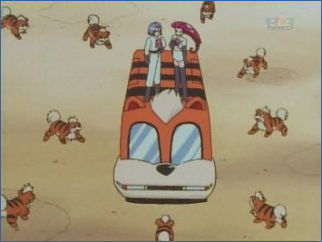
These episodes happened.  They were a thing.  Let’s talk about them.Looks like we've got a badass here, guys.  Screenshots from filb.de/anime.
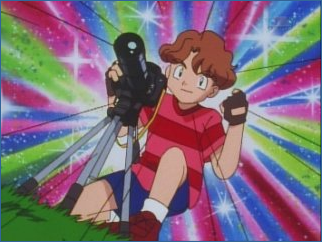
One day, as the kids are eating, Ash glimpses what he takes for a rifle scope poking out of some nearby grass.  Thinking quickly, he knocks Misty and Brock down and summons Squirtle to flush out the gunman… who turns out to be just an egotistic young photographer named Todd.  Todd quickly gets over the misunderstanding and invites everyone back to his cottage for pancakes.  He tries to get some shots of Pikachu eating, but Pikachu gets nervous and fries him.  He explains that he refuses to take pictures of Pokémon posing, since his art is to capture a Pokémon’s natural image – and, far more strangely, is only interested in Ash’s camera-shy Pikachu.  When the group leaves, Todd follows stealthily, but Ash playfully springs into all of his shots, and complains that Todd is being disrespectful to Pikachu’s feelings.  He persists, since he was hired to ‘capture’ Pikachu by a tearful old couple, figuring they must have once owned a Pikachu themselves.  When Ash and the others fall into a pitfall trap (courtesy of the ‘old couple’), Todd notices that Pikachu and Ash are positioned perfectly for a photo… until the bottom of the pit crumbles and Ash falls into an old aqueduct pipe.  Todd leaps in after him and gets Ash to grab the end of his tripod before he is swept away, soaking the camera (so he has learnt A Valuable Lesson).  Team Rocket appear and start lobbing grenades as Ash dangles over a sheer drop, but Ash twists the camera around to get them to pose, and James forgets to throw the grenade in his hand.  Once Ash is rescued, Todd sets up his (spare?) camera to take a photo of himself with his new friends, but trips as he dashes to join the picture, bowling the others over and ending up with a naturalistic, unplanned scene of laughter.  Todd joins the team briefly after this, and will be with us for the rest of the entry.
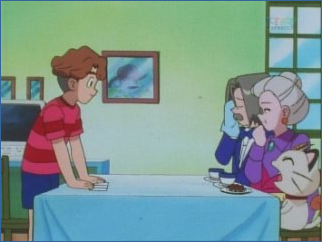
Seems legit.I couldn’t care less about this episode, and I couldn’t care less about Todd, who is a transparent tie-in to the photography game in which he stars, Pokémon Snap, though I suppose his insistence on photographing Pokémon as they appear in nature, which the episode presents in a positive light, is at least a fairly admirable way for someone in his position to do business.  If there’s anything about this episode that interests me, it’s Pikachu’s reluctance to be photographed, which none of the other Pokémon Todd is offered seem to share.  Pikachu has never before, in my recollection, been shown to be particularly shy or self-conscious; in fact, aside from his initial rocky start with Ash, he’s generally very friendly.  Then again, he’s never been the subject of a photographic study before, and he may find Todd’s somewhat obsessive manner off-putting.  Ash’s irritation at Todd for not respecting Pikachu’s wishes is, of course, entirely in-character.

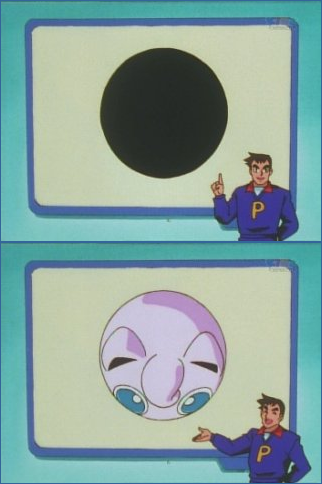
In the Ultimate Test, Misty makes a suggestion to Ash: “you haven’t gotten a badge in a long time… maybe you should make another Gym Leader feel sorry for you.”  Ash furiously challenges her to a battle but Todd interrupts to suggest that Ash try taking the Pokémon League entrance exam, and conducts them to a testing centre where he can sit it.  Also at the centre are Nurse Joy #84, and a disguised Jessie and James.  Joy tells the kids a bit more about the test: it’s an alternative way to earn membership in the Pokémon League, which is great for people who are too old, sick or busy to travel between towns for badges.  The first two sections of the exam are theoretical: one section of true-or-false questions, another of pictures and silhouettes to identify (how can anyone tell the silhouette of a Jigglypuff, seen from above, from that of a Voltorb?).  Ash manages to come third-to-last, out of more than five hundred candidates, ahead of only James and Jessie (who is disqualified for insulting the examiner).  The third section is a three-on-three battle against the examiner, using only rental Pokémon.  Ash gets off to a good start, defeating the examiner’s Flareon with a Weezing, but his Arbok tries to Wrap a Jolteon and gets filled with spikes for her trouble, and his Meowth is frozen solid by a Vaporeon.  James, meanwhile, tries to take down a Graveler with a Pikachu’s Thunderbolt, and is then disqualified for calling out both his remaining Pokémon (an Ivysaur and a Charizard) at once.  He refuses to return the rental Pokémon, but the examiner commands the Pokémon to turn on Jessie and James, and Ash finishes them off with his Weezing’s Explosion.  Team Rocket’s presence has apparently invalidated the whole exam, and Ash is offered a chance to retake it, but can’t be bothered.
He even laughs at them.  Oh, how I loathe him.

This is one of those episodes that really start me thinking.  It gets me thinking because it offers a way to bypass the eight Gym battles normally necessary to become a member of the Pokémon League and compete in the Indigo tournament – in other words, to bypass what is normally the point of a good chunk of each game.  There is nothing in the exam that even requires you to own Pokémon at all.  Joy mentions that the exam provides a way for those hampered by age, sickness or full-time employment to join the League, but there isn’t necessarily anything that prevents someone in such a position from owning or training Pokémon – only from travelling to collect badges.  In fact, the exam is very deliberately set up to strip trainers with powerful Pokémon of any advantage they might have, by forcing them to use rental Pokémon only.  The implication seems to be that the exam is meant to invite people who aren’t Pokémon trainers at all to become members of the Pokémon League.  This in turn implies that the League isn’t purely a sporting organisation, that it has reasons for wanting to attract hobbyists, academics, and specialists to its ranks, and that there are benefits to membership beyond simply being able to enter tournaments (just about any random ten-year-old can become a trainer, so it stands to reason that there are some restrictions on non-members… one hopes).  Membership in the League may be the first step to finding employment with them, or a beneficial addition to one’s credentials in searching for other jobs (heaven knows, anyone seeking to enter the Pokémon healthcare profession would need one heck of a resume to break the Joy family’s iron grip on all the senior positions).  What I mean to suggest is that the Pokémon League is responsible for general Pokémon-related affairs in Kanto, not just the practice of competitive battle, and therefore benefits by having a roster of sanctioned experts in fields such as Pokémon breeding, human-Pokémon relations, and Pokémon ecology, upon whom it can call for consultation, and who in turn benefit from enfranchisement.  Pokémon trainers likely make up the bulk of the League’s membership – after all, the entrance exam is implied to be extremely challenging, and Ash scores dismally despite his generally decent knowledge of Pokémon, so it is by no means an easy way in, as Jessie and James seem to think – but it seems clear that other people with quite different interests in Pokémon are a significant minority.
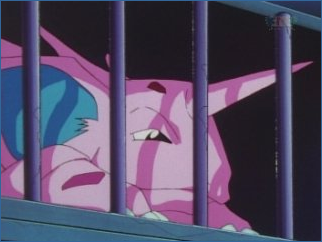
Making animals live in cages is bad, mmmkay?As they continue their journey through a small city, the kids see an advertisement for a breeding centre that claims to be able to evolve Pokémon.  Todd says that centres like this are the newest big thing, so Ash decides to check it out.  The woman working the front desk gives a ludicrous spiel about “Pokémon love power!  Love love love!” but people seem to be getting results, so Misty decides to leave Psyduck there to see if they can’t knock some sense into him.  Soon afterward, the kids meet a restaurant owner who’ll give a free meal to anyone who can show him his favourite Pokémon… Psyduck.  Misty decides to double back to the breeding centre and, finding it closed, the kids slip in the back door.  All the Pokémon, including Psyduck, are caged in a dark room.  As Todd starts taking pictures to document what’s happening, the kids overhear the centre’s owners in the next room gloating over their plan to steal all these Pokémon.  As Misty attempts to free Psyduck, Jessie and James arrive to steal some Pokémon themselves, and the ensuing argument attracts the attention of the owners, Butch and Cassidy, Jessie and James’ hyper-competent rivals with far higher standing in Team Rocket.  The duos start quarrelling, and the kids slip away, but the centre’s security system cages everyone except for Misty, Pikachu and Togepi.  Jessie and James are caught as well trying to retrieve a Victreebel, which supposedly belongs to James… even though we’ve never seen it before… and it promptly begins a long-running gag by trying to eat its trainer…  Anyway.  Butch and Cassidy call the police, and Officer Jenny #319 arrests everyone.  Misty, however, returns the next day in disguise and distracts Cassidy so Pikachu can slip inside and grab Todd’s camera, which she uses to prove Butch and Cassidy’s guilt.  The breeding centre is shut down and the kids all go to the restaurant for their free lunch.  Finally, Todd leaves the group to go climb some mountains, but not before finally pointing Ash in the direction of Cinnabar Island.
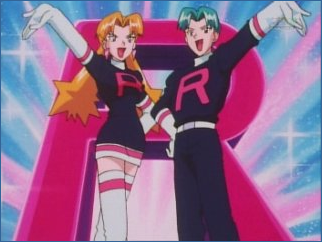
"To infect the world with devastation!" "To blight all peoples in every nation!" "To denounce the goodness of truth and love!" "To extend our wrath to the stars above!" "Cassidy!" "Butch!" "Team Rocket, circling Earth all day and night!" "Surrender to us now, or you'll surely lose the fight!"

There’s no single theme I really want to draw attention to in this episode, but there are a couple of little points, so I’ll comment on each.  The breeding centre, first of all, is interesting.  How do Butch and Cassidy actually run this place without being caught?  They could probably delay people who asked for their Pokémon back, possibly for days, but eventually someone would surely grow suspicious.  We do see them handing Pokémon back to trainers, so obviously they don’t steal everything.  The centre is marketed towards people who are too busy to exercise and pamper their Pokémon, so it’s possible they target people who could go for weeks before getting concerned.  When that happens, they claim to have lost the paperwork… and only once several people are seriously annoyed do they pack up and vanish with all the Pokémon.  It seems possible that some amateur trainers might neglect their Pokémon to an extent if they think the breeding centre is taking care of things; indeed, when Misty first decides to leave Psyduck in the breeding centre, Ash suggests that she’s just trying to ditch him.  Misty, interestingly, insists that she caught Psyduck and she’s going to stick with him; she just wants to see if the breeding centre can accomplish anything with him in a couple of days.  This is interesting because – remember – Misty didn’t catch Psyduck at all.  He just… kinda climbed into her empty Pokéball.  Despite this, and although she doesn’t really like him very much, Misty apparently does feel responsible for Psyduck.  For better or worse, he came to her and she is his trainer, and that is just the world she lives in and has to accept, which I think is an interesting perspective and testifies, if nothing else, to Misty’s stubbornness.  Finally, Butch and Cassidy.  I like these two.  Unlike Jessie and James, they’re actually credible villains, and generally presented as coming near to success with their fairly intelligent plans.  In that, they fulfil the same dramatic function that Jessie and James would, much later, come to fill in their scarily competent Unova incarnations (and, similarly, they don’t appear all that often; overexposure would make their defeats stand out a little too much).  I think I may bring them up again in the Viridian Gym episode, but for now, I’d just like to point out their importance in demonstrating that Team Rocket as a whole is in fact a very real danger.

So, yeah.  These episodes happened.  They were a thing.  That is all.

Class dismissed.

If you could add an 18th type to the type listings what would it be and what would its strengths/weaknesses be? Would any previous Pokemon become this type? Would it be defensive/offensive/physical/special/fast ect.?

I think the better question is “would I do it at all”?

There are a lot of things I’d change about Pokémon, given the chance, including rebalancing the weaknesses and resistances of the existing types, but I don’t really see the need for a completely new one; I struggle to think of any concept that couldn’t be adequately expressed by one of the existing seventeen, or a combination.  Moreover, when Dark and Steel were added, there were only 151 existing Pokémon – now there are 649.  I wouldn’t want to add a new element without also committing myself to creating upwards of 35 Pokémon with that element in a single generation, and probably adding it to at least a dozen existing Pokémon.  From a purely practical standpoint, that would be a nightmare.

Still, you did ask…

After Dark was added, a lot of people started clamouring for a ‘Light’ or ‘Holy’ type, and I suppose I could go along with that. If so, I would want to use it as a balancing mechanism, so resistance to Dragon attacks would definitely be on the cards, as well as weaknesses to Poison and possibly Psychic attacks.  Resistance to Ghost attacks is sort of necessary for thematic reasons, but Ghost is already one of the weaker offensive types, so I’d really have to give Ghost an extra strength or two somewhere else to make up for it.  I think I would make Light and Dark super-effective against each other.  As for old Pokémon with this type… well, Volbeat and Illumise would be good candidates for Bug/Light, but no-one cares about Volbeat and Illumise.  Cresselia would definitely get it.  You could probably get away with slapping it on Clefable and maybe Arcanine.  Togekiss would probably get this in place of Normal.  It could potentially replace either of Jirachi’s types.  Sunflora would be an obvious candidate.  I’m really tempted by Dark/Light for Absol, but I’m not sure you could get away with it; maybe for an evolution.    Electric/Light might work for Luxray.  I can’t really think of any fifth-generation Pokémon it would work for, aside from maybe Cryogonal, at a stretch.

I will emphasise again that I would actually prefer not to add a new element, but if Game Freak showed up on my doorstep and told me “we want you to be team leader on the next Pokémon game, on the condition that you let us have an eighteenth type,” that’s more or less how I’d handle it.

I’m just wondering, are you ever going to do a “Top Ten Most Overrated Pokemon” list?

Hrm…

Tricky.

What would I base that on?  Pokémon that get a lot of attention for being powerful, but have flawed or uninteresting designs?  Pokémon that Nintendo dote on even though they’re weak?

The tricky thing about “overrated” is that it implies there is some sort of rating for me to evaluate.  I don’t really think I could do this without some source of data on the popularity of different Pokémon.

Seeing as these gaming companies are sheer and utter fools, due to the line of classic RPGs becoming MMO (Final Fantasy, Dragon Quest and even Shin Megami Tensei), what is the likely hood of Game Freak making Pokemon an official MMO and how badly/ well do you think it will do?

Well, I don’t know much about business or marketing, or about the games you mention.  I do know that Pokémon is one of the big items for Nintendo’s portable consoles, and I also doubt that those consoles will be able to support an MMORPG any time soon.  So, assuming Nintendo want to go on selling consoles, I don’t think that will happen for the foreseeable future, no.

As for how it would do… well, you should probably ask a marketer or entrepreneur; such things are beyond me.  I imagine anything with “Pokémon” on the label would sell reasonably well.

Interlude: The Pokémon Power Bracket – Round 2a

Unsurprisingly, the internet has failed to take my advice and tossed Mesprit, Raikou and Jirachi.  There is still hope for my other picks, though, so let’s talk about the next round…

Arceus vs. Celebi


Okay, so, anyone who’s been paying attention will know that this part of the entry is a total sham anyway because I have an irrational vendetta against Arceus, but let’s pretend for a moment that I’m not horribly biased and talk about these two.

Arceus is a creator god.  To say otherwise is to argue semantics.  I don’t think Game Freak ever actually use the word “god” of Arceus, and everything they tell us is couched in “it is said that” and “described in mythology.”  However, we do know from direct observation that Arceus can create complex life from nothing and imbue it with the power to rewrite the universe.  This goes well beyond just “Pokémon are wondrous creatures from whom we have much to learn.”  The problem is that Game Freak seem to hold two conceptions of Arceus simultaneously – as they do for most other legendary Pokémon, actually, but it’s most blatant for Arceus.  There’s the mythical Arceus, who created Dialga, Palkia and Giratina in the void to bind space, time and antimatter, shaped the world with his thousand arms, and brought about the birth of life and the soul.   There’s also the mundane Arceus, who is a Pokémon like any other, was born and will die, and is exceptionally rare and powerful but can be caught, befriended and trained.  This latter Arceus – or a member of his species – may in ancient times have accomplished some fantastic achievement that inspired an early version of the creation myth, but he’s not actually the creator.  When we capture Arceus and use him in battle, we’re clearly meant to have the mundane Arceus in mind.  The problem is that Game Freak shove the mythical Arceus in our faces at every opportunity and readily provide us with apparently solid proof of his existence, while repeatedly failing to provide similar evidence for a mundane Arceus.

Celebi, by contrast, has done nothing more heinous than introduce the possibility of time travel into the franchise.  I must emphasise that I think this was a bad idea, but at least Celebi has the grace to keep it low-key, unlike “now I shall unravel the universe” Dialga.  Celebi’s role is to “watch over the forest from across time,” which I take to mean that she moves back and forth, always appearing in the right place at the right time to ensure that there have always been and will always be enough forests in the world to provide habitats for forest Pokémon and keep the earth’s climate in balance.  Believe it or not, despite this potentially enormous power and this possibly vital role, she’s one of the legendary Pokémon who won’t give me too much of a headache at all if you capture her.  She’ll just wait for you to die and then get back to what she was doing.  She won’t even be upset about all those years spent waiting.  She’s a time traveller; she’s not exactly in a rush.  She’ll also let you believe that she can’t take anyone with her on her little time jaunts.  Celebi is thus, surprisingly, one of the few legendary Pokémon who actually make total sense.

Can anyone say “forgone conclusion”?

My vote goes to CELEBI!

Kyogre vs. Darkrai


I’ve been trying for a while now to pin down what it is that I like about Kyogre, and I think I have it.  Kyogre – like Lugia, actually – evokes one of the most mysterious parts of the known world, the deep ocean, and the fact that something like this could actually be down there and we wouldn’t know it.  I mean, it seems very unlikely from a modern scientific standpoint, but a) most people are not modern scientists and b) it has been said, with a fair degree of justification, that we know more about the surface of the moon than we do about the deepest parts of the ocean.  It’s a dark, forbidding, mysterious, wonderful place and you could hide some pretty massive things down there (as evidenced by our painful lack of detailed ecological data on giant squid) – Kyogre isn’t actually all that big, but he’s big compared to most Pokémon, and gives an impression of size because of his whale-like design.  In short, Kyogre taps into a series of ideas and emotions that have held humanity spellbound since ancient times, and captivates us (or… well, me, anyway) in a way Groudon can never match.  Darkrai evokes a similar place: the world of nightmares, a place most of us visit but few can remember in detail, where we are most often powerless against the whims of our own subconscious minds.  Darkrai, fittingly enough, takes the shape of a spectre, vague and insubstantial, like a shadow in a dream.  However, I take issue with Darkrai’s characterisation.  According to the games, Darkrai’s nightmare powers are just a means of self-defence, meant to chase people and Pokémon away from his territory, and he actually hides himself away from others to protect them from his power.  Now, this type of characterisation – the misunderstood noble pariah who is hated and feared by those he tries to protect – is fun in itself, but I don’t think it was the best use of the concept.  First of all, I think Absol did it better.  Second, it doesn’t totally make sense: he has these powers to keep people out of his territory, and he needs to keep people out of his territory to protect them from his powers.  It’s like a bizarre, sadistic, evolutionary Catch-22.  I actually prefer the way Rise of Darkrai interpreted Darkrai’s nightmare powers – the horrific dreams he sends are actually visions of the future, sent to warn people – because that evokes all sorts of wonderful old ideas about the purpose of dreams and the fearful nature of prophecy (again, this is sort of Absol’s schtick, but Absol experiences the visions herself while Darkrai inflicts them on others).  The movie, of course, has problems of its own that I discussed in more depth a while ago.  For today, my point is that I think Darkrai would be more interesting and have more potential if he were morally ambiguous, and that Kyogre has enjoyed a more flattering interpretation of his concept.

My vote goes to KYOGRE!

Mewtwo vs. Latios


I hinted earlier that I have problems with Mewtwo.  Let’s talk about that, because there’s nothing I love more than complaining.  In truth I don’t hate Mewtwo, but I think that his backstory invokes another one of those awkward tensions I like to natter about: Mewtwo’s backstory belongs to that class of moralising tales that characterises scientists as hubristic ivory-tower academics who overreach themselves in their single-minded quest for knowledge and are destroyed by their own creations (you all know the story; Jurassic Park is one notable example).  This is all very well in itself.  It does rather clash with the overall portrayal of science in the Pokémon franchise, which almost universally presents it as wondrous and beneficial, particularly as the Pokémon world’s technology is, in general, more powerful than ours and has fewer side-effects and drawbacks (this is hardly surprising coming from a company that makes its money out of the proliferation of ever-improving technology).  This arguably provides opportunity for interesting conflicts, though.  What really irks me is the more specific clash with fossil resurrection, which works on essentially the same principles as the science that created Mewtwo but is consistently portrayed as cheap, easy, risk-free and not at all ethically contentious.  After all, it wouldn’t do to have the player forced to do anything shady to complete the Pokédex.  Fortunately for Mewtwo, Latios is not guilt-free either.

As I mentioned the last time Latios came up, against Jirachi, my issue with the Eon Twins is quite different, and one on which I’m aware there are many who would disagree with me.  I am of the opinion that legendary Pokémon should have legends, which add something to the background and general aesthetic of the whole Pokémon world.  I hold this opinion because legendary Pokémon (with many notable exceptions, though Latios is not one of them) simply enjoy massive advantages over most mortal Pokémon, with superior stats and often with powerful type combinations and excellent movepools (I am making the tacit assumption here that we want the game to be balanced, an assumption which I am aware is not self-evident and does not seem to be shared by the game’s designers).  In brief, I think that if legendary Pokémon are going to have these advantages, they need to justify them, and that if they are going to harm the game’s balance they should offset this harm by improving its background and lore.  Latios does not do this.  Latios’ characteristics are as follows: he understands human speech (most or all Pokémon implicitly do), he can outpace a jet (this quality is shared by a number of flying Pokémon), he can detect the presence of others through telepathy (a quality shared by a number of Psychic Pokémon), he dislikes fighting (so does Togepi), and he can create illusions.  This last characteristic is interesting and a perfectly valid concept to build a Psychic Pokémon around.  However, there is nothing in this list that requires ‘legendary’ status, ludicrous stats, Latios’ fundamentally obscene movepool, or the insanity that is the Soul Dew.

It’s funny, but the more I think about legendary Pokémon, the more they stick in my craw, so to speak.  My arguments in this match-up have been broadly analogous to those I made in my shorter “Mew vs. Heatran” passage, so I suppose I ought to follow the same rationale in casting my vote: a problematic story is better than none at all…

My vote goes to MEWTWO!

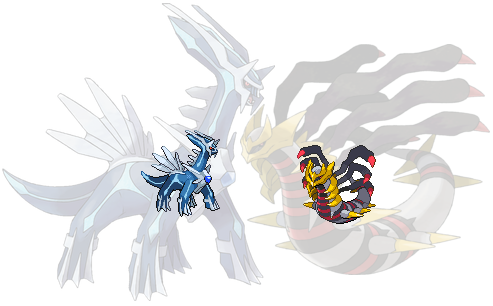
Dialga vs. Giratina


Up until now, I’ve been judging members of trios primarily by the characteristics of their trios, but Dialga and Giratina are both members of the same trio – the one that infamously raised Pokémon to the level of deities and forevermore rendered the setting’s cosmology utterly incomprehensible.  Nonetheless, I’m sure I can pick one of them to hate more.  Quite apart from simply giving us the opportunity to capture and command celestial beings, Dialga and Palkia draw attention to one of the more egregious rifts in Pokémon’s conception and style: it keeps thinking it can be science fiction.  Pokémon is not science fiction.  Pokémon barely passes as science fantasy.  This would not be a bad thing, except for the fact that it sometimes wants to be.  Thus, we get Pokémon who are described entirely through myth in order to create ambiguity about what they can actually do (see my complaints about Arceus) but have power over extremely abstract concepts like space and time – did “space becomes more stable with Palkia’s every breath” really come from the commonplace campfire stories of ancient Sinnoh?  I can in fact think of at least one ancient reference to time travel; Pythagoras – yes, the triangle guy – was said to have been able to move freely through time (I’m serious; it’s in a fragment of Aristotle), and many cultures have a mythic personification of time, so maybe this is more a problem for Palkia than Dialga.  I will bet my copies of the Iliad and the Odyssey, though, that no ancient civilisation ever had a mythic personification of antimatter, which is what Game Freak have told us Giratina is supposed to represent.  I don’t believe them; I think Giratina is the personification of death in the Pokémon universe and was quietly retconned when the designers began to wonder whether they’d gone too far.  I mean, really.  “It appears in an ancient cemetery”?  How about “it was banished for its violence”?  If Game Freak try to claim that isn’t a reference to the Devil, or some equivalent mythic being, I’m calling ‘Death of the Author’ on them.  What would make the most sense out of this, though, would be to claim that Giratina was viewed by the ancients as a personification of death.  This would make Giratina the only one of the trio to have a believable distinction between his mythic role and his actual powers, thus escaping (to a small extent, anyway) the trap that I spent Arceus’ section ranting about.  Like Dialga and Palkia, he still occupies a ridiculously high place in the setting’s cosmology and it makes little sense for anyone to be capturing him in a tiny ball, but I’d regard him as slightly better done (even if only by accident).  I also think Giratina has – and achieves – far better-defined aesthetic goals than Dialga; he’s meant to be creepy and he is, while Dialga looks like a robot space dinosaur and is meant to be… I don’t even know.

My vote goes to GIRATINA!

Anime Time: Episode 54

The Case of the K-9 Caper

Ash’s location: Rhode Island.

 The illustration on Growlithe's card from the Secret Wonders expansion of the TCG, by Kagemaru Himeno.

I can’t remember ever actually seeing this episode as a kid.  I was missing out; I really like this one.  It makes for a great opportunity to get back into one of my old favourite subjects, the ethics of Pokémon training, and to start asking new questions about whether the series considers Pokémon to be ethical agents in themselves, or merely instruments of their trainers.  Seriously, if I had my way this is what the whole series would be about.

Ash and company are innocently strolling through the woods when they hear the cry of “stop, thief!” and see a suspicious-looking man carrying a bag of loot fleeing pursuit.  Ash, not one to take this sort of thing lying down, commands Pikachu to stop him, but the more observant Pikachu has noticed that the man is carrying a handgun and, to Ash’s annoyance, refuses to attack… until a Growlithe bursts from the undergrowth and tackles the thief, causing him to drop his gun.  Pikachu merrily begins blasting away and brings him down, but the nine other Growlithe who arrive immediately afterward, led by Officer Jenny #40, don’t seem particularly happy.  It turns out that Ash and Pikachu have just interrupted a training exercise and assaulted a plainclothes police officer.  Whoops.  Jenny quickly gets over it once she realises it was an honest mistake, and invites Ash, Misty and Brock back to the police station for a hot meal.  This particular Jenny runs the academy that trains Kanto’s police dogs, specially drilled Pokémon capable of taking on humans with firearms at relatively low risk to themselves.  Jenny and Misty both admonish Ash for ordering Pikachu, who has no such special training, to attack an armed man, which annoys and offends him.  He asks for Jenny’s permission to enrol Pikachu in her training program so he can become stronger.  Jenny warns him that the training is difficult, but gladly allows it.  The next morning, she wakes Ash and Pikachu at 4am for a race against one of her Growlithe – and Ash and Jenny will be running too, because a trainer should never expect more of his Pokémon than of himself.  Ash and Pikachu are faster than Jenny and Growlithe, but are defeated by their obstacle course (which Jenny completes in her high heels).  While Ash and Pikachu recover, Brock tries to remind Ash that Pikachu is great even without special training.  Ash responds that he wants Pikachu to keep getting even better, though Pikachu himself doesn’t seem so sure anymore.

 You have to hand it to them... they've got style.  Screenshots from filb.de/anime.

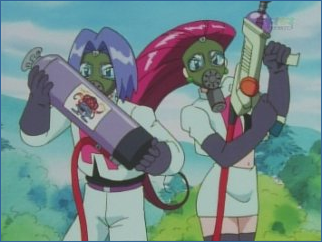
Then Team Rocket crash through the wall of the academy in the Mutt Cuts van from Dumb and Dumber, pull on some gas masks, and start blasting away at everyone with canisters of Gloom spores.

I really feel sorry for other anime shows that have to trudge through the bleak desolation of existence without Jessie and James to brighten their lives.

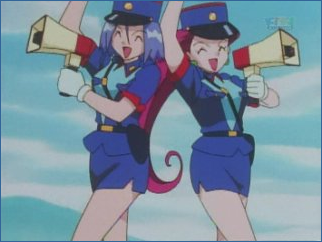
This week, Jessie, James and Meowth have gotten it into their heads that it would be a good idea to steal all of Jenny’s Growlithe and use them to commit crimes, because the irony is just too delicious to pass up.  Jenny insists that her Growlithe would never be party to Team Rocket’s criminal schemes, but Jessie and James seem unconcerned, and pull out more gas canisters – this time to dose everyone with helium.  Between the overpowering stench of the Gloom spores and the helium raising the pitch of her voice, the Growlithe can’t recognise Jenny’s scent or the sound of her voice, and stop responding to her commands.  Jessie and James then change into police uniforms, produce voice synthesisers and use Jenny’s own voice to command the Growlithe to arrest her, which they do, taking ropes in their mouths and tying her up.  Meanwhile, Ash, Brock and Misty have stupidly left their Pokéballs back in the station’s dormitory, so Pikachu is all they’ve got.  Jessie tries to command him too, using Ash’s voice, but Pikachu is not impressed; Brock claims that Pikachu knows Ash by what’s in his heart, and can’t be fooled by a cloud of foul-smelling gas and a voice synthesiser.  Pikachu unloads a Thunderbolt on the Growlithe, but there are just too many for him to handle on his own and he quickly runs out of power.  Jigglypuff appears, tries her song, finds that the helium renders her enchanting voice powerless, and wanders off again.  Finally, Jessie orders one of the Growlithe to attack Jenny, but as it bites down on her wrist, she looks into its eyes and invokes the Power of Friendship to remind it who she is.  Team Rocket try to command the others to deal with her, but their synthesisers choose this moment to malfunction, and the Growlithe turn on them and chase them away.  The episode ends with Jenny commending Ash and Pikachu on the strength of their partnership: “you two recognise what’s in each others’ hearts, and that’s what count.  I’ll try to keep that in mind.”  Also Brock uses one of the discarded voice synthesisers to deliver an incredibly creepy ode to himself in Jenny’s voice.  Because he is Brock.

 Lock and load, bitches.

Let’s talk about these Growlithe.  Jessie, James and Meowth have – for once – actually come up with a pretty damn solid plan for their daily mischief.  To a human, it seems ludicrous that a Growlithe could have trouble telling Jessie in a police uniform apart from Jenny – who is, after all, their trainer – but humans rely on sight a lot more than most animals do and consequently have unusually good vision compared to other mammals.  Most mammals – like dogs – compensate with their keener hearing and sense of smell, and this episode suggests that many Pokémon are much the same.  Once Team Rocket have deprived the Growlithe of their usual means of identifying their masters, they have only their sub-par vision to fall back on, and they are left following orders given in the voice they were trained to obey.  Then Pikachu comes in.  Pikachu isn’t fooled; although Ash sounds and smells nothing like himself, Pikachu can recognise his trainer anyway – not immediately, he has to think about it for a few seconds, but he gets there.  I suppose the obvious explanation is that Pikachu is simply much more intelligent than the Growlithe (an attribute that is sorely neglected in the games’ portrayal of many Pokémon).  He’s been paying attention to what’s going on, and although he doesn’t exactly understand what Team Rocket have been doing to confuse him, he knows they’re an underhanded lot and is on his guard for tricks.  As a result, he’s able to decide to ignore what his trainer’s voice is telling him and do what he figures makes sense, whereas the Growlithe latch onto a voice they know and follow its orders, even though Jenny has been standing right there the whole time and they should know who she is even if they can’t hear or smell her clearly.  What’s interesting is that the Growlithe eventually figure it out too – or, at least, one of them does – by staring into Jenny’s eyes and having a touching flashback montage of all their happy times together.  The obvious explanation – the Growlithe aren’t as intelligent as Pikachu – doesn’t quite seem to make sense anymore; the tone of the scene doesn’t fit with Growlithe suddenly putting together the information and figuring out that Jenny’s voice is being faked.  It’s a lot more consistent with Growlithe knowing who she is the whole time and only now wondering why he’s being ordered to attack her.

 These guys seriously never get old.  Wait; does James have breasts in this scene?

Pokémon follow orders; this we know.  The Growlithe, in particular, are probably being trained to follow orders from any police officer (or perhaps simply from any Jenny; there are non-Jenny police officers in this episode, but I get the impression that the Jennies are the ones who most often work with Pokémon), so they aren’t necessarily supposed to have the same deep personal relationship with their handlers as Pikachu does with Ash.  There’s a further point to this, though.  Jessie and James are both quite convinced that they will be able to order the Growlithe to commit robberies, and Jenny is equally convinced that the Growlithe would never do such a thing.  The story is structured so as to suggest to us that Jenny is actually wrong – her comment is immediately followed by Team Rocket successfully taking control of her Pokémon and ordering them to restrain her.  The difference between their views is that Jenny regards the Growlithe as moral agents in and of themselves, capable of understanding that certain actions are ‘wrong’ and refusing to take part in them, while Jessie and James think that they’ll be able to order the Growlithe to do just about anything once they establish themselves as authority figures (and I feel I should emphasise again that the structure of the episode immediately shoots Jenny down).  I’m reminded of Ekans’ dialogue in Island of the Giant Pokémon – “Pokémon not bad; Pokémon do bad things because Master bad” – which suggests that, although Ekans and Koffing are totally aware that they are aiding their trainers in committing morally repugnant acts and would never do such things on their own, this is trumped by the principle of loyalty to their masters.  The Growlithe – who have been taught to view anyone who knows how to command them as ‘master’ – would find themselves in just the same position if they were taken by Team Rocket.  When you think about it, this has to be the case in order for Team Rocket even to exist as an organisation: their modus operandi is to steal Pokémon for use in other crimes with more direct rewards.  This could hardly be practical if a significant number of stolen Pokémon were likely to rebel against trainers who committed crimes.  As Pikachu and Growlithe remind us, though, Pokémon are in fact capable of understanding that an action is ‘wrong.’  It’s much easier for Pikachu – probably because Ash places an unusual amount of emphasis on treating his Pokémon as friends and individuals – though even Growlithe, raised specifically to be part of a squad, can do it when ordered by a new ‘authority figure’ to attack an old one.

In short, Pokémon do understand human morality – it’s just that most of them are used to thinking that it doesn’t apply to them.  They simply don’t see themselves as moral agents – thinking about that stuff is their trainers’ job – unless they’re been strongly encouraged to, one way or another.  I think this is what Brock and Jenny are talking about when they say that Ash and Pikachu “understand what’s in each other’s hearts;” Pikachu recognises Ash not merely as his trainer, but as an objectively good person, and would continue to emulate Ash’s moral character even if they were somehow torn apart.  As she acknowledges at the end of the episode, Jenny and her Growlithe could stand to learn a lot here.

Anime Time: Episode 50

Who Gets to Keep Togepi?

Ash’s location: Sweden.

 Ash realises with a start that he doesn't know where he is any better than I do.  Screenshots from filb.de/anime.

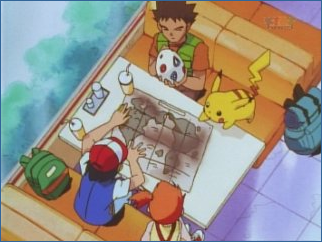
This episode gets an entry to itself not so much because I think it’s really interesting, more because it was sort of awkwardly left over after I blocked out all of the others for this chunk of the series, and I suppose it is a fairly important one.  I may yet think of something clever to say in this entry, though – I never really know until I write the damn things.  Here goes nothing…

At the beginning of this episode, Ash calls Professor Oak to check in.  The professor has a gift for Ash: the latest patch for his Pokédex, which contains updated information on dozens of species of Pokémon.  Ash delightedly downloads the upgrade and goes on his way.  He, Misty and Brock briefly discuss the possibility of heading for another Pokémon Gym… after all, it has been eighteen episodes (close to four months, by my reckoning) since Ash earned his Soul Badge… but they have something way more important on their minds today: the egg Ash found at Grandpa Canyon.  As the party’s breeder, Brock has been responsible for looking after the egg since Ash found it, going so far as to sleep with it to keep it warm.  Misty’s hoping it will hatch into a Tentacruel, a Pokémon she inexplicably finds adorable, while Brock wants a Golem (you’d think a Pokémon breeder and a Rock-type specialist would know better than to expect a fully-evolved Golem from an egg… I mean, I know the games hadn’t laid out the mechanics of Pokémon breeding yet, but surely there are reasonable assumptions you can make), and Ash is simply praying that it won’t be another Aerodactyl.  As they speculate, they run into a pair of old women carrying baskets filled with brightly-coloured Pokémon eggs.  When Ash insists that he doesn’t want one, the women fling their baskets in the air, knock Ash’s egg from Brock’s hands and reveal themselves as Jessie and James.  With eggs flying everywhere, they manage to grab the real one while the kids are sorting through the fake ones, and abscond.  James wants to cook the egg so they can have a decent meal for once in their miserable lives, but Meowth wants to mother it instead, keeping it warm in the remote log cabin they suddenly seem to own.  Meowth spends all of his attention on the egg, singing to it, cuddling it, bathing with it, and genuinely seems to find a spark of actual decency in himself.  However, Ash, Pikachu, Misty and Brock eventually track Team Rocket down and attack their cabin, leading to a confused mêlée in which the egg is tossed back and forth across the room several times, until it eventually ends up in Pikachu’s hands… and starts to hatch.  Everyone crowds around to look, Misty butting in to get closest.

I would like to point out that the “who’s that Pokémon?” silhouette for this episode, which appears at just this moment, is Aerodactyl.  I never noticed this as a kid, but it made me laugh out loud when I saw the episode again.

 Even having seen this episode before, I was still a little disappointed that she wasn't an Aerodactyl.

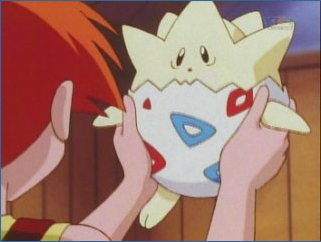
Most of the eggshell stays intact, but a set of tiny arms and legs pop out, along with a rounded, three-horned head.  No-one can identify the baby Pokémon, but the kids don’t mean to hang around with Team Rocket to figure it out, so Pikachu drops a Thunderbolt and they flee the scene with their child.  Once the kids get back to civilisation, they ask the Pokédex – after all, it’s just been upgraded.  It successfully identifies the baby as a Togepi, but is unable to produce any further information.  For some reason, the kids immediately start arguing over who owns the damn thing.  Ash found the egg and Brock cared for it, but Togepi seems to like Misty best.  Team Rocket soon show up, and declare that they deserve a say as well, citing Meowth’s tender care of the egg.  The kids eventually decide on a six-way tournament, but Meowth declares that neither Jessie nor James ever did a thing to help look after Togepi’s egg, and consequently they have no right to compete, so instead it comes down to a four-way tournament between Ash, Misty, Brock and Meowth in an empty stadium.  As Meowth stares down Brock’s Onix, he suddenly realises that he doesn’t own any Pokémon, and looks to Jessie and James for help, but they are sulking over being excluded.  Meowth eventually remembers that he is himself a Pokémon, and spends the match jumping in and out of the ring, alternating between shouting commands and carrying them out.  He quickly realises that he can’t harm Onix, but notices some buckets of water by the side of the field, and throws them over Onix, weakening him enough to finish up with Fury Swipes.  Ash and Misty step up next.  Ash chooses Bulbasaur, and Misty means to pick Staryu, but gets Psyduck in its place.  Misty tries in vain to get Bulbasaur to attack Psyduck’s head and trigger his powers, but Ash instructs Bulbasaur to lick and tickle Psyduck into submission instead.  Finally, Meowth faces off against Pikachu… and gets fried to a crisp in five seconds flat.  When Ash tries to claim his prize, though, Togepi gets visibly upset whenever anyone other than Misty tries to hold her.  He consults the Pokédex, and learns that Togepi imprint on the first things they see when they hatch – and the first thing Togepi saw was Misty.

…which… y’know, would have been a really good thing to know earlier, when the Pokédex told them it didn’t know anything else.  I swear the thing was designed by a nitwit.

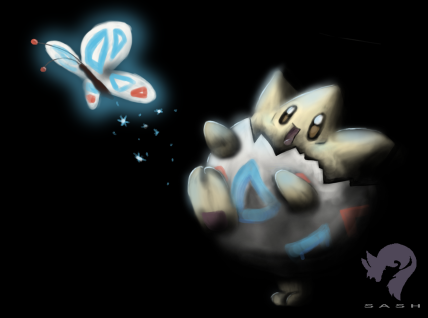
 An adorable Togepi chasing a sparkly butterfly, by Janice268 (http://janice268.deviantart.com/).

So, aside from the fact that Brock apparently doesn’t know much about how Pokémon actually breed, what did we learn today?  Well, Ash and Brock are surprisingly slow to consider Togepi’s feelings in the question of who gets to be her trainer.  Misty points out from the start that Togepi likes her the best, and it’s clear from the end of the episode that Ash is willing to let that sway his decision, but that doesn’t stop them from having a tournament over her anyway.  Considering that Togepi is just a baby, it does make some sense that Brock would put what he feels is best for her over what she wants, and as a breeder he is probably the best choice to care for a baby Pokémon from a purely objective standpoint.  That viewpoint also makes sense for Ash if we accept my past arguments that he generally believes he knows what’s best for his Pokémon better than they do, though his motivation here seems to be more “I found it; it’s mine.”  Strictly speaking, he found Togepi’s egg on a palaeontological site, which probably puts him on shaky ground as far as ownership goes, but he likely neither knows nor cares.  I can’t think of any real reason Togepi should be particularly desirable to him; she clearly isn’t going to be ready for training for quite some time.  He’s probably just exercising his famous stubbornness.  Brock’s being a little weird about it too, since he cares for the whole group’s Pokémon anyway, and would presumably help look after Togepi as long as the three of them stayed together, regardless of who was formally her owner.  I suppose Ash and Brock may have simply assumed that Misty was just making stuff up as an excuse to take Togepi for herself because she’s so cute, which… well, okay, that…wouldn’t really be out of character for Misty and might actually be true.

 I think the way Rock-types and water work in the anime is that water doesn't hurt them all *that* much (though more so than it hurts most Pokémon) but screws them over by rendering them more vulnerable to standard attacks..

What this episode doesn’t tell us – and which I don’t think we ever actually learn – is where the heck Togepi came from in the first place.  At the end of Attack of the Prehistoric Pokémon, while Ash is slumbering under the influence of Jigglypuff’s song, her egg just… sort of rolls down from somewhere and gently comes to a stop resting against him.  I think maybe the implication is supposed to be that the egg was unearthed in the excavation, and had somehow been preserved in the same way as the fossil Pokémon who attack Ash and Team Rocket (who were supposedly in some kind of incredibly deep hibernation).  As for how the egg got into the site… well, although Togepi was introduced to the games in Gold and Silver, the species isn’t native to Johto or Kanto.  I suppose it’s possible that Togepi and Togetic used to live in Grandpa Canyon and were subsequently driven out by climate change – probably quite recently, since Togepi aren’t actually extinct (seeing as how every fossil Pokémon ever revealed has subsequently appeared in the show, alive and well, I’m not sure extinction is even really a thing in the Pokémon world, but let’s pretend that it is for a moment).  The idea that the egg was in some sort of dormant state does make some sense in relation to the rules the games later established for Pokémon eggs, which are stimulated by the activity of other Pokémon and can gestate for an indefinite period without suffering any harm… of course, Togepi is rather pushing it to the limit.

The other thing that’s important today is how the addition of Togepi to the party affects Misty.  In the past, I’ve characterised Misty as snarky, cynical and, in general, a great deal more pragmatic than either Ash or Brock, both of whom have very strong idealistic streaks.  Two moments that define the difference between Ash and Misty (for me, anyway; there are others, but these are the two that stick out in my memory) are her comment to Ash after he trades away his beloved Butterfree – “look on the bright side; you got a Raticate!” – and her question to Bulbasaur when he confronts the ancient Venusaur in the Mysterious Garden – “don’t you want to have that kind of power?”  Misty does have a sentimental side and we do see it from time to time, but until now her relationships with her Pokémon have tended to suppress it rather than exhibit it.  Her signature Pokémon are the inscrutable, alien Staryu and Starmie, whose emotions – assuming they even have them – are impossible for the audience to see.  Goldeen gets so little screentime as to be a nonentity, because she can only fight in water.  I suspect Horsea was meant to provide Misty with an outlet for her softer emotions, but she falls into the same trap as Goldeen and almost never does anything.  I think Togepi may have been brought in when the writers realised they didn’t have enough flexibility with Horsea (and, lo and behold, Horsea actually leaves the team permanently ten episodes later).  Finally, the idea of Misty openly admitting to any sort of tender feelings towards Psyduck is almost laughable.  When Togepi becomes her sixth Pokémon, however, Misty takes to her new role as Togepi’s ‘mother’ wholeheartedly.  She’s as prickly and sarcastic as she ever was, but we get to see in her the same concern for Togepi’s safety as Ash has for Pikachu, which she never shows for her other Pokémon.  Misty is used to thinking of Pokémon primarily in terms of their relationship with her as a trainer, but Togepi – who can’t fight – gives her the opportunity to think about Pokémon in an entirely different way, as well as indulge the stereotypically ‘feminine’ traits she’s preferred to downplay for most of her life to keep her sisters off her back.

Just in case I didn’t make myself clear:

VOTE PHIONE!

Because Phione winning, or even making it past the first round, would be WAY MORE HILARIOUS than any other possible result and also FORCE NINTENDO TO LET PHIONE BE AWESOME FOR ONCE.

(NB: everyone seems to be assuming that the winner of the tournament will be downloadable from the Global Link by Wi-Fi, but no official source has ever said or even implied that this is what “special downloadable prize pack” means, so I’m just going to keep supporting Phione even though we all know she’s useless)

Why do you suppose the legendary birds aren’t on the power bracket?

There was a preliminary round.  They had 35 legendary Pokémon and wanted 32 so they could have a neat tournament format, so they put the Kanto birds up against the Johto beasts before the main tournament started.  Suicune, Entei and Raikou won.

I didn’t cover this because I was late to the party and didn’t know about the event until the preliminary round was over.

There’s a lot of legendary stories that pretty much ruin each other, the Arceus vs. Mew thing being the biggest one, but what about Groudon/Kyogre and Regigigas? I personally don’t like the whole “pulled the continents apart” so I refuse to acknowledge its existence. What would you do with that story if you were in charge of all that?

Hrm.  I don’t think there necessarily has to be a conflict between the two; we can assume that Groudon raised a single Pangaea-like landmass out of the ocean while Regigigas was responsible for dragging the continental plates into their present positions.  Basically, Groudon and Kyogre are primordial beings, while Regigigas is from a more recent era.  Alternatively, though, since I don’t think we’ve ever seen direct evidence of Regigigas’ power, you could suggest that “towing continents” is a simple exaggeration.  After all, the image of Regigigas running around the face of the planet, dragging India a few metres northward before nipping off to shove the two halves of North America a few metres closer together, is just a little bit absurd.

I think my first assumption, if I wanted to keep the continent-towing, would be that there are multiple Regigigas, dragging multiple plates in multiple directions and often working at cross-purposes (hence earthquakes and such).  The second would probably be that they didn’t come to exist until long after Groudon and Kyogre went to sleep.  They’re not elemental forces in the same way that Groudon and Kyogre are; they don’t drive continental drift for the sake of continental drift.  Rather, they generally have some reason or another for dragging a continent – moving it to a warmer or cooler region of the planet, or further away from a rival Regigigas.