
I’m afraid I don’t really know the manga, so I can’t comment on that, and as far as the anime goes, there’s a massive gap in my knowledge between Johto and Unova. I’m mainly going off the games (the anime version of Professor Oak is a fun character; I’ll give you that). To the best of my memory, Aurea Juniper is the only one who ever actually *discovers* anything over the course of the game in which she features. Also Oak apparently spent his *entire career* creating a totally blank Pokédex and is now too old to go out and fill it. He doesn’t actually know anything about Pokémon; he’s a glorified computer programmer.
Category: Not yet categorised
Which is your favourite out of the myriad of pokemon professors?
Juniper, purely because the others are hilariously incompetent.
Break Time
In case you missed it when I mentioned this at the end of the Empoleon entry, this’ll be my last post for a couple of weeks ‘cause I totally have SERIOUS SCHOLARLY RESEARCH that I need to do and I swear it’s important even though it’s not about Pokémon. I could post extracts from some of my coursework essays if you like but that might be even more boring than just posting nothing, so I’m just going to shut up for a little while; I’ll be back on… let’s see… the 15th of June. Promise!
Starter Pokémon: Final Thoughts
WARNING: This entry is clearly too long and I have no idea why I wrote it.
Let’s talk about starter Pokémon.
Your starter Pokémon is your partner, a bird of your feather, a pea in your pod, the cheese to your macaroni. It is like a huge feathery pea covered in melted parmesan.
…yeah, that metaphor got away from me a little.

My point is, this is supposed to be the Pokémon that defines your experience of Pokémon training, what Pokémon mean to you personally, and your own style as a trainer… so it had better be good. These are the most important designs in the game to get right, barring maybe plot-relevant legendary Pokémon, and there’s even more to get right than when you’re just working on any old filler Pokémon. For one thing, you have to be sure – at least, as far as humanly possible – that there will be at least one starter Pokémon in each trio that appeals to everyone. Obviously that battle’s over before it even starts because there are always going to be a few people who think that all three are terrible, but there are a couple of ways to minimise that, and Game Freak do seem to try their best. Of course, many of us will just accept the Grass/Fire/Water paradigm and take what we’re given from our favourite elements, but for a lot of people, including a lot of new players, other factors are going to be important. It’s good to give a choice of personality types and aesthetic styles – often these are divided along elemental stereotypes, so we generally get an aggressive Fire-type, a stoic Water-type and a laid-back Grass-type. This isn’t always the case, though; Black and White, for instance, have a stoic Grass-type, a laid-back Fire-type and an aggressive Water-type (forgetting for the moment that Oshawott’s art and sprites are terrible and should never have seen the light of day). I think you can argue that it’s probably better, in general, for starter Pokémon to be exemplars of their elements’ defining traits, rather than exceptions, because many people are going to choose starters according to element and won’t necessarily want Pokémon that are radically different from the norm. Obviously, that’s not a hard-and-fast rule, but this is probably not the place to get experimental and create a Grass Pokémon with the power to drain and kill plants or something weird like that. Anyway… the other important thing is that these Pokémon have to be strong, or at least decent (bearing in mind, of course, that the things that make a Pokémon good for high-powered competitive play are often quite different to the things that make a Pokémon good for in-game storyline play). If your starter Pokémon is weak, you’re either going to ditch the thing as soon as possible or keep it around as a sort of mascot while vaguely resenting it the whole time. You can find accounts of exactly this kind of thing happening in Yellow Version – although later games have made an effort to help him out, an unevolved Pikachu is, let’s be fair here, a pretty terrible Pokémon. A lot of people just stuff him in the PC and never look back (and, heck, why not? Yellow gives you all three of the original starters anyway); others accept that he’s terrible and use him anyway because why else would you play Yellow Version, damnit, and a few people just never notice that he’s terrible because they’re also using Raticate and Butterfree.
Yellow Version gives you no choice in your starter Pokémon, so if you don’t like Pikachu, you’re out of luck, and it sticks you with a starter Pokémon who is demonstrably weaker than almost any other Pokémon you could possibly pick. For these reasons, it is an example of a really terrible way of handing out starter Pokémon. It works anyway because 1) Pikachu can get away with anything, 2) we all wanted to re-enact Ash’s journey, 3) if you didn’t like Pikachu you wouldn’t have bought Yellow anyway, and 4) let’s face it, the real reason we were playing Yellow was because we wanted Bulbasaur, Charmander and Squirtle. All that said, Yellow is the only game so far that actually makes an effort to treat your starter Pokémon as special and emphasise your relationship with that Pokémon by introducing, just for Pikachu, the forerunner of the happiness mechanic that has been part of the game since Gold and Silver, as well as having Pikachu follow you around in the overworld. He may be just a mascot, but a fair bit of effort went into making him the best mascot possible, and as a result the game works. Well, it does if you like Pikachu. If not then you dump him in the PC and forget about him; he’ll hate you when you take him out, but it’s not like you were planning on doing that anyway. None of the other main series games has ever done anything like what Yellow did, probably because no other Pokémon can really compare to Pikachu for widespread popular appeal. The original Pokémon Ranger, like Yellow, gave you no choice of partner, sticking you with Plusle (if you’re a girl) or Minun (if you’re a boy), which is a little painful if you despise Plusle and Minun as much as I do, but aside from having powers that no other Pokémon in the game possesses, your partner actually plays an active role in the storyline, which seems only appropriate. According to Bulbapedia, Guardian Signs gives you a Pichu with a ukulele, however I am convinced that this is some sort of misinformation because not even Nintendo is that ridiculous. I think Gale of Darkness starts you off with an Eevee, who is sort of the ideal choice for a single starter because her split evolution ensures that most anyone will be able to evolve her into something that appeals (how many Yellow version players wish that your douchebag rival hadn’t swiped the Eevee that Professor Oak meant for you?). However, I digress.

One of the uncomfortable little problems with the Pokémon games that we don’t like to talk about is the severe disconnect between the series’ persistent and often heavy-handed theme of partnership and the way the games actually play. This has come up in my reviews of the anime a couple of times: we’re clearly meant to want to imitate Ash, who has only a handful of Pokémon and loves them like his family, but in practice I (and, I’ll bet, most other players) are more like Gary – if I take a quick look through my PC on Black Version, for instance, I find a couple of dozen Pokémon I use for battles, perhaps another dozen I use for various utility purposes like swimming and flight, and literally hundreds that I never use at all; they just sit there gathering dust because, having earned their Pokédex entries, I no longer have any particular need of them. I keep them around because I might someday need them to produce children for serious training. Does that seem right to you? A game that placed a great deal of importance on players’ relationships with every individual Pokémon would, of course, be vastly impractical if it were based on anything like the game’s current structure, with its monolithic Pokédex quest and the notable disadvantages associated with continuing to use your in-game team after completing the storyline. Just one Pokémon, though, for whom the player is assumed to care particularly deeply, as with Pikachu in Yellow… that, I feel, would make gameplay and message hang together a touch less haphazardly.
There’s a few ways this could be done. Having the starter follow you around, as Pikachu in Yellow, is an obvious starting point; having it react to events in the storyline, as Plusle and Minun do in Ranger, is a logical continuation. Something that has tempted me for a long time is the idea of evolution triggered by plot events (with some alternative method available post-Elite Four so you can evolve other starter Pokémon you obtain later); possibly even a single starter Pokémon with a split evolution determined by the way the player tends to react to in-game events, or the way the player treats the starter – which isn’t necessarily a strict contrast between ‘well’ and ‘badly,’ but more a contrast between different but valid and potentially overlapping types of relationship, like ‘intellectual,’ ‘emotional,’ ‘competitive,’ ‘protective’ and so on. To keep this working without hiccups, it might be wise to include an option for the starter to stay with the player at all times, even when there are six other Pokémon in the party, but become ‘inactive’ and unusable until a space opens up – some people just don’t like using their starters, while others may want to branch out after several playthroughs. Perhaps the starter’s presence even grants some kind of bonus to the rest of the party. I could go on. All of this, of course, ups the ante on creating starters that no one will strongly object to (or picking some from the ranks of existing Pokémon – Eevee seems to be universally adored) or offering a wider variety of starters (BLASPHEMY!) to ensure that there’s something for everyone. Personally, if I were aiming for this kind of effect, I would probably base the design around something associated with partnership in the real world somehow, like a dog or horse, just to hammer in the point. Assuming new Pokémon were being created, I would imagine rejecting dozens of designs (perhaps reworking some into regular Pokémon) before deciding on the final set; after all, this is not something to be done by halves.

The other main topic I want to address today is the Grass-Fire-Water paradigm. A lot of people want a change; I remember there was a great deal of excited speculation prior to the release of Diamond and Pearl that Game Freak were going to try experimenting with a Dark-Fighting-Psychic trio instead. This trio doesn’t have quite the same relationships between the types as Grass, Water and Fire, because Dark-types are strictly immune to Psychic attacks rather than simply resistant. In fact, it’s very difficult to construct a trio that works in just the same way as Grass-Fire-Water without using at least one of those three types, since so many elemental relationships aren’t reciprocal (for instance, Ice attacks are strong against Ground-types, but Ice-types don’t resist Ground attacks). The only one I can think of is Fighting-Flying-Rock, which is somewhat problematic because of Game Freak’s apparent distaste for pure Flying-types. It’s not immediately obvious why this should be a point against a change, but the big advantage of Grass-Fire-Water is its potential for easing new players into the system; the way the three types interact is quite simple compared to other possible trios, and the reasons for those interactions are also fairly intuitive (Grass-drains-Water is a little out there, but Fire-burns-Grass and Water-douses-Fire are much easier to understand than, say, Dark-mindfucks-Psychic or however that one is supposed to work). However, Game Freak have shown by way of the Striaton Gym and its triplet Gym Leaders that they are open to more sophisticated ways of indoctrinating new players into Pokémon’s vast and convoluted game of Rock-Paper-Scissors-Lizard-Spock, so it’s possible to imagine a game where the starters are no longer the primary vehicle for introducing the mechanic. Arguably, it would actually help to have a starter trio with more complicated relationships, since new players are going to have to deal with stuff like immunities, mutual resistances, and the Dragon- and Ghost-types’ strengths against themselves sooner or later, and at present the games make no real effort to introduce any of that; they just encourage a vague (incorrect) belief that all elemental advantages are reciprocal. I spent much of my childhood assuming that Steel attacks must be strong against Dark-types, Ghost-types, and goodness knows what else because Steel Pokémon were resistant to those attack types. Again, I could bring up my favourite game mechanic of the day, the split evolution; in this case, the potential advantage is in allowing new players to delay their choice of element until after they understand the ramifications of that choice. Two other ideas I’ve toyed with are having a set of starters that all become Dragon-types upon reaching their final evolutions, so that all three are strong against each other, or having a set of starters who shift into each other’s elements (so the Grass-type becomes Grass/Water, the Water-type becomes Water/Fire, and the Fire-type becomes Fire/Grass)… not because these would necessarily be good ideas, you understand, but because they would be different and strange and would probably force the designers to come up with some really weird, quirky stuff.
We’ve seen an impressive variety of starter Pokémon over the years; tough, proud, gentle, courageous, reclusive, wise… for the most part, these are – as they very well should be – quite good designs. Like so much else in Pokémon, however, this is one place where I wish that, once in a while, Game Freak would dare to be different. Give them another year or two, and they’ll be announcing the approach of generation six… and goodness knows, none of us want another Fire/Fighting-type…
Piplup, Prinplup and Empoleon
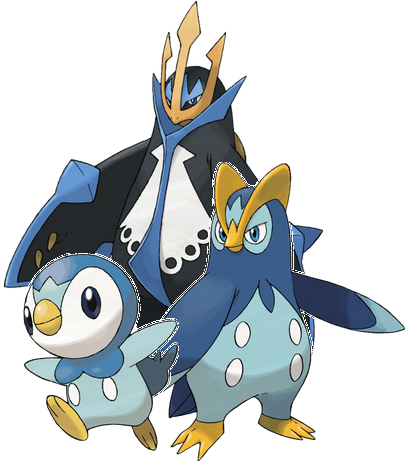 I love penguins. So clumsy on land, so graceful the moment they hit the water, and adorable to boot… Who doesn’t think Piplup is cute? Seriously, who doesn’t? I certainly do, although I have the same sort of problem with him and his evolved form, Prinplup, as I did with Totodile, Croconaw and Feraligatr; namely that they’re just penguins. Those capelike flaps they have down their backs are a nice touch, beginning the line’s background nobility-and-royalty aesthetic by making them look like little princes or dukes without seeming too out-of-place. That’s hardly at the centre of the design, though, and overall they’re a little bit unremarkable. Luckily, unlike with poor Totodile, Game Freak actually seem to have put some thought into this Pokémon’s personality. Cute though they may be, Piplup are also filled with stubborn pride; they ignore orders, quickly brush off any failures, and seem to find charity and kindness offensive, caring only to prove that they don’t need any help to survive. Prinplup, likewise, have an incredibly strong arrogant streak. In a major departure from the way real penguins behave, Prinplup are incapable of living together in colonies because, like monarchs, they cannot stand to look upon others as equals (or, heaven forbid, superiors). As Empoleon, the ‘Emperor Pokémon,’ they remain extremely proud and lash out at anyone or anything offensive, however they do seem to gain a measure of self-control; they’re said to avoid squabbles if they can, and it’s implied that they can live in groups, led by the Empoleon with the biggest horns (presumably Piplup live in colonies led by Empoleon, leave when they evolve into Prinplup, and return only once they have evolved again and learned to keep their pride under control). Now, those horns… The designers really do seem to have made an effort to make sure that Empoleon isn’t ‘just a big penguin,’ with the clawed hands on the insides of his bladed flippers, and his sharp-edged dorsal and ventral fins, but the big, obvious thing is that set of three horns. Empoleon’s horns spring from the upper surface of his beak and form a kind of visor over his face, in the shape of a trident. It looks a bit strange, and probably implies that his beak works more like a mammalian jaw than most birds’ do (since the upper part would be more or less fixed in place and wouldn’t be able to flex upwards) but that’s not inherently a problem. It protects his face, and the trident is a good strong symbol of power and the ocean (in fact, now that I come to think of it, it forms a nice symbolic connection between his two elements, Water and Steel). I can’t help but think that Piplup and Prinplup are missing something in their art to give them uniqueness and focus, some extra detail or adornment; Empoleon does have that, though, and the heavy emphasis placed on their character traits is quite refreshing.
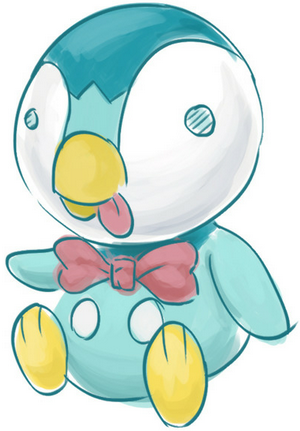
So, what do you do with Empoleon? Well… he’s a pretty weird Pokémon. He’s the only Water/Steel dual-type in the game, which is a big plus; his unique set of weaknesses and resistances leaves him with unfortunate vulnerabilities to three of the stronger offensive types, Fighting, Ground and Electric, but eleven resistances and a Poison immunity is nothing to sniff at (Steel-types have all the luck…). In spite of all the talk in his Pokédex entries about being able to cleave apart icebergs with his bladed wings, Empoleon is actually a special attacker – one of the most powerful Water-type special attackers in the game, in fact, behind Omastar, Gorebyss and a couple of legendary Pokémon. Unless you teach him Agility, he’s far too slow to be a sweeper, but with solid defences and all those resistances, he might do okay as a sort of tanky thing. I know that what people used to like doing with Empoleon was this one absurdly specific moveset that only he could do properly, which involves using Substitute to slowly drop Empoleon’s HP until he’ll eat a Petaya Berry to boost his special attack, then using Agility and going nuts. Thanks to Empoleon’s Torrent ability, his low health causes his Water attacks to enjoy a further damage bonus, so very little can stand up against his Surf at that point, and Ice Beam cleans up most everything else. Petaya Berries aren’t available on Black and White yet, though, and the synergy between the berry and Torrent is kind of the lynchpin of the whole tactic. That’s not to say you can’t still use Empoleon as a sweeper, of course. He doesn’t have a whole lot of special attacks outside the Water-type standbys of Surf and Ice Beam, but with Grass Knot to handle other Water-types, that doesn’t leave all that many blind spots (refrain from using Flash Cannon unless you really hate Ice Pokémon; Steel attacks are silly). If you can be bothered importing an Empoleon from Platinum and desperately need help with Dark- and Psychic-types, Signal Beam is an option, but you’re probably better off with Grass Knot. If you really want to confuse people, you could slap Swords Dance on your Empoleon, since his physical attack stat isn’t terrible and his physical movepool is decent (you’ve got Waterfall, Earthquake, Rock Slide, Drill Peck, and Brick Break) and he does have Aqua Jet to compensate for his appalling speed. Like I said, though… only if you really want to confuse people.
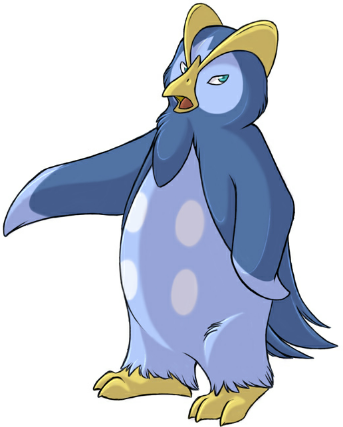 Personally I think I’d go with the tank-style Empoleon; he has to rely on Rest or Aqua Ring for healing, which is a pain, but then again, eleven resistances… as with most bulky Water Pokémon, you’ll want to go with Black and White’s great gift to Water, Scald, over Surf – it’s less powerful, but burns will make life hell for opposing physical attackers (and, what do you know, physical is Empoleon’s weaker defensive side). I’m pretty sure Empoleon’s only real ‘support’ moves are Stealth Rock and Roar (and Stealth Rock requires importing him from a fourth-generation game), but being able to lay the rocks down for yourself and then send Pokémon running into them with Roar isn’t too shabby. And yeah, I guess technically Empoleon does have a Dream World ability – Defiant, which responds to any reduction in Empoleon’s stats by doubling his attack score – but unless you’re going with the confusing Swords Dance Empoleon route, this is just plain useless, so if you haven’t got a Dream World Empoleon, don’t worry; you’re not missing much.
The more I think about it, the weirder it seems that Empoleon isn’t a physical attacker; he certainly looks imposing enough, it fits his flavour, his physical movepool is, to be honest, probably better than his special movepool, and he gets Swords Dance and Defiant (in fact, Swords Dance is technically on his level-up list, so he doesn’t even need a TM). I mean, it’s not like it’s central to the design, but “wings that can cleave through an ice floe” sort of suggests physical attacks are his primary fighting style, and also that he would, y’know, learn Steel Wing (okay, he can, but only by using an obsolete TM). Some days though, I just don’t care, because Empoleon is still a pretty badass Pokémon – come on, an imperial armoured war-penguin? Why the hell not? Some of the artists seem to have a slight tendency to abuse him in the sprites and the anime, he gets very fat in some portrayals and it just doesn’t look right; penguins are meant to be sleek, and even if this is a bulky armoured penguin he still needs to swim. Prinplup annoys me a little because he’s given up Piplup’s cuteness but hasn’t yet picked up the details that make Empoleon more than just a penguin; honestly, if he weren’t a starter Pokémon, I would be totally happy just to ditch Piplup and Prinplup and keep Empoleon as a stand-alone. Again, though, I’m pleased that Game Freak have given these Pokémon psychological traits (because that’s the sort of thing we don’t learn about just by using them), and I like that those traits seem to develop as they evolve… even though it’s anyone’s guess whether that’s by coincidence or design. On the whole, Mudkip, Marshtomp and Swampert are probably better designed, but as we know by now, I have an irrational dislike for Swampert, so Empoleon is probably my favourite Water-type starter Pokémon.
And that’s a wrap! Twelve starter Pokémon, and all their evolved forms, done and dusted. I want to do a sort of wrap-up for my next entry, talk about trends and ideas that have been thrown up by these entries, and maybe talk about my take on what’s important for a starter Pokémon. After that, well, I’m sorry to say that real life has been catching up with me to some extent, so I’m going to take a break for, say, two weeks to work on my dissertation on archaeometry and the Greco-Roman pottery trade; then it’s right back to another thirty-odd episodes of the anime. Should be fun!
Do you think it would make more sense for Samurott to be Water/ Fighting than for Emboar to triple the Fire/ Fighting line up?
Well, I would certainly prefer that. And I think Samurott would work as a Water/Fighting dual-type. Would Emboar still make sense as a straight Fire-type? Maybe? Might need to be redesigned a bit.
Chimchar, Monferno and Infernape
 OH DEAR GODS IT’S INFERNAPE RUN YOU FOOLS
These are Pokémon to inspire terror. You wouldn’t know it to look at them, but trust me, they are. Not because of sheer power – Charizard, Typhlosion and Blaziken are more powerful than Infernape – but because of two things that, in Pokémon, are often far more important: speed and versatility. I’m getting ahead of myself, though. Ladies and gentlemen: Chimchar, Monferno and Infernape.
The first thing you notice about these Pokémon is that they don’t really have a lot of heft to them. Charmander, Cyndaquil and even Torchic are more solidly built than Chimchar, and that doesn’t change as they evolve. This is because Chimchar marks a (small) divergence, at last, from the fire-as-destroyer archetype and focuses on a closely related quality of fire – its speed. Like Rapidash and Arcanine, Chimchar, Monferno and Infernape are Fire Pokémon whose element manifests not as huge destructive power but as phenomenal agility. They are among the few Fire-types who are not described as fighting primarily with their fire; one assumes that they do, and they do learn attacks like Ember and Fire Spin, but they seem to prefer using fire to intimidate enemies rather than to incinerate them directly (Monferno and Infernape’s bright facial markings, blue and red respectively, likewise seem meant for intimidation, as in mandrills and similar species). There’s actually something of a disconnect here, in that Infernape is really just as good at special attacks as at physical attacks, but this bothers me far less than all the Pokémon who aren’t good at the things they are supposed to be, so I’ll leave it. Rather than using fire, Chimchar and his evolutions use flurries of lightning-quick blows from all of their limbs simultaneously and from every possible direction to batter foes into submission – as might well be expected from anthropomorphic monkeys with prehensile limbs and tails (or a practitioner of ‘monkey’ style kung fu). This kind of acrobatic, literally off-the-wall combat style, familiar to us all from martial arts films, has few other exponents in the world of Pokémon; before Infernape, I can think of maybe Hitmontop, and after him, Mienshao. Is it especially clever creating a monkey Pokémon based on monkey kung fu? Perhaps not, but it makes sense, and it’s pretty damn kickass. Aesthetically speaking… aesthetically Chimchar bugs me; his proportions seem off, his head too big for his scrawny body and limbs – it’s a common feature of most primates, I think, that infants have disproportionately large heads, but you can go too far (the effect is reduced in the in-game sprites, but it’s still there). I suspect they may have made him too human; his hands, eyes and hair remind me, disconcertingly, of a human baby, but then he has no nose… if you’re familiar with the ‘uncanny valley’ effect, this is what Chimchar makes me feel. Monferno and Infernape lose that, though, so I suppose I’m okay with it. It’s also a little strange that Infernape loses his flaming tail and gains a crown of flames instead, but I can’t deny it does look cool, as does the spiral motif that develops out of the swirls visible on Chimchar and Monferno’s chests, adding to the overall impression of fluidity.
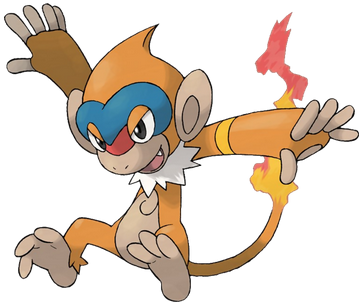
As we learned in Blaziken’s entry, however, Infernape has committed a fairly serious sin: he pretty much stole her schtick, in the process becoming the nexus of just about the biggest balance clusterfuck this franchise has ever seen (or would have seen, if game balance had ever been a thing in Pokémon anyway). Blaziken, when she was introduced, was the only Fire/Fighting type, and a powerful and terrifying mixed attacker with a wide range of dangerous attacks. Come Diamond and Pearl, she was still a powerful and terrifying mixed attacker with a wide range of dangerous attacks… but Infernape had all that, and blinding speed to back it up. Most offensive Pokémon are best used by focussing solely on either physical or special attacks; likewise, you’ll get the most mileage out of many defensive Pokémon by focussing solely on one type of defence. You can use Infernape and Blaziken this way, and they will perform wonderfully. However, they also perform wonderfully as mixed attackers, called ‘wallbreakers’ for their ability to consistently pick on the weaker defensive sides of powerful defensive Pokémon like Weezing and Snorlax. Now, yes, Blaziken’s attack and special attack stats are higher than Infernape’s. However, we’re talking here about two Pokémon whose job is to use some of the most powerful attacks in the game (Fire Blast, Flare Blitz, Earthquake, Close Combat, Focus Blast, Hi Jump Kick) to hammer Pokémon who are specialised in the wrong kind of defence. At this point, extra power isn’t all that big a deal. Speed, on the other hand, is the only all-or-nothing stat in Pokémon – you’re either faster than your opponent or you aren’t – and as such, a few points of speed can be disproportionately useful or useless depending on exactly how fast you are. In this case, extra speed means outrunning some of the most powerful Pokémon in the game and potentially landing a fatal hit where you might otherwise wind up sprawled on the ground. With access to both Swords Dance and Nasty Plot, Infernape can buff either of his offensive stats to ridiculous levels anyway, should you so desire. To add insult to injury, Infernape gets U-Turn, which Blaziken lacks, the so-called ‘best move in the game,’ for its ability to switch a Pokémon out after seeing whether your opponent will do the same, and if so, what’s being switched in (the fact that it does damage as well is the icing on the cake). It’s hard to think of a reason to use Blaziken over Infernape… or at least, it was in Diamond and Pearl, before part two of that balance clusterfuck happened and Blaziken got Speed Boost, and you can read all about that in her entry.

So, assuming no Speed Boost for Blaziken (and Dream World abilities for starter Pokémon aren’t exactly easy to get; all of the released Dream World starters are male, which makes breeding them impossible) Infernape is, essentially, ‘Blaziken, only better.’ Swampert had a similar thing going on with Feraligatr, but Feraligatr later staked out his own territory, and the fact that Blaziken and Infernape share the same specific type combination, Fire/Fighting, accentuates our natural impulse to compare the two. If Infernape existed in a vacuum, so to speak, I would regard this as a job well done. He’s one of those Pokémon that can swing matches very quickly, but he’s also quite delicate and has a couple of nasty common weaknesses, so I don’t think I’d say he’s too strong, taken in isolation. Infernape doesn’t exist in a vacuum, though. I don’t think the designers necessarily realised that Infernape is better (or, more adequately, has more potential) than Blaziken, since it’s pretty clear they don’t think about individual Pokémon in the same way or under the same conditions as studied competitive players, but it must surely have occurred to them that the two Pokémon have very similar sets of powers, and that their position as successive Fire starters would encourage comparison. My default stance is that it’s bad form to design one Pokémon that usurps another, whether successfully or not, and while Infernape and Blaziken definitely have very distinct flavour they have the same type combination, the same strong points, and similar tactics. If this were my last year’s Unova Pokédex series, when I was dealing with a whole new generation, I would either shout incoherently for a while and slam a big heavy “I hereby deny this Pokémon’s right to exist” on Infernape’s head, or sheepishly admit that the second attempt really was better and maybe recommend some additions to the older Pokémon. The trouble is Game Freak already did try improving Blaziken, bless their little hearts, and totally failed to comprehend the enormity of what they were giving her, so now I have no idea where to go with this; I have a fairly solid doctrine in place for complaining about new mistakes, but I’m still not totally sorted on how to handle old ones.

Infernape is an awesome Pokémon; I love his aesthetic qualities, his concept, while not as clever as Torterra’s, is still at the very least amusing, and he’s one of the best non-legendary Pokémon in the game. And… frankly, Game Freak shouldn’t have made him. I guess I’m feeling paradoxical today. I think that, for Blaziken’s sake, this design should have been worked into something quite different. For a primate design, I would be very tempted to work with fire as a symbol of creativity and inspiration, particularly focussing on Infernape’s crown of fire, and make him a Fire/Psychic-type, focusing on special attacks, although that doesn’t work with the whole ‘monkey kung fu’ thing, and would imply a total art redesign, so a more practical suggestion would be to go with the old monkey-as-trickster archetype and turn Infernape into something more like what Mienshao later became – a hard-hitting Pokémon whose greatest strength isn’t actually hitting hard, but spreading disruption and chaos. Basically, since the flavour side of things is where Infernape really is quite different from Blaziken, I’d want to work with that to create mechanical distinctions as well. In the end the resulting Pokémon probably wouldn’t be as powerful… whether that’s a bad thing or not, I leave up to you.
Turtwig, Grotle and Torterra
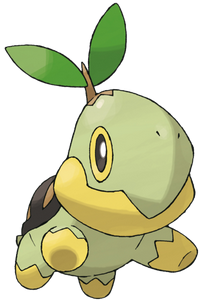 Okay; Diamond and Pearl. The last three starters (since I’ve already covered Tepig, Snivy and Oshawott). I’ve always liked these three; the designs are quirky, they’re all pretty powerful (if I had to use a whole trio on a single team, this is probably the one I’d go for, although the Ruby/Sapphire ones give them a run for their money), and the way they interact with each other is pretty interesting in itself. Let’s take a look at Turtwig and see how he measures up.
As you’ve probably read by now, I love all the Grass-type starters. However, I think Torterra is the only one whose design potentially equals or betters Venusaur’s. Turtwig, Grotle and Torterra are based on the old mythological motif of the ‘world turtle,’ who appears in several places around the world, but most famously in Hindu legend as one of the avatars of Vishnu, his shell serving as a pivot when the gods and demons together churn the ocean of milk using an upturned mountain to produce the water of life (it… was just that kind of Friday night, okay?). The world turtle motif is directly referenced in the Pokémon world’s corresponding ancient myth that an enormous Torterra lived deep beneath the earth. The design includes elements of every part of the natural world – earth, water, plants and animals. Turtwig originally hosts a tiny sapling on his head, which grows into twin rows of bushes on Grotle’s shell of compacted soil, and finally into a huge tree on Torterra’s immense carapace, accompanied by great spikes of moss-covered stone. Grotle often carry smaller Pokémon around on their backs over long distances, and Torterra becomes so large, and his foliage so luscious, that entire communities of Pokémon can be found on a wild Torterra’s back, creating a pocket ecosystem in which some Pokémon spend their whole lives. Turtwig, Grotle and Torterra also have some minor powers related to water, completing their miniature world. All Grass Pokémon, logically, are very reliant on water, but the designers seem to have wanted to drive it home with these three; they always live by lakes and rivers, drinking causes their shells to harden and grow strong, they have the special ability to sense sources of pure water, which they use to lead other Pokémon there, and wild Grotle are said to protect hidden springs. These Pokémon aren’t just parts of ecosystems, they are ecosystems. I love this design. It’s detailed and fascinating, drawing on a well-known mythological motif combined with symbolically significant traits and powers to give Turtwig, Grotle and Torterra an interesting place in the world of Pokémon. I don’t think it would be at all bold to say that Torterra is one of the best-designed Grass Pokémon in the entire history of the game. My one minor gripe here is the scale; as Pokémon go, Torterra is pretty massive, more than two meters high and about five meters long, but I can’t help but feel that he (and perhaps Grotle as well) should be even bigger, to realistically fit their portrayal as supporters of whole communities. At some point, though, it would become ridiculous to talk about using these things in a battle in a stadium. Besides, we never see wild Torterra in the game; all of them are given out as starter Turtwig or hatched from eggs – who knows how old they get in the wild, or whether they ever stop growing?
The fact that they remind me of dinosaurs has nothing to do with why I like them. Honest.
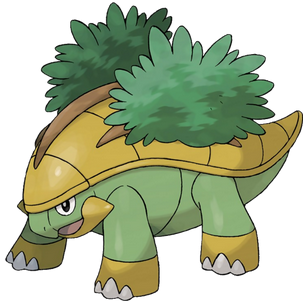
Turtwig is the only Grass-type starter who gains a second type upon evolving, becoming Grass/Ground, appropriately enough, upon reaching his final form (Bulbasaur is Grass/Poison to begin with, and the others stay pure-Grass all the way through). This is interesting because it’s part of the way Game Freak decided to play with the traditional Grass/Fire/Water paradigm in Diamond and Pearl. Normally, Grass drains Water, Fire burns Grass, and Water douses Fire, and this is the way Turtwig, Chimchar and Piplup work as well, but when they reach their adult forms, they mix up the usual strengths and weaknesses a little bit. Torterra is a Ground-type, so even though he’s still vulnerable to Fire attacks, he can smack Infernape with a pretty nasty Earthquake. Empoleon is a Steel-type, so he is no longer particularly weak against Grass attacks, but he’s almost as frightened of Earthquake as Infernape is. On the flip side, Torterra’s second element makes him even more vulnerable to Empoleon’s Ice Beam than most Grass-types, and strips him of his resistance to Water attacks. Finally, Empoleon can still hammer Infernape with Water attacks, but also has to be wary of Infernape’s Close Combat, since Steel Pokémon don’t like Fighting attacks one bit. Essentially, the game starts with a traditional Grass-beats-Water-beats-Fire-beats-Grass setup, but by the end of the game all three have some pretty devastating guns to level against each other. I suspect that quite a lot of thought went into this; it’s an interesting change to the usual dynamic and part of what I like about the fourth-generation starters. It’s sort of a shame Black and White didn’t continue this – Emboar can smack Samurott around with Grass Knot or Wild Charge, if you have the appropriate TMs, and Samurott can give Serperior a Megahorn to the face, but they seem to have forgotten to give Serperior anything to hurt Emboar (as usual, Grass-types Don’t Get Nice Things). Oh well…
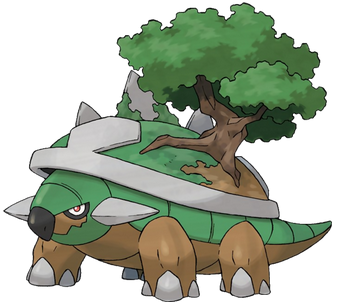
The mechanics changes of Diamond and Pearl opened up the possibility of physical Grass attacks, so why not kick things off with a Grass-type physical tank? Only two previous Grass Pokémon had ever shown a significant bias towards physical attacks over special attacks – Parasect and Breloom, whom, let’s face it, we use for Spore, not for their attacks (Breloom less and less as the generations passed, but Spore is still his biggest advantage) – so Torterra blazed new ground… and boy, did he blaze it. Torterra is the slowest of all the starters, but possibly the toughest, and also one of the most powerful. Curse is an obvious choice to emphasise those qualities since Torterra isn’t going to outrun anything that cares anyway, but if you want something a little less predictable you can try Rock Polish, to bring Torterra’s speed up to something resembling respectability, or even Swords Dance if you’re reckless enough. Torterra’s primary attack, of course, is Earthquake; sadly, Grass attacks don’t combine particularly well with Ground attacks, since they share all of Ground’s offensive weaknesses. If you do want one, you have two options; Wood Hammer is stronger than Seed Bomb, but Seed Bomb doesn’t cause recoil damage. Rock attacks, on the other hand, do mesh very well with Earthquake, so Stone Edge is a good place to go. Torterra’s other main offensive options are Crunch and Superpower; Superpower is much more useful for actually killing stuff, but the penalty it inflicts to the user’s physical attack and defence is particularly undesirable for a slow, bulky Pokémon like Torterra. Leech Seed gets you a trickle of healing, though Torterra, with his large HP total and relative inability to stay in control of a Leech Seed/Substitute scenario, is not really an ideal candidate for using it; Synthesis is weather-dependent but probably your best option. There are also a few support moves to mix things up if you feel so inclined; Reflect and Light Screen for team defence, the ever-present Stealth Rock is available from a TM on Diamond and Pearl if you don’t have a team member who can use it yet, Roar is always welcome on a slow, tough Pokémon for messing with your opponent’s strategies, and for a particularly defensive Torterra you might use Stockpile, a hereditary move from Carnivine or Victreebel, which boosts both defence and special defence together (it has other effects, but they are irrelevant and distracting).
It’s not all good news, of course. Grass/Ground is a fairly poor defensive typing, with two resistances and an immunity to four weaknesses – including a crippling double-weakness to Ice. Torterra is very easily dealt with using a good solid Ice Beam, and he’s too slow to do much about it. He also has difficulty handling other Grass-types, who are largely unperturbed by most of his offensive powers. In short, although he’s a perfectly respectable Pokémon, he has some crucial flaws, and is much less versatile than a Pokémon like Venusaur, which makes him a lot easier to stop. However, if you play him to his strengths, Torterra can flatten some powerful enemies, and with some of the coolest flavour I’ve ever seen in Pokémon, he’s easily one of my favourite starters.
I really liked your posts about every region’s champions and teams. They were interesting and made me think (ex: realizing that Steven could have been so much more). Could you analyze more humans of the pokeverse?
Hmm. Maybe? The trouble is that there are relatively few human characters that get a lot of decent characterisation in the games. I don’t think I could come up with enough material for a full entry on a Gym Leader or Elite Four member, for instance. Maybe the Professors…? Or rivals…? Yeah… yeah, I could probably do a series on the rivals. At some point. I can’t remember at the moment what I was planning to do after my next thirty-odd anime episodes; it can’t have been that important…
TL;DR – suggestion noted. I’ll think about it.
Mudkip, Marshtomp and Swampert
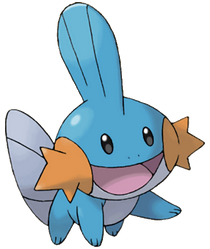 So i herd u liek Mudkipz?
…eheh. Sorry. I couldn’t resist.
…caelicolae immortales, I hate that meme…
Today’s cute little bundle of utter nonsense is Mudkip, the… swampy… fishy… thing. Now, as for me personally, I’m sorry to say that, no, I don’t liek Mudkipz. His evolutions, Marshtomp and Swampert, belong to an archetype that I’m simply not very fond of. However, that doesn’t mean this is a bad design. Maybe Game Freak realised on their own how boring Feraligatr was, or maybe someone pointed out to them, or maybe (far more likely) Mudkip just happened to get lucky, because he is anything but a simple cartoon of an ordinary animal. He’s probably based on something like an axolotl – a curious species of salamander that, although it does have an ‘adult’ form, never actually metamorphoses under natural conditions, and retains the gills of a larval salamander for its whole life (you can force an axolotl to metamorphose and become a land animal, but the stress will either drastically shorten the poor thing’s lifespan or kill it outright – I’m sure there’s a metaphor in that somewhere…). Axolotls are fully aquatic, but Mudkip is more an amphibious creature; he has fins to help him move through the water, but his legs can support him on land, and while he still has functioning gills, he seems to have air-breathing lungs as well. He retains this mixture of traits as he evolves into a veritable ‘creature from the black lagoon.’ Well, eventually. I’ve always thought Marshtomp looked a little bit gormless, and to be honest Swampert does too, in Sugimori’s art, but most of his sprites are much better, and it doesn’t take a great deal of imagination anyway to picture this froglike behemoth as a pretty terrifying opponent. As I said, I don’t liek Mudkipz – in general, I’m simply not a fan of brutish, physically imposing Pokémon, which is what he eventually becomes (Mudkip himself, I admit, is pretty cute). As brutish, physically imposing Pokémon go, however, Swampert is a keeper. Pure boulder-crushing power isn’t all there is to him; the whole line also has impressive sensory abilities. Mudkip, Marshtomp and Swampert can use their fins to detect pressure differences and ‘feel’ objects and Pokémon moving around them – most effectively in water, but in air as well – and have extremely good vision, allowing them to see through murky water with ease. Swampert can even predict storms well in advance by sensing air currents, and will pile up boulders to protect his coastal territory. I find it odd that they apparently live on beaches, since they seem to be based on a freshwater animal and are linked with swamps and marshes; in particular they like to dig burrows in mud and damp soil, not sand. I think they must live in estuaries, mangroves and salt marshes, intersections of terrain types, which implies a fair degree of hardiness and adaptability – and, to look at these Pokémon, I can certainly believe that.
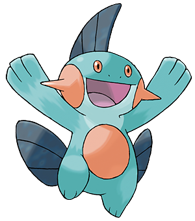
Swampert is a great big bulky physical attacker, and in that respect he does a pretty good job of stealing what little of importance Feraligatr ever had to his name. Like Sceptile, he shows that Game Freak did, in fact, learn from their mistakes with Feraligatr, but unlike Sceptile he takes every possible opportunity to rub Feraligatr’s face in it by being better at everything ever. Both of them were mainly reliant on Earthquake in Ruby and Sapphire, but Swampert was by choice and Feraligatr by necessity; since Swampert is a Water/Ground dual-type his Earthquakes are significantly stronger than Feraligatr’s and actually make a good primary attack. Swampert got just about every important attack Feraligatr did except for Swords Dance, and was better at all of them. In fact, his stat distribution makes him better than Feraligatr at pretty much everything. He’s slower, but Feraligatr isn’t fast enough for speed to matter a whole lot anyway; all his attacks are more powerful, he’s significantly better at taking special attacks, and thanks to his higher HP they’re actually pretty similar in terms of physical bulk. To cap it all off, Swampert’s type combination doesn’t just make his Earthquakes stronger; it also grants immunity to Electric attacks, leaving him with only one weakness (Grass – a type not exactly known for its powerful attacks or formidable sweepers). He also steps on Wooper and Quagsire’s toes a great deal; they have very different design aims, since Quagsire is clearly supposed to be cute, but they’re both big amphibious swamp-dwelling Water/Ground Pokémon that act as physical tanks, which Swampert is much better at doing than poor Quagsire. Don’t get me wrong, it’s good that Swampert is effective; it just hammers home how much of a lottery Pokémon’s ‘game balance,’ if you really want to call it that, can be. The differences between Feraligatr and Swampert appear to suggest that Game Freak knew, by this point, that a Water-type couldn’t be a top-notch physical attacker under the rules of Ruby and Sapphire without some kind of extra sparkle, and the combination of Quagsire’s excellent typing with Feraligatr’s high stats provide Swampert with just that. Kind of a shame about his predecessors, though. In general, my stance is that making a new Pokémon that totally supersedes an old one, when you could just make the old one good, is Bad Design. They did eventually start being nice to the older Pokémon; Feraligatr’s a sweeper now, and Quagsire is potentially useful if oddly specific, though at the time of Swampert’s introduction, Quagsire could practically have evolved into Swampert. In the end, I want to forgive Game Freak this time – in Feraligatr’s case, anyway – because I think Feraligatr is an unimaginative gob of mindless sputum hocked up by a dying frog, and that Swampert is a far superior design anyway.
Yes. That entire paragraph was only in there so I could bash Feraligatr some more.
Let us move on.
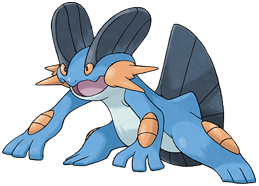
So, like I was saying, Swampert is tough. Unlike Feraligatr, who by this point had Swords Dance and was pretending to be fast enough to be a sweeper, Swampert’s buff of choice was Curse, which acts to turn him into a slow but powerful behemoth of a Pokémon capable of taking, and dishing out, physical attacks ‘til the Miltank come home. To back up his terrifying Earthquake attack, Swampert picked up Rock Slide with the release of Leaf Green and Fire Red – not a powerful attack, but good for punishing Flying-types. Surf and Ice Beam worked off his weaker special attack stat, but he was still better at them than Feraligatr, and didn’t actually have to rely on them, thanks to Earthquake. If you like paralysis, Body Slam was an option, and he could turn his bulk and lack of weaknesses into formidable weapons with Counter or Mirror Coat. Roar, finally, is a handy toy for a tough Pokémon to have; Swampert can often afford to wait for his opponent to attack first if it means throwing a spanner in the works by forcing a switch. In short, Swampert was a highly effective physical tank from the moment of his release, and Diamond and Pearl only made things better – the introduction of physical Water attacks, obviously, being the main benefit. With them came Hammer Arm, a strong and reliable Fighting attack, and eventually Ice Punch. His support options also expanded to include the time-delayed sleep attack, Yawn, but for all practical purposes Yawn is mostly for forcing switches, since switching out a drowsy Pokémon will keep it from falling asleep, and Swampert can already force switches very effectively with Roar. Finally, of course, Diamond and Pearl gave Swampert the oh-so-delightful Stealth Rock, so now he can damage whichever Pokémon comes in to replace one he Roars away. And that… well, that is pretty much the end of Swampert’s development. Black and White didn’t really change him at all. His Dream World ability, Damp, prevents Pokémon from using Explosion or Selfdestruct – amusing, but ultimately very situational, especially since Black and White drastically reduced the effectiveness of both attacks. Like most Water Pokémon, he can now burn opponents with Scald to weaken their physical attacks, but Scald is a special attack, and Swampert isn’t exactly bad at taking physical attacks anyway, so sticking with Waterfall is fine too.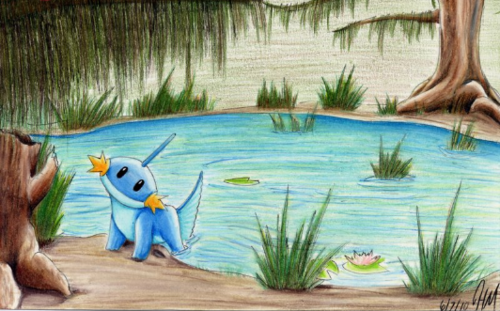
Although Black and White seem to have largely forgotten about him, Swampert is still a perfectly solid Pokémon with a small but useful support movepool and wonderful all-around endurance. Be careful of Black and White’s sleep mechanics if you want to use him – switching a Pokémon out now resets the number of turns it will take to wake up, which means that Rest is no longer a reliable form of healing, and Swampert doesn’t have anything else. Don’t expect him to take too many hits… and, as always, avoid Grass attacks like the plague. If you can find it in your heart to love a monstrous swamp-thing, though, you could do far worse than Swampert.
 Pokémaniacal