Charmander, Charmeleon and Charizard

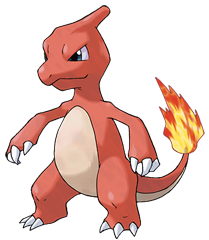
Charmander.  Artwork by Ken Sugimori; Nintendo is Luke's father.There’s something about Charizard.  Maybe it’s the inherent awesomeness of Fire as an element.  Maybe it’s the allure of his base set trading card, whose Fire Spin was pretty much the most powerful attack in the game.  Maybe it’s the fact that he’s a goddamn freakin’ dragon.  Charizard is easily the most popular of the first-generation starters and, despite my perpetual love affair with the Grass type, I have to admit that it’s easy to see why.  Charmander may be cute as a button but one look at his burning tail shows that he means business nonetheless.  Charmeleon has the look of a proud fighter who loves to punch above his weight.  Charizard simply demands respect, and incinerates anyone who denies him.  What more could we possibly want?

Charmander and his family are just what you’d expect from Fire-types: figuratively and literally hot-headed Pokémon who believe quite firmly that if there is a problem that can’t be solved with fire, it’s only because you aren’t using enough fire.  Although this seems like it would be the default stance for most Fire Pokémon, none of the other first-generation Fire-types (with the possible exception of Flareon) embrace “Flamethrower first, ask questions later” with the same gusto that Charmeleon and Charizard do.  Similarly, Charmander’s connection with fire is so strong that his tail flame is actually an indicator of his life force – the stronger and brighter the flame, the healthier the Pokémon.  It’s a very straightforward idea, but again, it helps to establish Charmander as the archetypal Fire Pokémon, to a much greater degree than Bulbasaur or Squirtle can be considered exemplars of their elements, which probably goes some way towards explaining his popularity.  The dragon factor is significant as well, especially since Charizard was – and arguably still is, even with Salamence around – the closest thing in Pokémon to a traditional Western dragon and, for much of Pokémon’s English-speaking audience, that’s a pretty big deal.  The actual Dragon-with-a-capital-D Pokémon of Red and Blue, for a Western audience anyway, don’t quite deliver; Dratini and Dragonair clearly have Eastern dragons in mind and, while Dragonite’s physical form owes something to the European conception of what a dragon is, he’s a softer-toned, almost ‘cartoonish’ (if I can even say that) representation of that idea; like a gentle parody of what Charizard is playing straight.  Dragonite’s personality, too, comes from a profoundly different tradition; he’s a benevolent ocean-dweller, very much at odds with the European dragons of, say, the Icelandic sagas.  Charmeleon and Charizard, on the other hand, have a definite malevolent streak, which brings me to something else I like about them, or rather about the way they’ve been handled – there’s definite evidence that the writers of the Pokédex have been trying to build up different aspects of their personality over the years to create a more detailed picture of these Pokémon.  The obsession with combat, for instance, seems to be something Charmeleon developed after the release of Red and Blue.  Also, remember the way Ash’s normally disobedient Charizard would voluntarily step up to the plate if he felt there was a worthy opponent on offer?  As of Ruby and Sapphire, that’s actually a recognised trait of Charizard as a species; in nature, they search constantly for powerful opponents to fight, and never use their fire against weaker enemies.  If you’ve been hanging around here long enough to be familiar with my philosophy of ‘doing more with less,’ well, this kind of thing – the gradual accretion of details that expand our view of a Pokémon’s nature and powers – is a big part of what I mean.  It’s really not that hard.
 Charmeleon.  Artwork by Ken Sugimori.

As Pokémon types go, Fire is pretty high up in terms of awe-inspiring elemental fury.  However, in Red and Blue, Fire actually got shafted pretty badly.  In a world where a lot of Pokémon relied on Normal attacks like Body Slam and Hyper Beam for type coverage, having primary attacks that were resisted by Rock Pokémon was not an enviable position, especially since most of the Fire-types had nothing else worth using – Magmar got Psychic and our dear friend Charizard managed to score Earthquake, but that was it.  Charizard had a further specific problem, which was that in Red and Blue his attacks were – despite what that awesome trading card might suggest – actually fairly lacklustre.  Not exactly bad but Venusaur, believe it or not, could do better; Charizard’s strength was not power but speed – very useful if you wanted to abuse the way Fire Spin worked in Red and Blue, but honestly, if Fire Spin abuse is your thing you’d probably be better off with Rapidash or Ninetales anyway.  Charizard’s attacks were lacklustre because neither his attack stat nor his special stat was particularly high – pretty good, but nothing to write home about.  Then, of course, Gold and Silver split special into special attack and special defence, and suddenly Charizard’s Fire attacks started looking a lot more attractive.  Until Diamond and Pearl came along he still had few workable special attacks other than Fire-type ones, but Gold and Silver also brought Charizard the gift of Belly Drum, which can turn him into a devastating physical attacker at the cost of half of his health.  Again, speed is his strength – Charizard was, and remains, the fastest Belly Drummer in the game (well, tied with Linoone now, but who’s counting?), an important attribute to keep other Pokémon from preying on his weakened health bar.
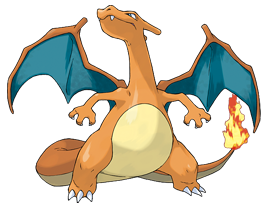
 Charizard.  Artwork by Ken Sugimori.

Diamond and Pearl eventually gave Charizard physical Fire attacks to use with Belly Drum and special Flying attacks (as well as Focus Blast and Solarbeam) to bulk out his other sets.  Unfortunately, they also gave the world Stealth Rock, a pox of a move that almost every serious player uses.  It’s similar in concept to Spikes, introduced in Gold and Silver, in that it creates a trap to damage Pokémon as they switch in, but with a number of differences.  Stealth Rock can be set up in a single turn, while Spikes takes two uses to match Stealth Rock’s average damage output, and three to exceed it.  Spikes is a relatively exclusive move, while Stealth Rock was available as a TM and therefore accessible to all and sundry.  Finally, Stealth Rock accounts for weaknesses and resistances.  Pokémon doubly weak to Rock attacks, like poor Charizard, lose 50% of their health just for switching in against a team with the foresight to set up Stealth Rock.  The notion of game balance has never really existed in Pokémon anyway, but if it had, Stealth Rock would have killed it by making a weakness to Rock attacks far more important than any other single aspect of a Pokémon’s resistance profile.  The point for us here today is that, from Diamond and Pearl onwards, you can’t use Charizard without a Pokémon with Rapid Spin to clear away Stealth Rock when it turns up.  Well, I mean… you can.  You’ll just lose.  Repeatedly.
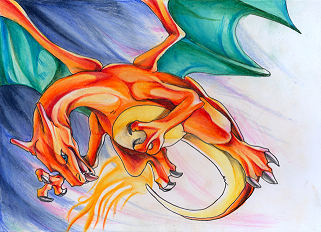
 This little slice of awesome is from the Destroyed Steak Pokémonathon (http://destroyedsteak.deviantart.com/), a sadly short-lived attempt by two artists to draw every Pokémon in order.  Seems to have been pretty epic while it lasted, though.

The transition to Black and White didn’t significantly alter Charizard’s movepool; he’s never been much of a tank, so losing the potential for healing with Roost doesn’t bother him much, and Thunderpunch was nice but it’s not like he doesn’t have plenty of other physical attacks to toss around.  The big change for him, as for Venusaur, was his Dream World ability.  There’s nothing wrong with the standard Fire starter ability, Blaze, which adds a little spice to Fire attacks when your health is low, but Charizard’s new Solar Power ability – like Chlorophyll for Venusaur – is something else.  Only two other Pokémon, Sunflora and Tropius, possess this lovely ability, and both of them are far too slow to take advantage of it.  Charizard is another story.  Solar Power burns a little of Charizard’s health every turn while Sunny Day is in effect, but in return boosts his special attack by 50%.  Meanwhile, the normal effects of Sunny Day will be jacking up his Fire attacks anyway.  Keeping a solar Charizard alive for any length of time is profoundly difficult, since Charizard isn’t exactly renowned for toughness anyway, but even the toughest of Water Pokémon will wither in the face of his Fire Blast.

In some ways I think that Charmander, Charmeleon and Charizard provide the best example from the first generation of what a starter should be, a Pokémon that embodies the essential characteristics of its element – in this case, Fire’s destructive nature and passion for combat.  Unfortunately Red and Blue let them down a little, as they let down all Fire-types, but ever since Gold and Silver, Fire has held a prestigious position as one of the few elements able to reliably damage Steel Pokémon, and Charizard has been generally well-supported throughout the games’ development, in spite of his present difficulties in dealing with Stealth Rock.  In summary, then, while they aren’t my favourites, I believe these Pokémon are the result of strong designs that have been quite well-handled from start to finish – good pieces of work.

Bulbasaur, Ivysaur and Venusaur

Oh, Bulbasaur; I know you aren’t as popular as Squirtle or Charmander, but my heart will always belong to you…

 Bulbasaur.  Artwork by Ken Sugimori; we are all part of the Great Circle of Nintendo.

Today is basically going to be one huge nostalgia trip for me, since we’ll be looking at my first Pokémon ever: Bulbasaur, the first-generation Grass-type starter Pokémon.  It’s hard for me to express how much I loved this little guy; I honestly don’t think I ever chose a different starter on any of my myriad playthroughs of Blue version as a kid (I branched out a little on Leaf Green, but Bulbasaur remained my favourite).  It’s probably fair to say I’m slightly biased, but I will do the best I can to back myself up with sensible argument.  Here’s why I think Bulbasaur is awesome.


What made Bulbasaur stand out amongst the Grass Pokémon of Red and Blue was his heavy emphasis on the idea of symbiosis.  Most of the first-generation Grass-types (in fact, most Grass-types full stop) are plants – Oddish, Bellsprout, Tangela and Exeggcute may move, talk and fight, but they’re very clearly plants with a couple of animal traits rather than the other way around.  The subsequent Grass-type starters, and a few other weirdoes like Leafeon, all reject the trend and are animals with a couple of plant traits.  Bulbasaur is unique in being neither; his appearance gives the impression of two distinct but joined organisms, one animal and one plant, and this is explicitly what he is, with a seed “planted on its back at birth.”  Even today, there’s only one other Pokémon that balances its plant and animal aspects in the same way, and it’s actually one that’s been around from the beginning.  It’s Paras.  Truthfully, though, Paras and Parasect with their story of parasitism are even stranger.  They may be terrible Pokémon but they have one of the most fascinating designs of the entire first generation; they’re not the point of this entry, though.  The point is, although Bulbasaur is the first Grass Pokémon many trainers will ever meet, he’s not at all archetypal; in fact he’s the best example of an idea that the subsequent Grass starters never quite caught onto.  In Bulbasaur’s Mysterious Garden, Brock describes Bulbasaur, Ivysaur and Venusaur as a symbol of nature’s interconnectedness and the fundamental dependence plants and animals have on each other.  He’s perhaps poeticising a bit excessively, but I actually quite like this way of looking at them; if you wanted to come up with such a symbol, you could do much worse than Bulbasaur.  It might have been nice if the later starters had explored symbiosis in different ways to create contrasts with Bulbasaur – Torterra, actually, does this quite well – but he’s still fun on his own.  As compared to the other starters of his own set, Bulbasaur is a little odd.  Squirtle and Charmander follow broadly similar progressions from cute through tough to full-on badass; Blastoise with his heavy cannons and Charizard with his, y’know, being a freakin’ dragon.  Bulbasaur is different.  I think he is meant to be cute (well, I think he’s cute) but clearly not so overtly as Charmander or Squirtle; he almost seems to aim for the ‘tough’ aesthetic from the beginning (the fact that he’s the only quadruped in the group is probably a factor since it adds to his physical stability) and then just builds on it as he grows through Ivysaur to Venusaur.  ‘Badass’ is a hard adjective to define, but I don’t think it describes Venusaur, or at least not as well as it describes Blastoise and Charizard.  Instead Venusaur projects a sense of age, experience and self-control – this is a Pokémon that can fight, but chooses not to.  Venusaur is not for everyone, but for me it was his differences that made him my favourite.

 Ivysaur.  Artwork by Ken Sugimori.

I’m sentimental, of course, but there are plenty of reasons to like Bulbasaur’s line other than their design characteristics.  Venusaur is a starter Pokémon, and as such high stats are his birthright – solid all around, with a bias towards his special stats.  Back in the olden days, Venusaur was the fastest Grass Pokémon in the game, which made him a good choice for using Grass’s two big trump cards: Sleep Powder and Leech Seed.  He was also one of only two fully evolved Grass Pokémon (the other being Victreebel) with Razor Leaf, easily the best Grass-type attack at the time because of Red and Blue’s idiosyncratic critical hit mechanics and the absence of any way to speed up a Solarbeam.  On the ‘con’ side, Venusaur was a Poison-type Pokémon in a world ruled by Psychic-types, an uncomfortable place to be, and Poison had no powerful attacks in Red and Blue.  Over the years, Venusaur developed into a versatile tank who can focus on physical or special, offense or defence.  With the advent of Sunny Day, Razor Leaf was replaced by Solarbeam as the Grass type’s strongest offensive option, then Solarbeam eventually by Giga Drain and Seed Bomb, but Leech Seed and Sleep Powder remained potent weapons in Venusaur’s arsenal.  He gained the ability to rebalance himself towards slow, bulky physical offense with Curse in Gold and Silver; with the addition of Earthquake to his movepool in Ruby and Sapphire, he can act as a competent physical tank.  Power Whip and Leaf Storm present devastating options for Grass-type damage.  As a Grass-type, Venusaur is also one of the few Pokémon who actually appreciates having Poison as a secondary offensive element in the form of Sludge Bomb, since it can swiftly deal with other Grass Pokémon, who are immune to Leech Seed and resistant to Earthquake.  Finally, Synthesis lets Venusaur heal – it may be unreliable, dependent as it is on fine weather, but it backs up his reasonable defensive stats nicely.

 Venusaur.  Artwork by Ken Sugimori.

Black and White brought Venusaur two major gifts, the first of which is Growth.  Growth has been a part of Venusaur’s movepool from the beginning, but its usefulness decayed after the special stat was split into special attack and special defence in Gold and Silver, since it then increased only special attack, not both.  Black and White have given Growth – and with it, many Grass Pokémon – a new lease on life; it now increases both physical and special attack, giving Venusaur more diverse options for putting together an offensive moveset.  Even better, Growth’s effect is now doubled in bright sunlight, allowing Venusaur to slot quite neatly into almost any sun team as a dangerous bulky sweeper.  The other great blessing Venusaur received was his Dream World ability, Chlorophyll.  When Ruby and Sapphire introduced abilities Venusaur, like all the other starters, received an ability that boosts the damage of his elemental attacks when his health is low (for the Grass-types, this ability is called Overgrow).  While this is nice to have, it’s difficult to plan to make use of it.  Chlorophyll, on the other hand, an ability available to many Grass Pokémon which doubles their speed in bright sunlight, compliments the newly-improved Growth perfectly to make the Grass-types that possess both extremely dangerous.  Several other Grass Pokémon have this combination, but few of them can compete with Venusaur. Victreebel is stronger, but he’s also much frailer and doesn’t learn Earthquake, which limits the usefulness of his excellent physical attack score.  Tangrowth is so slow that he still risks being outrun even with the Chlorophyll boost, and his special defence is shockingly bad (though it’s worth noting that Tangrowth can sit and get pummelled by physical attacks all day without blinking).  Shiftry is fast and has a nice movepool, whether you want to go physical, special, or both, but curls up and dies after even the weakest attacks.  This is not to say that all three don’t have advantages of their own, of course, but Venusaur is definitely up there with the strongest solar Pokémon.  Getting your hands on a Dream World Bulbasaur may not necessarily be easy, but they are out there, so see if you can find something valuable to trade for one.

As my very first Pokémon, Bulbasaur has inevitably become something of a gold standard for me.  A simple but well-executed design with pleasing symbolic connotations, coupled with measures of power and versatility that, for most of his history anyway (the additions from Black and White change this somewhat), have proven generous without creating an unachievable benchmark for the poor rank-and-file Pokémon.  Even today, even if I must admit to having soft spots for many of them, given the choice of any of the fifteen starter Pokémon of the past and present, I would find it very difficult not to stop looking at #001.

Next Time On Pokémaniacal: Starter Pokémon

Right.  That’s enough of that.  For now, anyway.

A few weeks ago (or… maybe it was months… or… something) reader NateyM suggested I review and rank the starter Pokémon.  I wasn’t so sure about the ranking, mainly because I have to admit I’m horribly biased on this one: I like all the Grass-type starters better than all the Fire- and Water-type ones; in fact I’ve never actually chosen a Fire- or Water-type for my first playthrough of a game.  Why?  Because Grass Pokémon are awesome; now shut up.  Anyway, although I do my darnedest to stay impartial when I review individual Pokémon and have honed my objectivity to a razor edge, I’m not convinced I could produce a ranking that would be truly meaningful.  Not to mention I’m genuinely frightened of what everyone else would think of my decisions – if you look at my Top Ten Worst Pokémon Ever, well, most rational people can agree that Kricketune is a rat’s anus of a Pokémon that should never have existed in the first place, but if I actually come out and say that I think Empoleon is better than Blastoise or whatever, I could get lynched!  I prefer courses of action that keep lynchings to a minimum, where practicable, especially in situations where I would be the lynchee.  Hmm.  Lynchee.  Is that even a word? *right-click; add to dictionary* It is now.

Nor am I going to be doing my old “I hereby affirm/deny this Pokémon’s right to exist” schtick, partly because that would also fail to minimise lynchings, but also because the starter Pokémon as a group are pretty well designed, on the whole.  There are very few that I have major problems with.  The fact is, Game Freak do pay a lot of attention to the starters; they know how important these Pokémon are  to creating a good first impression with the audience and getting players invested right from the start, so for the most part they do a pretty good job with them.  With… y’know… certain exceptions, but let’s leave that discussion to the individual entries.  The other problem is that it’s hard to establish a point of reference when talking about the starters because there’s a batch of them in every generation.  Each trio of starters was created in a different environment, with a different set of Pokémon around already and a different set of Pokémon being introduced concurrently, and each trio has endured different changes in the way the games’ mechanics function and different changes in their own battle roles, and so on.  I’m going to talk about all that stuff as we go, of course, but in most cases it’s a bit more complicated than a simple yes/no.

I’m not going to cover the Black and White starters ‘cause, y’know, I already did.  Here’s Snivy, Tepig and Oshawott.  I guess I might do Snivy again if I feel like it, since that was my first entry ever and quite a bit shorter than what I’ve become accustomed to writing, but I don’t think there are any major points I need to make.

Anyway, there’s no place to start like the beginning, so my next entry will be about Bulbasaur, Ivysaur and Venusaur, the original Grass-type starters.  See you then!

Anime Time: Episodes 26 and 32

Pokémon Scent-sation – The Ninja Poké-Showdown

Last anime review for a few weeks so we can look at something else, so let’s make it a good cut-off point: Ash’s next two Gym battles, against Erika of the Celadon Gym and Koga of the Fuchsia Gym.  Can he defeat these fearsome foes?  Don’t be silly; of course he can.  He’s the main character.

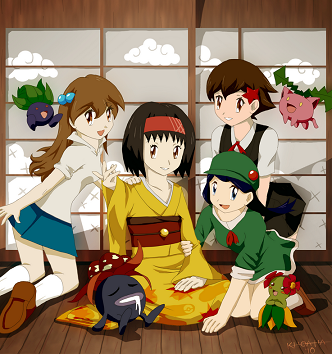
 Erika and her homies chilling at the Celadon Gym with their Grass Pokémon, by Dark Lugia (http://darklugia1.deviantart.com/).

When the gang arrives in Celadon City, Misty immediately drags them into a perfume shop to do girl things while Brock ogles the shop assistants.  Ash scoffs, declares to everyone in earshot that perfume is foul-smelling, overpriced garbage that “turns guys into zombies,” and is thrown out of the store by the bitterly offended manager.  He doesn’t care, because he’s only interested in getting to the Celadon Gym anyway.  Unfortunately, it turns out that the Gym manufactures perfume, and the trainers there are none too pleased with him.  They refuse him entry and he wanders off, dejected, until serendipity strikes.  Jessie, James and Meowth have been trying to infiltrate Celadon Gym to steal their secret perfume recipe – unsuccessfully; they ran into the Leader’s Gloom, whose stench was bad enough to overpower even Koffing.  They concoct a cunning plan to get both Ash and themselves inside.  Because they are Team Rocket, this plan involves cross-dressing.  They disguise themselves as parents wanting to enrol their ‘daughter’ – Ash in a dress and a blonde wig – in a Pokémon training class at the Gym, so they can slip inside too.  Ash is permitted to enter the Gym’s inner rooms, where he finds not only that the Gym Leader, Erika, is the manager he insulted in the perfume store, but also that Misty, Brock and Pikachu are there already, participating in one of Erika’s classes.  Misty asks why Erika’s Gloom doesn’t stink, and she responds by telling the story of how Gloom saved her from a wild Grimer when she was a child, and explains that Gloom’s stench is purely defensive and won’t trigger if Gloom feels safe.  Ash can’t maintain his disguise for long once Misty and Pikachu start talking to him, so he drops the act and challenges Erika.  Bulbasaur is unable to defeat Erika’s Tangela, but her next Pokémon, Weepinbell, quickly loses to Charmander.  Erika grudgingly acknowledges Ash’s skill, but declares that “there’s one thing you don’t have – empathy for your Pokémon!”  Erika’s… kinda full of it; Ash has many shortcomings as a trainer but empathy is probably his greatest strength.  Anyway, she calls out Gloom and Charmander passes out within seconds.  Pikachu volunteers to step into the ring, but the battle is interrupted by Team Rocket appearing and blowing themselves up by mistake (although they do escape with a vial which, sadly, turns out to be only one ingredient of Erika’s perfume – “essence of Gloom”).  The Gym is now on fire.  The trainers rush around frantically to evacuate the Grass Pokémon, and once they’re all outside Squirtle and Misty try to put out the blaze.  In the chaos, however, Erika… somehow left behind her Gloom.  Y’know, her partner Pokémon, her dearest friend.  Ash charges back into the burning building, finds Gloom, manages to calm her down enough to get her to stop filling the area with noxious fumes, and carries her out.  Erika is sufficiently impressed by all this to concede that Ash really does possess true empathy, and decides to write off their battle and award Ash a Rainbow Badge for going beyond the call of duty (for those counting, that’s 1/5 badges so far that he’s earned by winning a legitimate Gym battle).

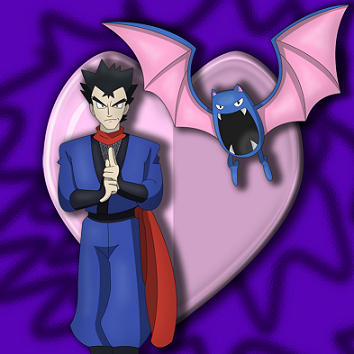
 Koga with his Golbat and Soul Badge, by Fox0808 (http://fox0808.deviantart.com/)

Some weeks later, we find Ash and his companions lost in the forest, as usual.  They’re looking for the Fuchsia Gym, but the problem is that, in the anime, there doesn’t seem to be a “Fuchsia City,” or if there is, they never visit it; the Gym is very remote.  As they weave across the landscape, they find a walled mansion built like an old Japanese castle, and enter through the front gates to see whether anyone’s home.  The mansion is full of traps – rotating false walls, Voltorb concealed under the floorboards, glass panels that spring up to block their path – and the only inhabitant seems to be a Venonat who keeps leading them into trouble (we know, from our privileged position as the audience, that this Venonat has been watching Ash and his friends for some time).  Venonat turns out to belong to a pink-clad ninja girl named Aya, who introduces herself by nailing Ash’s jacket to the wall with a fistful of shuriken, and refuses to let them leave without a battle.  Ash’s Bulbasaur counters Venonat’s Stun Spore with… Whirlwind… which is not a thing Bulbasaur has ever been able to do in any version of the games, although, to give them credit, it doesn’t come completely out of nowhere because Bulbasaur actually pulled the same thing on Butterfree when Ash first met him (Bulbasaur’s Whirlwind just involves puffing up his cheeks and blowing really hard).  Finally Bulbasaur saps away all of Venonat’s power with Leech Seed.  Aya’s older brother, Koga, shows up to critique her battling, and explains that the mansion is, in fact, the Fuchsia Gym and he is the Gym Leader.  He accepts Ash’s challenge and meets Pidgeotto with another Venonat, who rather dramatically evolves into Venomoth the moment the battle begins.  Venomoth’s powder attacks are too strong for Pidgeotto’s Whirlwind, and Ash is forced to switch in Charmander, who is rapidly becoming his powerhouse Pokémon and can handle Stun Spore quite effectively with his Flamethrower.  Jessie and James show up to interrupt and hurl sticky webs around the room to disable everyone’s Pokémon, and the heroes are forced to retreat from Arbok and Weezing through the Fuchsia Gym’s traps.  Eventually, to Misty’s dismay, her perennially confused Psyduck is the only thing standing between Team Rocket and the good guys.  Ash flips open the Pokédex to help her figure out what Psyduck can actually do, and his pathetic attempts at Scratch and Tail Whip attacks reduce Jessie and James to hysterics.  Meowth is getting impatient, however, so Arbok eats Psyduck’s head.  This turns out to be a mistake, because – as the Pokédex helpfully explains – when Psyduck’s perpetual headaches become worse than usual, he gains phenomenal telekinetic powers, which he uses to crush Arbok and Weezing and send Team Rocket flying.  Ash and Koga resume their battle outside, and although Koga’s Golbat proves quite a challenge with its blistering speed and horrible Supersonic attack, Charmander manages to overcome it with Fire Spin and earn Ash his Soul Badge.

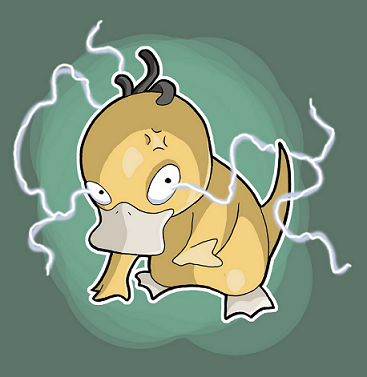
 A little reminder from Jake Richmond (http://jakerichmond.deviantart.com/) of just why Psyduck is a badass.

The Ninja Poké-Showdown is the first of many episodes with subplots that revolve around Misty and Psyduck.  Misty never wanted Psyduck and it’s not entirely clear that Psyduck understood what he was doing when he climbed into Misty’s Pokéball either.  She tolerates him, barely, but his tendency to leap out of his Pokéball when she wants a different Pokémon (usually Starmie) grates on her nerves, especially since he invariably has no idea what’s going on and can’t actually fight.  Whenever his headaches get bad enough to unlock his powers, however, he becomes probably the strongest Pokémon in the whole party.  At the beginning of this episode, Misty suggests that she trade Psyduck for Brock’s Vulpix in order to get rid of him, but by the end, she’s turning down Koga’s generous offer of a trade for his Venomoth.  Although she never stays happy with Psyduck for long, I feel that his sporadic successes do gradually wear her down over the course of the series, softening her less attractive character traits, like her impatience and her superficiality, and increasing her capacity for empathy.

Anyway, this entry was supposed to be about Gyms, so let’s look at those some more.  Again, we see that Pokémon Gyms are fundamentally very independent.  No-one questions Erika’s decision to bar Ash from the Gym for insulting her profession, or her later decision to confer a Rainbow Badge, even though he was actually losing their battle (hey, the guy did run into a burning building to save a Pokémon; he deserves something).  More importantly, one can suppose that Erika isn’t reliant on Pokémon League funding to maintain the Celadon Gym, because the high-quality perfume the place produces probably earns her and her trainers a fair amount of money.  I’m not sure I even want to guess what Koga and Aya might do to supplement their income, but presumably they don’t live in the middle of nowhere practicing ninja arts just for their health, y’know?  The isolation of Fuchsia Gym is another interesting point; the games like to portray Gym Leaders as pillars of the community, but anime Koga is almost a hermit and the Fuchsia Gym doesn’t even announce itself as a Pokémon Gym.  In both the games and the anime, it’s a historic ninja training ground, presumably with a long tradition of Pokémon training, and probably predates the formation of the Pokémon League.  It’s odd that the League would award official status to such a remote compound; it’s unlikely they get many visitors or take many challenges.  It seems like common sense that a Gym is supposed to provide a place for local trainers to practice their craft, and the way Erika runs the Celadon Gym – offering classes on Pokémon training – seems to back this up, but the Gyms Ash visits in the anime have such wildly varying administrative structures and community roles that it’s difficult to work out what on earth is supposed to constitute ‘normal’ for these people.  We can strike off the Saffron Gym right away because it’s inhabited by a maniacal cult; likewise the Viridian Gym, which is a crime lord’s den.  The fact that the Cinnabar Gym even exists is one of Kanto’s best-kept secrets.  The Pewter and Vermillion Gyms seem like dark, forbidding places occupied only by the Gym Leader and (in Vermillion) a couple of sidekicks.  The Cerulean Gym, worst of all, is run by Misty’s sisters.  No-one has a particularly clear idea of what a Gym ought to be or do other than that it should accept challenges and give out badges, as appropriate.  Celadon seems like a good model for how a Gym should be run, but it’s the exception, not the rule, and I doubt the Pokémon League has much say in any of this.

I can’t help but assume that Koga, like Sabrina, has some excuse for operating his Gym the way he does, because his is one of the weirder situations.  If I can be allowed to speculate a little, the Fuchsia Gym – since we know it has a long history – might have been involved in creating the Indigo League in the first place; it’s been a Gym for as long as there have been Gyms, and has stayed the same as conceptions of ‘what a Gym should be’ have changed around it.  Any attempt to get rid of it now would deny its historic contributions, so Koga is free to sit in his ninja castle and give Soul Badges to anyone crazy enough to trek out to the Gym, pick through all his traps, and get past his lunatic pink ninja sister.  It’s a little unfortunate I haven’t had much to say about Celadon Gym today but, well, I’m drawn to things that require explanation and, frankly, Erika’s Gym is almost freakishly normal considering what whacked-out places most of the Kanto Gyms are…

Anime Time: Episodes 30-31

Sparks Fly for Magnemite – Dig Those Diglett

 This fanart of a Grimer in a place not unlike Gringy City, by Quinnzel (http://quinnzel101.deviantart.com/), actually looks marginally less repulsive than most Grimer.  It's almost cute... y'know, in a... hideous misshapen travesty of nature kinda way...

Sparks Fly for Magnemite sees Ash, Misty and Brock visit Gringy City, an industrial town that is almost as pleasant as it sounds.  Dirty, smelly, and blanketed with choking smog, the place seems to be all but abandoned, and as if today weren’t bad enough already, Pikachu’s cheeks are discharging sparks at random.  The distressingly ineffectual Nurse Joy #222 lazily diagnoses Pikachu with a cold and tell Ash to leave him at the Pokémon Centre overnight… but then, to add a finishing touch to what is already the low point of the week, the power cuts out and leaves all the Pokémon in the ICU without vital life-support machinery.  Ash leaves Pikachu at the Pokémon Centre, but he sneaks out and follows them because he’s kind of insecure and is worried Ash might ditch him.  After stopping at the police station to consult Officer Jenny #400, who’s almost as unhelpful as Joy but at least gives them directions, they head for the seemingly abandoned power plant.  As they walk through the dark corridors, they sense something following them – a wild Magnemite.  Ash initially wants to catch it but Misty points out that it doesn’t seem to want to battle (yes, this matters; trying to capture a Pokémon that doesn’t want to fight you almost seems to be thought rude, if not downright impossible).  In fact, Magnemite just wants to hit on Pikachu.  Before anyone has time to ponder Magnemite’s choice of love interest, a swarm of Grimer, led by a Muk, burst into the corridor and, insulted by Ash and Misty’s failure to appreciate their charming aroma, attack.  Ash, Misty and Brock flee and find their way to the control room, where a pair of cowering engineers explain the situation: the huge numbers of Grimer have clogged the power planet’s seawater intake.  The Grimer break down the door, and it seems all is lost; there are just too many for Ash, Misty and Brock to deal with… until Pikachu’s strange boyfriend reappears with an army of Magnemite and Magneton.  Together with Pikachu, they send the Grimer scurrying away, restoring power, and weaken the Muk enough for Ash to capture it (since it turns out that Muk’s smell leaks through the Pokéball – how the hell do those things work, anyway? – Ash quickly sends it back to Pallet Town for Professor Oak to deal with).  Magnemite loses interest in Pikachu, since the sparks were actually symptoms of overcharging, which altered his magnetic field (it actually makes a lot of sense that Magnemite would recognise each other by their magnetism; I quite like this), and he’s burnt up his excess in the battle with Muk.  Our heroes suggest keeping the charming little town cleaner to reduce the numbers of Grimer, Useless Joy and Useless Jenny thank them for making everyone in Gringy City a better person just by meeting them, and they go on their merry way.

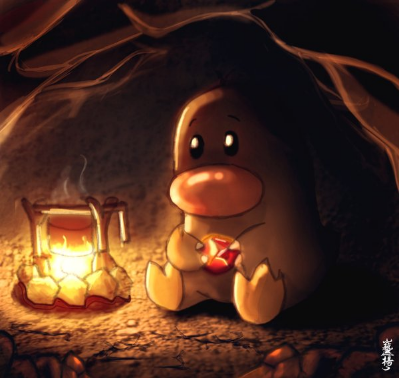
 The most adorable possible interpretation of the question "what does the lower half of Diglett's body look like?", by YiYang1989 (http://yiyang1989.deviantart.com/)

Of course, they promptly get lost again.  Ash is looking for the Fuchsia Gym, but unfortunately “Fuchsia City” doesn’t actually appear to be a thing in the anime, and the Gym is in the middle of nowhere, which makes it rather difficult to find.  As they wander, an explosion rocks the hills (disturbing Team Rocket’s lunch and prompting them to seek revenge), and as they run to look they see a convoy of trucks being wrecked by a troupe of Diglett.  The Diglett are interfering with the construction of a dam nearby, and the foreman has called for Pokémon trainers to help drive them off, including Gary, who remains as insufferable as ever.  In the English continuity this is the first time Brock and Misty have met him, because Beauty and the Beach was axed.  They hate him instantly.  Fortunately, Gary isn’t around for long: none of the trainers present, including Ash and Gary, can get their Pokémon to emerge from their Pokéballs, much less actually fight the Diglett, and Gary leaves in disgust, along with most of the others.  While Ash, Brock and Misty try to understand, Jessie and James are having a nervous breakdown because none of their evil schemes ever bear fruit.  They conclude that their Pokémon aren’t powerful enough, and decide to invoke “The Principle of Induced Evolution!”  This turns out to be a rather dull textbook.  They learn that Ekans and Koffing will only evolve if they gain enough experience, but also that evolution might change their personalities.  Jessie and James become conflicted and start sobbing over Ekans and Koffing, who begin to evolve when the tears touch them.  Meowth says smugly that “their time to evolve just happens to be now;” he seems to be suggesting that they were about to evolve anyway, but Ekans and Koffing haven’t fought anything for two and a half episodes, so this seems to be less a matter of gaining experience and more about making their masters proud.  Anyway, Ash and the others follow one of the Diglett away from the construction site and find a landscape being tilled and cultivated by Diglett and Dugtrio.  They realise that all the forests in the region – which the new dam would flood – are gardens built and maintained by the Diglett, who are understandably protective of their lands.  The other Pokémon refused to fight them because they agreed with what the Diglett were doing.  The foreman, seeing everything his plans would destroy, gives in and decides to halt the construction.  At this point Jessie and James show up with their new Pokémon, Arbok and Weezing, and try to go after Pikachu, but only seconds into the battle Jessie makes the supreme tactical mistake of sending Arbok underground, invoking the wrath of the Dugtrio, who summarily crush Arbok and Weezing before they can bring their new powers to bear (not sure what I think of this – on the one hand, it makes their evolution distressingly anticlimactic; on the other, it emphasises that power isn’t all that matters).  Order is restored and, well, the dam couldn’t have been that important anyway, right?

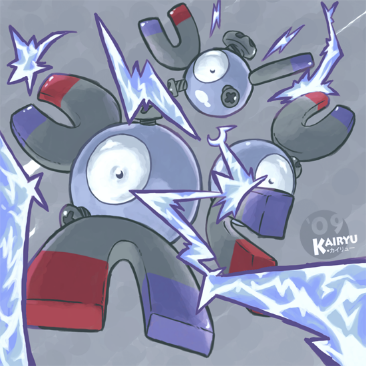
 Magneton fanart, by Kairyu (http://kairyu.deviantart.com/ - I don't think this dude's been using his account for some time but his Pokémon fanart is awesome, so check it out).  For those of the audience who had no childhood, three Magnemite make up a Magneton, their evolved form.

In the Pokémon world, the environment is a very fiddly thing to deal with – and not least because it will fight back!  Some (most? all?) Pokémon are sentient, which makes the notion of compromising their habitats an even trickier ethical question than it is in the real world.  It’s effectively conquest, which is the same kind of theme as we got in Tentacool and Tentacruel.  Of course, when your tools of conquest are, themselves, Pokémon, the whole thing doesn’t work so smoothly.  The refusal of the trainers’ Pokémon even to come out of their Pokéballs implies some very curious things.  First, they know what’s going on around them even while inside (again, how the hell do those things work, anyway?).  Second, they already know what the Diglett are trying to do, and since I doubt they would immediately understand the implications of the construction project on their own, this further suggests that they’re already familiar with the Diglett as regulators and protectors of the environment.  Attacking them is in some sense ‘not part of the deal.’  That’s not the interesting part, though.  The interesting part is how this episode differs from Tentacool and Tentacruel.  Until the bizarre accident with Team Rocket’s stun sauce, the Tentacool are essentially a passive part of the environment; everything they do is reactive.  The Dugtrio, on the other hand, are active agents in all of this, just as much as the humans are.  They deliberately manipulate the environment in order to create and maintain habitats for themselves and for many other species – and Brock speculates that this isn’t just a local phenomenon either, but something that Diglett and Dugtrio do all over the world.  They have a large-scale, systematically implemented plan for the management of the landscape, and mount a co-ordinated defence of that plan when it is threatened.  In fact, I think it’s a mistake to see the Dugtrio as part of ‘nature,’ or to see the ‘natural’ landscape of the hills and forests in the region as any less of a created, artificial environment than it would have become if the dam had been completed.  The way the Dugtrio handle things revolves around balancing the needs of multiple species, and is much more subtle than what the humans have learned to do.  Bear in mind, however, that the dam would probably have provided hydroelectric power and thus lessened the atmospheric pollution created by human dependence on fossil fuels (made so very prominent in Gringy City).  In short, although ‘nature’ and ‘civilisation’ form one of the core dualities that Black and White focus on, and although that same contrast is a theme that Pokémon as a franchise has always dwelt on often, I don’t think we should view Dig Those Diglett in quite those terms, since the Diglett and Dugtrio as presented here are, dare I say it, ‘civilised’ in their approach to the world around them.  Complications like this are – I think – exactly why trainers, who can act as mediators between Pokémon and humanity, are a vital part of society in the Pokémon world.

So, what about the Grimer?  Where do they fit in all of this?  Grimer and Muk (along with Koffing and Weezing, for that matter) are another of those strange little corner cases that make the Pokémon word so interesting.  Like the Diglett, they blur the lines between civilisation and nature, in that they’re a product of civilisation but not a part of it; in fact they’re a product of that most undesirable aspect of civilisation, industrial pollution.  You could even make the analogy that, just as Diglett create environments that are suitable for Rattata, Pidgey and other typical forest Pokémon, humans create environments that are suitable for Pokémon like Grimer, Koffing and Magnemite.  Sparks Fly for Magnemite clearly has an environmentalist moral; the people of Gringy City get their comeuppance for all the pollution their town vomits into the air when the Grimer, who feed on that pollution, multiply out of control.  The message is clear: we want a world without Grimer.  They’re still Pokémon like any other, though, presumably with the same rights from an ethical perspective.  Although Ash doesn’t often have reason to deploy his Muk, the Sludge Pokémon is a fantastic ally when he does (and an interesting… friend… to Professor Oak the rest of the time), so I don’t think we should necessarily assimilate the undesirable nature of their origins to the Pokémon themselves.  Is it right to clean up the polluted areas that constitute their ‘habitat’?  I’m not sure I have a satisfactory answer to this one yet, but for now I’m going to suggest seeing Grimer and Muk as regulators of the sensitive balance between humans and the environment – they can’t create toxic waste from nothing, and in fact they consume industrial waste.  One can only assume that they actually break the stuff down, resulting in products that are less harmful to other Pokémon.  They appear to make a situation worse because of the way they concentrate toxins, but I suspect that they’re really a positive influence.  Too much pollution, though, and they’ll just multiply and swallow your city, and you’ll be no better off.

I’m not sure how far my conclusions today match the writers’ original intentions (if at all); rather, this is an outline of a starting point for questions the franchise could ask and elaborations that could be made on its existing themes.  When I reviewed all the Unova Pokémon last year, I often talked about ‘doing more with less’ – this is sort of what I mean.  New Pokémon are great, but we don’t actually need them when the existing ones still have so much untapped storytelling potential.  Or at least, that’s what I think.  You may have other ideas.

Anime Time: Episodes 27-28

Hypno’s Naptime – Pokémon Fashion Flash

 (Apologies for the delay on this entry – internet connection conked out last night and I wasn’t able to post it.  Of course, that hasn’t stopped me from writing, so my next entry will be up on schedule.)

There’s little to connect these two episodes other than the fact that Misty and Brock each happen to gain new Pokémon, so for the most part I’ll be dealing with them separately.  That’ll take time, so without further ado…

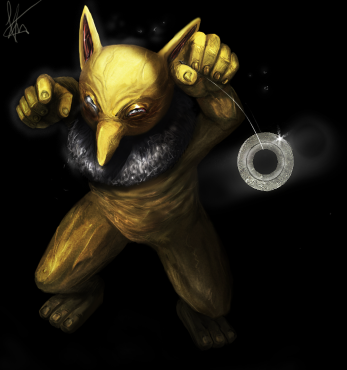
 Yikes, Hypno is creepy.  For this picture, thanks are due to =Snook-8 at http://snook-8.deviantart.com/.

In a place inexplicably known as “Hop Hop Hop Town,” Ash is suddenly accosted by an enormous pair of breasts calling him Arnold.  Once Ash explains that he is not Arnold, the woman attached to the breasts calms down and tells his group that her son has disappeared recently.  Ash wonders whether Arnold might have just wandered off to become a Pokémon trainer, which is apparently not an unreasonable thing for a young boy to do on a whim without telling anyone, but the mother has her doubts.   In fact, as they soon learn from Officer Jenny #309, Arnold is only the most recent of several young children to go missing over the last three days.  Ash, in his official capacity as a random wandering trainer, offers to help Jenny solve the case.  They check the Pokémon Centre for kids who know the missing children, but none of them have any information.  Nurse Joy #558 doesn’t know anything either, and has her hands full with her own crisis; all the Pokémon in her care are becoming lethargic, and she can’t understand why.  It all started – gasp! – three days ago.  Jenny suddenly remembers that she possesses a piece of technobabble known as a Sleep Wave detector, and that it’s been acting up recently.  She hasn’t been following up on it because, honestly, she’s just a terrible officer, but now she decides to follow the Sleep Waves to their source:  a mansion on top of a skyscraper.  Because, y’know, what better place to build a mansion.  Ash storms the mansion, and finds that it houses a society of well-to-do aristocrats, who term themselves the Pokémon Lovers’ Club, as well as a Drowzee and a Hypno, their favourite Pokémon.  Apparently, the members have been using Hypno’s powers to combat their crippling insomnia ever since their old Drowzee evolved… three days ago.  Brock suggests that their mysteries might be connected to Hypno modifying his Hypnosis for use on humans… so they do the sane thing and sit Misty down in front of him to see what happens!  Misty promptly becomes convinced she is a Seel and flees the building, leading the team to a park where they find the missing children, who all think they’re different kinds of Pokémon.  Brock has the idea of dragging Misty back up to the mansion to have Drowzee zap her, on the theory that Drowzee’s “Dream Waves” will cancel out Hypno’s “Sleep Waves” because… whatever.  Despite a characteristically incompetent intervention from Team Rocket, Drowzee cures Misty and puts the other kids to sleep.  When they wake up, they all remember who they are and rush back to their homes.  Nurse Joy’s Pokémon, likewise, all recover after a short nap… except for a single Psyduck, who remains totally dazed.  Psyduck doesn’t seem to have a trainer and no-one really wants him, but he manages to capture himself in a Pokéball Misty drops by accident, so she’s stuck with him.


This is one of many episodes that I think would make a good one-off side quest to stick in a game; it’s fairly simple, there’s a clear motive for most reasonable people to help, and most importantly you learn something about a particular species of Pokémon in the process.  Given the chance, I’d probably stuff the games with diversions a lot like this.  What we learn from Hypno’s Naptime specifically is that Psychic Pokémon are really friggin’ dangerous if you don’t know what you’re doing with them.  Granted, I can’t make head or tail of why Hypno’s powers affected either the kids or the Pokémon in just the way they did, and I’m pretty sure the writers didn’t know either, but it’s clear that exposure to his abilities can cause chronic psychological damage at tremendous range even when he’s aiming at someone else.  Even though the aristocrats seemed healthy, it’s possible they too would have begun to suffer some other totally unpredictable mental disorder if they had kept using Hypno to treat their insomnia.  I’m inclined to suggest that this is at least partly due to the absence of a proper Pokémon trainer or Psychic-type specialist to help Hypno learn to control his newly enhanced powers, and that practice will keep his Hypnosis from causing negative effects on the townspeople.  However, if this were the real world, I’d want to keep all Hypno away from major population centres if at all possible until I had the results a couple of independent studies on the effects of long-term exposure.  In the Pokémon world, of course, no-one does studies like this because, hey, if a Pokémon drives your kid insane, why not just throw other Pokémon at him until you find one that fixes him?  Although Hypno is clearly a risk, no-one even considers trying to get rid of him.  Legislating to restrict the freedom of people to own and use Pokémon is probably unthinkable in this world; Pokémon are just too great a part of their industry and culture.

 All0412 (http://all0412.deviantart.com/) turns on the charm with his adorable Vulpix art.

The gang’s next misadventure is all about fashion, and the things people will do to stand out.  Brock has dragged his companions to Scissor Street, a district famous for both breeders and fashion, so he can meet one of his idols: a young woman named Susie who runs a Pokémon grooming and healthcare shop.  She and her Vulpix, according to Brock, are world-famous in breeder circles.  Brock is here to tell Susie that, in his words, “I wanna breed like you!” (I mean, breed with you!  I mean, wanna come back to my place and check out my rocks?)  Brock wants to become Susie’s apprentice.  She’s not interested, but invites them all out to lunch anyway, where she forlornly tells them that she’s been losing a lot of business to a big new salon.  Salon Rocket (pronounced “Ro-KAY”) makes its money selling gaudy Pokémon makeup, clothing and accessories, and is making Susie wonder whether she’s right to spend all her time focussing on a Pokémon’s ‘inner beauty’.  Ash affirms that yes, of course she’s right, but Misty muses that looking pretty on the outside can be nice too.  Even though she’s not actually saying he’s wrong, they have a massive argument and Misty eventually stalks off to Salon Rocket to check out the latest trends.  Meanwhile, Brock and Ash plan to draw customers back to Susie’s shop with seminars on Pokémon healthcare, and the line outside Salon Rocket dwindles as people wander over to Susie’s lecture on Pokémon massage technique.  She eventually calls on Ash to demonstrate what he’s learned by massaging Pikachu’s electrical cheek pouches.  Ash performs perfectly, Pikachu seems to enjoy the attention (I like to think this becomes part of their daily routine), and several members of the audience sheepishly remove the tasteless decorations from their Pokémon as they listen to Susie and Brock discuss Pokémon nutrition and grooming.  Meanwhile, Misty is having the time of her life at Salon Rocket.  Jessie and James (who else?), presented with only one customer to spend their time on, are enthusiastically covering her with face paint, glitter, bracelets, bangles and every other item of tween fashion they can lay their hands on.  Tragically, Meowth grows impatient, blows their cover and has Jessie and James take Misty hostage.  Meowth explains their dastardly plan to make obscene profits peddling trashy fashion items, then steal any rare Pokémon a trainer brought in, which… would have worked exactly once, I expect, so I hope they were waiting for a good one.  Psyduck escapes and dashes off for reinforcements.  Ekans and Koffing apparently get some kind of defensive edge against Pikachu and Geodude from all the frills and other nonsense they’re wearing, but also trip over themselves a lot.  Eventually Susie gets annoyed and commands Vulpix to burn them to ashes with her Fire Spin.  Later, Susie reveals that she’s going to close down her shop to go on a journey and learn more about breeding… and has decided to give Brock Vulpix, since he’s the only other person who’s ever managed to gain Vulpix’s trust or appease her discerning palette.

 Misty: paragon of style.  Screenshot from www.filb.de/anime.

This seems like a good time to talk about how the series portrays Brock and Misty, because their reactions are actually important to the plot in this episode.  Pokémon Fashion Flash really does its best to show off Misty’s superficial side, which raises its head from time to time throughout the series: she gets along with Jessie and James astonishingly well up until Meowth has them break cover.  Her new look is played for laughs when Ash and Brock arrive, but Misty sincerely thinks it’s great, and so do Jessie and James.  In general, Misty likes Pokémon that are “cute” and distastefully rejects ones that aren’t, like poor Caterpie – with the corollary that she thinks all Water Pokémon are cute – and regularly has lines suggesting that she doesn’t really ‘get’ a lot of the things that are important to Ash.  She’s the least idealistic of the group, tends to adopt a ‘whatever works’ approach to the rules, and doesn’t regard her Pokémon as close friends or understand how much Ash cares for his.  Although generally practical, she’s as stubborn as Ash and can be irrational where Water Pokémon are concerned (see Tentacool and Tentacruel, where she’s worried about protecting the Tentacool who are destroying the city).  None of this makes her a bad person, though – just flawed, like anyone.  Her heart is very much in the right place, and if nothing else she’s loyal, which this series values highly.  Brock, likewise, has his issues.  If a pretty girl – Susie, for instance – needs help, he will happily drag the whole group out of their way to take care of things, which gets him into a lot of trouble in the Ghost of Maiden’s Peak.  His desperation to get a date notwithstanding, Brock is generally patient and level-headed.  Although he has powerful Pokémon, he rarely fights except in episodes that are particularly important for him personally; he’s not a serious trainer and just wants to become a good breeder.  He prepares meals for Ash and Misty’s Pokémon as well as his own, and presumably keeps an eye on their general conditioning as well – based on this episode, advising people on how to take better care of their Pokémon seems to be a breeder’s primary role in society.  Brock’s strong sense of responsibility probably plays into this; he’s passionate about teaching people how to raise Pokémon well and bothered by the idea that a renowned breeder like Susie could be forced out of business by people who don’t really know what they’re talking about.  Although a lot of what Brock and Susie say about raising Pokémon in this episode, like the importance of healthcare and nutrition, seems like common sense, it pays to remember that most people who own Pokémon aren’t actually dedicated trainers and would probably never put much thought into it of their own accord, which makes Pokémon breeders tremendously important players in the relationship between humans and Pokémon.

You will have noticed by now that I’ve skipped over episode 26 – Ash’s battle with Erika in Celadon City.  I want to do that episode together with episode 32, the Fuchsia Gym episode, so those will both be coming up soon.  Before that, though, we have two environmentalist episodes to get through: Sparks Fly for Magnemite and Dig Those Diglett.  See you next time!

Anime Time: Episodes 22-24

Abra and the Psychic Showdown – The Tower of Terror – Haunter vs. Kadabra

It’s time for the Saffron Gym episodes already?  Ash does the Gyms in kind of a weird order, since he doesn’t take roundabout routes through underground paths the way we do in the games to avoid pointlessly obstructive gate guards.  As a result, Sabrina, normally the sixth challenge for players of the games, is Ash’s fourth.  As expected, he gets curb-stomped.

Let’s laugh at him!

 Sabrina's two selves, portrayed by Stephen Yang (http://stephenayang.deviantart.com/) - her mature, blankly psychotic self and her childlike, playful and incredibly disturbing self.

The thing about the Saffron Gym is that its leader is a certifiable loon.  Sabrina has a split personality: a playful and childish self, outwardly manifested as a psychic projection of an incredibly creepy little girl, and an intense, heartless Pokémon trainer, both of whom possess formidable telekinetic powers.  Sabrina senses Ash coming a mile away, and sends the image of her child self to lead him off a cliff.  She’s kinda like that.  After Ash, Brock and Misty make it to Saffron City alive and are captured by Team Rocket (in possibly the most successful day of their entire career), child Sabrina teleports in, freezes Jessie and James, retrieves Pikachu, and teleports the group right to the Saffron Gym.  A passing jogger warns Ash that the leader is a total psycho, but Ash (being Ash) enters the Gym anyway.  The place is practically a cult.  The other psychics fear and worship Sabrina, who mind-blasts one for daring to question her, then responds to Ash’s challenge by insisting that, if he loses, they have to ‘play’ with her.  Ash… still isn’t taking the hints, so Sabrina sends out her Abra.  Abra rather lazily teleports around Pikachu’s attacks and then, seemingly at Sabrina’s command, evolves into Kadabra.  As well as teleporting, he can now redirect attacks with Confusion, and basically make Pikachu his bitch with Psychic.  Ash surrenders, and Sabrina makes good on her promise to ‘play with them’… literally, shrinking them and stuffing them into her doll’s house.  Luckily, just as child Sabrina is about to crush them, the random jogger teleports in to rescue them.  Once they’ve teleported outside, Ash demands that he teach him to use psychic power to even the odds against Sabrina.  They argue, and the man pummels Ash with telekinesis until, impressed by Ash’s determination, he reluctantly suggests that they should travel to Lavender Town to catch a Ghost Pokémon, since only they can face Psychic-types on an even footing.

Ash is nothing if not determined, and a few days later he enters the Pokémon Tower in Lavender Town.  I don’t really like the way the anime does Pokémon Tower; in the games it’s an incredibly important monumental cemetery built to honour all Pokémon, while in the anime it’s just this dingy old tower at the edge of town that people don’t talk about because it smells like old socks.  Also, a Gastly, a Haunter and a Gengar live there and spend most of their time watching slapstick comedy on TV and playing silly practical jokes to mess with anyone who stops by.  This… is actually really interesting.  Because this episode aired so long ago, everyone has gotten used to the idea of Gastly and friends as pranksters rather than anything truly malevolent, but the idea is actually original to the anime; nothing in the games is even remotely suggestive of this kind of characterisation (for all we know, it could be just these individuals that are like that).  Anyway, after Brock and Misty have been scared away by the ghosts’ tricks, Ash eventually works out that they’re more interested in comedy than horror… only to be knocked out cold by a falling chandelier.  Haunter releases Ash and Pikachu’s souls from their bodies so they can fly with the Ghost Pokémon for a night.  They all have a good long romp around the tower pranking each other, and poor Misty, who has no idea what’s going on, as Ash learns to see the funny side in scaring people.  Eventually, though, Misty and Brock find Ash’s body, and he decides he’d better return to the world of the living, much to the disappointment of his new friends.  Ash gives up on catching a Ghost-type, since they’re near-impossible to track down and aren’t interested in battling… but Haunter decides to follow Ash anyway.  Together, they head back to Saffron City with renewed confidence…

 Karzahnii's (http://karzahnii.deviantart.com/) depiction of the three Kanto Ghost-types; Gastly, Haunter and Gengar.

… which turns out to be utterly misplaced when Haunter vanishes the moment Ash steps into Sabrina’s chamber.  Ash panics and forfeits, so Sabrina turns Brock and Misty into dolls and chases after Ash as well, but the random jogger returns and teleports him out again.  The jogger (actually Sabrina’s dad, though Ash never quite catches on) explains Sabrina’s backstory – her singleminded devotion to pursuing psychic power isolated her from her family, and eventually split her soul in two.  He’s actually waiting for someone who can save Sabrina.  While Ash goes to look for Haunter, who’s busy tormenting Team Rocket, Brock and Misty strike up a conversation with the doll next to them on the sofa – Sabrina’s mother, who’s been a doll for years, but continues to insist “please don’t think badly of Sabrina!  She’s really a good daughter!”  I… I’m calling PTSD.  Anyway, Ash finds Haunter and returns to the gym to challenge Sabrina again… and Haunter disappears.  This time Pikachu (to Ash’s tearful gratitude) voluntarily steps into the ring to keep Ash from being doll’d.  Although he manages to land a good Thunderbolt on Kadabra, Kadabra just Recovers off the damage and Pikachu gets mangled as badly as the last time… until Haunter reappears.  He makes no attempt to battle anything, but instead tries out his latest slapstick routine.  Sabrina watches in bewilderment for a while, but eventually cracks a smile, which soon runs over into hysterical laughter.  Because of their psychic link, Kadabra succumbs as well, and Sabrina’s dad declares him unable to battle.  By getting Sabrina to laugh for the first time in over a decade, Haunter has managed to reunify her soul, making her give up the whole ‘psychotic cult leader’ thing.  Out of gratitude, Sabrina confers the Marsh Badge on Ash and releases her ‘dolls.’  Haunter chooses to stay in Saffron City with Sabrina, and Ash, Misty and Brock go on their merry way.

Okay, remember how I thought Pokémon League oversight must be fairly slack to let Lily, Violet and Daisy get away with running the Cerulean Gym as a ballet studio?  Well, I take it all back, because Cerulean City has NOTHING on this nonsense.   Actually, I can sort of empathise with the Pokémon League here.  When a Gym Leader is a criminally insane cult leader and the most powerful psychic of her generation, but also perfectly happy to sit around in her Pokémon Gym not bothering anyone, except for the occasional trainer too stupid to notice the warning signs… well, can you blame them for just letting her get on with it?  After all, if someone tried to get rid of Sabrina, she might be provoked into leaving the Gym, and no-one wants that.  Still, it’s rather a depressing comment on the central authority for Pokémon trainers in Kanto, and for that matter on Kanto’s law enforcement, that the one who eventually sorts it all out (after Sabrina has been Gym Leader for, one imagines, several years) is a relatively inexperienced wandering trainer with three badges and a grand total of six Pokémon.  In fact, no, it wasn’t even Ash; Haunter totally saved his ass in there.  The people of Kanto were saved from the Psycho Psychic of Saffron by a wild Pokémon with an interest in slapstick comedy (clearly no-one ever thought to try sitting Sabrina down with a box set of Monty Python’s Flying Circus).  The League are either woefully incompetent or just don’t care; nothing else adds up.  Either way, it’s clear that Pokémon Gyms can, if they so choose, act with a tremendous degree of autonomy.  Heck, the Gyms themselves are probably the power behind the Pokémon League, rather than the other way around – the anime has no Elite Four until much later seasons, so the Gym leaders are pretty much the cream of the crop, and several Gyms, notably Fuchsia and Blackthorn, probably predate the formation of the League.  Although the society of the Pokémon world appears superficially very similar to our own, there must be some pretty major differences lurking beneath the surface if powerful trainers are as above the law as they seem to be.  The fact that the strongest trainers are generally decent people is probably all that keeps the whole tottering edifice from collapsing.

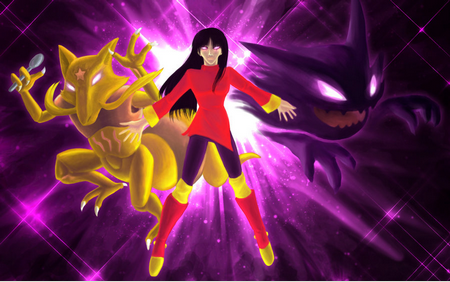
 A spectacular piece by Jo Tyler (http://jotyler.deviantart.com/) of Sabrina commanding Kadabra and her new ally, Haunter.

The elephant in the room is the question of how Sabrina ever became a Gym Leader in the first place.  We know from her dad’s flashbacks that she began her psychic training at a young age (I’d guess between six and eight) and very quickly developed a habit of lashing out at her parents with her telekinesis when they annoyed her.  It’s unlikely, then, that she became the Saffron Gym Leader first and a deranged psychopath later.  Nor would she have gotten her Gym officially registered and gained the authority to hand out Marsh Badges if she had come to the Pokémon League with a proposal like “please give me League funding so I can build a temple for my personal cult and have a place to keep all the people I turn into dolls with my horrifying mind-powers.”  I may not give the Pokémon League a whole lot of credit, but let’s be reasonable here.  It follows that the Saffron Gym was already established and she took over at some point – getting League authorisation for a Gym isn’t easy (if it were, then A.J. from the Path to the Pokémon League would have done it), but taking over an existing one seems relatively hassle-free in the conclusion of Showdown in Pewter City – it’s probably assumed (falsely, I might add) that no Gym Leader would hand over the reins of power to an inferior trainer.  It seems normal for Pokémon Gyms to be family businesses, but I don’t think Sabrina’s father is a Pokémon trainer (her mother, conceivably, might have been, but I have trouble imagining Sabrina’s mother as a Gym Leader).  The other odd thing about the situation is that Sabrina’s cultists don’t actually seem to be Pokémon trainers either.  They’re totally occupied with exercising their psychic abilities (which are remarkably feeble in comparison to Sabrina’s) and, aside from Kadabra, we don’t see a single Pokémon in the Saffron Gym.  What’s more, the cultist who ‘greets’ Ash, although he declares emphatically that Ash is not worthy of challenging Sabrina, doesn’t make any effort to meet that challenge himself.  I suspect what this all adds up to is that Sabrina muscled in on the Saffron Gym as soon as she was old enough to train Pokémon, turned the old leader and the other trainers into dolls, and converted the place into a training centre for human telepaths.  Taking challenges is a minor nuisance, but at least gives her opportunities to practice her terrifying powers.  Moreover, I suspect the original Saffron Gym didn’t specialise in Psychic-types, otherwise you’d expect her to have kept a lot of the trainers and Pokémon from the old regime.  Remember the Fighting-type secondary Gym in the games’ version of Saffron City?  Yeah… I think I know why it doesn’t appear in the anime.

(Its anime equivalent is actually the “Fighting Spirit Gym,” which turns up in the very next episode, but that’s even less of a proper Gym, so I’m sticking with my wild speculation)

So that’s Saffron Gym – a place I hope never to visit again, but which offered some surprisingly valuable insights on the culture of Pokémon training in Kanto.  For the rest of this chunk of the series I’ll be hopping around a bit – I want to put episodes 25 and 29 (Primeape’s episodes) together, as well as 26 and 32 (Ash’s Fuchsia and Celadon Gym battles) – so bear with me; I’m on the home stretch.

Anime Time: Episodes 15-17

Battle Aboard the St. Anne – Pokémon Shipwreck – Island of the Giant Pokémon

Fresh off Ash’s victory at the Vermillion Gym, Ash and his friends are given free tickets by a pair of teenage girls to a lavish Pokémon trainers’ convention aboard the world-famous luxury cruise liner, the St. Anne!  THERE IS NO WAY THIS COULD POSSIBLY BE A SCAM!

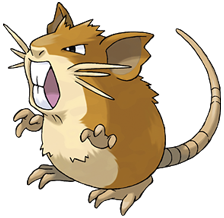
 This is going to be a boring day for art since I couldn't find any relevant fanart for these episodes; here's Sugimori's Raticate art instead.

We quickly learn that the ‘teenage girls’ were Team Rocket in disguise (yes, James too), and that they were giving out free tickets to all the trainers they could find on the orders of their shadowy Boss, Giovanni, who appears for the first time in this episode.  The Boss (who seems to be the closest thing Meowth has to a formal ‘owner,’ but has come to prefer his Persian – this will be a constant source of insecurity to Meowth during the series) is displeased with the time and energy they have expended failing to catch Pikachu, but still seems to have enough confidence to put them in charge of the ambush planned on the St. Anne.  His confidence, of course, is misplaced – not only do the Team Rocket goons fail miserably to steal even a single Pokémon, James also loses a ludicrous amount of money buying into a Magikarp-breeding pyramid scheme, and the entire ship capsizes and sinks with Jessie, James and Meowth still on board (not to mention our plucky heroes).  This, of course, is all totally incidental as far as I’m concerned.  I want to talk about what happens in the meantime: Ash encounters a dapper gentleman with a top hat and moustache, whose name is never given, challenging other trainers to exhibition battles with a powerful Raticate.  Ash, being Ash, takes up the challenge and finds that Raticate and his Butterfree are very evenly matched; however, just as Butterfree begins to gain the upper hand with Stun Spore, the Gentleman – to Ash’s annoyance – recalls his Raticate and suggests calling it a draw.  The Gentleman later proposes a trade, his Raticate for Ash’s Butterfree, which Ash hesitantly accepts but later regrets.  Luckily, the Gentleman reluctantly agrees to trade back at the end of the episode, just as the ship is sinking.

When you think about it, Pokémon trading is a pretty bizarre practice from the perspective of a trainer like Ash, who regards each and every one of his Pokémon as a close personal friend (which I think counts as further evidence that Ash’s way of doing things is actually quite unusual, since Pokémon trading manifestly isn’t).  The Gentleman’s ideas about trading are interesting ones – he believes that trading Pokémon is a way of deepening and widening new friendships and spreading relationships between trainers all around the world; basically, a form of social networking.  You could argue that he’s running what amounts to a scam here, proposing a trade for the first Pokémon he could find that was stronger than his Raticate and then dazzling the Pokémon’s kid trainer with some pretty rhetoric, but since he does agree to trade back when Ash asks him, I think it’s more likely he actually believes it.  Misty’s perspective on the situation is almost as interesting because it shows, I think, that she relates to Pokémon in a very different way to Ash: although she is sympathetic when he begins to regret trading away Butterfree, her response, “look on the bright side; you got a Raticate!” seems to indicate that she doesn’t really understand the depth of Ash’s attachment to his Pokémon yet.  I’m kind of disappointed to miss Brock’s opinion; Ash does ask him before the trade, but he’s too busy getting goo-goo-eyed over the Gentleman’s lady friend to offer a coherent response.  For a person like Ash, trading away a Pokémon is basically signing away the health and wellbeing of a close friend to someone else.  If Ash’s attitude is at all typical, you wouldn’t expect Pokémon trading ever to happen except between good friends but, again, this is manifestly not the case.  I think this indicates that for a ‘typical’ trainer, a Pokémon is less like a friend and more like… not a possession, but… perhaps a colleague, co-worker, or subordinate – basically, someone with whom you have a formal, rather than an emotional, relationship.  I should qualify that, like most complex issues, this is probably more of a spectrum than a dichotomy; Ash is at one end, and trainers like the Gentleman at the other, but a lot of people probably fall somewhere in the middle.

Anyway, the ship flips upside down and sinks, and due to the captain’s gross incompetence no-one notices that a few of the passengers were still on board.  There’s still plenty of air in the ship, but it’s steadily filling up with water from the bottom, and it’s balanced precariously on a huge spire of rock over a deep ocean trench…

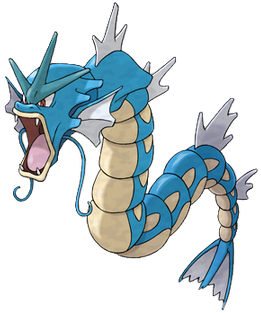
 Fun fact: in the beta version of Red and Blue, Gyarados' English name was "Skulkraken."  It works on so many levels, each more terrifying than the last!  Artwork by Ken Sugimori; render unto Nintendo what is Nintendo's, etc.

Pokémon Shipwreck is kind of a ‘meh’ episode, if you ask me.  It’s basically supposed to be about Ash’s party and Team Rocket having to work together to escape their mutual dilemma, but it’s actually about Ash’s party working together to escape their dilemma while Team Rocket cling to their coattails and scream incoherently.  Suffice to say, they eventually escape the ship by blowtorching through the hull with Charmander’s Flamethrower and swimming to the surface with the help of their Water Pokémon (Team Rocket use the Magikarp James bought on the St. Anne and nearly die, but to Pikachu’s immense displeasure they recover).  Once they’re all on a raft cobbled together from the debris of the St. Anne, James throws a fit, kicks his Magikarp, and renounces his ownership of the useless thing… which, of course, prompts it to evolve into a Gyarados, summon its brothers, and go all you-ain’t-in-Kansas-no-more on their asses, which leads to the next episode, Island of the Giant Pokémon

I love Island of the Giant Pokémon.  If I had my way the whole damn series would be done like Island of the Giant Pokémon.  The set-up is that Gyarados’ waterspout separated Pikachu, Bulbasaur, Squirtle and Charmander from the rest of the group on an island which is, for no immediately obvious reason, inhabited by Pokémon of unusual size (hereafter known as POUSes).  Ash, Misty and Brock do stuff in this episode too but it is irrelevant and distracting, because this is the episode in which everything the Pokémon characters say is subtitled, which means we get a closer look at their personalities.  Squirtle is laid-back and irreverent, and has something of a black sense of humour (among other things, he upsets Pikachu and Charmander by joking that Ash might have been eaten by wild Pokémon).  Bulbasaur is stoic, pessimistic and cynical; he’s the one who suggests that Ash might have abandoned them, which I think speaks to the way he views humans in general.  Charmander… well, Charmander is kind of boring, actually.  He seems nice.  He’s quite trusting, maybe a little naïve.  Mostly he just goes along with Pikachu (who, as we know from the rest of the series, is defined mainly by fierce loyalty to his friends).  Odd that there’s no foreshadowing of the problems Ash is going to have with him after he evolves into Charmeleon in episode forty-something; maybe they hadn’t planned that far ahead yet.  And then… there’s Ekans and Koffing.  They’ve also been separated with their trainers, along with Meowth, who orders them to attack Pikachu and his friends when they run into each other.  Ekans and Koffing seem to be portrayed as not particularly bright, even by Pokémon standards (especially Koffing, who mostly parrots Ekans); their dialogue is subtitled in broken English, and their worldview is basically “we do as our masters tell us”… and Meowth, they are most emphatic, is not their master.  They claim that if Pokémon do bad things, it’s out of loyalty to bad masters (contrast Meowth, who points out that his master is never around and he’s as rotten as Jessie and James on his own); they apparently understand morality but think it either isn’t important or doesn’t apply to them.  Alone, Meowth is easily overpowered and tied up, while Ekans and Koffing join the group.  As they eat dinner, and Squirtle taunts Meowth with the promise of food if he’ll just apologise (which, of course, he refuses to do), they hear a loud rumbling sound and are nearly crushed by a rampaging POUS.  Pikachu goes back to untie Meowth as the others leg it (like Ash, he’s a kind soul), and they eventually spend much of the night running away.  Then… then there is this one wonderfully mad scene in which, later that night, the whole group stops at a bar.

When I was a kid, I could accept this without any problem.  As an adult, I've played Pokémon: Mystery Dungeon.  Then again, even in Mystery Dungeon I'm pretty sure they never go to a bar and get wasted.  Screenshots from www.filb.de/anime.In the middle of the jungle.  Run by a Slowbro.  Bulbasaur and Squirtle get totally hammered and start drunkenly arguing over something (hard to say what, since this scene doesn’t have subtitles) while Meowth quietly passes out, and Pikachu and Charmander try to comfort Ekans and Koffing, who have been reduced to tears (and are presumably pretty deep in their cups themselves).  At a random bar in the middle of the jungle run by a Slowbro.
…I’m not even going to question it; I’m just going to accept it.

They all go to sleep together, curled up with Ekans coiled around everyone else.  This is a lovely scene; it illustrates very well how ready Ash’s Pokémon are to trust, even when Ekans, Koffing and Meowth have been their enemies for the whole season so far – or perhaps it’s more appropriate to say that Ekans and Koffing work for their enemies.  Off-duty, they’re no more hostile than anyone else.  Anyway, the next day, they try to negotiate with the POUSes they encounter, fail miserably, wind up getting chased by them, and eventually run into Ash, Misty and Brock being chased by more POUSes, as well as Jessie and James in a mine cart dragging another one behind them (they… had an interesting couple of days, put it that way).  Everyone reunites, there is much rejoicing on both sides, and all the POUSes trip over each other, get tangled together, and are completely destroyed – they’re robots, it turns out, and the whole thing is a theme park called Pokémon Land (a theme park, incidentally, run by Giovanni, who gets a call shortly afterwards to tell him of its destruction).

Again, I wish every episode were like Island of the Giant Pokémon.  Most of Ash’s Pokémon are surprisingly expressive considering they can’t really speak, and Pikachu in particular builds up a reasonably developed character by sheer weight of screen-time alone, but the characterisation of and relationships between all the Pokémon characters we see in this episode are just wonderful stuff, if you ask me.  That they never did this again is probably one of my biggest regrets for the whole series.

Anime Time: Episode 14

Electric Shock Showdown

 Official artwork of Raichu, by Ken Sugimori; do unto Nintendo as you would have Nintendo do unto you.

Oh, the excitement!  Ash is on a roll, and now he’s in Vermillion City for his third Gym battle!  Oh… but we forgot to mention… the Vermillion Gym Leader, Lt. Surge, is a total nutcase who’s hospitalised sixteen Pokémon in the past month.  Pikachu doesn’t like the idea of fighting this crazy person, but Misty taunts Ash for the two pity Badges he collected in Pewter City and Cerulean City, and that’s the end of that.  Ash and Pikachu, with Brock and Misty in tow, march up to the Vermillion Gym and demand a battle with Lt. Surge, a jovial but condescending fellow who, for some reason, assumes that Misty is the challenger, even though Ash is the one standing front and centre in their group (does he really present such an unimposing figure?).  Surge thinks the idea of Ash challenging him is hilarious, and laughs even louder when he sees Pikachu, calling them both “babies.”  Surge calls out his own signature Pokémon: a Raichu, Pikachu’s evolved form, whose electrical powers are vastly superior to Pikachu’s.  “Electric Pokémon,” Surge claims, “are only useful once they learn all their Electric attacks,” so Ash should have forced Pikachu to evolve at the first possible opportunity to maximise his power, like Surge did.  Pikachu’s doubts about the battle evaporate when Surge and Raichu taunt him, and the match begins.  Raichu quickly demonstrates that she has Pikachu totally outgunned, ignoring his relatively paltry Thundershocks and hitting back with a blast that nearly knocks him out cold.  Pikachu doggedly keeps fighting, but Raichu just starts tossing him around the field with her superior physical strength and Ash has to surrender to keep him from being beaten up any further.  While Ash and the team regroup at the Pokémon Centre, Nurse Joy #98 overhears their conversation and randomly decides to offer Ash an incredibly valuable Thunder Stone, which would evolve Pikachu into a Raichu – no strings attached, though she cautions them to think carefully about it, since evolution is irreversible.  Ash doesn’t think he wants Pikachu to evolve just to fight, but decides to leave it up to him.  Pikachu slaps the Thunder Stone away and gives an impassioned speech; Ash, of course, doesn’t understand a single word, but Meowth translates for Jessie and James, who are spying from the window: he wants to fight Raichu again to defend the honour of all Pikachu.  Ash, with a suggestion from Brock, devises a new strategy while Pikachu recovers, and as soon as they’re both ready, they head back to the Vermillion Gym.  On the way they run into Team Rocket, who have come to cheer for them – Jessie and James have realised that if Pikachu loses, then all the effort they’ve spent trying to steal him will have been a waste, so they do a strange little dance with a morale-boosting chant, then run away.  These guys already have way too much emotional investment in stalking the kids and Pikachu, and we’re only a few weeks in… at this rate they’re going to be basket cases by the end of season one.  Anyway, Ash and Surge have their rematch, but this time, Pikachu makes use of his one big advantage over Raichu: she has greater physical and electrical strength, but he’s a lot faster, and can evade most of Raichu’s physical attacks like Mega Punch and Body Slam.  Surge gets annoyed and commands Raichu to blast the whole stadium at once with her Thunderbolt so Pikachu can’t dodge, but when the dust clears, Pikachu is… standing on his tail, perfectly unharmed, having discharged all the electricity through it and into the ground.  Raichu tries to attack again, but she’s all out of power and has to go back to physical attacks.  Pikachu gives her the run-around until she can’t keep fighting any longer, then finishes her off.  Lt. Surge admits defeat and gives Ash his Thunder Badge, they shake hands, Ash and Pikachu celebrate, and Team Rocket wander off into the sunset, realising too late that “we wasted this episode cheering for the good guys!”

 Raichu doing what she does best, by OrcaOwl (http://orcaowl.deviantart.com/).

So, if you’ve been paying attention to my anime reviews so far, you’ve probably guessed that I’m interested in Electric Shock Showdown because of Pikachu’s refusal to evolve.  In the end, this is how he beats Raichu – in the games, Pokémon that evolve using stones normally stop learning attacks, which is why Raichu, who evolved before learning Quick Attack or Agility, was so much slower than Pikachu.  If we’re just thinking in terms of the ability to learn new attacks, though, why not evolve Pikachu after the battle?  He’s already learnt the speed techniques that gave him an edge over Raichu, and (as long as we’re going by the logic of the games here) evolving won’t cause him to lose those techniques, so surely he’d have the best of both worlds?  It’s plausible the anime is taking the position that Pikachu are, universally, capable of quicker and more precise movements than Raichu, which really does make a lot of sense if you just take your eyes off their in-game stats for a moment.  I think it’s also plausible that Pikachu might have more endurance than Raichu; notice that, in the second match, Raichu’s pretty much done after one good Thunderbolt – she burns twice as bright, but half as long.  However, tactical considerations are clearly not what’s occupying Ash’s mind when Nurse Joy offers him the Thunder Stone.  In general, Ash, Brock and Misty seem to take the view that using a stone to evolve a Pokémon constitutes forcing it to evolve, which seems fair enough, on the face of it.  Assuming my previous wild inferences are correct, most Pokémon evolve when they are psychologically ready for the change, which is more or less voluntary.  Using a Thunder Stone or similar item, on the other hand, takes the choice out of the Pokémon’s hands and puts it firmly in the trainer’s.  This is something of an ethical tangle in itself but it actually isn’t the main question here, because Ash, who doesn’t like the idea of forcing Pikachu into a massive and permanent physical and psychological metamorphosis, leaves it up to Pikachu.  The main question here is why, when given the opportunity to decide for himself, does Pikachu refuse evolution?

 I love this one; it's so cute.  This is by Asphodels, and I would love to give you a link because if this is anything to go by then he/she is very good, but his/her DeviantArt account has been deleted recently and I don't know where else to look...

Back in Ash Catches a Pokémon, Caterpie wanted nothing more in all the world than to become a Butterfree.  As I noted at the time, though, Caterpie is, well, a caterpillar, and the whole purpose of his existence is to prepare for evolution.  I suppose it’s not impossible to imagine a Caterpie who is perfectly happy being a Caterpie and never becoming an adult, but I doubt that’s common; most of them probably assume that succeeding in life entails evolution.  The only other evolution we’ve seen in the series so far is Clefairy evolving into Clefable in Clefairy and the Moon Stone, which I kind of skimmed over at the time.  Like Caterpie, the Clefairy are something of a weird little corner case as far as the psychology of evolution goes, because of their strange relationship with the Moon Stone, the meteor which (according to the conspiracy theorists) first brought them to Earth.  The Clefairy worship the Moon Stone and perform ritualistic dances around it while singing and praying.  We also see them gathering up shards of the meteor and collecting them in a central chamber around the main stone.  Their reverence for the stone doesn’t seem to be related to any desire to evolve (in fact, they don’t even evolve when they hold the shards), but then again, they don’t seem to be particularly upset when they wind up Metronomesploding it into a million pieces, so I guess they took it as a consolation that a bunch of them evolved when the pieces touched them.  Maybe they have a concept of fate and didn’t evolve themselves using the Moon Stone earlier because it wasn’t “the right time”?  The Clefairy are inscrutable by design and trying to probe their motivations makes my head hurt, but we can at least say that they aren’t upset by the idea of evolving due to a chance event at a time not of their own choosing.  I suspect they may be unique in this, though, because of their unusual relationship with their Moon Stones.  In the games, Pokémon that have evolved using stones typically don’t exist in the wild; that type of evolution normally requires human intervention to bring the Pokémon and the stone together.   Assuming this holds true in the anime as well (which, granted, is quite an assumption), Pikachu may not consider Raichu a natural evolution of his species, but rather a form specifically modified by humans to be better at fighting (not unlike Mewtwo – assuming Pikachu doesn’t understand the science involved, what would the difference be from his perspective?).  He might even think of Raichu and other Pokémon like them as sell-outs, which would explain why the whole thing seems to be a point of pride for him.

Another, possibly complimentary, explanation is that the anime simply makes certain basic assumptions about evolution, and particularly the use of evolutionary stones, that the games do not.  With the exception of The School of Hard Knocks (in which Joe has to memorise trivia like “Pidgey evolves at level 18”) the anime is generally extremely vague about the concept of “level;” it’s possible that Pokémon in the anime can, or believe they can, continue to grow stronger without limit, in which case the Thunder Stone would only be a quicker and easier way to power Pikachu would also be able to earn with hard work.  Remember also Meowth’s odd comment in Ash Catches a Pokémon about Pikachu’s power “exceeding its evolutionary level;” on the one hand, yes, it’s Meowth, on the other hand, he seems to be suggesting Pikachu could be, or could become, even stronger than a Raichu.  Equally, it might be the case that the stones are not the only way for Pokémon like Pikachu to evolve – or, again, that he might believe they aren’t.  When you think about it, this makes a lot of sense; a species that can’t reach adulthood without access to rare substances found only in certain areas would be pretty odd, especially given that most Pokémon that use stones can’t dig for them.  If this seems fishy given what we know from the games, consider that Electric Shock Showdown was made fairly early in the franchise’s life, when it might not have been at all clear which – if any – of the rules laid down in Red and Blue would remain immutable as (or, for that matter, if) the franchise matured.  I think the theory is fairly consistent with Pikachu’s behaviour during and after this episode; he could use the stone to provide the surge of energy he would need to evolve right now, but believes he could eventually evolve in his own time – if he ever even needed to – and doesn’t want to take the ‘easy way out’.

Whether he is correct or not, I leave as a question for the reader.

An Interesting Year

Y’know… now that I come to think about it, it’s totally my blog’s one-year anniversary today.  I mean, I was on Blogspot for most of that time, but it still counts.

(The archive may tell you differently, but it is a lying bastard, and is also confused because I live in a country that is in the future.  I’m… pretty sure it’s a year today.)

To recap: in that time, I’ve passed judgement on every single one of the 5th-generation Pokémon (well, okay, except for Kyurem, but he had an excuse), discussed the various Team Evils of the past and present, vigorously insulted all six Champions of the Pokémon League, taken on the top ten dumbest Pokémon of all time (plus Farfetch’d) and gotten a couple of weeks into the first season of the Pokémon anime.

Not bad, if I do say so myself.  Maybe if I keep this up I’ll finally be made a Pokémon Master someday, for my great and glorious contributions to… whatever it is I claim to be doing here.  I probably had a point; I can’t remember what it was at the moment but I must have had one.

Anyway, in celebration of my anniversary, here are my five favourite entries of the year, in no particular order.  If you haven’t read them before, check ‘em out!

Maractus
The Top Ten Worst Pokémon Ever, #10: Delibird
Ducklett and Swanna
Champions of the Pokemon League, Part 3: Steven
Roggenrola, Boldore and Gigalith

And, just for the nostalgia value, my very first real post:

Snivy, Servine and Serperior

As for the year to come… well, who knows?  I’m hoping to get into a good rhythm alternating between blocks of anime and blocks of other stuff, and so far my plans for that “other stuff” include:
– Reviews of all the starter Pokémon (well, except for the Unova ones because, y’know, I did them already).
– A series on what I would do with the Pokémon games once I finally manage to assassinate and replace Junichi Masuda if I ever, through some entirely non-felonious coincidence, gain a position of power in Game Freak.
– A playthrough journal of Black/White 2, once they’re released.
– And if you’re really unlucky I might even try my hand at writing a fanfic at some point.

As always, though, I’m open to suggestions – speak up and I might decide that whatever you’re thinking of is a way better idea than that dumb stuff I was planning anyway!  Now, let’s have us a good year!