Anime Time: Episodes 10-12

Bulbasaur and the Hidden Village – Charmander: The Stray Pokémon – Here Comes the Squirtle Squad

Okay, last entry was so long this is starting to get ridiculous, so I’ll try to blaze through the synopsis of these three episodes as quickly as I can so I can spend more time on commentary; here goes nothing!
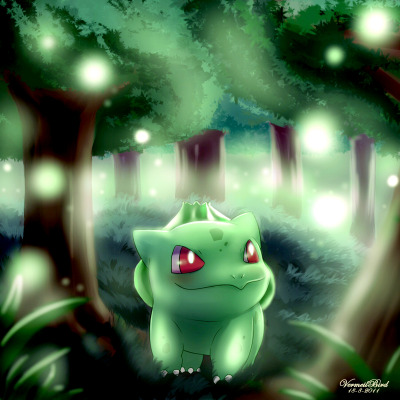
 Bulbasaur surveying his domain, by Vermeilbird (http://vermeilbird.deviantart.com/).

These are the episodes in which Ash meets and catches, in rapid succession, his Bulbasaur, Charmander and Squirtle, each under unusual circumstances.  Bulbasaur is the guardian of the ‘hidden village,’ a kind of halfway house deep in the forest for Pokémon abandoned by their trainers, run by a girl named Melanie, who patches them up and releases them back into the wild.  Bulbasaur is initially hostile towards Ash for intruding into the village and trying to capture one of the Pokémon, an Oddish, but warms to him when he, Brock and Misty help protect the village from Team Rocket.  Melanie suggests that Bulbasaur leave with Ash so he can grow stronger, and so the Pokémon of the village can get used to surviving on their own again, and Bulbasaur agrees on the condition of a battle with Ash – which, of course, Ash wins.  Soon after, Ash and his friends encounter Charmander waiting alone on a rock in the forest.  Ash tries to capture Charmander, but Pikachu establishes that he actually has a trainer already, so they decide to leave him and travel on to the next Pokémon Centre.  That night, they overhear a trainer named Damian bragging about his huge collection of Pokémon and explaining how he finally managed to ditch his useless Charmander in the wilderness by telling it he’d be back soon.  Brock is furious and Damian’s group nearly comes to blows with the heroes, but Nurse Joy #147 breaks up the fight.  Since a storm is brewing, Ash, Brock and Misty go back and look for Charmander, and manage to bring him back to the centre before his tail flame sputters out.  Early in the morning, Charmander escapes and wanders off to look for Damian again, but he stumbles across Ash’s group on the road and saves them from Team Rocket.  Damian shows up and wants Charmander back, but Ash convinces Charmander that Damian is a good-for-nothing jerk and the little salamander Pokémon joins Ash’s team instead.  Ash’s Squirtle, finally, leads a gang of juvenile delinquent Squirtle who terrorise a small town with pranks, vandalism, theft, and their awesome sunglasses.  The Squirtle Squad resent humans because all of them were abandoned by their trainers, and Meowth exploits this by tricking them into thinking that he owns and controls Jessie and James (which… let’s face it, is not far from the truth).  Meowth manipulates the Squirtle into capturing Ash, Pikachu, Misty and Brock, but they let Ash return to town to buy medicine since Pikachu is injured.  When Ash returns as promised, he finds that they have released his friends, since they aren’t a genuinely malicious bunch.  He then helps the Squirtle Squad when Team Rocket inevitably turn on them, and coordinates them to put out a forest fire started by Team Rocket’s weapons.  The Squirtle are reintegrated into society as part of the local fire brigade, and the leader joins Ash to travel Kanto with him.


Whew.

 An adorable Charmander by Yamio (http://yamio.deviantart.com/)

Let’s talk about Pokémon and their trainers.  As I said, Bulbasaur, Charmander and Squirtle all join Ash’s team under unusual circumstances, and furthermore all of them had been abandoned by other trainers in the past (well, Charmander and Squirtle had; Bulbasaur could have been wild but I think it’s more likely that he was abandoned – how else would he have come to be working with Melanie? – and it would explain his somewhat aloof and suspicious nature), so all three of them presumably have somewhat skewed perspectives on humanity compared to wild Pokémon.  Given this, it’s interesting that only Charmander acts in the way you’d expect an ‘outsider’ to act in the games – growing rapidly and later becoming disobedient.  Part of the reason is probably that Squirtle and Bulbasaur had largely forgotten their trainers and washed their hands of humanity in general (except for Melanie, in Bulbasaur’s case) until Ash came along and forced them to totally rethink their attitudes towards people, while Charmander was still ‘loyal’ to Damian until making a snap decision to Flamethrower him in the head two minutes from the end of his episode.   He may have regretted that choice later, and may even have come to feel he’d been forced into it – Bulbasaur and Squirtle both had other reasonable choices, but Charmander’s options, besides Ash, were going back to Damian or wandering off into an environment he wasn’t very well suited to (as he had learned the hard way only the night before).  Finally, while Bulbasaur and Squirtle were both befriended by Ash specifically, it was actually Brock who did most of the work of rescuing Charmander, and Brock who decided to brave the storm to look for him in the first place.  In fact, Ash acknowledges that Brock has as much right as him, if not more, to become Charmander’s trainer, but Brock insists Ash catch Charmander because… y’know, I’m honestly not sure.  In short, Charmander may actually have legitimate reasons to be upset here.

Probably the single thing I find most interesting about these episodes is Bulbasaur’s insistence on a battle with Ash, which seems like a formality by that point – Ash and Bulbasaur have worked together, Bulbasaur clearly has at least some degree of respect for him, and Melanie has suggested that everyone involved would benefit if Bulbasaur joined the team, and given her blessing.  Honestly, I think it seems like a formality because that’s precisely what it is: trainers catch Pokémon, and Bulbasaur is not going to go easy on Ash just because he seems like kind of a decent guy; he is damn well going to be captured, because that’s what trainers are for.  Squirtle and Charmander don’t challenge Ash; they just join up because they feel he’s already earned their respect, and I think the fact that Bulbasaur does is at least partly because, as we’ll see in Island of the Giant Pokémon, he’s very stubborn and also a bit of a cynic (Squirtle the reformed gang leader, by contrast, isn’t so likely to be a stickler for tradition).  What does being captured actually mean for a Pokémon, anyway?  Theoretically they belong to the trainers who capture them, but we know they can break out of their Pokéballs whenever they really want to (case in point, Misty’s Psyduck, but others do it too, and not just for comic relief either), so there’s nothing stopping them from wandering off in the night and never coming back, but in practice they don’t.  The very act of capturing a Pokémon normally seems to instil a degree of loyalty, which tends to remain even when it’s not such a good idea, as with Damian and Charmander.  This is presumably why releasing a Pokémon is viewed as such a jerkass thing to do in the anime.  Speaking of capture, when Ash first tries and fails to catch Charmander, Brock observes that he’s quite weak and tired – in theory, an easy catch.  Now, what happens in the anime when you try to catch another trainer’s Pokémon is neither entirely clear nor totally consistent across different seasons, but here and now I think the only reasonable interpretation is that Charmander’s loyalty to Damian is what makes it so easy for him to break out of Ash’s Pokéball.  Even for a weak or injured Pokémon, being captured still involves an element of choice: no Pokémon can be captured unless it is at least receptive to being partnered with a human (with the caveat that most wild Pokémon will still want to test a trainer’s worth by battling first).  This gives an interesting perspective to Nurse Joy’s seemingly nonsensical comment, when she breaks up the fight with Damian, that it’s disrespectful to Pokémon to use them for settling personal disputes.  How is it any more disrespectful than using Pokémon to battle at all?  I suspect it’s meant to be implicit that practice battles and official challenges, as part of the advancement of a Pokémon’s career with a trainer, are in some sense “what they signed up for,” while “hey, Pikachu, beat up this guy’s Pokémon for me because he’s a douchebag” is unfairly bringing Pokémon into a wholly human dispute (although this particular example is something of a grey area; Damian’s mistreatment of his Pokémon could be considered just as much Pikachu’s business as Ash’s).
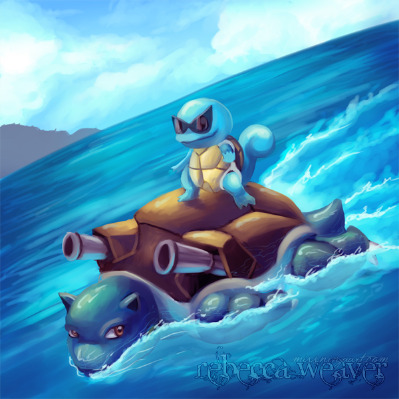
 Squirtle, wearing his trademark Squirtle Squad shades, gives us a lesson in awesome.  Art by Rebecca Weaver (missninjaart.tumblr.com)

To finish up for today, I want to take a closer look at Squirtle’s street gang.  For the Squirtle Squad, being abandoned by their trainers resulted in disillusionment with humanity in general, so clearly they had expectations of partnership with trainers which weren’t met – presumably power, knowledge and friendship.  Again, abandonment is regarded as an unambiguously rotten thing to do, by both human characters and Pokémon; in a sense it’s a breach of the implied agreement a trainer makes with any Pokémon who joins his team.  I suspect the Squirtle Squad are a Pokémon-world instance of the depressing phenomenon reported by real-world animal shelters, who invariably receive kittens and puppies in huge numbers after each Christmas – presents given to children who weren’t ready for the responsibility.  Squirtle, of course, are one of Kanto’s standard starter Pokémon.  It seems likely that the Squirtle Squad all belonged to new trainers who quickly realised that they weren’t cut out for the trainer’s life and ditched their starters in the wilderness.  Ash and Officer Jenny #604 are quick to blame the trainers, but honestly I think the Pokémon League is just as much at fault here; obtaining a Pokémon License seems to be literally just a matter of turning ten and showing up.

What I’m driving at with this entry is that – easy as it is to dismiss Pokémon training as slavery and thereby demonise the franchise – the ethics of Pokémon training are, even from an in-universe perspective, a great deal more complicated than that, which is why I’m so glad the games finally caught up in Black and White and produced a whole storyline about whether ownership of Pokémon is morally justified.  I still wish the story was a little more complex and the antagonists not so… well, cartoonish, but hey, it’s a kid’s series.  Baby steps.
Anime Time: Episodes 8, 9 and 13

The Path to the Pokémon League – The School of Hard Knocks – Mystery at the Lighthouse

Yep; I’m doing these out of order, for a couple of reasons.  One is that I really want to do episodes ten, eleven and twelve as a group, and spend a whole entry just on episode fourteen, which sort of leaves thirteen as the odd one out.  The other and far more important reason is that I feel these three episodes have a unifying theme, which is what I want to discuss today – see if you can guess what it is.

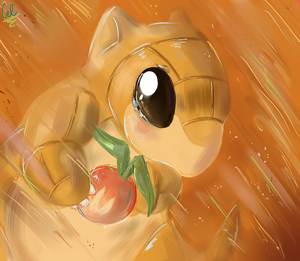
 A Sandshrew being adorable, by Celesime (http://celesime.deviantart.com/)

In the Path to the Pokémon League, Ash challenges an unofficial Pokémon Gym run by a gruff Texan kid called A.J. with an unbroken winning streak of ninety-eight battles – ninety-nine after A.J.’s fierce Sandshrew defeats Ash’s Pidgeotto.  Ash decides that A.J. must have cheated to beat a Flying Pokémon with a Ground Pokémon and starts poking around the gym.  A.J. is an extremely harsh master, having his Pokémon engage in constant practice fights and training exercises, and keeping them in line with his whip (A.J. has trained his Pokémon to respond to the crack of his whip, and uses it to command them in battles).  All of A.J.’s Pokémon wear restraining harnesses, possibly the forerunners to the Macho Brace introduced in Ruby and Sapphire, which restrict their movements and force them to develop stronger muscles to move normally, and he has his Sandshrew swim in his pool to train away its weakness to water.  Ash is horrified by his Spartan training style, but Brock observes that A.J.’s Pokémon are actually in excellent health; A.J. prepares all of their food himself and carefully tailors his recipes to the dietary needs of each species.  Ash attempts to convince the other Pokémon that they can leave A.J. and travel with him instead, but they seem to find him tiresome and ignore him.  Sandshrew is especially loyal to A.J.; they have been together for many years and long ago promised to grow strong together, no matter what obstacles stood in their way.  The episode ends with A.J. and Sandshrew earning their hundredth victory by defeating Team Rocket, who tried to sneak in and steal Pikachu but accidentally got Sandshrew instead.  As they had promised themselves, they close down the gym and leave on their own journey to start collecting badges and entering tournaments.

The School of Hard Knocks is set at Pokémon Tech, a prestigious private school in the middle of nowhere which Ash and his friends stumble into entirely by mistake on a foggy day.  Rich families who want their kids to become powerful trainers without anything so messy and plebeian as a Pokémon journey will pay top dollar to send them to Pokémon Tech instead.  Successfully completing each phase of the school’s program is considered an achievement equivalent to earning two Gym Badges, and graduation comes with automatic no-questions-asked membership in the Pokémon League.  Kids who fall behind are subjected to distressingly rough ‘tutoring’ sessions by their classmates in order to keep them from disgracing the school, a system run by the strongest member of the beginner class, a Ground-type specialist named Giselle.  Ash stumbles upon one of these sessions and rescues the supposedly underachieving student, a boy called Joe, who shows them around the school and asserts that his place there marks him as roughly Ash’s equal as a trainer, and that the school’s computer simulations predict he would defeat a Cerulean Gym trainer with little difficulty.  Misty soon shows him the error of his thinking by effortlessly crushing his Weepinbell with her Starmie, ‘Grass beats Water’ be damned.  Giselle shows up and gives Joe a condescending lecture on how a Pokémon’s level is just as important as type match-ups, and goes on to prove it by defeating Starmie with her Graveler.  She mocks Ash’s ignorance and inexperience, provoking him and Pikachu into a battle against her Cubone to defend their ideals of Pokémon training based on friendship.  Despite her confidence in Cubone’s immunity to electrical attacks, Pikachu prevails by spinning Cubone’s skull helmet backwards and blinding him, a tactic Giselle’s study of conventional Pokémon battling had left her completely unprepared for.  Giselle is considerably more gracious in defeat than victory, and concedes that she is still a beginner as well, while Joe decides to start his career over with a Pokémon journey like Ash’s, since Pokémon Tech is not for him.

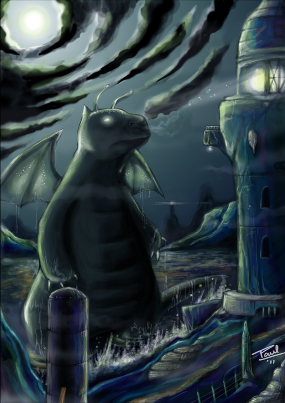
 KidScribbles' (http://kidscribbles.deviantart.com/ - seriously, go look) gloriously tragic interpretation of the events of Mystery at the Lighthouse.

The last episode I want to look at today is Mystery at the Lighthouse.  This episode starts with Ash capturing a Krabby, his seventh Pokémon, which of course vanishes back to Professor Oak’s lab.  In order to check up on Krabby the group walks to the nearest building, a lighthouse, and request the use of the owner’s phone.  The owner, a researcher named Bill, invites them inside via intercom and directs them to his phone.  Once Ash has established that Krabby arrived safely, they meet Bill himself, a somewhat unhinged cosplayer who has trapped himself in a particularly Byzantine costume of a Kabuto, in order to… research its behaviour.  Or something.  Once freed, he shows them his current research project – he’s broadcasting a reply to the call of an unknown ocean Pokémon he recorded some time ago, inviting it to come to the lighthouse and meet him – and, wonder of wonders, tonight is the night!  Bill hears his mystery Pokémon calling out to him, and the group sees its immense form emerge from the mist (it’s pretty clearly a Dragonite, a Pokémon Ash’s Pokédex seems to be familiar with in the very next episode, but it’s also ten times the size of a normal Dragonite, so it might be a weird subspecies).  Unfortunately Team Rocket, lurking on the cliffs below the lighthouse, attack the Pokémon with bazookas (James, interestingly, is quite distressed; I think this is the first episode to portray him as markedly less immoral than Jessie), enraging it.  It swats Team Rocket, smashes the top of the lighthouse, and then leaves in a huff.  In the morning, Bill tells Ash and his friends that he feels privileged even to have seen the mysterious Pokémon and gives them a few words of encouragement.  They set off for Vermillion City, and Bill spends the rest of the day quietly sobbing in his basement, having lost an opportunity he will probably never get again (or at least, this is what I imagine to have happened).

So, who’s picked up on the theme?

The theme these episodes have in common is different ways of living and interacting with Pokémon.  The series focuses primarily, of course, on Ash’s relationship with his Pokémon, but as the opening scenes of Mystery at the Lighthouse point out, Ash’s training style and philosophy are actually quite unorthodox.  Brock and Misty note that it’s entirely normal or even expected for full-time trainers to capture dozens of Pokémon before settling on a few they like (if they ever do at all).  This is more or less how Gary’s campaign is described, and it’s implied that the other two Pallet trainers are doing the same thing, while Ash’s comparatively small roster has more in common with those of the numerous small-time trainers who stay in their hometowns (the interesting thing about this is that the one who behaves in a manner more consistent with a typical player of the Pokémon games is actually Gary, not Ash).  As far as Ash is concerned, the most important thing for a trainer is having a strong emotional bond with your Pokémon, and if you get that right the rest is just bells and whistles (I swear there are moments when Ash thinks you can win a battle with the power of friendship).  This isn’t to say that others are cruel or neglectful, but it’s hard to imagine Gary treating all or even many of his Pokémon with the affection Ash does, and Ash’s relationship with Pikachu regularly earns comment for their remarkable closeness.  The first character in the series to demonstrate a comparable friendship with a Pokémon is, funnily enough, A.J., who is as inseparable from his Sandshrew as Ash will eventually become from Pikachu – they’re a lot more alike than Ash would probably admit.  For Ash, though, being a Pokémon trainer is about exploring the world and making new friends, while for A.J. it’s about endurance and determination in the face of suffering and hardship, which is why he works his Pokémon so hard.  The episode still portrays him sympathetically, though, since he genuinely cares for his Pokémon and works them hard because he wants them to be healthy and strong.

Contrast, for instance, Giselle.  Although Giselle is clearly intended to be arrogant to the point of being obnoxious, and although she expects very high standards from her human friends, she appears to be at least tolerably kind to her Pokémon and believes that responsibility for defeat rests squarely on the shoulders of trainers, not Pokémon.  A.J. would probably react to a loss by working the Pokémon harder, because his first responsibility as a trainer is, well, to train; Giselle would be more likely to react by studying harder herself and researching new tactics, because her first responsibility as a trainer is to command.  Giselle’s general attitude implies a rather condescending view of Pokémon.  They’re objects of study to her, more like underlings or even tools than partners, but she’s smart enough to know that mistreating them won’t get her anywhere.  The implication is that she represents the philosophies of Pokémon Tech as a whole, which is why Joe decides to leave when he comes to admire Ash’s way of doing things more, but – Giselle’s own character flaws aside – the episode as a whole seems to view this outlook as just as much a viable alternative as A.J.’s, with the caveat that each trainer has to make his or her own way.

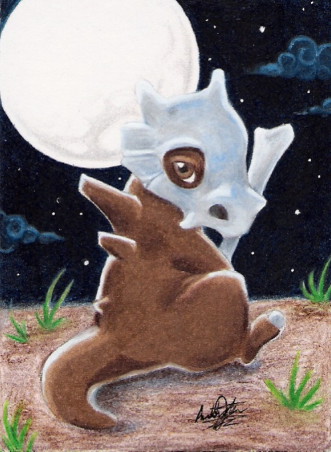
 As this evocative depiction by Spectrolite (http://spectrolite.deviantart.com/) attests, Cubone are pretty complex Pokémon themselves in terms of the emotions they play to, but this, sadly, is just one of many things I don't have time to discuss today.

Finally, we have Bill, who as a researcher has no interest in owning Pokémon at all.  For Ash, and for most other trainers, the first step in making friends with a Pokémon is to capture it, which seems like it would actually be a fairly counterintuitive notion for someone who isn’t a trainer.  Ash automatically assumes that Bill wants to catch the mystery Pokémon he’s looking for, but Bill can’t think of any reason why he would and just wants to meet it.  He’s like Giselle and the rest of Pokémon Tech in that his relationship with Pokémon has a huge intellectual component, but at the same time he’s very different in that they study Pokémon in order to make more effective use of them, while Bill actually seems to look up to Pokémon and admire them.  His bizarre cosplay fixation, for instance, is part of an attempt to understand Pokémon from their own points of view.  In short, someone like Giselle cultivates an intellectual approach to Pokémon so that they might benefit from association with humanity, while someone like Bill cultivates that same approach so that humanity might benefit from association with them.  At the same time, Bill’s final speech at the episode’s conclusion makes clear that he regards trainers as vital to the continuation of Pokémon research.  This is partly a statement of practicality – trainers are the ones who catch Pokémon, and often the ones who discover new species as they explore – but also an assertion of the importance of embracing different ideas and worldviews (a theme which, years later, was wholeheartedly taken up by Black and White).

Wow, this was a long entry.  Okay, quick summary: because Ash is the main character of the anime, it’s easy to forget that his experience of Pokémon is in fact an atypical one.  These episodes, among others, show that the relationship between Pokémon and humanity is actually a far more complex one than Ash’s rather idealistic interpretation might suggest.  This is another of those recurring themes that I’m probably going to comment on more as I move through the series – as well as something I’d like to see more of in the games!

Anime Time: Episodes 5-7

Showdown at Pewter City – Clefairy and the Moon Stone – The Waterflowers of Cerulean City

In which Ash… earns… his first two Gym Badges.  Arguably.  Also stuff happens with some Clefairy.

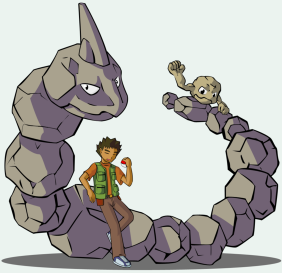
 Some nice crisp art of Brock and his Rock Pokémon, by Fluna (http://fluna.deviantart.com/)

When Ash and Misty arrive in Pewter City, they are greeted by an aged hobo selling rocks.  Don’t scoff; rocks are the whole basis of Pewter City’s economy.  The hobo leads them to the Pokémon Centre where Misty points out a poster advertising the Indigo League tournament, which explains that contestants need to earn eight official Gym Badges to enter.  Ash… apparently didn’t know this.  Why the hell was he going to Pewter City?  If he didn’t know about collecting badges, what could he possibly have wanted to do there?  Buy rocks?  Misty cautions Ash not to rush into a Gym battle and offers to lend him some of her Pokémon, but Ash ignores her, challenges the local leader, Brock, and quickly learns that Brock’s signature Pokémon, Onix, is fifty times Pikachu’s size and invulnerable to electricity.  Ash surrenders to keep Pikachu from being turned into red paste, and leaves the Gym in despair.  On the street he meets the hobo, Flint, who explains that Brock is a very powerful trainer and could go much further than being Gym Leader of a hick town, but is kept in Pewter City by his countless younger siblings – Brock’s father ditched the family to become a Pokémon trainer, this sort of thing being socially acceptable in Kanto, and his mother died soon after (or… so the English translation claimed… long story).  Despite his sympathy for Brock, Flint provides Ash with a “strategy” to defeat him: overcharge Pikachu by hooking him up to a derelict hydroelectric paddle-wheel… which Ash will turn manually (realism is cast aside so Ash can work for his victory and prevent this whole episode from being a blatant exercise in cheating… I mean, it kind of is anyway, but they were trying).  Although Pikachu nearly explodes, Flint’s plan works: the next day, he fries Brock’s Geodude with relative ease.  Onix is still too strong, but unfortunately for Brock, Pikachu’s wild electrical blasts set off the Gym’s fire suppression systems, drenching Onix and rendering him vulnerable.  The characters’ reactions are fascinating.  Ash declares that he doesn’t want to win on a fluke and leaves the Gym, which makes sense; he’s still far too proud to accept this kind of victory.  Misty, who’s watching, seems to think Ash should have taken his lucky break and finished Onix, because all’s fair in Pokémon and war, so she clearly has no moral compass.  And Brock… Brock follows him and just gives him the Boulder Badge, because he doesn’t really give a damn about this whole Gym Leadering thing anyway.  Flint turns up and reveals himself as Brock’s father; apparently he was an appalling trainer and returned to Pewter City not long after leaving, but decided to become a rock salesman instead of going home to care for his vermin offspring.  I guess Ash has reminded him how not to be a massive jerk, because he’s decided to become a proper father again (and also run the Gym, presumably… despite being a self-confessed failure as a trainer…) so Brock can go on a road trip.

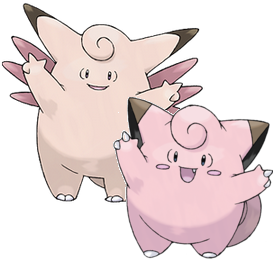
 Clefairy and Clefable.  Artwork by Ken Sugimori; twinkle twinkle, little star, how I wonder whether you'll come after me for copyright infringement.

Ash, Misty and Brock leave Pewter City together and travel past Mt. Moon, where they meet a… ‘scientist’… named Seymour and have to deal with Team Rocket, who are trying to steal an ancient meteorite known as the Moon Stone from Mt. Moon (this meteorite, presumably, is the source of all the smaller Moon Stones we’re familiar with from the games).  Team Rocket is dealt with quite comprehensively by the community of Clefairy who inhabit Mt. Moon; their Metronome chorus results in a powerful explosion that actually blows the Moon Stone itself to smithereens, but no-one seems to mind because the shards cause many of the Clefairy to evolve into Clefable.  Then Seymour decides to go and live with the Clefairy because he’s nuts.  Honestly, I could probably spend an entire entry just talking about this episode.  It’s the first time we see a Pokémon using an evolutionary stone in the anime, which is interesting in itself, but the Clefairy and Clefable relate to the Moon Stone in a way that’s so weird and unique that it adds a whole extra dimension to the matter.  Sadly that doesn’t really fit with the ideas I want to talk about today, but I’ll probably come back to it when I discuss episode fourteen (which is definitely getting a whole entry to itself).

Despite Misty’s inexplicable protests, the group’s next destination is Cerulean City, where Ash wants to try for his second badge in as many weeks.  When they reach the city, Misty vanishes in a huff, and Brock wanders off to take care of some unspecified “stuff,” returning only at the end of the episode.  Ash makes his way to the Cerulean Gym-cum-aquarium, where – to his surprise – he witnesses the end of a water ballet performed by a trio known as the “Sensational Sisters.”  As he explores the Gym later, he meets the sisters, Lily, Violet and Daisy, and learns that the three of them are, in fact, the Gym Leaders.  As it turns out, however, they’re just as sick of their Gym Leader gig as Brock was, having just suffered three devastating losses to the other three trainers who left Pallet Town at the same time as Ash.  In fact, apart from a Goldeen and a low-level Seel, all of their Pokémon are resting at the Pokémon Centre.  Lily, Violet and Daisy would rather focus on the water ballets that have made their Gym famous than deal with challenges so, with a collective shrug, they decide to hand Ash his Cascade Badge just for the asking… until Misty bursts in.  Misty, it turns out, is the family’s fourth and youngest sister, and she is none too pleased about the way her sisters are handling their Gym (or failing to).  She answers Ash’s challenge herself, and soundly defeats his Butterfree with her Staryu.  They both switch Pokémon, and Pidgeotto nearly beats Misty’s Starmie, but Team Rocket interrupts the battle by attacking the Gym with some kind of giant vacuum cobbled together from cannibalised household appliances they stole earlier in the episode.  They intend to use this godawful device to suck up all the water in the Gym, and all the Water Pokémon with it, but Ash, of course, defeats Team Rocket and saves the sisters’ last few Pokémon.  Lily, Violet and Daisy decide to award Ash the Cascade Badge for services rendered to the Cerulean Gym, and point out to Misty that Pikachu could have flattened her Water Pokémon anyway if he’d wanted to (Pikachu refused to fight a friend – he doesn’t yet follow all of Ash’s orders without question; he can also be troublesome about going into battles he doesn’t think he can win).  They meet up with Brock, who never does explain what his “stuff” involved, and move on to their next misadventure.

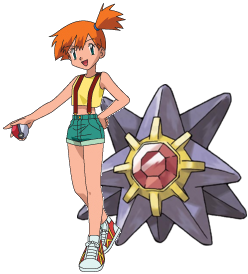
 Misty and Starmie.  People seem to think Misty forgets about Starmie as the series goes on, because she doesn't use it much, but it's actually her go-to Pokémon for most situations... it's just Starmie suffers the most from Psyduck's tendency to come out when Misty wants a different Pokémon.

These episodes begin Ash’s extremely chequered career of earning Gym Badges under questionable circumstances.  Of his eight Kanto badges, only three were totally legitimate (you could certainly make arguments for some of the other five, but they’re definitely suspect). Gym Leaders appear to have a lot of latitude in running their Gyms and handing out their badges, and once you get your hands on one of the things, no-one ever really questions it.  Strange as it might seem, this is actually something I would like to put in the games; Black and White made a decent effort at showing the Gym Leaders as people rather than just bosses, but Claire from Gold and Silver remains the only one in history ever to demand something other than a battle as proof of a player’s worthiness.  A Gym Leader’s job is to certify that a challenger possesses a certain degree of skill as a trainer, and a battle is the most straightforward and obvious way to do that, but it’s plainly not the only way.  Providing a service to the Gym or to the city, in a manner that demonstrates one’s abilities to the satisfaction of the Gym Leader, seems like a perfectly sensible way to earn a badge.  Arguably, so is putting up a good fight when your main Pokémon is plainly unsuited to the task at hand.  Happening to show up just as the Gym Leader gets sick of battling… not so much.  How Lily, Violet and Daisy became the Gym Leaders of Cerulean City in the first place is beyond me, since they don’t appear to have much commitment to their position, which suggests to me that general oversight for the whole system is relatively slack.  I think two or three years pass before someone picks up on their uselessness and Misty has to come home and run the gym for them.  Honestly I suspect that the Pokémon League just quietly overlooks Cerulean City in exchange for a percentage of their ticket sales.

The other important thing about these episodes is that they introduce Brock and fill in Misty’s backstory.  Brock is the oldest (I don’t know if his age is ever mentioned but I think he’s supposed to be about sixteen) and most responsible member of the team… until he sees an attractive woman, at which point he turns into a drooling idiot.  He’s used to taking care of a huge family, and probably finds it a welcome break to have only two demented children on his hands.  Although Brock is quite powerful, he doesn’t actually like fighting and wants to become a Pokémon Breeder – a somewhat nebulous term in the anime, since any actual ‘breeding’ would probably spoil the show’s G-rating; basically Brock is a specialist in Pokémon nutrition and general healthcare.  Misty is a lot of fun.  She’s often described as a tomboy – she normally wears boyish clothes and she’s as adventurous, outgoing and stubborn as Ash – but she does regularly show interest in stereotypically ‘girly’ things, and loves anything that’s pink, cute, sparkly, or all three, so I think the tomboy aspect is something she developed as a gesture of rebellion against her sisters’ obsession with fashion and beauty.  She can be superficial at times and is prone to romanticising, but she’s also capable of being a very determined, practical person when she needs to be.  Misty and Brock will, of course, both get fuller treatment in episodes to come… so let’s get going!

Anime Time: Episodes 3-4

Ash Catches a Pokémon – Challenge of the Samurai

 Caterpie.  Artwork by Ken Sugimori; all hail Nintendo, etc.

These two episodes record Ash and Misty’s journey through Viridian Forest, during which Ash captures his first two wild Pokémon: Caterpie and Pidgeotto.  Pidgeotto really isn’t very interesting; he’s mostly a utility Pokémon who turns up whenever Ash needs to take advantage of his flight, and I don’t think there are any episodes that focus on Ash’s relationship with him (until, amusingly enough, the episode where he finally evolves into a Pidgeot and promptly ditches Ash to go hang with his old flock).  He does serve as an illustration of the kind of rapport ‘normal’ trainers and Pokémon tend to have, which I guess is useful in its way because Ash’s relationships with most of his other Pokémon are anything but normal.  For me, though, Pidgeotto is probably Ash’s most forgettable Pokémon.  Caterpie is much more fun to talk about so I’ll probably spend most of this entry on him.

Ash effortlessly catches Caterpie right at the beginning of the imaginatively titled third episode, Ash Catches a Pokémon, and it quickly transpires that Misty cannot stand the poor thing, even though he’s immediately very affectionate towards her.  This deserves comment in itself because Pikachu seems to be very trusting of Misty as well (although the business with the Spearow in I Choose You was a good start, he’s going to remain somewhat aloof, though no longer disdainful, towards Ash for quite a while yet), which suggests to me that they both instinctively recognise her longer history and deeper experience as a Pokémon trainer; Caterpie is quickly rebuffed by Misty’s open disgust for Bug-types, though (as well as by the ludicrously oversized mallet she apparently keeps in the back pocket of her shorts).  Ash tells Misty to go away if she doesn’t like Caterpie, but she continues to follow them out of a stubborn desire to make sure Ash pays her for her ruined bike and they eventually share a campsite.  Ash and Misty go to sleep but Pikachu and Caterpie stay up talking, which is where the really interesting stuff starts.  If you’ve ever wondered how Pokémon can possibly communicate when they can only say their own names, this scene suggests that extended conversations tend to involve a significant gestural component – which means that we can, more or less, understand it: Caterpie seems to be describing his future evolutions to Pikachu.  The conversation ends with Caterpie gazing longingly up at the night sky.  We’re clearly meant to take from this that Caterpie knows and understands what he could one day be, and wants desperately to get there, but is also aware of the odds against it (Caterpie are common Pokémon and Butterfree are not; ergo, most of them don’t make it).  That’s… a pretty high-level thought process for a caterpillar, and I think it can be taken as a comment on the level of sentience we can ascribe to Pokémon in general in the anime.  It’s also the first perspective the series gives us on Pokémon evolution, which is something that it can be a little schizophrenic about.  Here evolution is an unambiguously positive change, which is understandable because, as a caterpillar, Caterpie’s whole life is about preparing to evolve and he’ll never accomplish much if he doesn’t, but many other episodes give some quite different perspectives that I’ll be looking at as I go.

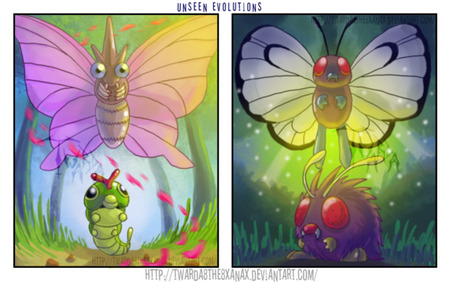
This lovely bit of fanart is by Karolina 'Twarda' Twardosz (http://twarda8the8xanax.deviantart.com/ - a lot of wonderful pieces here, Pokémon and otherwise; do take a look) and expresses one of the more interesting bits of Pokémon fan speculation: that Metapod was originally supposed to evolve into Venomoth, and Venonat into Butterfree, but the sprites were accidentally switched in Red and Blue.  What do you think?

The next day brings two major events, the first being Ash’s battle with Pidgeotto, in which he flippantly disregards two of the most basic lessons of life as a Pokémon trainer: he tries a Pokéball without weakening Pidgeotto first (and I thought he’d learnt better after episode one), showing that he doesn’t actually understand how to catch Pokémon, and he tries to fight Pidgeotto with Caterpie (and reacts with abject confusion when Misty points out that “Pidgeotto is a bird; Caterpie is a worm; birds eat worms, Mister Pokémon Master!”) showing… not so much that he doesn’t understand the concept of a type advantage, more that he doesn’t even understand the concept of fighting.  Pikachu steps in to save his sorry butt and fries Pidgeotto into submission, and we quickly move on to the next big event of the day: Team Rocket’s appearance.  They’ve decided to follow Ash and steal Pikachu, since the Viridian City Incident has convinced them that, in Meowth’s words, “[Pikachu’s] powers exceed its evolutionary level” (a fascinating comment in itself, but one I don’t have time for now).  Ekans and Koffing attack Ash together, so Misty offers to step in to even the odds, but Ash refuses because the Pokémon League rules say that battles are one-on-one.  Never mind that he’s being mugged by notorious criminals; the rules say that he can only use one Pokémon and he will defend those rules with Pikachu’s life if need be.  Long story short, Caterpie manages to overcome Ekans, Koffing and Meowth with a particularly well-executed String Shot, of all things, and Team Rocket are forced to retreat.  This victory prompts Caterpie’s longed-for evolution into Metapod, and an observation from Ash’s Pokédex that no other Caterpie on record has ever evolved so rapidly.  Ignoring for the moment how the Pokédex could possibly know how mature Ash’s Caterpie was when he caught it, this is the first of many indications given in the anime that evolution isn’t just about reaching a certain level, as in the games; there’s a psychological component as well.  I think Caterpie’s remarkably fast evolution is implicitly a result of his unusual ambition; it took less to make him evolve because he was more ‘ready’ for it, mentally speaking, than most Caterpie.  Basically, he’s a little Pokémon with big dreams, and being with Ash is going to help fulfil them.

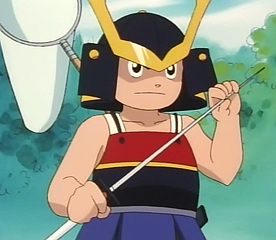
 Sammy the Samurai.  Oh, this kid... Screenshot swiped from Bulbapedia.

In the next episode, Challenge of the Samurai, Ash is accosted by a weird kid in samurai gear while trying to catch a wild Weedle.  And when I say “accosted” I mean he nearly gets cut in half by an honest-to-goodness steel katana.  This kid… oh, this kid… I don’t think he even has a name; if he does, he never tells Ash and Misty what it is, so I’m just going to call him Sammy.  Sammy lives in the darkest part of Viridian Forest with his Bug Pokémon and challenges other trainers as they pass through.  I don’t know why.  He just does.  He doesn’t seem to be interested in travelling or collecting badges, in fact he has a permanent cabin deep in the woods, so the only conceivable reason for him to be interested in getting stronger is so he can make himself more of an inconvenience to travellers.  The kid’s a friggin’ random encounter (“random” being the operative word).  Anyway, he calls Ash “dim-witted and clumsy” for letting the Weedle escape, Ash protests that it was Sammy’s fault for coming at him with a sword (this is supposed to be the beginning of a point the episode is making about Ash learning not to blame his failures on others, but I can’t help but feel Ash is in the right here), and they quickly engage in battle.  Pidgeotto doesn’t manage to make much of an impact on Sammy’s Pinsir because Ash has been overworking him and he’s done for the day, so Ash turns to Metapod.  Only after he makes this choice does it occur to him that Metapod can’t actually fight, but luckily for him evolution didn’t make his Caterpie any less exceptional, and Pinsir injures itself trying to crack Metapod’s tough shell, forcing Sammy to recall it.  This leads us into one of the most awesome Pokémon battles of all time, an epic struggle of titans to be remembered by our children’s children for aeons to come: Metapod vs. Metapod.  I really don’t know what Ash and Sammy are trying to prove in this battle.  It conveys rather effectively, though, that both of them are astonishingly stubborn.  Their Metapod keep staring at each other and using Harden for some time – possibly hours – until the battle is interrupted by a swarm of wild Beedrill, apparently the friends of the Weedle that escaped Ash earlier.  Metapod is snatched up by a Beedrill before Ash can recall him, and they all have to leg it back to Sammy’s cabin to escape being stabbed to death.

 Metapod and Butterfree.  Artwork by Ken Sugimori.

Ash eventually goes to get Metapod, whom they saw on the way to Sammy’s cabin sitting at the base of a tree filled with Kakuna.  This is problematic because Kakuna will apparently evolve into Beedrill at the slightest provocation, but Ash is able to reach Metapod alive, despite Team Rocket’s antics causing the Beedrill to become aggressive again.  Metapod, unsurprisingly, seems very hurt that Ash allowed him to be taken in the first place, which Ash initially blames on Sammy but soon admits was his own fault, giving a heartfelt apology.  The resulting surge of loyalty prompts Metapod to jump into the path of a Beedrill trying to skewer Ash, violently splitting his shell open… which catalyses his final evolution into Butterfree.  Butterfree pacifies the whole swarm with Sleep Powder, Sammy is sufficiently impressed, and Ash, Pikachu and Misty get to move on to Pewter City.

In Challenge of the Samurai we see Pokémon evolving out of transitional states, ones which are never supposed to be long-term, so the conclusions we can draw from it aren’t necessarily all-inclusive, but there’s no harm in speculation.  Ash’s Pokédex claims that Metapod evolve into Butterfree one week after evolving from Caterpie, which sounds way too long, but since Ash tells Brock in the next episode that he’s been with Pikachu for two weeks already, it’s probably about right.  Regardless, it’s clear that Metapod didn’t evolve because he was ready; he evolved because he needed to, as do all the Kakuna we see evolving in this episode, which comes back to the idea of evolution having a psychological component in the anime: at some point, despite being physically able to evolve, Metapod and Kakuna still need some kind of stimulus to kick things off.  It’s interesting that Metapod doesn’t evolve when he’s first snatched away by the Beedrill, because he doesn’t actually ‘gain experience’ between there and the end of the episode, and judging by his reaction when Ash comes to save him I think it’s because he felt abandoned when Ash ran away without him and may have given up hope (one of his persistent character traits in the episodes that focus on him seems to be that he has self-esteem issues).  It’s the renewed feeling of being in a partnership with his trainer, and the associated swell of devotion, that eventually makes a Butterfree of him.

Anime Time: Episodes 1-2

Pokémon: I Choose You – Pokémon Emergency

Today I begin my journey through the Pokémon anime, scheduled to last… until I get bored, though I’ll be taking breaks periodically to keep doing stuff related to the games too.  Well, there’s no sense wasting time; here we go!

 Our Beloved Protagonist.

The first episode, Pokémon: I Choose You, introduces us to our hero – and I use the term loosely – Ash Ketchum of Pallet Town.  Ash is, of course, in all the movies, including the ones I’ve been reviewing recently, but before now I haven’t wanted to spend a lot of time describing his character, so let’s do that now.  He’s ten years old (supposedly, he is exactly ten years, ten months and ten days old when he begins his journey – which would mean that he actually turns eleven at some point between now and episode nine, and never mentions it) and absolutely fanatical about Pokémon and Pokémon training, but, as soon becomes clear, knows next to nothing about either.  If you’ve seen anything of the anime at all, you’ll know Ash can be a little slow at times, to put it mildly, though he does gradually get better, and is also unflinchingly honest, forthright and idealistic (to the point of being rather “Lawful Stupid” initially, but he seems to get over this fairly quickly).  His general ignorance, while somewhat odd given his lifelong ambition to become a Pokémon Master, is a necessary conceit to ease in viewers who are unfamiliar with the franchise; when your viewers need things explained to them, it helps if one of your characters does too.  Ash’s other most important trait is probably his pride.  He is absolutely convinced that he is an immeasurably talented Pokémon trainer and bound – nay, destined – to one day become the very best, like no-one ever was.  He hates to lose and has a bad habit of inventing excuses for his defeats, or even accusing his opponents of foul play. This, ladies and gentlemen, is our protagonist.


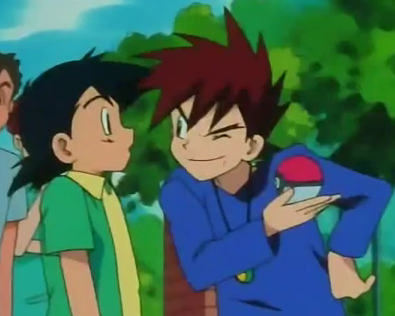
Ash oversleeps on the day he is supposed to start his journey and winds up desperately racing down the road in his pyjamas to make his appointment to receive his first Pokémon from Professor Oak.  Outside Oak’s lab, Ash runs into his rival, the Professor’s grandson Gary Oak, who is, astonishingly, as much of a douche as his in-game counterpart Blue, and just about the only character in the series more arrogant than Ash.  The interesting thing about Ash’s encounter with Gary is that (in contrast to Red and Blue, who were supposedly rivals from infancy) this seems to be the first time they’ve ever met.  Putting aside the obvious questions of how they could possibly have avoided each other in a relatively small town like Pallet, this actually explains quite neatly how the two manage to get off on the wrong foot so badly: Gary’s first impression of Ash is of a kid who wants to be a Pokémon trainer sleeping in on his first day and turning up to receive his first Pokémon still in his pyjamas.  Put yourself in his shoes.

 Gary gives Ash what I like to think of as a saucy wink as he brags about how far ahead he is after only a couple of hours.

Professor Oak only had three Pokémon for the four trainers leaving that day – one Bulbasaur, one Charmander, one Squirtle – which he handed out on a first-come, first-serve basis.  Ash, the last to arrive, missed out.  Confronted with Ash’s plaintive face, Oak reluctantly gives him a fourth Pokémon: Pikachu.  Pikachu are notoriously difficult for new trainers to handle, in contrast to the three standard starters, who seem to be the standards because they’re comparatively easy to deal with.  Why Oak had Pikachu in the first place is never explained; nor is why he didn’t have enough Pokémon for the trainers he knew were coming.  I suspect he originally intended to offer Pikachu to Gary, believing his grandson would be talented enough to handle him, but was stymied when Gary chose one of the three traditional starters, and was forced to hand over Pikachu to the unfortunate kid who arrived late.  Pikachu, as anticipated, takes an instant dislike to Ash, electrocuting him repeatedly and refusing to return to his Pokéball, forcing Ash to physically drag him out of Pallet Town, where they get acquainted with the aggressive fauna of the Pokémon world and learn that Pikachu isn’t the only Pokémon who hates Ash; in fact, they all do.  Ash manages to incur the wrath of an entire flock of Spearow, who severely injure Pikachu as they pursue the hapless duo.  Ash scoops his Pokémon up, jumps into a river to escape, and is soon fished up by Misty, a red-haired Water Pokémon specialist who will shortly become his ABSOLUTELY NOT GIRLFRIEND.  Ash promptly steals her bike to escape the Spearow, and runs it straight into a ditch.  As a storm brews overhead Ash puts himself between Pikachu and the flock, defiantly proclaiming his destiny to become a Pokémon Master.  I couldn’t say how much of this he actually believes, since he must be entertaining the possibility that he is about to die and is probably just trying to go out with some semblance of credibility by protecting his Pokémon.  However, Ash’s bravado inspires Pikachu to take action, and he channels a lightning bolt from the storm clouds above them to blast the entire flock into submission.

When Ash wakes up some hours later, Pikachu is half dead, and Ash carries him the rest of the way to the Pokémon Centre in Viridian City, where Nurse Joy #512 manages to patch him up.  While Ash waits for Pikachu to recover, he speaks to his mother and Professor Oak on the phone and confesses that maybe this whole Pokémon training thing isn’t quite going the way he planned.  Misty catches up to him, carrying the battered and charred remains of her bike, and furiously demands repayment, but softens visibly when she sees his obvious concern for Pikachu.  As all this is happening, the Pokémon Centre is attacked without warning by everyone’s favourite comic relief villains, Jessie and James of Team Rocket, and their talking Pokémon companion Meowth, who mean to steal all the injured Pokémon at the centre.  They’re a great deal less bumbling and more intimidating than they become in later episodes, particularly as Misty is the only person in the building who is in any condition to fight back.  Their Ekans and Koffing lay waste to the building as Joy frantically tries to teleport as many Pokéballs as she can to the Pokémon Centre in nearby Pewter City and Misty fails to do anything useful since she’s forgotten that her Goldeen can only fight underwater.  Luckily, the group of Pikachu who run the centre’s backup power supply step in to recharge Ash’s Pikachu, who fries the thieves with his Thundershock and forces them to flee, completely destroying the Pokémon Centre in the process and likely costing Viridian City several million dollars in repairs.  Everyone is totally fine with this.

So, what do these first two episodes teach us (aside from the fact that the officials of the Pokémon world are remarkably permissive about massive property damage)?

 Why do we even watch Ash, anyway?  The show should totally have been about Pikachu!

I want to talk about the idea of a Pokémon journey, since this seems like an appropriate moment and it’s easily one of the most bizarre things about this setting: many parents in the Pokémon world seem to have no problem at all with letting their children leave school and wander off into the wilderness accompanied only by a magic lizard.  Episode one demonstrates, unquestionably, that this can be dangerous – Ash’s circumstances are unusual, since most trainers don’t have so much trouble with their starter Pokémon, but the events that led to him and Pikachu nearly being killed by a horde of rabid starlings could have happened to anyone.  Professor Oak, interestingly, refers to Ash and the other three trainers who leave Pallet Town that day as “the newest class of Pokémon students,” which seems to imply that the whole dreadful business is regarded as part of their education in some roundabout manner.  When you think about it, given that the inhabitants of this world use Pokémon for just about everything, Pokémon trainer is probably a fairly solid career choice (I doubt Ash is thinking in those terms, but his mother, and the parents of other young trainers, could conceivably be).  The fact that Ash seems to have daddy issues is probably important for him specifically as well; we never meet Ash’s father and references to him are rare, but we know from Ash’s phone conversation with his mother that dad was a Pokémon trainer too, and Ash implies that he never thought much of his only son.  Ash’s own ambitions are almost certainly related, and his mother’s willingness to let him follow them probably ties into it as well.  I quietly suspect that, although Pokémon-users are ubiquitous, full-time Pokémon trainers normally come from families with a history of working closely with Pokémon (though not always; if memory serves Casey, from the Johto series, was the first person in her family to become a trainer).  Four trainers leave Pallet Town in episode one, and although never meet the other two, both Ash and Gary come from such families.  In short, I think that many or most people in the Pokémon world probably find the idea of a Pokémon journey as odd as we do, but accept that it’s just the way some families do things.

The other thing that deserves a mention about episode one is a comment made by Ash’s Pokédex when the first Spearow attacks Pikachu: “wild Pokémon are often jealous of human-trained Pokémon,” because this is a hugely important point for the relationship between Pokémon and humans.  We’ll probably talk about this in a lot more depth later, but for now I think it’s important to take note of this quote.  The franchise normally portrays the discipline of Pokémon training as being beneficial to Pokémon, and in that context jealousy makes sense, but wild Pokémon obviously don’t want to be captured by trainers under normal circumstances, which confuses things.  On interpretation is that some species of wild Pokémon (particularly aggressive, temperamental species like Spearow) think that trained Pokémon have an easy life and resent them for being lap dogs, so to speak.  Another, which I think I like more, is that wild Pokémon fight back because they want to be owned by trainers they can respect, and are jealous of Pokémon who have found such trainers, but in Ash’s particular case that doesn’t really fit since the entire world seems to agree in the first episode that Ash is an absolutely terrible trainer.  Again, this stuff is going to recur often, so keep it in mind.

This, then, is the world in which we find ourselves: ten-year-olds running around with magical creatures as bodyguards, fighting crime and blowing up public buildings.  Yep.  That’s Japan, all right.  Next time, I’ll be covering the Viridian Forest episodes, in which Ash captures and rapidly evolves a Caterpie.

Next Time On Pokémaniacal: Anime Time!

I haven’t really watched the Pokémon anime in… I don’t even know.  Years.  I stopped paying attention about midway through the Johto series, largely because the timeslots just weren’t convenient for me anymore.  However, I’ve just recently begun watching it again on the official website, which has about ten episodes available at a time from each of Kanto, Johto, Hoenn, Sinnoh and (as of last week) Unova, and rotates them at a rate of five episodes each week.  A couple of months ago, the Kanto series rotated back to Pokémon, I Choose You, (a.k.a. episode one) and I started watching from the beginning.  I have been taking notes.  No, seriously.  They’re in my desk drawer.  I’ll give a synopsis of each episode so everyone knows what’s going on, but you can find one of those anywhere on the internet; what I really want to write about is what they tell us about the world of Pokémon (particularly stuff that we don’t learn from the games or that seems to contradict the games), why I think that’s interesting and, perhaps in some cases, what the games might be able to take from the anime.

I’m not going to devote an entry to each individual episode because I just don’t think I’d have that much to say about them (except for a couple of really important ones).  More likely, I’ll do them two or three at a time, according to whatever seems to make sense – I’m anticipating that some groups of episodes will just ‘go’ together.  Also, I’m not going to try to take on the whole fifteen-year run of the anime in one go, since that would a) get boring and b) probably kill me.  My current plan is to do everything up to episode 32 (when Ash earns his Soul Badge), which should take six or seven weeks, then do another project (on the suggestion of a reader, I’ll be reviewing all of the starter Pokémon), which should take about five weeks, then cover the anime up to episode 63 (when Ash earns his Earth Badge – he kind of takes a holiday of about 25 episodes between his Fuchsia and Cinnabar Gym battles and I don’t even know where he is for most of that time… possibly Belgium).  After that… whatever takes my fancy, I guess!

Pokémon: the Rise of Darkrai (Part 2 of 2)

So, Alamos Town is surrounded by thick fog, no-one can leave, most of the town’s Pokémon trainers have just been summarily crushed by a living nightmare, and apparently there is an extradimensional god/pink magic dinosaur hanging out somewhere in the town.  Also the local baron is a Lickilicky.

That’s great odds.

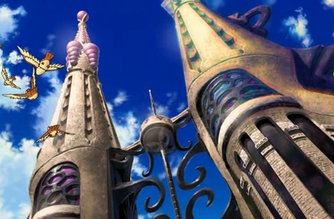
 The Space-Time Towers, which are almost certainly not going to be vitally important to the climax of the movie.  This screenshot is swiped from Bulbapedia.

Once Ash and his friends learn that Palkia is in Alamos Town, they rush out to the square, where Darkrai has managed to detect the Spatial Pokémon hiding invisibly inside a little pouch of folded space above the Space-Time Towers.  Darkrai begins to attack Palkia with his freaky shadow powers, so Palkia bursts out of hiding and banishes the fog enveloping the town – revealing that the whole place has been yanked into a pocket universe and is now floating in space.  They can still breathe and stuff because physics is having an off day.  Palkia will do that to you.  Also, all of the freaky dream things stop happening, the victims of Darkrai’s Dark Void wake up and Alberto is no longer a Lickilicky, because… I don’t know.  I don’t think the movie ever really gave a reason; it just sort of happened.  Palkia and Darkrai throw explosions at each other for a bit, until Palkia’s enemy the blue magic dinosaur (alias Dialga, the god of time) shows up, bearing even more explosions, and all hell breaks loose.  With every blast they lob at each other, the fringes of Alamos Town begin to disintegrate as their space- and time-warping powers destabilise Palkia’s pocket universe.  Alice runs out into the middle of the square and tells the two combatants, in what I imagine to be her very sternest voice, to “stop fighting right now!”  This, predictably, has absolutely no effect and Darkrai has to rescue her when Dialga and Palkia nearly fall on her head.  To be fair to Alice, no-one else seems to have any better ideas.  They just watch the two magic dinosaurs blowing each other up and taking the town with them, while Darkrai flies around intercepting any attacks that endanger the Space-Time Towers, until both Dialga and Palkia get annoyed and blast Darkrai to the ground.  This leads to a scene where Darkrai mistakes Alice for her grandmother, Alicia, and a touching little flashback in which a young Alicia encounters an injured Darkrai in the gardens, sees past his fearsome exterior, and heals him with the music of her leaf whistle (okay, okay, it’s clichéd, but “the healing power of music” isn’t exactly out of place in a setting like Pokémon), encouraging him to stay as long as he likes because “this garden is everyone’s.”  Ash apologises for assuming Darkrai was the bad guy, and Darkrai just gives him a dirty look (I’m not sure whether this was intentional but it’s hilarious).  Once he’s gotten his breath back, Darkrai flies back to the battle.

It’s at about this point, I think, that Tonio starts reciting the description from Godey’s journal of his nightmare, which seems to be playing out right in front of them, as well as the part about “leaving Oración for the world.”  The name Oración rings bells for Alice, since it’s the name of the song her grandmother taught her to play on the leaf whistle – the one that magically calmed down the squabbling Pokémon in the first act (odd that she hasn’t tried this song already, come to think of it, since it was her go-to option earlier in the movie – and even odder that Tonio hasn’t already asked her whether she’s heard the word before).  Light bulbs start coming on in everyone’s heads.  The Space-Time Towers aren’t an insanely extravagant and recklessly impractical tourist attraction… well, okay, they are, but they’re also Godey’s way of “leaving Oración for the world” – his contingency plan for the prophetic nightmare Darkrai sent him.  There’s no music disc labelled “Oración” in Tonio’s rooms beneath the towers, but Alice manages to find it hidden amongst the relief sculptures on the ground floor.  She, Tonio, Ash and Dawn head for the control room on her balloon, which doesn’t last long in the crossfire of Dialga and Palkia’s battle.  Ash and Dawn somehow manage to jump over to the control tower without shattering their legs, while Alice and Tonio fall, but are rescued by Tonio’s Drifblim and Alberto’s Lickilicky.  Unfortunately, Ash and Dawn now have to climb the rest of the way up the control tower… which is starting to disintegrate, like the rest of the town… and here I have to stop and talk about this disintegration business because it really bothers me.  Whatever dimension-twisting power is causing the effect has obviously reached the towers by this point, but it isn’t causing them to collapse, even as their foundations begin to dematerialise.  What’s more, Ash, Dawn and their Pokémon suffer no harm at all (apart from the obvious danger of falling as the steps vanish from beneath their feet), while the objects around them are being taken apart at a subatomic level by the sheer ridiculousness of it all.  Because it’s Pokémon, my suspension of disbelief will just about stretch to accommodate that, but to crown it all, the other trainers in Alamos Town are attempting to slow the progress of the advancing wave of disintegration by attacking it with their Pokémon.  I… honestly can’t even articulate how little sense that makes.  Luckily for the movie, I couldn’t tell whether it was supposed to be working.

For the first time in recorded history, a Lickilicky almost does something useful (yeah, almost - he actually drops her, and Tonio and Drifblim grab her at the last minute).  Screenshot from Pokemon.com.

Anyway, Tonio’s computer decides (using SCIENCE) that one more collision between Palkia’s Spatial Rend and Dialga’s Roar of Time will collapse the pocket universe and destroy everyone.  Darkrai seems to have worked out the same thing and pours all his strength into trapping both of them in a swirly energy thingy, defiantly shouting, in his deep, booming voice, the strangest battle cry I have ever heard: “THIS GARDEN IS EVERYONE’S!”  The swirly energy thingy doesn’t last long, and Darkrai is quickly annihilated for daring to intrude, but he’s bought Ash and Dawn enough time to get the song disc to the control room.  Pikachu and Dawn’s Pachirisu have to supply the towers with electricity, since the dematerialisation has cut off their power source, but the delicate mechanisms that create the towers’ music seem totally undamaged.  Oración plays, and Dialga and Palkia suddenly think “wait… why were we fighting again?”  This scene… this scene bothers me.  I think it would have been a perfectly effective scene if it had just focussed on the dragons’ reactions to the sound of Oración as the song played… but this is the climax to a Pokémon movie, which means that sparkly things need to happen.  A bunch of extra protrusions, which remind me of the hands of an old-fashioned clock, unfold from the sides of the towers (this I can deal with).  The towers start glowing.  The clock hands actually start to grow and blossom.  Finally, two enormous golden wings of light unfurl and bathe the entire town (or what’s left of it) in their radiance.

…I’m guessing no-one has ever actually played Oración on these things in the hundred years since they were built, ‘cause that really would have given the game away.

 The Space-Time Towers play Oración.  Notice all the extra frilly bits springing out. (Again, swiped from Bulbapedia)

Seriously, though, this climax has a perfectly respectable age-old theme – “music hath charms to soothe the savage breast” – which can stand on its own two feet just fine, thank you very much.  Invoking extraneous sparkly things and making the whole business literally magical just puts more distance between reality and an idea that isn’t at all out of place there.  Isn’t the monumental architecture of the Space-Time Towers themselves spectacular enough?

Not that anyone ever listens to me.

Dialga shrugs and flies off back to his own dimension, leaving Palkia to clean up the mess.  Ash and Dawn give Palkia a very stern talking to, commanding her to put Alamos Town back the way it was… and Palkia is like, “whatevs,” does it, and flies away.  Ash and his friends are all distraught that Darkrai is dead, and have a little mourning scene complete with a greyscale montage of their memories of Darkrai… which is quite poorly done, if you ask me; the music playing is slow and sentimental, exactly as you’d expect from a scene like this, but since they have no soft, gentle memories of Darkrai, the montage is mainly comprised of the coolest explosions Darkrai was involved in during the battle.  Honestly, it feels like a parody of eulogistic montages, but I think they mean it.  None of that really matters though; as they very quickly learn, Darkrai isn’t dead at all, because Pokémon movies have a huge difficulty with allowing their heroic sacrifices to stick.  It actually does make sense with reference to the movie’s internal logic; when Palkia restored Alamos Town, she restored everything – including all the living things that were destroyed, like the trees – so it stands to reason that Darkrai would be back too.  I just find the effect on the movie’s emotional tone unnecessary and irritating, especially after that godawful montage – did Victini get one of those in movie 14?  I’m not sure, but I don’t think he did.

Then the movie ends.  During the credits we see footage of the Pokémon Contest they came to Alamos Town for in the first place, but it’s basically over.  Rise of Darkrai… has its moments; I’ll give it that (not all of them are good moments, mind you).  I quite like the idea that the Space-Time Towers had been Godey’s defence against his nightmares all along (although I question the wisdom of some of his decisions, like not explaining the towers’ true purpose to anyone, storing the unclearly-labelled Oración disc in a completely different place from most of the other songs, and putting the control room halfway up the towers).  I’m also generally pleased with Darkrai’s characterisation, which is almost a complete one-eighty from the way he’s portrayed in the games.  On the other hand, the movie is very prone to putting funny words in Tonio’s mouth and expecting you to accept them because he’s a scientist.  Also, although the movie’s obsession with sparkly things isn’t noticeably greater than that of any other Pokémon movie, it definitely bothers me more, simply because of the way it manifests.  Finally… what’s up with the name “Rise of Darkrai”?  Darkrai doesn’t really do anything in this movie that could be described as “rising” in the sense that the title implies.  I realise “a Film with Darkrai in it” doesn’t have quite the same punch but, honestly, it would have made more sense.  On balance, I think I’d probably rate Victini and Zekrom higher, but Jewel of Life remains immovably upon its last-place throne (no; I’m not writing a review of it, so don’t ask me to – this means you, Jim).

Gonna do some other stuff for a while, then Giratina and the Sky Warrior when we eventually get around to watching it.  Stay tuned.

EDIT: I WAS MISTAKEN.  Darkrai’s characterisation in the games is similar to this movie’s.  I APOLOGISE TO ALL THOSE I HAVE MISLED.

Pokémon: the Rise of Darkrai (Part 1 of 2)

This movie…

Oh, this movie…

My so-called “best friend,” Jim, gave me the DVD for this movie, the tenth in the series, (along with the eleventh, Giratina and the Sky Warrior) for Christmas.  A couple of weeks ago I managed to make him watch it with me.  This movie…

It’s not that it doesn’t make sense, because it does eventually, it’s more that the whole first half of it is one great big long “what the hell is going on and why do I care?” It opens with a scientist guy reading cryptic nonsense from a dead person’s journal, intercut with scenes of the nightmare the journal describes: two enormous magic dinosaurs fighting in the middle of an electrical storm in space, a place the narration calls the “space-time rift.”

One quickly learns that in Rise of Darkrai it’s generally best just to go with it.

HERE BE SPOILERS!

The pink magic space dinosaur gets the blue magic space dinosaur in a headlock (I think this actually happens later in the movie but I found the picture too hilarious to leave out).
 The pink dinosaur is injured by the blue dinosaur and attempts to flee, as they continue to lob explosions at each other.  The scientist’s hourglass falls and shatters.  This is SYMBOLISM; I’m pointing it out because it’s very subtle and I was worried you might not catch it.  We then cut to our dearly beloved heroes Ash and Pikachu, and their current minions, Brock and Dawn.  Like Iris and Cilan in Victini and Zekrom, these two don’t really contribute a lot to the movie but you can tell the writers were still trying on this one.  Ash’s quest for Pokémon ‘mastership,’ to use the narrator’s ‘word’, has taken the trio to a place called Alamos Town.  On the way, they meet a young woman named Alice who can play music with a leaf (this is actually a thing, apparently) and, to Brock’s astonishment, is not in his “little blue book of babes” (presumably a journal of his life as an incredibly creepy stalker).  She gives them a lift into town on her hot-air balloon, during which they experience a strange and disconcerting but apparently harmless shockwave of some kind, and points out Alamos Town’s major landmark, the Space-Time Towers.  Team Rocket show up in their own hot-air balloon but are blown out of the sky by a group of Drifloon without even managing to attract the attention of the real cast.

When they land, Alice shows them around, they have some battles, and then they visit Alamos Town’s public gardens, which were built by the same architect who designed the Space-Time towers, a fellow named Godey.  There are some cute scenes where the team’s Pokémon play with the wild Pokémon that live in the gardens and get into a fight over an accident, but Alice uses her mad leaf whistling skillz to calm everyone down.  While the kids are complimenting Alice’s music, a wild Gallade shows up to warn her about something.  They all follow Gallade to an area of the gardens where some stone pillars have been twisted out of shape somehow, which the local pompous aristocrat, Baron Alberto, is quick to blame on Darkrai, a mysterious Pokémon associated with nightmares.  Alberto notices a rustling in the bushes and, sensing Darkrai, sends out his Pokémon partner – a Lickilicky (proving once and for all that Nintendo know the easiest way to make the audience hate their designated antagonist is by giving him a Lickilicky).  Alberto’s strategy with Lickilicky throughout this entire movie is to Hyper Beam everything, and this is just what he does here, but the rustling unfortunately turns out to be a man named Tonio, the scientist from the prologue and Alice’s sort-of-boyfriend, who is… doing science things… to investigate the distortion effects.  While he recovers from this wacky misunderstanding, there is another shockwave and Ash spots the real Darkrai appearing in the shadows.  Alberto is quick to aim a Hyper Beam at him but fails to understand how massively outclassed his Lickilicky is against the embodiment of all nightmares.  Darkrai evades Lickilicky’s attacks without effort by turning into a shadow and then hurls a sphere of darkness back at Lickilicky, but misses and hits Ash, causing him to trip out and have a vision of the enormous magic dinosaurs from the prologue.

 "My god!  The levels of SCIENCE in this area are off the charts!"

Hours later, Pikachu manages to shock Ash awake in the local Pokémon Centre, where Nurse Joy explains that anyone who falls asleep near Darkrai suffers from terrible nightmares, so he is shunned by just about everyone.  While they’re talking about this, Tonio obsesses over what looks to me like a knot in the wood of the floorboards, which he is convinced is another space-time distortion, and runs off back to his study beneath the Space-Time Towers.  He spends the night there reading the journal, which belonged to Godey the architect (Tonio’s great-grandfather), and recounts how Darkrai appeared in the gardens long ago and was befriended by Alice’s grandmother, Alicia, when she was a little girl.  Tonio then finds an early schematic of the Space-Time Towers, accompanied by Godey’s statement that his nightmare had made him understand “for the future, I needed to leave Oración for the world.”  The journal fails to explain what Oración actually is, though.  Tonio falls asleep in his study and is found in the morning by Alice, who is giving Ash, Brock and Dawn a tour of the Space-Time Towers.  While Alice berates Tonio for sleeping on the floor and Tonio goes over his discoveries of the previous night, Pikachu and Dawn’s Piplup discover a shelf of heavy brass discs, about the size of film reels, filled with clockwork mechanisms and dotted with complex patterns of holes like the punch-cards used to program the first computers.  Tonio explains that these ‘music discs’ are used to make the towers play songs and, at Dawn’s insistence, leads the group up to the control room that sits between the two towers, about halfway up.  When an impressive-looking machine is activated with a disc in its slot, an array of enormous hammers positioned up and down the insides of the towers play the music encoded on the disc by striking a series of taut cables, like a ludicrously oversized piano.  THERE IS SURELY NO WAY THIS COULD POSSIBLY BE IMPORTANT LATER IN THE MOVIE.

 Darkrai.  Artwork by Ken Sugimori.

Shortly after the group leaves the Space-Time Towers and Tonio returns to his lab, Alamos Town experiences more shockwaves.  We cut back to the space thunderstorm for a minute and see the pink magic dinosaur trying to escape the blue magic dinosaur by diving through a tear in space, through which the Space-Time Towers are visible.  This is accompanied by an especially impressive shockwave, which Tonio, down in his lab, realises is emanating from “between the dimensions”…whatever that means (for something to be between dimensions it’d have to be outside them, and does the word “outside” even have meaning when excluded from physical space, and how the hell does Tonio measure this nonsense, and I don’t think they even really know what the word “dimension” means, and you know what I’m just going to go with it).  Without warning, Darkrai appears in the town square, where Ash and his friends are enjoying more battles against the trainers they met the day before, and gives the terse command “go away!”  Alberto and his Lickilicky are on the scene instantly (accompanied by Team Rocket, who are pretending to be reporters doing a story on him) but fail just as spectacularly as before to make any impact on the mysterious Pokémon, who puts a dozen Pokémon in the square to sleep with his Dark Void attack and then flees.  Ash and Alberto pursue him, but he quickly escapes after putting Lickilicky to sleep.  They are then confronted with a hallucination of a Bibarel floating in the air and walking through walls… which… is weird, don’t get me wrong, but the movie’s just getting started, because Alberto then turns into a Lickilicky.  He can still speak normally for some reason, despite now having a tongue twice the length of his body; in fact at a later point in the movie he even manages to talk while using his tongue to restrain Darkrai with Wrap.  Like I said at the beginning, it’s best just to go with it – especially as it prompts Alberto to wail what is easily the best line of the movie: “MY ROYAL TONGUE!!!”  When Ash, Team Rocket and Alberto arrive back at the gardens, they learn that images of all the Pokémon Darkrai put to sleep are running around them in circles.  Tonio deduces – through SCIENCE – that the space-time distortions are merging their dreams with reality, and suggests that Lickilicky is dreaming about being Alberto.  I’m pretty sure this makes no sense at all.  Shouldn’t there just be an image of Alberto wandering around nearby making Lickilicky noises?  Besides, if all the other dream effects are just illusions, why does Alberto actually gain all of Lickilicky’s powers?  All this aside, I am delighted by the implication, which Jim pointed out after the movie had ended, that Lickilicky’s worst nightmare is being Alberto.

The other trainers discover that the town has been surrounded by a thick, impassable bank of fog, which prompts Baron Lickilicky (as Jessie of Team Rocket quickly dubs him) to start a witch-hunt for Darkrai.  Alice isn’t sure Darkrai’s behind it all, though, and Tonio agrees, recounting a day from their childhood when (he suspects) Darkrai saved Alice from a fall in the gardens, though she had always believed Tonio saved her.  They return to Tonio’s lab and review some video footage of the biggest shockwave, collected by Tonio’s Drifblim.  Zooming in and enhancing the image, Tonio sees, for a fraction of a second, the pink magic dinosaur from the prologue appearing at the epicentre of the shockwave, and identifies it as Palkia, an ancient godlike Pokémon that rules over the spatial dimensions.  Darkrai’s earlier command, “go away!” was directed at Palkia, and, after dealing in short order with Alberto’s phenomenally poorly-conceived witch-hunt, Darkrai is now on his way to enforce that command…

Dun-dun DUNH!

Pokémon White: Victini and Zekrom (Part 3 of 3)

Where I left off last time, Ash was chilling with Zekrom in the basement while Damon continued his ill-advised plan to return the Sword of the Vale to its original site.  While Ash is gone, Mannes (who has been doing recon in his crazy-awesome home-built Klinklang-powered helicopter) tries to suggest to Damon that something might not be quite right here, since the Dragon Force appears to be doing a few minor things it probably shouldn’t, like incinerating the forest.  Damon is unconcerned.  Meanwhile, Juanita decides to have another go at Reshiram with her Golurk, because she apparently has terrible pattern recognition; Golurk lobs a couple of Hyper Beams at Reshiram but quickly winds up embedded in the castle wall.  Just as Reshiram is about to nuke it, Ash and Zekrom explode out of the base of the Sword of the Vale and intercept the white dragon’s attack.  As soon as he gets the chance, Zekrom drops Ash off at the tower and goes to deal with Reshiram, which involves a great deal of incredibly flashy CG explosions, lasers, shockwaves and miscellaneous sparkly bits (okay, I’m disdainful, but as Pokémon battles go, Reshiram vs. Zekrom is pretty spectacular).  Reshiram loses and nearly falls into the chasm created by the seething Dragon Force as it flows across the land, but Zekrom saves her at the last minute.  By this point, Pikachu has gained the upper hand over Damon’s Reuniclus up in the tower, and Ash is trying to break Victini free from the six miniature Pillars of Protection at the centre of the room.  He isn’t having much luck, until Reshiram suddenly turns up and obliterates the pillars.  Then this exchange happens.

Damon: Reshiram!?  What the hell!?  This was totally not in the plan!

Reshiram: Oh, hey, Damon… so, about that plan?  That little project we had going?  Turns out it might destroy the world a little bit.  My bad; this is totes my bad.  But, you know, who’d have thought, right?

I’m writing this from memory, so that may not be an exact quote.

Green good.  Purple bad.

Anyway, the Sword of the Vale doesn’t immediately drop out of the sky, which leads me to wonder what exactly Victini was doing that was so important, since all the Solosis and Duosion seem perfectly capable of holding it up without him.  Reshiram and Zekrom make another fantastically sparkly CG explosion to blow the clouds away, so Damon can actually see what’s going on down on the ground and goes into “my god, what have I done?” mode.  The two dragons then attempt to mitigate the damage by redirecting the excess energy of the Dragon Force into the Sword of the Vale, which… kind of works.  The progress of the chaos is slowed, and the castle absorbs a lot of energy.  Unfortunately Sigilyph, who’s still piloting the castle, can’t handle the strain and abandons ship, along with all the other Psychic Pokémon.  It still doesn’t drop out of the sky; in fact it flies even higher and shows every sign of intending to go into orbit.  I have long since stopped trying to figure out what is keeping it up.  Everyone evacuates using Mannes’ helicopter and Carlita’s Hydreigon, but Damon stays behind to man the controls, and Ash refuses to let go of Victini and gets stuck behind the Pillars of Protection, which are closing in on the castle.  Damon falls out, and I’m not sure why they even bother to show this, because he’s absolutely fine; Golurk rescues him and brings him back within five minutes.  In that time, the six pillars have continued to close in on Ash, Pikachu and Victini and eventually lock together.  Reshiram, Zekrom and Golurk blast them repeatedly, to no effect, while Ash begins to freeze to death from the cold of the upper atmosphere.  He apologises to Victini for not being able to take him to the ocean and then slips into blissful unconsciousness.  This scene, with Pikachu in tears and trying to wake Ash up… well, don’t get me wrong, it is touching, but it’s kind of clichéd and I’m having flashbacks to the climax of Mewtwo Strikes Back, which had, y’know, pretty much the exact same scene.  Also, for me anyway, the earlier scene from Victini’s memories actually had a far bigger impact, maybe because we know the King is actually dying, whereas Ash is contractually obliged to stay alive at least until he finishes the Unova series.  After all the ridiculousness Ash has survived over the years, including facing off with honest-to-goodness not-even-joking deities, I have trouble believing that this is going to finish him off.

 You teared up.  ADMIT IT.

Whatever I may think, Victini is certainly affected by Ash’s impending demise.  He suddenly remembers that he knows the most absurd attack in the entire game, V-Create, then sets himself on fire and rams the pillars at full speed, causing the movie’s most dramatic explosion yet, in which the pillars are completely destroyed and a huge flare of unstable Dragon Force is released into space (where, ten million years later, it will reach a peaceful planet on the other side of the galaxy and scourge it of all life).  The Sword of the Vale, incidentally, still doesn’t crash back to the ground.  When Ash wakes up, Sigilyph and the other Psychic Pokémon are back on board and Reshiram, Zekrom and Golurk are helping to guide the castle (this is the only indication the movie ever gives, by the way, that the Sword of the Vale is even slightly impaired by losing Victini and the Pillars of Protection).  Victini is nowhere to be found, and they all believe he’s given his life to destroy the pillars and save Ash and Pikachu.  Damon lands the Sword of the Vale in an entirely new location, a forested headland just in front of the oncoming stream of instability rushing through the Dragon Force.  This finally settles the chaos down, because of the plot.  Ash has a sad moment on the beach, because he’s brought the castle to the ocean but not Victini.  That lasts for about five seconds before – in the most predictable twist of the entire move – Victini turns out to be alive after all… in fact he doesn’t even seem to be particularly tired, which raises the question; if Victini could destroy the Pillars of Protection without killing or even severely weakening himself, why didn’t he do that centuries ago?  In the context of the movie’s efforts at characterisation, it’s because his desperation to save Ash caused him to unleash powers well beyond what he’d ever realised he had, but you’d expect him to be very much worse for wear after pulling something like that (and let’s not forget that his wish to escape the barrier has been weighing very heavily on Victini’s psyche for a long time, so I’d expect him to have tried absolutely everything to get out of there before now).  Anyway, there is much rejoicing, the end credits roll, and they all go back to the Vale, where Victini works his magic and begins to return life to the place.

Actually, I kind of liked it, mostly because it didn’t make my brain hurt the way Jewel of Life did.  I realise this may not seem like a major selling point, but bear in mind that my expectations were low.  I don’t think I would recommend it to anyone who isn’t a Pokémon fan, but it won’t actually make you stupider when you watch it.

 <em>Arceus and the Jewel of Life</em>: a simple film, but one that taught us so much.

I assume this movie has a moral, but I’m not entirely certain what it is.  At the moment I’m in favour of “don’t mess with what you don’t fully understand,” although “just follow your dreams and everything will work out, although you might risk destroying the planet along the way” works too.  I think the moral of Jewel of Life was “don’t let the High Priest brainwash you with his magic bell,” so either is a definite step up.  Speaking of not fully understanding things, the vagueness of the Dragon Force bothers me.  I don’t mind this kind of vagueness in a story with a lot of complex characters because it’s fairly easy to accept that a fuller explanation would just get in the way, and that the plot device only matters anyway because it provides something for the characters to react to.  Pokémon doesn’t do stories with deep characterisation, though.  What’s more, Victini and Zekrom/Reshiram places a great deal of emphasis on the Dragon Force itself; visually it gets a lot of attention because it’s one of the shinier things in the movie.  The movie resents having to explain how it actually works or make it behave consistently, though.  Why does the original battle between Reshiram and Zekrom turn it into a destructive force?  Why does moving the Sword of the Vale fix it?  Why, for goodness’ sake, does moving the thing again, a thousand years later, turn the Dragon Force chaotic again?  These are, incidentally, exactly the kind of questions people don’t bother asking if they’re more interested in your characters anyway.

Finally, I know I complained about Reshiram and Zekrom already, but I want to do that some more.  Compared to everything the Pokémon series has produced before them, Black and White (the games) were a triumph of storytelling.  I mean, I realise that’s not exactly saying much, but it’s a huge step in the right direction.  The movie offered an opportunity to expand on that by developing Reshiram and Zekrom as independent characters with motives and ideals (shut up, Zekrom), in a context that didn’t demand that they be freely interchangeable the way the games did.  Instead, by using that weird two-movies-for-the-budget-of-one gimmick, it embraced the same bizarre line of thinking that forces the two dragons (who are supposed to be opposites, mind) to become blandly identical.  The result is that they act more like plot devices than the pivotal characters they should, by all rights, be.  When you think about it, Reshiram – who symbolises truth – should be the last person (…dragon…whatever) to rush into action without fully understanding a situation, but this is exactly what Damon and Reshiram do in this version of the movie, a mistake which ought to be more characteristic of the brash and idealistic Zekrom.  In contrast, I could see Reshiram being prepared to accept Victini’s suffering in the Sword of the Vale as a necessary evil, with Zekrom demanding much more persuasion from Damon to go along with it.  This is an issue in the games as well, of course, but I’m much less prepared to accept it here because the games are, first and foremost, games, not stories; I would certainly like better stories out of them, but I’m happy to take what I can get.  My expectations are a bit higher for something that is, first and foremost, a story.

 No, really, I swear they're in the movie somewhere.

There you have it, then; my thoughts on- oh!  Wait!  I almost forgot!  Team Rocket are totally in this movie too!  Because… well, I don’t really know why and I don’t think the writers did either; they just are!  Team Rocket show up right at the beginning wearing absurd disguises and overhear Juanita as she tells Ash the legend of Victini, which, of course, they believe instantly.  They then spend the rest of the movie flailing around trying to capture Victini, pretending that they’re going to have some kind of impact on the plot but never actually getting close enough to do anything, to the point that the none of the real cast members even see them (much the same way as in Jewel of Life, except not quite as mind-meltingly stupid).  Like Iris and Cilan, they’re completely superfluous to the plot, but kind of form a package deal with Ash and Pikachu.

Anyway, that’s the movie, and I hope you enjoyed my rambling; see you next time!

Pokémon White: Victini and Zekrom (Part 2 of 3)

Now, where were we?  Ah, yes; Ash, Pikachu, Iris and Cilan were in mayor Mannes’ office with him and Damon, who were about to tell our plucky young heroes the history of Eindoak Town and the Sword of the Vale.  Right.

 Continuing to snatch screenshots from Pokemon.com.  Here we see Reshiram demonstrating her special skill: she is made of explosions. (Incidentally: yes, I know Reshiram has a male voice actor in the film, but she was explicitly designed to have a feminine appearance and I've always thought of her as feminine, so nyeh)

One thousand years ago, according to Damon and Mannes, their ancestors lived in the Vale, a now-lifeless area which is just visible from the battlements of the castle.  At the time, the Vale was a paradise, thanks to a mysterious power called the Dragon Force, which is basically the life energy of the planet; the flow of the Dragon Force through the Vale made it one of the most naturally temperate and fertile places on Earth.  The Dragon Force… has never been mentioned in the series before now, to my knowledge, and will probably never be mentioned again.  It doesn’t come completely out of nowhere because it’s well-established that some sort of “life force” is as much a part of the Pokémon universe as gravity, and that Dragon Pokémon have a particularly close connection with it, but as we’ll see, the Dragon Force has an alarming tendency to function in whatever manner the plot requires it to.  Anyway.  The Vale was ruled by a benevolent old king – Victini’s master – and his two sons, who were known as the “Hero of Truth” and the “Hero of Ideals” because of their “unique qualities” (yes, that’s as specific as the movie ever gets) and partnered with two almighty Dragon Pokémon: the white dragon Reshiram and the black dragon Zekrom, respectively.  For reasons that are never explained and which cannot be extrapolated because we’re never told anything else about the heroes or their beliefs, the two princes quarrelled, and their argument gradually escalated into a full-scale war that devastated the Kingdom of the Vale.  The King, whose Pokémon partner had the power to make him unbeatable at everything ever, including diplomacy, sat his sons down for a good long talk that resolved all of their disputes and made everyone happy again.  This is exactly what didn’t happen because then there wouldn’t be a story.  The King… I don’t know, watched, I guess.  Reshiram and Zekrom nearly killed each other and were turned into two small round stones, at which point the princes stopped to think about it and realised that they were shredding their kingdom.  Unfortunately, the chaos of the battle between two of the most powerful Dragon Pokémon ever had infected the Dragon Force and caused it to become destructive, because of the plot.  The King, in desperation, created the Pillars of Protection to channel Victini’s power and used them to cast the spell that moved the Sword of the Vale, with all his surviving people crowded inside, to the castle’s present location at Eindoak Town.  At the same time, he altered the flow of the Dragon Force to restore its balance, but had to cut off the Vale to do so, leaving it a wasteland.  Unfortunately, the exertion was too much for the King and he died before he could dismantle the pillars, causing Victini to become trapped in Eindoak Town.  Most of the People of the Vale, bereft of their ancestral home, left the region for good.

 Zekrom's special skill is very similar to Reshiram's.  He is made of explosions also.

This is where Damon comes in.  When he was a child, Juanita once told him about her dream of seeing the Kingdom of the Vale restored to life, which he apparently took to heart, leaving Eindoak Town to travel the world and reunite the scattered People of the Vale when he grew up.  Most of them seem to have thought he was insane; they probably didn’t even believe in the old legends anymore.  Dejected, Damon returned home, where he heard a mysterious voice telling him to seek the truth.  The voice led him and Mannes to the crystal caverns beneath the Sword of the Vale, where Damon found the Light Stone and reawakened Reshiram, who told him that “the truth within you has been judged worthy.”  Suddenly his distant cousins find him far more credible.  Now, he’s brought everyone he met back to Eindoak Town and wants to re-enact the King’s spell, return the castle to the Vale and restore the original flow of the Dragon Force.

By the time all this has been explained, it’s late at night, so Ash and his friends go to bed.  In the garden.  Cilan has a sleeping bag, Iris climbs a tree, and Ash just leans against the trunk and drapes a cloth over his knees.  I guess hard core badass Pokémon Masters can get a good night’s sleep anywhere.  While they sleep, Ash appears to share Victini’s dream: a vision of the old King dying.  It turns out, unsurprisingly, that the poor little guy was horribly traumatised when his master died right in front of him and left him trapped and alone for a thousand years.  The next morning, Ash resolves to find a way to free Victini and, rather rashly, promises to take him to the ocean.

Meanwhile, Damon has gone up to the central tower of the Sword of the Vale, where his Sigilyph helps him to coordinate the vast numbers of Solosis and Duosion who live in the tower and provide the psychic energy required to move the castle.  Victini realises something is going on and flies up to the tower.  He doesn’t like what Damon is up to one bit, but Sigilyph uses a set of six miniature Pillars of Protection to trap Victini on the altar in the middle of the room.  The full-size ones are now airborne and revolving steadily around the castle.  The pillars use Victini’s power to fire up the horde of Duosion and Solosis, and the castle takes flight, granting Damon control over the Dragon Force.  Ash, Iris, Cilan, Juanita and Carlita lean out over a balcony and watch joyfully as Damon redirects the flow of energy back to the Vale… until Ash hears Victini cry out in pain.  He runs to the tower, sees Victini trapped, and tries to free it, but Damon calls out his Reuniclus to stop him.  Pikachu and Reuniclus are fairly evenly matched, so Damon plays his trump card and summons Reshiram.  Juanita tries to fight Reshiram with her Golurk, which goes better than you might expect, in that Golurk is not instantaneously reduced to a heap of molten glass and actually manages to keep Reshiram busy in aerial combat for a few minutes (yes, Golurk can fly; it is perfectly aerodynamic).  Damon is confused that they’re trying to stop him, which is not entirely unreasonable; everything seems to be going according to plan.  Victini clearly isn’t happy about it, but they’re not doing anything that hasn’t been done before, so Damon has no reason to think he’ll cause Victini any long-term harm.  We the audience, however, were watching when Victini and the King did this the first time, and Victini wasn’t struggling or in pain then.  Something is wrong here.  With his dreams so close to fulfilment, though, Damon won’t listen to his family or friends, and Reuniclus knocks them all out with its Psychic attack.

 The set-up in the central tower of the Sword of the Vale that allows Damon to control everything.

While Ash is unconscious, he receives another vision from Victini, which shows him what the problem is: Victini is resisting Damon because the King’s last words were to tell his friend that the Sword of the Vale must never be moved again; its new position in Eindoak is essential to keeping the Dragon Force balanced, because of the plot.  So, to summarise, Victini watched his beloved master die, was imprisoned alone for a millennium, and is now being forced to violate his master’s dying wish.  Also he met Ash.  This movie really hates him.  Reshiram doesn’t understand the danger, so Ash goes to explain and- oh, no, wait, he’s Ash, so instead of that he goes down into the crystal caverns (which are attached to the castle’s foundations and lifted off with it) to find Reshiram’s opposite, Zekrom.  I’m not sure why they think this will help, since Zekrom doesn’t know anything more about the situation than Reshiram does and is no more likely to listen to reason.  Nonetheless, like Damon before him, Ash is inexplicably able to navigate the maze inside the caves when no-one else can, and finds Zekrom sleeping at the bottom in the form of the Dark Stone.  Zekrom demands to know what Ash’ s ideal is, to which Ash stammers that he wants Victini to see the ocean.  This… is apparently good enough for Zekrom, and here I really have to talk about this “truth and ideals” stuff.  See, the one major difference between the two versions of this movie is that in the other version, Damon found Zekrom and Ash finds Reshiram, which means that, in theory, Damon’s ideals and Ash’s truth should be put to the test in the other story.  The writers, however, weren’t keen on actually having to write two separate plots for their two movies with separate character arcs for both Ash and Damon in each one, so what they’ve done instead is whitewash (no pun intended) the concepts of “truth” and “ideals” to the point that they are completely interchangeable, and translate out to “your vision of how the world should be”.  As a result, Reshiram talks about “truth” as though it’s an incredibly subjective thing that each person has to find inside him or herself, and both of them, in their respective versions of the film, are perfectly satisfied that Ash’s wish to take Victini to the ocean exemplifies each of their respective virtues.  As in the games, therefore, Reshiram and Zekrom both represent exactly the same things: desire and the will to pursue it.

…suddenly it makes perfect sense to me that they wound up fighting.