You’ve mentioned in the past that Grass is one of the weakest types. What would you do to change that? For example, what weaknesses and strengths would you change, or how would you alter certain attacks?

Grass… kinda gets a raw deal, yeah.  Just purely in terms of the number of other types it’s strong/weak against, it’s one of the games’ worst… which is kind of a sore spot for me, since it’s also my favourite.  Most types are defensively vulnerable to two or three others; a few are vulnerable to only one, and Ice (which also kinda got shafted, I think mainly because Generations 1 and 2 had no pure Ice-types) is vulnerable to four.  Grass is vulnerable to five: Flying, Ice, Fire, Bug and Poison.  Only one other type has that many defensive weaknesses – ironically, that would be Rock (vulnerable to Fighting, Steel, Ground, Grass and Water).  Rock, though, gets to enjoy being one of the game’s better offensive types – Rock is the only type other than Ground to be strong against a greater number of types than it is weak against, offensively.  Grass, not so much – Grass attacks are weak against seven different types (Grass, Flying, Bug, Fire, Dragon, Poison and Steel), which until X and Y was more than any other – and that changed not because Grass’s situation improved, but because the next-worst-off type, Bug, gained a new disadvantage against Fairy-types.  They’re strong against three (Rock, Ground and Water), which is sort of average, really.

Grass does, admittedly, have a decent number of resistances – four of them (Water, Electric, Ground and Grass itself), while many types only have two or three, but it doesn’t really stand out in that regard – Water, Rock and Dragon also have four, as do Ghost, Fairy and Flying if you count their immunities (which, y’know, are kind of better), Poison has five, Fire has six, and Steel blows them all out of the water with eleven.  It has to be said that counting types can only go so far – Dragon, for instance, was hands-down the best attacking type of the fourth and fifth generations, despite being strong against only one type (itself), because it had nearly perfect neutral coverage, resisted only by Steel.  The problem, though, is that where types like Dragon and Rock lose out in one respect but do very well in another, Grass kinda loses everywhere.  Grass-types are, admittedly, also immune to Leech Seed and, as of X and Y, powder attacks (the important ones being Stun Spore, Sleep Powder and Spore) – so basically they’re really good at blocking other Grass-types.  That seems to be the niche Game Freak has in mind for them here.  I mean… not that those immunities aren’t useful, but they’re also kind of a slap in the face.

So, when I put it like that, it seems like the obvious thing to do is strip out some of those damned weaknesses (the attacks, I think, are fine as they are – Solarbeam could maybe use some work, because at the moment it’s kind of a gimmick and only viable on dedicated sun-abuse teams, but I’m not sure how to change it).  Let’s start with Flying.  Why does Flying beat Grass?  I’ve seen element-based systems before where Plant/Forest is actually strong against Wind/Sky, birds can help plants through pollination (analogy with the Grass-Water relationship), and it’s scientific fact that plants bolster hillsides against erosion by the wind.  I say make Grass-types resist Flying attacks, and Grass attacks neutral to Flying-types.  Make Flying-types strong against Water instead; the smug pricks deserve it.  We can probably get away with removing Steel’s resistance to Grass too, since Steel has too many damn resistances anyway.  In flavour terms that’s not as solid, because there’s precedent for Metal-beats-Wood in the Chinese Wu Xing cycles, but the fact is, there are probably ways to justify having Steel resist everything, so I think a little more restraint is in order when dealing with that type.  Those things won’t make Grass an amazing type, but it’ll certainly make it not suck!

Bug could use some help too, but I’ve been babbling long enough…

Ever thought of giving Kid Icarus: Uprising a try? It may only be loosely based on Greek Myth, but it’s got enough references, along with an engaging plot with interesting characters and hilariously witty dialogue, to make anyone smile. Though some of the jokes that refer to the old NES title may fly over your head (no pun intended), and it takes a bit of time to get used to the control style, I’m still sure you’d be in for a fun time.

Not really a good time for me to be picking up new games at the moment, sorry.

Are you considering doing a review specifically on mega-evolving (digivolving) pokemon? Your opinion on them is something I crave since re-reading your analysis on various starter pokemon.

Thinking about it.  After the Kalos Pokédex.  I suppose I would want to talk about what Mega Evolution does for each Pokémon that receives it (in some cases: not as much as you’d think), as well as what the change in appearance seems to signify about that Pokémon.  What else?  I’m not sure how much I could usefully say about them, but we’ll see.

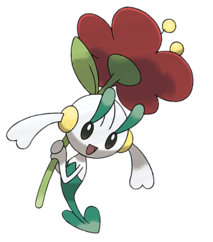
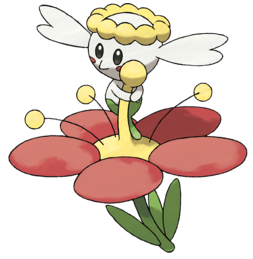
Flabébé, Floette and Florges

Official art of Flabébé by Ken Sugimori.

Okay, I’m just going to come out and say it: I have no idea how to pronounce this Pokémon’s name.  Under standard French orthography, Florges would be pronounced… Florj?  That doesn’t sound right.  Florjé?  Florjéz?  Florjis?  Florghés?  I don’t know; just imagine me mispronouncing it in the most ludicrous way you can think of whenever I type the name.  Flogress…  Florgos…  Florg…

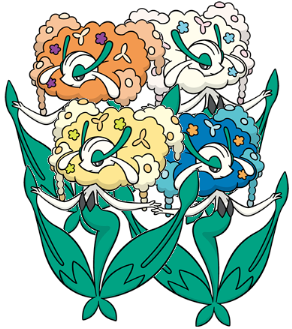
Anyway.  Flabébé.  When I first met this Pokémon I assumed she was a Grass/Fairy dual-type, which I don’t think is unreasonable given the dominance of flowers in her design and their importance to her lifestyle.  Actually, I still have trouble believing she’s not a Grass-type, seeing as most of her level-up moves are Grass attacks, and her offensive movepool certainly seems to have fallen prey to the curse of Grass-Types Don’t Get Nice Things.  Flabébé, Floette and Florges probably come closest to emulating Xerneas’ conception of the Fairy type, which sees them as guardians of nature and nurturers of life, but in this case specifically of flowering plants.  Flabébé and Floette possess symbiotic relationships with single flowers, which they keep for their entire lives, presumably using their Fairy powers to keep them from wilting and dying.  There’s a minor little gimmick here which is not particularly interesting but deserves to be mentioned; their flowers come in different colours – red, white, orange, yellow, and blue – with certain colours being more or less common in different flower beds, Flabébé’s natural habitat.  The colour carries through when she evolves into Floette, and then Florges.  All three stages are said to draw energy from blooming flowers specifically, which may be the key to why they’re not Grass-types, thematically speaking; their powers are drawn not from plants as such, but from the beauty of plants, flowers in particular, and may be related to the symbolic meanings of different types of flowers.  I’m not sure whether beauty and the appreciation of beauty are attributes of the Fairy type, but they certainly wouldn’t be inconsistent with it, so perhaps that’s what Flabébé gets out of the deal.  Or at least, that’s the spin I’d put on it if I were Game Freak.

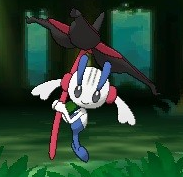
 Floette.

Florges becomes something quite rare and interesting – a Pokémon who actually manipulates terrain type, creating beautiful flower gardens for her territory, and even being invited by humans to do the same for grand estates and castles.  Notice the verb, “invite,” which is exactly what the Pokédex says; what’s happening here is being glossed in very different terms to a trainer/Pokémon relationship.  It seems like we’re being told about wild Florges being asked (contracted, even?) to perform specific services for human nobles, possibly before the invention of Pokéballs (“in times long past”).  One might ask what the Florges gets out of it, and the simplest answer seems to be that she would be permitted to live in the garden indefinitely, providing her and any family members with a long-term home that would be isolated from most predators – this makes sense with the idea that Florges are “invited;” they normally want to create gardens anyway, independent of any human incentive, and there is a mutual benefit to having them do it in a specific place.  My over-active imagination, however, can’t help but wander to the idea of particularly skilled and powerful Florges gaining a reputation for truly fantastical flower gardens and travelling from one great estate to another in order to practice her art and receive pampering, adulation and luxuries in return (I am rather fond of the idea of Pokémon just doing their own thing in the world of humans).  Either of these views of Florges is particularly appropriate to Kalos, with its major background theme of the excessive wealth and luxury of the old aristocracy that alludes to the proverbial decadence of the French ancien régime.  This Pokémon, to me, represents what Kalos itself is all about: precise, studied expressions of elegance that nurture and exalt natural beauty through the imposition of order.

 AZ's Floette, the Eternal Flower.  In addition to her unusual flower, this Floette is also shiny (note the purple body).

Given that, perhaps it’s fitting that one particular Floette gets to play a critical role in the backstory of X and Y: AZ’s Floette, instantly recognisable by her unique black tulip-like flower whose shape seems to have provided the model for AZ’s Ultimate Weapon.  This Floette, who answers to “The Eternal Flower,” fought and died for AZ in the war against his brother and was subsequently resurrected, at the cost of several hundred other Pokémon’s lives, using the Ultimate Weapon.  This puts her right at the centre of the game’s primary conflict of change and stasis (AZ’s refusal to let go of what he had lost eventually brought ruin to Kalos), which also has relevance to Floette’s nature as a Pokémon who preserves and enhances beauty through order.  What AZ did, and what Lysandre wanted to do, are ultimately an extension of what Flabébé, Floette and Florges do throughout their lives: preventing what is beautiful about the world from fading and dying.  As always in Pokémon, the villains are villains because they take it too far, and because they believe that the ends justify the means – something Floette cannot accept, which is why she abandons AZ.  We know from those talented people who specialise in hacking Pokémon games that AZ’s Floette likely to be available to players at some point through an event, because she has her own stats, completely different to a regular Floette or Florges’ – she’s a fast special attacker – and even her own signature move: Light of Ruin.  This move seems to be, effectively, a special Fairy-type equivalent to Head Smash (complete with that painful 50% recoil), and narrowly edges out Xerneas’ Fairy Aura-boosted Moonblast as the most powerful Fairy attack in the game.  It seems likely that this move draws on whatever power was imparted to Floette by the Ultimate Weapon to make her immortal, a power encompassing both life and death – the heavy cost of using it serves as an ever-present reminder that the weapon has always been a double-edged sword.

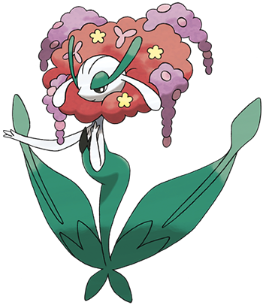
 Florges.

A normal, fully-evolved Florges is a very different Pokémon to AZ’s Floette.  Her greatest strength, instead, is her monumental special defence.  Being a pure Fairy-type doesn’t hurt either, since they have a pretty cushy deal with three resistances and an immunity (to, need I remind you, Dragon) against only two weaknesses.  Her HP and physical defence are relatively poor, though, so either invest heavily in both or keep her far away from physical attackers; this fair maiden is without question a special wall and a supporter.  Florges seems designed to function best in double or triple battles, with two unique abilities and a very rare move which all benefit her allies – if she actually were a Grass-type, two of them would benefit her as well and make her much stronger, but she’s not and they don’t.  First, the move: Flower Shield raises the defence of all Grass Pokémon in play, meaning it’s useless in a single battle, and even in a triple battle with two Grass-type allies (which is just asking for a Sludge Wave to the face) it’s questionable.  This technique really makes a lot more sense on Cherrim, who also learns it.  Florges’ first ability, Flower Veil, is likewise nothing special; it prevents allied Grass Pokémon from having their stats lowered, which basically amounts to granting an ally the Clear Body ability (and before you ask, no, it doesn’t negate Leaf Storm recoil).  I really have to question whether it would have been so bad to let Florges benefit from this as well.  The hidden ability – Symbiosis – may actually be interesting.  Again, it can only be useful in a double or triple battle: if one of Florges’ allies consumes an item (including through the use of Fling or Natural Gift), she will pass her own item to that Pokémon instead.  Being able to transfer items to a partner without spending a moveslot and a turn on something like Trick or Bestow is such a unique thing to be able to do that it seems like it would have to be useful somehow, but I’m at a loss as to how exactly that might be.  Perhaps using a Toxic Orb to activate Poison Heal on Gliscor, Flinging it away, and then replacing it with a Life Orb?  Or something similar to get Leftovers on a Guts Pokémon to help compensate for burn damage?  Once elemental Gems are available on X and Y, maybe they could be combined with Choice Specs or a Choice Band for a single, enormously powerful attack (since the Gem is consumed before the attack, and the new item is transferred immediately)?  I leave this as a puzzle for those more ingenious than myself.

 Florges' other colours - orange, yellow, blue and white - on parade.

While Florges’ special attack pales in comparison to her special defence, it’s actually really high as well.  She also gets a strong offensive type and a powerful primary attack, Moonblast, which will leave a hell of a sting on anything that takes her for set-up bait.  There’s even the option of Calm Mind if you want to make a bulky attacker-style Florges.  Unfortunately, other than Moonblast her offensive movepool is awful.  She only learns Grass attacks, which do almost nothing to supplement Fairy attacks (all the types that resist Fairy resist Grass as well), and Psychic, which is at least good for Poison-types.  It’s pretty clear that Florges isn’t supposed to be an attacker anyway, so consider Psychic, but focus mainly on her support skills – she has plenty to choose from.  Wish and Aromatherapy can be used to heal the team of both regular injuries and status ailments (you’ll need train Florges’ HP heavily to get the most out of Wish, but you should probably do that anyway).  She learns both Grassy Terrain and Misty Terrain, the new Grass- and Fairy-themed field moves, both of which are fairly exclusive (and she happens to be the only non-Grass-type to learn Grassy Terrain).  Light Screen rounds out her options – Florges herself would benefit much more from Reflect, which she doesn’t get, but team support is always good.  I’d hesitate to call her a great support Pokémon, but she can take most any special attack that isn’t super-effective and some that are, hit back with a very strong attack that relatively few Pokémon resist, and heal the team while she’s out.  Although her abilities may be useless in a single battle (and not even all that exciting in doubles, to be honest), she has everything she needs to contribute to her team.

Florges has her shortcomings, but she’s good at what she does, and I think the important thing about this line is that they can, in a way, be seen as mascots for the entire Kalos region.  What they do and what they value in their regular lives have special significance in the context of the plot of X and Y, making Floette a perfect choice for the starring role she has in AZ’s story.  I might still think they would make more sense as Grass-types, and I might wish they had an ability choice that’s actually useful in a single battle, but I wish for things I can’t have for almost every Pokémon.  This one (as anime Bonnie would say) is a keeper.

Are you a fan of the sci fi genre? Heinlein, Haldeman, Adams, Bear etc.? Or do you prefer fantasy, i.e. Tolkien?

Well, I always know where my towel is, though none of the other names on that list have ever been big ones for me.  To be honest, I haven’t had much time for reading fiction lately.  I have so much work-related reading to do (which is interesting, don’t get me wrong, but tiring), much of it in Latin or French, that picking up another book at the end of the day just makes me feel “oh, god, why?” which is a shame, because there are a lot of books out there I want to read (in particular I’ve always meant to read more Terry Pratchett, because the two or three of his that I have read were great).  I did find time a couple of weeks ago, however, for The Princess Bride, which is a very different experience in book form to the subsequent movie adaptation, and which I wholeheartedly recommend.  I have a kind of cold, standoffish relationship with Tolkien because I read The Hobbit as a child, loved it, and then attempted to read The Fellowship of the Ring, which I think was just too old for me at the time, because I got about a hundred pages in, realised that nothing had actually happened yet, put it down, and never returned to it (this was all before the movies, of course).

EDIT: Oh, and I also count myself among the legions of people desperately hoping that George D-Bag Martin doesn’t die before he finishes murdering every character in A Song of Ice and Fire.

Fletchling, Fletchinder and Talonflame

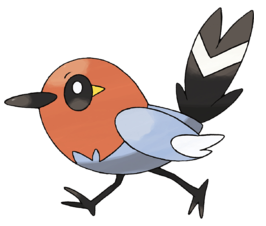
Official art of Fletchling by Ken Sugimori.

I didn’t do the Unova Pokédex in order, and I’m not going to do Kalos in order either (more for variety than anything else).  I’m planning to start with Central Kalos, then the Coastal Pokémon, and then the Mountain areas, but beyond that, I’m just going to play it by ear – starting today with the second Kalosian Pokémon to join my main party, Fletchling.  For obvious reasons, Fletchling didn’t exactly move me to excitement when I first met him: “oh, here we go again; another Normal/Flying fast physical songbird-to-raptor progression with wind powers and no other remarkable traits to eat the local obligatory caterpillar.”  One of the things I was particularly interested in decrying with my Unova reviews – something I’m still very easily annoyed by – is ‘template’ Pokémon, Pokémon who start not with an actual idea but with a principle that every game ‘should’ have a sequel to Pidgey, or Caterpie, or Pikachu.  It’s lazy, it’s boring, and most of all, it doesn’t actually provide any benefit.  There is nothing about these templates that makes the game better, except maybe that they provide an easy introduction to the concept that some Pokémon are just bad.  Part of the reason I’ve always been so irascible about these things is that, although all generations have them, Unova was particularly obnoxious about it, needing stand-ins for things like Geodude and Machop in addition to the usual suspects, which made the absence of any older Pokémon feel like nothing so much as an irritating charade.  Kalos is something else.  Kalos has the templates, but it tries much harder than previous generations to play with them.  On principle, we ‘needed’ a Normal/Flying songbird Pokémon for the early game – so Kalos decided to make one that was as badass as possible.

It’s a simple idea, really.  Take the standard songbird-to-raptor pattern, and set it on fire.  What could possibly go wrong?
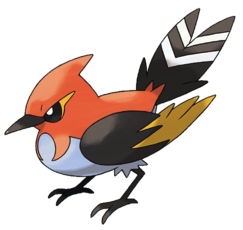
 Fletchinder.

The question here is, how far does a different type go?  Fletchling, Fletchinder and Talonflame still share a lot of traits with Pidgeot et al. – does the fact that they also have fire powers make that okay?  And what does that say about how we look at elements in Pokémon?  Most Pokémon have supernatural powers of one sort or another, and as I’ve recently discussed, it is to an extent the powers that make the Pokémon, but if the essence of Pokémon design is just giving elemental traits to an animal, the Normal-types who mostly lack such traits are damned from the start.  Part of designing these things is matching up the powers to the creature in a clever way.  Birds with wind powers are very straightforward as Pokémon go, since wind and flight ‘go together’ intuitively, while birds with fire powers are a little more interesting, and Talonflame doesn’t just take the obvious phoenix angle, which Moltres and Ho-oh have already done to death anyway.  On the other hand, what makes attaching fire-related abilities to a falcon particularly insightful?  The most interesting Fire Pokémon aren’t just “this animal, but on fire;” they’re ones that play with the idea of fire, either by combining it with another element (like Magcargo, whose body of lava hardens into a stone shell, or Chandelure, whose ghostly lights lead wanderers into another world), or by focusing on an unusual aspect of fire (like Torkoal, who mines and burns coal for energy).  If I like Fletchling and his evolutions, then I’m going to have to dig a little deeper than “new type” – I need to find the flourishes.  Let’s have a look at them.
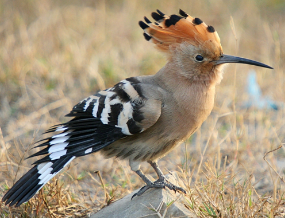
 The hoopoe, the bird Fletchinder reminds me of (it helps that I named my Fletchling, Tereus, after a mythical Greek king who gets turned into a hoopoe).

Fletchling, obviously enough, is a robin, while Talonflame has made the transition to peregrine falcon, while keeping the distinctive red colouring of his juvenile form that also evokes his fire powers.  There doesn’t seem to be any consensus on exactly what Fletchinder is, but he reminds me very much of the hoopoe, a medium-sized bird common throughout most of Eurasia who shares the red colouring of his head, as well as the striking black-and-white striped pattern of Fletchinder’s tail.  The hoopoe is also a larger and more powerful bird than a robin, but not a major predator like a falcon, so he’d be a sensible intermediate.  All three stages incorporate arrows into the design as well, in the form of the distinctive shape and stripes of their tails, like the fletching of an arrow – perhaps making their beaks serve metaphorically as the arrowheads.  The swept-back posture of Talonflame’s wings in the official art might even be meant to recall the shape of a bow, with an ‘arrow’ nocked and ready to fire, formed by the line from his beak to his tail… but maybe that’s getting a little far-fetched.  The famed 310 kilometer per hour dive of the peregrine falcon (which Talonflame insistently one-ups, at 310 miles per hour) is reminiscent of a falling arrow too, particularly in its effects on the health of whatever stands at its destination.  As generic bird Pokémon go, this is already quite a good one, without even mentioning the fact that it’s on fire.  What’s more, Fletchinder and Talonflame’s fire powers do relate in some ways to the rest of their design, adding a little depth to them.  Fletchinder supposedly flies faster the hotter his fire burns, for instance (linking the Fire and Flying elements, the way I talked about with Chesnaught), which makes a good tie-in to the presence of Flame Charge on his level-up set.  The assumption of fire abilities as the Pokémon ages could also be linked to his taking on a more predatory ecological niche as he becomes more powerful, and indeed Fletchinder hunts by starting fires to drive his prey out of hiding.  Flaming arrows, of course, were also a staple of a wide variety of ancient and Mediaeval armies, so giving fire to a Pokémon whose name and appearance are intended to evoke arrows makes good sense.  I actually would have liked to see a greater focus on the arrow motif, which is neglected in the English and French translations of Talonflame’s name, because that’s one of the cleverest things in terms of tying the whole design together.  In balance, though, I think it works.  Talonflame is far from a masterful Pokémon, but I can certainly appreciate the effort to do something unexpected with a highly standardised form, in a manner which integrates the new and different features with the common traits of the traditional early-game Flying-type.
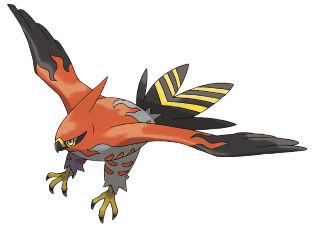
 Talonflame.

Another common thread with Pokémon from the Pidgeot mould is that they are not normally very powerful.  Staraptor excepted, none of Talonflame’s predecessors have ever been important Pokémon for the competitive scene, though Swellow is a persistent dark horse.  The difficult thing about Talonflame, of course, is the double-weakness to Rock associated with his otherwise strong Fire/Flying type combination, because Stealth Rock is showing every sign of continuing to be a thing.  Like all Pokémon with this trait, Talonflame needs diligent Rapid Spin support to keep him from dying painfully, and also needs something pretty special to make him worth that support.  Good news: he’s got an amazing hidden ability.  I don’t want to knock Flame Body, because the combination of Flame Body and Fly makes Talonflame one of the best solo Pokémon to keep with you while hatching groups of eggs, like Volcarona on Black and White (Flame Body causes eggs in your party to gestate at twice their normal rate), but Gale Wings is where it’s at.  This ability gives all of Talonflame’s Flying-type attacks priority, which means, combined with his already excellent speed, that almost nothing will ever be able to outrun his devastating Brave Bird attack – he can beat higher base speed, he can beat Choice Scarves, he can beat Agility, and he doesn’t even care if you paralyse him (but he can’t beat Extremespeed, so watch out for that).  In flavour terms it’s an odd ability because Talonflame doesn’t really have wind powers (‘Gale Wings’ sounds like something Pidgeot should get), but it also happens to make him one of the game’s best revenge killers – Pokémon whose job is to take advantage of the free switch you get after losing a Pokémon to come in and destroy a powerful aggressor – as well as just a frightening thing to face in general.  Flare Blitz provides a secondary attack just as powerful which turns out to combine quite well with Brave Bird; stay away from Rock-types, Heatran, Lanturn, certain legendary Pokémon you shouldn’t be tangling with anyway, and toasters, and you’re golden (you can always take Steel Wing for the Rock-types, but the low power combined with Talonflame’s merely average attack score may disappoint).  Finally, I would be remiss if I did not mention that Talonflame still enjoys the one really spectacular feature shared by most bird Pokémon: U-Turn, which has been called ‘the best move in the game’ for allowing a player to postpone a switch until after seeing whether the opponent will switch that turn, and even doing damage into the bargain.

 Pidgeot actually gained +10 base speed in X and Y.  Pretty sure it hasn't helped.  I'm holding out for Mega Pidgeot, though.

So, what’s the bad news?  Talonflame’s other stats are mediocre all around; his attacks lack punch by the standards of offensive Pokémon, and he’s not tough either.  However, these failings are not as significant for Talonflame as they are for most of his ancestors.  The ease with which Talonflame can outrun his foes using Gale Wings, for instance, means that he doesn’t actually need the maximum possible training investment in his speed, and can afford to spend more time shoring up his defences than most offensive Pokémon (focusing on HP will make Flare Blitz and Brave Bird recoil sting less too).  Furthermore, it’s worth bearing in mind that Roost enjoys Gale Wings priority too!  This bird can be much tougher than his mediocre defensive stats suggest.  He also has options to boost his own attack power – Bulk Up and Swords Dance – which Pokémon like Unfezant, Pidgeot and even Staraptor lacked.  Talonflame really has to work for his power, though; a Choice Band makes Roost infeasible, and Life Orb recoil takes too heavy a toll when combined with Brave Bird and Flare Blitz, so things like a Sharp Beak, Expert Belt or Muscle Band will often have to do, supplemented by Swords Dance and the naturally high power of Talonflame’s main attacks.  Remember that his attack stat is only average, and make sure you look for opportunities for him to switch in and scare something away for a free set-up turn.  Other options… well, Taunt could be neat, to make Talonflame into a total nightmare for defensive and set-up Pokémon, especially with Roost to back him up in a more drawn-out fight, and Will’o’Wisp is weird on such an aggressive attacker but between the attack penalty from a burn and a potential Bulk Up boost Talonflame would actually be pretty hard for a physical attacker to take down.  Talonflame’s special attack is actually not far off his attack, but sadly his special movepool sucks – it’s pretty much just Fire attacks plus Solarbeam and, critically, no special Flying attacks to spam with Gale Wings.  In short, don’t go there.  Finally, and bizarrely, Talonflame is said to prefer devastating kicks when striking finishing blows against its prey – bizarrely because Talonflame has no kicking attacks.  A line like that seems tailored specifically to justify the inclusion of Blaze Kick on Talonflame’s level-up list, but the move fails to make an appearance, an odd lack of nuance for an otherwise quite carefully put-together Pokémon. 

Talonflame’s effective movepool isn’t really very wide – basically everything he can do is variations on the theme of Gale Wings abuse – so finding something for your team that can take at least two of those Brave Birds and hit back is the key here.  He’s not a subtle Pokémon, which makes sense for a bird of prey based on a flaming arrow, but he knows what he does, and he does it well.  Talonflame makes me optimistic for the future.  I feel like Game Freak is trying to say “we’re sorry for all the $#!t birds.  We’ll make better ones in future, and we’ll even make them more than just birds!  See?”  Now, if only poor Pidgeot got Gale Wings, maybe he could feel slightly less miserable about himself…

Since you recently discussed the new Fairy type and briefly talked about the defining factors of other Pokémon types in doing so, I’ve been wondering about your opinions on a couple of types. I have my own of course, but your thoughts are always so interesting. First, what do you make of the Flying type, specifically the fact that it exists almost solely as half of a dual typing (with the exception of one legendary)? And second, what do you think are the defining attributes of the Normal type?

Flying is weird, because it seems like it can consist of either being a bird or having the ability to fly – not necessarily both (see: Dodrio, Scyther).  In addition to the fact that there’s only one straight Flying-type (and even that in generation five), it might also be important that Flying is almost never the first of two types; there’s no functional distinction at all, but which element gets put first often seems to say something about which one is considered more important to the design (e.g. Water/Rock – Relicanth and Corsola – vs. Rock/Water – Kabutops and Omastar).  Noibat and Noivern, only just introduced with X and Y, are the only Pokémon to put Flying first.  What’s more, wind powers – which we now associate with Flying-types, and which are Tornadus’ main feature – originally seem to have been connected with Normal, not Flying, because Gust was a Normal-type attack in Red and Blue, while Whirlwind and Razor Wind, the other wind attacks that existed in the original game, still are Normal.  I think what all this adds up to is that Flying wasn’t originally considered a type, as such – it acts more like a trait or ability that certain Pokémon possess, which makes sense when you think about it, because that’s what flight is (Dodrio is explained by the fact that, as we know from Missingno., the type was originally called “Bird,” not “Flying”).  Tornadus shows that Game Freak’s conception of what the type means has changed significantly since Pokémon began, but some things about this game resist change.  Charizard, then, isn’t so much “a Fire/Flying-type” as “a Fire-type who can fly,” while Pidgeot – and this is important when we move into the next half of your question – isn’t “a Normal/Flying-type,” but “a Normal-type who can fly.”

Now, Normal-types.  They rely primarily on attacks of pure bodily strength, but without the complex motions and training that allow Fighting-types to overpower them hand-to-hand.  As such, they also find it difficult to harm the rigid, reinforced hides of Rock- and Steel-types, and cannot inflict any harm at all on the insubstantial Ghost-types.  However, being more aware than most Pokémon of the limitations of physical reality also makes them distant from the world of ghosts and spirits, rendering them invulnerable to harm from that direction.  So, what do I think are the defining attributes of the Normal-type?

None.  It doesn’t have any.

Normal is the “everything else” type, where we find Pokémon who have powers that either relate to none of the other elements (like Pigeotto’s wind powers, Jigglypuff’s song, or Chansey’s healing abilities), or that encompass all of them (like Ditto’s transformation skill).  This becomes difficult when we confront dual-typed Normal Pokémon… but other than Normal/Flying-types, whom we’ve discussed already, how many of those are there in the first three generations?  I count only Girafarig, who is something of a special case because his design focuses on his bifurcated nature; his front half has the more cerebral temperament associated with Psychic-types, while his back half is animalistic and has no special powers.  It’s not until Bibarel in generation four, then Sawsbuck and Meloetta in five, that this really starts to change, and only now, with the introduction of Diggersby, Heliolisk and Pyroar, and the retyping of Jigglypuff, that non-Flying Normal dual-types have become a significant element of Pokémon’s diversity.  What this says about those Pokémon, I think, is that their elemental powers are comparatively less developed than in the case of other Ground-, Electric-, Fire- or Fairy-types, and that they rely as much or more on their non-elemental abilities (sound-related powers are still unaligned, for instance – hence Jigglypuff, Meloetta and Pyroar, who has a sound-based signature move, Noble Roar).  It was difficult to give Normal-types abilities related to types other than Flying for a long time because the thing that made them Normal-types was their lack of any such abilities.  It’s only fairly recently that they’ve been able to reconcile this with their desire to use a greater variety of Normal dual-types.

How would you say will you go to prom with me in Greek?

Well, off the top of my head I can’t think of anything that would really be equivalent to a ‘prom’ in the ancient Greek world (or even the concept of dating, for that matter), but I guess you could just call it, like, the Dionysia or something; that’s probably as close as you can get.  In which case, something like:

ἆρα βούλει μετ᾽ἐμοῦ πρός την Διονύσιαν ἰέναι;
ara boulei met’emou pros ten Dionysian ienai?

(N.B. if you’re writing this out, standard Greek orthography uses a semicolon for a question mark.)

Chestnuts

I meant to put images of true chestnuts (left) and horse chestnuts (right) into my last post about Chespin and his evolutions to illustrate the point I was making about their sources of inspiration, but it slipped my mind.  I’ve edited this into the original post as well, but I wanted people to see it, so here: these are what I was talking about.  Incidentally, horse chestnuts are poisonous – they won’t kill you, but they’re definitely not for eating (never let it be said that I don’t do my part to educate the global community).