
I’m back from Italy and on the home stretch, with only three more Pokémon to go, so let’s check out today’s, the second of three Pokémon that still don’t officially exist according to Nintendo (and therefore have no official art; the pictures I’m using here are by Xous54 and are closely based on the in-game sprites): the enigmatic Meloetta.
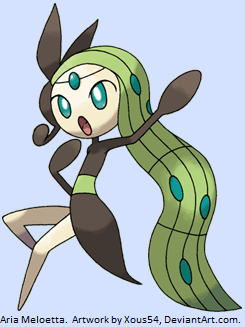 Meloetta is a dainty humanoid Pokémon with powers related to music. Her arms and hands, as well as part of her headdress, are shaped like musical notes, and her wavy hair is reminiscent of a musical score. She can influence the emotions of people with her song, helping them to achieve the right state of mind for composing music, and could well be based on the Muses, the ancient Greek goddesses of inspiration, or possibly on less ancient interpretations of the same concept. There were traditionally supposed to be nine Muses, but Meloetta has only two forms (I’m not particularly bothered by this, incidentally; nine forms would be interesting but it would have been difficult to achieve enough differentiation between them to make it worthwhile), which are related to the two main ways humans can participate in music: song and dance. In her “Aria” form, Meloetta’s hair is green and flows out behind her, while in her “Pirouette” form, her orange hair is wrapped up around the top of her head like a turban and her skirt blows up around her like a ballerina’s tutu. Meloetta can switch from her Aria form, in which she is a Normal/Psychic dual-type, to her Pirouette form, in which she is a Normal/Fighting dual-type, by using an attack called Relic Song, a technique she forgot long ago but which she can remember with the help of a musician in Castelia City who will also tell you Meloetta’s story. Continue reading “Meloetta”


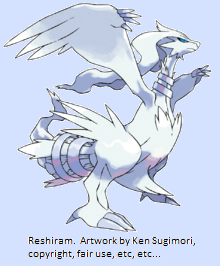 Seeing as I just finished talking about the story of Black and White, I may as well take the opportunity to look a little more closely at the two Pokémon that are central to that story: the dragons of truth and idealism, Reshiram and Zekrom. The design for these two has its roots in the Taoist concept of yin-yang, which I believe states (forgive me; I’m a little hazy on exactly how Taoism works) that the world and everything in it come into being through the interaction and harmonisation of opposites. In much the same way, Unova, the region in which Pokémon Black and White are set, is said to have been created by Reshiram and Zekrom working in harmony, as a single being (and then devastated when the two split apart and fought). To play into this theme of dualism, Reshiram is graceful, avian and feminine, with a soft-sounding name, while Zekrom is dynamic, saurian and masculine, with a hard-sounding name. This is all wonderful and I love the way the designs complement each other and develop the theme and all that, and it’s very nicely done… but there’s one thing nagging at me. They’re the wrong way around.
  Pokémaniacal