
Rivals, part 1: Silver

Silver as depicted in the remakes, Heart Gold and Soul Silver.

Right, well, I was going to do a thing on Mega Evolution, but the thought occurs that trying to write that at a point in time when everyone in the world except for me has played Alpha Sapphire and Omega Ruby would probably lead to silly places.  That being the case, then, the plan is to do the rivals now – I’m not going to write about Blue, because he’s already covered in my old Champions series, and I don’t think there’s all that much to be gained by going over him again; I’m also going to delay May/Brendan and Wally to the end, since it wouldn’t make a whole lot of sense to talk about them before playing Alpha Sapphire.  That means that the second-generation rival, Silver, is first up, and then we’ll skip to Barry and Dawn/Lucas in the fourth generation.  For the next couple of months, Jim the Editor and I will be discussing the lot of them in a series of increasingly pointless conversations, which we will inflict upon you here.  Welcome to the blog, Jim.

Hey.

So, where do we start this?

I don’t think we need to go through everything that happens in the games; your readers all know that stuff.  You answered a question a little while ago saying that Silver is your favourite rival.  I think you should start by backing up that statement.

Hmm.  All right.  What I like about Silver – and I think I might have talked about this before – is his character development.  First of all, he has character development, which, let us note, was kind of a step forward for the series at that point!  Second, though… Silver is a dick.  He’s abrasive, obnoxious, sullen, and unpleasant.  Through being with his Pokémon and fighting with them, he learns to open up to them and love them, care for them, like Lance tells him he has to (and just as an aside here, I like the way his Golbat doesn’t evolve until the very end, despite being a very high level – since the original Gold and Silver were the games that introduced evolution based on friendship, I think it’s likely that this was intentional and meaningful).  And having successfully done that, at the end of it all… he’s still a dick.  He’s still abrasive, obnoxious, sullen and unpleasant.  He’s noticeably a better person by the end of the game, but he’s still the same person – I think the overall effect is much more realistic than if he had just turned into a nice person through the magic of friendship or whatever.  Improving himself doesn’t mean that he has to abandon who he is or even what he values, and I think that actually makes the overall character arc not just more real but also more inspiring, in a way.

Yeah, you would.  I don’t think they handled him well at all.

…of course you don’t; that would be too easy.  What problems do you see?

Well, my main problem is that Silver has nothing to do with the story of those games; he just runs alongside it and gets in the way.  In the first generation games, Team Rocket was more incidental to the whole ‘story,’ which, let’s face it, was not about collecting all the Pokémon either but about collecting badges and building up to challenging the Elite Four, and then Blue is the Champion.  He does everything that you do, and even though he never beats you he’s always one step ahead in the gym quest (and usually the Pokédex quest too).  Silver kinda tries to do the same thing as Blue and has the same ambition to be the world’s greatest Pokémon trainer, but he never even comes close.  Blue does get to the very top – becomes “the most powerful trainer in the world” – even if it’s only briefly.  The game gives him recognition as a powerful and worthy rival, which Silver never gets.  Silver tags along after you and loses whenever he fights you; he turns up during the Team Rocket quests but never does anything useful – Blue doesn’t either, but Blue doesn’t care, and neither did the games.  Presumably Silver challenges gyms too but it doesn’t seem like he ever achieves… well, anything.

I don’t think Silver does challenge the Gyms and collect badges though, does he?  I’m not sure that this kind of official recognition is important to him; it kind of seems to go against his whole ‘personal strength’ and ‘despising the weak’ deal.

He visits the Olivine Gym while Jasmine is at the lighthouse, remember?  He wanted to challenge her, but she’s away, so he complains about her being soft.

Oh yeah.  Hmm.  Well, I suppose challenging gyms is a natural way for him to pursue strength and push his limits, even if he doesn’t respect the leaders for their authority.

There’s an easy way to check; is his name on the statues inside the gyms, like Blue’s is in the first generation games?

Hmm.  Good point.  Hang on; let me find my Soul Silver.

It does not; only the player is recorded as a successful challenger.  Silver’s name does not appear.

Well, either way.  He’s not important in the gym quest, and I know you like the contrast between him and Team Rocket and the way the game has two ‘bad guys’ that aren’t automatically on the same team, but he’s not really important in that part of the story either.  And I think at the end of the game he is a broken character.

Broken how?

 'Original flavour' Silver, as depicted in Gold and Silver.  I feel like the newer art gives him a more mature, sophisticated look - appropriately for someone who grew up as the heir of an organised crime syndicate - but maybe that's the difference in the art style.

Look at his dialogue when you beat him in rematches at the Indigo Plateau.  “…Oh, no… I still can’t win after all that training… I…I have to believe more in my Pokémon…” All that ‘character development’ and he’s still never going to beat you!  I think that just goes to show that caring about your Pokémon doesn’t really matter at all; Silver starts to and it doesn’t get him any closer to winning.  The moral of his arc is broken; he does everything he’s supposed to and nothing changes – and he seems like he knows it too; look at how hesitant he sounds compared to all his condescension, confidence and bravado earlier in the game.

Well, I think there he’s sort of a victim of how winning and losing works in single-player Pokémon – not only is its general power curve easy enough that you’re never terribly likely to lose a battle if you know what you’re doing, the games don’t really know how to handle it if you ever do; you just keep going as though nothing had ever happened.  Pokémon’s never really figured out how to make recurring rival-type characters seem competent; just look at… well, just about any of the other characters we’re going to be doing in this series.  I think Silver’s relative power level at the end of the game might also be something that wasn’t quite thought through all the way; on the original Gold and Silver, when the Elite Four didn’t get power-ups after being beaten the first time, Silver’s six Pokémon all finished in their high 40s, which is high enough for him to give Lance a run for his money.  The only characters in the game who were stronger than Lance as Champion, to my memory, were Blue and Red, which actually makes Silver in his final state the fourth most powerful trainer in those games (not counting the player) and very close on the heels of the third.  In terms of objective power, the remakes levelled Silver up just like everyone else, but I don’t think they considered how much weaker he is relative to the rest of the world now; he’s on a par with most of the Kanto Gym Leaders, but he’d have a hard time with the upgraded version of Will, let alone Lance.  And in terms of what he actually does in the game, well, most of Team Rocket are a joke to us, but other characters in the world take them very seriously, so we probably should too – and Silver, as far as we can tell, trounces them every bit as thoroughly as the player does!

I guess all that’s fair.  Still, that doesn’t change the fact that he doesn’t really have the ending he should have; his story doesn’t finish properly.  I would have liked it if, say, he had become a Gym Leader.  He misses out on getting some scene of final closure or at least recognition for how far he’s come.

Well, in fairness, I think the stuff they added in Heart Gold and Soul Silver did a lot to fix that – like when, if you go back to Professor Elm’s lab at the end of the game, one of his assistants tells you how Silver came back to return his starter, but Elm decided to let him keep it, because they had obviously come to care for each other.  Going right back to the beginning to make up for his past actions, and being forgiven for them by the person he wronged, gives the whole thing a very pleasing symmetry, I think.
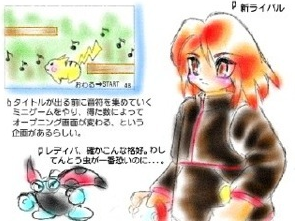
 Some very early concept art of Silver, along with what appears to be a somewhat feistier primordial version of Ledyba.

Yeah, that bit is definitely good, and it makes a nice tie-in to the franchise’s themes about how being with Pokémon is supposed to make you a better person and all that, but would it have been so hard to actually show us that scene rather than just telling us later that it happened?  It could have made a really good character moment!

Mmm… point taken.  How about the double battle with Lance and Clair in the Dragon’s Den?

That does help a lot, actually.  In practice the player will almost certainly carry Silver through that battle, but on the other hand, he does get to beat Lance, and he gets some recognition for his potential.  I still think it leaves him only part of the way through his development, but it’s definitely an improvement over the original games.

What I like about that scene is that it puts his whole character in perspective.  It stresses the stuff I mentioned right at the beginning – how he’s still the same, somewhat unpleasant person, but noticeably calmer and more cooperative – as well as reminding us that Lance doesn’t see him as a bad person or even as an enemy, just a kid who wound up on the wrong path for a while, which is important for Lance’s characterisation as well.  There is one more nice end-game bit the remakes add to Silver; the scene that comes with the Celebi event, where we see Silver talking to Giovanni.

Right; I think we should talk about that.  Do you like it?

Yeah, I do, actually.  I think it provides a good explanation for everything we’ve seen of Silver’s character up to that point.  When Giovanni loses to Red and disbands Team Rocket, what young Silver sees is that his father’s reliance on the power of his organisation counted for nothing in the end because his own personal strength failed him, and that this is what comes of relying on others.  They’ve really gone back and thought about the way the original games presented the character and his motivations and values, and the result is a backstory that ties it all together very neatly.  What do you think?

It’s good, and I like it; it just doesn’t do enough to grab me.  There’s no follow-up to it because Silver isn’t the point of the event – the fight with Giovanni is – and although getting the origins of the character is nice it doesn’t do anything to fix his lack of a satisfying ending.  And it shouldn’t have been put in that Celebi event, where a lot of players outside Japan and the US never got the chance to see it; it’s just dumb to hide something so important to his characterisation like that.

Mmm.  Agreed, I suppose.  Well, I think that’s everything we planned to cover for today… as long as we’re here, do you think we should talk about the other ‘rival’ from Heart Gold and Soul Silver?

Huh?  What other rival?

You know, the annoying kid from New Bark Town with the Marill who just kind of wanders around uselessly and never actually fights you.

Oh.  Yes.  That one.

Um…do you… want to?

…not really, no.

Good.

What do you think makes Pokémon separate from other classes of animals? Like, what certain traits does an animal have to have to be classified as one? It seems like “able to use certain fighting techniques and can be stored in a Poké ball” are the only ones, but a class should have more specific traits than that…

Eh.  How you think about this kinda depends on how widespread and diverse you believe non-Pokémon animals are in the Pokémon world, which is awkward because early generations and anime episodes often implied that there were quite a lot of them and then later on they were sort of quietly swept under the carpet and it’s hard to tell whether they were retconned out of existence or we just don’t care about them, and personally I kinda tend to lean towards the former, but… meh?

In any case, I don’t think the groups in which Pokémon are defined are terribly scientific – like, I actually think “able to use certain fighting techniques” is probably pretty damn close to how they actually think about it in-universe.  Type, I’ve pretty well convinced myself now, has absolutely nothing to do with shared ancestry and in many cases (Flying, Ground, Normal, some others) not a whole lot to do with biology either, but is more of a descriptive framework for how a Pokémon functions in battle.  Bear in mind that people have supposedly been training Pokémon for hundreds if not thousands of years.  Pokémon training probably far predates any sort of scientifically rigorous approach to evolutionary biology, so the relevant terms and classifications are most likely to have utilitarian rather than analytical relevance – i.e., when you ask “is it a Pokémon?” early trainers would understand you to mean “can you battle with it?”

You have answered in the past what your favorite Pokémon of each generation and type is, as well as your least favorites of the same. You now have a new generation and type. Please finish these lists.

Hang on, let me find the old ones; I just want to stick in some links for reference… and also remember what the hell I said the first time…

Least favourite of each generation, favourite of each generation, least favourite of each type, favourite of each type.

All right, let’s see… 

Least favourite of this generation is Dedenne, hands down.  I generally felt that X and Y had better designs than Black and White did, overall; they had fewer that seemed derivative of earlier ones, and some really cool and weird stuff.  Even the ones that I don’t like are generally pretty interesting.  Except Dedenne, who is dumb.

Favourite of this generation is much harder, but Trevenant is definitely up there, and so is Malamar.  One of those two, probably.

Now, do any of the 6th-generation Pokémon manage to usurp spots on the two type lists?

Amaura and Aurorus, from an analytical perspective, are not terribly clever or interesting designs, I think, but I love them anyway for reasons of dinosaurs, and I think I can give them Rampardos’ old spot as my favourite Rock-types.

As I said in the original list, I’m not a huge fan of most Flying-types, but I am really fond of both Hawlucha and Noivern.  Either of them could claim that spot.  Hawlucha might also beat out Mienshao as my favourite Fighting-type.

That’s about it, I think.

And, finally, I guess I need to pick Fairy-types.  Hmm.  Least favourite is probably Dedenne again, followed by Snubbull and Granbull, whom you may recall popping up as my least favourite second-generation Pokémon.  Favourite Fairy Pokémon… mmm… might be Clefable, because I’m fond of the weird moon-worship thing they have going on, and the question of whether they’re aliens or not is kind of interesting.

Something came to mind: Back in Gen I, Mew was the first Mythical only attainable via a limited time real life event because it was literally thrown in at the last minute and was never meant to be obtainable, right? So why exactly do Game Freak keep making these kinds of Pokémon when they’ve clearly got no reason to be so? You don’t expect me to believe Diancie, Hoopa and Volcanion were all last minute too, do you? Aren’t they inherently against the series slogan, “gotta catch ’em all”?

You know, I never thought about it that way, but that’s a good point.  The whole idea of Pokémon that are unobtainable in the game started as an accident.  I can only suppose that they kept it up because Mew worked so well.  Remember the mystique Mew had in the first-generation era?

Or, uh… I don’t know; maybe you don’t… damn, I’m old…

But basically the fact that there was this ‘secret Pokémon’ that existed but couldn’t be found or captured normally was the source of more rumours and speculation than just about any other aspect of the game.  It helped that the internet was still young then, and reliable information was hard to come by (I didn’t have an internet-capable device of my own, and even if I had I wouldn’t have known where to begin looking).  There is in fact at least one glitch that you can manipulate to obtain Mew in Red and Blue (I’ve done it), but to my knowledge it didn’t become widely known until well after the end of those games’ time.  I think the continued introduction of ‘secret’ Pokémon – first Celebi, then Jirachi and Deoxys, and so on – was designed to capitalise on the same sense of mystery and excitement that surrounded Mew.

Now, of course, the idea that these Pokémon exist and will inevitably be revealed by Nintendo in due course has become totally routine – as has the fact that the Pokémon fan community will find any information about them that exists in the games, long before we’re actually ‘supposed to.’  But maybe getting us to run around and trade scraps of information and speculation like that is all part of the fun?  They must know, after all, that this is not the 1990s anymore and our capacity to extract, verify and share this information is orders of magnitude above what it was in Mew’s time.  They’re not stupid.  I think they do it specifically to make us talk about it.

A woman goes to her mother’s funeral. There, she meets what she believes is her soul mate. However, after the funeral, she has no way of contacting/finding him ever again. Three days later, she kills her sister. Why did she kill her?

Three possibilities.

a) Her sister was a right bitch.

b) She hopes that the man she believes to be her soulmate will attend her sister’s funeral, giving her another shot.

c) Her sister was a fetus in fetu which, entirely by coincidence, she was getting removed that week anyway.

Behold: the Snateor!

So a classics teacher friend of mine mentioned on Facebook that a student had made an amusing misspelling on an exam, saying that Julius Caesar was murdered by a group of ‘Snateors,’ and asked me to draw one because ‘Snateor’ sounded like a Pokémon and one of her other friends thought it should be a Fire/Rock-type combination of a snake and a meteor and I AM SO SORRY

Now, humans and Pokémon clearly have different traits which mark them as separate classes of life (eggs, the ability to be stored in a Poké Ball, etc.). We also know in the Pokémon world that there are multiple real-world plants and animals such as worms, your occasional fish, and all the animals they compare Pokémon to, and Raichu’s Asian elephants. My question is, how did humans manage to survive and evolve? Almost all of their traits are easily surpassed by Pokémon–even the lowly Magikarp

This question continues: “…*cont* leap over a mountain. Why didn’t natural selection kick humanity’s ass during their development, leaving only Pokémon? What circumstances would lead to humans surviving alongside Pokémon?”

Well, now, that is a difficult one, isn’t it?  I’m inclined to suggest that the way to get the answer is to go back to how natural selection and Darwinian evolution actually work.  ”Survival of the fittest” doesn’t mean that the biggest, fastest, strongest, or even smartest species survives.  It means that the species (or individual) survives whose traits are best suited to make efficient use of the available resources and reproduce.  My own country, New Zealand, provides some illustrative examples here.  Before its colonisation by the Maori people in about the 12th century AD or so, there were no land mammals in New Zealand – no dogs, no cats, no mustelids, none of that; in short, there were no land-based predators (although there were once giant eagles – some of the stuff in the Lord of the Rings is actually true).  What do you think happened to the birds?  Well, a great many of them, over the course of millions of years, lost the ability to fly.  Flight is expensive in terms of energy consumption, hugely so.  If you don’t need to fly, then that energy is better put to use having more babies.  Evolution dislikes waste intensely, and this can cause it to do things that often seem counterintuitive to us.  Primates, including humans, are among the most intelligent animals in the world, have excellent colour vision, and like all mammals can maintain a constant body temperature in the face of fairly significant environmental change – and we pay for those things dearly; we’re forced to rely on relatively large amounts of high-energy foods like meat and fruits while slower, stupider animals can just sit and munch on leaves all day.  Consider Pokémon, then, who have a myriad of abilities that must be every bit as costly as flight or great intelligence, from a metabolic perspective.  They must have a very high energy diet to sustain those powers.  I don’t know what’s in those berries, exactly, but I suspect it’s got a lot more of a kick than the standard fructose/sucrose mix you find in fruits like apples.  An entire Pokémon ecosystem has a number of specialised organisms – powerful Grass Pokémon, for instance – who help to cycle energy around and increase the efficiency of the whole thing by accelerating growth and decay, but we’re still looking at a world populated by organisms who consume and use a fundamentally ridiculous amount of cellular energy on a daily basis.  Now, to an organism whose energy requirements are relatively frugal by comparison, this looks like a very attractive environment – sure, predators and competitors are both very dangerous and powerful, but you can live for a week on the equivalent of a bunch of grapes and half a banana, and you can easily outbreed them.  Humans, I think, found a niche for themselves within that context by doing something slightly different, based on taking interspecies cooperation (something we see a lot of in the Pokémon world, even in nature) to a whole new level of organisation and complexity, which they can do because of pretty much the same things that got us ahead in the real world – namely intelligence and complex languages.

We could probably go on at this for a while, but I think that’s enough for today.