*cough*omegarubyandalphasapphire*cough*

All right, all right; I get it already.

(This counts as my answer to ALL readers, past and future, asking about Alpha Sapphire and Omega Ruby)

So, I’m not that excited, I guess because Ruby and Sapphire just don’t have the same nostalgia value for me as they do for younger players, but I am very interested to see how they handle the story.  A somewhat expanded treatment is surely to be expected, and they’ll probably draw on material and dialogue from Emerald, but they can’t lean too heavily on Emerald either because the paired game structure dictates that Team Aqua have to take the lead in Alpha Sapphire and Team Magma in Omega Ruby.  Hopefully we can expect to see a slightly more nuanced portrayal of both teams’ motivations and plans (as well as of some other characters, like Steven – speaking of which, who will be the Champion, I wonder?).  

I’m also curious whether contests will return, and in what form – will they give contest statistics to all the 5th- and 6th-generation moves that never had any, or create something completely new that has more in common with, say, Black and White’s musicals?  Ruby and Sapphire were the generation that introduced the idea of interacting with Pokémon in that kind of way, so it seems only fitting that a return to those games will result in something fairly spectacular in that department.

In any case, seeing Hoenn on the 3DS is going to be a pretty huge deal – I can’t help but wonder whether some of the cities will look a little bland next to the varied and often eccentric settlements of Kalos, like Laverre with its fairytale aesthetic or Anistar with its… big-ass sundial whatsit… In fact, X and Y have just been such a huge step-up from their predecessors in such a wide variety of little ways that bringing Ruby and Sapphire up to speed with them seems to me like quite a daunting prospect!

Oh, and secret bases?  Hell yes.

Alpha Sapphire and Omega Ruby strike me as odd titles to go with.  I think probably the reference is to the logos of Team Aqua and Team Magma – Team Aqua’s would pass for a capital alpha as easily as a capital A (which looks exactly the same), while I guess Team Magma’s kinda looks like a capital Ω?  If you squint a bit?  Alpha and Omega placed in opposition like that tend to represent “the beginning and the end,” particularly in Christian iconography (come to think of it, Alpha and Omega would have made way better titles than X and Y for two games themed around life and death, but what’s done is done).  Maybe the titles hint that the games will play up the importance of Mount Pyre and the Cave of Origin?

Probably I won’t do a playthrough journal in the style of what I did for White 2 or X, because honestly that $#!t’s getting kinda old for me and it’d be a little weird with a game where I already knew at least the outline of the story.  I’ll probably think of something fun though.  We’ll see.

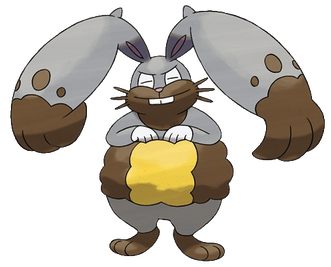
Bunnelby and Diggersby

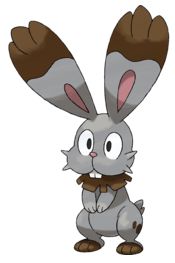
Official art of Bunnelby by Ken Sugimori; Nintendo is the way and the truth and the light, etc.

Tradition is tradition is tradition, and tradition dictates that no Pokémon generation is complete without an evolutionary line of exceptionally mundane Normal-type rodent Pokémon. [EDIT: correction for my phylogenic carelessness; rabbits and hares are not rodents but belong to a closely related group of their own, the lagomorphs – for our purposes, though, the distinction is probably academic] As with Talonflame, Game Freak seem to feel that they are in quite an odd position; if the Pokémon they design is not sufficiently banal and inconsequential, it will not fulfil the implicit requirements of Tradition, but if they go too far… well, is there really anyone out there who wants more perfectly generic rodent Pokémon?  Pokémon are weird creatures with a penchant for doing the impossible, but they are also a representation of the variability of life in the real world, variability that includes the animals we see all over the place and get, frankly, a little bored with – how should that conflict be handled?

History lesson time.

My difficulty with Raticate is that, although larger-than-life as all Pokémon are, otherwise he is a rat and does rat things: gnawing and chewing and infesting and breeding and surviving everywhere it has no right to be.  That’s great, don’t get me wrong, but it’s also just about the only Pokémon I can think of that has no supernatural powers whatsoever – even the ability to gnaw through concrete is something actual rats can do, which I suppose in a way is just testament to what a badass animal the Norwegian rat is.  Similarly, Furret’s most significant power, as far as I can make out, is being long and bendy, while Linoone… can run in a straight line, I guess?  Bibarel represents an early experiment in the same kind of encouraging dual-typing as we see in both Talonflame and Diggersby, but Water is a type that tends to get splashed around (pun most heinously intended) rather liberally, normally on the grounds that a Pokémon lives in or near water, and I’m shadowed by the question of what it actually adds to Bibarel.  Don’t even get me started on those creepy Unovan hell-beasts.  Linoone’s Belly Drum shenanigans notwithstanding, none of these are particularly effective Pokémon either, because if there’s no flavour reason for a Pokémon to have useful abilities, it often won’t get them (although it has to be said that many of them make amazing HM whores in generations three and four, particularly Bibarel with his access to water-related abilities).  Bland designs make bland strategies; the two can’t be completely separated.  With that in mind, let’s go to Bunnelby and Diggersby.

 Some species of rabbit are very social creatures and build complex interconnected systems of burrows, normally with at least two entrances - as mammals go, they are quite impressive architects.

Bunnelby’s thing is his ears.  Rabbits’ long ears are of course among their most distinctive characteristics, but they don’t really do a whole lot other than… well, hear things.  Presumably help to radiate heat in species that live in hot climates.  Pretty standard stuff for ears to do, really.  Not so Bunnelby’s ears.  They are the largest organ in his body and are also his primary manipulative appendages, with ends almost like paws that he uses to scoop earth and dig the warrens that rabbits are famous for; the anime also portrays him as using his ears for most of his attacks.  The tips are brown, as though stained by mud, but a ruff of brown fur around his neck, the same shade, suggests that this is their natural colouring.  Diggersby continues to create the same impression with a speckled pattern at the edge of the brown portion; it’s a nice way of bringing his Ground typing into his physical appearance.  His mighty ears, even more potent than Bunnelby’s, can pummel through bedrock or lift and carry heavy loads.  How they can do this, tethered as they are to his body by the relatively slender and probably hollow parts of his ears responsible for hearing, is something of a mystery; in a real animal it would be difficult to understand how they can even be held up, let alone swung forcefully without simply ripping them off.  Then again, many Pokémon are in the habit of doing six impossible things before breakfast, and anatomical plausibility should probably be low on our list of criteria for evaluating them (although, having said that, this is one of the harder ones to overlook since Diggersby doesn’t have a lot of explicit special powers that could be used to justify it).  Ground Pokémon are known for being especially solid and stable, so maybe their flesh and bones can take a great deal more weight than we are accustomed to putting on our various appendages?  The information about Diggersby presented to us by the Pokédex focuses on their uses in the human world, where like Machoke and Gurdurr they are regularly enlisted as construction workers – like the comedic stereotype of construction workers, they are also lazy and like nothing more than lounging around once their work is done.  I’d actually be more interested in how they work ecologically, though; Bunnelby only dig into soil like ordinary rabbits (albeit rabbits with prehensile ears) but Diggersby can go much deeper and presumably can only navigate larger tunnels as well.   What might their ‘warrens’ start to look like?  The purpose of a burrow is surely defeated if something much larger than a Bunnelby can easily get inside, so the resulting structures could end up looking quite complicated, with the Diggersby-sized entrances protected carefully from smaller predators.

The thing about my relationship with Diggersby is that I can’t help but think he looks a little bit like a mouldy potato.  A damning assessment, one might think.  I’m pretty sure Diggersby isn’t meant to be a particularly elegant or awe-inspiring Pokémon, though; in fact I’m pretty sure he is meant to look fat and lazy, and he does that remarkably well.  He doesn’t exactly look like he could crush bedrock (although he certainly could – see below for the reasons bludgeoning power is at the core of Diggersby’s skill set) and is a little out of place in the traditionally ‘tough’ and ‘badass’ Pokémon crowds; to be honest, I’m not sure who he’s supposed to be appealing to.  The unkempt lazy bastard demographic, I suppose (you know, now that I put it like that, I’m really starting to empathise).  In a way, strangely, the fact that Diggersby is so shamelessly unappealing is actually what I like about him.  Rabbits are cute and cuddly; making a cute and cuddly rabbit like Buneary – or, to an extent, Bunnelby – is just a little bit cliché and predictable.  Making a muscular but pudgy rabbit who looks kind of like he needs a shave is much more out of left field, while still tying into a well-known trait of actual rabbits via the construction worker aesthetic: they’re good at digging.  This Pokémon has undeniable personality – not exactly an attractive personality, but nonetheless a much clearer one than his normal and Normal rodent predecessors have tended to exhibit… with the possible exception of Watchog, who, again, scares me.  Some unorthodox ideas went into this Pokémon, and I think on some level they kind of work.

 Diggersby.

If you want to use Diggersby, you’re going to want one with the hidden ability, no ifs, no buts.  As truly entrancing as Diggersby’s Cheek Pouch bull$#!t is (I mean, who doesn’t want to get bonus health back for eating any kind of berry?  That thing is gold, am I right?), there is simply no passing up the ridiculousness that is Huge Power.  To make clear how big a deal this ability is, I should clear up a common misconception about it – a lot of people seem to think Huge Power doubles the abstract ‘base attack’ score generic to a Pokémon’s species, which would effectively move Diggersby from an abysmal 56 to a fairly convincing 112.  In fact, it doesn’t; what it doubles is the Pokémon’s actual concrete attack stat with training, level, nature and individual variation factored in – for a level 100 Diggersby, this is likely to be somewhere in the low 200’s if he’s been trained for physical attacks (which he should be!) and will double to about 440-460 – equivalent to a base attack score around 160, approaching the likes of Slaking and Rampardos.  This Pokémon is a blunt instrument of epic proportions.  Earthquake is, of course, the key move here, backing up Huge Power with similarly dramatic bludgeoning force.  Either Stone Edge or Wild Charge is practically mandatory to punish Flying-types who seek to take advantage of their Ground immunity.  Normal attacks are, as always, mainly useful for being able to do neutral damage to most things, which isn’t that great an asset on a Pokémon like Diggersby, who has a fairly solid array of offensive types to choose from, but since he is a Normal-type, Return is probably worth checking out.  Hammer Arm and Power-Up Punch add Fighting-type options to round out the spread of dangers Diggersby can present.  Power-Up Punch is probably the smarter option unless you’re looking at a Choice Band set, since Diggersby can’t really afford to lose speed using Hammer Arm, and the power you sacrifice on your Fighting attack (which isn’t going to be your main one anyway) is relatively easy to justify when you can get a boost for your other attacks by using Power-Up Punch.  Always worth consideration, especially in conjunction with Choice items, is U-Turn; with Diggersby’s doubled attack stat, even this relatively weak move will leave quite a sting as he flees the scene.

The bad news for Diggersby is practically everything else about him: his defences are reasonable, but nothing to write home about, and he’s not the fastest thing on two legs.  The former, he mostly just has to deal with; the latter, on the other hand, can be at least partially alleviated by his access to Agility and Quick Attack – you probably should use one or the other, since, again, Diggersby is great at dishing out hits but not so good at taking them.  Being a Normal-type with such a colossal attack stat actually makes Quick Attack reasonably solid – after all, Aqua Jet always worked for Azumarill, who functions on the same basic principles.  As an alternative to Agility, Diggersby also gets Swords Dance (you know, just in case that 460 attack stat starts to bore you); you definitely want Quick Attack available if you pick that option.  He can also learn Flail, and a Focus Sash set with Flail and Agility might be sufficiently amusing and destructive to be worth a shot if you can keep him from taking any passive damage that would break the sash – it helps that Diggersby is immune to Sandstorm damage, but with entry hazards as popular as they are it’s probably more trouble than it’s worth (still… as Epic Flails go, Diggersby’s would be pretty impressive… maybe the AI trainers in the Battle Maison would fall for it…).  There aren’t really any other compelling options for this guy, which is sort of a weakness – he’s fairly predictable.  Almost nothing can absorb his attacks with impunity, but he’s naturally slow, not all that tough, has only a passable defensive type combination, and is very likely to be carrying a Choice item that will restrict his tactical options further.  Reliance on Normal and Ground attacks is also a big welcoming invitation to any of the many Levitating Ghost-types out there.  Diggersby is a sledgehammer – use him as such, but remember to bring your chisels along as well.

The bottom line for me is that you can pretty much explain Raticate, or Furret, or Bibarel, by saying “it’s a rat Pokémon” “it’s a ferret Pokémon” or “it’s a derpy beaver Pokémon.”  Saying of Diggersby “it’s a rabbit Pokémon,” while certainly correct, would clearly be missing the point.  There should be rodent Pokémon in the game, there should be Normal Pokémon in the game, and there should be common Pokémon based on common animals in the game – indeed, some of these categories deserve, if anything, more attention!  Bunnelby and Diggersby are a step in the right direction; they take something generic and everyday, and they twist it.  It doesn’t necessarily make total sense, but it’s interesting, and it immediately suggests a battle role based on overwhelming physical force, giving this Pokémon something cool to do.  Diggersby is far from my favourite Kalos design, but for once that’s mostly because of my own taste in Pokémon and not because the template has led to a half-assed creation.

Fennekin, Braixen and Delphox

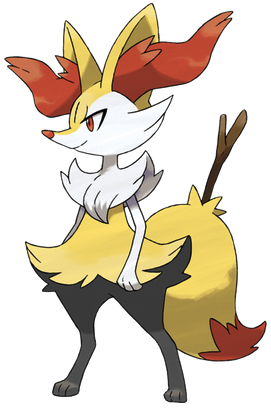
Official art of Fennekin by Ken Sugmori (praise be to Nintendo, etc).Probably one of the most popular commonplaces of fan-made Pokémon design for years and years has been the Pokémon with pyrokinetic abilities – the use of psychic power to manipulate heat and fire – and it looks like we’ve finally got one.  I’ll be honest, though: when I first saw Fennekin I was not optimistic.  A fiery fox Pokémon with a mystical streak?  That… sounds awfully familiar.  When all’s said and done, Vulpix and Ninetales are a lot more straightforward as far as their physical design goes; aside from the split tail thing they are basically foxes, and what’s interesting about them is mostly in their mystical powers and their obsession with vengeance.  Fennekin develops into something a bit more complicated with more of a mixture of influences going on, eventually ending up looking more like Lucario or Zoroark than anything else (Japanese sure do like their magic foxes).  That’s something we should probably talk about first, actually; let’s talk about the anthro-fox thing.
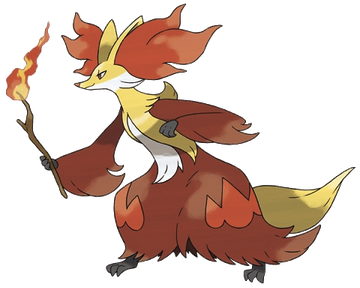
I know there are people who don’t like Lucario or Zoroark, or presumably Delphox either, because the anthropomorphism offends their sensibilities on some level, which is something I don’t quite ‘get,’ personally (now, whether we really need quite so many fox-like Pokémon is another matter entirely, but I spend enough time bitching about that kind of thing already).  The concept of anthropomorphic animals is literally as old as civilisation, even if depicting them physically as human/animal hybrids isn’t quite so universal, and I think everyone recognises the apparent callbacks from Lucario to Anubis, the jackal-headed Egyptian god of burial and funerary rites.  It’s not just some weird fetish thing of the last couple of decades, it’s actually kind of a millennia-old universal mythic archetype that resonates with people of radically different cultural backgrounds all over the planet.  Just to prove my point, I would like to note that, in fact, if you Google the phrase “anthropomorphic fox,” the first result is the Wikipedia page for a mediaeval French trickster-hero named Raynard or Renart (so an anthropomorphic fox actually makes a great deal of sense in a region based on France), whose principal rival is an anthropomorphic wolf named Isengrim.  It’s really quite amazing how much I learn from writing this bull$#!t.  The trope also makes a lot of sense in the context of some of Pokémon’s core themes, like the desire for balance between civilisation and nature – anthropomorphic animals straddle the line and can symbolically act as intermediaries or go-betweens in much the same way as Pokémon trainers can from the other direction.  Foxes in Japanese folklore are regularly depicted as shapeshifters as well, and are often quite fond of assuming human form for a variety of whimsical purposes, so it makes a great deal of sense that we should see fox-like Pokémon in particular filling this role (even if, again, I might wish for more variety in that respect, as elsewhere…).  Basically what I’m saying is that any complaint that anthropomorphic foxes are just inherently a dumb idea will be met with several heavy and fast-moving books.  Moving on.

 Braixen.

My favourite thing about Delphox is probably her name, which evokes ancient Delphi in Greece, a place closely associated with oracular foresight – and, lo and behold, Delphox can see the future by staring into the flames at the tip of her wand, and also learns Future Sight (though of course among Psychic Pokémon this is far from an unusual attack; it’s much more interesting with respect to flavour when it appears on a Pokémon of a different element).  Maybe it’s just me, but I also can’t help but see one of the ancient Greek words for fire, phlox, in there.  In contrast to Ninetales, who is a very faithful rendition of, essentially, a purely Japanese kitsune spirit, Fennekin and her evolutions seem very keen to bring western ideas into the design – which, again, makes sense both in the context of Kalos as a French-inspired region and of Pokémon’s growing interest in portraying itself as an international entity.  Braixen in particular, and Delphox as well to an extent, have a very strong east-meets-west thing going, combining the mystic foxes of Japanese folklore with the witches of European fairytale, whose signature broomstick is clearly visible in the shape of Braixen’s tail.  Delphox, likewise, directs her fire powers through a wand which also acts as a focus for her psychic abilities.  It’s a shame Braixen can’t use her ‘broomstick’ to fly, but then again, neither making her a Flying-type nor sticking Levitate on her would have been all that practical.  Potion-making abilities or herbal lore might have been nice too, but similarly difficult to reconcile with the Fire/Psychic typing, requiring a mixture of Grass- and Poison-type powers.

I cannot get over this line’s majestic ear hair.  I didn’t notice it at first because it just looks like they have big red ears at a glance, but when you actually look at them, it’s clear that those are huge bushy tufts of hair or fur sprouting from inside their ears, apparently meant to mimic the appearance of bursts of flame.  It confuses me so much because, although a fennec fox’s large heat-dissipating ears are one of its most noticeable traits and are referenced in the fact that Fennekin emits blasts of heat from her ears to frighten attackers, their ear hair, while admittedly impressive if you look at it with that in mind, is not really anything special.  In humans ear hair denotes age, so I guess you could say that it’s meant to be a sign of wisdom, but it’s usually in men that we think about prominent ear hair, and Delphox seems to very aiming at a feminine design.  Also, ear hair tends to be grouped with the less desirable traits of old age, like senility.  Maybe in Japan impressive ear hair is considered a good thing…?  Where does one go on the internet for information about the symbolic associations of ear hair in different cultures, anyway?  How has my life even gotten to the point where this is a question I am legitimately interested in knowing the answer to?

…yeah, I’m just going to talk about Delphox’s battle capabilities now.

 Delphox.

Delphox has an unusual type combination, shared only by Victini and Zen Darmanitan (who, of course, doesn’t count): Fire/Psychic, which comes with quite a lot of resistances but also some very nasty weaknesses, particularly Rock, Ground and Dark.  Offensively it’s a viable combination but not a brilliant one; Fire and Psychic share no weaknesses, but don’t cover each other’s weaknesses particularly well either.  Overall, it’s sort of a mixed bag as far as type combinations go, and the rest of Delphox’s traits follow suit.  The odd thing about this Pokémon is that her stats suggest a special sweeper – very good speed and special defence with excellent special attack, and poor physical stats – while her movepool and hidden ability are very much those of a supporter.  Aside from her core attacks – Flamethrower or Fire Blast, Psyshock or Psychic – Delphox really only has Grass Knot and Shadow Ball for coverage.  Grass attacks go great with Fire, but Grass Knot’s dependence on the target’s weight makes it a bit of a tricky move (the types that are weak against Grass – Ground, Rock and Water – do tend to have disproportionately heavy Pokémon, though, so it can work pretty well as a secondary attack).  Ghost attacks are also moving up in the world now that Steel-types no longer resist them, leaving excellent neutral coverage, but that’s not really a huge priority for Delphox, who already has a pretty solid offensive type behind her.  Calm Mind is difficult for a Pokémon whose physical defences are as weak as Delphox’s, although she’s pretty frightening with a special attack boost behind her.  Her support movepool has some great stuff: Light Screen, Will’o’Wisp, Switcheroo, Hypnosis, hell, if you’re good at reading your opponents she can even muck around with Magic Coat (although, if you really want to reflect status effects back at their users, just using a Pokémon with the Magic Bounce ability is a lot easier, albeit predictable).  Switcheroo could make for a neat Choice Specs set.  It’s worked for other Pokémon in the past and Delphox certainly has the stats for it; act as a traditional special attacker with a nasty Choice Specs power boost until you see a support-oriented Pokémon who won’t deal well with being locked into a single attack, then swap items with Switcheroo and hopefully cripple them.  The other moves are just universally useful, although it’s not exactly easy to see why you’d pick a relatively frail Pokémon like Delphox to use them.

Like Chesnaught and Greninja, Delphox enjoys access to a signature move, Mystical Fire.  This attack looks decidedly underwhelming at first glance since it’s simply much less powerful than the traditional ‘gold standard’ moves like Thunderbolt and Earthquake.  What’s interesting about it, though, is that on top of its damage Mystical Fire also reduces its target’s special attack, which is a surprisingly rare effect; only a handful of moves can do that, and many of them will not do so consistently (Moonblast only does so 20% of the time, Captivate only works on Pokémon of the opposite gender, and so on).  Considering that Delphox can also partially neutralise most physical attackers with Will’o’Wisp, the ability to reliably dampen special attackers as well is pretty cool.  In a similar vein, her hidden ability, Magician, is almost unique, shared only by the mischievous Klefki (who really has better things to do, since his other ability is Prankster, the greatest blessing any support Pokémon has ever received).  Magician basically adds the effect of Thief to all of Delphox’s direct attacks for free – if she’s not already holding an item, she’ll steal whatever her target is holding.  A lot of Pokémon rely quite heavily on their items, and being able to nab these reliably without taking up a moveslot is pretty cool, especially if you happen to gank something Delphox can actually use herself.  Combine this with a consumable item like an Air Balloon or a Fire Gem (once Fire Gems actually exist in X and Y) and you could seriously mess with even Pokémon who don’t think Delphox can harm them.  All in all, it’s probably best to think of Delphox as a special attacker whose greatest strength is actually not her special attacks, but her capacity to screw with people.  Make sure to pack at least one nasty little spell, and spring it when your opponent is least expecting it.

Delphox might actually be my favourite Fire starter so far – and only partially because we have finally broken the curse of Fire/Fighting.  She balances power and cunning in a way that’s quite rare in a Fire-type, and just being able to shrug off her attacks doesn’t necessarily mean she can’t leave your head spinning.  Like mythological foxes the world over, she’s clever and possesses mystical insight into the world of spirits and magic, embracing the magical quality of fire like few of her predecessors ever have.  You know, I think I’m good with that.

Your last question that was talking about attract made me want to throw in my 2 cents. I’m a big fan of the percy jackson series, which is a book series about greek demigods. one girl is a daughter of Aphrodite and has a power called charmspeak, which allows her to influence people’s decisions by talking. She could ask for free food at a deli or tell someone to fall asleep. I think attract works this way, so I don’t think it would force sexuality out of the target unless thats the user’s intent.

Hey, anything that involves Percy Jackson in the discussion is fine by me.  Piper’s charmspeak is an interesting comparison to make; I think we can all agree that Attract obviously doesn’t compel sexual acts, even where the target’s species would allow it, but at the same time the imagery associated with the technique is clearly meant to make us think that romance or sexuality is involved somehow (same way as charmspeak, really, since it comes from the goddess of romantic love and sexual desire – although the way that series portrays Aphrodite, and that portrayal’s relationship to the original myths, is actually kind of complicated).  It has similar versatility too; same way as Attract can work between Pokémon who would never breed, charmspeak can apparently work on anything that even approaches sentience, up to and including a robot dragon head.  I think the important difference is that Piper can’t easily command someone not to attack her because charmspeak works best if she can phrase it in terms of something the target actually wants to do, or at least could potentially be neutral to.  Attract seems like it’s maybe a bit more forceful in that way, which is weird.  I think it may have a greater capacity to create desires rather than just manipulate existing ones.

Espurr and Meowstic

Coming to you from Los Angeles Airport as I wait for my connecting flight to Auckland!  Isn’t that exciting?  Well, no, not really, but this is my life apparently.  Anyway.

Espurr.  Bow before the perfection of Sugimori, etc etc.We’ve just had a dog, so now let’s have some cats.  We’ve had loads of cats before, but these ones at least have the decency to be weird, alien cats with mysterious powers.  I’m torn between wondering why we needed more cats after Persian, Delcatty, Purugly and Liepard, and being relieved that Espurr and Meowstic are not just the pampered pets with few notable powers that we’ve come to expect from cat Pokémon in the past.  These cats certainly have a few tricks up their sleeves… or rather, their ears (as we’ll see)… so let’s take a look and figure out what makes them worth our time.


Espurr and Meowstic are known as the ‘Restraint Pokémon’ and the ‘Constraint Pokémon.’  They possess absolutely devastating psychic powers, possibly the greatest of any non-legendary Psychic Pokémon described to date (though it’s hard to tell because any sort of quantification of psychic power is hard to come by in Pokémon) – the Pokédex credits Meowstic with the ability to disintegrate a heavy-duty truck with the sheer force of their telekinetic blasts.  Unfortunately, their control over these powers is somewhat lacking.  I’m not exactly certain how serious this lack of control is, but I think the implication is that actually unbinding that degree of power would mean subjecting everything in a 90-metre radius to the full force of their psionic wrath – this, in many cases, would probably be a bad idea.  The idea of someone’s ‘true power’ being too wild and dangerous to use except in the most dire of circumstances is a fairly well-explored one in fiction about super-powered characters, particularly psychic ones because mental abilities are often associated with discipline and force of will; I think even Pokémon has had one or two designs before that draw on the theme, like Golurk, whose overwhelming power is kept in check by the seal on his chest.  The weird thing about the way Espurr and Meowstic handle that trope is exactly how they keep their powers under control: they emit psychic energy from a pair of eyeball-patterned organs inside their ears, so they can apparently hold it in quite simply by folding up their ears to cover these glands.  So apparently these are the kind of psychic powers that can be blocked by flimsy layers of fur and cartilege.  Well, it makes sense that containment would involve something fairly straightforward – otherwise these Pokémon would surely have levelled Kalos long ago – but it does make the whole thing seem a little bit silly.  On the other hand, Espurr’s art and in-game model do a good job of conveying the idea that she’s basically a walking bomb – her posture is stiff, her eyes wide and staring, as if constantly under stress and potentially about to explode (this also gives her a very different aesthetic feel to previous cat Pokémon).  Meowstic appear, appropriately enough, to have grown a bit more comfortable with the whole thing; their movements remain understated and controlled, though, and they keep their ears firmly folded over, just in case.  Training these Pokémon, unusually, is an exercise in getting them to unleash power they already have – very carefully.

 The cunning male Meowstic.

Aside from the radical and dangerous psychic abilities, Meowstic’s other big thing is somewhat more obvious: pronounced sexual dimorphism.  The females are white with blue trim and yellow eyes, the males blue with white trim and blue-green eyes.  They also adopt very different battle roles – their stats are the same, but they learn very different sets of moves as they level; the males favour support techniques, while the females learn powerful special attacks.  This seems to subvert the kinds of roles traditionally assigned to male/female counterpart characters in video games – when there is an explicit contrast, female characters will regularly have support powers and often healing abilities, while male characters tend to be the heavy damage dealers (the age-old domestic woman/warrior man trope).  Nidoqueen, for instance, has a very similar selection of moves to Nidoking but is encouraged by her more defensive stat bias to favour their support options like Stealth Rock rather than going total-aggression like Nidoking tends to.  I’m not sure what to say about Meowstic’s inversion of the typical arrangement other than that it seems to be there, but it’s nice to see and makes a pleasant contrast to many other male/female Pokémon pairs (Pyroar, for instance, who sticks to the stereotypes despite the fact that the real behaviour of lions gives her a very good reason not too…).  Actually, the fact that Meowstic have a support archetype option at all is pretty odd considering the kind of things we’re told about them and the nature of their powers – maybe the thing to take from this is that the males are better at letting out very small, restricted doses of energy, while the females are capable of going to higher levels of intensity without losing control?

It’s unfortunate that Meowstic’s stats don’t quite reflect what we’re told about their tremendous capacity for destruction – one is rather led to expect phenomenal special attacking power, with relatively poor speed to represent the need for constant restraint.  In fact, although Meowstic are very fast, their special attack leaves quite a lot to be desired, which I suppose is a testament to the level of control these Pokémon can maintain over their powers… a little too much, if anything.  Either that, or reports of their might are greatly exaggerated (which, coming from the Pokédex, would admittedly not be a huge shock).  An excellent special movepool – Psychic or Psyshock, Thunderbolt, Energy Ball, Dark Pulse, Shadow Ball – means that Meowstic can at least bolster an uninspiring special attack score with strong type coverage.  There’s also Calm Mind and Charge Beam to think about, if you want to take a more direct route to powering up; the female also gets Stored Power, which gets stronger with every stat boost the user accrues and can outdamage Psychic after two Calm Minds.  Meowstic probably doesn’t have the defences to play that sort of game, especially without healing, but Stored Power is an unusual enough move to be worth looking into on anything that gets it.  Me First (again, only for the female) is also interesting but tricky to use; it anticipates an incoming attack with more power, but fails if the user is slower than the target, and also relies on being able to guess what kind of attacks are coming at you.  Really, Meowstic’s stat spread seems to belong more to some manner of supporter than a true focused attacker; passable but unremarkable in all areas except speed (and physical attack – don’t even go there), and with a respectable support movepool, this sounds awfully like a utility Pokémon – and, of course, Meowstic can do either, depending on gender.

 The destructive female Meowstic.

The difficulty with Meowstic’s bifurcated movepool is that a lot of the best moves, particularly from the female’s list, are actually available to both of them anyway through a variety of TMs.  What it all boils down to in terms of actually useful moves, as far as I can see, is that female Meowstic get Signal Beam, Me First and Stored Power while male ones get Mean Look and Misty Terrain (indeed, male Meowstic are at this point the only non-Fairy-type Pokémon to have access to this technique, for what it’s worth).  The real distinction between males and females is their hidden abilities, which reinforce the battle roles outlined for them by their level-up moves.  The female’s Competitive ability is a special attacker equivalent to Defiant, giving her a major special attack bonus whenever one of her stats is lowered by an opponent – kind of tricky to use, considering that lowering the enemy’s stats is not a particularly common tactic, but there are enough Pokémon with Intimidate running around that it’s worth a try, and Meowstic might actually do some serious damage if she could grab a Competitive boost.  Infiltrator, one of the regular abilities available to both genders (which allows attacks to bypass Reflect, Light Screen and Substitutes), might end up being just as useful for an offensive Meowstic.  The male’s ability, though, is far shinier (although in flavour terms it’s very difficult to see how it fits the ‘restrained’ Meowstic): the ever-delightful Prankster, which grants speed priority to all support moves.  Being able to go first with his most important techniques means that a male Meowstic doesn’t need to focus so much on his speed and can afford to train his defences more instead, and even common moves like Reflect, Light Screen, Thunder Wave and especially Substitute have a lot to gain from an automatic first strike.  The male also has access to a couple of unusual support moves the female lacks; the most notable ones are Mean Look, which could potentially make an interesting addition to a Calm Mind set if you manage to trap something with lacklustre special attacking capabilities, and Misty Terrain, the new Fairy-type field move (Meowstic is in fact the only non-Fairy-type Pokémon who can use this move so far).  Misty Terrain blocks all major status ailments for Pokémon on the ground, and also dampens the effects of Dragon attacks – handy if for some reason you can’t have an actual Fairy or Steel Pokémon around.

More of a distinction between what these two Pokémon can do would be nice – the separate level-up movepools aren’t much good if most of the moves they contain are either not actually exclusive or kind of silly (Imprison and Miracle Eye, anyone?).  I would have liked to see some more unusual stuff showing up, for both of them, like Gravity, Power Split and Healing Wish for the male, or Zap Cannon, Moonblast and Aura Sphere for the female.  It’s also a shame the female’s hidden ability doesn’t really match up to the male’s Prankster, which is one of the best abilities in the game – I might have gone with something like Technician and stuffed her level-up movepool with really weird special attacks like Hidden Power and Silver Wind.  The concept is pretty neat, though, if a little underdeveloped, and the gender differences add some spice; it certainly puts Delcatty to shame.  Meowstic are the kind of Pokémon that live and die on their movepools, so it’ll be interesting to see what happens to them once we have some sixth-generation move tutors running around…

Of all the ailments like burn, freeze or poison and including ones like confusion, infatuation or curse… if you could get rid of one you think doesn’t quite contribute well to the gameplay or the concept of Pokemon; alternatively, if you had to make a new ailment, even if you don’t think its necessary, what kind of ailment would you add?

Hmm… I sort of feel like regular poison is sufficiently underwhelming to consider taking out or reworking completely.  It’s strictly inferior to the burn status, and arguably helps the affected Pokémon as much as it hurts in some cases by making it immune to more dangerous conditions like sleep or paralysis.  It’s also kind of a slap in the face to the poor Poison-types, who don’t have much else going for them, that most of their attacks are associated with this condition that doesn’t actually help the user much.  Just give all poison the Toxic effect.  Not sure about what to do with the attacks that currently cause severe poisoning.  Maybe have them cause poison as well as something else nasty on top of that, like confusion?  Freezing is also sort of pointless the way the game is now – no attack has more than a 10% chance to cause the effect, and when it does come up, it sometimes wears off before even a single turn has passed, having no actual impact on the battle.  Why even bother with it?

As for adding something (since I am apparently being required to)… dunno.  A lot of games have blindness and deafness as status conditions; blindness would basically just be an accuracy reduction, which is something we have already, but maybe Pokémon could be temporarily deafened by exposure to attacks like Hyper Voice?  Deafened Pokémon would be at risk of mishearing their trainer’s instructions and using the wrong attacks until they were recalled to rest.  Basically the condition would cause Pokémon to ‘disobey’ (if a Pokémon is already disobedient, well, now it has an excuse…).

Interesting questions you’ve getting last 2 weeks or so. Here I will throw in one myself. Suppose one day you wake up and you suddenly see a pokemon (of your own choice) what you do? how you react? how would you introduce him into this totally different life. etc etc

What, you mean, like, in the real world?

Um… hmm… well, I suppose my immediate reaction would be to wonder where the hell it came from and whether there were any more.  Those things could wreck havoc on just about any real-world ecosystem if they were able to establish a breeding population.  There’s sort of a worrying tension between reporting it to the authorities so they can take action (which would probably involve quarantining the poor thing and possibly killing it) and keeping it secret (which would be hugely irresponsible and risk catastrophic ecological damage if there are any more that I don’t know about).  In any case, I certainly can’t let it wander about unsupervised.

Anyway…

Probably the first thing to do is figure out what it can and can’t eat (assuming it needs to eat, which for some Pokémon is not necessarily a given).  Most Pokémon probably have fairly high energy requirements, so I’d have to buy a lot more fruit or meat, depending on what kind of diet it naturally has.  Best to set aside a few days to experiment with that and figure out what’s palatable.  Also gotta figure out what it would do during the day while I’m busy; there’s a big park near my apartment that I walk past every day, and it could hang out there, under strict instructions to go nowhere else in the city, at least not at first.  Probably want to stay with it the first couple of days and make sure it knows to treat humans in this world with extreme caution.  Beyond that… hard to say.  It’s difficult to know what to do with someone who’s been dumped in a totally foreign world.  Whatever personal goals a Pokémon might have had are probably not going to be relevant or achievable here, which is unfortunate, to say the least.  Depending on the species it might be okay with just having food and a place to sleep, but some might need to find a way to contribute to the lives of others to be happy.

How do you cite your academic papers? MLA format? APA? (Just a curious random question about your academic profession)

Well, I haven’t actually had a paper published yet (I’m still a student), and when I do I’ll probably have to think harder about that than I’ve bothered to in the past.  Most academic journals have a preferred format, so it’s sort of up to them and not the individual researcher.  Honestly, thinking about different referencing styles just annoys me.  As long as an author gives all the details necessary for readers to track down the source of the information themselves (including page numbers, which some irritating reference styles don’t give), anything else is just being snooty, as far as I’m concerned.

If the Pokémon franchise were to receive a major overhaul, would you enjoy seeing it become less ‘haxxy’? i.e. a lot of random game mechanics would be changed or removed such as for confusion, sleep duration, random effects on moves, or–my favority–a complete removal of the Accuracy stat for moves? Instead of Accuracy I think PP should be replaced with a gauge that has maybe 20 PP in total, and every move costs a certain amount to perform. This can keep moves balanced. What do you think?

Dunno.  I actually like having a certain amount of luck involved, because it means you have to be able to think on your feet and deal with stuff that, through no fault of your own, just doesn’t go your way.  There’s also a few Pokémon that can make a strategy of it by manipulating luck – I’m thinking of the Serene Grace Pokémon – and it might be interesting to have more Pokémon that play with luck in different ways.  Obviously how beneficial these things can be is a matter of degree, though, because most people agree that stuff like Double Team, Brightpowder, one-shot moves and the Moody ability are just a pain – at some point it stops being about calculated risks and starts being about random long shots.  So I don’t know.  Constant sleep duration seems reasonable enough (and could open up a different way of balancing various sleep moves – some might last longer than others).  Confusion I’m in two minds about because, although it’s annoying (which I think is its purpose), it doesn’t get used very much because it’s actually just not consistent enough to be effective – honestly, I could get behind either removing it completely or making it stronger.  I’m not sure what your PP suggestion has to do with accuracy or randomness, I’m afraid…