Not really, no. I actually felt like we had enough to cover most any design even before Fairy was added, and I tend to prefer parsimony in these things. The only thing I felt could be missing was something along the lines of a ‘Holy’ type, and Fairy is probably close enough to cover most designs that would fall within that. If anything I feel like the game would survive with fewer types, not more (do we really need Ground and Normal?).
So I’m making my own fake Pokemon region, Unotos, and in it I’ve got gremlin Pokemon. I know I want them to be Fairy-type, but what should be the secondary type (if any)? I mean, Dark seems apropos, but Flying is closer to the gremlins’ origins but not in the “correct” way. Maybe a Fairy/Dark line with an ability that makes their moves super effective against Flying and Steel-types as gremlins in folklore sabotaged aircraft? I respect your opinion immensely and would love your advice on this. :)
I like the idea; it’s a good excuse to have a Fairy Pokémon on the more malicious side. I agree that Fairy/Flying isn’t quite right because gremlins don’t (I think) actually fly in spite of being traditionally associated with aircraft, and Fairy/Dark seems to make the most sense immediately – but then hey, who says your gremlin Pokémon can’t have wings after evolving (or just be able to learn Fly)? I think that would also make a great deal of sense, and be a good way of playing with the basic concept. As for beating Steel-types, what jumps to my mind would be a “Sabotage” attack – Fairy-type (physical?) but super-effective against Steel Pokémon in the same way as Aurorus’ Freeze Dry beats Water-types. As for an ability… Technician seems like the logical choice (bonus points if Sabotage has 60 power and can get a Technician boost).
What is Stockholm syndrome and how is it applied here?
I assume by “here” you mean here?
Stockholm Syndrome is a term used to describe the phenomenon of coming to empathise with one’s captor in a kidnapping or hostage situation. Sometimes victims in such situations, after talking to their captors and learning their stories, start to view them as being not entirely bad people, and may begin to cooperate with them or even take action after being rescued to ensure that their captors are treated leniently. Actual psychological research into the phenomenon is a little thin on the ground (since, for obvious reasons, you can’t really conduct experiments), but it’s a common trope in modern fiction.
In the context of Pokémon, the principle is relevant to questions of the underlying morality of Pokémon training – to wit, is the ‘friendship’ conventionally displayed between Pokémon and trainer really just a manifestation of this irrational tendency to bond with one’s captor?
Did you hear that Charizard and Greninja were recently released as fighters for the new Smash Bros? I mean, they’re awesome, but would it’d have killed them to add a grass starter as well?
I know the franchise only by reputation, but I have seen the trailer in question. I feel like Grass-types get left out of these things not so much because of any sort of systematic prejudice as because most of them are neither particularly iconic (like Pikachu and Jigglypuff) nor particularly badass (like Lucario and Greninja), which is unfortunate, but kind of understandable. Still, I feel like Grovyle would fit right in…
Pause
Going to take maybe a week and a bit off, so I can work on a presentation I need to do about the role of women in Etruscan society. I’ll continue answering questions as I am able (after a long lull, I received several today, and will work through those over the next couple of days). Might post something on the weekend about Etruscan civilisation since it’s on my mind anyway.
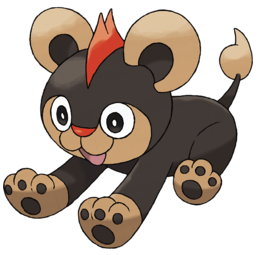
Litleo and Pyroar

We should probably talk about these ones next. I didn’t use Litleo for very long, because my Fletchling unexpectedly evolved into a Fire-type and I didn’t want two of them. Still, I had one on my party for a little while, and I feel like I got to know her, so it makes sense. So, these Pokémon are lions. I am notoriously ill-disposed to Pokémon that are just animals, because I want more. Granted, of course, these are lions that breathe fire, but hey, Beartic is a polar bear that shoots icicles and just look how well I got along with him. That was three years ago, though; I’m being nice now. Well… okay, ‘nice’ is a bit much. I’m being marginally less irritable now. Let’s give these two a shot and see what I can make of them.
So let’s start with the obvious: gender differences. Pyroar is one of only two Pokémon in X and Y with major sexual dimorphism, the other being Meowstic. In Pyroar’s case, it obviously mimics one of the most famous and recognisable examples of sexual dimorphism in the real world: lions have manes, lionesses don’t (although female Pyroar get that long flowing crest so that they don’t seem too boring). Sort of an predictable choice for a lion Pokémon, but major gender differences are something that Pokémon underexploits, so I’m hardly going to complain about seeing more of it. The way the pattern of red-and-yellow stripes on a male Pyroar’s mane recalls the distinctive shape of a Fire Blast attack – the Japanese symbol for “large” or “great” – is also a nice touch. The divergences between male and female Pyroar also come through in their behaviour, which is nice – you can compare Nidoking and Nidoqueen, or contrast Jellicent and Unfezant, who draw attention to gender but don’t make much of it. Male Pyroar, specifically the male with the most impressive mane, are said to be the leaders of their prides, which obviously draws on the male leadership of real leonine social structure. It’s also worth noting that only ¼ of all Pyroar are male, reflecting the composition of real prides, which will generally include only 1-2 males and perhaps 5-6 females. Interestingly the Pokédex chooses to emphasise the females’ role in raising cubs, when in fact real lionesses are generally responsible for hunting (something for which the stronger but slower males are less suited) and tend to leave the males to protect the cubs in their absence; otherwise the males and females are equally involved. I suspect the reversal comes from the fact that the activity of raising children tends to be gendered ‘female’ in most human societies, while hunting is more likely to be gendered ‘male,’ and the designers attributed a standard feminine activity to female Pyroar without thinking about what lions actually do. It’s a little disappointing that Pyroar should be made to conform to human gender stereotypes in this way when there exists such an obvious reason for them not to (I always thought the role of lionesses in literally bringing home the bacon was fairly well-known, but perhaps not…).

Litleo and Pyroar don’t subdue prey with claws, teeth, and brute strength like real world lions – why bother with any of that when you can breath fire? Probably because of the sunburst shape of the males’ manes, there’s a long-standing association between lions and solar imagery going back to the Near Eastern Bronze Age, which male Pyroar are happy to accentuate. That does make Fire something of an obvious choice, granted, but not as obvious as Ice on a polar bear. I sort of wish they had played up the solar idea a bit, maybe with a sun-related ability (goodness knows none of Pyroar’s current abilities would be missed). Another critical aspect of what these Pokémon are about is also drawn from real lions – their roar. Lions roar; aside from the males’ glorious manes, their fearsome roar is probably the most iconic thing about them (for fans of A Song of Ice and Fire, think of the crest and motto of House Lannister: respectively, a golden lion and the phrase “Hear Me Roar”), and Litleo and Pyroar have two skills related to that: the relatively rare Hyper Voice attack, and their signature move, Noble Roar. This, I think, is the reason they’re Normal dual-types and not straight Fire, which would otherwise make just as much sense; they rely as much on their explosive vocal range as on their fire, and sonic abilities remain among the ‘miscellaneous’ powers still associated with the Normal type (compare Jigglypuff, who became Fairy/Normal in X and Y while Clefairy is now pure Fairy).
The other interesting thing about Pyroar is that the male seems almost made to be Lysandre’s signature Pokémon (and Lysandre is, to my recollection, the only NPC in the game who uses a male one): the bright red mane is reminiscent of Lysandre’s extravagant hairdo, the species designation “the Royal Pokémon” matches Lysandre’s royal Kalosian heritage, lions are a common symbol in Mediaeval heraldry, perhaps furthering the ‘royal’ associations, and they are traditionally associated with pride (to the point that the word even became the collective noun for a group of them), which is probably Lysandre’s most significant flaw – the pride that led him to believe he had the right, indeed the duty, to decide who would live and who would die all around the world. Even the fire abilities recall the name of Lysandre’s organisation, and Lysandre himself is regularly described metaphorically as ‘burning’ with passion. This wouldn’t be the first time a human character has taken certain cues from a Pokémon – Wake’s lucha mask is modeled on a Swampert (though he doesn’t actually have a Swampert, in any of his incarnations), Chilli, Cilan and Cress match the distinctive hairstyles of Simisear, Simisage and Simipour, Alder’s hair seems to be styled after Volcarona, and I believe Gardevoir inspired Diantha’s dress. The intended implication may be that Pyroar was Lysandre’s first Pokémon (Gyarados is now his strongest, but seriously what kind of troll Professor starts a kid off with a Magikarp?) and the one with whom he has the deepest relationship. Can you push that even further? Maybe – Pyroar’s ‘royal’ designation might come from being a traditional starter Pokémon given to children of the Kalosian monarchy, and even today given to their descendants.
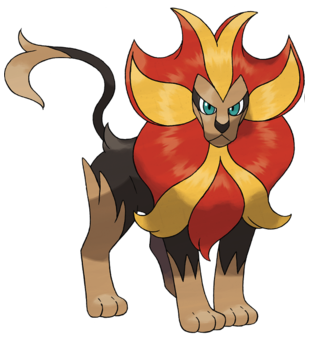
Pyroar seems intended to serve as a special sweeper. Although her defences are poor and her physical attacks not worth the effort, she’s very fast, and her special attacks pack quite a punch. Defensively, Normal/Fire is a mixed bag – six resistances (including Fire, Ice and Fairy) and a Ghost immunity (something which is shaping up to be quite valuable in this generation) are nothing to sniff at, but Pyroar’s four weaknesses are all to powerful and common offensive types: Ground, Rock, Fighting and Water. Offensively, though, Fire Blast and Hyper Voice are a pretty solid combination, even if they leave her in a bit of trouble against most Rock-types. The neat thing about Hyper Voice is that sound-based attacks have been improved in X and Y and can now bypass Substitute, which makes Pyroar very dangerous to certain Pokémon who rely on Substitutes to stall for time. Beyond that, options are sadly limited – there’s Dark Pulse on the side, and if you’re planning a sun team, Solarbeam is an option, though bear in mind that weather in general is substantially weaker now that the effects of Drought et al. have limited durations. The usual package of alternate Fire moves is available – Flamethrower for greater reliability and Overheat for single-shot power. Other than that, you’re probably looking at either Hidden Power or a support move for the final slot. Hidden Power is easier to use now, since its power rating is always 60 rather than randomly determined for each individual. A Grass-type Hidden Power is probably the best complement to Pyroar’s main attacks, if you can get it, but a move with 60 power is not exactly a brilliant deal. The signature move, Noble Roar, seems like more of a flavour thing than something that would be especially useful in battle – it reduces the target’s attack and special attack, which is irritating, but can be shaken off by switching out and won’t protect Pyroar from critical hits. The nice thing about Noble Roar is that it’s good for catching Pokémon as they switch in, since it doesn’t matter whether the target favours special or physical attacks. Still, it might be better suited to a somewhat tougher Pokémon. Burning incoming opponents with Will’o’Wisp is probably a better option if you’re looking to give Pyroar stronger defensive capabilities. Yawn could also be interesting; most people will switch out after being hit by Yawn rather than let a Pokémon fall asleep the next turn, so that could be good for keeping Pyroar’s most dangerous opponents off her back. Finally, she’s fast enough to make good use of Taunt, and can more effectively break defensive Pokémon that way by denying them access to their support moves.

None of Pyroar’s abilities are much use, sadly. Rivalry gives a damage bonus against Pokémon of the same gender, but a corresponding penalty against Pokémon of the opposite gender – certainly flavour-appropriate for a Pokémon with strong gender differentiation, but too unpredictable to plan strategies around, since there’s no way to know the gender of Pokémon you’ll be facing ahead of time. Moxie is an attack boost every time you knock out an opponent – great, except Pyroar doesn’t use physical attacks. If for some reason you do want to focus on Pyroar’s physical side, well, get used to disappointment, because her strongest physical Fire-type attack is Fire Fang, and her coverage options basically extend to Crunch and Wild Charge. Flame Charge lets you do damage while increasing your speed, and is generally a good secondary attack, but speed isn’t really high on Pyroar’s list of concerns anyway. Her final ability, Unnerve, prevents opponents from eating berries. Whoop-dee-f*cking-doo. In short, Normal/Fire is actually pretty solid and Pyroar certainly has the stats to back it up, but she’s just not a versatile Pokémon, and her lack of relevant, useful abilities makes it difficult for her to sparkle.
I think overall I lean a little on the ‘meh’ side with Pyroar. On reflection I don’t think there’s anything really wrong with her; as far as the whole ‘being a lion’ thing goes, she does a solid job, and the focus on her roar as a weapon makes sense with the design while giving her a pretty good combination of primary attacks. I come away from this one feeling like there’s room for more, though. Playing up the royalty aspect somehow might have been more interesting, and Pyroar would be an excellent Pokémon to give a sun motif and solar abilities, which would also make a good combination with a royal theme, particularly in Kalos (given the presence in the background of Louis XIV, the ‘sun king,’ as a historical model for the Kalosian monarchy and the Parfum Palace). Drawing on the heraldic associations of lions, maybe going for a more stylised look, might be a good way of doing that. I like Pyroar well enough, particularly the female form which makes an effort to match the male form in overall majesty while still creating a very different impression of her nature, but I feel just a little underwhelmed.
You’ve mentioned in the past that Grass is one of the weakest types. What would you do to change that? For example, what weaknesses and strengths would you change, or how would you alter certain attacks?
Grass… kinda gets a raw deal, yeah. Just purely in terms of the number of other types it’s strong/weak against, it’s one of the games’ worst… which is kind of a sore spot for me, since it’s also my favourite. Most types are defensively vulnerable to two or three others; a few are vulnerable to only one, and Ice (which also kinda got shafted, I think mainly because Generations 1 and 2 had no pure Ice-types) is vulnerable to four. Grass is vulnerable to five: Flying, Ice, Fire, Bug and Poison. Only one other type has that many defensive weaknesses – ironically, that would be Rock (vulnerable to Fighting, Steel, Ground, Grass and Water). Rock, though, gets to enjoy being one of the game’s better offensive types – Rock is the only type other than Ground to be strong against a greater number of types than it is weak against, offensively. Grass, not so much – Grass attacks are weak against seven different types (Grass, Flying, Bug, Fire, Dragon, Poison and Steel), which until X and Y was more than any other – and that changed not because Grass’s situation improved, but because the next-worst-off type, Bug, gained a new disadvantage against Fairy-types. They’re strong against three (Rock, Ground and Water), which is sort of average, really.
Grass does, admittedly, have a decent number of resistances – four of them (Water, Electric, Ground and Grass itself), while many types only have two or three, but it doesn’t really stand out in that regard – Water, Rock and Dragon also have four, as do Ghost, Fairy and Flying if you count their immunities (which, y’know, are kind of better), Poison has five, Fire has six, and Steel blows them all out of the water with eleven. It has to be said that counting types can only go so far – Dragon, for instance, was hands-down the best attacking type of the fourth and fifth generations, despite being strong against only one type (itself), because it had nearly perfect neutral coverage, resisted only by Steel. The problem, though, is that where types like Dragon and Rock lose out in one respect but do very well in another, Grass kinda loses everywhere. Grass-types are, admittedly, also immune to Leech Seed and, as of X and Y, powder attacks (the important ones being Stun Spore, Sleep Powder and Spore) – so basically they’re really good at blocking other Grass-types. That seems to be the niche Game Freak has in mind for them here. I mean… not that those immunities aren’t useful, but they’re also kind of a slap in the face.
So, when I put it like that, it seems like the obvious thing to do is strip out some of those damned weaknesses (the attacks, I think, are fine as they are – Solarbeam could maybe use some work, because at the moment it’s kind of a gimmick and only viable on dedicated sun-abuse teams, but I’m not sure how to change it). Let’s start with Flying. Why does Flying beat Grass? I’ve seen element-based systems before where Plant/Forest is actually strong against Wind/Sky, birds can help plants through pollination (analogy with the Grass-Water relationship), and it’s scientific fact that plants bolster hillsides against erosion by the wind. I say make Grass-types resist Flying attacks, and Grass attacks neutral to Flying-types. Make Flying-types strong against Water instead; the smug pricks deserve it. We can probably get away with removing Steel’s resistance to Grass too, since Steel has too many damn resistances anyway. In flavour terms that’s not as solid, because there’s precedent for Metal-beats-Wood in the Chinese Wu Xing cycles, but the fact is, there are probably ways to justify having Steel resist everything, so I think a little more restraint is in order when dealing with that type. Those things won’t make Grass an amazing type, but it’ll certainly make it not suck!
Bug could use some help too, but I’ve been babbling long enough…
Ever thought of giving Kid Icarus: Uprising a try? It may only be loosely based on Greek Myth, but it’s got enough references, along with an engaging plot with interesting characters and hilariously witty dialogue, to make anyone smile. Though some of the jokes that refer to the old NES title may fly over your head (no pun intended), and it takes a bit of time to get used to the control style, I’m still sure you’d be in for a fun time.
Not really a good time for me to be picking up new games at the moment, sorry.
Are you considering doing a review specifically on mega-evolving (digivolving) pokemon? Your opinion on them is something I crave since re-reading your analysis on various starter pokemon.
Thinking about it. After the Kalos Pokédex. I suppose I would want to talk about what Mega Evolution does for each Pokémon that receives it (in some cases: not as much as you’d think), as well as what the change in appearance seems to signify about that Pokémon. What else? I’m not sure how much I could usefully say about them, but we’ll see.
Flabébé, Floette and Florges

Okay, I’m just going to come out and say it: I have no idea how to pronounce this Pokémon’s name. Under standard French orthography, Florges would be pronounced… Florj? That doesn’t sound right. Florjé? Florjéz? Florjis? Florghés? I don’t know; just imagine me mispronouncing it in the most ludicrous way you can think of whenever I type the name. Flogress… Florgos… Florg…
Anyway. Flabébé. When I first met this Pokémon I assumed she was a Grass/Fairy dual-type, which I don’t think is unreasonable given the dominance of flowers in her design and their importance to her lifestyle. Actually, I still have trouble believing she’s not a Grass-type, seeing as most of her level-up moves are Grass attacks, and her offensive movepool certainly seems to have fallen prey to the curse of Grass-Types Don’t Get Nice Things. Flabébé, Floette and Florges probably come closest to emulating Xerneas’ conception of the Fairy type, which sees them as guardians of nature and nurturers of life, but in this case specifically of flowering plants. Flabébé and Floette possess symbiotic relationships with single flowers, which they keep for their entire lives, presumably using their Fairy powers to keep them from wilting and dying. There’s a minor little gimmick here which is not particularly interesting but deserves to be mentioned; their flowers come in different colours – red, white, orange, yellow, and blue – with certain colours being more or less common in different flower beds, Flabébé’s natural habitat. The colour carries through when she evolves into Floette, and then Florges. All three stages are said to draw energy from blooming flowers specifically, which may be the key to why they’re not Grass-types, thematically speaking; their powers are drawn not from plants as such, but from the beauty of plants, flowers in particular, and may be related to the symbolic meanings of different types of flowers. I’m not sure whether beauty and the appreciation of beauty are attributes of the Fairy type, but they certainly wouldn’t be inconsistent with it, so perhaps that’s what Flabébé gets out of the deal. Or at least, that’s the spin I’d put on it if I were Game Freak.

Florges becomes something quite rare and interesting – a Pokémon who actually manipulates terrain type, creating beautiful flower gardens for her territory, and even being invited by humans to do the same for grand estates and castles. Notice the verb, “invite,” which is exactly what the Pokédex says; what’s happening here is being glossed in very different terms to a trainer/Pokémon relationship. It seems like we’re being told about wild Florges being asked (contracted, even?) to perform specific services for human nobles, possibly before the invention of Pokéballs (“in times long past”). One might ask what the Florges gets out of it, and the simplest answer seems to be that she would be permitted to live in the garden indefinitely, providing her and any family members with a long-term home that would be isolated from most predators – this makes sense with the idea that Florges are “invited;” they normally want to create gardens anyway, independent of any human incentive, and there is a mutual benefit to having them do it in a specific place. My over-active imagination, however, can’t help but wander to the idea of particularly skilled and powerful Florges gaining a reputation for truly fantastical flower gardens and travelling from one great estate to another in order to practice her art and receive pampering, adulation and luxuries in return (I am rather fond of the idea of Pokémon just doing their own thing in the world of humans). Either of these views of Florges is particularly appropriate to Kalos, with its major background theme of the excessive wealth and luxury of the old aristocracy that alludes to the proverbial decadence of the French ancien régime. This Pokémon, to me, represents what Kalos itself is all about: precise, studied expressions of elegance that nurture and exalt natural beauty through the imposition of order.

Given that, perhaps it’s fitting that one particular Floette gets to play a critical role in the backstory of X and Y: AZ’s Floette, instantly recognisable by her unique black tulip-like flower whose shape seems to have provided the model for AZ’s Ultimate Weapon. This Floette, who answers to “The Eternal Flower,” fought and died for AZ in the war against his brother and was subsequently resurrected, at the cost of several hundred other Pokémon’s lives, using the Ultimate Weapon. This puts her right at the centre of the game’s primary conflict of change and stasis (AZ’s refusal to let go of what he had lost eventually brought ruin to Kalos), which also has relevance to Floette’s nature as a Pokémon who preserves and enhances beauty through order. What AZ did, and what Lysandre wanted to do, are ultimately an extension of what Flabébé, Floette and Florges do throughout their lives: preventing what is beautiful about the world from fading and dying. As always in Pokémon, the villains are villains because they take it too far, and because they believe that the ends justify the means – something Floette cannot accept, which is why she abandons AZ. We know from those talented people who specialise in hacking Pokémon games that AZ’s Floette likely to be available to players at some point through an event, because she has her own stats, completely different to a regular Floette or Florges’ – she’s a fast special attacker – and even her own signature move: Light of Ruin. This move seems to be, effectively, a special Fairy-type equivalent to Head Smash (complete with that painful 50% recoil), and narrowly edges out Xerneas’ Fairy Aura-boosted Moonblast as the most powerful Fairy attack in the game. It seems likely that this move draws on whatever power was imparted to Floette by the Ultimate Weapon to make her immortal, a power encompassing both life and death – the heavy cost of using it serves as an ever-present reminder that the weapon has always been a double-edged sword.

A normal, fully-evolved Florges is a very different Pokémon to AZ’s Floette. Her greatest strength, instead, is her monumental special defence. Being a pure Fairy-type doesn’t hurt either, since they have a pretty cushy deal with three resistances and an immunity (to, need I remind you, Dragon) against only two weaknesses. Her HP and physical defence are relatively poor, though, so either invest heavily in both or keep her far away from physical attackers; this fair maiden is without question a special wall and a supporter. Florges seems designed to function best in double or triple battles, with two unique abilities and a very rare move which all benefit her allies – if she actually were a Grass-type, two of them would benefit her as well and make her much stronger, but she’s not and they don’t. First, the move: Flower Shield raises the defence of all Grass Pokémon in play, meaning it’s useless in a single battle, and even in a triple battle with two Grass-type allies (which is just asking for a Sludge Wave to the face) it’s questionable. This technique really makes a lot more sense on Cherrim, who also learns it. Florges’ first ability, Flower Veil, is likewise nothing special; it prevents allied Grass Pokémon from having their stats lowered, which basically amounts to granting an ally the Clear Body ability (and before you ask, no, it doesn’t negate Leaf Storm recoil). I really have to question whether it would have been so bad to let Florges benefit from this as well. The hidden ability – Symbiosis – may actually be interesting. Again, it can only be useful in a double or triple battle: if one of Florges’ allies consumes an item (including through the use of Fling or Natural Gift), she will pass her own item to that Pokémon instead. Being able to transfer items to a partner without spending a moveslot and a turn on something like Trick or Bestow is such a unique thing to be able to do that it seems like it would have to be useful somehow, but I’m at a loss as to how exactly that might be. Perhaps using a Toxic Orb to activate Poison Heal on Gliscor, Flinging it away, and then replacing it with a Life Orb? Or something similar to get Leftovers on a Guts Pokémon to help compensate for burn damage? Once elemental Gems are available on X and Y, maybe they could be combined with Choice Specs or a Choice Band for a single, enormously powerful attack (since the Gem is consumed before the attack, and the new item is transferred immediately)? I leave this as a puzzle for those more ingenious than myself.

While Florges’ special attack pales in comparison to her special defence, it’s actually really high as well. She also gets a strong offensive type and a powerful primary attack, Moonblast, which will leave a hell of a sting on anything that takes her for set-up bait. There’s even the option of Calm Mind if you want to make a bulky attacker-style Florges. Unfortunately, other than Moonblast her offensive movepool is awful. She only learns Grass attacks, which do almost nothing to supplement Fairy attacks (all the types that resist Fairy resist Grass as well), and Psychic, which is at least good for Poison-types. It’s pretty clear that Florges isn’t supposed to be an attacker anyway, so consider Psychic, but focus mainly on her support skills – she has plenty to choose from. Wish and Aromatherapy can be used to heal the team of both regular injuries and status ailments (you’ll need train Florges’ HP heavily to get the most out of Wish, but you should probably do that anyway). She learns both Grassy Terrain and Misty Terrain, the new Grass- and Fairy-themed field moves, both of which are fairly exclusive (and she happens to be the only non-Grass-type to learn Grassy Terrain). Light Screen rounds out her options – Florges herself would benefit much more from Reflect, which she doesn’t get, but team support is always good. I’d hesitate to call her a great support Pokémon, but she can take most any special attack that isn’t super-effective and some that are, hit back with a very strong attack that relatively few Pokémon resist, and heal the team while she’s out. Although her abilities may be useless in a single battle (and not even all that exciting in doubles, to be honest), she has everything she needs to contribute to her team.
Florges has her shortcomings, but she’s good at what she does, and I think the important thing about this line is that they can, in a way, be seen as mascots for the entire Kalos region. What they do and what they value in their regular lives have special significance in the context of the plot of X and Y, making Floette a perfect choice for the starring role she has in AZ’s story. I might still think they would make more sense as Grass-types, and I might wish they had an ability choice that’s actually useful in a single battle, but I wish for things I can’t have for almost every Pokémon. This one (as anime Bonnie would say) is a keeper.
