One lunatic's love-hate relationship with the Pokémon franchise, and his addled musings on its rights, wrongs, ins and outs. Come one, come all, and indulge my delusions of grandeur as I inflict my opinions on anyone within shouting distance.
Hmm… well, outside of the ones I already talked about in that series, the one I most want to see evolved is easily Dunsparce; the problem is that Dunsparce is such a weird and unique creature that it’s difficult to know what to do with him, stylistically. I feel like he should have the head of a Chinese dragon with the whiskers and antler-like horns, a feathery body, still small wings but multiple pairs (which he uses to ‘swim’ through the ground; yes I know that doesn’t make sense), a larger, more vicious-looking drill, and his existing yellow/black/white colour scheme. Normal/Dragon type, Levitate in place of Run Away, keeping Serene Grace. It’s said that if you catch a wild one with your bare hands and hold onto it while it tunnels through the earth to escape, this Pokémon will grant you a wish.
I often have difficulty with pre-evolutions; I don’t always see the point of them. Manktyke I get, because I like how the unique evolution method ties him to Remoraid. Tyrogue I get because they wanted to link Himonchan and Hitmonlee. Munchlax I get because he actually makes an interesting contrast with Snorlax’s inactivity. In many cases, though, they’re just smaller, cuter versions of Pokémon that were small and cute to begin with; I don’t see why that’s necessary. I guess if I had to do one, I’d go with a baby form of Druddigon – soft and cute on the outside, but just as bad-tempered on the inside, with a conniving streak that it uses to trick prey into its cave.
A bit busy this week because we’ve got our potential new PhD students for the next academic year visiting us, everything is chaos, and I foolishly volunteered to bake delicious treats for 50-odd people for an afternoon tea. Apologies for tardiness in producing new Pokémon-related madness.
I’m not sure whether I’ve discussed it yet or not either. It sounds like the sort of thing I might talk about. Could have come up in passing.
I think the obvious answer is that, in keeping with the franchise’s normal stance on what it takes to be a good trainer, most of the grunts for the various evil Teams are just not very nice people. The more happy and fulfilled your Pokémon are, the more dedicated, energetic and creative they can be. Most members of Team Aqua, Team Magma and Team Galactic are little more than thugs and may not be giving them the kind of emotional stimulation they need; Team Rocket certainly don’t. Some members of Team Plasma are genuinely decent people, but most of them are also avowedly distant from their Pokémon because they intend to release them and don’t want to get attached. Team Flare may have a similar rationale, if they’re aware that Lysandre’s plan for a new world involves the extermination of Pokémon as well as other humans.
Actually, I think the more interesting question is why the Pokémon belonging to the leaders of these groups are not shite. In many cases it probably has something to do with the genuine charisma of these figures – Giovanni, Maxie, Archie, Cyrus, Ghetsis and Lysandre all have very strong personalities and a great capacity to lead (on top of which, Maxie, Archie and especially Lysandre have legitimately noble personality traits as well – although one must wonder whether Lysandre’s Pokémon know the full extent of what he has in mind). Their Pokémon may admire them every bit as much as their human followers, to the extent that they can ignore any deficiencies in the affection they receive – and might, through that admiration, come to emulate their trainers’ moral and ethical leanings, in much the same way as Pikachu emulates Ash’s…
Sorry, but no; there is no chance of that. I don’t really play hacks often anyway, I’m already very busy between work and my regular writing, and I don’t particularly want to add to that by playing a game I can’t even understand (I know, like, ten words of Japanese on a good day and I can’t read Japanese script).
Thanks. 🙂 Now, the Elite Four… Hmm. To some extent I think the fact that they just don’t know what’s going on might play into it; Team Rocket, for example, keep their takeover of Silph Company very quiet until the protagonist bursts in and starts making a mess of everything, while Team Galactic, Team Plasma and even Team Flare to an extent do make some effort to appear legitimate. That can only get us so far, though; at some point in every game from Gold and Silver onward the s#!t hits the fan in a pretty spectacular fashion. I think the reason has to be something to do with the differences between the roles of the Elite Four and the Champion, because the Champion normally does get involved in some capacity. The Elite Four, as far as we can discern, are somehow selected or appointed; they are chosen to represent the Pokémon League and they have very clear-cut responsibilities: they’re supposed to spend most of their time at the League headquarters, ready to accept challenges, and training for challenges when they’re not doing that. Since they’re always there, they may also have other duties related to the day-to-day running of the Pokémon League – appointing referees and adjudicating rules disputes, co-ordinating public works, overseeing Gym Leaders and Professors, just generally getting stuff done (also, some of them may genuinely not give a rat’s @$$ about whatever’s going on – it’s hard to imagine the self-centred, callous Agatha taking the time to sort out Team Rocket on her own initiative, even if she knew what they were up to – although other cases are less easily explained away; it’s strange, for instance, that Phoebe, whose grandparents are the shrine guardians of Mount Pyre, doesn’t take a personal interest in the Hoenn crisis). The Champion, by contrast, attains his or her position through a sort of direct meritocracy, by defeating the previous Champion. Changeovers don’t happen often, but they can happen without warning, and you have no idea ahead of time who the next Champion is going to be. This is probably not the person you want to be in charge of quotidian affairs. The Champion is a figurehead; he or she describes vague, long-term “visions” or “missions” for where the Pokémon League should be and what it should look like one year or five years from now, and then the underlings run around and make it so. The position comes with few actual responsibilities other than “maintain the good standing and reputation of the League,” and the Champion probably doesn’t need to stay at the headquarters because there should be plenty of warning if a challenger looks likely to get past the Elite Four. As a result, the Champion has a lot more freedom to go on adventures at random and indulge personal whims, including being a Big Damn Hero. Basically: the Elite Four have s#!t to do. They’re employees of the Pokémon League with clearly defined responsibilities, which generally do not include dealing with crazy apocalypse scenarios. Crazy is the Champion’s department.
Well, I gotta say, I sympathise with the guest host’s angry rant two minutes in. Incidentally, I’ve encountered Game Theory before, and while the host’s exuberance has a tendency to get on my nerves the ideas themselves are very interesting.
Anyway. I don’t think it sounds “random” or “ridiculous” at all. In fact, I myself have wondered more than once what, if anything, really makes Pokémon different from humans. In terms of evolutionary biology, as the video points out, it’s really quite clear cut: in the same way as all birds are dinosaurs, humans are Pokémon, although we don’t think of them that way. I don’t see any other creatures in the Pokémon world that might be relatives of humans, and Pokémon pretty much run the gamut of eukaryotic life forms, so actually I think you’d need to make some pretty strange assumptions in order to argue that humans aren’t Pokémon. I can think of two (EDIT: THREE) possible scenarios:
1) Humans are the last surviving descendants of a completely separate ‘kingdom’ of life, with fundamentally different cellular biology – the Pokémon world’s equivalent to the Archaea, basically – once as diverse and widespread as Pokémon are today (this would actually be really interesting to run with, and might help provide an explanation for why humans can’t be captured in Pokéballs, or why Pokémon react to things like evolutionary stones while humans don’t, but I don’t see any strong evidence for it).
2) Humans are actually from another planet or an alternate reality and were transplanted into the Pokémon world relatively recently in evolutionary terms (sounds mad, but I have seen commentators and fan fiction authors use this in background).
3) Pokémon themselves are from another world, and were introduced to Pokéarth long ago enough that they have out-competed all other animals and driven them the lot of them to extinction, with humans managing to survive (this seems highly unlikely given the evidence for fossil Pokémon hundreds of millions of years old – I doubt humans have been around all that time).
The rest is trivia – some I agree with, some I don’t; in particular, I would dispute the statement that “the ‘dex ain’t no Wikipedia,” because although I love my Pokémadex, as primary sources go it can be a bit mad – tell me again how Magcargo’s body is hotter than the surface of the sun? The myth stuff, I’m neither here nor there on – the myth about Pokémon shedding their skins to become humans, for example, has a very clear real-word antecedent in the myth of the selkie, so I’m hesitant to ascribe a Pokéverse-specific interpretation to it. Similarly, the notion of a forgotten age when humans, animals and supernatural beings mingled more freely than in the present is common enough in the real world that I believe a similar story could exist in the Pokémon world whether or not it’s actually true. Still, the cumulative effect of these and other myths seems to be that Game Freak want to suggest to us that something is going on. The idea that death itself is a form of evolution (in the Pokémon sense) I find fascinating; something like that would be worth pursuing through fan fiction, because it would have profound implications for how the whole cosmology of the Pokémon universe is put together, and it has a solid grounding in the backstories of Pokémon like Yamask and Spiritomb (assuming we believe them). Lastly, I feel compelled to point out three important faulty assumptions in their biological line of argument: 1) that being a Psychic-type necessarily means a Pokémon is highly intelligent (they come to this conclusion by looking at just one species – Alakazam – when looking at another, like, say, Slowpoke, might prompt the opposite reaction), 2) that, if humans evolved from Pokémon, the most intelligent Pokémon should be the ones that most resemble humans (at best a very self-centred approach to the question), and 3) that the “body style” to which a Pokemon is assigned by the Pokédex is a reliable indicator of evolutionary kinship (which, to be blunt, is simply wrong; juvenile and adult Pokémon very often have different body styles – for instance, Chingling and Venonat both belong to the bipedal-tailless group, which should make them among humanity’s closest relatives… closer, in fact, than Primeape…). Egg group, though, which they also discuss, I am much more willing to buy.
Yes, I did just write a substantial paragraph attacking the logic of a very eloquent expression of a position I actually agree with. Because I’m me; don’t argue.
Hmm. Not that I can think of… Pokémon on my opponents’ teams from time to time, sure, but never one of my own. ’cept for maybe that time when my Illumise used Metronome and exploded on an Emerald Nuzlocke… but then strangling would have been a touch impractical because… y’know… chunky salsa…
Anyone have tales of intense frustration to share?
Silph’s magnum opus and Team Rocket’s ultimate goal: the Master Ball.
Because I am me, I had a great deal of fun with the episode in which Ash challenges the Viridian Gym. Among my bigger regrets for that series, though, are that Ash never got a chance to confront Giovanni, his battle being delegated to Jessie and James instead, and that Giovanni himself didn’t get the kind of characterisation many other anime Gym Leaders enjoy in their keynote appearances. Episode 3 of Origins has the chance to rectify this deficiency, and it does so with gusto. Let’s take a look.
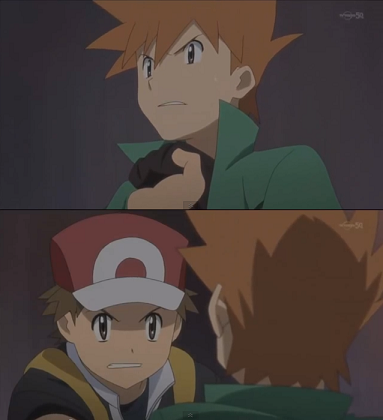
Red persuades Blue to help out against Team Rocket with his impeccable debating skills and smooth negotiating manner.
After winning his Rainbow and Soul Badges, taking on Team Rocket once more in Celadon City, and evolving his Charmeleon into a Charizard, Red finds himself in Saffron City, the home of the region’s leading producer of Pokémon-related supplies and technology, Silph Company. Red and Blue briefly team up to rescue a woman being harassed by a pair of Team Rocket grunts, and learn that she is the secretary of Silph’s president. Team Rocket has taken over the company headquarters in order to force Silph’s scientists to perfect the prototype Master Ball by performing unethical experiments on large numbers of wild Pokémon, and she has been given orders to escape and return with reinforcements. Blue, though he seems to understand the worrying implications of a world where Team Rocket can commission Master Balls, doesn’t see what any of this has to do with winning Badges or becoming Champion and has no intention of sticking his neck out for anyone, though Red eventually manages to… ‘persuade’ him to escort the secretary to Celadon City and raise the police. Red himself, meanwhile, is unwilling to let the Pokémon in the building suffer for even a moment longer than necessary, and decides to take a more direct approach: a frontal assault with all his Pokémon. As we know from the games, this is a resounding success. Red frees the imprisoned Pokémon and scientists from the Silph laboratories, then makes his way to the president’s office to confront Giovanni. If Giovanni is frustrated by what he admits is the total ruination of his plans, he doesn’t show it, and is prepared to leave without a fight, but Red is having none of that, and vows to thwart Team Rocket’s plans wherever they go. Irritated by Red’s presumptuousness, Giovanni calls on his Nidoqueen, who Double Kicks Charizard through a wall and counters his Flamethrower with Surf, causing an explosion that takes out most of the building’s top floor. When the dust settles, Nidoqueen and Giovanni are standing unfazed, while Red and Charizard are lying crumpled on the floor. Giovanni, almost disappointed by the ease of his victory, comments that Red’s failure to achieve more with Charizard is “a pitiful waste of such gifts.” Red demands an explanation for Team Rocket’s actions, and he replies that Pokémon are a business, and success in business requires sacrifice – if Pokémon must suffer, then so be it. Red angrily retorts that Pokémon should be a trainer’s friends, to which Giovanni points out, looking to Charizard, that Red is perfectly willing to let his ‘friends’ suffer as well. Red has no answer to that, and Giovanni leaves by helicopter, cleanly escaping all police action.
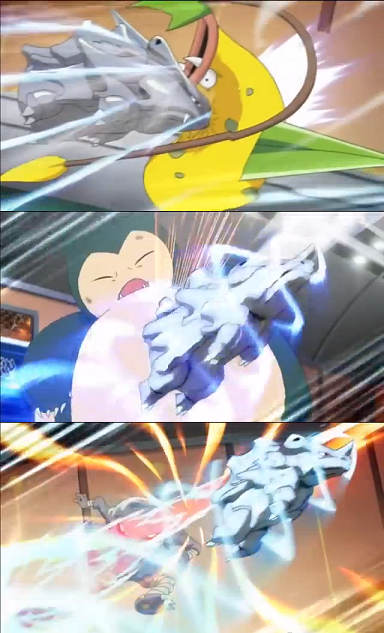
Red’s team nearly gets swept by the most badass Rhyhorn ever.
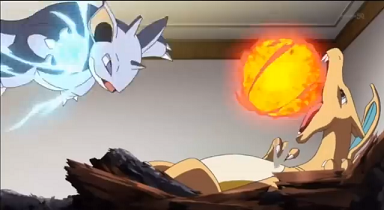
Fast-forward to Viridian City. Red is effervescent at the prospect of meeting and learning from the strongest Gym Leader, whom Blue has already defeated, and is horrified when he realises that – spoiler alert – the leader is Giovanni himself. He refuses, point blank, to acknowledge Giovanni as a Gym Leader at all, and instead challenges him as “the enemy of all Pokémon.” Accordingly Giovanni, who had been perusing a selection of Pokéballs like the one we saw in Brock’s Gym, remarks that he won’t accept Red’s challenge as a Gym Leader either and instead selects two Ultra Balls from a hidden compartment. Red knew Giovanni’s specialty ahead of time and came prepared with Grass-, Water- and Fighting-types, but his Pokémon simply aren’t powerful enough – Giovanni’s Rhyhorn crushes his Victreebel, Kabutops, Snorlax and Jolteon almost without effort, before his Hitmonlee manages to force a tie. Throughout the battle, we get snippets of Giovanni’s inner thoughts on the battle – he finds Red utterly infuriating, but doesn’t quite know why; nor can he account for his disappointment that Red isn’t as challenging an opponent as he’d anticipated. Though he hides it well, his smugness steadily fades to agitation and then intensity, until with only one Pokémon left on each side, Giovanni realises that the battle will come down to Charizard and Rhydon, and gloats that Red has made a critical mistake by not saving a Pokémon better suited to this fight. Red replies that he always meant for Charizard to be his last, whatever happened, since the whole battle will mean more to him if he finishes it with his partner. Giovanni’s façade cracks – he’s visibly furious now at Red’s overconfidence – but then he notices that Red throws his Pokéballs in the same way as Giovanni himself used to as a child, and he finally understands the emotions Red has triggered in him. Giovanni recognises himself in Red (complete with a flashback scene in which Giovanni is revealed to have once owned a Charmander), and has been inspired by him to find excitement in their battle that he hasn’t felt in years. He grows even more intense as he realises that Charizard really is a match for his Rhydon, and finally is left with a sense of satisfaction when Red manages to overcome him. Apparently no longer mindful of their earlier conversation, Giovanni offers Red the Earth Badge – and, when Red refuses to accept it from the leader of Team Rocket, continuing to deny his status as a Gym Leader, he turns to his attendants and orders them to spread the word: Team Rocket is dissolved, and all of their operations are to cease immediately. Red’s expression softens as he comes to perceive Giovanni’s change of heart, and accepts the badge. Giovanni encourages him to continue seeking greater strength, since only one as strong as the Champion will have any hope of completing the Pokédex quest. As Red leaves, Giovanni muses on his own future, apparently hopeful now for some sort of redemption.
Like a snake’s, Charizard’s jaw can stretch to incredible angles when he prepares to launch a Flamethrower.
Pokémon has always liked the idea, and has grown more fond of it in recent years, culminating with the player’s battle against N in Black and White, that Pokémon battles are a way for trainers and Pokémon to express their convictions to each other, a subtle but powerful medium of communication that functions on the level of one’s deepest emotions and most firmly held beliefs. Neither of Red’s battles with Giovanni have practical aims. In Saffron City, Giovanni fully intends to leave, and Red can’t really stop him (this should be contrasted to the way the same events are portrayed in the games, where it is only Red’s defeat of Giovanni that forces him to withdraw), but he fights Red anyway because he wants to send a message: this is beyond you, I am beyond you, and you must learn your place. Likewise, Red’s motivation for challenging the Viridian Gym apparently goes out the window once he realises who his opponent is; he cannot have any reasonable expectation of breaking Team Rocket’s power with one battle, but he continues his course in order to make a statement of his opposition. Similarly, while Giovanni makes it clear that he takes his duties as a Gym Leader seriously – he mentions his earlier battle against Blue, noting that he accepted that challenge despite being unimpressed by his arrogance because Blue’s potential intrigued him – he makes it equally clear that his battle against Red is something else entirely; he is again trying to put Red in his place. Red’s decision to save Charizard for last is likewise built as much on symbolism as on strategy. Their climactic battle can be seen as a parallel to his first Gym challenge against Brock – the lessons Red first learned from Brock, Giovanni now relearns from Red. The same rising intensity and heightened synchronicity between trainer and Pokémon prompt a similar realisation: “Pokémon are not just tools” (whether “for battle,” as Red realises in the first episode, or “for business,” as he tells Giovanni repeatedly in this one). Giovanni’s choice of Pokéballs is also significant: his initial selection implies that like Brock he is considering his opponent’s experience level in order to select appropriate Pokémon for a difficult but not insurmountable challenge, as he presumably did for Blue, but when Red declares that he does not consider this a real Gym battle, he instead picks two hidden Ultra Balls – this should be taken to mean that he is not moderating his own strength but now intends to crush Red with the full power of his two mightiest Pokémon. This fact takes on a greater significance when we consider a fragment of gossip overheard by Red – that the Viridian Gym Leader has never needed even half of his true strength to defeat a challenger. While this is likely hyperbole, it must prompt us to wonder just how long it has been since Giovanni has needed to invest himself truly in a battle, in the way he does with Red. Perhaps spending too long without a real challenge is what causes Giovanni, little by little, to lose touch with his Pokémon and come to act with the callousness evident in his encounter with Red in Saffron City.
A young Giovanni and his Charmander.
At the end of their battle, Giovanni is taken aback when Red refuses to accept his Earth Badge, even though both sides made it clear from the start that this was not a battle between a Gym Leader and a challenger. For Giovanni, though, the significance of the battle – the meaning of the conversation – changed greatly over its course. His initial intention to break Red’s insolence lost its relevance once he started to liken Red to a young version of himself, and the battle instead became about finding himself and recapturing the energy and excitement of his youth. A badge, aside from its importance to entering the ranks of the Pokémon League, is also a memento of a trainer’s battle with the leader who confers it and, as Red says before bringing out Charizard, that trainer’s understanding of the leader’s beliefs: Giovanni offers it because he wants Red to remember their battle as he undoubtedly will, as well as his new understanding of Red’s beliefs. Red’s refusal is tantamount to a statement that their battle did not carry the same significance for him, and that he has no wish to remember it fondly – so Giovanni gives him a reason to (contrast, again, the way the games portray his decision to disband Team Rocket: he feels that, after losing even at his full strength, he is no longer worthy to lead). In spite of the dramatic change Red brings about in him, though, Giovanni is still the same man who built Team Rocket; his final exhortation to Red is not the kind of sage advice about love for Pokémon that one normally expects from a defeated Gym Leader (after all, this would surely be hypocritical coming from Giovanni), but focuses particularly on the importance of accumulating greater strength. Giovanni’s comments to Red after their battle in Saffron City make it clear that he considers struggle, ambition and sacrifice to be paramount, and none of those things are incompatible with Red’s idea of what it means to be a trainer; in fact, Giovanni would likely say that Red clearly sees the importance of all three. As Red says before their battle, all Gym Leaders practice different philosophies for living and working with their Pokémon, having in common only their love for their Pokémon – something Giovanni, once again, shares.
There’s only one more episode to go in the Origins mini-series. The Elite Four awaits… as do further challenges beyond…
Well, Final Fantasy VII was sort of a special case, partly because I didn’t have any other pressing projects in the lead-up to X and Y, partly because it was a request from Jim the Editor, who has best friend privileges. I don’t want to say that I definitely won’t do it again, but I don’t plan to; certainly not in the near future.
After defeating Brock, Red continues his journey through the classic storyline – such as it is – of the first generation. Most of this is related to us through a voice over by Red himself, with the help of dialogue boxes in the style of the original games (all direct quotes, of course), covering his victories over Misty and Lieutenant Surge, his initial skirmish with Team Rocket, Charmander’s evolution to Charmeleon, and a variety of other minor events from the games (mercifully, he sees fit to leave out all the Pokémon he is capturing during this time – we’d be here all day otherwise). Red’s narration is bland, conveying only the barest hint of his own feelings about any of the events in question, and gives little detail. I find myself questioning why things like receiving a bike voucher from the chairman of the Pokémon Fan Club even needed to be brought up if no attempt is going to be made to elaborate on them – and find myself answering that the only effect can be to call to mind viewers’ own memories of those same events. Maybe for some of us, the Magikarp Red mentions buying outside Mt. Moon became a valued team member when it evolved! It reminds us, essentially, that this is our story too. If the whole show were just Red’s rather dull, functional account, though, there wouldn’t be much point in watching, so the story picks up again with a sequence that the writers thought worthy of special attention: Red’s experiences in Lavender Town and the Pokémon Tower.




 Pokémaniacal