Bradley_P15 [Patreon cultist] asks:

Read a thing on twitter recently that hypothesises that Gen V were the last mainline games that felt quote “Comfortable in their own skin”, since VI, VII and VIII all have big showy gimmicks whilst feeling the need to keep oldschool fans happy. What’re your thoughts on this as one of the internet’s prime Pokemon overthinkers?

Hmm.  It doesn’t especially square with my intuitions or experiences about those games – I didn’t enjoy V as much as VI or VII, in spite of it having what I still feel is the best story of the Pokémon games so far. I think I just disagree outright with the characterisation of Mega Evolution and Z-moves (I mean, I assume that’s what this is referring to; I don’t know what else it could mean) as showy gimmicks.  They never felt intrusive to me, and I always got the impression that most Pokémon players really liked Mega Evolution?  Certainly a lot of people are upset that it’s apparently not coming back.  They’re also fairly major additions to the battle system that come with a fair degree of strategic depth, and they’re part of the culture of each region in which they appear.  I don’t know whether all that’s going to be true of Dynamaxing, and frankly neither does anyone else, despite all the people lining up to declare otherwise. 

I think there is… let’s say a certain amount right now of people trying to fit their anger over the recent National Pokédex (ahem) “issue” into an overarching narrative of why Pokémon has been in decline ever since… since whichever generation they thought was best.  That’s not necessarily a wrong thing to try to do, but it rarely comes with arguments that I find convincing on the basis of my own experience of the games, and at the moment it seems like it’s tied to a desire to pre-judge Sword and Shield, which I just think is silly.  I mean, for heaven’s sake, even after a Pokémon game comes out, it takes me months to decide whether I liked it (and only some of that is because I don’t usually pick up the game on launch day).
Ty asks:

Have you seen this (https://www.youtube.com/watch?v=DVO8QrGAPHs) Battle Royale of Legendary Pokemon yet? If not, congrats! Now you have! 

Anyway, the question is: Which Legendary Pokemon do you think would most likely win in a Battle Royale scenario where Pokedex Entries are assumed to be true (i.e. do you agree with the video), and also in a scenario where they aren’t true (because the Pokedex really doesn’t seem like a reliable source of information) and you’re just using their in-game combat capabilities?

…I think I might love this

But yeah, to answer the question… well, I don’t think I need to agree with the video for it to be great, because it’s supposed to be funny and not, like, a watertight argument for a position in a “who would win” debate.  But let’s talk about it anyway.

Continue reading “Ty asks:”

Anonymous asks:

What did you think of the change to Lusamine’s motivations in USUM? I kind of preferred her SM version, but that’s mostly because Lillie telling her why she was wrong was Lillie’s best moment to me.

Iiiiiiiiii have mixed feelings.  I don’t want to go into it in too much detail now because a full article on Lusamine and the Aether Foundation is on my to-do list for after I finish my Pokémon reviews, but I think both versions of Lusamine’s story get at aspects of her character the writers wanted to show.  There’s an argument that a better writer would have been able to do that with a single cohesive plotline rather than two alternate versions, but I think there’s also an argument that showing how the same character’s story could have progressed in two different ways as a result of fairly minor changes in circumstance is kind of interesting – we’ve seen Lusamine both as the story’s primary villain and as an arguably heroic supporting character, and each portrayal is true to the other.  I quite like the anime’s characterisation of Lusamine and its portrayal of her experiences with Nihilego in Ultra Space, but unfortunately it doesn’t get Lillie’s fantastic “the reason you suck” speech either.

Smugleaf asks:

Why Nidorino & Nidorina evolve via Moon Stone? Clefairy, Jigglypuff and others are somewhat related to moon, night, or sleep. But I can’t find the connection with the Nido family.

Personally, I think it’s because they’re supposed to be – very loosely – based on rabbits (definitely the weirdest fµ¢£ing rabbits I’ve ever seen, though, I’ll give you that; maybe they’re influenced by jackalopes or wolpertingers or something).  Rabbits are associated with the moon in China, Japan and Korea, because the shapes on the surface of the moon that we see as “The Man in the Moon” in culturally western countries are traditionally interpreted as a rabbit, often with a mortar and pestle, in east Asia.  There are a bunch of different stories about exactly why the rabbit is up there and what the mortar and pestle are for, but the fact that it’s a rabbit is pretty well agreed, and this gets referenced a fair bit in Japanese pop culture (Dragon Ball had an anthropomorphic rabbit villain who wound up imprisoned on the moon; Sailor Moon’s real name, Tsukino Usagi, is a pun on tsuki no usagi, “moon rabbit”; Digimon World: Dusk gives the player a partner Digimon who is a rabbit with moon-related powers; etc).  It’s a little tricky to be sure that’s the intent, but it’s the best explanation I can think of.

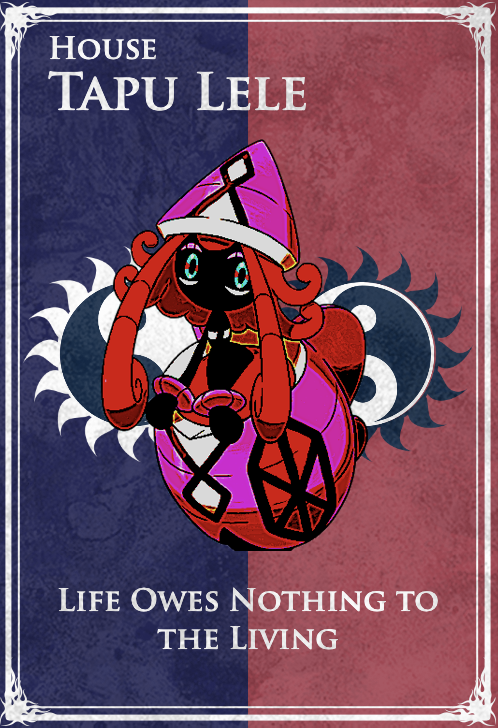
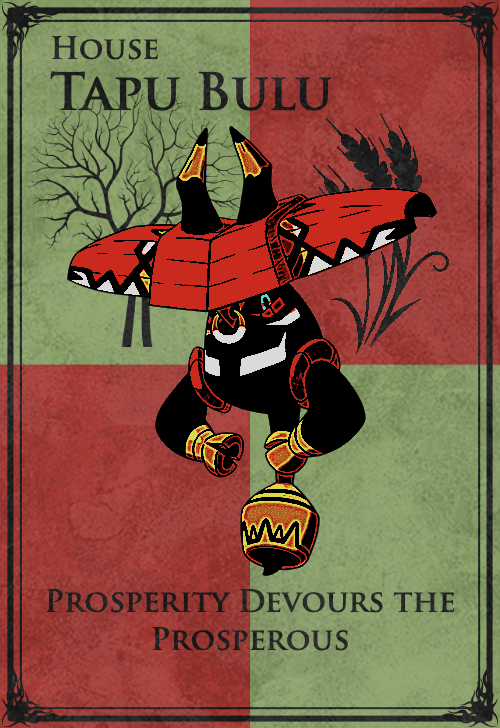
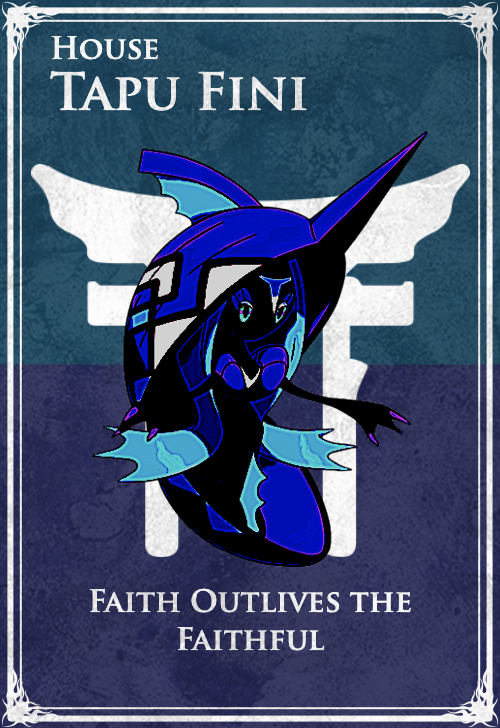
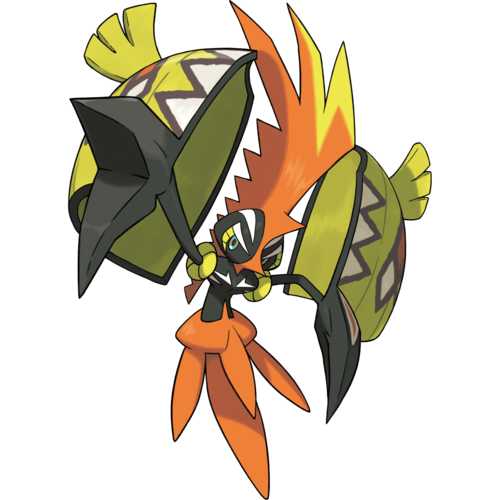
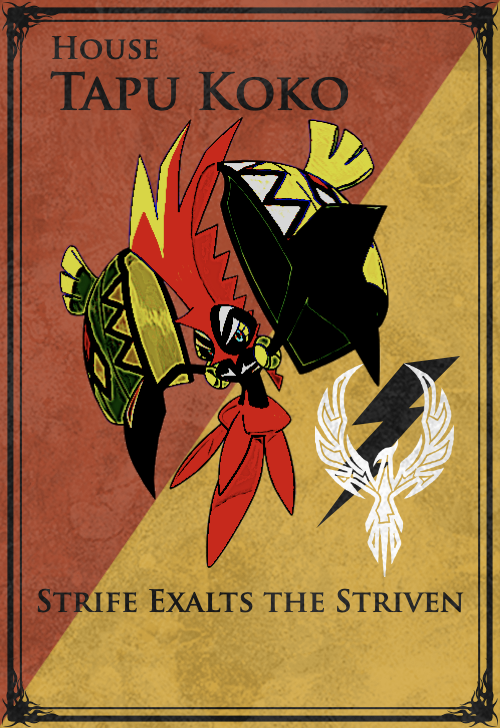
Tapu Koko, Tapu Lele, Tapu Bulu and Tapu Fini

So… I guess it’s time to learn about native Hawaiian mythology, huh?

Tapu Koko

We’re on the home stretch of seventh-generation Pokémon now, and today we’re talking about the four guardian deities of the Alolan islands: Tapu Koko, Tapu Lele, Tapu Bulu and Tapu Fini.  These four are deeply woven into Alolan culture and identity, and they have a special relationship with the Alolan trial system and its administrators, the four Island Kahunas.  They’re also the pièce de résistance of generation VII’s unprecedented level of interest in taking inspiration from the culture, ecology and history of the real-world region its setting is based on.

Continue reading “Tapu Koko, Tapu Lele, Tapu Bulu and Tapu Fini”

. asks:

What do you think of Toucannon’s anger, both from an aesthetic and character standpoint?

Well, I think it… looks angry?

I don’t know, it has this really surly, grumpy look to it, like it hasn’t slept in days and has just been asked to submit its budget report a week early, but I don’t think it’s actually described or portrayed as an unusually angry Pokémon.  The Pokédex even references the fact that it’s seen as a good Pokémon to have at an Alolan wedding ceremony because it mates harmoniously for life.  So, I actually think under its gruff exterior it might be a sweet perfect cinnamon roll.

Not Me asks:

Could the giant Torterra in Detective Pikachu be linked to dynamax somehow? Arguably, they did not have much of a purpose in the movie…

Proooooooobably not.  The movie was filmed in early 2018, and the script was written in 2016-2017, at which point Sword and Shield would have been in a very early stage of development (presumably Game Freak would still have had all hands on deck for the release of Ultra Smoon later that year).  I’m not sure even Game Freak would have known about Dynamaxing at that point – or at least, it could have been only one of several ideas they were tossing around for generation VIII’s flagship mechanic.  Even if they were already certain that Dynamaxing was going to be a core feature of the next game, Detective Pikachu was written by American screenwriters who would have had no more special insight into Game Freak’s plans for the next generation than the rest of us.  Some higher-up at the Pokémon Company could have told the screenwriters “hey, slip in a giant Pokémon somehow – no reason!” (you wouldn’t tell them why, because that’s an unnecessary risk of a leak), but honestly that seems to me like a weird process to go through.  I think it’s more likely to be a coincidence.

RandomAccess asks:

I recently thought of something, though you may want to save this for the inevitable review. Considering it’s propensity for “absorbing all the light in the universe” and basically being the ends of said universes, is it possible that Necrozma is Pokémon’s equivalent to the phenomenon astrophysicists call the “heat death of the universe?” That being entropy inevitable cooling down every single particle in the universe until there isn’t a bit of useable light or energy left and everything decays until there’s nothing left so that there’s basically nothing left except complete darkness?

I will indeed talk more about Necrozma when I get to the review, but I don’t know that this works with the way it’s portrayed in Ultra Smoon, or for that matter in the anime.  Necrozma used to be a being of light, a creative and generative force.  Its dark form that steals light is a result of some kind of damage it suffered in the past, but that damage is supposed to be fixable, resulting in the restoration of the radiant form we know as Ultra Necrozma (which sort of clashes with the feeling of inevitability that the whole “heat death”/entropy theme would be trying to evoke).