
…and what a Pokémon Day it is!
Continue reading “Happy #PokémonDay, peeps”how dare they do this to me
WHY WON’T THEY LEAVE ME ALONE
what gives them the right to just KEEP RELEASING POKÉMON GAMES on this PLANET THAT I LIVE ON, where I’ll SEE them and BUY them and PLAY them and then have to spend UNTOLD HUNDREDS OF HOURS WRITING LUDICROUS NONSENSE ABOUT THEM ON THE INTERNET just to hold onto the frail shards of sanity that make up my ravaged mind!?
WHEN WILL I HAVE MY LIFE BACK
And I have to be up at 6 am PST? That’s… what is that here? 9 am!? I’ve NEVER been up at 9 am! What the hell even HAPPENS!?
Someone fetch me a drink…
Mega Bidoof asks:
Do you think Game Freak will continue to add new evolutions to existing Pokemon now that mega evolutions exist?
I think the two are largely unconnected. Think about it: generation V had no new evolutions of existing Pokémon, before Mega Evolution was introduced, and generation VII featured neither. In fact, the only new evolution of the past three generations – Sylveon – actually coincided with the introduction of Mega Evolution. It’s true that both serve a similar thematic purpose; they both give a new generation of games a more concrete link to Pokémon’s past. I agree that new evolutions seem to be on the way out, but I think the “replacement” concept to fill that role, if any, is much more likely to be the continuation of regional variant Pokémon. Mega Evolution is generation VI’s mechanic and tied to the history of Kalos and Hoenn, just as Z-moves are generation VII’s mechanic and tied to the history of Alola, just as the Dream World was generation V’s and has not returned (though the hidden abilities it unlocked remain). The concept of regional variation, by contrast, doesn’t carry mechanical or worldbuilding baggage, and innately lends itself to being reused again and again through new forms that express the personality of each new region. Even that, though, is not certain; the designers may have liked regional variation as a feature of Alola specifically, expressing the unusual paths that evolution can take on archipelagos in the real world. To me it’s most plausible that generation VIII will feature no new evolutions of existing Pokémon, no new Mega Evolutions, and no new species-specific Z-moves (I’m 50/50 on new regional variations), instead spotlighting some other entirely new mechanic that will be tied to the history of the new region and the plot of the new games.
All of this is, of course, as likely as not to be proven completely wrong within the next couple of weeks (heck, maybe even days). I don’t do predictions; it makes me ill-tempered.
Adventures in baking the entire Athenian Acropolis
Regular readers of this blog may know that, although from New Zealand, I am currently living in the United States, where I am studying for a PhD in classical archaeology. Long-time regular readers may further be aware that I have something of a penchant for baking. And, of course, even the most cursory of readers will be perfectly cognisant of the fact that I am completely insane.
Once a year, these three facets of my life come into glorious conjunction.
Continue reading “Adventures in baking the entire Athenian Acropolis”Long time; second time asks:
So you’ve been at this a while…. What are you most proud of?
That’s a tough one…
To be honest, I don’t much like thinking back to things I’m proud of, because most of them are quite a long time in the past and it just makes me feel as though I peaked a while ago. By the time I finish reviewing all the generation VII Pokémon it will have taken me almost two years, and there’ll probably be precious little time left before I have to start doing something about generation VIII (which is coming; you know it’s coming; there’s always another bloody one coming). In some ways it’s sort of justified, because my Alola reviews are twice as long and much better researched than my Unova ones, and I wasn’t taking regular questions from readers when I did Unova, so of course it takes me longer, and there are quite a few more new Pokémon in Alola than in Kalos, so of course it’s longer than that generation too. The trouble is that Pokémon reviews feel very routine, very business-as-usual, and they’re a bit formulaic in format (especially the mechanics/competitive second half). They’re good, and frankly I am proud of how much better they are than the Unova ones, but they don’t make me feel like I’ve written something important and challenging, like when I used to write about the ethics of Pokémon training. I think the most important and significant thing I’ve written recently was a couple of months ago, when I wrote about why Pokémon may need – may have a moral obligation – to embrace a more pessimistic worldview than has always been its preference. I don’t feel proud of that, though, because I don’t feel like it accomplished anything – just set out something that needs to be accomplished, that perhaps I need to find some way to do myself.
Continue reading “Long time; second time asks:”Nihilego

The Alolan archipelago has at last surrendered all (or, well, most) of its secrets – so now the time has finally come for us to leave behind the world we know. The stars have aligned, the ritual is complete, the Dark Forces from Parts Unknown have imparted their mystic secrets, the Ultra Wormhole beckons, and the void opens before us, promising nothing at the price of everything. Yep – we’re figuring out the Ultra Beasts. There’s ten of these freaky bastards (not counting Lunala, Solgaleo and Necrozma), and they’re each getting their own entry. My aim over the course of those ten articles will be not just to review the Ultra Beasts individually, but also to, hopefully, figure out… well, something about them as a group. What are they? What exactly is Ultra Space? Why are they such a threat to Alola? Are they really a group at all, or just a random sample of the variety of life that exists in an infinite multiverse? All these questions, and more, will… honestly, let’s face it, probably not be answered here on Pokémaniacal, but we’ll bloody well give it a go – starting with probably the best-known Ultra Beast of all, Nihilego.
Continue reading “Nihilego”Pokémottos #793
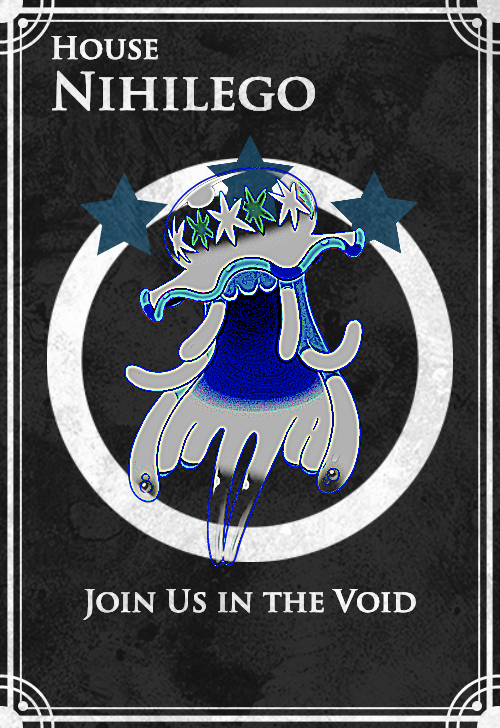
House Nihilego: Join Us in the Void
Mr. Slushy Dawg asks:
“Pickup is not useful. That is all.”
Along the same lines, what are other universally useless abilities?
Well, there’s not a lot that are literally useless – even Pickup occasionally does something if you’re fighting an opponent who uses berries – but there are a couple with no in-battle effect whatsoever. Honey Gather is used only to generate Honey, Illuminate only increases the wild Pokémon encounter rate, and Run Away only allows you to escape wild Pokémon without fail. An honourable mention should go here to Zygarde’s Aura Break, which improves his matchups against exactly two Pokémon – Xerneas and Yveltal – but otherwise does absolutely nothing.
Continue reading “Mr. Slushy Dawg asks:”Not Me asks:
The recent question about flying types got me thinking. What about fighting type? How does fighting type make any sense really? Isn’t fighting something that all Pokemon do anyway? And fighting types do not seem to be any better at it than other types…?
I have a long-standing claim that I make about Fighting-types, which is that they are not just Pokémon who fight – which, as you point out, is all of them – but Pokémon who take fighting particularly seriously, and more specifically, approach fighting with similar attitudes to humans, including a preoccupation with recognition and glory. Fighting Pokémon, even in the wild, spend their time training to become better at fighting. Many of them have codes of honour, which often extend to refusing to fight weaker opponents. They desire competition with powerful rivals, whether of their own species or of another. Aesthetically, almost all Fighting Pokémon (and most of their attacks) reference human warriors or martial artists, or more rarely athletes. They are, essentially, Pokémon who fight like humans, both in style and in ethos. I won’t go through all of them (or even claim to be able to), but for some illustrative examples, we have Pokémon based on specific martial arts (e.g. capoeira for Hitmontop, sumo for Hariyama, lucha libre for Hawlucha, karate for Sawk), Pokémon based on historical classes of human warriors (e.g. European knights for Gallade, French musketeers for Cobalion and co., Asian monks for Medicham), and Pokémon based on athletes (e.g. swimmers for Poliwrath, American footballers for Passimian). In the Pokédex, explicit comparisons to the skills of human fighters are common, as are references to the Pokémon’s dedication to training. Fighting-type attacks are regularly based on martial arts moves – Karate Chop, Submission, Reversal, Sky Uppercut, Force Palm, Circle Throw – while the only common special Fighting attack, Focus Blast, references the mastery of 気, ki (spiritual power or life force) supposedly attained by great martial artists (see also: Dragonball). Fighting for them is more than a necessity; it’s a way of life.
Dosidicus Giygas asks:
There’s an interesting parallel in Gen I between Eevee’s three original evolutions and the three Legendary Birds in terms of typing. Fire, ice, and lightning are common elemental distinctions in RPGs with magic/energy/psionics/whathaveyou, so it makes sense that Pokemon would draw from this tradition for inspiration, though it’s a little odd that there is a discrepancy between Vaporeon (Water Type) and Articuno (Ice Type). Any thoughts on why that is? Furthermore, why didn’t Game Freak apply this logic to the starters, who are halfway there anyway? For something more varied/interesting? For a better justification of type balance?
Type balance isn’t exactly right, because I don’t think it’s about fairness, or at least not entirely, but it’s something like that. Grass/Fire/Water has this nice rock/paper/scissors relationship that serves as an easy and intuitive introduction to one of Pokémon’s core mechanics, which is a pretty valuable thing for new players. It doesn’t really work if you try to shoehorn Electric in there, because thematically there just isn’t an obvious relationship between Electric and Fire. Other games that use Fire/Ice/Lightning don’t usually have “type advantages” in the same way as Pokémon does; several iterations of Final Fantasy, for example, have Fire and Ice being strong against each other, with Lightning doing its own thing (often being strong against mechanical enemies); Final Fantasy X adds Water as a fourth element to form another opposed pair with Lightning. Pokémon just has different needs to those games.
Continue reading “Dosidicus Giygas asks:” Pokémaniacal