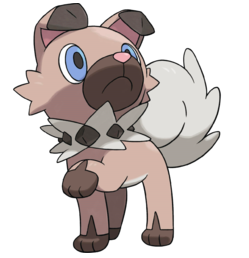
Rockruff and Lycanroc

Rockruff.
Rockruff

Today’s Pokémon is Professor Kukui’s loyal partner, Rockruff, and his evolved form – or rather forms, as we’ll see – Lycanroc, the latest additions to Pokémon’s growing stable (or, uh… kennel) of dog Pokémon.  Physically, Rockruff’s design is very straightforwardly based on a domestic dog, perhaps an Akita Inu (a large Japanese dog breed with a wolf-like countenance and a fluffy tail).  Physically we’re looking at something quite close to Growlithe, with a different colour scheme and obviously very distinct powers, but very similar in terms of personality and behaviour.  Rockruff’s most distinctive feature is a “collar” (or “ruff”?) of stones, which apparently has a social function – Rockruff greet each other by rubbing their stony collars on each other’s bodies.  This little ritual apparently extends to their human friends as well, which can cause significant discomfort.  Nonetheless, Rockruff is one of the Pokémon most favoured for beginners in the Alola region because they have a friendly and loyal disposition that makes them easy to train and command, and are also extremely tenacious in battle.  In other words, they’re almost exactly like real dogs – energetic, devoted and affectionate to the point of being overbearing.  A bit generic, slotting in alongside Growlithe and Lillipup almost unnoticed, but that’s sort of to be expected for the basic stage of an early-game Pokémon, and the Rock element is incorporated in a neat way with the “collar.”  The meat of what this design is supposed to be doing comes with the evolved form: Lycanroc. Continue reading “Rockruff and Lycanroc”

VikingBoyBilly asks:

The fact that every pokémon, with few exceptions, can learn Toxic, Double Team, Protect, and Substitute leads me to the (fallacious) conclusion that all pokémon are ninjas. In a setting where their entire purpose is battling, well, I guess they are by a loose definition. If Joe & Mac are caveman ninjas, why not pokémon?

I don’t know who Joe and Mac are and I suspect I don’t give a $#!t

But, well, we explicitly know that Toxic is a ninja technique from Koga, and Double Team and Substitute (and Protect? Don’t know about that one) seem to be based on legendary ninja techniques.  Perhaps more importantly, that makes them human techniques, which means Pokémon can do them regardless of which bull$#!t magical powers they happen to have, or even without necessarily having any bull$#!t magical powers at all.

Anonymous asks:

I don’t know how true this is, or if you’ve heard of it before already, but the supposed reason why so many Alola Pokemon are slow was because Gamefreak wanted to focus on diversifying the Doubles competitive environment what with Trick Room being a huge thing.

Don’t know how we would determine how true it is without actually asking Game Freak about it, but that thought had occurred to me, and it makes sense.  A lot of Pokémon in Sun and Moon (and for that matter X and Y) also have moves or abilities that seem most useful, or only useful, in multiple battles.  Me, I’m one of those cranky old bastard trainers who still insists on seeing doubles as something of a sideshow, but I agree they seem to be doing their best to push it.

Check out this thing; I command it

My BFF, Jim the Editor, who proofreads everything on this blog and helps me think over most of the questions I receive, has a new podcast, starting in a few days.  He calls it Nearly Experts, and it is a series of interviews with PhD students from around the world and in different fields about their research, their lives, and academia (I do not feature in season 1, because Jim and his recording studio are at the University of St. Andrews in Scotland, whereas I normally live in Ohio and am currently spending a year in Greece, but the stars may yet align for me to make an appearance in season 2).  If that sounds like the sort of thing you might be interested in, check out the introductory episode below!

https://soundcloud.com/nearlyexperts

https://www.facebook.com/NearlyExperts/

RandomAccess asks:

Do you think it’d be fun if, for some reason, they remade the gen 1 and 2 games again and they made regional variants for some of the new Pokémon? Or even a regional variant for some new Pokémon that got retyped to fairy as their original typing? Maybe a fairy/normal Clefairy that even has the original light pink color scheme way different from the much more vivid pink clefairy we have today.

I’m not sure what you mean by the “original light pink colour scheme” – Clefairy in generations VI and VII is a noticeably paler shade of pink than in II through IV (especially II, where the sprites would, I think, be best described as “shocking pink”).  But as a general principle, I guess sure?  I’m decidedly unconvinced by the idea of re-remaking generations I and II, but if you were going to do it, details like that would give the exercise some point.

Adamfrolick asks:

Really love your blog! I was wondering if you could clear something up between the relationship of a pokemons type and there relation to a pokemons physicality or physiology. Like, rock types are weak to fighting cause they are made of rocks and with enough strength, someone could shatter one. But in the case of, lets say, a ground type, it isn’t necessarily made of ground? Like, Hippowdon is just a sandy hippo, so why would it be weak to grass?

Ground is… tricky… I tend to sort of recuse myself from attempting to explain anything to do with the Ground type because I don’t think it actually makes sense and I’m not sure there’s a good reason for it to exist.  You could probably explain those particular relationships by positing that they have sort of porous exoskeletal plates which can become waterlogged very easily, and from which Grass Pokémon can also drain water effectively (that being notionally the same reason Grass is strong against Water).  Honestly, though, I’m not totally convinced there is a consistent relationship between type and physiology.  We know that the same type can encompass Pokémon with radically different biology, and we know that Pokémon within a type do not necessarily share a common ancestor.  I kinda lean towards thinking that “type” is just something humans came up with to describe how Pokémon behave in battles and create a heuristic for which of two Pokémon is likely to be favoured in any given match-up, not a real biological phenomenon.

Anonymous asks:

How do you feel about natures? There are 25 of them in total, but for almost every Pokemon, only 2-4 of them are viable. Even then, many Pokemon strongly prefer 1 of those few, and having anything else might actually be hindering said Pokemon? Espeon, for example, would really appreciate Timid, is also cool with Modest, and doesn’t hate Calm or Bold even if Espeon doesn’t get much out of them. Any other Nature either doesn’t grant any benefits at all, or actually hurts Espeon.

I feel like natures work the way they do at least partly as a result of their interaction with generation III’s contest mechanics, which failed to survive in most of the later games, and in that respect they’re sort of emblematic of the way Pokémon is now composed of a whole bunch of legacy systems that no one is quite willing to get rid of.  I don’t think you would design natures the same way if you were creating that system from scratch in generation VII without reference to things like the five contest stats, or berry flavours.  Some discussion of what you could do here, here and here.