One lunatic's love-hate relationship with the Pokémon franchise, and his addled musings on its rights, wrongs, ins and outs. Come one, come all, and indulge my delusions of grandeur as I inflict my opinions on anyone within shouting distance.
Once more I am faced with my immortal enemy, the creeping darkness at the heart of Pokémon that threatens to bring down all that we hold dear…
…the Pikachu clones.
I don’t even think I’m allowed to just reflexively dislike these fµ¢&ing things anymore because of that damn Pachirisu that won a world championship; no, I’m actually supposed to have reasons now, whatever that means. Well… here goes nothing. Continue reading “Togedemaru”→
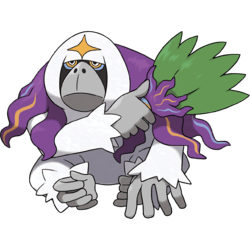
Making strange arguments and dubious assertions about Pokémon lore is an important branch of my schtick. Normally this comes up in questions addressed to this blog, or in whatever mad articles I decide to write in between generational Pokémon reviews, or occasionally in my musings on playthroughs of new games. It’s relatively unusual for a routine Pokémon review to provoke me to a really energetic bit of wild speculation. Luckily(?), however, today we have just the Pokémon to set me off: Oranguru. Continue reading “Oranguru”→
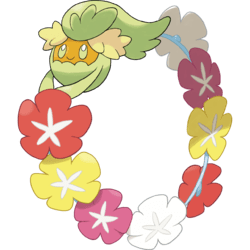
One of the most recognisable symbols of Hawaiian culture is the lei – a garland of flowers, worn around the neck on special occasions. If you’ve ever been to Hawai‘i, you might have been presented with one of these at some point; tourists love receiving lei, and Hawai‘i loves tourists. You can also see them in the stereotypical image of a traditional Hawaiian hula dancer. Lei are so well known as a distinctive element of Hawaiian ceremony and celebration that, really, it would be almost impossible for our Hawai‘i-inspired Pokémon region not to have a Pokémon that referenced them somehow. Enter: Comfey, the Posy Picker Pokémon. Continue reading “Comfey”→
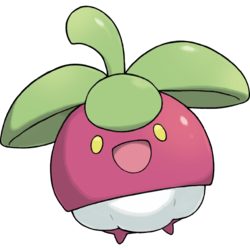
There are a lot of Grass Pokémon out there – it’s currently the fourth most common type in Pokémon, with almost one hundred representatives. It’s slightly curious, then, that there are so few Pokémon based on fruit. Tropius sort of counts, with fruit dangling off his neck, and Cherubi shifts into cherry blossom upon evolving, which has its own cultural significance in Japan, so arguably the only Pokémon wholeheartedly based on fruit are Ferroseed and Ferrothorn – assuming you do in fact classify the durian as a fruit and not as a sort of spiteful biological land mine. It’s possible that fruit Pokémon make Game Freak nervous since they draw attention to the old “do we eat Pokémon?” dilemma, but that doesn’t seem to stop them from cranking out mushrooms, or harvesting cast-off Crabrawler claws – or, for that matter, creating Swirlix and Vanillite. In any case, it’s time to break out your recipe books, because our next potentially edible Pokémon is here: Bounsweet, and her evolved forms Steenee and Tsareena. Continue reading “Bounsweet, Steenee and Tsareena”→
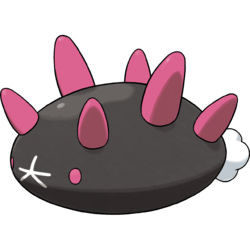
Today’s Pokémon is the weird spiky loofah that lives behind Kahuna Hala’s toilet-
wait
Today’s bathing accoutrement is the weird spiky Pokémon that-
okay, let me start again
Today’s Pokémon is the weird spiky sex toy that lives behind-
no, that’s even worse
Look, we’re talking about Pyukumuku, okay
Pyukumuku
On account of its willingness to sit placidly between its trainer and certain death, Pyukumuku… is just barely a Pokémon, despite clearly being more closely related to the exfoliating bath sponge. It is, everyone is pretty much agreed, based on a sea cucumber. Sea cucumbers are soft-bodied echinoderms, distantly related to starfish and sea urchins. They’re essentially long, squishy tubes, with a mouth at one end and a multi-purpose respiratory/reproductive/excretory hole at the other. This is a body setup that makes for a pretty passive lifestyle. Continue reading “Pyukumuku”→
As their species designation – the Bee Fly Pokémon – attests, Cutiefly and Ribombee are based (in Ribombee’s case, somewhat loosely and with the addition of fairy-like traits) on bee flies. Bee flies, as their remarkably inventive name suggests, are a family of insects within the fly order, Diptera, that pollinate flowers and look like bees, though they are usually smaller. They are related to predatory robber flies, and despite their fuzzy appearance, most bee flies are parasites that will lay their eggs on the larvae of other insects, typically beetles or solitary bees, resulting in the slow and gruesome death of the larvae. There are over 5000 species of bee fly around the world (because clearly the world needed that many), but the particular one referenced by Cutiefly is the adorable internet celebrity Anastoechus nitidulus, a rare species that lives only in southwest Japan, in the area around the city of Okayama. As far as I can tell, this species is so rare, and bee flies in general are so poorly studied by entomologists, that it doesn’t even have an English name – I’ve seen them called “tiger bee flies,” which I think is an attempt to translate the Japanese name toratsuri-abu, but in English the name “tiger bee fly” ought to refer to a different species of bee fly, the larger, blacker and more sinister-looking Xenox tigrinus, which can be found throughout North America. Thankfully, Cutiefly already represents a fully adult bee fly, so we don’t have to observe first hand the family’s parasitic tendencies; instead we see only the adults’ more palatable diet of nectar, which they harvest with their mosquito-like proboscises. Cutiefly and Ribombee express this through their flavour text, through the Honey Gather ability they share with Combee, and through their in-game distribution in the areas in and around Alola’s Oricorio meadows.
Why are you doing the reviews out-of-order? You should have done crabominable by now.
I’ve never done my Pokémon reviews in order. Actually, even doing the starters all together at the beginning is kind of a major departure from my practice of generations V and VI.
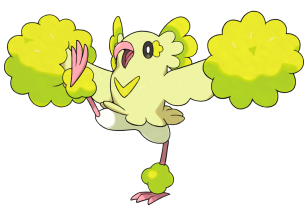
I do not have a good record with anything capable of earning the title of “gimmick” Pokémon – Pokémon whose schtick is some unique move, ability or game mechanic that was so clever Game Freak felt they could stop there, and didn’t need to have the Pokémon be any good or the design make any sense. Today we decide whether Oricorio, the dancing honeycreeper Pokémon, fits that description. Four interchangeable and mostly cosmetic forms, a weird signature move, a weirder ability… the phrase “walks like a duck, quacks like a duck” comes to mind, but let’s take a closer look. Continue reading “Oricorio”→
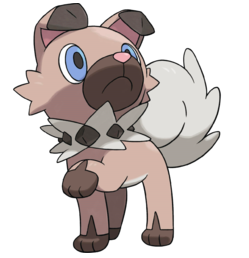
Today’s Pokémon is Professor Kukui’s loyal partner, Rockruff, and his evolved form – or rather forms, as we’ll see – Lycanroc, the latest additions to Pokémon’s growing stable (or, uh… kennel) of dog Pokémon. Physically, Rockruff’s design is very straightforwardly based on a domestic dog, perhaps an Akita Inu (a large Japanese dog breed with a wolf-like countenance and a fluffy tail). Physically we’re looking at something quite close to Growlithe, with a different colour scheme and obviously very distinct powers, but very similar in terms of personality and behaviour. Rockruff’s most distinctive feature is a “collar” (or “ruff”?) of stones, which apparently has a social function – Rockruff greet each other by rubbing their stony collars on each other’s bodies. This little ritual apparently extends to their human friends as well, which can cause significant discomfort. Nonetheless, Rockruff is one of the Pokémon most favoured for beginners in the Alola region because they have a friendly and loyal disposition that makes them easy to train and command, and are also extremely tenacious in battle. In other words, they’re almost exactly like real dogs – energetic, devoted and affectionate to the point of being overbearing. A bit generic, slotting in alongside Growlithe and Lillipup almost unnoticed, but that’s sort of to be expected for the basic stage of an early-game Pokémon, and the Rock element is incorporated in a neat way with the “collar.” The meat of what this design is supposed to be doing comes with the evolved form: Lycanroc. Continue reading “Rockruff and Lycanroc”→
Today’s Pokémon are probably the strangest thing Alola has thrown at me so far, and definitely spice up the early game a bit – electrical Bug-types with battery-like abilities, which (thank all the gods) conspicuously do not become butterflies or moths. We’ve had beetle Pokémon before – Heracross – and even stag beetle Pokémon – Pinsir – but Grubbin, Charjabug and Vikavolt have little in common with either, as we’ll see.
Grubbin
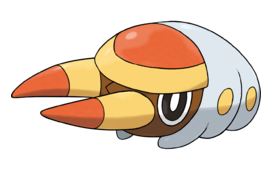
Grubbin is… well, a grub – a soft-bodied beetle larva. As far as I can tell, it’s not based on any one species in particular; beetle larvae mostly look pretty similar to non-specialist eyes (unlike caterpillars, which are often brightly coloured or have bristles, or eye patterns that make them resemble dangerous snakes). Grubbin instead achieves a distinctive look by exaggerating the mandibles of a beetle grub into two brightly coloured, striped horns as long as the whole rest of its body – in fact it kinda winds up looking like a stag beetle or Hercules beetle pupa. Continue reading “Grubbin, Charjabug and Vikavolt”→



 Pokémaniacal