Anime Time: Episodes 27-28

Hypno’s Naptime – Pokémon Fashion Flash

 (Apologies for the delay on this entry – internet connection conked out last night and I wasn’t able to post it.  Of course, that hasn’t stopped me from writing, so my next entry will be up on schedule.)

There’s little to connect these two episodes other than the fact that Misty and Brock each happen to gain new Pokémon, so for the most part I’ll be dealing with them separately.  That’ll take time, so without further ado…
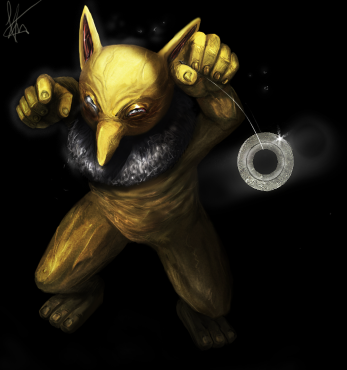
 Yikes, Hypno is creepy.  For this picture, thanks are due to =Snook-8 at http://snook-8.deviantart.com/.

In a place inexplicably known as “Hop Hop Hop Town,” Ash is suddenly accosted by an enormous pair of breasts calling him Arnold.  Once Ash explains that he is not Arnold, the woman attached to the breasts calms down and tells his group that her son has disappeared recently.  Ash wonders whether Arnold might have just wandered off to become a Pokémon trainer, which is apparently not an unreasonable thing for a young boy to do on a whim without telling anyone, but the mother has her doubts.   In fact, as they soon learn from Officer Jenny #309, Arnold is only the most recent of several young children to go missing over the last three days.  Ash, in his official capacity as a random wandering trainer, offers to help Jenny solve the case.  They check the Pokémon Centre for kids who know the missing children, but none of them have any information.  Nurse Joy #558 doesn’t know anything either, and has her hands full with her own crisis; all the Pokémon in her care are becoming lethargic, and she can’t understand why.  It all started – gasp! – three days ago.  Jenny suddenly remembers that she possesses a piece of technobabble known as a Sleep Wave detector, and that it’s been acting up recently.  She hasn’t been following up on it because, honestly, she’s just a terrible officer, but now she decides to follow the Sleep Waves to their source:  a mansion on top of a skyscraper.  Because, y’know, what better place to build a mansion.  Ash storms the mansion, and finds that it houses a society of well-to-do aristocrats, who term themselves the Pokémon Lovers’ Club, as well as a Drowzee and a Hypno, their favourite Pokémon.  Apparently, the members have been using Hypno’s powers to combat their crippling insomnia ever since their old Drowzee evolved… three days ago.  Brock suggests that their mysteries might be connected to Hypno modifying his Hypnosis for use on humans… so they do the sane thing and sit Misty down in front of him to see what happens!  Misty promptly becomes convinced she is a Seel and flees the building, leading the team to a park where they find the missing children, who all think they’re different kinds of Pokémon.  Brock has the idea of dragging Misty back up to the mansion to have Drowzee zap her, on the theory that Drowzee’s “Dream Waves” will cancel out Hypno’s “Sleep Waves” because… whatever.  Despite a characteristically incompetent intervention from Team Rocket, Drowzee cures Misty and puts the other kids to sleep.  When they wake up, they all remember who they are and rush back to their homes.  Nurse Joy’s Pokémon, likewise, all recover after a short nap… except for a single Psyduck, who remains totally dazed.  Psyduck doesn’t seem to have a trainer and no-one really wants him, but he manages to capture himself in a Pokéball Misty drops by accident, so she’s stuck with him.


This is one of many episodes that I think would make a good one-off side quest to stick in a game; it’s fairly simple, there’s a clear motive for most reasonable people to help, and most importantly you learn something about a particular species of Pokémon in the process.  Given the chance, I’d probably stuff the games with diversions a lot like this.  What we learn from Hypno’s Naptime specifically is that Psychic Pokémon are really friggin’ dangerous if you don’t know what you’re doing with them.  Granted, I can’t make head or tail of why Hypno’s powers affected either the kids or the Pokémon in just the way they did, and I’m pretty sure the writers didn’t know either, but it’s clear that exposure to his abilities can cause chronic psychological damage at tremendous range even when he’s aiming at someone else.  Even though the aristocrats seemed healthy, it’s possible they too would have begun to suffer some other totally unpredictable mental disorder if they had kept using Hypno to treat their insomnia.  I’m inclined to suggest that this is at least partly due to the absence of a proper Pokémon trainer or Psychic-type specialist to help Hypno learn to control his newly enhanced powers, and that practice will keep his Hypnosis from causing negative effects on the townspeople.  However, if this were the real world, I’d want to keep all Hypno away from major population centres if at all possible until I had the results a couple of independent studies on the effects of long-term exposure.  In the Pokémon world, of course, no-one does studies like this because, hey, if a Pokémon drives your kid insane, why not just throw other Pokémon at him until you find one that fixes him?  Although Hypno is clearly a risk, no-one even considers trying to get rid of him.  Legislating to restrict the freedom of people to own and use Pokémon is probably unthinkable in this world; Pokémon are just too great a part of their industry and culture.

 All0412 (http://all0412.deviantart.com/) turns on the charm with his adorable Vulpix art.

The gang’s next misadventure is all about fashion, and the things people will do to stand out.  Brock has dragged his companions to Scissor Street, a district famous for both breeders and fashion, so he can meet one of his idols: a young woman named Susie who runs a Pokémon grooming and healthcare shop.  She and her Vulpix, according to Brock, are world-famous in breeder circles.  Brock is here to tell Susie that, in his words, “I wanna breed like you!” (I mean, breed with you!  I mean, wanna come back to my place and check out my rocks?)  Brock wants to become Susie’s apprentice.  She’s not interested, but invites them all out to lunch anyway, where she forlornly tells them that she’s been losing a lot of business to a big new salon.  Salon Rocket (pronounced “Ro-KAY”) makes its money selling gaudy Pokémon makeup, clothing and accessories, and is making Susie wonder whether she’s right to spend all her time focussing on a Pokémon’s ‘inner beauty’.  Ash affirms that yes, of course she’s right, but Misty muses that looking pretty on the outside can be nice too.  Even though she’s not actually saying he’s wrong, they have a massive argument and Misty eventually stalks off to Salon Rocket to check out the latest trends.  Meanwhile, Brock and Ash plan to draw customers back to Susie’s shop with seminars on Pokémon healthcare, and the line outside Salon Rocket dwindles as people wander over to Susie’s lecture on Pokémon massage technique.  She eventually calls on Ash to demonstrate what he’s learned by massaging Pikachu’s electrical cheek pouches.  Ash performs perfectly, Pikachu seems to enjoy the attention (I like to think this becomes part of their daily routine), and several members of the audience sheepishly remove the tasteless decorations from their Pokémon as they listen to Susie and Brock discuss Pokémon nutrition and grooming.  Meanwhile, Misty is having the time of her life at Salon Rocket.  Jessie and James (who else?), presented with only one customer to spend their time on, are enthusiastically covering her with face paint, glitter, bracelets, bangles and every other item of tween fashion they can lay their hands on.  Tragically, Meowth grows impatient, blows their cover and has Jessie and James take Misty hostage.  Meowth explains their dastardly plan to make obscene profits peddling trashy fashion items, then steal any rare Pokémon a trainer brought in, which… would have worked exactly once, I expect, so I hope they were waiting for a good one.  Psyduck escapes and dashes off for reinforcements.  Ekans and Koffing apparently get some kind of defensive edge against Pikachu and Geodude from all the frills and other nonsense they’re wearing, but also trip over themselves a lot.  Eventually Susie gets annoyed and commands Vulpix to burn them to ashes with her Fire Spin.  Later, Susie reveals that she’s going to close down her shop to go on a journey and learn more about breeding… and has decided to give Brock Vulpix, since he’s the only other person who’s ever managed to gain Vulpix’s trust or appease her discerning palette.

 Misty: paragon of style.  Screenshot from www.filb.de/anime.

This seems like a good time to talk about how the series portrays Brock and Misty, because their reactions are actually important to the plot in this episode.  Pokémon Fashion Flash really does its best to show off Misty’s superficial side, which raises its head from time to time throughout the series: she gets along with Jessie and James astonishingly well up until Meowth has them break cover.  Her new look is played for laughs when Ash and Brock arrive, but Misty sincerely thinks it’s great, and so do Jessie and James.  In general, Misty likes Pokémon that are “cute” and distastefully rejects ones that aren’t, like poor Caterpie – with the corollary that she thinks all Water Pokémon are cute – and regularly has lines suggesting that she doesn’t really ‘get’ a lot of the things that are important to Ash.  She’s the least idealistic of the group, tends to adopt a ‘whatever works’ approach to the rules, and doesn’t regard her Pokémon as close friends or understand how much Ash cares for his.  Although generally practical, she’s as stubborn as Ash and can be irrational where Water Pokémon are concerned (see Tentacool and Tentacruel, where she’s worried about protecting the Tentacool who are destroying the city).  None of this makes her a bad person, though – just flawed, like anyone.  Her heart is very much in the right place, and if nothing else she’s loyal, which this series values highly.  Brock, likewise, has his issues.  If a pretty girl – Susie, for instance – needs help, he will happily drag the whole group out of their way to take care of things, which gets him into a lot of trouble in the Ghost of Maiden’s Peak.  His desperation to get a date notwithstanding, Brock is generally patient and level-headed.  Although he has powerful Pokémon, he rarely fights except in episodes that are particularly important for him personally; he’s not a serious trainer and just wants to become a good breeder.  He prepares meals for Ash and Misty’s Pokémon as well as his own, and presumably keeps an eye on their general conditioning as well – based on this episode, advising people on how to take better care of their Pokémon seems to be a breeder’s primary role in society.  Brock’s strong sense of responsibility probably plays into this; he’s passionate about teaching people how to raise Pokémon well and bothered by the idea that a renowned breeder like Susie could be forced out of business by people who don’t really know what they’re talking about.  Although a lot of what Brock and Susie say about raising Pokémon in this episode, like the importance of healthcare and nutrition, seems like common sense, it pays to remember that most people who own Pokémon aren’t actually dedicated trainers and would probably never put much thought into it of their own accord, which makes Pokémon breeders tremendously important players in the relationship between humans and Pokémon.

You will have noticed by now that I’ve skipped over episode 26 – Ash’s battle with Erika in Celadon City.  I want to do that episode together with episode 32, the Fuchsia Gym episode, so those will both be coming up soon.  Before that, though, we have two environmentalist episodes to get through: Sparks Fly for Magnemite and Dig Those Diglett.  See you next time!

Anime Time: Episodes 25 and 29

Primeape Goes Bananas – The Punchy Pokémon

Ash has been messing around with only five Pokémon for three episodes now, and it’s time for him to get a new one to refill his party (what, use Krabby?  Don’t be ridiculous!).  Unfortunately, the Pokémon he winds up catching to fill his sixth slot… presents certain methodological issues for Ash’s training style; put it that way.

(…he’s insane!)

Primeape. Artwork by Ken Sugimori; six rings for the dwarf lords in their halls of stone, one ring for Nintendo on their dark throne, etc.

So, on the way out of Saffron City, Ash stops at a payphone to check in with Professor Oak and show off his Marsh Badge.  Oak gives him a kindly old man smile and a “well done,” but explains that Gary already has five badges, a few dozen Pokémon, and a Krabby about five times as big as Ash’s.  Ash isn’t really that far behind in terms of badges, but clearly his efforts at capturing new Pokémon aren’t even on the same scale as Gary’s, and the Professor is noticeably disappointed.  I’ve argued this before, but it bears repeating: I believe Gary’s training style (catching and regularly using dozens of Pokémon) represents what’s normal and expected, at least for a full-time trainer, while Ash is something of an oddball.  Misty and Brock are broadly supportive of Ash’s more idiosyncratic style, but hearing about how many Pokémon Gary has caught gets Ash in the mood to capture something – and, wonder of wonders, a wild Mankey chooses this moment to appear before the group.  Mankey seems like a far less volatile Pokémon than the games make him out to be, more mischievous than irritable, and Brock shares a rice ball (which the English translation charmingly refers to as a “donut”) with him.  Of course, while Mankey is eating, Ash – because he is Ash – decides to lob a Pokéball at him.  Mankey blocks the Pokéball with the rice ball and furiously prepares for battle.  I can’t help but think he’s insulted – not only did Ash attack Mankey while he was eating, he apparently didn’t think battling Mankey was worth the effort and figured a Pokéball right off the bat would be all he needed.  Mankey’s subsequent behaviour reinforces my belief; he isn’t happy with just beating Ash up, but also steals his hat and imitates him in a mocking dance.  This doesn’t ring of self-defence to me; this is a deliberate response to a personal insult.  Now, I’ll repeat part of that in case you missed it: Mankey steals Ash’s hat.

He steals Ash’s hat.

Ash won his hat in a competition by sending in an ungodly number of postcards.  It is a piece of exclusive Pokémon League merchandise, emblazoned with their official insignia and probably worth more than all of Ash’s other worldly goods put together, and gives him limitless street cred (or so he would have us believe).  He can deal with not catching Mankey but he will not abandon his hat.  Damn right, too.  Behind each and every one of history’s great men and women is a nice hat.  Unfortunately Mankey is simply far too acrobatic for Ash to catch him, and he doesn’t try to use any of his Pokémon to help (Mankey stole his hat; this is a matter of honour).  At this point Jessie and James show up for their daily attempt to steal Pikachu, and Jessie gives Mankey a good solid kick when he gets in the way.  This… turns out to be a mistake.  See, as we’ve seen already, although Pokémon in the anime do need to gain battle experience to evolve, the actual moment of evolution is often triggered by strong emotion.  Mankey hasn’t actually defeated a single Pokémon yet, so he hasn’t ‘gained experience’ in this episode… but being kicked aside by Jessie makes him furious enough to push him over the edge and evolve him into Primeape.  The situation quickly deteriorates and soon everyone’s mind is focused on that timeless adage, “I don’t have to outrun the Primeape; I just have to outrun you!”  Eventually Ash decides that, damnit, he’s a Pokémon trainer, and trainers don’t run from Pokémon – they battle their asses and catch them!  Primeape is remarkably unconcerned by Bulbasaur and Squirtle’s attacks, but Charmander’s Rage allows him to grow stronger and stronger as Primeape pummels him, and he eventually strikes back with a devastating Flamethrower (with Ash’s hat still sitting on Primeape’s head – luckily, Pikachu dives in to rescue it at the last minute).  Now that Primeape is weakened, Ash manages to catch him in a Pokéball… but soon learns that controlling him is something of a tricky proposition.

Mankey and Primeape, by Ninjendo (http://ninjendo.deviantart.com/ – not to be confused with Nintendo). Because she is a good person, Jen has drawn Mankey with Ash’s hat, in memory of this episode.

Ash thinks about using Primeape a couple of times during the next few episodes.  However, he never actually pulls him out because it’s not worth the risk and, frankly, Primeape Goes Bananas has left some pretty heavy mental scars on the poor kid.  A few days after leaving Celadon City, however, Ash and company run into what they assume is a wild Hitmonchan jogging down the road, occasionally stopping to practice a flurry of jabs.  Ash wants to catch the Hitmonchan – and fair enough, too – but instead of just having Pikachu fill his face with lightning like he usually does, he decides to have Pikachu engage Hitmonchan in a boxing match.  This goes about as well as you might expect.  I could tie this in with one of my pet theories by saying that Hitmonchan would never acknowledge Ash as a worthy trainer and submit to capture unless he was beaten at his own game, since there are no other skills he respects, but at some point my ideas get too far-fetched even for me, so this time I’m just going to go with the good old standby, “Ash is a moron.”  During the battle, a man named Anthony – who turns out to be Hitmonchan’s trainer – arrives to berate him for letting his guard down and finishes up the battle.  His daughter, a young woman named Rebecca, appears soon after to beg Anthony to come home, but he ignores her and returns to his ‘gym’ (the “Fighting Spirit Gym”, which is more like a real-world gym – and a pretty dingy one at that – than a Pokémon training facility).  Rebecca explains that Anthony is obsessed with winning an upcoming tournament for Fighting Pokémon, the P-1 Grand Prix, and has basically ditched his family so he can train with Hitmonchan (y’know… kinda like how Ash leaves his mother all alone for months at a time).  Because he hopes someday to go on a date with her, Brock declares that their group will help Rebecca.  His hare-brained scheme is for him and Ash to enter the tournament themselves and defeat Hitmonchan… using his Geodude (a Pokémon weak to Fighting-type attacks) and Ash’s notoriously insane Primeape.  I’m honestly not sure how they imagine this would help, assuming it even worked, but hey, at least they’ll be doing something.

Meanwhile, Jessie and James also want to get in on the tournament so they can win the fabulously expensive championship belt, so they beat up another contestant, leave him trussed up and gagged in the men’s room, and steal his Hitmonlee.  The tournament begins, and Ash’s Primeape is matched up against a Machop, who beats him up for a while and then lobs him straight out of the ring with Seismic Toss.  Ash runs to break Primeape’s fall, and thus manages to earn his trust; Primeape then leaps back into the fray and becomes pretty much unbeatable for the remainder of the tournament.  Jessie’s Hitmonlee wallops Brock’s Geodude in the first round, predictably enough, and goes on to win all of his matches as well, as does Hitmonchan.  When Hitmonchan and Hitmonlee fight in the semi-final, Meowth slips under the floor of the ring and uses some glue to slow Hitmonchan’s steps and give Hitmonlee the edge.  Then… Rebecca inexplicably leaps in front of Hitmonchan to block a Mega Kick, and Anthony has to leap in front of her to keep Hitmonlee from pulverising every bone in her body.  I think this is supposed to be the moment when he learns his lesson and becomes a good family man again.  I don’t know; the whole moral of this one is pretty screwy.  Anthony surrenders, and Jessie faces Ash in the finals.  Meowth tries to cheat again, this time by electrifying the floor at a prearranged moment when Hitmonlee leaps into the air, but Pikachu spots him mucking around beneath the ring and sabotages his plan, levelling the playing field.  Primeape does his thing and beats Hitmonlee to a pulp, winning the P-1 Grand Prix and the bejewelled championship belt.

Hitmonchan. Artwork by Ken Sugimori.

Then… then Anthony compliments Ash on his Primeape’s awesomeness and suggests “hey, why don’t you let me train it for a while?  I’ll turn it into a true P-1 Champion!”

Quite aside from the fact that Primeape already is a P-1 Champion… he and Ash have finally started making some progress towards a healthy relationship, the whole point of the exercise was to get Anthony to cut down on training to spend time with his family, and Primeape would, without a doubt, be Ash’s strongest Pokémon by a significant margin once they trusted each other enough for Ash’s superior tactical expertise to be a factor (yes, I just credited Ash Ketchum with “superior tactical expertise” but I’m comparing him to an insane man-ape-pig).  The truly boneheaded thing about all this is that Ash says yes.  Before I saw this episode again, I had planned to tie this back to the argument I made when I looked at Bye Bye, Butterfree, and point to this as a natural and healthy example of a trainer and Pokémon parting ways once they’ve each learned something from one another to allow the Pokémon to get on with its own life, but when I watched it I realised that, actually, no, this conclusion pretty much undoes everything positive Ash and his friends have just achieved.  We can’t even really say anymore that getting rid of the insane Primeape is a plus because Primeape actually likes Ash by the end of the episode, enough that his eyes water when he waves goodbye.  So instead I’m going to take this episode as showing the effects of addiction to Pokémon training on a person’s family.  Honestly, Rebecca is getting off fairly lightly compared to Brock and his siblings, Ash’s mother, and Sabrina’s parents (oh, Sabrina’s parents…) but it’s clear that her family is suffering from all the hours Anthony spends with his Hitmonchan rather than looking after them.  Now that the tournament is over, he’s happy to make promises to be a better father in the future, but what will happen when the next big event is coming up?  Especially now that he’s managed to sweet-talk Ash into feeding his addiction by handing over a proven Fighting Pokémon champion?

This ending just annoys me.  I hope you’re happy, Ash.

Anime Time: Episodes 22-24

Abra and the Psychic Showdown – The Tower of Terror – Haunter vs. Kadabra

It’s time for the Saffron Gym episodes already?  Ash does the Gyms in kind of a weird order, since he doesn’t take roundabout routes through underground paths the way we do in the games to avoid pointlessly obstructive gate guards.  As a result, Sabrina, normally the sixth challenge for players of the games, is Ash’s fourth.  As expected, he gets curb-stomped.

Let’s laugh at him!

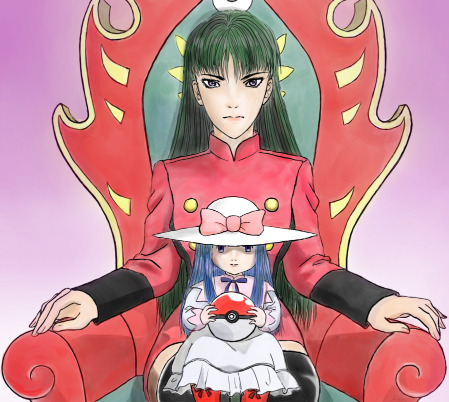
 Sabrina's two selves, portrayed by Stephen Yang (http://stephenayang.deviantart.com/) - her mature, blankly psychotic self and her childlike, playful and incredibly disturbing self.

The thing about the Saffron Gym is that its leader is a certifiable loon.  Sabrina has a split personality: a playful and childish self, outwardly manifested as a psychic projection of an incredibly creepy little girl, and an intense, heartless Pokémon trainer, both of whom possess formidable telekinetic powers.  Sabrina senses Ash coming a mile away, and sends the image of her child self to lead him off a cliff.  She’s kinda like that.  After Ash, Brock and Misty make it to Saffron City alive and are captured by Team Rocket (in possibly the most successful day of their entire career), child Sabrina teleports in, freezes Jessie and James, retrieves Pikachu, and teleports the group right to the Saffron Gym.  A passing jogger warns Ash that the leader is a total psycho, but Ash (being Ash) enters the Gym anyway.  The place is practically a cult.  The other psychics fear and worship Sabrina, who mind-blasts one for daring to question her, then responds to Ash’s challenge by insisting that, if he loses, they have to ‘play’ with her.  Ash… still isn’t taking the hints, so Sabrina sends out her Abra.  Abra rather lazily teleports around Pikachu’s attacks and then, seemingly at Sabrina’s command, evolves into Kadabra.  As well as teleporting, he can now redirect attacks with Confusion, and basically make Pikachu his bitch with Psychic.  Ash surrenders, and Sabrina makes good on her promise to ‘play with them’… literally, shrinking them and stuffing them into her doll’s house.  Luckily, just as child Sabrina is about to crush them, the random jogger teleports in to rescue them.  Once they’ve teleported outside, Ash demands that he teach him to use psychic power to even the odds against Sabrina.  They argue, and the man pummels Ash with telekinesis until, impressed by Ash’s determination, he reluctantly suggests that they should travel to Lavender Town to catch a Ghost Pokémon, since only they can face Psychic-types on an even footing.

Ash is nothing if not determined, and a few days later he enters the Pokémon Tower in Lavender Town.  I don’t really like the way the anime does Pokémon Tower; in the games it’s an incredibly important monumental cemetery built to honour all Pokémon, while in the anime it’s just this dingy old tower at the edge of town that people don’t talk about because it smells like old socks.  Also, a Gastly, a Haunter and a Gengar live there and spend most of their time watching slapstick comedy on TV and playing silly practical jokes to mess with anyone who stops by.  This… is actually really interesting.  Because this episode aired so long ago, everyone has gotten used to the idea of Gastly and friends as pranksters rather than anything truly malevolent, but the idea is actually original to the anime; nothing in the games is even remotely suggestive of this kind of characterisation (for all we know, it could be just these individuals that are like that).  Anyway, after Brock and Misty have been scared away by the ghosts’ tricks, Ash eventually works out that they’re more interested in comedy than horror… only to be knocked out cold by a falling chandelier.  Haunter releases Ash and Pikachu’s souls from their bodies so they can fly with the Ghost Pokémon for a night.  They all have a good long romp around the tower pranking each other, and poor Misty, who has no idea what’s going on, as Ash learns to see the funny side in scaring people.  Eventually, though, Misty and Brock find Ash’s body, and he decides he’d better return to the world of the living, much to the disappointment of his new friends.  Ash gives up on catching a Ghost-type, since they’re near-impossible to track down and aren’t interested in battling… but Haunter decides to follow Ash anyway.  Together, they head back to Saffron City with renewed confidence…

 Karzahnii's (http://karzahnii.deviantart.com/) depiction of the three Kanto Ghost-types; Gastly, Haunter and Gengar.

… which turns out to be utterly misplaced when Haunter vanishes the moment Ash steps into Sabrina’s chamber.  Ash panics and forfeits, so Sabrina turns Brock and Misty into dolls and chases after Ash as well, but the random jogger returns and teleports him out again.  The jogger (actually Sabrina’s dad, though Ash never quite catches on) explains Sabrina’s backstory – her singleminded devotion to pursuing psychic power isolated her from her family, and eventually split her soul in two.  He’s actually waiting for someone who can save Sabrina.  While Ash goes to look for Haunter, who’s busy tormenting Team Rocket, Brock and Misty strike up a conversation with the doll next to them on the sofa – Sabrina’s mother, who’s been a doll for years, but continues to insist “please don’t think badly of Sabrina!  She’s really a good daughter!”  I… I’m calling PTSD.  Anyway, Ash finds Haunter and returns to the gym to challenge Sabrina again… and Haunter disappears.  This time Pikachu (to Ash’s tearful gratitude) voluntarily steps into the ring to keep Ash from being doll’d.  Although he manages to land a good Thunderbolt on Kadabra, Kadabra just Recovers off the damage and Pikachu gets mangled as badly as the last time… until Haunter reappears.  He makes no attempt to battle anything, but instead tries out his latest slapstick routine.  Sabrina watches in bewilderment for a while, but eventually cracks a smile, which soon runs over into hysterical laughter.  Because of their psychic link, Kadabra succumbs as well, and Sabrina’s dad declares him unable to battle.  By getting Sabrina to laugh for the first time in over a decade, Haunter has managed to reunify her soul, making her give up the whole ‘psychotic cult leader’ thing.  Out of gratitude, Sabrina confers the Marsh Badge on Ash and releases her ‘dolls.’  Haunter chooses to stay in Saffron City with Sabrina, and Ash, Misty and Brock go on their merry way.

Okay, remember how I thought Pokémon League oversight must be fairly slack to let Lily, Violet and Daisy get away with running the Cerulean Gym as a ballet studio?  Well, I take it all back, because Cerulean City has NOTHING on this nonsense.   Actually, I can sort of empathise with the Pokémon League here.  When a Gym Leader is a criminally insane cult leader and the most powerful psychic of her generation, but also perfectly happy to sit around in her Pokémon Gym not bothering anyone, except for the occasional trainer too stupid to notice the warning signs… well, can you blame them for just letting her get on with it?  After all, if someone tried to get rid of Sabrina, she might be provoked into leaving the Gym, and no-one wants that.  Still, it’s rather a depressing comment on the central authority for Pokémon trainers in Kanto, and for that matter on Kanto’s law enforcement, that the one who eventually sorts it all out (after Sabrina has been Gym Leader for, one imagines, several years) is a relatively inexperienced wandering trainer with three badges and a grand total of six Pokémon.  In fact, no, it wasn’t even Ash; Haunter totally saved his ass in there.  The people of Kanto were saved from the Psycho Psychic of Saffron by a wild Pokémon with an interest in slapstick comedy (clearly no-one ever thought to try sitting Sabrina down with a box set of Monty Python’s Flying Circus).  The League are either woefully incompetent or just don’t care; nothing else adds up.  Either way, it’s clear that Pokémon Gyms can, if they so choose, act with a tremendous degree of autonomy.  Heck, the Gyms themselves are probably the power behind the Pokémon League, rather than the other way around – the anime has no Elite Four until much later seasons, so the Gym leaders are pretty much the cream of the crop, and several Gyms, notably Fuchsia and Blackthorn, probably predate the formation of the League.  Although the society of the Pokémon world appears superficially very similar to our own, there must be some pretty major differences lurking beneath the surface if powerful trainers are as above the law as they seem to be.  The fact that the strongest trainers are generally decent people is probably all that keeps the whole tottering edifice from collapsing.

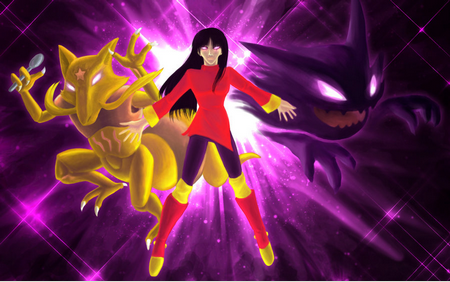
 A spectacular piece by Jo Tyler (http://jotyler.deviantart.com/) of Sabrina commanding Kadabra and her new ally, Haunter.

The elephant in the room is the question of how Sabrina ever became a Gym Leader in the first place.  We know from her dad’s flashbacks that she began her psychic training at a young age (I’d guess between six and eight) and very quickly developed a habit of lashing out at her parents with her telekinesis when they annoyed her.  It’s unlikely, then, that she became the Saffron Gym Leader first and a deranged psychopath later.  Nor would she have gotten her Gym officially registered and gained the authority to hand out Marsh Badges if she had come to the Pokémon League with a proposal like “please give me League funding so I can build a temple for my personal cult and have a place to keep all the people I turn into dolls with my horrifying mind-powers.”  I may not give the Pokémon League a whole lot of credit, but let’s be reasonable here.  It follows that the Saffron Gym was already established and she took over at some point – getting League authorisation for a Gym isn’t easy (if it were, then A.J. from the Path to the Pokémon League would have done it), but taking over an existing one seems relatively hassle-free in the conclusion of Showdown in Pewter City – it’s probably assumed (falsely, I might add) that no Gym Leader would hand over the reins of power to an inferior trainer.  It seems normal for Pokémon Gyms to be family businesses, but I don’t think Sabrina’s father is a Pokémon trainer (her mother, conceivably, might have been, but I have trouble imagining Sabrina’s mother as a Gym Leader).  The other odd thing about the situation is that Sabrina’s cultists don’t actually seem to be Pokémon trainers either.  They’re totally occupied with exercising their psychic abilities (which are remarkably feeble in comparison to Sabrina’s) and, aside from Kadabra, we don’t see a single Pokémon in the Saffron Gym.  What’s more, the cultist who ‘greets’ Ash, although he declares emphatically that Ash is not worthy of challenging Sabrina, doesn’t make any effort to meet that challenge himself.  I suspect what this all adds up to is that Sabrina muscled in on the Saffron Gym as soon as she was old enough to train Pokémon, turned the old leader and the other trainers into dolls, and converted the place into a training centre for human telepaths.  Taking challenges is a minor nuisance, but at least gives her opportunities to practice her terrifying powers.  Moreover, I suspect the original Saffron Gym didn’t specialise in Psychic-types, otherwise you’d expect her to have kept a lot of the trainers and Pokémon from the old regime.  Remember the Fighting-type secondary Gym in the games’ version of Saffron City?  Yeah… I think I know why it doesn’t appear in the anime.

(Its anime equivalent is actually the “Fighting Spirit Gym,” which turns up in the very next episode, but that’s even less of a proper Gym, so I’m sticking with my wild speculation)

So that’s Saffron Gym – a place I hope never to visit again, but which offered some surprisingly valuable insights on the culture of Pokémon training in Kanto.  For the rest of this chunk of the series I’ll be hopping around a bit – I want to put episodes 25 and 29 (Primeape’s episodes) together, as well as 26 and 32 (Ash’s Fuchsia and Celadon Gym battles) – so bear with me; I’m on the home stretch.

Anime Time: Episodes 19-21

Tentacool and Tentacruel – The Ghost of Maiden’s Peak – Bye Bye, Butterfree

Yeah, yeah, I know, I missed episode 18.  Beauty and the Beach was banned in most Western countries because James wears a set of fake boobs to enter a beauty contest (yeah… he does that sometimes) and it doesn’t air on the official website with the rest of the series because they’re trying to pretend it never happened.  I’m sure I could probably find it on the internet if I could be bothered looking but I really, really can’t.  I’ve read episode synopses and it doesn’t look like Beauty and the Beach is all that interesting an episode anyway, so I’m not convinced it’s a great loss.  Maybe someday I’ll do a few of the banned episodes all together.  Anyway.

Continue reading “Anime Time: Episodes 19-21”

Anime Time: Episodes 15-17

Battle Aboard the St. Anne – Pokémon Shipwreck – Island of the Giant Pokémon

Fresh off Ash’s victory at the Vermillion Gym, Ash and his friends are given free tickets by a pair of teenage girls to a lavish Pokémon trainers’ convention aboard the world-famous luxury cruise liner, the St. Anne!  THERE IS NO WAY THIS COULD POSSIBLY BE A SCAM!

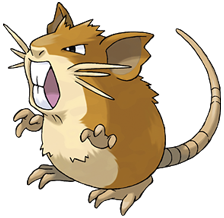
 This is going to be a boring day for art since I couldn't find any relevant fanart for these episodes; here's Sugimori's Raticate art instead.

We quickly learn that the ‘teenage girls’ were Team Rocket in disguise (yes, James too), and that they were giving out free tickets to all the trainers they could find on the orders of their shadowy Boss, Giovanni, who appears for the first time in this episode.  The Boss (who seems to be the closest thing Meowth has to a formal ‘owner,’ but has come to prefer his Persian – this will be a constant source of insecurity to Meowth during the series) is displeased with the time and energy they have expended failing to catch Pikachu, but still seems to have enough confidence to put them in charge of the ambush planned on the St. Anne.  His confidence, of course, is misplaced – not only do the Team Rocket goons fail miserably to steal even a single Pokémon, James also loses a ludicrous amount of money buying into a Magikarp-breeding pyramid scheme, and the entire ship capsizes and sinks with Jessie, James and Meowth still on board (not to mention our plucky heroes).  This, of course, is all totally incidental as far as I’m concerned.  I want to talk about what happens in the meantime: Ash encounters a dapper gentleman with a top hat and moustache, whose name is never given, challenging other trainers to exhibition battles with a powerful Raticate.  Ash, being Ash, takes up the challenge and finds that Raticate and his Butterfree are very evenly matched; however, just as Butterfree begins to gain the upper hand with Stun Spore, the Gentleman – to Ash’s annoyance – recalls his Raticate and suggests calling it a draw.  The Gentleman later proposes a trade, his Raticate for Ash’s Butterfree, which Ash hesitantly accepts but later regrets.  Luckily, the Gentleman reluctantly agrees to trade back at the end of the episode, just as the ship is sinking.

When you think about it, Pokémon trading is a pretty bizarre practice from the perspective of a trainer like Ash, who regards each and every one of his Pokémon as a close personal friend (which I think counts as further evidence that Ash’s way of doing things is actually quite unusual, since Pokémon trading manifestly isn’t).  The Gentleman’s ideas about trading are interesting ones – he believes that trading Pokémon is a way of deepening and widening new friendships and spreading relationships between trainers all around the world; basically, a form of social networking.  You could argue that he’s running what amounts to a scam here, proposing a trade for the first Pokémon he could find that was stronger than his Raticate and then dazzling the Pokémon’s kid trainer with some pretty rhetoric, but since he does agree to trade back when Ash asks him, I think it’s more likely he actually believes it.  Misty’s perspective on the situation is almost as interesting because it shows, I think, that she relates to Pokémon in a very different way to Ash: although she is sympathetic when he begins to regret trading away Butterfree, her response, “look on the bright side; you got a Raticate!” seems to indicate that she doesn’t really understand the depth of Ash’s attachment to his Pokémon yet.  I’m kind of disappointed to miss Brock’s opinion; Ash does ask him before the trade, but he’s too busy getting goo-goo-eyed over the Gentleman’s lady friend to offer a coherent response.  For a person like Ash, trading away a Pokémon is basically signing away the health and wellbeing of a close friend to someone else.  If Ash’s attitude is at all typical, you wouldn’t expect Pokémon trading ever to happen except between good friends but, again, this is manifestly not the case.  I think this indicates that for a ‘typical’ trainer, a Pokémon is less like a friend and more like… not a possession, but… perhaps a colleague, co-worker, or subordinate – basically, someone with whom you have a formal, rather than an emotional, relationship.  I should qualify that, like most complex issues, this is probably more of a spectrum than a dichotomy; Ash is at one end, and trainers like the Gentleman at the other, but a lot of people probably fall somewhere in the middle.

Anyway, the ship flips upside down and sinks, and due to the captain’s gross incompetence no-one notices that a few of the passengers were still on board.  There’s still plenty of air in the ship, but it’s steadily filling up with water from the bottom, and it’s balanced precariously on a huge spire of rock over a deep ocean trench…

 Fun fact: in the beta version of Red and Blue, Gyarados' English name was "Skulkraken."  It works on so many levels, each more terrifying than the last!  Artwork by Ken Sugimori; render unto Nintendo what is Nintendo's, etc.

Pokémon Shipwreck is kind of a ‘meh’ episode, if you ask me.  It’s basically supposed to be about Ash’s party and Team Rocket having to work together to escape their mutual dilemma, but it’s actually about Ash’s party working together to escape their dilemma while Team Rocket cling to their coattails and scream incoherently.  Suffice to say, they eventually escape the ship by blowtorching through the hull with Charmander’s Flamethrower and swimming to the surface with the help of their Water Pokémon (Team Rocket use the Magikarp James bought on the St. Anne and nearly die, but to Pikachu’s immense displeasure they recover).  Once they’re all on a raft cobbled together from the debris of the St. Anne, James throws a fit, kicks his Magikarp, and renounces his ownership of the useless thing… which, of course, prompts it to evolve into a Gyarados, summon its brothers, and go all you-ain’t-in-Kansas-no-more on their asses, which leads to the next episode, Island of the Giant Pokémon

I love Island of the Giant Pokémon.  If I had my way the whole damn series would be done like Island of the Giant Pokémon.  The set-up is that Gyarados’ waterspout separated Pikachu, Bulbasaur, Squirtle and Charmander from the rest of the group on an island which is, for no immediately obvious reason, inhabited by Pokémon of unusual size (hereafter known as POUSes).  Ash, Misty and Brock do stuff in this episode too but it is irrelevant and distracting, because this is the episode in which everything the Pokémon characters say is subtitled, which means we get a closer look at their personalities.  Squirtle is laid-back and irreverent, and has something of a black sense of humour (among other things, he upsets Pikachu and Charmander by joking that Ash might have been eaten by wild Pokémon).  Bulbasaur is stoic, pessimistic and cynical; he’s the one who suggests that Ash might have abandoned them, which I think speaks to the way he views humans in general.  Charmander… well, Charmander is kind of boring, actually.  He seems nice.  He’s quite trusting, maybe a little naïve.  Mostly he just goes along with Pikachu (who, as we know from the rest of the series, is defined mainly by fierce loyalty to his friends).  Odd that there’s no foreshadowing of the problems Ash is going to have with him after he evolves into Charmeleon in episode forty-something; maybe they hadn’t planned that far ahead yet.  And then… there’s Ekans and Koffing.  They’ve also been separated with their trainers, along with Meowth, who orders them to attack Pikachu and his friends when they run into each other.  Ekans and Koffing seem to be portrayed as not particularly bright, even by Pokémon standards (especially Koffing, who mostly parrots Ekans); their dialogue is subtitled in broken English, and their worldview is basically “we do as our masters tell us”… and Meowth, they are most emphatic, is not their master.  They claim that if Pokémon do bad things, it’s out of loyalty to bad masters (contrast Meowth, who points out that his master is never around and he’s as rotten as Jessie and James on his own); they apparently understand morality but think it either isn’t important or doesn’t apply to them.  Alone, Meowth is easily overpowered and tied up, while Ekans and Koffing join the group.  As they eat dinner, and Squirtle taunts Meowth with the promise of food if he’ll just apologise (which, of course, he refuses to do), they hear a loud rumbling sound and are nearly crushed by a rampaging POUS.  Pikachu goes back to untie Meowth as the others leg it (like Ash, he’s a kind soul), and they eventually spend much of the night running away.  Then… then there is this one wonderfully mad scene in which, later that night, the whole group stops at a bar.

When I was a kid, I could accept this without any problem.  As an adult, I've played Pokémon: Mystery Dungeon.  Then again, even in Mystery Dungeon I'm pretty sure they never go to a bar and get wasted.  Screenshots from www.filb.de/anime.In the middle of the jungle.  Run by a Slowbro.  Bulbasaur and Squirtle get totally hammered and start drunkenly arguing over something (hard to say what, since this scene doesn’t have subtitles) while Meowth quietly passes out, and Pikachu and Charmander try to comfort Ekans and Koffing, who have been reduced to tears (and are presumably pretty deep in their cups themselves).  At a random bar in the middle of the jungle run by a Slowbro.

…I’m not even going to question it; I’m just going to accept it.

They all go to sleep together, curled up with Ekans coiled around everyone else.  This is a lovely scene; it illustrates very well how ready Ash’s Pokémon are to trust, even when Ekans, Koffing and Meowth have been their enemies for the whole season so far – or perhaps it’s more appropriate to say that Ekans and Koffing work for their enemies.  Off-duty, they’re no more hostile than anyone else.  Anyway, the next day, they try to negotiate with the POUSes they encounter, fail miserably, wind up getting chased by them, and eventually run into Ash, Misty and Brock being chased by more POUSes, as well as Jessie and James in a mine cart dragging another one behind them (they… had an interesting couple of days, put it that way).  Everyone reunites, there is much rejoicing on both sides, and all the POUSes trip over each other, get tangled together, and are completely destroyed – they’re robots, it turns out, and the whole thing is a theme park called Pokémon Land (a theme park, incidentally, run by Giovanni, who gets a call shortly afterwards to tell him of its destruction).

Again, I wish every episode were like Island of the Giant Pokémon.  Most of Ash’s Pokémon are surprisingly expressive considering they can’t really speak, and Pikachu in particular builds up a reasonably developed character by sheer weight of screen-time alone, but the characterisation of and relationships between all the Pokémon characters we see in this episode are just wonderful stuff, if you ask me.  That they never did this again is probably one of my biggest regrets for the whole series.

Anime Time: Episode 14

Electric Shock Showdown

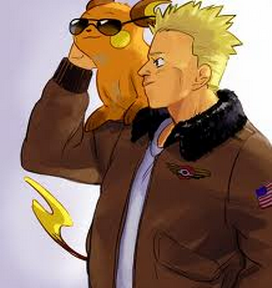
 Official artwork of Raichu, by Ken Sugimori; do unto Nintendo as you would have Nintendo do unto you.

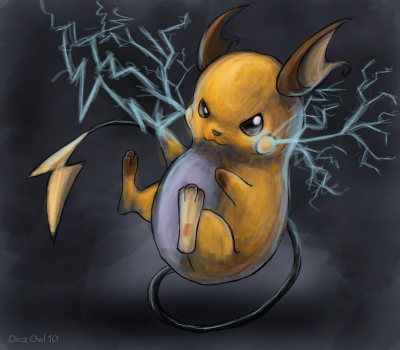
Oh, the excitement!  Ash is on a roll, and now he’s in Vermillion City for his third Gym battle!  Oh… but we forgot to mention… the Vermillion Gym Leader, Lt. Surge, is a total nutcase who’s hospitalised sixteen Pokémon in the past month.  Pikachu doesn’t like the idea of fighting this crazy person, but Misty taunts Ash for the two pity Badges he collected in Pewter City and Cerulean City, and that’s the end of that.  Ash and Pikachu, with Brock and Misty in tow, march up to the Vermillion Gym and demand a battle with Lt. Surge, a jovial but condescending fellow who, for some reason, assumes that Misty is the challenger, even though Ash is the one standing front and centre in their group (does he really present such an unimposing figure?).  Surge thinks the idea of Ash challenging him is hilarious, and laughs even louder when he sees Pikachu, calling them both “babies.”  Surge calls out his own signature Pokémon: a Raichu, Pikachu’s evolved form, whose electrical powers are vastly superior to Pikachu’s.  “Electric Pokémon,” Surge claims, “are only useful once they learn all their Electric attacks,” so Ash should have forced Pikachu to evolve at the first possible opportunity to maximise his power, like Surge did.  Pikachu’s doubts about the battle evaporate when Surge and Raichu taunt him, and the match begins.  Raichu quickly demonstrates that she has Pikachu totally outgunned, ignoring his relatively paltry Thundershocks and hitting back with a blast that nearly knocks him out cold.  Pikachu doggedly keeps fighting, but Raichu just starts tossing him around the field with her superior physical strength and Ash has to surrender to keep him from being beaten up any further.  While Ash and the team regroup at the Pokémon Centre, Nurse Joy #98 overhears their conversation and randomly decides to offer Ash an incredibly valuable Thunder Stone, which would evolve Pikachu into a Raichu – no strings attached, though she cautions them to think carefully about it, since evolution is irreversible.  Ash doesn’t think he wants Pikachu to evolve just to fight, but decides to leave it up to him.  Pikachu slaps the Thunder Stone away and gives an impassioned speech; Ash, of course, doesn’t understand a single word, but Meowth translates for Jessie and James, who are spying from the window: he wants to fight Raichu again to defend the honour of all Pikachu.  Ash, with a suggestion from Brock, devises a new strategy while Pikachu recovers, and as soon as they’re both ready, they head back to the Vermillion Gym.  On the way they run into Team Rocket, who have come to cheer for them – Jessie and James have realised that if Pikachu loses, then all the effort they’ve spent trying to steal him will have been a waste, so they do a strange little dance with a morale-boosting chant, then run away.  These guys already have way too much emotional investment in stalking the kids and Pikachu, and we’re only a few weeks in… at this rate they’re going to be basket cases by the end of season one.  Anyway, Ash and Surge have their rematch, but this time, Pikachu makes use of his one big advantage over Raichu: she has greater physical and electrical strength, but he’s a lot faster, and can evade most of Raichu’s physical attacks like Mega Punch and Body Slam.  Surge gets annoyed and commands Raichu to blast the whole stadium at once with her Thunderbolt so Pikachu can’t dodge, but when the dust clears, Pikachu is… standing on his tail, perfectly unharmed, having discharged all the electricity through it and into the ground.  Raichu tries to attack again, but she’s all out of power and has to go back to physical attacks.  Pikachu gives her the run-around until she can’t keep fighting any longer, then finishes her off.  Lt. Surge admits defeat and gives Ash his Thunder Badge, they shake hands, Ash and Pikachu celebrate, and Team Rocket wander off into the sunset, realising too late that “we wasted this episode cheering for the good guys!”

 Raichu doing what she does best, by OrcaOwl (http://orcaowl.deviantart.com/).

So, if you’ve been paying attention to my anime reviews so far, you’ve probably guessed that I’m interested in Electric Shock Showdown because of Pikachu’s refusal to evolve.  In the end, this is how he beats Raichu – in the games, Pokémon that evolve using stones normally stop learning attacks, which is why Raichu, who evolved before learning Quick Attack or Agility, was so much slower than Pikachu.  If we’re just thinking in terms of the ability to learn new attacks, though, why not evolve Pikachu after the battle?  He’s already learnt the speed techniques that gave him an edge over Raichu, and (as long as we’re going by the logic of the games here) evolving won’t cause him to lose those techniques, so surely he’d have the best of both worlds?  It’s plausible the anime is taking the position that Pikachu are, universally, capable of quicker and more precise movements than Raichu, which really does make a lot of sense if you just take your eyes off their in-game stats for a moment.  I think it’s also plausible that Pikachu might have more endurance than Raichu; notice that, in the second match, Raichu’s pretty much done after one good Thunderbolt – she burns twice as bright, but half as long.  However, tactical considerations are clearly not what’s occupying Ash’s mind when Nurse Joy offers him the Thunder Stone.  In general, Ash, Brock and Misty seem to take the view that using a stone to evolve a Pokémon constitutes forcing it to evolve, which seems fair enough, on the face of it.  Assuming my previous wild inferences are correct, most Pokémon evolve when they are psychologically ready for the change, which is more or less voluntary.  Using a Thunder Stone or similar item, on the other hand, takes the choice out of the Pokémon’s hands and puts it firmly in the trainer’s.  This is something of an ethical tangle in itself but it actually isn’t the main question here, because Ash, who doesn’t like the idea of forcing Pikachu into a massive and permanent physical and psychological metamorphosis, leaves it up to Pikachu.  The main question here is why, when given the opportunity to decide for himself, does Pikachu refuse evolution?

 I love this one; it's so cute.  This is by Asphodels, and I would love to give you a link because if this is anything to go by then he/she is very good, but his/her DeviantArt account has been deleted recently and I don't know where else to look...

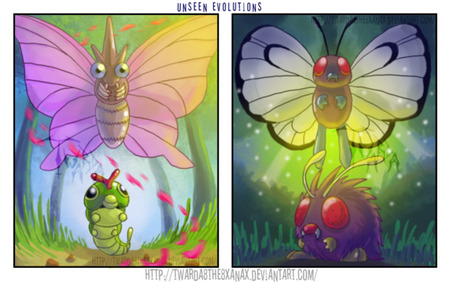
Back in Ash Catches a Pokémon, Caterpie wanted nothing more in all the world than to become a Butterfree.  As I noted at the time, though, Caterpie is, well, a caterpillar, and the whole purpose of his existence is to prepare for evolution.  I suppose it’s not impossible to imagine a Caterpie who is perfectly happy being a Caterpie and never becoming an adult, but I doubt that’s common; most of them probably assume that succeeding in life entails evolution.  The only other evolution we’ve seen in the series so far is Clefairy evolving into Clefable in Clefairy and the Moon Stone, which I kind of skimmed over at the time.  Like Caterpie, the Clefairy are something of a weird little corner case as far as the psychology of evolution goes, because of their strange relationship with the Moon Stone, the meteor which (according to the conspiracy theorists) first brought them to Earth.  The Clefairy worship the Moon Stone and perform ritualistic dances around it while singing and praying.  We also see them gathering up shards of the meteor and collecting them in a central chamber around the main stone.  Their reverence for the stone doesn’t seem to be related to any desire to evolve (in fact, they don’t even evolve when they hold the shards), but then again, they don’t seem to be particularly upset when they wind up Metronomesploding it into a million pieces, so I guess they took it as a consolation that a bunch of them evolved when the pieces touched them.  Maybe they have a concept of fate and didn’t evolve themselves using the Moon Stone earlier because it wasn’t “the right time”?  The Clefairy are inscrutable by design and trying to probe their motivations makes my head hurt, but we can at least say that they aren’t upset by the idea of evolving due to a chance event at a time not of their own choosing.  I suspect they may be unique in this, though, because of their unusual relationship with their Moon Stones.  In the games, Pokémon that have evolved using stones typically don’t exist in the wild; that type of evolution normally requires human intervention to bring the Pokémon and the stone together.   Assuming this holds true in the anime as well (which, granted, is quite an assumption), Pikachu may not consider Raichu a natural evolution of his species, but rather a form specifically modified by humans to be better at fighting (not unlike Mewtwo – assuming Pikachu doesn’t understand the science involved, what would the difference be from his perspective?).  He might even think of Raichu and other Pokémon like them as sell-outs, which would explain why the whole thing seems to be a point of pride for him.

Another, possibly complimentary, explanation is that the anime simply makes certain basic assumptions about evolution, and particularly the use of evolutionary stones, that the games do not.  With the exception of The School of Hard Knocks (in which Joe has to memorise trivia like “Pidgey evolves at level 18”) the anime is generally extremely vague about the concept of “level;” it’s possible that Pokémon in the anime can, or believe they can, continue to grow stronger without limit, in which case the Thunder Stone would only be a quicker and easier way to power Pikachu would also be able to earn with hard work.  Remember also Meowth’s odd comment in Ash Catches a Pokémon about Pikachu’s power “exceeding its evolutionary level;” on the one hand, yes, it’s Meowth, on the other hand, he seems to be suggesting Pikachu could be, or could become, even stronger than a Raichu.  Equally, it might be the case that the stones are not the only way for Pokémon like Pikachu to evolve – or, again, that he might believe they aren’t.  When you think about it, this makes a lot of sense; a species that can’t reach adulthood without access to rare substances found only in certain areas would be pretty odd, especially given that most Pokémon that use stones can’t dig for them.  If this seems fishy given what we know from the games, consider that Electric Shock Showdown was made fairly early in the franchise’s life, when it might not have been at all clear which – if any – of the rules laid down in Red and Blue would remain immutable as (or, for that matter, if) the franchise matured.  I think the theory is fairly consistent with Pikachu’s behaviour during and after this episode; he could use the stone to provide the surge of energy he would need to evolve right now, but believes he could eventually evolve in his own time – if he ever even needed to – and doesn’t want to take the ‘easy way out’.

Whether he is correct or not, I leave as a question for the reader.

Anime Time: Episodes 10-12

Bulbasaur and the Hidden Village – Charmander: The Stray Pokémon – Here Comes the Squirtle Squad

Okay, last entry was so long this is starting to get ridiculous, so I’ll try to blaze through the synopsis of these three episodes as quickly as I can so I can spend more time on commentary; here goes nothing!

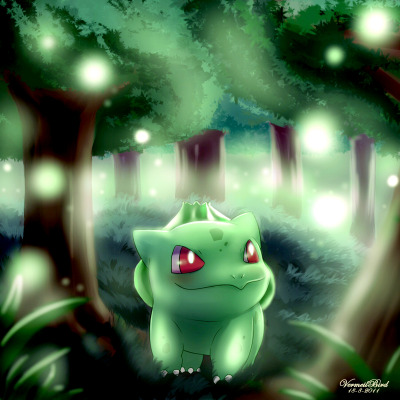
 Bulbasaur surveying his domain, by Vermeilbird (http://vermeilbird.deviantart.com/).

These are the episodes in which Ash meets and catches, in rapid succession, his Bulbasaur, Charmander and Squirtle, each under unusual circumstances.  Bulbasaur is the guardian of the ‘hidden village,’ a kind of halfway house deep in the forest for Pokémon abandoned by their trainers, run by a girl named Melanie, who patches them up and releases them back into the wild.  Bulbasaur is initially hostile towards Ash for intruding into the village and trying to capture one of the Pokémon, an Oddish, but warms to him when he, Brock and Misty help protect the village from Team Rocket.  Melanie suggests that Bulbasaur leave with Ash so he can grow stronger, and so the Pokémon of the village can get used to surviving on their own again, and Bulbasaur agrees on the condition of a battle with Ash – which, of course, Ash wins.  Soon after, Ash and his friends encounter Charmander waiting alone on a rock in the forest.  Ash tries to capture Charmander, but Pikachu establishes that he actually has a trainer already, so they decide to leave him and travel on to the next Pokémon Centre.  That night, they overhear a trainer named Damian bragging about his huge collection of Pokémon and explaining how he finally managed to ditch his useless Charmander in the wilderness by telling it he’d be back soon.  Brock is furious and Damian’s group nearly comes to blows with the heroes, but Nurse Joy #147 breaks up the fight.  Since a storm is brewing, Ash, Brock and Misty go back and look for Charmander, and manage to bring him back to the centre before his tail flame sputters out.  Early in the morning, Charmander escapes and wanders off to look for Damian again, but he stumbles across Ash’s group on the road and saves them from Team Rocket.  Damian shows up and wants Charmander back, but Ash convinces Charmander that Damian is a good-for-nothing jerk and the little salamander Pokémon joins Ash’s team instead.  Ash’s Squirtle, finally, leads a gang of juvenile delinquent Squirtle who terrorise a small town with pranks, vandalism, theft, and their awesome sunglasses.  The Squirtle Squad resent humans because all of them were abandoned by their trainers, and Meowth exploits this by tricking them into thinking that he owns and controls Jessie and James (which… let’s face it, is not far from the truth).  Meowth manipulates the Squirtle into capturing Ash, Pikachu, Misty and Brock, but they let Ash return to town to buy medicine since Pikachu is injured.  When Ash returns as promised, he finds that they have released his friends, since they aren’t a genuinely malicious bunch.  He then helps the Squirtle Squad when Team Rocket inevitably turn on them, and coordinates them to put out a forest fire started by Team Rocket’s weapons.  The Squirtle are reintegrated into society as part of the local fire brigade, and the leader joins Ash to travel Kanto with him.


Whew.

 An adorable Charmander by Yamio (http://yamio.deviantart.com/)

Let’s talk about Pokémon and their trainers.  As I said, Bulbasaur, Charmander and Squirtle all join Ash’s team under unusual circumstances, and furthermore all of them had been abandoned by other trainers in the past (well, Charmander and Squirtle had; Bulbasaur could have been wild but I think it’s more likely that he was abandoned – how else would he have come to be working with Melanie? – and it would explain his somewhat aloof and suspicious nature), so all three of them presumably have somewhat skewed perspectives on humanity compared to wild Pokémon.  Given this, it’s interesting that only Charmander acts in the way you’d expect an ‘outsider’ to act in the games – growing rapidly and later becoming disobedient.  Part of the reason is probably that Squirtle and Bulbasaur had largely forgotten their trainers and washed their hands of humanity in general (except for Melanie, in Bulbasaur’s case) until Ash came along and forced them to totally rethink their attitudes towards people, while Charmander was still ‘loyal’ to Damian until making a snap decision to Flamethrower him in the head two minutes from the end of his episode.   He may have regretted that choice later, and may even have come to feel he’d been forced into it – Bulbasaur and Squirtle both had other reasonable choices, but Charmander’s options, besides Ash, were going back to Damian or wandering off into an environment he wasn’t very well suited to (as he had learned the hard way only the night before).  Finally, while Bulbasaur and Squirtle were both befriended by Ash specifically, it was actually Brock who did most of the work of rescuing Charmander, and Brock who decided to brave the storm to look for him in the first place.  In fact, Ash acknowledges that Brock has as much right as him, if not more, to become Charmander’s trainer, but Brock insists Ash catch Charmander because… y’know, I’m honestly not sure.  In short, Charmander may actually have legitimate reasons to be upset here.

Probably the single thing I find most interesting about these episodes is Bulbasaur’s insistence on a battle with Ash, which seems like a formality by that point – Ash and Bulbasaur have worked together, Bulbasaur clearly has at least some degree of respect for him, and Melanie has suggested that everyone involved would benefit if Bulbasaur joined the team, and given her blessing.  Honestly, I think it seems like a formality because that’s precisely what it is: trainers catch Pokémon, and Bulbasaur is not going to go easy on Ash just because he seems like kind of a decent guy; he is damn well going to be captured, because that’s what trainers are for.  Squirtle and Charmander don’t challenge Ash; they just join up because they feel he’s already earned their respect, and I think the fact that Bulbasaur does is at least partly because, as we’ll see in Island of the Giant Pokémon, he’s very stubborn and also a bit of a cynic (Squirtle the reformed gang leader, by contrast, isn’t so likely to be a stickler for tradition).  What does being captured actually mean for a Pokémon, anyway?  Theoretically they belong to the trainers who capture them, but we know they can break out of their Pokéballs whenever they really want to (case in point, Misty’s Psyduck, but others do it too, and not just for comic relief either), so there’s nothing stopping them from wandering off in the night and never coming back, but in practice they don’t.  The very act of capturing a Pokémon normally seems to instil a degree of loyalty, which tends to remain even when it’s not such a good idea, as with Damian and Charmander.  This is presumably why releasing a Pokémon is viewed as such a jerkass thing to do in the anime.  Speaking of capture, when Ash first tries and fails to catch Charmander, Brock observes that he’s quite weak and tired – in theory, an easy catch.  Now, what happens in the anime when you try to catch another trainer’s Pokémon is neither entirely clear nor totally consistent across different seasons, but here and now I think the only reasonable interpretation is that Charmander’s loyalty to Damian is what makes it so easy for him to break out of Ash’s Pokéball.  Even for a weak or injured Pokémon, being captured still involves an element of choice: no Pokémon can be captured unless it is at least receptive to being partnered with a human (with the caveat that most wild Pokémon will still want to test a trainer’s worth by battling first).  This gives an interesting perspective to Nurse Joy’s seemingly nonsensical comment, when she breaks up the fight with Damian, that it’s disrespectful to Pokémon to use them for settling personal disputes.  How is it any more disrespectful than using Pokémon to battle at all?  I suspect it’s meant to be implicit that practice battles and official challenges, as part of the advancement of a Pokémon’s career with a trainer, are in some sense “what they signed up for,” while “hey, Pikachu, beat up this guy’s Pokémon for me because he’s a douchebag” is unfairly bringing Pokémon into a wholly human dispute (although this particular example is something of a grey area; Damian’s mistreatment of his Pokémon could be considered just as much Pikachu’s business as Ash’s).

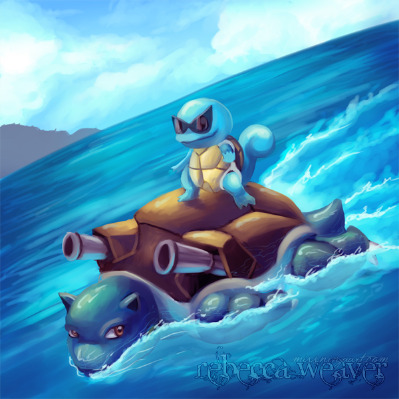
 Squirtle, wearing his trademark Squirtle Squad shades, gives us a lesson in awesome.  Art by Rebecca Weaver (missninjaart.tumblr.com)

To finish up for today, I want to take a closer look at Squirtle’s street gang.  For the Squirtle Squad, being abandoned by their trainers resulted in disillusionment with humanity in general, so clearly they had expectations of partnership with trainers which weren’t met – presumably power, knowledge and friendship.  Again, abandonment is regarded as an unambiguously rotten thing to do, by both human characters and Pokémon; in a sense it’s a breach of the implied agreement a trainer makes with any Pokémon who joins his team.  I suspect the Squirtle Squad are a Pokémon-world instance of the depressing phenomenon reported by real-world animal shelters, who invariably receive kittens and puppies in huge numbers after each Christmas – presents given to children who weren’t ready for the responsibility.  Squirtle, of course, are one of Kanto’s standard starter Pokémon.  It seems likely that the Squirtle Squad all belonged to new trainers who quickly realised that they weren’t cut out for the trainer’s life and ditched their starters in the wilderness.  Ash and Officer Jenny #604 are quick to blame the trainers, but honestly I think the Pokémon League is just as much at fault here; obtaining a Pokémon License seems to be literally just a matter of turning ten and showing up.

What I’m driving at with this entry is that – easy as it is to dismiss Pokémon training as slavery and thereby demonise the franchise – the ethics of Pokémon training are, even from an in-universe perspective, a great deal more complicated than that, which is why I’m so glad the games finally caught up in Black and White and produced a whole storyline about whether ownership of Pokémon is morally justified.  I still wish the story was a little more complex and the antagonists not so… well, cartoonish, but hey, it’s a kid’s series.  Baby steps.

Anime Time: Episodes 8, 9 and 13

The Path to the Pokémon League – The School of Hard Knocks – Mystery at the Lighthouse

Yep; I’m doing these out of order, for a couple of reasons.  One is that I really want to do episodes ten, eleven and twelve as a group, and spend a whole entry just on episode fourteen, which sort of leaves thirteen as the odd one out.  The other and far more important reason is that I feel these three episodes have a unifying theme, which is what I want to discuss today – see if you can guess what it is.

 A Sandshrew being adorable, by Celesime (http://celesime.deviantart.com/)

In the Path to the Pokémon League, Ash challenges an unofficial Pokémon Gym run by a gruff Texan kid called A.J. with an unbroken winning streak of ninety-eight battles – ninety-nine after A.J.’s fierce Sandshrew defeats Ash’s Pidgeotto.  Ash decides that A.J. must have cheated to beat a Flying Pokémon with a Ground Pokémon and starts poking around the gym.  A.J. is an extremely harsh master, having his Pokémon engage in constant practice fights and training exercises, and keeping them in line with his whip (A.J. has trained his Pokémon to respond to the crack of his whip, and uses it to command them in battles).  All of A.J.’s Pokémon wear restraining harnesses, possibly the forerunners to the Macho Brace introduced in Ruby and Sapphire, which restrict their movements and force them to develop stronger muscles to move normally, and he has his Sandshrew swim in his pool to train away its weakness to water.  Ash is horrified by his Spartan training style, but Brock observes that A.J.’s Pokémon are actually in excellent health; A.J. prepares all of their food himself and carefully tailors his recipes to the dietary needs of each species.  Ash attempts to convince the other Pokémon that they can leave A.J. and travel with him instead, but they seem to find him tiresome and ignore him.  Sandshrew is especially loyal to A.J.; they have been together for many years and long ago promised to grow strong together, no matter what obstacles stood in their way.  The episode ends with A.J. and Sandshrew earning their hundredth victory by defeating Team Rocket, who tried to sneak in and steal Pikachu but accidentally got Sandshrew instead.  As they had promised themselves, they close down the gym and leave on their own journey to start collecting badges and entering tournaments.

The School of Hard Knocks is set at Pokémon Tech, a prestigious private school in the middle of nowhere which Ash and his friends stumble into entirely by mistake on a foggy day.  Rich families who want their kids to become powerful trainers without anything so messy and plebeian as a Pokémon journey will pay top dollar to send them to Pokémon Tech instead.  Successfully completing each phase of the school’s program is considered an achievement equivalent to earning two Gym Badges, and graduation comes with automatic no-questions-asked membership in the Pokémon League.  Kids who fall behind are subjected to distressingly rough ‘tutoring’ sessions by their classmates in order to keep them from disgracing the school, a system run by the strongest member of the beginner class, a Ground-type specialist named Giselle.  Ash stumbles upon one of these sessions and rescues the supposedly underachieving student, a boy called Joe, who shows them around the school and asserts that his place there marks him as roughly Ash’s equal as a trainer, and that the school’s computer simulations predict he would defeat a Cerulean Gym trainer with little difficulty.  Misty soon shows him the error of his thinking by effortlessly crushing his Weepinbell with her Starmie, ‘Grass beats Water’ be damned.  Giselle shows up and gives Joe a condescending lecture on how a Pokémon’s level is just as important as type match-ups, and goes on to prove it by defeating Starmie with her Graveler.  She mocks Ash’s ignorance and inexperience, provoking him and Pikachu into a battle against her Cubone to defend their ideals of Pokémon training based on friendship.  Despite her confidence in Cubone’s immunity to electrical attacks, Pikachu prevails by spinning Cubone’s skull helmet backwards and blinding him, a tactic Giselle’s study of conventional Pokémon battling had left her completely unprepared for.  Giselle is considerably more gracious in defeat than victory, and concedes that she is still a beginner as well, while Joe decides to start his career over with a Pokémon journey like Ash’s, since Pokémon Tech is not for him.

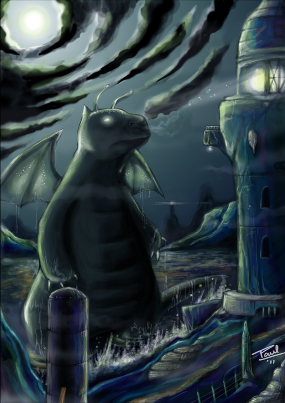
 KidScribbles' (http://kidscribbles.deviantart.com/ - seriously, go look) gloriously tragic interpretation of the events of Mystery at the Lighthouse.

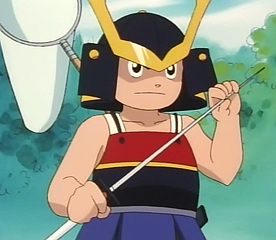
The last episode I want to look at today is Mystery at the Lighthouse.  This episode starts with Ash capturing a Krabby, his seventh Pokémon, which of course vanishes back to Professor Oak’s lab.  In order to check up on Krabby the group walks to the nearest building, a lighthouse, and request the use of the owner’s phone.  The owner, a researcher named Bill, invites them inside via intercom and directs them to his phone.  Once Ash has established that Krabby arrived safely, they meet Bill himself, a somewhat unhinged cosplayer who has trapped himself in a particularly Byzantine costume of a Kabuto, in order to… research its behaviour.  Or something.  Once freed, he shows them his current research project – he’s broadcasting a reply to the call of an unknown ocean Pokémon he recorded some time ago, inviting it to come to the lighthouse and meet him – and, wonder of wonders, tonight is the night!  Bill hears his mystery Pokémon calling out to him, and the group sees its immense form emerge from the mist (it’s pretty clearly a Dragonite, a Pokémon Ash’s Pokédex seems to be familiar with in the very next episode, but it’s also ten times the size of a normal Dragonite, so it might be a weird subspecies).  Unfortunately Team Rocket, lurking on the cliffs below the lighthouse, attack the Pokémon with bazookas (James, interestingly, is quite distressed; I think this is the first episode to portray him as markedly less immoral than Jessie), enraging it.  It swats Team Rocket, smashes the top of the lighthouse, and then leaves in a huff.  In the morning, Bill tells Ash and his friends that he feels privileged even to have seen the mysterious Pokémon and gives them a few words of encouragement.  They set off for Vermillion City, and Bill spends the rest of the day quietly sobbing in his basement, having lost an opportunity he will probably never get again (or at least, this is what I imagine to have happened).

So, who’s picked up on the theme?

The theme these episodes have in common is different ways of living and interacting with Pokémon.  The series focuses primarily, of course, on Ash’s relationship with his Pokémon, but as the opening scenes of Mystery at the Lighthouse point out, Ash’s training style and philosophy are actually quite unorthodox.  Brock and Misty note that it’s entirely normal or even expected for full-time trainers to capture dozens of Pokémon before settling on a few they like (if they ever do at all).  This is more or less how Gary’s campaign is described, and it’s implied that the other two Pallet trainers are doing the same thing, while Ash’s comparatively small roster has more in common with those of the numerous small-time trainers who stay in their hometowns (the interesting thing about this is that the one who behaves in a manner more consistent with a typical player of the Pokémon games is actually Gary, not Ash).  As far as Ash is concerned, the most important thing for a trainer is having a strong emotional bond with your Pokémon, and if you get that right the rest is just bells and whistles (I swear there are moments when Ash thinks you can win a battle with the power of friendship).  This isn’t to say that others are cruel or neglectful, but it’s hard to imagine Gary treating all or even many of his Pokémon with the affection Ash does, and Ash’s relationship with Pikachu regularly earns comment for their remarkable closeness.  The first character in the series to demonstrate a comparable friendship with a Pokémon is, funnily enough, A.J., who is as inseparable from his Sandshrew as Ash will eventually become from Pikachu – they’re a lot more alike than Ash would probably admit.  For Ash, though, being a Pokémon trainer is about exploring the world and making new friends, while for A.J. it’s about endurance and determination in the face of suffering and hardship, which is why he works his Pokémon so hard.  The episode still portrays him sympathetically, though, since he genuinely cares for his Pokémon and works them hard because he wants them to be healthy and strong.

Contrast, for instance, Giselle.  Although Giselle is clearly intended to be arrogant to the point of being obnoxious, and although she expects very high standards from her human friends, she appears to be at least tolerably kind to her Pokémon and believes that responsibility for defeat rests squarely on the shoulders of trainers, not Pokémon.  A.J. would probably react to a loss by working the Pokémon harder, because his first responsibility as a trainer is, well, to train; Giselle would be more likely to react by studying harder herself and researching new tactics, because her first responsibility as a trainer is to command.  Giselle’s general attitude implies a rather condescending view of Pokémon.  They’re objects of study to her, more like underlings or even tools than partners, but she’s smart enough to know that mistreating them won’t get her anywhere.  The implication is that she represents the philosophies of Pokémon Tech as a whole, which is why Joe decides to leave when he comes to admire Ash’s way of doing things more, but – Giselle’s own character flaws aside – the episode as a whole seems to view this outlook as just as much a viable alternative as A.J.’s, with the caveat that each trainer has to make his or her own way.

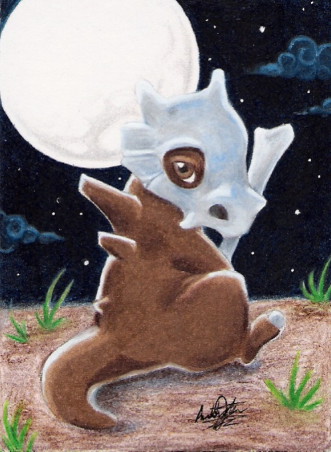
 As this evocative depiction by Spectrolite (http://spectrolite.deviantart.com/) attests, Cubone are pretty complex Pokémon themselves in terms of the emotions they play to, but this, sadly, is just one of many things I don't have time to discuss today.

Finally, we have Bill, who as a researcher has no interest in owning Pokémon at all.  For Ash, and for most other trainers, the first step in making friends with a Pokémon is to capture it, which seems like it would actually be a fairly counterintuitive notion for someone who isn’t a trainer.  Ash automatically assumes that Bill wants to catch the mystery Pokémon he’s looking for, but Bill can’t think of any reason why he would and just wants to meet it.  He’s like Giselle and the rest of Pokémon Tech in that his relationship with Pokémon has a huge intellectual component, but at the same time he’s very different in that they study Pokémon in order to make more effective use of them, while Bill actually seems to look up to Pokémon and admire them.  His bizarre cosplay fixation, for instance, is part of an attempt to understand Pokémon from their own points of view.  In short, someone like Giselle cultivates an intellectual approach to Pokémon so that they might benefit from association with humanity, while someone like Bill cultivates that same approach so that humanity might benefit from association with them.  At the same time, Bill’s final speech at the episode’s conclusion makes clear that he regards trainers as vital to the continuation of Pokémon research.  This is partly a statement of practicality – trainers are the ones who catch Pokémon, and often the ones who discover new species as they explore – but also an assertion of the importance of embracing different ideas and worldviews (a theme which, years later, was wholeheartedly taken up by Black and White).

Wow, this was a long entry.  Okay, quick summary: because Ash is the main character of the anime, it’s easy to forget that his experience of Pokémon is in fact an atypical one.  These episodes, among others, show that the relationship between Pokémon and humanity is actually a far more complex one than Ash’s rather idealistic interpretation might suggest.  This is another of those recurring themes that I’m probably going to comment on more as I move through the series – as well as something I’d like to see more of in the games!

Anime Time: Episodes 5-7

Showdown at Pewter City – Clefairy and the Moon Stone – The Waterflowers of Cerulean City

In which Ash… earns… his first two Gym Badges.  Arguably.  Also stuff happens with some Clefairy.

 Some nice crisp art of Brock and his Rock Pokémon, by Fluna (http://fluna.deviantart.com/)

When Ash and Misty arrive in Pewter City, they are greeted by an aged hobo selling rocks.  Don’t scoff; rocks are the whole basis of Pewter City’s economy.  The hobo leads them to the Pokémon Centre where Misty points out a poster advertising the Indigo League tournament, which explains that contestants need to earn eight official Gym Badges to enter.  Ash… apparently didn’t know this.  Why the hell was he going to Pewter City?  If he didn’t know about collecting badges, what could he possibly have wanted to do there?  Buy rocks?  Misty cautions Ash not to rush into a Gym battle and offers to lend him some of her Pokémon, but Ash ignores her, challenges the local leader, Brock, and quickly learns that Brock’s signature Pokémon, Onix, is fifty times Pikachu’s size and invulnerable to electricity.  Ash surrenders to keep Pikachu from being turned into red paste, and leaves the Gym in despair.  On the street he meets the hobo, Flint, who explains that Brock is a very powerful trainer and could go much further than being Gym Leader of a hick town, but is kept in Pewter City by his countless younger siblings – Brock’s father ditched the family to become a Pokémon trainer, this sort of thing being socially acceptable in Kanto, and his mother died soon after (or… so the English translation claimed… long story).  Despite his sympathy for Brock, Flint provides Ash with a “strategy” to defeat him: overcharge Pikachu by hooking him up to a derelict hydroelectric paddle-wheel… which Ash will turn manually (realism is cast aside so Ash can work for his victory and prevent this whole episode from being a blatant exercise in cheating… I mean, it kind of is anyway, but they were trying).  Although Pikachu nearly explodes, Flint’s plan works: the next day, he fries Brock’s Geodude with relative ease.  Onix is still too strong, but unfortunately for Brock, Pikachu’s wild electrical blasts set off the Gym’s fire suppression systems, drenching Onix and rendering him vulnerable.  The characters’ reactions are fascinating.  Ash declares that he doesn’t want to win on a fluke and leaves the Gym, which makes sense; he’s still far too proud to accept this kind of victory.  Misty, who’s watching, seems to think Ash should have taken his lucky break and finished Onix, because all’s fair in Pokémon and war, so she clearly has no moral compass.  And Brock… Brock follows him and just gives him the Boulder Badge, because he doesn’t really give a damn about this whole Gym Leadering thing anyway.  Flint turns up and reveals himself as Brock’s father; apparently he was an appalling trainer and returned to Pewter City not long after leaving, but decided to become a rock salesman instead of going home to care for his vermin offspring.  I guess Ash has reminded him how not to be a massive jerk, because he’s decided to become a proper father again (and also run the Gym, presumably… despite being a self-confessed failure as a trainer…) so Brock can go on a road trip.

 Clefairy and Clefable.  Artwork by Ken Sugimori; twinkle twinkle, little star, how I wonder whether you'll come after me for copyright infringement.

Ash, Misty and Brock leave Pewter City together and travel past Mt. Moon, where they meet a… ‘scientist’… named Seymour and have to deal with Team Rocket, who are trying to steal an ancient meteorite known as the Moon Stone from Mt. Moon (this meteorite, presumably, is the source of all the smaller Moon Stones we’re familiar with from the games).  Team Rocket is dealt with quite comprehensively by the community of Clefairy who inhabit Mt. Moon; their Metronome chorus results in a powerful explosion that actually blows the Moon Stone itself to smithereens, but no-one seems to mind because the shards cause many of the Clefairy to evolve into Clefable.  Then Seymour decides to go and live with the Clefairy because he’s nuts.  Honestly, I could probably spend an entire entry just talking about this episode.  It’s the first time we see a Pokémon using an evolutionary stone in the anime, which is interesting in itself, but the Clefairy and Clefable relate to the Moon Stone in a way that’s so weird and unique that it adds a whole extra dimension to the matter.  Sadly that doesn’t really fit with the ideas I want to talk about today, but I’ll probably come back to it when I discuss episode fourteen (which is definitely getting a whole entry to itself).

Despite Misty’s inexplicable protests, the group’s next destination is Cerulean City, where Ash wants to try for his second badge in as many weeks.  When they reach the city, Misty vanishes in a huff, and Brock wanders off to take care of some unspecified “stuff,” returning only at the end of the episode.  Ash makes his way to the Cerulean Gym-cum-aquarium, where – to his surprise – he witnesses the end of a water ballet performed by a trio known as the “Sensational Sisters.”  As he explores the Gym later, he meets the sisters, Lily, Violet and Daisy, and learns that the three of them are, in fact, the Gym Leaders.  As it turns out, however, they’re just as sick of their Gym Leader gig as Brock was, having just suffered three devastating losses to the other three trainers who left Pallet Town at the same time as Ash.  In fact, apart from a Goldeen and a low-level Seel, all of their Pokémon are resting at the Pokémon Centre.  Lily, Violet and Daisy would rather focus on the water ballets that have made their Gym famous than deal with challenges so, with a collective shrug, they decide to hand Ash his Cascade Badge just for the asking… until Misty bursts in.  Misty, it turns out, is the family’s fourth and youngest sister, and she is none too pleased about the way her sisters are handling their Gym (or failing to).  She answers Ash’s challenge herself, and soundly defeats his Butterfree with her Staryu.  They both switch Pokémon, and Pidgeotto nearly beats Misty’s Starmie, but Team Rocket interrupts the battle by attacking the Gym with some kind of giant vacuum cobbled together from cannibalised household appliances they stole earlier in the episode.  They intend to use this godawful device to suck up all the water in the Gym, and all the Water Pokémon with it, but Ash, of course, defeats Team Rocket and saves the sisters’ last few Pokémon.  Lily, Violet and Daisy decide to award Ash the Cascade Badge for services rendered to the Cerulean Gym, and point out to Misty that Pikachu could have flattened her Water Pokémon anyway if he’d wanted to (Pikachu refused to fight a friend – he doesn’t yet follow all of Ash’s orders without question; he can also be troublesome about going into battles he doesn’t think he can win).  They meet up with Brock, who never does explain what his “stuff” involved, and move on to their next misadventure.

 Misty and Starmie.  People seem to think Misty forgets about Starmie as the series goes on, because she doesn't use it much, but it's actually her go-to Pokémon for most situations... it's just Starmie suffers the most from Psyduck's tendency to come out when Misty wants a different Pokémon.

These episodes begin Ash’s extremely chequered career of earning Gym Badges under questionable circumstances.  Of his eight Kanto badges, only three were totally legitimate (you could certainly make arguments for some of the other five, but they’re definitely suspect). Gym Leaders appear to have a lot of latitude in running their Gyms and handing out their badges, and once you get your hands on one of the things, no-one ever really questions it.  Strange as it might seem, this is actually something I would like to put in the games; Black and White made a decent effort at showing the Gym Leaders as people rather than just bosses, but Claire from Gold and Silver remains the only one in history ever to demand something other than a battle as proof of a player’s worthiness.  A Gym Leader’s job is to certify that a challenger possesses a certain degree of skill as a trainer, and a battle is the most straightforward and obvious way to do that, but it’s plainly not the only way.  Providing a service to the Gym or to the city, in a manner that demonstrates one’s abilities to the satisfaction of the Gym Leader, seems like a perfectly sensible way to earn a badge.  Arguably, so is putting up a good fight when your main Pokémon is plainly unsuited to the task at hand.  Happening to show up just as the Gym Leader gets sick of battling… not so much.  How Lily, Violet and Daisy became the Gym Leaders of Cerulean City in the first place is beyond me, since they don’t appear to have much commitment to their position, which suggests to me that general oversight for the whole system is relatively slack.  I think two or three years pass before someone picks up on their uselessness and Misty has to come home and run the gym for them.  Honestly I suspect that the Pokémon League just quietly overlooks Cerulean City in exchange for a percentage of their ticket sales.

The other important thing about these episodes is that they introduce Brock and fill in Misty’s backstory.  Brock is the oldest (I don’t know if his age is ever mentioned but I think he’s supposed to be about sixteen) and most responsible member of the team… until he sees an attractive woman, at which point he turns into a drooling idiot.  He’s used to taking care of a huge family, and probably finds it a welcome break to have only two demented children on his hands.  Although Brock is quite powerful, he doesn’t actually like fighting and wants to become a Pokémon Breeder – a somewhat nebulous term in the anime, since any actual ‘breeding’ would probably spoil the show’s G-rating; basically Brock is a specialist in Pokémon nutrition and general healthcare.  Misty is a lot of fun.  She’s often described as a tomboy – she normally wears boyish clothes and she’s as adventurous, outgoing and stubborn as Ash – but she does regularly show interest in stereotypically ‘girly’ things, and loves anything that’s pink, cute, sparkly, or all three, so I think the tomboy aspect is something she developed as a gesture of rebellion against her sisters’ obsession with fashion and beauty.  She can be superficial at times and is prone to romanticising, but she’s also capable of being a very determined, practical person when she needs to be.  Misty and Brock will, of course, both get fuller treatment in episodes to come… so let’s get going!

Anime Time: Episodes 3-4

Ash Catches a Pokémon – Challenge of the Samurai

 Caterpie.  Artwork by Ken Sugimori; all hail Nintendo, etc.

These two episodes record Ash and Misty’s journey through Viridian Forest, during which Ash captures his first two wild Pokémon: Caterpie and Pidgeotto.  Pidgeotto really isn’t very interesting; he’s mostly a utility Pokémon who turns up whenever Ash needs to take advantage of his flight, and I don’t think there are any episodes that focus on Ash’s relationship with him (until, amusingly enough, the episode where he finally evolves into a Pidgeot and promptly ditches Ash to go hang with his old flock).  He does serve as an illustration of the kind of rapport ‘normal’ trainers and Pokémon tend to have, which I guess is useful in its way because Ash’s relationships with most of his other Pokémon are anything but normal.  For me, though, Pidgeotto is probably Ash’s most forgettable Pokémon.  Caterpie is much more fun to talk about so I’ll probably spend most of this entry on him.

Ash effortlessly catches Caterpie right at the beginning of the imaginatively titled third episode, Ash Catches a Pokémon, and it quickly transpires that Misty cannot stand the poor thing, even though he’s immediately very affectionate towards her.  This deserves comment in itself because Pikachu seems to be very trusting of Misty as well (although the business with the Spearow in I Choose You was a good start, he’s going to remain somewhat aloof, though no longer disdainful, towards Ash for quite a while yet), which suggests to me that they both instinctively recognise her longer history and deeper experience as a Pokémon trainer; Caterpie is quickly rebuffed by Misty’s open disgust for Bug-types, though (as well as by the ludicrously oversized mallet she apparently keeps in the back pocket of her shorts).  Ash tells Misty to go away if she doesn’t like Caterpie, but she continues to follow them out of a stubborn desire to make sure Ash pays her for her ruined bike and they eventually share a campsite.  Ash and Misty go to sleep but Pikachu and Caterpie stay up talking, which is where the really interesting stuff starts.  If you’ve ever wondered how Pokémon can possibly communicate when they can only say their own names, this scene suggests that extended conversations tend to involve a significant gestural component – which means that we can, more or less, understand it: Caterpie seems to be describing his future evolutions to Pikachu.  The conversation ends with Caterpie gazing longingly up at the night sky.  We’re clearly meant to take from this that Caterpie knows and understands what he could one day be, and wants desperately to get there, but is also aware of the odds against it (Caterpie are common Pokémon and Butterfree are not; ergo, most of them don’t make it).  That’s… a pretty high-level thought process for a caterpillar, and I think it can be taken as a comment on the level of sentience we can ascribe to Pokémon in general in the anime.  It’s also the first perspective the series gives us on Pokémon evolution, which is something that it can be a little schizophrenic about.  Here evolution is an unambiguously positive change, which is understandable because, as a caterpillar, Caterpie’s whole life is about preparing to evolve and he’ll never accomplish much if he doesn’t, but many other episodes give some quite different perspectives that I’ll be looking at as I go.

This lovely bit of fanart is by Karolina 'Twarda' Twardosz (http://twarda8the8xanax.deviantart.com/ - a lot of wonderful pieces here, Pokémon and otherwise; do take a look) and expresses one of the more interesting bits of Pokémon fan speculation: that Metapod was originally supposed to evolve into Venomoth, and Venonat into Butterfree, but the sprites were accidentally switched in Red and Blue.  What do you think?

The next day brings two major events, the first being Ash’s battle with Pidgeotto, in which he flippantly disregards two of the most basic lessons of life as a Pokémon trainer: he tries a Pokéball without weakening Pidgeotto first (and I thought he’d learnt better after episode one), showing that he doesn’t actually understand how to catch Pokémon, and he tries to fight Pidgeotto with Caterpie (and reacts with abject confusion when Misty points out that “Pidgeotto is a bird; Caterpie is a worm; birds eat worms, Mister Pokémon Master!”) showing… not so much that he doesn’t understand the concept of a type advantage, more that he doesn’t even understand the concept of fighting.  Pikachu steps in to save his sorry butt and fries Pidgeotto into submission, and we quickly move on to the next big event of the day: Team Rocket’s appearance.  They’ve decided to follow Ash and steal Pikachu, since the Viridian City Incident has convinced them that, in Meowth’s words, “[Pikachu’s] powers exceed its evolutionary level” (a fascinating comment in itself, but one I don’t have time for now).  Ekans and Koffing attack Ash together, so Misty offers to step in to even the odds, but Ash refuses because the Pokémon League rules say that battles are one-on-one.  Never mind that he’s being mugged by notorious criminals; the rules say that he can only use one Pokémon and he will defend those rules with Pikachu’s life if need be.  Long story short, Caterpie manages to overcome Ekans, Koffing and Meowth with a particularly well-executed String Shot, of all things, and Team Rocket are forced to retreat.  This victory prompts Caterpie’s longed-for evolution into Metapod, and an observation from Ash’s Pokédex that no other Caterpie on record has ever evolved so rapidly.  Ignoring for the moment how the Pokédex could possibly know how mature Ash’s Caterpie was when he caught it, this is the first of many indications given in the anime that evolution isn’t just about reaching a certain level, as in the games; there’s a psychological component as well.  I think Caterpie’s remarkably fast evolution is implicitly a result of his unusual ambition; it took less to make him evolve because he was more ‘ready’ for it, mentally speaking, than most Caterpie.  Basically, he’s a little Pokémon with big dreams, and being with Ash is going to help fulfil them.

 Sammy the Samurai.  Oh, this kid... Screenshot swiped from Bulbapedia.

In the next episode, Challenge of the Samurai, Ash is accosted by a weird kid in samurai gear while trying to catch a wild Weedle.  And when I say “accosted” I mean he nearly gets cut in half by an honest-to-goodness steel katana.  This kid… oh, this kid… I don’t think he even has a name; if he does, he never tells Ash and Misty what it is, so I’m just going to call him Sammy.  Sammy lives in the darkest part of Viridian Forest with his Bug Pokémon and challenges other trainers as they pass through.  I don’t know why.  He just does.  He doesn’t seem to be interested in travelling or collecting badges, in fact he has a permanent cabin deep in the woods, so the only conceivable reason for him to be interested in getting stronger is so he can make himself more of an inconvenience to travellers.  The kid’s a friggin’ random encounter (“random” being the operative word).  Anyway, he calls Ash “dim-witted and clumsy” for letting the Weedle escape, Ash protests that it was Sammy’s fault for coming at him with a sword (this is supposed to be the beginning of a point the episode is making about Ash learning not to blame his failures on others, but I can’t help but feel Ash is in the right here), and they quickly engage in battle.  Pidgeotto doesn’t manage to make much of an impact on Sammy’s Pinsir because Ash has been overworking him and he’s done for the day, so Ash turns to Metapod.  Only after he makes this choice does it occur to him that Metapod can’t actually fight, but luckily for him evolution didn’t make his Caterpie any less exceptional, and Pinsir injures itself trying to crack Metapod’s tough shell, forcing Sammy to recall it.  This leads us into one of the most awesome Pokémon battles of all time, an epic struggle of titans to be remembered by our children’s children for aeons to come: Metapod vs. Metapod.  I really don’t know what Ash and Sammy are trying to prove in this battle.  It conveys rather effectively, though, that both of them are astonishingly stubborn.  Their Metapod keep staring at each other and using Harden for some time – possibly hours – until the battle is interrupted by a swarm of wild Beedrill, apparently the friends of the Weedle that escaped Ash earlier.  Metapod is snatched up by a Beedrill before Ash can recall him, and they all have to leg it back to Sammy’s cabin to escape being stabbed to death.

 Metapod and Butterfree.  Artwork by Ken Sugimori.

Ash eventually goes to get Metapod, whom they saw on the way to Sammy’s cabin sitting at the base of a tree filled with Kakuna.  This is problematic because Kakuna will apparently evolve into Beedrill at the slightest provocation, but Ash is able to reach Metapod alive, despite Team Rocket’s antics causing the Beedrill to become aggressive again.  Metapod, unsurprisingly, seems very hurt that Ash allowed him to be taken in the first place, which Ash initially blames on Sammy but soon admits was his own fault, giving a heartfelt apology.  The resulting surge of loyalty prompts Metapod to jump into the path of a Beedrill trying to skewer Ash, violently splitting his shell open… which catalyses his final evolution into Butterfree.  Butterfree pacifies the whole swarm with Sleep Powder, Sammy is sufficiently impressed, and Ash, Pikachu and Misty get to move on to Pewter City.

In Challenge of the Samurai we see Pokémon evolving out of transitional states, ones which are never supposed to be long-term, so the conclusions we can draw from it aren’t necessarily all-inclusive, but there’s no harm in speculation.  Ash’s Pokédex claims that Metapod evolve into Butterfree one week after evolving from Caterpie, which sounds way too long, but since Ash tells Brock in the next episode that he’s been with Pikachu for two weeks already, it’s probably about right.  Regardless, it’s clear that Metapod didn’t evolve because he was ready; he evolved because he needed to, as do all the Kakuna we see evolving in this episode, which comes back to the idea of evolution having a psychological component in the anime: at some point, despite being physically able to evolve, Metapod and Kakuna still need some kind of stimulus to kick things off.  It’s interesting that Metapod doesn’t evolve when he’s first snatched away by the Beedrill, because he doesn’t actually ‘gain experience’ between there and the end of the episode, and judging by his reaction when Ash comes to save him I think it’s because he felt abandoned when Ash ran away without him and may have given up hope (one of his persistent character traits in the episodes that focus on him seems to be that he has self-esteem issues).  It’s the renewed feeling of being in a partnership with his trainer, and the associated swell of devotion, that eventually makes a Butterfree of him.