Champions of the Pokémon League, Part 8: Diantha

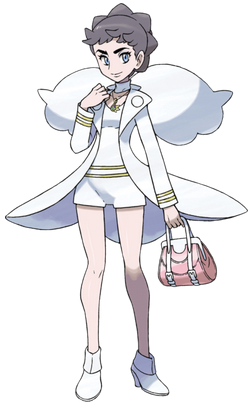
Diantha in her angel-winged white coat.  Note the jewelled necklace - that's her Digivice.

Glamorous but relatable, ethereal but down-to-earth, the Kalosian Champion, Diantha, is everything you want in an actress – but how does she stack up as a Pokémon League Champion?  She certainly has the look down, with an extravagant costume reminiscent of angel wings, and more importantly she also has the right kind of attitude to Pokémon and training.  Sadly – and I may as well be up front about this – the story of X and Y doesn’t give Diantha very much of an opportunity to do anything, something that was rather a disappointment to me.  Still, she gets a few good lines, and when you get her into a battle she’s the equal of any of her predecessors, so let’s take a look at her and see what makes this Champion tick.

We first meet Diantha in Lumiose City at the Café Soleil, and this scene is probably her most interesting because she has the opportunity to speak directly to Lysandre and set up a compelling argument against his beliefs – even here, the game doesn’t let her have many lines, but she makes them count.  Lysandre puts to Diantha the question of whether, as an actress, she would prefer to stay young forever, since it is her duty to inspire people with her beauty.  He clearly expects the answer ‘yes,’ but Diantha finds the question bizarre – being forever young would mean playing the same kinds of roles forever, but she views change and age as essential parts of the experience of human life, and eagerly anticipates the variety of more mature characters she will play as she grows older.  Their conversation betrays a certain narrowness and superficiality on Lysandre’s part; despite his comment that Diantha’s great contribution consists in “[moving] the multitudes with her excellent acting,” it seems clear that he regards her physical beauty as the most important aspect of her craft – to him, Diantha really is just a pretty face.  Her second appearance makes it clear that Diantha herself has a very different understanding of what she does.  We meet her again in Coumarine City, where she is talking with Professor Sycamore at the monorail station.  Diantha offers some comments on Mega Evolution, suggesting that perhaps the reason it seems to be limited to Kalos is because it has something to do with the legendary Pokémon of the region (if Professor Sycamore is correct in his eventual conclusion that Mega Stones were evolutionary stones irradiated with the energy of the Ultimate Weapon three thousand years ago, she’s not far off – although Xerneas and Yveltal don’t seem to have been directly involved with the weapon’s first use, they command similar powers).  More interesting from a characterisation perspective, though, is what she talks about after he leaves.  Sycamore had mentioned the bonds between trainer and Pokémon as a critical component of Mega Evolution, and Diantha makes an interesting comparison with the way she approaches acting: she sees it as an exercise in empathy.  In order to enjoy a role and play it effectively, Diantha says, she needs to put herself in her character’s shoes and understand what they have in common.  She also believes in taking the same approach to interacting with both people and Pokémon.  Essentially, the reason she’s both a successful actress and a great Pokémon trainer is because she’s figured out that the two professions share a key skill – empathy – and made it a part of her general approach to life.
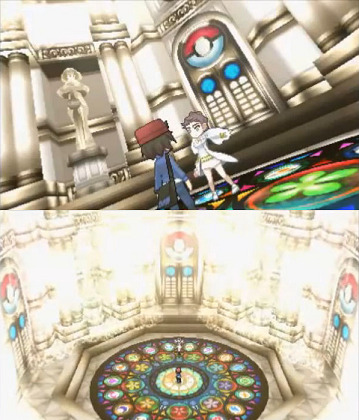
 Diantha's Radiant Chamber, in all its stained-glass glory, seems intended to be 'heavenly' in its appearance, like her costume.

And that… is the last we see of her.  Diantha doesn’t take any further part in the storyline of X and Y until your troubles with Team Flare are all over and you reach the cathedral of the Elite Four.  Realistically enough, she seems to have almost forgotten you herself by this point, but quickly realises that she does know who you are and what you’ve done for Kalos after all – which brings us to the battle.  Like Blue and Cynthia, Diantha is very hard to pin down to a preferred Pokémon type or battling style.  She appears to favour Rock- and Dragon-types, with two of each on her team, but her signature Pokémon, the strongest in her line-up, whose physical appearance is recalled in the flaring white skirts of her coat, is a Fairy/Psychic dual-type, Gardevoir.  In Hawlucha, her opener, Diantha has a strong and fast physical attacker with excellent type coverage thanks to Flying Press, Hawlucha’s idiosyncratic signature move, while Tyrantrum adds a sledgehammer to her tool kit.  Aurorus provides Reflect and Light Screen support, though with two double-weaknesses it may not last long enough to set up more than one.  Goodra is a resilient special tank with a wide variety of powerful attacks.  Gourgeist is surprisingly tough and can hit almost anything for super-effective damage by adding the Ghost type to Pokémon with Trick-or-Treat.  Last, but most definitely not least, is Gardevoir, who proves that Diantha can put her money where her mouth is when it comes to empathy and bonding with her Pokémon – by using her Mega Charm to Digivolve Gardevoir, Diantha can turn her partner into as great a threat as the whole of the rest of her team put together (as I learned to my cost when I first challenged her and won with my Venusaur’s last three hit points).  Mega Gardevoir’s Moonblast and Psychic attacks are phenomenal, more powerful than anything a Champion has brought to bear against us before, and without a Steel-type to resist her primary attacks she is one of the most dangerous single opponents the games have ever produced.  Ironically, Diantha’s greatest vulnerability is probably to Fairy Pokémon, since she has three Pokémon that are weak to their attacks, none that resist them, and only one super-effective attack to hit back with (Hawlucha’s Poison Jab); she also has great difficulty with Ice- and Steel-types.  Still, her weak points are certainly less easy to exploit than those of predecessors like Water-type master Wallace and the closeted Flying-type specialist Lance, making her a solid end-game challenge.
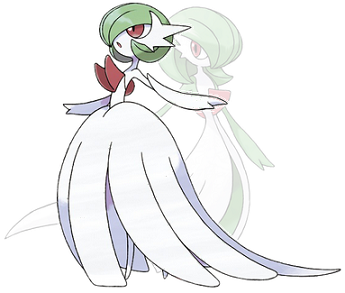
 Diantha's partner, Mega Gardevoir.

(Of course, if you’ve been using the Exp. Share consistently throughout the game Diantha is probably a walk in the park, but hey, who’s counting?)

The variety of Pokémon we see on Diantha’s team – in terms of not only their types and skills but their personalities and dispositions – may be intended to recall her desire for variety in her career and her life.  Partly I’m just saying this because I can’t find any other sort of theme to link her team together, but it seems to me that a wide variety of popular film genres have Pokémon representatives on her team; she has action (Hawlucha), horror (Gourgeist), family/comedy (Goodra and Aurorus), disaster (Tyrantrum) and, of course, romance (Gardevoir) all covered.  Perhaps that’s entirely in my head and the designers just wanted to give her a diverse bag of the new Pokémon the sixth generation has to offer, but it makes sense, given Diantha’s stated interest in playing a variety of roles, that she might have acted in many different genres, possibly meeting many different Pokémon in the process.
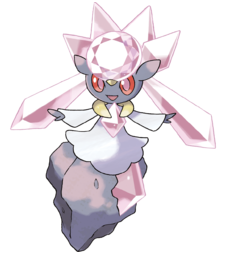
 The recently-revealed legendary Pokémon, Diancie, whom I'm bringing up because I know someone else will if I don't.  A lot of people speculate about a connection between Diantha and Diancie, but I don't believe there is any, because the similarity between their names doesn't exist in Japanese, where Diantha's name is Carnet, and because it makes as much sense for the design of her coat to be based on Gardevoir as on Diancie.

One last thing that’s worth mentioning about Diantha is her reappearance in the Café Soleil after the end of the game.  Diantha here offers you the opportunity to trade for a Ralts holding the Gardevoirite Mega Stone, so that you can raise a Mega Gardevoir of your very own.  This is not in itself particularly interesting; what is noteworthy is that she actually takes the time to think about how the Pokémon involved in this trade feel about it – something I can’t recall any other character in the games ever doing (although, granted, most in-game trades are with random NPCs who have no other discernable purpose in life).  “We Trainers all feel a bit nervous when trading Pokémon,” she comments as the trade begins, “but I’m sure it’s nothing compared to how the Pokémon must feel!”  When the switch has been completed, she even takes a moment to address the Pokémon you’ve given her directly, asking “was it a bit shocking to be traded?” and promising to care for it to the best of her ability.  A tiny detail at the very end of the game, but one that once again demonstrates that Diantha really does know what she’s talking about when it comes to empathy and consistently makes an honest effort to understand the perspectives of her Pokémon on their lives together.

On some level Diantha’s non-existent involvement in the Team Flare crisis makes sense, since she’s very clear that she’s only a Pokémon trainer “in [her] off time” – acting is her real career, and for all her power, she’s not really a ‘saving the world’ kind of girl.  Still, I find her remoteness from the actual plot as disappointing as I did Iris’s, and I don’t think Diantha even gets as much screen time (ironically) as Iris did in Black and White.  Having said that, she makes a good effort to stay relevant in the time she does get – and I can always hope for more in any future games.  Though she never gets the chance to be a hero, through her dialogue she does manage to establish herself as a role model for Kalos’ trainers and a champion of a worldview opposite to Team Flare’s.  Lysandre wants to put the beauty of the world on a pedestal and keep it from changing for all time, but Diantha wants to engage with and understand beauty, and prefers to embrace change, for better or worse, which, ultimately, is what the central conflict of X and Y is about.
Champions of the Pokémon League, (Belated) Part 7: Iris

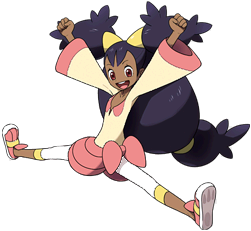
Original recipe Iris, in the relatively simple clothes she wears in Black and White.

As odd a time as this is to be talking about Iris, my next post is going to be on Diantha, which would otherwise make Iris the only Champion I haven’t written about, having discussed all the previous ones about two years ago now, a possibility that makes me feel a little twinge of unfairness in my normally blackened iron heart.  For the sake of completeness, then, let’s give some thought to the fifth generation games’ portrayal of the dragon master Iris, our second female and first dark-skinned Champion (yay diversity!).

Iris first shows up when the player reaches Castelia City in Black and White, where she enthusiastically volunteers to be Bianca’s bodyguard after the latter’s Munna is abducted, and takes part in the standoff with Team Plasma.  She is here portrayed as passionate and firm in her convictions, reacting with anger and dismay when she learns of Team Plasma’s theft and bewilderment when the rest of the group agrees to let Ghetsis and his minions leave without a fight, but is also extremely ready to help people in need, and perhaps a little naïve (Burgh suggests that Iris will need Bianca’s help finding her way around the huge city as much as Bianca will need Iris’s protection).  On White, Iris is subsequently revealed to be the Gym Leader of the ancient, traditionalist version of Opelucid City; on Black (and I say this as a player of Black version) one is rather left wondering what the point of her is supposed to be.  In both games, she also helps Drayden narrate of the story of Reshiram and Zekrom.  Since they’re both Gym Leaders of Opelucid City, it makes sense to look at Drayden in Black and White as something of a foil to Iris.  Compared to her older mentor, Iris stands out for her excitable speech patterns, liberally peppered with exclamation marks, and her emotional, evocative language.  Both are idealistic, but Iris is much more liberal in showing it.  On Black, the Opelucid Gym gives Drayden, as its leader, the epithet “the Spartan Mayor,” announcing him to be hardworking, physically strong and austere, as well as reminding challengers of the respect he commands as Mayor of Opelucid City (also, almost uniquely for these titles, it makes no reference to his elemental specialisation).  On White, where Iris is the Gym Leader, she is referred to as “the Girl Who Knows the Hearts of Dragons,” a description that focuses instead on her capacity for empathy and intuition, her deep connection with one of the most mysterious Pokémon types, and possibly her raw talent as a Pokémon trainer.  It may also be worth comment, in connection with Iris’ characterisation as energetic and youthful, that the only difference between the teams they deploy as Gym Leaders (aside from the gender of their Pokémon – Drayden’s are male; Iris’s are female) is which abilities their Druddigon possess; Drayden’s has Rough Skin, reflecting endurance and severity, while Iris’s has Sheer Force, suggestive of potency and vitality.  A minor difference, but when everything else about their Pokémon is kept the same, one little change feels that much more purposeful.  Even the city itself may contribute.  Drayden is the Gym Leader of a futuristic, technologically advanced Opelucid City, the result of industrious dedication to progress, while Iris’ Opelucid City is peaceful, quiet and very traditional, in keeping with her emphasis on closeness to Pokémon and nature (though her ‘nature girl’ traits, it must be said, are much less noticeable than in her anime incarnation).

Iris in the extravagant, flowing dress she wears as Champion of the Unova League.

At some point before the events of Black and White 2, Iris replaces Alder as Unova’s Champion.  As it did for Wallace in Hoenn, this apparently occasions a change of costume, with Iris’ relatively plain beige sweater being replaced by a frilled pink dress like something out of a fairy tale (appropriately enough, given her specialisation), complete with a golden, emerald-studded tiara.  We first encounter her, again, in Castelia City.  She retains her desire to help people in need, immediately volunteering to assist in your search for Team Plasma despite her belief that they are no longer a threat – but in a pointed contrast to her last appearance suggestive of her greater experience and maturity, she now appears to know the city very well, and is immediately able to direct the player to the most likely site of any suspicious activity, namely the Castelia Sewers.  She does very little else in that game, however, appearing again only in Opelucid City for a brief and not especially revealing conversation about Drayden (if nothing else, we learn here that although she calls Drayden ‘grandpa,’ they aren’t actually related).  At the time of Black and White 2, Iris was the only Champion since Blue not to take an active role in fighting the primary villains (she is now joined by Diantha), which, given her keen interest in the legends of Reshiram and Zekrom, is baffling.  Her initial scepticism at the possibility of a Team Plasma comeback goes some way towards explaining this, but the flying battleship shelling Opelucid City with ice cannons must have been one hell of a wakeup call.  Having said that, I’m not sure what her presence would have added other than opportunities for characterisation – unlike Alder, whose own personal flaws and troubled past complicate his opposition to Team Plasma, Iris’s involvement in that plot would have been fairly straightforward, so in some ways it’s perhaps better that she wasn’t there to take the spotlight from Hugh.

Probably the most interesting bit of characterisation Iris gets in Black and White 2 is not actually in the events of the games themselves but through a Memory Link scene (if you’re not familiar with these, they’re scenes which take place between the original Black and White and the sequels, which you can only view if your Black 2 or White 2 game is associated with the same Global Link account as a Black or White game which has completed certain parts of the storyline).  In Opelucid City, you can hear from Drayden about how Iris became his student and eventually the Champion – a position she has apparently been groomed for by Drayden since she first came to Unova as his successor.  In fact, having the opportunity to challenge Alder and become Champion was apparently her condition for leaving her home in the distant Village of Dragons, hinting at ambition, vigour, and possibly (as we’ve already seen from her) a touch of naïveté about the magnitude of this goal, though it appears she was an exceptionally talented trainer even before she met Drayden.  The fact that Alder, in consultation with Drayden, apparently chose his successor is interesting, although it appears that actually defeating him was still a requirement for Iris to take up the position and, far from considering it a formality, Alder actually put himself through a special training regimen (“ghastly,” according to Drayden) to prepare himself for this final duty, intent on pushing Iris to her limit.  Now that she’s there, Iris declares that her mission as Champion will be to help people and Pokémon continue to grow ever closer (a pledge that is not without resonance in the overarching themes of the fifth generation).  We also see in this flashback that the enormous pink dress Iris wears as the Champion was actually Drayden’s idea, a gift from him upon the completion of her training; now that she’s the Champion, he tells her, it’s okay to dress up – her hard work has earned her the right to a little frivolity now and then.

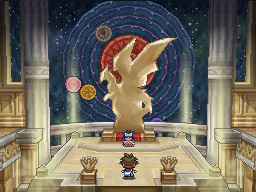
Iris' astronomically-inspired throne room.

When we finally meet Iris again in the palace of the Elite Four and battle her for the championship, the game pulls out all the stops.  Not only is Iris’ chamber particularly spectacular in comparison to those of past champions, with a huge throne in the shape of a dragon silhouette and a rotating circular backdrop apparently meant to represent the planets in orbit around the sun, the battle scene itself is marked by eye-catching streaks of rainbow light flashing across a twilight background.  The battle scenery of X and Y, of course, put it all to shame, but it was quite spectacular compared to everything that had preceded it, making the battle with Iris a unique and memorable one.  Nor does Iris herself let us down.  The game designers, apparently ashamed at their decision to neuter Ghetsis’ Hydreigon with a bizarre physical attacker moveset, have Iris open with a proper special attacker Hydreigon, as deadly a foe as any you’re likely to face in this game.  The rest of her team illustrates nicely that it’s quite easy to design a varied and balanced line-up for a Dragon master, simply because there are so many ‘dragon’ Pokémon who aren’t actually Dragon-with-a-capital-D Pokémon.  Iris uses three of them: Aggron, Lapras and Archeops.  Lapras ensures that she has an answer to Water- and Ice-type Pokémon who think they can sweep her team with Ice attacks, while Aggron covers up her defensive weakness to opposing Dragon Pokémon, and Archeops is simply vicious, and even carries Endeavour to help compensate for the Defeatist ability that normally renders him harmless when his health is low.  Druddigon would be the weakest member of her team, but the designers apparently realised this and gave him a Life Orb (making him the only member of her team aside from her partner to use a held item) so as to abuse the way Life Orb and Sheer Force work together – Sheer Force negates Life Orb recoil damage, but only on attacks that Sheer Force applies to normally.  Finally her partner, a Pokémon that needs no introduction, is a Dragon Dance Haxorus, complete with an Earthquake that can bring down even Levitating Pokémon thanks to Mold Breaker.  With the possible exception of Lapras, all of Iris’ Pokémon and their movesets are ones which emphasise overwhelming force; no stalling Spiritomb, Recover-spamming Milotic or defence-buffing Vanilluxe for her (even her Lapras exploits its powerful special movepool in preference to, say, a more sedate and arguably more effective Rest/Sleep Talk strategy).  Iris is all about enthusiasm and passion, and her first priority is to jump right in and blast away from start to finish.

Iris may still be an AI trainer, but as AI trainers go, she’s very much at the top of her game.  As a character, she has an odd relationship with the story, spending as little time directly interacting with it as possible but managing to snatch a fair bit of characterisation anyway, courtesy of the greater screen time Black and White gave to most of their Gym Leaders.  Her beliefs and goals as Champion also make a very clear statement about the central theme of the games – whether humans should become closer with Pokémon or move further apart.  While I remain a bigger fan of Alder and Cynthia, she’s a neat character, and has little trouble stepping into the larger-than-life boots of her predecessors.  Will her successor, Diantha, measure up?  Only one way to find out…

Champions of the Pokémon League, Part 6: Alder

…y’know, after the scale of my last project, finishing this one just doesn’t have the same inherent drama.  Then again, I’m a little scared to try for something bigger, for fear I may rope myself into reviewing every Pokémon ever and die before I finish.  Hrm.  Anyway, on with the show!
 
The Champion of the Unova region, the New York-inspired setting of Black and White, is an exuberant, light-hearted giant of a man named Alder, who is the Pokémon universe’s equivalent to Bear Grylls.  The man jumps off a cliff, for heaven’s sake, quite casually, without comment, and apparently for no other reason than that it was faster than walking.  Not content with sitting in his palace at the Pokémon League waiting for challengers, Alder prefers to spend his time exploring Unova, and claims to know “every corner” of the region; it is on just such a trip that he first meets you and Cheren, one of the two rival characters of Black and White.  Cheren is… well, I wouldn’t call him a jerk, to be fair; compared to Blue he’s an absolute saint, but he tends to look down on people who don’t take life as seriously as he does, and he’s extremely focussed on becoming a more powerful trainer, to the exclusion of all else.  Cheren’s great ambition in life is to become the Champion, and he’s not impressed when he meets the current Champion, in his words, “goofing off” at a festival outside Nimbasa City, feeling that such frivolity is beneath the dignity of this noble office.  Alder responds by questioning why Cheren wants to become Champion in the first place and what he thinks the whole point is, something Cheren doesn’t seem to have ever thought about.  Another day, after Alder watches you defeat Cheren in a battle, Cheren is disturbed and annoyed that Alder described it as “a fine battle,” assuming that Alder was pleased he had lost (because, after all, what about a battle could possibly matter besides who won and who lost?).  You later learn that Alder is interested in Cheren’s motives because he sees something of himself in Cheren; when Alder was younger, he was equally obsessed with becoming stronger, an obsession shared by his Pokémon partner.  In time, though, Alder’s Pokémon (whose species is never mentioned, though it could conceivably have been one of Unova’s three starter Pokémon) became sick and died, causing Alder’s outlook to change.  He now views strength for its own sake as transient and ultimately pointless, and focuses more on enjoying life.


So, if Alder isn’t still the Champion because he wants to keep getting stronger, why does he have the job, anyway?  Alder is the first Champion who is explicitly identified as such before you challenge him, so his involvement in the story of Black and White gives us a closer look at the responsibilities of a Champion and the significance of the position.  Alder is important to the plot because Team Plasma’s spiritual leader N, a strange teenager who wants to free all Pokémon from human oppression, thinks he can convince Unova’s people to side with him by defeating the greatest champion of the opposite set of beliefs (that humans and Pokémon are both stronger together) – I think N’s desire to prove the validity of his beliefs to himself plays into this too.  Alder is the Champion, and the Champion is supposed to be the most powerful trainer as well as the most committed to the philosophies of Pokémon training, so defeating Alder (as N eventually does, with the help of one of the legendary dragons, Reshiram and Zekrom) should represent a decisive symbolic victory in Team Plasma’s campaign to separate humans and Pokémon.  Alder, for his part, recognises the importance of this challenge to the wider ideological conflict, and meets it with all of the considerable vigour he can muster.  The trouble is that Alder isn’t as dedicated to his beliefs as N is.  Ghetsis, Team Plasma’s ‘power behind the throne,’ taunts him at one point by suggesting that Alder hasn’t fought a real battle since his partner Pokémon died, and that he’s avoiding his responsibilities by spending his time travelling Unova and leaving the Elite Four to take care of things at the Pokémon League.  What’s more, he seems to strike a nerve by suggesting that Alder, of all people, should agree with them, because of his memories of the pain of losing his first Pokémon.  My suspicion is that the death of his partner, although it taught Alder to enjoy life with his Pokémon, also shook his faith in the idea of Pokémon training.  Alder ‘believes’ that people and Pokémon should stay together, but N has an absolute conviction burnt into his very soul that they should be separated – and this is why Alder loses when N challenges him.  It takes your subsequent defeat of N, with your own legendary dragon at your side, to restore Alder’s conviction and turn him back into the trainer he used to be – the trainer you face when you return to the Pokémon League for the second time.


Okay, I found this on the internet and it's brilliant but I cannot for the life of me figure out who the artist is.  This piece of fanart shows Alder in the company of his his entire team.  Clockwise from the top right: Volcarona, Vanilluxe (who seems to be wilting under Volcarona's radiance), Accelgor, Bouffalant, Escavalier and Druddigon.

Alder is like Blue and Cynthia in that he has no avowed preference for any given element, but when you actually fight him it seems that, like Steven, he actually does like to use mainly Pokémon from a single type, and it’s just about the last one you’d expect: Alder trains Bug-types.  None of this namby-pamby Beautifly-and-Dustox nonsense for him either; Alder is a Real Man and his three Bug-types are a ninja, an armoured knight, and a sun god.  Accelgor makes a frustrating lead to face, being faster than everything and capable of stealing the attacks you’re about to use with Me First (Alder isn’t that good at predicting attacks, though, so Accelgor will often mimic an attack that would be weaker than one of his own anyway), while Escavalier is simply a pain to kill, with only one weakness (Fire), good defences, and some powerful attacks.  Volcarona is Alder’s signature Pokémon, and he seems to have styled his hair in imitation of it.  Volcarona are always tricky Pokémon to deal with because of Quiver Dance, which can buff their special attack, special defence and speed all at once, but Alder’s Volcarona has a tendency to burn itself out with Overheat, so it will normally become a much less significant threat if you can just string it along until it’s incinerated most of its own special attack score.  You’ll also get a free turn now and then courtesy of the recharge time for Volcarona’s Hyper Beam, a move that was a brilliant finisher in Red and Blue but has become a complete trap since Gold and Silver because of mechanical changes (a trap that every Champion since then has fallen into with gusto).  Volcarona’s terrible moveset notwithstanding, these are Pokémon I can respect.  The rest of Alder’s team… not so much.  If you remember my entry on Bouffalant, you’ll know I didn’t like it much, but I actually think Bouffalant was a strikingly appropriate choice for Alder: like its trainer, Bouffalant is big, loud, and has ridiculous hair.  Heck, Bouffalant could practically have been his signature Pokémon (and I must grudgingly admit that it can be problematic if you’re not ready for it).  Druddigon is the sort of Pokémon that I like to describe as “not unusable” in order to spare its feelings; Alder has exacerbated Druddigon’s many issues by giving it two Dark attacks (Payback and Night Slash), the kind of redundancy you quickly learn to avoid in the real world.  Alder’s final Pokémon is Vanilluxe, whom I can scarcely bear to dignify with a mention.  I think its presence on Alder’s team proves that the designers really did think it was a good Pokémon simply because of its high stats, but all it really does is throw into harsh relief what a terrible Pokémon Vanilluxe actually is.
 
Remember how I thought that Steven had an excellent team but was terribly portrayed as a character?  Well, Alder is just the opposite; he’s a great character who fits into the story of Black and White extremely well and is probably the most interesting Champion of the lot in terms of characterisation, but his team is full of holes!  He utterly fails to use most of his Pokémon to their full potential, and when he succeeds, it’s only because the Pokémon in question have so little potential to begin with!  Luckily, this is a much easier problem to fix than a boring character; I’ve got my fingers crossed for a slightly less poorly-designed team for Alder in the inevitable Grey Version.
 
So, that’s the Champions!  As always, I hope my rants have amused you; check back in a couple of days, when I will begin the month-long course of self-flagellation that is my list of the Top Ten Worst Pokémon Ever…

Champions of the Pokémon League, Part 5: Cynthia

Just to prove that the Pokémon League is an equal-opportunity employer, here’s the series’ only female Champion to date: Cynthia, master of the Sinnoh League.  Of all the Champions across all the different versions of the game, Cynthia is dearest to my heart, because, as of her debut in Diamond and Pearl, she was quite possibly the only halfway legitimate archaeologist in the entire Pokémon universe.  She seems to think of herself as a Pokémon trainer first and a historian second, but her research is clearly important to her and she spends every free moment studying the history and mythology of ancient ruins around Sinnoh, like the Spear Pillar.  If Cynthia’s glorious trench coat and its luxuriant fur trim represent what qualifies as casual attire for her, she has probably not spent a full day on a dig site in a very long time.  Nonetheless, I can scarcely put into words how refreshing it was to meet someone in these games who was genuinely interested in the Pokémon world’s ruins for their historical significance and not because of the obsession with ancient treasure that drove the Ruin Maniacs of Ruby and Sapphire.  Cynthia’s function in the plot is mainly to provide hints and exposition about the ruins you encounter, but she also has an inexplicable tendency to give you things at random for her own impenetrable reasons, like the HM for Cut when you first meet her in Eterna City, along with (only on Platinum) a Togepi egg, which is a remarkably silly thing for a Pokémon master to give to a total stranger (then again, it’s well-established that Pokémon masters can recognise, or think they can recognise, talented trainers by sight).  Later she turns up again and gives you a few doses of Secretpotion to allow you to clear one of the most absurd obstacles in video game history: a blockade of Psyduck whose chronic headaches have rooted them to the spot on the road to Celestic Town.  These headaches are not going to get better on their own, there is no other way to move the Psyduck, and Cynthia definitely isn’t going to give them the medicine herself; her research is far too important for her to waste time with such trivialities.  This is doubly inexplicable because as soon as you give them the Secretpotion, Cynthia shows up to congratulate you and gives you your next assignment: to return a necklace (some kind of artefact she’s been studying) to her grandmother in Celestic Town.  Wouldn’t this sequence have made far more sense if she’d given you the Secretpotion and the necklace at the same time?  As far as Diamond and Pearl go, Cynthia fades into the background after that – almost to the point that meeting her again at the Pokémon League creates the same reaction as Steven does; you remember that you used to know who she was, but you’re not sure why you ever cared.
 
Cynthia is similar to Steven, in some ways; although a tremendously adept and unfailingly noble Pokémon trainer, she’s almost more concerned with her own studies and interests, in contrast to characters like Lance and Alder, for whom Pokémon are very much the centre of their personal worldviews.  Again like Steven, Cynthia isn’t a notably vibrant or excitable person either.  The difference is that in Cynthia’s case (in Platinum, anyway; Diamond and Pearl do nearly as bad a job with her as Ruby and Sapphire do with Steven) it actually works because her personal research is directly related to what’s going on in the plot – Dialga and Palkia, the legendary Pokémon summoned by Cyrus to end the world, feature in the myths Cynthia studies, as do Uxie, Mesprit and Azelf, the spirit Pokémon that try to stop him.  She’s the one who figures out what’s going on when Giratina appears on Mount Coronet and drags Cyrus into hell, the one who explains why you need to follow them (the portal into Giratina’s freaky chaos dimension is apparently destabilising the real world, and needs to be closed), and the one who goes through the portal with you.  Finally, she manages to understand something of the nature of the other dimension where Cyrus fails; Cyrus believes that defeating Giratina will destroy its world, which, as our world’s twin, was the only thing keeping it stable as Dialga and Palkia attempted to dissolve it.  After you defeat him, he encourages you to go on and fight Giratina, which was what he’d planned to do anyway.  Cynthia also encourages you to fight Giratina, believing that if you can master it, you will calm it down and repair the damage done to the connection between the worlds (why she doesn’t deal with it herself will have to remain a mystery for the ages); she turns out to be right.  In short, she does a heck of a lot more than Steven (again, at least she does in Platinum).  There’s also an interesting scene with her in the Celestic Ruins if you return there after the epilogue, in which Cynthia discusses her theories on the meaning of the designs in the ruins, and how the appearance of Giratina at the Spear Pillar has altered her interpretation, hinting at the existence of Arceus, the Original One.  I would be concerned that all of this makes Cynthia less a character and more a vehicle for exposition, if not for one thing: she doesn’t actually know anything.  She’s speculating, just like we do all the time when we think about the nature and role of legendary Pokémon; Cynthia presumably has the benefit of a great deal of background knowledge on the beliefs and worldview of the ancients of Sinnoh, but in the end, her interpretations are just that – interpretations – and that’s a lot more interesting than just being told how something is and expected to go along with it.

Aonik (http://aonik.deviantart.com/) has here shown Cynthia with her partner Pokémon, Garchomp, taking some time out to watch the sunset from a beach.

In a return to tradition Cynthia, like Blue (and Red), has no specialty element, which makes her that much more difficult to fight.  She doesn’t seem to have a particularly pronounced theme either, but she tends to like Pokémon that belong to the game’s élite, particularly ones that are hard to hit for super-effective damage.  For instance, in all of Cynthia’s appearances, she begins the match with her Spiritomb, an extremely rare and ancient Ghost Pokémon that is best known for having no weaknesses at all and being harder to kill than a cockroach in a bomb shelter.  Spiritomb can only be found at an ancient ruined shrine in Sinnoh by using an item called an Odd Keystone after talking to other players in the Sinnoh Underground thirty-two times; similarly, her Lucario is a Pokémon that doesn’t exist in the wild and has to be hatched from an egg as a Riolu, while Milotic’s juvenile form, Feebas, can only be caught on four randomly-assigned squares of a large pool inside Mount Coronet, comprising several hundred squares.  As a Steel-type and a Water-type, respectively, Lucario and Milotic also have relatively few weaknesses.  The sea slug Gastrodon and the flower sprite Roserade are the least outlandish of her Pokémon, but they’re both powerful and have a wide variety of attacks at their disposal, and Gastrodon has only one weakness (Grass attacks).  On Platinum, Cynthia replaces her Gastrodon with a Togekiss, the final evolution of Togepi, another fantastically rare upper-echelon Pokémon, while in her appearance on Black and White, both Togekiss and Roserade go in favour of Eelektross and Braviary – again, Pokémon that are hard to find and naturally quite powerful (and Eelektross, like Spiritomb, has no weaknesses).  Then, of course, there’s her signature Pokémon: Garchomp.  Garchomp is commonly held to be Diamond and Pearl’s answer to Dragonite, but this is a malicious lie put about by Nintendo; he is in fact Diamond and Pearl’s answer to the entire damn Pokédex, being arguably the most powerful Pokémon Game Freak have ever created, outside of the high-tier legendary beasties like Mewtwo.  Then again, he is a cross between nature’s most perfectly-evolved hunter, the shark, and the most feared creature of high fantasy, the dragon, so when you think about it, he’s exactly the sort of thing you would come up with if you wanted to murder the universe and had a over-developed sense of flair.  With the exception of Spiritomb, none of Cynthia’s Pokémon have any connection to the particulars of her character; for this one, the designers seem to have been mostly interested in giving you a fight to remember – which is precisely what Cynthia does.
 
Cynthia’s extra characterisation is one of those little things that get added to the third game of each set that really, if we’re being honest, should have been in the first two.  Cynthia as Champion is not that interesting (although she does, one must admit, look pretty badass in that trench coat); Cynthia as a companion to Giratina’s world makes the whole experience a lot more fascinating, precisely because she finds it so fascinating – that, incidentally, is one thing that Platinum needed more of, because the Distortion World as it stands is more a vehicle for fancy 3D graphics than anything else.  She’s just a really good person to have around, and it’s a shame she doesn’t do anything in Black and White, where she likes to spend Spring and Summer at Caitlin’s villa in Undella Town checking out the Abyssal Ruins and sunbathing… mostly sunbathing… then again, she is on holiday.  Speaking of Black and White, I’m up to the last one now: the series’ newest Champion, Alder of Unova.  How does he compare?
 
The suspense is killing me.

Champions of the Pokemon League, Part 4: Wallace

I suppose some people just aren’t cut out for the life of a League Champion.  Like Red before him, Steven decides he has better things to do than defend his title in Ever Grande City and vanishes into the mountains so he can spend more time with his rocks, who miss him dreadfully while he’s training.  In Emerald version, the job is, again, taken by someone more suited to a life in the spotlight: Hoenn’s most powerful Gym Leader, Wallace, a Water Pokémon master from Sootopolis City.
 

A flamboyant trainer who describes himself as an artist, Wallace is interested not just in winning but in doing so with style.  He regards Pokémon battles as a form of artistic expression, promising you “a performance of illusions in water” before your gym battle in Ruby and Sapphire, and commending you first of all on your elegance when you defeat him in Emerald.  He also has a tendency to prefer poetic descriptions over more mundane turns of phrase.  He wears a beret and, in Emerald, extends his outfit with a long, flowing cape, evidently taking his fashion advice from Lance.  In short, like Lance, Wallace is in many ways a little bit over-the-top… and, like Lance, that’s what makes him fun.  Sadly Wallace doesn’t have nearly as much screen-time as Steven – he’s introduced in Sootopolis City at the game’s climax, later than any other Champion – but he does at least get an extra scene or two in Emerald that don’t appear in Ruby and Sapphire, where his entire function, story-wise, is to use his authority as Gym Leader of Sootopolis City to get you into the Cave of Origin, where Groudon (on Ruby) or Kyogre (on Sapphire) has set up its den and is preparing to take over the world, or something (I don’t know; I wasn’t really paying attention).  The Cave of Origin is a weird place.  It’s a deep, dark cavern in the middle of Sootopolis City, festooned with red and blue crystals, which appears to serve no function whatsoever.  The mouth of the cave is guarded and it’s normally forbidden to enter, except for the Gym Leaders (and former Gym Leaders) of Sootopolis City, who seem to have some kind of ceremonial role as the cave’s protectors.  According to legend, the Cave of Origin is opposite to Mount Pyre, the mountain where (apparently) everyone in Hoenn goes to bury their dead Pokémon; Mount Pyre is where life ends, while the Cave of Origin is where life begins.  I think they believe that Pokémon (and humans?) are reincarnated there – but, of course, Pokémon of every species don’t constantly spill out of the Cave of Origin, so maybe it’s supposed to be where their souls return to the world of the living?  Alternatively, maybe ‘Origin’ is to be taken literally, and it’s the place where life on Earth began?  That might explain why Groudon and Kyogre are attracted there.
 

Anyway, the Cave of Origin is where Wallace presides over what is probably the most bizarre scene in the entire game.  On Emerald, Groudon and Kyogre aren’t in the Cave of Origin; they’re busy settling their old grudges with a competition to see who can level the most of Sootopolis City in the shortest time.  Instead, Wallace is down there meditating.  He’s trying to figure out how to stop the two legendary Pokémon in the city above, and he thinks he knows how – summon a third, even stronger one, Rayquaza, who’s supposed to have calmed them down the last time they fought.  The trouble is that he has no clue where Rayquaza is… so he does the logical thing and questions the first poor bastard to disturb him, which happens to be you.  You have no idea where the blasted thing is either, but Wallace will keep asking even if you admit your ignorance, and you can give one of three answers.  If you say “Rayquaza’s at Mount Pyre,” Wallace responds “no, that doesn’t make any sense; if it lived there, the old people would know about it,” and, okay, I guess a bloody great sky dragon would probably get their attention.  If you try “um, wait, no, it’s inside the Cave of Origin!” he says something like “of course it isn’t, you nincompoop; that’s where we are now!” All right, maybe he doesn’t say ‘nincompoop’ but he’s thinking it.  Eventually, you throw your arms up in exasperation and say “all right; it’s at the top of the damn Sky Pillar!”  Now, at this point in the game, you have never been to the Sky Pillar.  You have probably never heard of the Sky Pillar and don’t know where it is.  You almost certainly have no reason to think that Rayquaza might be there (your rival would have told you in a phone call earlier that he/she saw a large green Flying Pokémon near Pacifidlog Town, a place you could have visited but probably didn’t, but since you don’t know that Rayquaza is a large green Flying Pokémon, that doesn’t help).  Despite all of this, the words ‘Sky Pillar’ immediately make a light-bulb start flashing in Wallace’s head and he shouts “of course!  It’s so obvious!  Quickly, to the Wallacemobile!” and bolts out of the Cave of Origin with unreasonable haste, leaving you wondering “…where the hell did I just tell him to go?”  Then, when you actually find the Sky Pillar and Wallace is there waiting, he immediately turns around and leaves because the crazy weather caused by Groudon and Kyogre is getting worse and he wants to protect Sootopolis.  It’s nice that he has such a strong sense of responsibility, I guess, but either he has much less confidence in Rayquaza than he seems to, or he really needs to give some serious thought to his priorities.

 This watercolour by Boolsajo shows Wallace in his (far more sensible) Ruby/Sapphire outfit and accompanied by his Milotic.  If you like it, take a look at http://boolsajo.deviantart.com/.

…and that’s just about all Wallace does until you meet him again in Ever Grande City and battle him for the Championship.  As a master Water Pokémon trainer, Wallace does his best to exploit the enormous variety of Water-types in the game and thus protect himself from the Grass and Electric attacks that plague Water specialists, using a Tentacruel to frighten away Grass Pokémon with its Sludge Bomb and a Whiscash to neutralise Electric attacks and make short work of the Pokémon behind them.  If there’s a unifying characteristic to Wallace’s team (other than element, of course), it’s that they’re difficult to squash, taking the age-old ‘bulky water’ stereotype and running with it.  Wailord, his opener, has ludicrous HP but does tend to burn through it rather quickly with lacklustre defences and Double Edge.  His job isn’t really to stick around, though; it’s to set up Rain Dance for the others and get out of the way.  Tentacruel can shrug off most special attacks fairly easily, Whiscash has only one weakness and likes to pump up his special defence with Amnesia, Gyarados also has excellent special defence and can Intimidate opponents to weaken their physical moves, and Ludicolo is just plain annoying, healing himself constantly with Leech Seed and Giga Drain while dodging attacks with the most obnoxious move in the game, Double Team.  Wallace’s signature Pokémon, fittingly enough, is Milotic, a powerful and beautiful serpentine Water Pokémon that actually evolves by feeling pretty.  She appears on his team as both Gym Leader and Champion, and she is the worst of the lot, thanks to her ability to Recover.  As a pure Water-type, she’s only weak to Grass and Electric attacks, and since those elements had no physical attacks back in the day, Milotic’s absurd special defence allows her to sit there and Recover off even super-effective damage, unless it comes from something with really crazily powerful attacks like a Magneton.  All in all, Wallace is everything a Water Pokémon master ought to be: elegant, sophisticated, and absolutely, utterly infuriating.  Not to mention, I have to give him bonus points for actually daring to use Luvdisc in his Gym Leader incarnation, and managing to use his only (miniscule) good points – speed and natural access to Attract and Sweet Kiss – to make him, if not exactly useful, at least horribly annoying.
 
Wallace suffers a lot from being given much less time in the spotlight than any other Champion.  I maintain that he still manages to be more interesting than Steven despite having only half as long to make his case though.  It’d be nice to have seen more of him, but that would have required actually thinking of something for him to do earlier in the game, and that was plainly too much effort.  Nonetheless, Wallace makes a fine showing as Hoenn’s ‘other’ Champion.  Even if that scene in the Cave of Origin is unbelievably stupid.

Champions of the Pokémon League, Part 3: Steven

Steven, Steven, Steven.  What is there to say about Steven?

Well… he likes rocks.
 
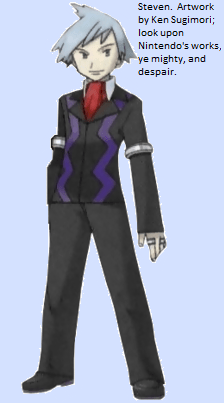
In Ruby and Sapphire, Steven is the Champion of Ever Grande City in Hoenn and the son of Mr. Stone, president of the Rustboro-based Devon Corporation, but lives in Mossdeep City, on an island in Hoenn’s northeast.  He wears neat, formal clothing, enjoys talking to other Pokémon trainers about their training style, and likes rocks.  Honestly, that’s pretty much it.  In comparison to the other Champions, Steven is really quite bland.  He seems to be a fairly quiet, analytical sort of person, and he often comes across as rather distant, particularly when he shows up near the end of Heart Gold and Soul Silver.  He’s plainly quite adventurous, but he travels alone and doesn’t seem to spend much time around people.  In fact, he steps down from his position at some point, so that Wallace becomes the Champion instead in Emerald version, possibly because he dislikes the attention and would prefer to spend his time looking for interesting rocks.   This is all absolutely fine in its own way, and there’s something appealing about the idea of an unassuming Champion – you can see Lance coming a mile off, whereas this guy isn’t nearly as blatant.  You’re not exactly surprised when you walk into the Champion’s room and find Steven there, since he was involved with saving the world during the game’s climax (albeit in an extremely vague advisory capacity); it’s more that there’s a moment of “oh, hey, it’s this guy!  Um… what was his name again?” …which is the problem, of course.  Steven is an incredibly forgettable character.  Heck, I barely remember him and this is my schtick.  His involvement in the story in Ruby and Sapphire is minimal.  You first meet him when you bring him a letter from his father while he’s in the Granite Cave on Dewford Island looking for cool rocks.  At one point you run into him on the road and exchange small talk before he wanders off.  When you reach Mossdeep City, you have another dull and pointless conversation and he gives you an item that you just happen to need to continue the story (not because he knows you need it; he just… kinda has one lying around that he doesn’t want).  Finally, when Groudon/Kyogre is awakened and begins playing havoc with Hoenn’s climate, he… talks for a while, tells you some things you knew already, and introduces you to Wallace, who actually matters.  If Ghetsis, the principal villain of Black and White, has unwittingly stumbled into Pokémon from a high fantasy story, then Steven has wandered over from an informative but ultimately rather tedious geology textbook.

Again, there’s nothing inherently wrong with the character Game Freak seem to have been trying to build with Steven.  However, the thing about quiet, aloof, intellectual loners is that, in real life, they’re not usually the most memorable people in a room unless you spend a bit of time with them, and this holds true here as well.  You have to be careful with your characterisation if you want to portray someone like this as anything other than hopelessly dull and, let’s face it, deep characterisation is not Pokémon’s strength (larger-than-life characters who can make a big impression in a short space of time, like Alder from Black and White, tend to fare better).  Ideally, for Steven to make a proper impact and not be boring and forgettable, we would need to work with him on something important to him, or see him become emotional about something (or, alternatively, not become emotional about something we’d expect him to), or at the very least get some dialogue out of him that isn’t the hopelessly generic “so, since we’re both trainers, why don’t you tell me what you like about Pokémon?” drivel he produces when you meet him on the road.  One of the little extra bits you get in Emerald that Ruby and Sapphire don’t have is a battle with Team Magma in the Mossdeep Space Centre, in which Steven fights at your side; you’d think the extra screen time would help, and… well, I guess it does reinforce that he’s not a big talker; considering how much dialogue the Team Magma leader, Maxie, has in that scene, Steven says remarkably little in response.  Honestly, the impression I get is that such a trivial thing as the plot is of relatively little significance to him, and he’s just annoyed that it’s happening on his island (come to think of it, since Mossdeep would’ve been one of the first places to be hit by the weather disturbances caused by Groudon and Kyogre during the climactic sequence, that could easily be his motivation for everything plot-related he ever does).  Left to his own devices… well, in Emerald, he just wanders off to the top of Meteor Falls to look for more rocks after the story’s over, where he becomes a ‘bonus boss’ along the lines of Red from Gold, Silver and Crystal.  His words to you when you speak to him?  “Do you maybe… think of me as just a rock maniac?”
 
Yes, Steven.  Yes, we do.

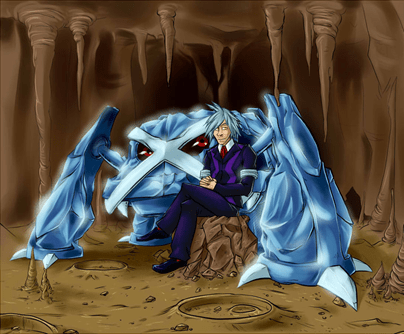
In this piece of fanart by Wildragon, Steven, his hair a little ruffled but his clothing immaculate as always, takes a break from rock-hunting in Meteor Falls with his strongest Pokémon, the steel behemoth Metagross, at his side.  If you like what you see, check out Wildragon's DeviantArt page, http://wildragon.deviantart.com/.

Contrary to what his obsession with rare stones might lead you to expect, Steven is not actually a Rock Pokémon trainer; he describes himself as a Steel-type specialist, although only three of his six Pokémon are Steel-types: Skarmory, Aggron, and his signature Pokémon, Metagross (who hits like a truck and, if you’ve never seen one before, has weaknesses that aren’t all that easy to figure out).  With Forretress, Steelix and Scizor unavailable in Ruby and Sapphire, there aren’t actually enough Steel Pokémon to assemble a full team of them.  He could conceivably have used Magneton, and a second Aggron wouldn’t have been too big a stretch, but the only other Steel-type around at this point is Mawile, and I think on some level Game Freak recognised that Mawile is not a Pokémon anyone should be forced to use, ever.  The composition of the rest of his team, therefore, comes down to what I was saying last time about choosing Pokémon that are ‘thematically appropriate,’ even if they aren’t necessarily from the right element.  Armaldo and Cradily are Rock-types, of course, but even among Rock Pokémon they are peculiarly suited to Steven since, as extinct Fossil Pokémon, Steven’s Cradily and Armaldo would have been resurrected for him from rocks – one imagines he found their fossils on one of his geological excursions and brought them to the scientist who studies that very technology for his father’s company.  Claydol is harder to place (Lunatone or Solrock might have been a better fit given their association with meteorites; on the other hand they’re much weaker than Claydol and perhaps not appropriate for a Champion) but again has shades of something he could conceivably have simply collected while exploring – Claydol and its juvenile form, Baltoy, are ancient ceramic figurines brought to life by mysterious forces; a dormant Baltoy is just the sort of thing Steven might decide to pick up whether he recognized it as a Pokémon or not.  The practical result of all this is that Steven has a team that not only makes sense for him personally but is far more diverse than anything his subordinate Elite Four have managed to put together – each of them has not one but two weaknesses shared by their entire teams (with the exception of the Kingdra Drake uses on Emerald, who has only one weakness, and Phoebe’s Sableye, who has no… well, no specific weaknesses).  You’d be hard-pressed to find such a magic bullet for Steven, which, in part, is testament to how difficult it is to inflict meaningful harm on Steel-types anyway, but still a point in favour of his team composition.
 
I always talk, quite deliberately, about two sides to everything: on the one hand, you have design, portrayal, character and story, and on the other, you have abilities, strengths and weaknesses, and how something is put together in terms of game mechanics.  With Steven, I think Game Freak have done a fairly depressing job on the former, and a surprisingly good one on the latter (his Aggron notwithstanding – I mean, yes, I know it looks cool, but you just don’t teach Dragon Claw, Thunder and Solarbeam to a Pokémon with a special attack stat normally reserved for root vegetables).  Despite my deep-seated conviction that he’s frightfully boring as he stands, having given Steven a closer look in the course of writing this entry, I’ve come to believe that he would be a very interesting character in a game that was actually character-driven, but, as I said, Pokémon tends to do a better job with eccentric, over-the-top people… who return in force when Wallace becomes Champion in Emerald…

Champions of the Pokémon League, Part 2: Lance

At some point after Blue loses the title of Champion to Red, the player character of the original games, Red buggers off to spend the next few years sitting at the top of a godforsaken mountain in the middle of nowhere gazing into the distance as the snow gradually piles up around his ankles.  Blue has evidently lost interest in the Championship by this point, which leaves the top spot open.  Eventually – whether this happens by election, or contest, or promotion is unclear – the position falls to the most senior member of the Pokémon League’s peerless death squad, the Elite Four: an eccentric dragon master from Johto by the name of Lance.
 
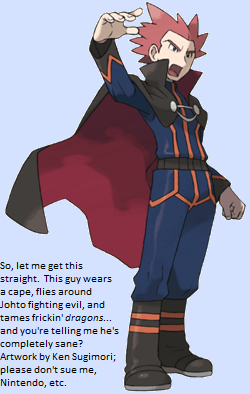
Never without his trademark cape (of which, rumour has it, he owns several), Lance is a proud, confident young man with absolute faith in his Pokémon – and justly so, since his “virtually indestructible” Dragon-types are among the most powerful Pokémon in the world.  In Red and Blue, where Lance appears as the leader of the Elite Four, that’s pretty much all we learn about him, but he gets more characterisation along with his more important role in Gold and Silver, and extra titbits of information pop up in the remakes of both sets of games.  The cape isn’t just an affectation; Lance is basically the closest thing in Johto to a superhero, flying around the region on his Dragonite, investigating suspect activity, righting wrongs, fighting for justice and being a general all-around good guy, if a somewhat overly dramatic one.  When Team Rocket shows up in Mahogany Town and causes trouble by forcing all the Magikarp in the nearby Lake of Rage to evolve into Gyarados, Lance follows along to sort them out, revealing the entrance to their hideout for you and figuring out what they’re up to.  Once he’s conscripted you as his partner in the investigation he gets surprisingly lazy about everything and leaves you to do most of the fighting, in spite of his vastly greater power and experience, although he comes through for you in the end when you’re attacked by the hideout’s commanders.  Based on what he has to say on the subject, this could be out of a desire either to test your potential or to let you have your share of the glory.  Alternatively he might have snuck back to the Lake of Rage while you weren’t looking to see whether there was another red Gyarados in the area.  You know he totally wanted it for himself.  After his intervention in Mahogany Town, it’s striking that Lance doesn’t make an appearance in the far more dramatic crisis of Team Rocket’s later takeover of Goldenrod City.  In fact, it’s striking that no-one at all bothers to do anything when they put the entire city under lockdown and start broadcasting their plans on national radio.  I can understand the local police being overwhelmed, and the Goldenrod Gym seems to have been barricaded with the Gym Leader, Whitney, and all her minions inside, but I would have thought that the repeated and insistent public radio announcements might draw a little attention from outside the city.  Did Lance really have better things to do that evening than liberate a city from a villainous organization planning to take over the whole damn country?  Was he ironing his cape?  Dyeing his hair?  Doing naked bloody cartwheels in the flipping moonlight for a pagan fertility ceremony?

Sorry.  I’m allergic to plot holes; they set off my cerebral haemorrhaging.

Anyway.  Lance.
Various characters across various games can tell us a few more things about Lance.  He’s a member of the ancient family of Dragon Pokémon trainers who rule Blackthorn City, and the cousin of the Gym Leader, Clair (who has all of Lance’s pride and elitism with none of his compassion or honour).  He apparently commands a great deal of respect there and seems to be by far the strongest trainer his clan has produced in a generation; the very suggestion of his displeasure is enough to shut Clair up when she refuses to hand over the Rising Badge after being defeated.  Lance’s clan regard Dragon Pokémon as sacred, treating them with reverence because of their boundless life energy, and only allow their members to train dragons once they have proven themselves “worthy.”  Given this background, Lance’s utter conviction in the supremacy of Dragon-types makes a great deal of sense.  The dragon-user characters of Blackthorn City are an interesting bunch, and one of the many things in this world I’d rather like to see developed more – where did their beliefs originally come from, and what is it that makes Dragon Pokémon so special?

A scene from the Pokémon Adventures manga, with colour and additional details by Djinnjo (http://djinnjo.deviantart.com/). Lance is here accompanied by his team from Red and Blue, and appears markedly more youthful than in his later incarnations.

Those of you who’ve fought Lance in Gold, Silver or Crystal (or the remakes) probably remember one thing about him more clearly than anything else: Lance is a cheating bastard.  As any truly dedicated Pokémaniac knows, Lance’s signature Pokémon, Dragonite, evolves from Dragonair at level 55.  Lance’s strongest Pokémon in those games is only level 50, yet he has not one but three of the damn things, two of them as low as level 47.  You could probably handwave this by saying that Lance’s heritage and upbringing give him special insight into training Dragon Pokémon, but I prefer to say that he’s a cheating bastard.  Fudging the numbers like that really was necessary, though – by this point, you’ve already fought Clair, who uses a trio of Dragonair (two Dragonair and a Gyarados on Heart Gold and Soul Silver), so more of them would get repetitive, not to mention a bit easy, since Dragonair starts to get quite lacklustre in the high 40s and early 50s compared to the other Pokémon that have reached their final forms already.  Funnily enough, however, this is not the only reason Lance is a cheating bastard, just the most obvious.  He also has a history of teaching his Pokémon attacks that they can’t actually learn.  In Gold, Silver and Crystal, Lance’s Aerodactyl knows Rock Slide, which Aerodactyl doesn’t get in those games (he can learn it from Ruby and Sapphire onward, but in Red and Blue this made him profoundly useless because he had no decent attacks from his own types).   There’s absolutely no reason, thematically speaking, that Aerodactyl shouldn’t learn Rock Slide, and I think what happened is that the designers thought he could learn it and didn’t bother to check, which just goes to show that some of Game Freak’s decisions regarding which Pokémon should learn which attacks make so little sense that even they don’t understand them (see also: Aerial Ace).  In this case, Lance’s cheating bastardry is merely correcting an unfortunate oversight anyway.  In the case of his Dragonite from Red and Blue inexplicably knowing Barrier, which has never been a TM, which Dragonite has never been able to learn by any means, and which isn’t a markedly appropriate move for Dragonite to have anyway, especially considering that Dragonite, compared to Aerodactyl, has a vast movepool… yeah, I’ve got nothing on that one.
 
The vaguely interesting thing about Lance’s line-up is that, for a Dragon master, he doesn’t actually use all that many Dragon-types – principally because there weren’t all that many in Gold and Silver.  Other than Dratini, Dragonair and Dragonite, the only true Dragon available was Kingdra – and Kingdra is already Clair’s signature Pokémon, so Lance can’t easily get away with using her.  As a result, Lance fills out his team with Pokémon that aren’t really Dragons but look like they should be: Gyarados, Aerodactyl, and Charizard.  Oddly enough, I like this – choosing Pokémon that are thematically appropriate to a given trainer rather than necessarily being restricted to ones of that character’s favoured element – because it adds a bit of depth to team composition and makes trainers a bit more interesting, but it’s something that Game Freak generally avoid, and they seem to have gotten worse at it lately.  Compensating for the small number of Dark-types in Gold and Silver by giving Karen a Vileplume and a Gengar, two Pokémon strongly associated with night, made sense.  Compensating for the miniscule number of Fire-types in Diamond and Pearl by giving Flint a Steelix, a Drifblim and a Lopunny, three Pokémon that… randomly happen to learn one Fire attack each… didn’t.  I really think Game Freak would have benefitted from taking a close look at some of the line-ups used by trainers from the first two sets of games (Lance is just one example) and giving some serious thought to which choices made sense and which ones didn’t, because often the most obvious answer isn’t the only one.
 
That’s all I think there is for me to say about Lance, really.  He’s the first ‘sitting’ Champion we get to see, and therefore our first introduction to the responsibilities of the position, a theme that comes up a fair bit in Black and White.  Together with Clair, he also did a lot of the work of defining what the Dragon type means in the world of Pokémon, which is kind of important, given how vague a type it really is, when you think about it.  And… okay, I guess I have to admit it, even the cape does grow on you after a while.  He’s a bit over-the-top, but that’s what makes him fun… in stark contrast to the next Champion in the series…