Are Pokémon animals or not?
…probably? Most of them?
Continue reading “Anonymous asks:”
One lunatic's love-hate relationship with the Pokémon franchise, and his addled musings on its rights, wrongs, ins and outs. Come one, come all, and indulge my delusions of grandeur as I inflict my opinions on anyone within shouting distance.
Some Pokemon like Eevee have evolutions that act like an actual evolution, some creature adapting to certain living conditions. However, most Pokemon don’t actually evolve, they just grow up; hence baby Pokemon. Bulbasaur isn’t adapting to a new environment or anything it’s just getting older, thus the bud on its back blooms and its body grows. Does this bother you at all, or do you not mind it?
Well, Pokémon evolution is sufficiently different to real-world evolution anyway that details like whether it’s ‘adaptation’ or not kind of go over my head. Darwinian evolution has no effect on individuals. Organisms cannot ‘evolve’ within their own lifetimes. Only populations can evolve. What Pokémon are doing – dramatic change within the lifetime of a single creature – is really metamorphosis; it makes more sense to compare Bulbasaur to, say, what a cicada or dragonfly does. Evolution is a bit of a silly thing to call it, I suppose, but I think I’ve been desensitised to it over the sixteen years I’ve been playing Pokémon.
The March of the Exeggutor Squad – The Problem with Paras – Attack of the Prehistoric Pokémon
Ash’s location: Belgium.
I have way too much to talk about in this entry so I’ll just get going.
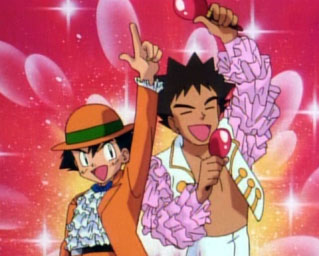 Ash, Pikachu, Misty and Brock find a carnival! Hooray! Ash and Brock promptly get changed into… I don’t even know. Frills. Misty and Pikachu, in a fit of embarrassment, ditch them and run into a down-on-his-luck magician named Melvin and his Pokémon partner, an Exeggcute. Misty foolishly agrees to fill in as his beautiful assistant for a little while… and is mortified when Ash and Brock turn up to watch the show. Melvin has zero stage presence, lacklustre juggling skills, and a fire spell that singes the audience and sets off the tent’s sprinkler system, causing everyone to leave in disgust. Ash tells Melvin not to give up, and devises his own magic act by stuffing his Pokémon into a chest and pretending to conjure fire and water. Misty watches in mock amazement until Charmander accidentally sets the others on fire and the whole thing dissolves into chaos. Ash notes that Exeggcute doesn’t do much… so the Pokémon uses Hypnosis to turn Ash into Melvin’s obedient mind-slave. They run off into the nearby Leaf Forest, without Brock and Misty, where Ash helps Melvin to capture a herd of Exeggutor, so he can brainwash people into… enjoying his magic show. Dream big, Mel. Dream big. Team Rocket appear and capture the ineffectual magician, and his Exeggcute evolves to save him, but unfortunately his newfound powers drive the other Exeggutor insane and start a stampede. By the time Misty and Brock find Ash and get him back to the carnival, the ringmaster has planted a bomb to destroy the rampaging Exeggutor before they cause too much harm. Ash quickly realises that only Charmander’s fire can snap them out of their trance, but Charmander isn’t strong enough to deal with all of them at once. Misty convinces Melvin that his fire spell WILL work if he really tries, and he does, and it does. The stampede ends, the Exeggutor go home, un-exploded, and Charmander is rewarded for his perseverance by evolving into Charmeleon.
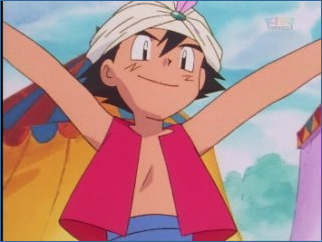 I really have only a couple of minor points to bring up for this episode. The first is that Hypnosis, which in the games just puts Pokémon to sleep, is used here (as in some other episodes) as a mind-control power. The fact that a power of this nature exists is clearly awesome, if a little worrying. The second is that Melvin’s Exeggcute apparently manages to evolve without the use of a Leaf Stone, as did, presumably, all the other Exeggutor in the herd. No-one questions this at the time; Ash is too stoned to care, Melvin probably doesn’t know how Exeggcute are supposed to evolve anyway, and Brock and Misty aren’t there. I can think of three explanations for this. 1) The writers screwed up… and, let’s be honest, this one has Occam’s Razor on its side here. 2) Stones aren’t the only way to make Pokémon that use them evolve; they’re just the easiest way, which, of course, massively affects the arguments in play in Electric Shock Showdown and the Battling Eevee Brothers. 3) The area is named the “Leaf Forest” because there are actually Leaf Stones buried there, or crushed and mixed through the soil, or something similar, and these unusual conditions allow Grass Pokémon to evolve there when they wouldn’t otherwise be able to (years later, it was established in an episode of the Johto series that Leaf Stones and Sun Stones can in fact remain potent if crushed and distributed on the wind, though obviously the writers of this episode didn’t know that yet). You may decide for yourself which seems most likely.
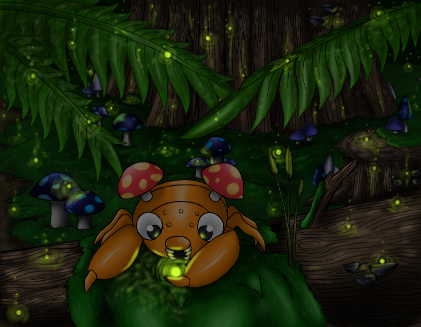 A few days later, near a hick town called Mossgreen Village, Meowth succumbs to a terrible fever. Jessie and James shrug; “he’s got eight lives left.” They are approached by a woman called Cassandra, who admonishes them for not taking better care of him and gives them some powerful medicine to cure the fever. Meowth, who has a bit of a human fetish, immediately falls in love with her. Later, looking for a Pokémon Centre and finding none, Ash himself meets Cassandra and learns she has a problem. Cassandra and her grandmother run a small shop selling herbal medicines, and she wants her Paras to evolve into a Parasect so she can use his spores in creating new miracle potions, but he’s too cowardly to fight, and can’t gain any experience points. Ash tries to challenge Cassandra and throw the match, but even the tiniest spark from Pikachu and the gentlest spray of water from Squirtle send Paras reeling… and then Ash tries Charmeleon. Charmeleon has no interest in toning things down and chases Paras off with a Flamethrower. In the woods, Paras falls in with Meowth. Meowth thinks that Cassandra will love him if he helps Paras, and drags Jessie and James into the scheme with promises of the vast wealth Cassandra’s miracle potion will bring. He quietly sabotages Arbok and Weezing when they battle Paras, and then pretends to faint from a gentle poke. Drunk on Exp., Paras goes to challenge Pikachu to a rematch, which Pikachu throws once again, this time successfully. Charmeleon remains unruly, but Team Rocket show up to cheer for Paras, who manages to stab Charmeleon into submission and evolves into Parasect at last, before finishing Charmeleon off with Spore. Unfortunately for Meowth, Cassandra refuses to take him on as the mascot of her company – she could never break up his team! Besides, her grandmother has just dragged in a random wild Persian that will serve just as well.
The Problem with Paras is a weird episode. It’s one of a scant handful of episodes that explicitly mention “experience points,” and seems to go out of its way to imply that they work exactly the same way as they do in the games, which is so counterintuitive it becomes absurd. How on earth is Paras ‘gaining experience’ or becoming stronger in any concrete sense by repeatedly having his ass saved by Meowth in his battles with Arbok and Weezing? The whole thing seems like a reference to the way we normally train weak Pokémon in the games – if you switch a Pokémon out of a battle, it will still gain an equal share of experience points, however little time it spent actually fighting (if any), but I doubt anyone thinks of this as anything more than an abstraction designed to simplify gameplay. I am convinced that this episode is actually a stealth parody of the whole concept of experience points. The repeated direct references to “experience points” are just so blatant, so far out of step with the series, and draw so much attention to the absurdity of what they’re doing that I really don’t see how they can be meant seriously. What’s actually going on here, then? The episode becomes far less logic-defying when viewed through the lens of evolution being a largely psychological phenomenon, which has always been hinted to be the case. Paras isn’t kept from evolution by needing more of some kind of abstract ‘points’ which are accrued when a Pokémon is formally declared the winner of a battle; he’s kept from evolution by a major psychological block, born of his own conviction that he is a poor fighter. When Paras appears to defeat Arbok, Weezing, Meowth and Pikachu, these false victories – although they do nothing to increase his actual strength – allow him to imagine himself as a winner (this remains true even if Paras is actually aware, subconsciously, that his victories are being staged; it’s still possible for him to become immersed in the fantasy). The lucky shot he gets in against Charmeleon finally pushes him over the threshold, causing him to realise that there’s no physical reason for him not to have evolved a long time ago.
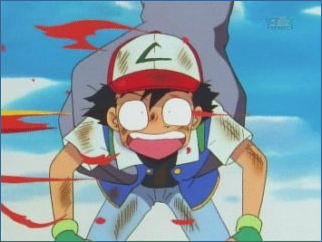
So, now that we’ve seen Charmander become Charmeleon, and his reaction to his newfound powers, let’s see how he gets the rest of the way. It all starts when Ash runs into Gary, who has joined in a Pokémon Fossil Rush at Grandpa Canyon. Because Ash and Gary compete over everything, Ash joins the dig as well. Team Rocket are lurking nearby as well, and planning to dynamite the whole place so they can scoop up the fossils at their leisure. Ash finds them and, one botched explosion later, he, Pikachu, Jessie, James and Meowth are trapped in an underground cavern, surrounded by supposedly extinct Pokémon. Pikachu’s electrical powers prove ineffective against the fossil Pokémon, so Ash brings out Charmeleon… who settles down for a nap. Luckily, the fossil Pokémon hear something that scares them off. Unluckily, that something is an Aerodactyl, who clocks Charmeleon on the head, grabs Ash, and breaks out through the roof of the cave, with Pikachu and Charmeleon clinging to his tail. Once they’re on the surface, Charmeleon challenges Aerodactyl, who just taunts him and flies away with Ash. Charmeleon decides he will take no more of this; he wants his wings NOW. He evolves into Charizard and pursues Aerodactyl through the sky, sniping him with Flamethrowers. Ash is overjoyed until he realises that Charizard will happily write him off as collateral damage. Misty realises the same thing, finds Jigglypuff, and convinces her to sing Aerodactyl and Charizard down. Aerodactyl drops Ash and falls back into the caverns, while Charizard grabs Ash as he falls and sets him down on the ground before falling asleep himself. When everyone wakes up, Officer Jenny #869 declares that IT WAS ALL A DREAM AND WE ARE SHUTTING DOWN THE SITE NOW BECAUSE OF REASONS. Ash remembers, though… and suddenly has a mysterious red- and blue-spotted egg in his possession…
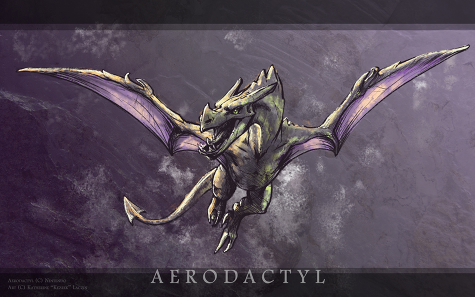
First things first: this episode is basically the poster child for evolution being triggered by psychological factors. There is no way Charmeleon has gotten from level 16 to level 36 in three episodes; he evolves not by gaining experience but through a supreme act of will, brought on by his overwhelming desire to reduce Aerodactyl to cinders. What I really want to talk about, though, is Charmeleon’s character development. Ash is astonished by Charmeleon’s sudden disobedience in the Problem with Paras, which Cassandra’s grandmother puts down to Ash’s own insufficient skill and Charmeleon’s lack of respect for him. It’s true that, by game logic, Charmeleon is an ‘outsider’ and can’t be expected to obey Ash past a certain level, but considering Ash’s strong relationship with his Pokémon, and the fact that Charmander was always so nice, it’s still a striking turnaround. There is a hint at the end of March of the Exeggutor Squad that Charmeleon is going to be quite a handful, but I think the problem really starts in the next episode. Charmeleon has just evolved, and was already Ash’s strongest Pokémon aside from Pikachu. He was probably expecting to face ever stronger opponents in his new form… but instead, for his very first battle after evolving, Ash sends him against a cowardly weakling Paras, and tells him to go easy on it. I think he found this unbelievably insulting, and was still in a bad mood when Ash called on him in Grandpa Canyon. When he was able to evolve into Charizard all on his own, he came to the conclusion that he simply didn’t need Ash anymore, and decided to act accordingly until Ash was prepared to treat him with more respect. Notably, though, he does have the presence of mind to catch Ash when Aerodactyl drops him, and bring him safely to the ground, even as he’s drifting off to sleep himself. He still regards Ash as his human, and clearly still feels he has some responsibility to him. I suggested in a recent entry that Ash’s relationship with his Pokémon has an almost parent/child cast to it; this works with relatively few problems when his Pokémon are small and cuddly, but grows problematic when they take on more mature, powerful forms. It takes sixty episodes before he and Charizard finally start working as a team again.
The Battling Eevee Brothers – Bulbasaur’s Mysterious Garden
Ash’s location: central Anatolia.
Evolution is one of my favourite themes. It’s apparently a very simple concept, but the way it’s treated in the anime has all kinds of fascinating implications that you can draw into an extremely complicated and morally nuanced vision of how this world works. As usual, much of what I have to say here is totally made up, but regular readers will know by now that I’ve never let that stop me before…
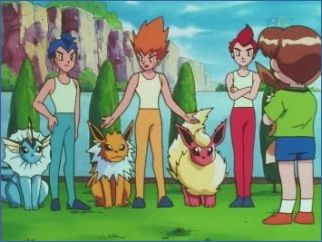
In the Battling Eevee Brothers, Ash, Misty and Brock find an Eevee tied to a tree in the woods with a bowl of food next to it. Brock suggests that the Eevee has been abandoned, at which Ash and Misty are horrified. They notice a gold tag on Eevee’s collar with an address engraved, in a place called Stone Town (at the foot of Evolution Mountain, claims Brock – three guesses what this episode’s going to be about…). Misty is tempted to keep Eevee, but they agree they should try to find Eevee’s owner first. Following Eevee’s tag leads them to an opulent manse with a spacious garden, where three triplets and their Pokémon – Rainer and his Vaporeon, Pyro and his Flareon, and Sparkyand his Jolteon – are hosting an evolution party, with free evolutionary stones for all comers. Eevee, who belongs to their younger brother Mikey, is the guest of honour; today is supposed to be the day he chooses his Eevee’s evolved form. Mikey himself is less than thrilled, and confides to Misty that he doesn’t care about battles, doesn’t actually want Eevee to evolve at all, and hid him in the woods to keep him out of sight, just until the party was over. Ash and Brock, meanwhile, argue with Rainer, Sparky and Pyro, who have offered them a Thunder Stone and a Fire Stone to evolve Pikachu and Vulpix. Team Rocket crash the party, have Weezing lay down some smog cover, and steal a dozen Pokémon, including Eevee and Misty’s Horsea, and as many evolution stones as they can carry before hightailing it out of there. Horsea, however, is clever enough to leave a trail of ink for the heroes to follow. While Jessie, James and Meowth are arguing over how to evolve Eevee (they eventually decide to use all three stones at once, just to see what happens) the good guys show up, and Vaporeon, Jolteon and Flareon give Arbok and Weezing a thrashing. Remarkably, though, Jessie and James manage to turn things around… until Mikey’s Eevee enters the fray and slams Arbok and Weezing with a powerful Take Down. As Misty had suggested, Mikey finally admits to his brothers that he’d rather just keep Eevee – and, after seeing what their brother’s Pokémon is capable of, they’re pretty cool with that.

Some weeks later, Ash’s Bulbasaur collapses, quivering, after winning a difficult battle against a hiker’s Rhyhorn, and his bulb starts glowing softly. Ash rushes him to a Pokémon Centre, where Nurse Joy #292 concludes that there’s nothing wrong with Bulbasaur at all: he’s preparing to evolve. It’ll soon be time for him to journey to a place called the Mysterious Garden, a semi-mythical grove where Bulbasaur gather every year to evolve into Ivysaur. Ash is overjoyed. That night, Bulbasaur slips out of the Pokémon Centre to brood. Pikachu follows him, and they talk for a while (Pikachu seems to be comforting him, and offering support). Without warning, a gang of wild Bulbasaur seize Ash’s Bulbasaur with their Vine Whips and carry him off. Pikachu runs to fetch Ash and the others, and together they track the Bulbasaur through the forest, even as the plants themselves try to keep them from following. They narrowly manage to slip through a solid wall of vines as it knits itself together, and find themselves in the Mysterious Garden. They see hundreds of Bulbasaur in the valley below them, singing, as the plants around them grow and blossom in moments. An ancient Venusaur emerges from within an enormous hollow tree in the centre of the valley and roars. The Bulbasaur roar in response, and all begin to evolve… except for Ash’s Bulbasaur, who seems to be struggling not to. Venusaur is furious, and Ash runs to Bulbasaur’s side to block a Vine Whip. Ash apologises to Bulbasaur for getting so excited about his evolution without considering his feelings, and tries to convince Venusaur that he shouldn’t be forced to evolve. Venusaur responds by demonstrating his miraculous abilities, causing a bare cherry tree to burst into bloom, and Misty wonders “don’t you want to have that kind of power, Bulbasaur?” As they argue, Team Rocket once again crash the party, floating over the wall of vines in their balloon and sucking up as many Ivysaur as they can with one of their ridiculous vacuum devices. The situation looks dire… until the sun rises. With a tremendous battle cry, Bulbasaur blasts Team Rocket with his first Solarbeam. The balloon is destroyed, the Ivysaur fall back to earth, and Venusaur finds it in his heart to forgive Bulbasaur for disrupting the ritual. Bulbasaur leaves with the kids as the wall of vines shrinks away, and they realise why no-one has ever been able to find the Mysterious Garden: once the ceremony ends, it simply ceases to exist.

Let’s look at some quotes from Eevee Brothers. The conversation Ash and Brock have with Rainer, Sparky and Pyro makes it plain as day that their views on evolution, particularly on induced evolution, are wildly different to the brothers’. Ash is asked “one of these days you’ll turn that Pikachu into a Raichu, won’t you?” in a very matter-of-fact tone, to which Pikachu reacts with obvious worry. The brothers also ask Brock “why don’t you just make [Vulpix] evolve?” as though it would be the easiest thing in the world – and, well, they’re offering him a free Fire Stone, so why not? After all, “evolution is what Pokémon are all about!” If you’ve been playing the games, this makes a lot of sense. If there’s a move you want your Pokémon to learn, you might hold off on evolution until it’s learnt it, because most Pokémon stop learning new attacks after using stones. In the long term, though, there’s no downside. If you mean to use a Pokémon for fighting, you will eventually evolve it, no ifs, no buts. That’s not how Ash and Brock see it. Ash tells the brothers, somewhat defensively, “we just don’t evolve our Pokémon that way,” while Brock says firmly “you like your way of evolving and we like ours.” You can read this either as making sense or as being utter bullshit. Personally I would rather read it as making sense but, y’know, to each his own. It makes sense when you think about what actually happens when Pokémon evolve; their physical bodies grow and change their proportions, sometimes drastically, and their mental state often undergoes a profound shift as well. Normally in the anime this seems to have some kind of psychological trigger; Pokémon evolve when they’re ready for it, and sometimes seem to be able to forestall evolution on their own – but when a trainer uses a stone, the Pokémon simply evolves on the spot, without any choice in the matter. It’s not really unreasonable for Ash and Brock to think that using these things is a little bit morally questionable, especially if it’s done for the sole aim of making the Pokémon in question better at battling.
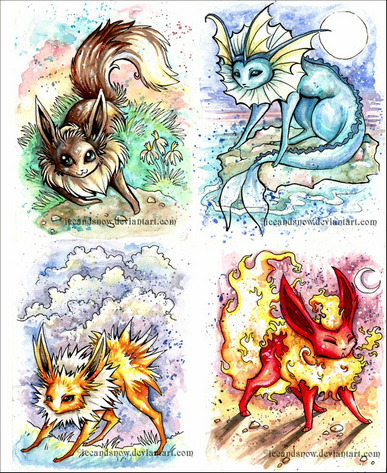 Where the argument breaks down – and where Ash and Brock’s position starts to make less sense – is that, for Pokémon like Pikachu and Vulpix, there is no other way to reach their final forms. If Ash and Pikachu aren’t willing to use a Thunder Stone, Pikachu’s never going to become a Raichu; no two ways about it. Brock’s statement suggests that he believes there is some other way for Pikachu and Vulpix to evolve, but if so, no-one ever hints at what that might be. Moreover, Ash’s statement suggests that refusing to use the Thunder Stone Sparky offers him is not simply a matter of waiting for the right time; he has absolutely no intention of evolving Pikachu at all, now, later, or ever. Surely Pokémon are supposed to reach their final forms eventually? Why else would they even have them? On the other hand, clearly evolution isn’t actually necessary for Pikachu to become an ‘adult’ since, as we just saw in Pikachu’s Goodbye, a community of wild Pikachu can get along just fine without a single Raichu. Obviously they’re capable of surviving without the protection of their more powerful cousins, and presumably they also reach reproductive maturity without any hiccups (indeed, if we can trust the games, there are very few Pokémon that do need to evolve before they can reproduce – only the ‘babies,’ such as Elekid and Bonsly). My newest pet theory on this is that Pikachu’s ability to evolve into Raichu is actually vestigial. At some point in the history of their development, for one reason or another, they stopped needing to evolve (maybe Pikachu fill an ecological niche that Raichu are less suited to, or maybe some kind of Ground-type predator made speed and small size more valuable than greater electrical power). They still have all the genes they need to become Raichu, but they’ve lost the genes that tell them when and why to evolve, so unless they’re triggered by some outside influence, they just don’t. Basically, what I’m suggesting is that Pokémon like Raichu, Ninetales and Poliwrath are throwbacks – forms that have become extinct in the wild, because they’re no longer suited to a changing ecosystem, but can be recreated via human intervention. That definitely leaves Ash and Brock plenty of room to feel a little bit uncomfortable about evolutionary stones, especially if the Pokémon have no choice in whether to use them.
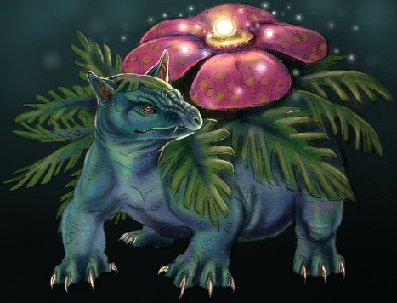
The degree of choice Pokémon have in when they evolve is another tricky question that the anime implies things about, but rarely explains outright. Most of the evolutions we’ve seen in the series so far have happened at moments of high emotion; it’s often implied that they’re triggered by strong desire or need – most notably, Ekans and Koffing evolving in Dig Those Diglett, in response to their trainers’ uncharacteristic outbursts of affection. Bulbasaur, it seems, are very different. They have little freedom to decide; evolution, for them, is an extremely ritualistic thing that all of them go through together – to the point that, when Ash’s Bulbasaur decides he doesn’t want to evolve, he provokes the outrage of the entire community. That isn’t merely because his refusal somehow disrupted the ceremony either. The scene between Bulbasaur and Pikachu is a little tricky to interpret because, y’know, they don’t speak, but I’m pretty sure that Bulbasaur is explaining to Pikachu that he doesn’t think he really wants to evolve yet, but doesn’t want to disappoint Ash either, and Pikachu is telling him that it’s okay and Ash will be cool with it. The other Bulbasaur who overhear the conversation are apparently so discomforted by the whole idea that they immediately kidnap him and drag him to the Mysterious Garden. Venusaur isn’t just upset about the ritual; he and all the Ivysaur are actually somehow offended that Bulbasaur doesn’t want to evolve. For them, it’s the most natural thing in the world, the way they attain the powers that are their birthright, and trying to deny it is just asking for trouble. Of course, if that’s how they do things, where the hell does Ash get off trying to stop them? Or, conversely, if we do let the Bulbasaur get on with their strictly enforced mass evolution ceremonies in peace, what kind of ground are we standing on if we say that Mikey’s Eevee shouldn’t be forced to evolve?
I could go on, you understand. It’s just that this entry is clearly getting far too long.
Electric Shock Showdown
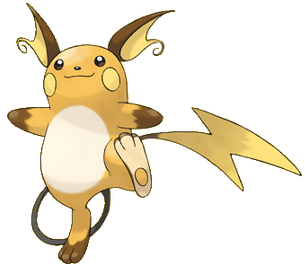
Oh, the excitement! Ash is on a roll, and now he’s in Vermillion City for his third Gym battle! Oh… but we forgot to mention… the Vermillion Gym Leader, Lt. Surge, is a total nutcase who’s hospitalised sixteen Pokémon in the past month. Pikachu doesn’t like the idea of fighting this crazy person, but Misty taunts Ash for the two pity Badges he collected in Pewter City and Cerulean City, and that’s the end of that. Ash and Pikachu, with Brock and Misty in tow, march up to the Vermillion Gym and demand a battle with Lt. Surge, a jovial but condescending fellow who, for some reason, assumes that Misty is the challenger, even though Ash is the one standing front and centre in their group (does he really present such an unimposing figure?). Surge thinks the idea of Ash challenging him is hilarious, and laughs even louder when he sees Pikachu, calling them both “babies.” Surge calls out his own signature Pokémon: a Raichu, Pikachu’s evolved form, whose electrical powers are vastly superior to Pikachu’s. “Electric Pokémon,” Surge claims, “are only useful once they learn all their Electric attacks,” so Ash should have forced Pikachu to evolve at the first possible opportunity to maximise his power, like Surge did. Pikachu’s doubts about the battle evaporate when Surge and Raichu taunt him, and the match begins. Raichu quickly demonstrates that she has Pikachu totally outgunned, ignoring his relatively paltry Thundershocks and hitting back with a blast that nearly knocks him out cold. Pikachu doggedly keeps fighting, but Raichu just starts tossing him around the field with her superior physical strength and Ash has to surrender to keep him from being beaten up any further. While Ash and the team regroup at the Pokémon Centre, Nurse Joy #98 overhears their conversation and randomly decides to offer Ash an incredibly valuable Thunder Stone, which would evolve Pikachu into a Raichu – no strings attached, though she cautions them to think carefully about it, since evolution is irreversible. Ash doesn’t think he wants Pikachu to evolve just to fight, but decides to leave it up to him. Pikachu slaps the Thunder Stone away and gives an impassioned speech; Ash, of course, doesn’t understand a single word, but Meowth translates for Jessie and James, who are spying from the window: he wants to fight Raichu again to defend the honour of all Pikachu. Ash, with a suggestion from Brock, devises a new strategy while Pikachu recovers, and as soon as they’re both ready, they head back to the Vermillion Gym. On the way they run into Team Rocket, who have come to cheer for them – Jessie and James have realised that if Pikachu loses, then all the effort they’ve spent trying to steal him will have been a waste, so they do a strange little dance with a morale-boosting chant, then run away. These guys already have way too much emotional investment in stalking the kids and Pikachu, and we’re only a few weeks in… at this rate they’re going to be basket cases by the end of season one. Anyway, Ash and Surge have their rematch, but this time, Pikachu makes use of his one big advantage over Raichu: she has greater physical and electrical strength, but he’s a lot faster, and can evade most of Raichu’s physical attacks like Mega Punch and Body Slam. Surge gets annoyed and commands Raichu to blast the whole stadium at once with her Thunderbolt so Pikachu can’t dodge, but when the dust clears, Pikachu is… standing on his tail, perfectly unharmed, having discharged all the electricity through it and into the ground. Raichu tries to attack again, but she’s all out of power and has to go back to physical attacks. Pikachu gives her the run-around until she can’t keep fighting any longer, then finishes her off. Lt. Surge admits defeat and gives Ash his Thunder Badge, they shake hands, Ash and Pikachu celebrate, and Team Rocket wander off into the sunset, realising too late that “we wasted this episode cheering for the good guys!”
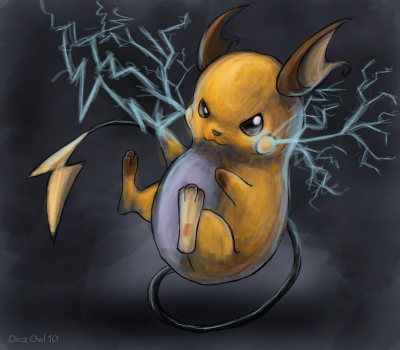
So, if you’ve been paying attention to my anime reviews so far, you’ve probably guessed that I’m interested in Electric Shock Showdown because of Pikachu’s refusal to evolve. In the end, this is how he beats Raichu – in the games, Pokémon that evolve using stones normally stop learning attacks, which is why Raichu, who evolved before learning Quick Attack or Agility, was so much slower than Pikachu. If we’re just thinking in terms of the ability to learn new attacks, though, why not evolve Pikachu after the battle? He’s already learnt the speed techniques that gave him an edge over Raichu, and (as long as we’re going by the logic of the games here) evolving won’t cause him to lose those techniques, so surely he’d have the best of both worlds? It’s plausible the anime is taking the position that Pikachu are, universally, capable of quicker and more precise movements than Raichu, which really does make a lot of sense if you just take your eyes off their in-game stats for a moment. I think it’s also plausible that Pikachu might have more endurance than Raichu; notice that, in the second match, Raichu’s pretty much done after one good Thunderbolt – she burns twice as bright, but half as long. However, tactical considerations are clearly not what’s occupying Ash’s mind when Nurse Joy offers him the Thunder Stone. In general, Ash, Brock and Misty seem to take the view that using a stone to evolve a Pokémon constitutes forcing it to evolve, which seems fair enough, on the face of it. Assuming my previous wild inferences are correct, most Pokémon evolve when they are psychologically ready for the change, which is more or less voluntary. Using a Thunder Stone or similar item, on the other hand, takes the choice out of the Pokémon’s hands and puts it firmly in the trainer’s. This is something of an ethical tangle in itself but it actually isn’t the main question here, because Ash, who doesn’t like the idea of forcing Pikachu into a massive and permanent physical and psychological metamorphosis, leaves it up to Pikachu. The main question here is why, when given the opportunity to decide for himself, does Pikachu refuse evolution?
Back in Ash Catches a Pokémon, Caterpie wanted nothing more in all the world than to become a Butterfree. As I noted at the time, though, Caterpie is, well, a caterpillar, and the whole purpose of his existence is to prepare for evolution. I suppose it’s not impossible to imagine a Caterpie who is perfectly happy being a Caterpie and never becoming an adult, but I doubt that’s common; most of them probably assume that succeeding in life entails evolution. The only other evolution we’ve seen in the series so far is Clefairy evolving into Clefable in Clefairy and the Moon Stone, which I kind of skimmed over at the time. Like Caterpie, the Clefairy are something of a weird little corner case as far as the psychology of evolution goes, because of their strange relationship with the Moon Stone, the meteor which (according to the conspiracy theorists) first brought them to Earth. The Clefairy worship the Moon Stone and perform ritualistic dances around it while singing and praying. We also see them gathering up shards of the meteor and collecting them in a central chamber around the main stone. Their reverence for the stone doesn’t seem to be related to any desire to evolve (in fact, they don’t even evolve when they hold the shards), but then again, they don’t seem to be particularly upset when they wind up Metronomesploding it into a million pieces, so I guess they took it as a consolation that a bunch of them evolved when the pieces touched them. Maybe they have a concept of fate and didn’t evolve themselves using the Moon Stone earlier because it wasn’t “the right time”? The Clefairy are inscrutable by design and trying to probe their motivations makes my head hurt, but we can at least say that they aren’t upset by the idea of evolving due to a chance event at a time not of their own choosing. I suspect they may be unique in this, though, because of their unusual relationship with their Moon Stones. In the games, Pokémon that have evolved using stones typically don’t exist in the wild; that type of evolution normally requires human intervention to bring the Pokémon and the stone together. Assuming this holds true in the anime as well (which, granted, is quite an assumption), Pikachu may not consider Raichu a natural evolution of his species, but rather a form specifically modified by humans to be better at fighting (not unlike Mewtwo – assuming Pikachu doesn’t understand the science involved, what would the difference be from his perspective?). He might even think of Raichu and other Pokémon like them as sell-outs, which would explain why the whole thing seems to be a point of pride for him.
Another, possibly complimentary, explanation is that the anime simply makes certain basic assumptions about evolution, and particularly the use of evolutionary stones, that the games do not. With the exception of The School of Hard Knocks (in which Joe has to memorise trivia like “Pidgey evolves at level 18”) the anime is generally extremely vague about the concept of “level;” it’s possible that Pokémon in the anime can, or believe they can, continue to grow stronger without limit, in which case the Thunder Stone would only be a quicker and easier way to power Pikachu would also be able to earn with hard work. Remember also Meowth’s odd comment in Ash Catches a Pokémon about Pikachu’s power “exceeding its evolutionary level;” on the one hand, yes, it’s Meowth, on the other hand, he seems to be suggesting Pikachu could be, or could become, even stronger than a Raichu. Equally, it might be the case that the stones are not the only way for Pokémon like Pikachu to evolve – or, again, that he might believe they aren’t. When you think about it, this makes a lot of sense; a species that can’t reach adulthood without access to rare substances found only in certain areas would be pretty odd, especially given that most Pokémon that use stones can’t dig for them. If this seems fishy given what we know from the games, consider that Electric Shock Showdown was made fairly early in the franchise’s life, when it might not have been at all clear which – if any – of the rules laid down in Red and Blue would remain immutable as (or, for that matter, if) the franchise matured. I think the theory is fairly consistent with Pikachu’s behaviour during and after this episode; he could use the stone to provide the surge of energy he would need to evolve right now, but believes he could eventually evolve in his own time – if he ever even needed to – and doesn’t want to take the ‘easy way out’.
Whether he is correct or not, I leave as a question for the reader.
Ash Catches a Pokémon – Challenge of the Samurai

These two episodes record Ash and Misty’s journey through Viridian Forest, during which Ash captures his first two wild Pokémon: Caterpie and Pidgeotto. Pidgeotto really isn’t very interesting; he’s mostly a utility Pokémon who turns up whenever Ash needs to take advantage of his flight, and I don’t think there are any episodes that focus on Ash’s relationship with him (until, amusingly enough, the episode where he finally evolves into a Pidgeot and promptly ditches Ash to go hang with his old flock). He does serve as an illustration of the kind of rapport ‘normal’ trainers and Pokémon tend to have, which I guess is useful in its way because Ash’s relationships with most of his other Pokémon are anything but normal. For me, though, Pidgeotto is probably Ash’s most forgettable Pokémon. Caterpie is much more fun to talk about so I’ll probably spend most of this entry on him.
Ash effortlessly catches Caterpie right at the beginning of the imaginatively titled third episode, Ash Catches a Pokémon, and it quickly transpires that Misty cannot stand the poor thing, even though he’s immediately very affectionate towards her. This deserves comment in itself because Pikachu seems to be very trusting of Misty as well (although the business with the Spearow in I Choose You was a good start, he’s going to remain somewhat aloof, though no longer disdainful, towards Ash for quite a while yet), which suggests to me that they both instinctively recognise her longer history and deeper experience as a Pokémon trainer; Caterpie is quickly rebuffed by Misty’s open disgust for Bug-types, though (as well as by the ludicrously oversized mallet she apparently keeps in the back pocket of her shorts). Ash tells Misty to go away if she doesn’t like Caterpie, but she continues to follow them out of a stubborn desire to make sure Ash pays her for her ruined bike and they eventually share a campsite. Ash and Misty go to sleep but Pikachu and Caterpie stay up talking, which is where the really interesting stuff starts. If you’ve ever wondered how Pokémon can possibly communicate when they can only say their own names, this scene suggests that extended conversations tend to involve a significant gestural component – which means that we can, more or less, understand it: Caterpie seems to be describing his future evolutions to Pikachu. The conversation ends with Caterpie gazing longingly up at the night sky. We’re clearly meant to take from this that Caterpie knows and understands what he could one day be, and wants desperately to get there, but is also aware of the odds against it (Caterpie are common Pokémon and Butterfree are not; ergo, most of them don’t make it). That’s… a pretty high-level thought process for a caterpillar, and I think it can be taken as a comment on the level of sentience we can ascribe to Pokémon in general in the anime. It’s also the first perspective the series gives us on Pokémon evolution, which is something that it can be a little schizophrenic about. Here evolution is an unambiguously positive change, which is understandable because, as a caterpillar, Caterpie’s whole life is about preparing to evolve and he’ll never accomplish much if he doesn’t, but many other episodes give some quite different perspectives that I’ll be looking at as I go.
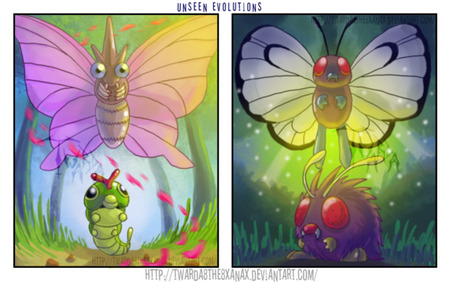
The next day brings two major events, the first being Ash’s battle with Pidgeotto, in which he flippantly disregards two of the most basic lessons of life as a Pokémon trainer: he tries a Pokéball without weakening Pidgeotto first (and I thought he’d learnt better after episode one), showing that he doesn’t actually understand how to catch Pokémon, and he tries to fight Pidgeotto with Caterpie (and reacts with abject confusion when Misty points out that “Pidgeotto is a bird; Caterpie is a worm; birds eat worms, Mister Pokémon Master!”) showing… not so much that he doesn’t understand the concept of a type advantage, more that he doesn’t even understand the concept of fighting. Pikachu steps in to save his sorry butt and fries Pidgeotto into submission, and we quickly move on to the next big event of the day: Team Rocket’s appearance. They’ve decided to follow Ash and steal Pikachu, since the Viridian City Incident has convinced them that, in Meowth’s words, “[Pikachu’s] powers exceed its evolutionary level” (a fascinating comment in itself, but one I don’t have time for now). Ekans and Koffing attack Ash together, so Misty offers to step in to even the odds, but Ash refuses because the Pokémon League rules say that battles are one-on-one. Never mind that he’s being mugged by notorious criminals; the rules say that he can only use one Pokémon and he will defend those rules with Pikachu’s life if need be. Long story short, Caterpie manages to overcome Ekans, Koffing and Meowth with a particularly well-executed String Shot, of all things, and Team Rocket are forced to retreat. This victory prompts Caterpie’s longed-for evolution into Metapod, and an observation from Ash’s Pokédex that no other Caterpie on record has ever evolved so rapidly. Ignoring for the moment how the Pokédex could possibly know how mature Ash’s Caterpie was when he caught it, this is the first of many indications given in the anime that evolution isn’t just about reaching a certain level, as in the games; there’s a psychological component as well. I think Caterpie’s remarkably fast evolution is implicitly a result of his unusual ambition; it took less to make him evolve because he was more ‘ready’ for it, mentally speaking, than most Caterpie. Basically, he’s a little Pokémon with big dreams, and being with Ash is going to help fulfil them.
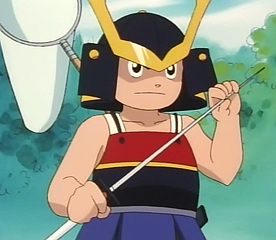
In the next episode, Challenge of the Samurai, Ash is accosted by a weird kid in samurai gear while trying to catch a wild Weedle. And when I say “accosted” I mean he nearly gets cut in half by an honest-to-goodness steel katana. This kid… oh, this kid… I don’t think he even has a name; if he does, he never tells Ash and Misty what it is, so I’m just going to call him Sammy. Sammy lives in the darkest part of Viridian Forest with his Bug Pokémon and challenges other trainers as they pass through. I don’t know why. He just does. He doesn’t seem to be interested in travelling or collecting badges, in fact he has a permanent cabin deep in the woods, so the only conceivable reason for him to be interested in getting stronger is so he can make himself more of an inconvenience to travellers. The kid’s a friggin’ random encounter (“random” being the operative word). Anyway, he calls Ash “dim-witted and clumsy” for letting the Weedle escape, Ash protests that it was Sammy’s fault for coming at him with a sword (this is supposed to be the beginning of a point the episode is making about Ash learning not to blame his failures on others, but I can’t help but feel Ash is in the right here), and they quickly engage in battle. Pidgeotto doesn’t manage to make much of an impact on Sammy’s Pinsir because Ash has been overworking him and he’s done for the day, so Ash turns to Metapod. Only after he makes this choice does it occur to him that Metapod can’t actually fight, but luckily for him evolution didn’t make his Caterpie any less exceptional, and Pinsir injures itself trying to crack Metapod’s tough shell, forcing Sammy to recall it. This leads us into one of the most awesome Pokémon battles of all time, an epic struggle of titans to be remembered by our children’s children for aeons to come: Metapod vs. Metapod. I really don’t know what Ash and Sammy are trying to prove in this battle. It conveys rather effectively, though, that both of them are astonishingly stubborn. Their Metapod keep staring at each other and using Harden for some time – possibly hours – until the battle is interrupted by a swarm of wild Beedrill, apparently the friends of the Weedle that escaped Ash earlier. Metapod is snatched up by a Beedrill before Ash can recall him, and they all have to leg it back to Sammy’s cabin to escape being stabbed to death.
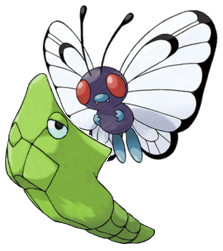
Ash eventually goes to get Metapod, whom they saw on the way to Sammy’s cabin sitting at the base of a tree filled with Kakuna. This is problematic because Kakuna will apparently evolve into Beedrill at the slightest provocation, but Ash is able to reach Metapod alive, despite Team Rocket’s antics causing the Beedrill to become aggressive again. Metapod, unsurprisingly, seems very hurt that Ash allowed him to be taken in the first place, which Ash initially blames on Sammy but soon admits was his own fault, giving a heartfelt apology. The resulting surge of loyalty prompts Metapod to jump into the path of a Beedrill trying to skewer Ash, violently splitting his shell open… which catalyses his final evolution into Butterfree. Butterfree pacifies the whole swarm with Sleep Powder, Sammy is sufficiently impressed, and Ash, Pikachu and Misty get to move on to Pewter City.
In Challenge of the Samurai we see Pokémon evolving out of transitional states, ones which are never supposed to be long-term, so the conclusions we can draw from it aren’t necessarily all-inclusive, but there’s no harm in speculation. Ash’s Pokédex claims that Metapod evolve into Butterfree one week after evolving from Caterpie, which sounds way too long, but since Ash tells Brock in the next episode that he’s been with Pikachu for two weeks already, it’s probably about right. Regardless, it’s clear that Metapod didn’t evolve because he was ready; he evolved because he needed to, as do all the Kakuna we see evolving in this episode, which comes back to the idea of evolution having a psychological component in the anime: at some point, despite being physically able to evolve, Metapod and Kakuna still need some kind of stimulus to kick things off. It’s interesting that Metapod doesn’t evolve when he’s first snatched away by the Beedrill, because he doesn’t actually ‘gain experience’ between there and the end of the episode, and judging by his reaction when Ash comes to save him I think it’s because he felt abandoned when Ash ran away without him and may have given up hope (one of his persistent character traits in the episodes that focus on him seems to be that he has self-esteem issues). It’s the renewed feeling of being in a partnership with his trainer, and the associated swell of devotion, that eventually makes a Butterfree of him.
 Pokémaniacal