One lunatic's love-hate relationship with the Pokémon franchise, and his addled musings on its rights, wrongs, ins and outs. Come one, come all, and indulge my delusions of grandeur as I inflict my opinions on anyone within shouting distance.
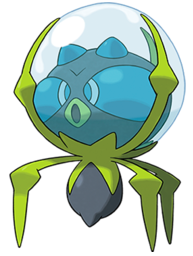
Sometimes, we all need more spiders in our lives. Spiders kill flies and mosquitos, keep the streets of New York safe from techno-goblins and octopus-physicists, rescue intelligent piglets from the slaughterhouse with their whimsical web messages, and keep you from getting hungry at night by crawling into your mouth while you sleep. Game Freak, bless their hearts, recognise the importance of spiders, and periodically give us more. Thus, today, we come to Dewpider and Araquanid, the alien bubble spiders of doom… Continue reading “Dewpider and Araquanid”→
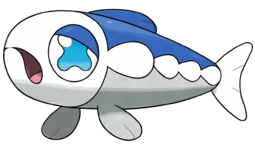
One of my favourite sequences in the whole of the original Sun and Moon was Lana’s Water trial on Akala Island, which introduces Wishiwashi: a small, very weak and actually rather pathetic-looking fish Pokémon with apparently no special powers. Before you actually enter the trial grounds, Lana leads you through Brooklet Hill to investigate several commotions taking place in the area’s many pools. Each is apparently caused by a group of Wishiwashi, most of which flee at your approach, leaving one behind to take the rap, but if you catch one, you’ll get some hint of what’s going on by reading the text of its Schooling ability. The further you go, the larger the splashes in the pools become, slowly building a sense of menace around whatever it is you’re following, and Lana starts dropping hints about a powerful Pokémon that must be causing everything, even telling you at one point that Kyogre is said to live in Brooklet Hill. Continue reading “Wishiwashi”→
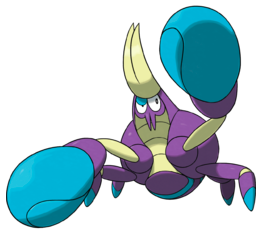
Today I would like to talk to you about crabs: specifically, Crabrawler and the delightfully named Crabominable (seriously, can we just take a minute to appreciate the wonderful tumbling rhythm of that name?). In the process of writing this piece, I have learned (because learning obscure and not particularly useful zoological trivia is just part of what I do here) that evolution just really likes crabs for some reason, and consequently keeps trying to turn other random animals into crabs with mixed results, a process known as carcinisation. Crabs have apparently evolved at least five separate times, from a variety of starting points (giving rise, surprisingly, to only two Pokémon before now: Kingler and Crustle, Crawdaunt being a lobster). On the basis of this vague half-substantiated piece of pseudo-knowledge, I have decided that crabs are the ultimate form of life, to which all other species aspire. Of course, Crabrawler and Crabominable have the advantage of already being there – so let’s see what the apex of all biological life has to offer the Alola region. Continue reading “Crabrawler and Crabominable”→
As their species designation – the Bee Fly Pokémon – attests, Cutiefly and Ribombee are based (in Ribombee’s case, somewhat loosely and with the addition of fairy-like traits) on bee flies. Bee flies, as their remarkably inventive name suggests, are a family of insects within the fly order, Diptera, that pollinate flowers and look like bees, though they are usually smaller. They are related to predatory robber flies, and despite their fuzzy appearance, most bee flies are parasites that will lay their eggs on the larvae of other insects, typically beetles or solitary bees, resulting in the slow and gruesome death of the larvae. There are over 5000 species of bee fly around the world (because clearly the world needed that many), but the particular one referenced by Cutiefly is the adorable internet celebrity Anastoechus nitidulus, a rare species that lives only in southwest Japan, in the area around the city of Okayama. As far as I can tell, this species is so rare, and bee flies in general are so poorly studied by entomologists, that it doesn’t even have an English name – I’ve seen them called “tiger bee flies,” which I think is an attempt to translate the Japanese name toratsuri-abu, but in English the name “tiger bee fly” ought to refer to a different species of bee fly, the larger, blacker and more sinister-looking Xenox tigrinus, which can be found throughout North America. Thankfully, Cutiefly already represents a fully adult bee fly, so we don’t have to observe first hand the family’s parasitic tendencies; instead we see only the adults’ more palatable diet of nectar, which they harvest with their mosquito-like proboscises. Cutiefly and Ribombee express this through their flavour text, through the Honey Gather ability they share with Combee, and through their in-game distribution in the areas in and around Alola’s Oricorio meadows.
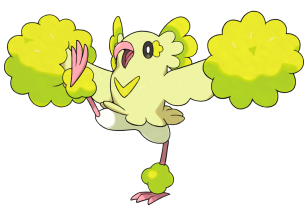
I do not have a good record with anything capable of earning the title of “gimmick” Pokémon – Pokémon whose schtick is some unique move, ability or game mechanic that was so clever Game Freak felt they could stop there, and didn’t need to have the Pokémon be any good or the design make any sense. Today we decide whether Oricorio, the dancing honeycreeper Pokémon, fits that description. Four interchangeable and mostly cosmetic forms, a weird signature move, a weirder ability… the phrase “walks like a duck, quacks like a duck” comes to mind, but let’s take a closer look. Continue reading “Oricorio”→
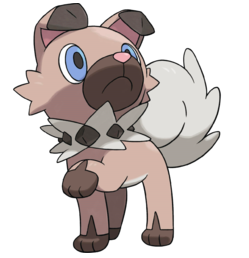
Today’s Pokémon is Professor Kukui’s loyal partner, Rockruff, and his evolved form – or rather forms, as we’ll see – Lycanroc, the latest additions to Pokémon’s growing stable (or, uh… kennel) of dog Pokémon. Physically, Rockruff’s design is very straightforwardly based on a domestic dog, perhaps an Akita Inu (a large Japanese dog breed with a wolf-like countenance and a fluffy tail). Physically we’re looking at something quite close to Growlithe, with a different colour scheme and obviously very distinct powers, but very similar in terms of personality and behaviour. Rockruff’s most distinctive feature is a “collar” (or “ruff”?) of stones, which apparently has a social function – Rockruff greet each other by rubbing their stony collars on each other’s bodies. This little ritual apparently extends to their human friends as well, which can cause significant discomfort. Nonetheless, Rockruff is one of the Pokémon most favoured for beginners in the Alola region because they have a friendly and loyal disposition that makes them easy to train and command, and are also extremely tenacious in battle. In other words, they’re almost exactly like real dogs – energetic, devoted and affectionate to the point of being overbearing. A bit generic, slotting in alongside Growlithe and Lillipup almost unnoticed, but that’s sort of to be expected for the basic stage of an early-game Pokémon, and the Rock element is incorporated in a neat way with the “collar.” The meat of what this design is supposed to be doing comes with the evolved form: Lycanroc. Continue reading “Rockruff and Lycanroc”→
Today’s Pokémon are probably the strangest thing Alola has thrown at me so far, and definitely spice up the early game a bit – electrical Bug-types with battery-like abilities, which (thank all the gods) conspicuously do not become butterflies or moths. We’ve had beetle Pokémon before – Heracross – and even stag beetle Pokémon – Pinsir – but Grubbin, Charjabug and Vikavolt have little in common with either, as we’ll see.
Grubbin
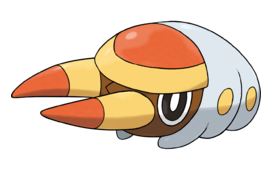
Grubbin is… well, a grub – a soft-bodied beetle larva. As far as I can tell, it’s not based on any one species in particular; beetle larvae mostly look pretty similar to non-specialist eyes (unlike caterpillars, which are often brightly coloured or have bristles, or eye patterns that make them resemble dangerous snakes). Grubbin instead achieves a distinctive look by exaggerating the mandibles of a beetle grub into two brightly coloured, striped horns as long as the whole rest of its body – in fact it kinda winds up looking like a stag beetle or Hercules beetle pupa. Continue reading “Grubbin, Charjabug and Vikavolt”→
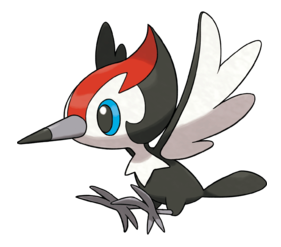
Pikipek and Trumbeak are woodpeckers, one of the broad classes of bird that Pokémon hadn’t previously gotten around to making an early-game Normal/Flying-type out of. Let’s run through the checklist… Pidgey’s a waxwing, Hoothoot’s an owl, Taillow’s a swallow, Starly’s a starling, Pidove’s a pigeon, Fletchling’s a robin, and Spearow’s not a sparrow. With the exception of Hoothoot and Pidove, they’re all based – more or less loosely – on members of the songbird family (or, well, technically they’re a sub-order or something, but who’s counting?), and most of them gain more raptor-like traits as they evolve. Which… y’know… is fine; that reflects the huge diversity of the real songbirds, but it would be nicer if they weren’t all (with the exception of Hoothoot) Normal/Flying-types with fairly generic powers and a bias towards speed and physical attacks. Continue reading “Pikipek, Trumbeak and Toucannon”→
Yungoos and Gumshoos, as their names and weasel-like forms indicate, are mongeese (this being, of course, the obviously correct plural form of the word “mongoose,” which I will extol and defend beyond all reason). Although they look very like weasels, mongeese, as I only recently learned, are actually not part of the mustelid family (weasels, otters and badgers) at all, but part of an entirely separate branch of the order Carnivora. They are related to cats, hyenas and civets, while mustelids are much closer to dogs, bears and seals. This is probably the reason for Zangoose’s odd species designation “the Cat Ferret Pokémon” – mongeese are to cats what ferrets are to dogs. Continue reading “Yungoos and Gumshoos”→
In generations one/five/six/seven you were just kind of given your starter to go an a journey. In two you were originally loaned your starter to do a short errand before it was permanently given to you (the best introduction to starters, imo). And in three/four you took a starter from a bag to defend someone (the professor/yourself and your rival respectively). How would you do it? How’d you frame being given your starter Pokemon?
I’ve always had rather a fondness for IV, which I think is the most involved version. It feels like it adds something to the relationship between you and your starter, to have you owe your Pokémon something like this, and for your partnership to begin with sheer chance (and the characterisation of the rival character Barry, through these events and your subsequent interaction with Professor Rowan, was interesting). Continue reading “Anonymous asks:”→



 Pokémaniacal