Reviewing Sapphosian Pokémon From “Ephemerald”

Okay, I’ve had some time with this hack I mentioned a little while ago, I’ve played it, I’ve finished it, I’ve become possibly the first person in the world to legitimately complete the Pokédex (I was the first person known to the creator, at any rate), so I think I’m in a good position to talk about some of the Pokémon designs a bit.

In case you’re just now joining us, or need a reminder, Ephemerald is a ROM hack of Emerald where almost every Pokémon has been redesigned and had its type changed.  The result is a bizzarro alternate-universe version of the classic Hoenn region experience, featuring “Sapphosian” forms of every Pokémon from generations I-III, crammed into a single region.  All the dual-types are unique and every possible combination is covered, but there are multiple single-typed Pokémon of each type.  Because this is generation III, attacks are classed as physical or special based on their type, rather than individually; for this reason, a lot of Sapphosian Pokémon have had their usual attack and special attack stats flipped to whatever suits their new type and movepool best (a courtesy that was not always given to officially designed Pokémon pre-gen IV).  There are also a couple of changes to the type chart balance, a heightened level curve, smarter movesets on most bosses and a couple of fun little extras here and there (although the story and most of the dialogue are basically untouched).

Anyway.  I can’t, and frankly don’t want to, discuss every last one of Ephemerald’s 382 redesigns, so I’m going to get a random number generator to pick ten of them, and hopefully this will serve as a rough barometer of How Good, collectively, all the Sapphosian Pokémon are.  I propose we tackle this enterprise as a field test of a perfect new rating system for Pokémon that came to me in a dream.  This system is based around five key attributes that were revealed to me through mystical channels as the cornerstones of good Pokémon design.  These are:

  • Cunning
  • Mystique
  • Disco
  • Chewiness
  • Curiousness

All of which are, I think, self-explanatory.

I will also mention a sixth attribute of each Pokémon, which is not part of what makes a Pokémon good but is very important anyway, and that is how much Respect I have for it.  Thus, we shall arrive at ultimate Truth.

So, let’s fire up the numberationer and get started! Obviously, do not read on if you wish to play this hack unspoiled.

Continue reading “Reviewing Sapphosian Pokémon From “Ephemerald””
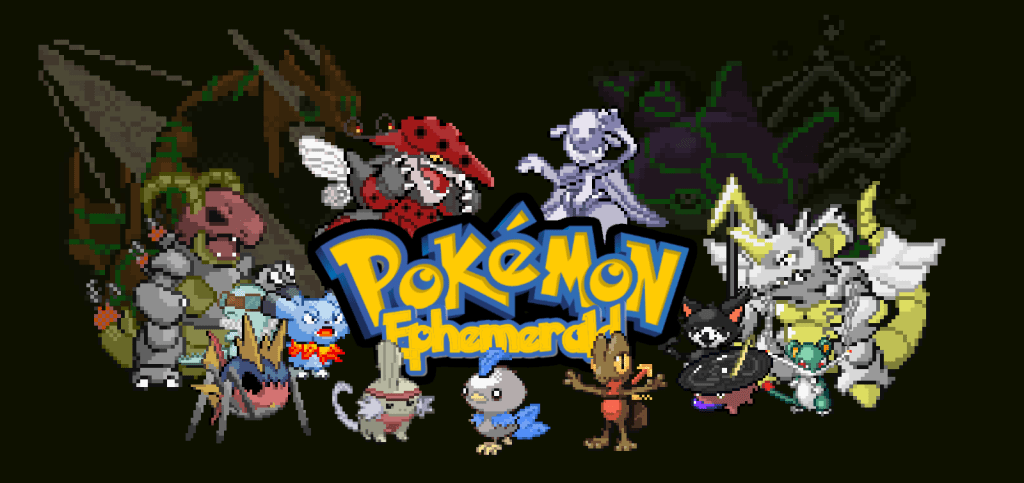
Wanna see some wild $#!t? Try this Emerald ROM hack

Long-time Friend of the Blog and expert spicy-take-haver Shibarianne has just finished and released her magnum opus: Pokémon Ephemerald, a ROM hack of Emerald with retyped and redesigned Sapphosian forms of every Pokémon (…minus Deoxys, Unown, Castform and Spinda, because apparently their multiple forms are coded into the gen III games in a way that makes them an absolute nightmare to do anything fun or interesting with).

Every last one of these bizarre fµ¢£ers has a new type, and apparently every possible combination of the 17 types is represented (17, not 18: Ephemerald is still gen III; it does not add the Fairy type, or import any other fundamental mechanical changes from generation IV+). Not only that, every Pokémon is obtainable; Shibarianne has found spots in the Hoenn region for all three-hundred-and-whatever, and crafted special areas and events for the legendary Pokémon that aren’t in vanilla Emerald. I believe the plot of Emerald is unchanged, but there are also several optional bonus bosses, a reworked difficulty curve and a little type rebalancing.

Also I know that at least one of my Pokémon suggestions made it into the game, so you should play it just for that.

More information and a download link can be found here. As is standard for ROM hacks, the download is a .ups file, which contains instructions for patching a standard Emerald .gba file, so you’ll also need a program that can read those instructions and apply the patch (Shibarianne recommends Tsukuyomi, Lunar IPS, or UpSet for Windows users; for Mac, I have found success with MultiPatch), as well as a vanilla Emerald ROM and an emulator that can run it; Google can help you find all of these.

I think I’m going to write some more about this, while/after playing it, but I’m not sure what exactly (if for some reason you have strong opinions, leave a comment!). Maybe short-form reviews of the redesigns for a couple of my favourite Pokémon. Maybe some commentary on how the difficulty curve feels, or some of the boss fights like gym leaders? We’ll see.

Ruby and Sapphire Revisited

Every month, in accordance with dark prophecies written in the stars, I am fated to write an article on a topic chosen by my Dark Council, the conspiratorial conclave of readers who support me for at least $10/month on Patreon.  This month, the decree of the Council was that I watch a video by Pokémon YouTuber Tama Hero (formerly Tamashii Hiroka) re-evaluating Pokémon: Ruby and Sapphire and use it as a springboard to revisit the characterisation of those games’ villains, Team Aqua and Team Magma.  The video can be found here; you don’t have to watch it to understand everything I’m about to say, but I do think it’s worth your time if you like thinking deeply about Pokémon and game design.  If you don’t know Ruby and Sapphire, the fifteen-second summary of Team Aqua and Team Magma is: Aqua likes the sea, Magma likes the land; they both want to wake up an ancient legendary Pokémon (Kyogre or Groudon, respectively) in order to “expand” the sea or land through floods or volcanic eruptions; they eventually succeed and very quickly wish they hadn’t; it’s now your job to clean up the mess.

So, I really liked this video.  Jim the Editor didn’t, because it’s framed as a review but doesn’t really succeed at being impartial, which… is true, but not in my opinion particularly relevant.  The way I see it, the ship has long since sailed on any kind of rating-oriented “review” of Ruby and Sapphire, but this discussion left me with a much clearer understanding of what those games were trying to do and a keener awareness of both their successes and failures in that attempt – and that, to me, is good media criticism, of the kind that I aspire to.  Honestly, to me it often feels like saying at the end of a piece “I liked this Thing” or “I didn’t like this Thing” or “here is how much I liked this Thing out of 10” obscures a lot of what you actually thought about the Thing, which may be a lot more nuanced than your conclusion captures.  I almost think there’s an argument for having no introduction or final summation at all, utterly refusing to give a condensed verdict just to force people to decide for themselves whether your analysis revealed more good points or bad points.

(There is a counterargument that this would needlessly cultivate an antagonistic relationship with one’s audience; however, the beauty of Pokémaniacal is that you bloodsuckers already know I plan to bring about the end of time so I can sacrifice you all to the dark gods I truly and ultimately serve, so really we have nothing to lose here.)

Continue reading “Ruby and Sapphire Revisited”