Litleo and Pyroar

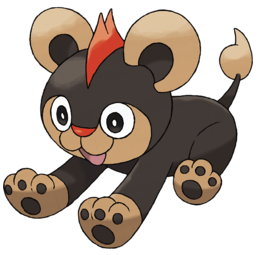
Official art of Litleo by Ken Sugimori.

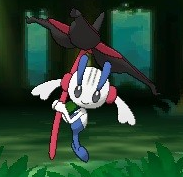
We should probably talk about these ones next.  I didn’t use Litleo for very long, because my Fletchling unexpectedly evolved into a Fire-type and I didn’t want two of them.  Still, I had one on my party for a little while, and I feel like I got to know her, so it makes sense.  So, these Pokémon are lions.  I am notoriously ill-disposed to Pokémon that are just animals, because I want more.  Granted, of course, these are lions that breathe fire, but hey, Beartic is a polar bear that shoots icicles and just look how well I got along with him.  That was three years ago, though; I’m being nice now.  Well… okay, ‘nice’ is a bit much.  I’m being marginally less irritable now.  Let’s give these two a shot and see what I can make of them.

So let’s start with the obvious: gender differences.  Pyroar is one of only two Pokémon in X and Y with major sexual dimorphism, the other being Meowstic.  In Pyroar’s case, it obviously mimics one of the most famous and recognisable examples of sexual dimorphism in the real world: lions have manes, lionesses don’t (although female Pyroar get that long flowing crest so that they don’t seem too boring).  Sort of an predictable choice for a lion Pokémon, but major gender differences are something that Pokémon underexploits, so I’m hardly going to complain about seeing more of it.  The way the pattern of red-and-yellow stripes on a male Pyroar’s mane recalls the distinctive shape of a Fire Blast attack – the Japanese symbol for “large” or “great” – is also a nice touch.  The divergences between male and female Pyroar also come through in their behaviour, which is nice – you can compare Nidoking and Nidoqueen, or contrast Jellicent and Unfezant, who draw attention to gender but don’t make much of it.  Male Pyroar, specifically the male with the most impressive mane, are said to be the leaders of their prides, which obviously draws on the male leadership of real leonine social structure.  It’s also worth noting that only ¼ of all Pyroar are male, reflecting the composition of real prides, which will generally include only 1-2 males and perhaps 5-6 females.  Interestingly the Pokédex chooses to emphasise the females’ role in raising cubs, when in fact real lionesses are generally responsible for hunting (something for which the stronger but slower males are less suited) and tend to leave the males to protect the cubs in their absence; otherwise the males and females are equally involved.  I suspect the reversal comes from the fact that the activity of raising children tends to be gendered ‘female’ in most human societies, while hunting is more likely to be gendered ‘male,’ and the designers attributed a standard feminine activity to female Pyroar without thinking about what lions actually do.  It’s a little disappointing that Pyroar should be made to conform to human gender stereotypes in this way when there exists such an obvious reason for them not to (I always thought the role of lionesses in literally bringing home the bacon was fairly well-known, but perhaps not…).
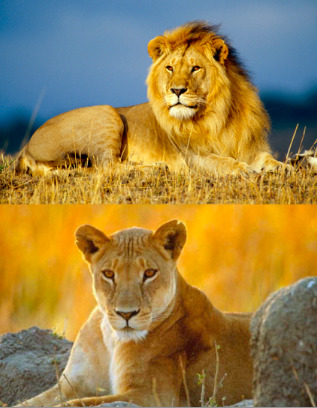
 A lion and a lioness.

Litleo and Pyroar don’t subdue prey with claws, teeth, and brute strength like real world lions – why bother with any of that when you can breath fire?  Probably because of the sunburst shape of the males’ manes, there’s a long-standing association between lions and solar imagery going back to the Near Eastern Bronze Age, which male Pyroar are happy to accentuate.  That does make Fire something of an obvious choice, granted, but not as obvious as Ice on a polar bear.  I sort of wish they had played up the solar idea a bit, maybe with a sun-related ability (goodness knows none of Pyroar’s current abilities would be missed).  Another critical aspect of what these Pokémon are about is also drawn from real lions – their roar.  Lions roar; aside from the males’ glorious manes, their fearsome roar is probably the most iconic thing about them (for fans of A Song of Ice and Fire, think of the crest and motto of House Lannister: respectively, a golden lion and the phrase “Hear Me Roar”), and Litleo and Pyroar have two skills related to that: the relatively rare Hyper Voice attack, and their signature move, Noble Roar.  This, I think, is the reason they’re Normal dual-types and not straight Fire, which would otherwise make just as much sense; they rely as much on their explosive vocal range as on their fire, and sonic abilities remain among the ‘miscellaneous’ powers still associated with the Normal type (compare Jigglypuff, who became Fairy/Normal in X and Y while Clefairy is now pure Fairy).

The other interesting thing about Pyroar is that the male seems almost made to be Lysandre’s signature Pokémon (and Lysandre is, to my recollection, the only NPC in the game who uses a male one): the bright red mane is reminiscent of Lysandre’s extravagant hairdo, the species designation “the Royal Pokémon” matches Lysandre’s royal Kalosian heritage, lions are a common symbol in Mediaeval heraldry, perhaps furthering the ‘royal’ associations, and they are traditionally associated with pride (to the point that the word even became the collective noun for a group of them), which is probably Lysandre’s most significant flaw – the pride that led him to believe he had the right, indeed the duty, to decide who would live and who would die all around the world.  Even the fire abilities recall the name of Lysandre’s organisation, and Lysandre himself is regularly described metaphorically as ‘burning’ with passion.  This wouldn’t be the first time a human character has taken certain cues from a Pokémon – Wake’s lucha mask is modeled on a Swampert (though he doesn’t actually have a Swampert, in any of his incarnations), Chilli, Cilan and Cress match the distinctive hairstyles of Simisear, Simisage and Simipour, Alder’s hair seems to be styled after Volcarona, and I believe Gardevoir inspired Diantha’s dress.  The intended implication may be that Pyroar was Lysandre’s first Pokémon (Gyarados is now his strongest, but seriously what kind of troll Professor starts a kid off with a Magikarp?) and the one with whom he has the deepest relationship.  Can you push that even further?  Maybe – Pyroar’s ‘royal’ designation might come from being a traditional starter Pokémon given to children of the Kalosian monarchy, and even today given to their descendants. 
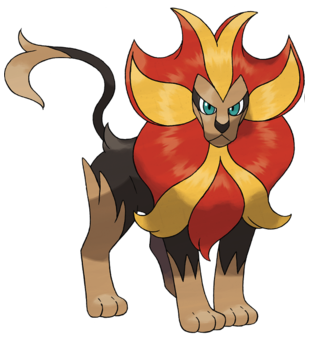
 Male Pyroar, with his distinctive mane.

Pyroar seems intended to serve as a special sweeper.  Although her defences are poor and her physical attacks not worth the effort, she’s very fast, and her special attacks pack quite a punch.  Defensively, Normal/Fire is a mixed bag – six resistances (including Fire, Ice and Fairy) and a Ghost immunity (something which is shaping up to be quite valuable in this generation) are nothing to sniff at, but Pyroar’s four weaknesses are all to powerful and common offensive types: Ground, Rock, Fighting and Water.  Offensively, though, Fire Blast and Hyper Voice are a pretty solid combination, even if they leave her in a bit of trouble against most Rock-types.  The neat thing about Hyper Voice is that sound-based attacks have been improved in X and Y and can now bypass Substitute, which makes Pyroar very dangerous to certain Pokémon who rely on Substitutes to stall for time.  Beyond that, options are sadly limited – there’s Dark Pulse on the side, and if you’re planning a sun team, Solarbeam is an option, though bear in mind that weather in general is substantially weaker now that the effects of Drought et al. have limited durations.  The usual package of alternate Fire moves is available – Flamethrower for greater reliability and Overheat for single-shot power.  Other than that, you’re probably looking at either Hidden Power or a support move for the final slot.  Hidden Power is easier to use now, since its power rating is always 60 rather than randomly determined for each individual.  A Grass-type Hidden Power is probably the best complement to Pyroar’s main attacks, if you can get it, but a move with 60 power is not exactly a brilliant deal.  The signature move, Noble Roar, seems like more of a flavour thing than something that would be especially useful in battle – it reduces the target’s attack and special attack, which is irritating, but can be shaken off by switching out and won’t protect Pyroar from critical hits.  The nice thing about Noble Roar is that it’s good for catching Pokémon as they switch in, since it doesn’t matter whether the target favours special or physical attacks.  Still, it might be better suited to a somewhat tougher Pokémon.  Burning incoming opponents with Will’o’Wisp is probably a better option if you’re looking to give Pyroar stronger defensive capabilities.  Yawn could also be interesting; most people will switch out after being hit by Yawn rather than let a Pokémon fall asleep the next turn, so that could be good for keeping Pyroar’s most dangerous opponents off her back.  Finally, she’s fast enough to make good use of Taunt, and can more effectively break defensive Pokémon that way by denying them access to their support moves.

 Female Pyroar, with her impressive crest.

None of Pyroar’s abilities are much use, sadly.  Rivalry gives a damage bonus against Pokémon of the same gender, but a corresponding penalty against Pokémon of the opposite gender – certainly flavour-appropriate for a Pokémon with strong gender differentiation, but too unpredictable to plan strategies around, since there’s no way to know the gender of Pokémon you’ll be facing ahead of time.  Moxie is an attack boost every time you knock out an opponent – great, except Pyroar doesn’t use physical attacks.  If for some reason you do want to focus on Pyroar’s physical side, well, get used to disappointment, because her strongest physical Fire-type attack is Fire Fang, and her coverage options basically extend to Crunch and Wild Charge.  Flame Charge lets you do damage while increasing your speed, and is generally a good secondary attack, but speed isn’t really high on Pyroar’s list of concerns anyway.  Her final ability, Unnerve, prevents opponents from eating berries.  Whoop-dee-f*cking-doo.  In short, Normal/Fire is actually pretty solid and Pyroar certainly has the stats to back it up, but she’s just not a versatile Pokémon, and her lack of relevant, useful abilities makes it difficult for her to sparkle.

I think overall I lean a little on the ‘meh’ side with Pyroar.  On reflection I don’t think there’s anything really wrong with her; as far as the whole ‘being a lion’ thing goes, she does a solid job, and the focus on her roar as a weapon makes sense with the design while giving her a pretty good combination of primary attacks.  I come away from this one feeling like there’s room for more, though.  Playing up the royalty aspect somehow might have been more interesting, and Pyroar would be an excellent Pokémon to give a sun motif and solar abilities, which would also make a good combination with a royal theme, particularly in Kalos (given the presence in the background of Louis XIV, the ‘sun king,’ as a historical model for the Kalosian monarchy and the Parfum Palace).  Drawing on the heraldic associations of lions, maybe going for a more stylised look, might be a good way of doing that.  I like Pyroar well enough, particularly the female form which makes an effort to match the male form in overall majesty while still creating a very different impression of her nature, but I feel just a little underwhelmed.
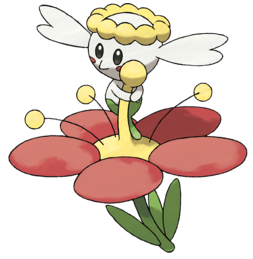
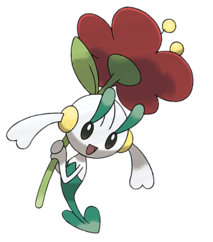
Flabébé, Floette and Florges

Official art of Flabébé by Ken Sugimori.

Okay, I’m just going to come out and say it: I have no idea how to pronounce this Pokémon’s name.  Under standard French orthography, Florges would be pronounced… Florj?  That doesn’t sound right.  Florjé?  Florjéz?  Florjis?  Florghés?  I don’t know; just imagine me mispronouncing it in the most ludicrous way you can think of whenever I type the name.  Flogress…  Florgos…  Florg…

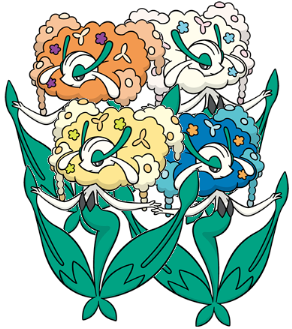
Anyway.  Flabébé.  When I first met this Pokémon I assumed she was a Grass/Fairy dual-type, which I don’t think is unreasonable given the dominance of flowers in her design and their importance to her lifestyle.  Actually, I still have trouble believing she’s not a Grass-type, seeing as most of her level-up moves are Grass attacks, and her offensive movepool certainly seems to have fallen prey to the curse of Grass-Types Don’t Get Nice Things.  Flabébé, Floette and Florges probably come closest to emulating Xerneas’ conception of the Fairy type, which sees them as guardians of nature and nurturers of life, but in this case specifically of flowering plants.  Flabébé and Floette possess symbiotic relationships with single flowers, which they keep for their entire lives, presumably using their Fairy powers to keep them from wilting and dying.  There’s a minor little gimmick here which is not particularly interesting but deserves to be mentioned; their flowers come in different colours – red, white, orange, yellow, and blue – with certain colours being more or less common in different flower beds, Flabébé’s natural habitat.  The colour carries through when she evolves into Floette, and then Florges.  All three stages are said to draw energy from blooming flowers specifically, which may be the key to why they’re not Grass-types, thematically speaking; their powers are drawn not from plants as such, but from the beauty of plants, flowers in particular, and may be related to the symbolic meanings of different types of flowers.  I’m not sure whether beauty and the appreciation of beauty are attributes of the Fairy type, but they certainly wouldn’t be inconsistent with it, so perhaps that’s what Flabébé gets out of the deal.  Or at least, that’s the spin I’d put on it if I were Game Freak.

 Floette.

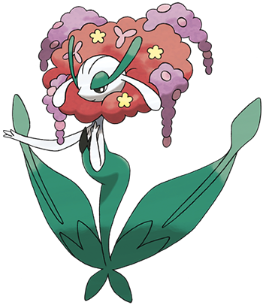
Florges becomes something quite rare and interesting – a Pokémon who actually manipulates terrain type, creating beautiful flower gardens for her territory, and even being invited by humans to do the same for grand estates and castles.  Notice the verb, “invite,” which is exactly what the Pokédex says; what’s happening here is being glossed in very different terms to a trainer/Pokémon relationship.  It seems like we’re being told about wild Florges being asked (contracted, even?) to perform specific services for human nobles, possibly before the invention of Pokéballs (“in times long past”).  One might ask what the Florges gets out of it, and the simplest answer seems to be that she would be permitted to live in the garden indefinitely, providing her and any family members with a long-term home that would be isolated from most predators – this makes sense with the idea that Florges are “invited;” they normally want to create gardens anyway, independent of any human incentive, and there is a mutual benefit to having them do it in a specific place.  My over-active imagination, however, can’t help but wander to the idea of particularly skilled and powerful Florges gaining a reputation for truly fantastical flower gardens and travelling from one great estate to another in order to practice her art and receive pampering, adulation and luxuries in return (I am rather fond of the idea of Pokémon just doing their own thing in the world of humans).  Either of these views of Florges is particularly appropriate to Kalos, with its major background theme of the excessive wealth and luxury of the old aristocracy that alludes to the proverbial decadence of the French ancien régime.  This Pokémon, to me, represents what Kalos itself is all about: precise, studied expressions of elegance that nurture and exalt natural beauty through the imposition of order.

 AZ's Floette, the Eternal Flower.  In addition to her unusual flower, this Floette is also shiny (note the purple body).

Given that, perhaps it’s fitting that one particular Floette gets to play a critical role in the backstory of X and Y: AZ’s Floette, instantly recognisable by her unique black tulip-like flower whose shape seems to have provided the model for AZ’s Ultimate Weapon.  This Floette, who answers to “The Eternal Flower,” fought and died for AZ in the war against his brother and was subsequently resurrected, at the cost of several hundred other Pokémon’s lives, using the Ultimate Weapon.  This puts her right at the centre of the game’s primary conflict of change and stasis (AZ’s refusal to let go of what he had lost eventually brought ruin to Kalos), which also has relevance to Floette’s nature as a Pokémon who preserves and enhances beauty through order.  What AZ did, and what Lysandre wanted to do, are ultimately an extension of what Flabébé, Floette and Florges do throughout their lives: preventing what is beautiful about the world from fading and dying.  As always in Pokémon, the villains are villains because they take it too far, and because they believe that the ends justify the means – something Floette cannot accept, which is why she abandons AZ.  We know from those talented people who specialise in hacking Pokémon games that AZ’s Floette likely to be available to players at some point through an event, because she has her own stats, completely different to a regular Floette or Florges’ – she’s a fast special attacker – and even her own signature move: Light of Ruin.  This move seems to be, effectively, a special Fairy-type equivalent to Head Smash (complete with that painful 50% recoil), and narrowly edges out Xerneas’ Fairy Aura-boosted Moonblast as the most powerful Fairy attack in the game.  It seems likely that this move draws on whatever power was imparted to Floette by the Ultimate Weapon to make her immortal, a power encompassing both life and death – the heavy cost of using it serves as an ever-present reminder that the weapon has always been a double-edged sword.

 Florges.

A normal, fully-evolved Florges is a very different Pokémon to AZ’s Floette.  Her greatest strength, instead, is her monumental special defence.  Being a pure Fairy-type doesn’t hurt either, since they have a pretty cushy deal with three resistances and an immunity (to, need I remind you, Dragon) against only two weaknesses.  Her HP and physical defence are relatively poor, though, so either invest heavily in both or keep her far away from physical attackers; this fair maiden is without question a special wall and a supporter.  Florges seems designed to function best in double or triple battles, with two unique abilities and a very rare move which all benefit her allies – if she actually were a Grass-type, two of them would benefit her as well and make her much stronger, but she’s not and they don’t.  First, the move: Flower Shield raises the defence of all Grass Pokémon in play, meaning it’s useless in a single battle, and even in a triple battle with two Grass-type allies (which is just asking for a Sludge Wave to the face) it’s questionable.  This technique really makes a lot more sense on Cherrim, who also learns it.  Florges’ first ability, Flower Veil, is likewise nothing special; it prevents allied Grass Pokémon from having their stats lowered, which basically amounts to granting an ally the Clear Body ability (and before you ask, no, it doesn’t negate Leaf Storm recoil).  I really have to question whether it would have been so bad to let Florges benefit from this as well.  The hidden ability – Symbiosis – may actually be interesting.  Again, it can only be useful in a double or triple battle: if one of Florges’ allies consumes an item (including through the use of Fling or Natural Gift), she will pass her own item to that Pokémon instead.  Being able to transfer items to a partner without spending a moveslot and a turn on something like Trick or Bestow is such a unique thing to be able to do that it seems like it would have to be useful somehow, but I’m at a loss as to how exactly that might be.  Perhaps using a Toxic Orb to activate Poison Heal on Gliscor, Flinging it away, and then replacing it with a Life Orb?  Or something similar to get Leftovers on a Guts Pokémon to help compensate for burn damage?  Once elemental Gems are available on X and Y, maybe they could be combined with Choice Specs or a Choice Band for a single, enormously powerful attack (since the Gem is consumed before the attack, and the new item is transferred immediately)?  I leave this as a puzzle for those more ingenious than myself.

 Florges' other colours - orange, yellow, blue and white - on parade.

While Florges’ special attack pales in comparison to her special defence, it’s actually really high as well.  She also gets a strong offensive type and a powerful primary attack, Moonblast, which will leave a hell of a sting on anything that takes her for set-up bait.  There’s even the option of Calm Mind if you want to make a bulky attacker-style Florges.  Unfortunately, other than Moonblast her offensive movepool is awful.  She only learns Grass attacks, which do almost nothing to supplement Fairy attacks (all the types that resist Fairy resist Grass as well), and Psychic, which is at least good for Poison-types.  It’s pretty clear that Florges isn’t supposed to be an attacker anyway, so consider Psychic, but focus mainly on her support skills – she has plenty to choose from.  Wish and Aromatherapy can be used to heal the team of both regular injuries and status ailments (you’ll need train Florges’ HP heavily to get the most out of Wish, but you should probably do that anyway).  She learns both Grassy Terrain and Misty Terrain, the new Grass- and Fairy-themed field moves, both of which are fairly exclusive (and she happens to be the only non-Grass-type to learn Grassy Terrain).  Light Screen rounds out her options – Florges herself would benefit much more from Reflect, which she doesn’t get, but team support is always good.  I’d hesitate to call her a great support Pokémon, but she can take most any special attack that isn’t super-effective and some that are, hit back with a very strong attack that relatively few Pokémon resist, and heal the team while she’s out.  Although her abilities may be useless in a single battle (and not even all that exciting in doubles, to be honest), she has everything she needs to contribute to her team.

Florges has her shortcomings, but she’s good at what she does, and I think the important thing about this line is that they can, in a way, be seen as mascots for the entire Kalos region.  What they do and what they value in their regular lives have special significance in the context of the plot of X and Y, making Floette a perfect choice for the starring role she has in AZ’s story.  I might still think they would make more sense as Grass-types, and I might wish they had an ability choice that’s actually useful in a single battle, but I wish for things I can’t have for almost every Pokémon.  This one (as anime Bonnie would say) is a keeper.

Fletchling, Fletchinder and Talonflame

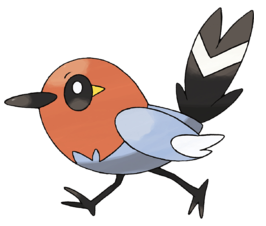
Official art of Fletchling by Ken Sugimori.

I didn’t do the Unova Pokédex in order, and I’m not going to do Kalos in order either (more for variety than anything else).  I’m planning to start with Central Kalos, then the Coastal Pokémon, and then the Mountain areas, but beyond that, I’m just going to play it by ear – starting today with the second Kalosian Pokémon to join my main party, Fletchling.  For obvious reasons, Fletchling didn’t exactly move me to excitement when I first met him: “oh, here we go again; another Normal/Flying fast physical songbird-to-raptor progression with wind powers and no other remarkable traits to eat the local obligatory caterpillar.”  One of the things I was particularly interested in decrying with my Unova reviews – something I’m still very easily annoyed by – is ‘template’ Pokémon, Pokémon who start not with an actual idea but with a principle that every game ‘should’ have a sequel to Pidgey, or Caterpie, or Pikachu.  It’s lazy, it’s boring, and most of all, it doesn’t actually provide any benefit.  There is nothing about these templates that makes the game better, except maybe that they provide an easy introduction to the concept that some Pokémon are just bad.  Part of the reason I’ve always been so irascible about these things is that, although all generations have them, Unova was particularly obnoxious about it, needing stand-ins for things like Geodude and Machop in addition to the usual suspects, which made the absence of any older Pokémon feel like nothing so much as an irritating charade.  Kalos is something else.  Kalos has the templates, but it tries much harder than previous generations to play with them.  On principle, we ‘needed’ a Normal/Flying songbird Pokémon for the early game – so Kalos decided to make one that was as badass as possible.

It’s a simple idea, really.  Take the standard songbird-to-raptor pattern, and set it on fire.  What could possibly go wrong?

 Fletchinder.

The question here is, how far does a different type go?  Fletchling, Fletchinder and Talonflame still share a lot of traits with Pidgeot et al. – does the fact that they also have fire powers make that okay?  And what does that say about how we look at elements in Pokémon?  Most Pokémon have supernatural powers of one sort or another, and as I’ve recently discussed, it is to an extent the powers that make the Pokémon, but if the essence of Pokémon design is just giving elemental traits to an animal, the Normal-types who mostly lack such traits are damned from the start.  Part of designing these things is matching up the powers to the creature in a clever way.  Birds with wind powers are very straightforward as Pokémon go, since wind and flight ‘go together’ intuitively, while birds with fire powers are a little more interesting, and Talonflame doesn’t just take the obvious phoenix angle, which Moltres and Ho-oh have already done to death anyway.  On the other hand, what makes attaching fire-related abilities to a falcon particularly insightful?  The most interesting Fire Pokémon aren’t just “this animal, but on fire;” they’re ones that play with the idea of fire, either by combining it with another element (like Magcargo, whose body of lava hardens into a stone shell, or Chandelure, whose ghostly lights lead wanderers into another world), or by focusing on an unusual aspect of fire (like Torkoal, who mines and burns coal for energy).  If I like Fletchling and his evolutions, then I’m going to have to dig a little deeper than “new type” – I need to find the flourishes.  Let’s have a look at them.

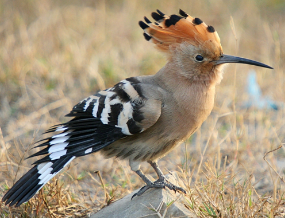
 The hoopoe, the bird Fletchinder reminds me of (it helps that I named my Fletchling, Tereus, after a mythical Greek king who gets turned into a hoopoe).

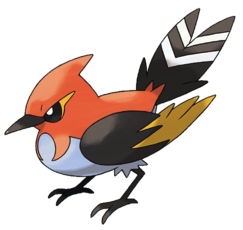
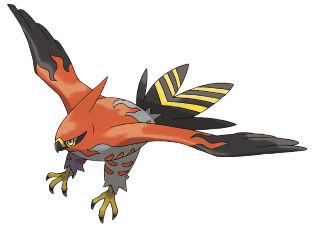
Fletchling, obviously enough, is a robin, while Talonflame has made the transition to peregrine falcon, while keeping the distinctive red colouring of his juvenile form that also evokes his fire powers.  There doesn’t seem to be any consensus on exactly what Fletchinder is, but he reminds me very much of the hoopoe, a medium-sized bird common throughout most of Eurasia who shares the red colouring of his head, as well as the striking black-and-white striped pattern of Fletchinder’s tail.  The hoopoe is also a larger and more powerful bird than a robin, but not a major predator like a falcon, so he’d be a sensible intermediate.  All three stages incorporate arrows into the design as well, in the form of the distinctive shape and stripes of their tails, like the fletching of an arrow – perhaps making their beaks serve metaphorically as the arrowheads.  The swept-back posture of Talonflame’s wings in the official art might even be meant to recall the shape of a bow, with an ‘arrow’ nocked and ready to fire, formed by the line from his beak to his tail… but maybe that’s getting a little far-fetched.  The famed 310 kilometer per hour dive of the peregrine falcon (which Talonflame insistently one-ups, at 310 miles per hour) is reminiscent of a falling arrow too, particularly in its effects on the health of whatever stands at its destination.  As generic bird Pokémon go, this is already quite a good one, without even mentioning the fact that it’s on fire.  What’s more, Fletchinder and Talonflame’s fire powers do relate in some ways to the rest of their design, adding a little depth to them.  Fletchinder supposedly flies faster the hotter his fire burns, for instance (linking the Fire and Flying elements, the way I talked about with Chesnaught), which makes a good tie-in to the presence of Flame Charge on his level-up set.  The assumption of fire abilities as the Pokémon ages could also be linked to his taking on a more predatory ecological niche as he becomes more powerful, and indeed Fletchinder hunts by starting fires to drive his prey out of hiding.  Flaming arrows, of course, were also a staple of a wide variety of ancient and Mediaeval armies, so giving fire to a Pokémon whose name and appearance are intended to evoke arrows makes good sense.  I actually would have liked to see a greater focus on the arrow motif, which is neglected in the English and French translations of Talonflame’s name, because that’s one of the cleverest things in terms of tying the whole design together.  In balance, though, I think it works.  Talonflame is far from a masterful Pokémon, but I can certainly appreciate the effort to do something unexpected with a highly standardised form, in a manner which integrates the new and different features with the common traits of the traditional early-game Flying-type.

 Talonflame.

Another common thread with Pokémon from the Pidgeot mould is that they are not normally very powerful.  Staraptor excepted, none of Talonflame’s predecessors have ever been important Pokémon for the competitive scene, though Swellow is a persistent dark horse.  The difficult thing about Talonflame, of course, is the double-weakness to Rock associated with his otherwise strong Fire/Flying type combination, because Stealth Rock is showing every sign of continuing to be a thing.  Like all Pokémon with this trait, Talonflame needs diligent Rapid Spin support to keep him from dying painfully, and also needs something pretty special to make him worth that support.  Good news: he’s got an amazing hidden ability.  I don’t want to knock Flame Body, because the combination of Flame Body and Fly makes Talonflame one of the best solo Pokémon to keep with you while hatching groups of eggs, like Volcarona on Black and White (Flame Body causes eggs in your party to gestate at twice their normal rate), but Gale Wings is where it’s at.  This ability gives all of Talonflame’s Flying-type attacks priority, which means, combined with his already excellent speed, that almost nothing will ever be able to outrun his devastating Brave Bird attack – he can beat higher base speed, he can beat Choice Scarves, he can beat Agility, and he doesn’t even care if you paralyse him (but he can’t beat Extremespeed, so watch out for that).  In flavour terms it’s an odd ability because Talonflame doesn’t really have wind powers (‘Gale Wings’ sounds like something Pidgeot should get), but it also happens to make him one of the game’s best revenge killers – Pokémon whose job is to take advantage of the free switch you get after losing a Pokémon to come in and destroy a powerful aggressor – as well as just a frightening thing to face in general.  Flare Blitz provides a secondary attack just as powerful which turns out to combine quite well with Brave Bird; stay away from Rock-types, Heatran, Lanturn, certain legendary Pokémon you shouldn’t be tangling with anyway, and toasters, and you’re golden (you can always take Steel Wing for the Rock-types, but the low power combined with Talonflame’s merely average attack score may disappoint).  Finally, I would be remiss if I did not mention that Talonflame still enjoys the one really spectacular feature shared by most bird Pokémon: U-Turn, which has been called ‘the best move in the game’ for allowing a player to postpone a switch until after seeing whether the opponent will switch that turn, and even doing damage into the bargain.

 Pidgeot actually gained +10 base speed in X and Y.  Pretty sure it hasn't helped.  I'm holding out for Mega Pidgeot, though.

So, what’s the bad news?  Talonflame’s other stats are mediocre all around; his attacks lack punch by the standards of offensive Pokémon, and he’s not tough either.  However, these failings are not as significant for Talonflame as they are for most of his ancestors.  The ease with which Talonflame can outrun his foes using Gale Wings, for instance, means that he doesn’t actually need the maximum possible training investment in his speed, and can afford to spend more time shoring up his defences than most offensive Pokémon (focusing on HP will make Flare Blitz and Brave Bird recoil sting less too).  Furthermore, it’s worth bearing in mind that Roost enjoys Gale Wings priority too!  This bird can be much tougher than his mediocre defensive stats suggest.  He also has options to boost his own attack power – Bulk Up and Swords Dance – which Pokémon like Unfezant, Pidgeot and even Staraptor lacked.  Talonflame really has to work for his power, though; a Choice Band makes Roost infeasible, and Life Orb recoil takes too heavy a toll when combined with Brave Bird and Flare Blitz, so things like a Sharp Beak, Expert Belt or Muscle Band will often have to do, supplemented by Swords Dance and the naturally high power of Talonflame’s main attacks.  Remember that his attack stat is only average, and make sure you look for opportunities for him to switch in and scare something away for a free set-up turn.  Other options… well, Taunt could be neat, to make Talonflame into a total nightmare for defensive and set-up Pokémon, especially with Roost to back him up in a more drawn-out fight, and Will’o’Wisp is weird on such an aggressive attacker but between the attack penalty from a burn and a potential Bulk Up boost Talonflame would actually be pretty hard for a physical attacker to take down.  Talonflame’s special attack is actually not far off his attack, but sadly his special movepool sucks – it’s pretty much just Fire attacks plus Solarbeam and, critically, no special Flying attacks to spam with Gale Wings.  In short, don’t go there.  Finally, and bizarrely, Talonflame is said to prefer devastating kicks when striking finishing blows against its prey – bizarrely because Talonflame has no kicking attacks.  A line like that seems tailored specifically to justify the inclusion of Blaze Kick on Talonflame’s level-up list, but the move fails to make an appearance, an odd lack of nuance for an otherwise quite carefully put-together Pokémon. 

Talonflame’s effective movepool isn’t really very wide – basically everything he can do is variations on the theme of Gale Wings abuse – so finding something for your team that can take at least two of those Brave Birds and hit back is the key here.  He’s not a subtle Pokémon, which makes sense for a bird of prey based on a flaming arrow, but he knows what he does, and he does it well.  Talonflame makes me optimistic for the future.  I feel like Game Freak is trying to say “we’re sorry for all the $#!t birds.  We’ll make better ones in future, and we’ll even make them more than just birds!  See?”  Now, if only poor Pidgeot got Gale Wings, maybe he could feel slightly less miserable about himself…

Chespin, Quilladin and Chesnaught

All right; let’s get this catastrophic $#!t-show on the road.  Grass-type starter time!

Official art of Chespin by Ken Sugimori.


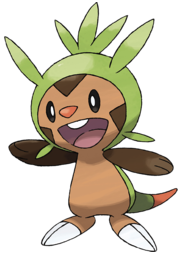
Since I have shown no signs at all of becoming even slightly less infatuated with the Grass type in the three years since I started this blog, selecting Chespin as my starter was something of a foregone conclusion.  The little tyke eventually found himself overshadowed in my affections by the return of my one true love, Bulbasaur, but he nonetheless remained a faithful companion throughout my playthrough of X version and has always been ready to pull his weight.  Where else to begin but with my first Kalosian Pokémon?

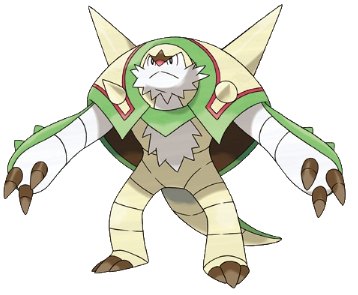
I begin with the Kalos Pokédex’s inaugural silly quote.  “Such a thick shell of wood covers [Chespin’s] head and back,” it faithfully explains, “that even a direct hit from a truck wouldn’t faze it.”  It is unlikely anyone will ever attempt to test this claim, Chespin being as adorable as he is, so we shall probably have to take the Pokédex’s word for it, but his sturdy spiked ‘helmet’ should at least afford solid protection from threats his own size.  I am a little readier to believe it of the human-sized Chesnaught, his final evolutionary stage – a bulky creature of uncertain mammalian extraction with a spiked tortoiseshell-like structure (presumably wood again) covering his back and shoulders, and spiny ‘gauntlets’ protecting the outsides of his forearms.  This guy’s shoulder-barges would surely be lethal.  So, Chespin nails ‘cute’ and Chesnaught nails ‘tough’ (particularly with the ‘come at me’ pose he adopts in both the official art and his battle stance), but as is often the case with Pokémon who have to make this transition, Quilladin is caught in a strange middle ground between the two; he seems to go for a little of both, mixed with a side of ‘impish.’  His long, pointed nose, the tuft of hair on his forehead, and his round sparkling eyes, together with his nigh-spherical body shape, all give me the disconcerting impression that Crash Bandicoot has seriously let himself go, and is disguising himself as a cactus to hide his shame and start building a new identity.  In some ways he doesn’t seem to fit smoothly as an intermediate between Chespin and Chesnaught; he’s more rotund than either of them, with short, stocky arms and legs, and the transition from Chespin’s helmet to Quilladin’s all-over body armour seems to go backwards again with Chesnaught, who seems to be more reliant on his tortoiseshell plate and armoured forearms.  None of that messes with the things I really like about these designs, though.

 Quilladin.

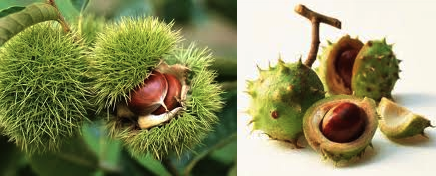
The inspiration for these designs is the spiny outer shell of the chestnut.  Nuts, berries and fruit have been underexploited by Grass Pokémon designs in the past, and chestnuts are distinctive and appropriate for a physical tank Pokémon.  There may even be a cultural allusion in play, to the horse chestnuts or ‘conkers’ beloved of British schoolchildren in the 19th and early 20th centuries – in traditional schoolyard games, the hard nuts are hung from strings and smashed together until the weaker one cracks and must be discarded, with veteran conkers that survive multiple such battles being especially prized (Roald Dahl gives a characteristically whimsical account of the game and its strategies in the book My Year).  Only the nuts themselves are used in the game, without the tougher but softer skins, but the nature of the game is so appropriate to Chespin’s physical bruiser battling style, as well as the habit Quilladin have of tackling each other in order to build their strength, that I can’t help but suspect a reference.  Chespin’s ‘helmet’ also resembles the tough, warty outer skin of the horse chestnut more closely than that of a true chestnut, with its dense thicket of bristly, almost needle-like spines.  What I particularly like about the way Chespin and his evolutions use chestnuts is that it ties together the Grass and Fighting elements.  They aren’t ‘chestnut Pokémon’ although that could very easily have been a workable starting point, since there are basically two ways to do a Grass Pokémon: ‘plant creature’ and ‘animal with plant characteristics,’ all Grass starters being the latter.  The Grass-type aspect of the design comes through in Chespin’s ‘helmet,’ Quilladin’s ‘armour,’ Chesnaught’s tortoiseshell plate, and their thorn shield signature move, which are also the things that convey their similarity to a human warrior or knight – in other words, the things that make them Grass-types are also the things that make Chesnaught a Fighting-type.  The combination of the two elements isn’t superficial; they work together.  It’s not always easy to make that happen, but I’m always fond of Pokémon who manage to pull it off.

True chestnuts on the left; horse chestnuts on the right.  Chespin and his evolutions, to me, are more of the latter.

Chesnaught handles in a similar manner to Torterra in battle, being a slow physical tank.  Probably his biggest problem is that he has rather a lot of weaknesses for a slow, defensive Pokémon, including a dangerous double-weakness to Flying attacks, but he does resist the powerful and popular Earthquake/Stone Edge combination, so it’s not all bad.  His biggest strength is the high power of his staple attacks, combined with a small but useful support movepool to keep opponents guessing.  His strongest Grass attack is Wood Hammer, which retains its 120 power rating in a generation where many of the strongest attacks in the game are being toned down; the recoil hurts, though, and doesn’t mesh well with the standard Grass-type ability Overgrow (because once you’re injured enough for the Grass-type damage boost to kick in, one or two more Wood Hammers have a good chance of dropping you), so Seed Bomb is also an option depending on what exactly you want to do with him.  Most Fighting-types have a wide selection of Fighting-type moves, but Chesnaught really only has two worth speaking of: Hammer Arm, which sacrifices speed for power (not that Chesnaught cares much about speed anyway) and Power-Up Punch, one of X and Y’s new moves, which boosts attack with every use (potentially a worthwhile choice for a more defensive Chesnaught who can afford to hang around for a couple of turns).  Grass with Fighting is not a particularly strong combination offensively – well, okay, let’s be fair, Grass with just about anything is not a particularly strong combination offensively, but Grass with Rock is one of the less bad ones, and Chesnaught can do that too, with Stone Edge.  Stone Edge is also important to make it a little bit harder for Flying Pokémon to walk all over him.  On the support side, there are basically two moves you can build sets around: Leech Seed, the eternal Grass-type favourite which also works well with Chesnaught’s signature move, discussed below, and Spikes, which is just universally useful.  Bulk Up and Swords Dance are both viable ways of increasing Chesnaught’s offensive presence, since he’s tough enough to take a neutral attack while setting up and scary enough to force some Pokémon to retreat.  Don’t count on a sweep, though; Chesnaught is just too slow.

Chesnaught.


All three Kalos starters have been blessed with a signature move to emphasise what is unique in their styles of fighting, and Chesnaught’s is Spiky Shield.  In mechanical terms, this thing is pretty neat.  It’s strictly an improvement over Protect, the standard option available to most Pokémon for blocking an incoming attack to stall for time; the advantage to Spiky Shield is that it additionally deals a small amount of damage if it blocks a ‘contact’ attack.  It’s a shame Spiky Shield damage can’t be stacked with the similar effect of a Rocky Helmet, because that would make Chesnaught a seriously daunting proposition for most physical attackers – perhaps not to the same extent as Ferrothorn, who can stack Rocky Helmet with his Iron Barbs ability, but then again, Ferrothorn actually has to take damage to cause recoil while Chesnaught doesn’t, so maybe that would have been too much ‘something for nothing.’  Besides, Protect is hardly a bad technique, particularly for Grass Pokémon who can use it to stall for damage and healing with Leech Seed, or in double battles where a Pokémon can potentially take two attacks in one turn, and Spiky Shield is, again, unambiguously better than Protect.

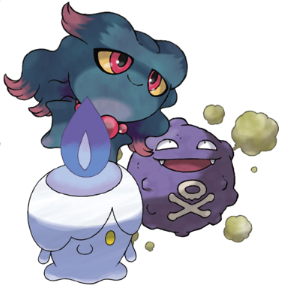
Some more typical users of Pain Split: Misdreavus, Litwick and Koffing.

Finally, you have two options for healing, besides Leech Seed.  Synthesis is the one you should use if you’re serious, because the sixth generation’s nerfing of Drizzle, Sand Stream and Snow Warning makes it much more likely you’ll be able to use the technique unobstructed.  I want to talk about Pain Split, though, because Pain Split is interesting from a flavour perspective.  Most of the Pokémon who learn Pain Split are Ghost- or Psychic-types, and of those who aren’t, most are in the Amorphous egg group and lack clearly defined anatomy, like Weezing and Swalot (even when it was available more widely, via move tutor, it was most prevalent among Pokémon with overtly magical powers or indistinct anatomy).  It seems to be implied that the attack normally functions on the literal sharing of pain with the opponent, usually through supernatural means, which makes it odd that Chesnaught can learn it at all, let alone as a level-up move.  Probably the intention here is to stress the retributive nature of Chesnaught’s defences, in line with Spiky Shield; the Pokédex is adamant that these Pokémon don’t start fights, but are happy to finish them.  This could possibly be pushed even further by suggesting that, since Pain Split is regularly associated with Pokémon who have mental powers, Chesnaught’s ability to use it stems from a deeply and firmly held belief in ‘eye-for-an-eye’-style justice.

Chesnaught also has an odd signature ability, Bulletproof, the in-game manifestation of his supposed ability to withstand bomb blasts, which grants total immunity to a select list of ball-, bomb- and bullet-themed attacks.  The most important of these are probably Shadow Ball, Sludge Bomb (which is super-effective against Chesnaught and more popular now that Poison attacks are strong against Fairy-types), Focus Blast and Aura Sphere, and to a lesser extent Seed Bomb, Energy Ball and Electro Ball (which Chesnaught resists anyway) and Gyro Ball (which does more damage to faster Pokémon, something Chesnaught is most definitely not).  Most of the others are either too weak or too rare to be major sources of concern.  Probably the main draw of this ability is that it makes him an unorthodox and somewhat risky but very interesting answer to Gengar, who relies heavily on Sludge Bomb, Shadow Ball and Focus Blast.  Aura Sphere immunity also makes him a good possible response to Clawitzer and Mega Blastoise – just watch out for Ice Beam – as well as special Lucario (though Lucario is more commonly a physical attacker).

In summary, then, Chespin and his evolutions have a pleasing design that take inspiration from an unusual place, and their most unique powers support that design well and create consistent characterisation.  They also combine Grass/Fighting more fluidly than the other representatives of that pair, Breloom and Virizion (though Breloom, it should be noted, is a kick-boxing dinosaur).  If I have complaints, they are mainly with Quilladin’s odd aesthetics – he could stand to be slimmed down, with more emphasis on his spines and perhaps more elaborate ‘armour’ to anticipate Chesnaught’s grand tortoiseshell plate – and with the more general problem that Grass is just a bad type and probably always will be.  That’s a complaint for another day, though…

Champions of the Pokémon League, Part 8: Diantha

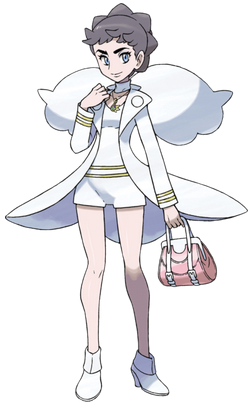
Diantha in her angel-winged white coat.  Note the jewelled necklace - that's her Digivice.

Glamorous but relatable, ethereal but down-to-earth, the Kalosian Champion, Diantha, is everything you want in an actress – but how does she stack up as a Pokémon League Champion?  She certainly has the look down, with an extravagant costume reminiscent of angel wings, and more importantly she also has the right kind of attitude to Pokémon and training.  Sadly – and I may as well be up front about this – the story of X and Y doesn’t give Diantha very much of an opportunity to do anything, something that was rather a disappointment to me.  Still, she gets a few good lines, and when you get her into a battle she’s the equal of any of her predecessors, so let’s take a look at her and see what makes this Champion tick.

We first meet Diantha in Lumiose City at the Café Soleil, and this scene is probably her most interesting because she has the opportunity to speak directly to Lysandre and set up a compelling argument against his beliefs – even here, the game doesn’t let her have many lines, but she makes them count.  Lysandre puts to Diantha the question of whether, as an actress, she would prefer to stay young forever, since it is her duty to inspire people with her beauty.  He clearly expects the answer ‘yes,’ but Diantha finds the question bizarre – being forever young would mean playing the same kinds of roles forever, but she views change and age as essential parts of the experience of human life, and eagerly anticipates the variety of more mature characters she will play as she grows older.  Their conversation betrays a certain narrowness and superficiality on Lysandre’s part; despite his comment that Diantha’s great contribution consists in “[moving] the multitudes with her excellent acting,” it seems clear that he regards her physical beauty as the most important aspect of her craft – to him, Diantha really is just a pretty face.  Her second appearance makes it clear that Diantha herself has a very different understanding of what she does.  We meet her again in Coumarine City, where she is talking with Professor Sycamore at the monorail station.  Diantha offers some comments on Mega Evolution, suggesting that perhaps the reason it seems to be limited to Kalos is because it has something to do with the legendary Pokémon of the region (if Professor Sycamore is correct in his eventual conclusion that Mega Stones were evolutionary stones irradiated with the energy of the Ultimate Weapon three thousand years ago, she’s not far off – although Xerneas and Yveltal don’t seem to have been directly involved with the weapon’s first use, they command similar powers).  More interesting from a characterisation perspective, though, is what she talks about after he leaves.  Sycamore had mentioned the bonds between trainer and Pokémon as a critical component of Mega Evolution, and Diantha makes an interesting comparison with the way she approaches acting: she sees it as an exercise in empathy.  In order to enjoy a role and play it effectively, Diantha says, she needs to put herself in her character’s shoes and understand what they have in common.  She also believes in taking the same approach to interacting with both people and Pokémon.  Essentially, the reason she’s both a successful actress and a great Pokémon trainer is because she’s figured out that the two professions share a key skill – empathy – and made it a part of her general approach to life.

 Diantha's Radiant Chamber, in all its stained-glass glory, seems intended to be 'heavenly' in its appearance, like her costume.

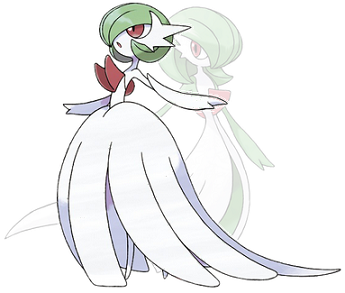
And that… is the last we see of her.  Diantha doesn’t take any further part in the storyline of X and Y until your troubles with Team Flare are all over and you reach the cathedral of the Elite Four.  Realistically enough, she seems to have almost forgotten you herself by this point, but quickly realises that she does know who you are and what you’ve done for Kalos after all – which brings us to the battle.  Like Blue and Cynthia, Diantha is very hard to pin down to a preferred Pokémon type or battling style.  She appears to favour Rock- and Dragon-types, with two of each on her team, but her signature Pokémon, the strongest in her line-up, whose physical appearance is recalled in the flaring white skirts of her coat, is a Fairy/Psychic dual-type, Gardevoir.  In Hawlucha, her opener, Diantha has a strong and fast physical attacker with excellent type coverage thanks to Flying Press, Hawlucha’s idiosyncratic signature move, while Tyrantrum adds a sledgehammer to her tool kit.  Aurorus provides Reflect and Light Screen support, though with two double-weaknesses it may not last long enough to set up more than one.  Goodra is a resilient special tank with a wide variety of powerful attacks.  Gourgeist is surprisingly tough and can hit almost anything for super-effective damage by adding the Ghost type to Pokémon with Trick-or-Treat.  Last, but most definitely not least, is Gardevoir, who proves that Diantha can put her money where her mouth is when it comes to empathy and bonding with her Pokémon – by using her Mega Charm to Digivolve Gardevoir, Diantha can turn her partner into as great a threat as the whole of the rest of her team put together (as I learned to my cost when I first challenged her and won with my Venusaur’s last three hit points).  Mega Gardevoir’s Moonblast and Psychic attacks are phenomenal, more powerful than anything a Champion has brought to bear against us before, and without a Steel-type to resist her primary attacks she is one of the most dangerous single opponents the games have ever produced.  Ironically, Diantha’s greatest vulnerability is probably to Fairy Pokémon, since she has three Pokémon that are weak to their attacks, none that resist them, and only one super-effective attack to hit back with (Hawlucha’s Poison Jab); she also has great difficulty with Ice- and Steel-types.  Still, her weak points are certainly less easy to exploit than those of predecessors like Water-type master Wallace and the closeted Flying-type specialist Lance, making her a solid end-game challenge.

 Diantha's partner, Mega Gardevoir.

(Of course, if you’ve been using the Exp. Share consistently throughout the game Diantha is probably a walk in the park, but hey, who’s counting?)

The variety of Pokémon we see on Diantha’s team – in terms of not only their types and skills but their personalities and dispositions – may be intended to recall her desire for variety in her career and her life.  Partly I’m just saying this because I can’t find any other sort of theme to link her team together, but it seems to me that a wide variety of popular film genres have Pokémon representatives on her team; she has action (Hawlucha), horror (Gourgeist), family/comedy (Goodra and Aurorus), disaster (Tyrantrum) and, of course, romance (Gardevoir) all covered.  Perhaps that’s entirely in my head and the designers just wanted to give her a diverse bag of the new Pokémon the sixth generation has to offer, but it makes sense, given Diantha’s stated interest in playing a variety of roles, that she might have acted in many different genres, possibly meeting many different Pokémon in the process.

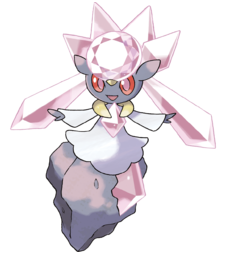
 The recently-revealed legendary Pokémon, Diancie, whom I'm bringing up because I know someone else will if I don't.  A lot of people speculate about a connection between Diantha and Diancie, but I don't believe there is any, because the similarity between their names doesn't exist in Japanese, where Diantha's name is Carnet, and because it makes as much sense for the design of her coat to be based on Gardevoir as on Diancie.

One last thing that’s worth mentioning about Diantha is her reappearance in the Café Soleil after the end of the game.  Diantha here offers you the opportunity to trade for a Ralts holding the Gardevoirite Mega Stone, so that you can raise a Mega Gardevoir of your very own.  This is not in itself particularly interesting; what is noteworthy is that she actually takes the time to think about how the Pokémon involved in this trade feel about it – something I can’t recall any other character in the games ever doing (although, granted, most in-game trades are with random NPCs who have no other discernable purpose in life).  “We Trainers all feel a bit nervous when trading Pokémon,” she comments as the trade begins, “but I’m sure it’s nothing compared to how the Pokémon must feel!”  When the switch has been completed, she even takes a moment to address the Pokémon you’ve given her directly, asking “was it a bit shocking to be traded?” and promising to care for it to the best of her ability.  A tiny detail at the very end of the game, but one that once again demonstrates that Diantha really does know what she’s talking about when it comes to empathy and consistently makes an honest effort to understand the perspectives of her Pokémon on their lives together.

On some level Diantha’s non-existent involvement in the Team Flare crisis makes sense, since she’s very clear that she’s only a Pokémon trainer “in [her] off time” – acting is her real career, and for all her power, she’s not really a ‘saving the world’ kind of girl.  Still, I find her remoteness from the actual plot as disappointing as I did Iris’s, and I don’t think Diantha even gets as much screen time (ironically) as Iris did in Black and White.  Having said that, she makes a good effort to stay relevant in the time she does get – and I can always hope for more in any future games.  Though she never gets the chance to be a hero, through her dialogue she does manage to establish herself as a role model for Kalos’ trainers and a champion of a worldview opposite to Team Flare’s.  Lysandre wants to put the beauty of the world on a pedestal and keep it from changing for all time, but Diantha wants to engage with and understand beauty, and prefers to embrace change, for better or worse, which, ultimately, is what the central conflict of X and Y is about.