…I have to do this, don’t I?

All right.  Let’s get a look at you.  Gotta figure out what the cringe-to-awesome ratio is.

I didn’t actually watch the Nintendo Direct broadcast when it first came out, ‘cause it was, like, the middle of the night in New Zealand and I’d been squinting at passages from Herodotus for two hours, so my immediate reaction was “I’m gettin’ too old for this $#!t.”  So now you get to experience my first impressions of the broadcast as I watch it.

Brace yourselves.

Oh hi there, Satoru Iwata.  Sure, I’ll listen to your… whatever.  Knock yourself out.

Yay for nostalgia time.  You know, I’ve always had mixed feelings about the whole two-versions thing, but he’s right, it does promote trading, and thereby interaction between players, and helps keep Pokémon from being a solitary pursuit… just as long as the damn link cable keeps working.

You have all the cool stuff from Gold and Silver to choose from, and you pick “shiny Pokémon” as the thing that defines that generation for you?  Ah, whatever floats your boat, I guess.

Yes, double battles were cool, and it was neat that Ruby and Sapphire were released overseas so much more promptly than their predecessors.  The wireless adapter that came with Fire Red and Leaf Green was great too, because it actually worked.  You’re right, Iwata, that was a big step.  Um… you don’t have any thoughts on the decision to remake Red and Blue?  No?  Okay, that’s cool.

And you’re rushing through the rest of the games.  Yeah, I guess you’re tired of the retrospective stuff.  Fair enough, I guess.  Time to talk about the new 3DS games.

Hey, Pikachu; how’re you doing?  Yeah, yeah, I know you’re excited, Iwata just told us OH MY GOD DID YOU JUST ELECTRIFY THE EIFFEL TOWER?

Right, trailer starts in earnest.  We have mirrors, that’s pretty.  And a full-sized player character image instead of a dinky little sprite, that’s a first.  And… wow, okay.  Yeah, I don’t know if “breathtaking” is totally fair but that is pretty.  And… it looks like we actually are in France, because that doesn’t look exactly like the Eiffel Tower, but it’s close, and Pikachu was definitely in France.  New region is based on Europe, I guess, the way Unova was based on New York?  That’s kinda cool; I like Europe.  (Please let there be a town based on Athens, please let there be a town based on Athens)  Also our running shoes have been replaced with roller skates.  That’s… actually kinda awesome.

AND STARTERS, with their foreign language names already set, no less.  The Grass-type… Chespin, who is… I guess like a chipmunk with a chestnut helmet?  And- oh, wow is that the battle interface?  *ahem* Sorry.  The Fire-type… Fennekin, who is… a fire-fox, which… well, yeah, y’know, that was kinda Vulpix’s thing, guys, and… yeah, okay, it sort of looks like you’ve given it psychic powers as well, which… was also Vulpix’s thing to an extent, and also Zorua’s as well, sort of, but I guess foxes are kind of important in Japanese culture and mythology so I’ll reserve judgement on that one.  And, the Water-type… Froakie, who is… a frog.  Well.  All right.  I’m guessing they never read my entry on Seismitoad but it’s not like I was expecting them to.  Maybe they’ll do something else with Froakie besides give him sonic powers.

I see… lots of cool forest, a wild Pikachu, some other ‘traditional’ Pokémon… they seem to be making a point of that.  I suppose that means they’re not going to do a Unova again and bar old Pokémon from their new region; hallelujah.  WHOA raging columns of fire; please don’t tell me that’s a Gym; I don’t want to be bacon.  And… okay, these are the new legendary Pokémon, I imagine.  Giant… evil… Y-shaped bird… getting kind of a vulture vibe from this thing?  I kinda think that designing a Pokémon specifically so it looks like the letter Y when seen from below is sort of a stupid design choice but it doesn’t impact too much on vulture-mon’s appearance from other angles, so I’ll let them have that one.  And his counterpart… the blue crystal rainbow stag thing.  Okay.  Sure.  Why not?  I’m not really sure what they’re trying to go for with this one, because the choice of a stag and the forest setting seem to imply they’re aiming for the old ‘nature guardian’ archetype but the whole rainbow crystal aesthetic doesn’t seem to mesh with that.  Hmm.  I wonder what they have in mind there?

Pokémon X and Pokémon Y?  Okay, so I guess you’ve finally run out of colours.  After Black and White I suppose anything else would have started sounding forced.   Speaking of which, there must be something significant in those names, since they wouldn’t abandon the traditional naming scheme without good reason, particularly after Black and White had such significant titles (the central theme of those games being duality, and the reconciliation of dualities).  Only… what the hell do X and Y signify?  Only thing that comes to mind for me is the two axes of a Cartesian plane, which… hmm.  Well, they are making rather a lot of the 3D-ness of it all, as they usually do.  Given that, I suppose it would make sense to have three games, X, Y, and Z to represent the three spatial axes of a three dimensional world.  It doesn’t exactly have the same delightful symbolic resonance as Black and White, but I suppose I should wait for the games to come out so I can experience the plot before I give a final word on that.  Based on the flaring of the letters in the logo, it looks like stag-dude’s antlers are supposed to recall the shape of an X the way birdie’s wings form a Y-shape, so… I guess they could be going for a land-and-sky thing based on X as the horizontal and Y as the vertical.  Kinda paints them into a corner with Z, though, since Z is just… y’know… the other horizontal direction.

And you’re giving it a single release date for Japan and overseas!  Wow, you’re really committed to this, aren’t you, Nintendo?  Er… wait. Japan, the Americas, Europe and Australia.  Um.  Hello?  New Zealand here?  Um… are we Australia now?  Guys?

Oh, whatever.  Yes, thank you very much too, Iwata, that was… interesting.

Hmm.

This is either going to be amazing and wonderful, or a catastrophic waste of time and resources.

Possibly both.

I have to review the new Pokémon, don’t I?  All of them?  It’s, like, my schtick, isn’t it?  And I have to do the whole “I hereby affirm/deny this Pokémon’s right to exist” thing again?

…great.  Well, that’s my project for all of 2014.

I’m not totally sure what to make of this.  I am made slightly uneasy by the emphasis the trailer puts on the visual aspects of the games, and the amount of work that’s going into a complete redesign of the graphics.  I mean, I’m sure the games will be visually stunning, and that’s nice, don’t get me wrong, but I don’t really care all that much; I was totally happy with the old Ruby/Sapphire graphics engine.  Still, that doesn’t mean they won’t be paying attention to the other aspects of the games.  The graphics of Black and White were hyped too, and that didn’t stop them from having the best story the series has yet produced (continuing to reserve judgement on Black and White 2, since I still haven’t finished playing).

So I suppose my final word on this is that I don’t really do optimism, as a rule, but Pokémon X and Y haven’t made me want to beat my head against the wall.  Yet.
Pokémon and Food

Food, you may have noticed, is important.

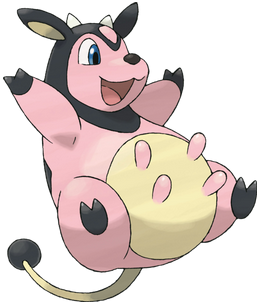
You wouldn't eat dear old Milky, would you?
You wouldn’t eat dear old Milky, would you?

While I look forward to the day when I shall no longer have any need of food, and shall be able to sustain my bodily functions by means of philosophy alone, I am for now bound, like most people, by the need to consume carbohydrates, proteins and fats on a regular basis in order to keep myself from, y’know, dying of starvation.  Food isn’t just important to each of us on a personal level, though, it’s important to society as a whole because, as a rule, when a population has more food than it needs, it gets larger, and continues to get larger until the food supply becomes an issue again.  Entire schools of political and economic thought are based around this simple problem, and it’s likely that civilisation as we know it came into being because we figured out how to produce a food surplus by growing crops in a regular and systematic fashion.

Continue reading “Pokémon and Food”

On Fossil Pokémon

Let’s talk about fossil Pokémon.

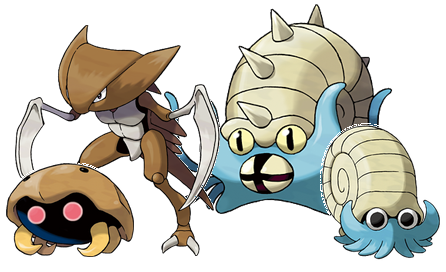
Official art of (left to right) Kabuto, Kabutops, Omastar, and Omanyte, by Ken Sugimori; quoth the raven "copyright Nintendo!"
From left to right: Kabuto, Kabutops, Omastar and Omanyte

Ever since the glory days of Red and Blue, the scientists of the Pokémon world have been trying to resurrect ancient, extinct species of Pokémon from their fossilised remains – and, in many cases, they’ve succeeded.  Every generation except for the second has brought a new set of fossil Pokémon with it; Omastar, Kabutops and Aerodactyl from Red and Blue, Cradily and Armaldo from Ruby and Sapphire, Rampardos and Bastiodon from Diamond and Pearl, and now Archeops and Carracosta from Black and White.  One could also include, as an honourable mention, Ruby and Sapphire’s Relicanth, who, like his inspiration the coelacanth, is an extremely archaic species believed for many years to be extinct until a few were unexpectedly found very much alive in the deep ocean.  I talked about Archeops and Carracosta at some length when I was reviewing the Unova Pokédex last year, so there’s little point in discussing them further, and I’m not especially anxious to do detailed reviews on all of the others either when there are so many other projects on my list, but I do think it would be worthwhile to talk about them as a group, since the whole concept of a ‘fossil Pokémon’ is quite interesting, particularly with reference to the context in which Game Freak started using these ideas in the first place.

Continue reading “On Fossil Pokémon”

The Ethics of Pokémon Training

When you get a title like that, you know there’s some serious sh*t gonna go down.

So, I’m writing this because of a question that turned up in my ask box a couple of weeks ago, which I will reproduce here:

“You’ve touched on the moralistic complaints about the Pokemon franchise before (your post on Torchic, Combusken and Blaziken). I’m on a similar ground to you, seeing teamwork etc being more of what Pokemon is about, but you can’t ignore the fact that violence and animal abuse seem to be essential in fostering that partnership between trainer and Pokemon, can you? Teamwork it may be, but the Pokemon take 100% of the physical side of things. Would you consider doing a post on this issue?”

This is, as it happens, a particularly good time to be talking about this.

PETA (People for the Ethical Treatment of Animals) has just gotten a lot of attention in the Pokémon community for producing a short online video game, Pokémon Black and Blue http://features.peta.org/pokemon-black-and-white-parody/, in which Pokémon free themselves from their cruel and sadistic trainers and start a rebellion with the intention of showing humanity a better way.  I urge readers to take a look at the page and the game for themselves, however the gist of it is as follows: Pokémon trainers are horrible people who keep their Pokémon trapped in Pokéballs most of the time, keeping them from getting exercise, and let them out only to have them beat each other bloody, and provide them with medical care only so they can send them back into the arena more quickly.  PETA has gotten a lot of flak for this, as they do for a lot of their stunts; from what I can tell, even the people who are theoretically on their side often think they’re insane.  Naturally, jumping on the bandwagon and attacking them would be too easy.  As always, I like to think I can outline a more nuanced view of the matter.  Here goes nothing.

I’m actually not convinced any of this is meant seriously.  I think the game itself was clearly made by someone who has more than a passing familiarity with Pokémon Black and White – in fact, I half suspect it was made by a fan with a black sense of humour.  I strongly doubt anyone at PETA actually believes that Pokémon is a genuine threat to their cause; it’s more likely that the game is a tool for sparking controversy and drawing attention to PETA than a real attempt to damage Pokémon.  I think there is something of a risk that going after Pokémon like this will risk trivialising the very real abuses they spend most of their time trying to tackle; however, I also think that attacking not just real instances of animal abuse in the world but also the cultural phenomena that appear to tolerate those abuses (in, I must again emphasise, what seems to me like a fairly tongue-in-cheek way) is actually a quite insightful strategy.  They’re probably not going to make any Pokémon fans change their mind about the franchise (they certainly haven’t changed mine), and I think they must know that, but they are going to make people react to what they’re doing, and in the course of that reaction people will be made to think about what makes real animal abuse different from Pokémon battling.  This, of course, means that people are thinking about animal abuse and why it’s horrible, which is exactly what PETA wants you to do, so the moment we even start having this conversation, the game has done its job.  Since I actually quite like what they seem to be doing here, I’m going to go along with it and discuss some of these ideas myself.

First of all, I wish to acknowledge one very important fact: they have a point.  Pokémon is a game about capturing wild animals, stuffing them into tiny balls, keeping them in there most of the time, and letting them out mainly so they can fight other animals, often for the amusement of spectators.  You can argue – and I’m going to – that this is a very simplistic reading of the ideas in the franchise, but bear in mind that it’s actually not the absence of good, wholesome ideas in Pokémon that’s the problem.  It’s very easy to point out the themes of partnership, discovery, charity, heroism and all the rest that we see everywhere in the Pokémon franchise; this is exactly what you see hordes of fans doing whenever PETA’s recent stunt is discussed.  The problem is that this doesn’t actually address their complaint at all.  It’s not the absence of good, wholesome ideas in Pokémon that they’re objecting to – it’s the way those family-friendly themes are mixed up and bound together with a premise that potentially has a lot of morally repugnant implications.  To quote the game’s website, “the difference between real life and this fictional world full of organized animal fighting is that Pokémon games paint rosy pictures of things that are actually horrible.”  Of course cockfighting is okay – after all, it’s no different to Pokémon training, and Pokémon don’t seem to mind… right?  That train of thought probably sounds as ridiculous to you as it does to me, but people believe and do ridiculous things every day.  Can you imagine that train of thought passing through the head of someone who already endorses cockfighting anyway?  How about an eight-year-old kid who’s never heard of cockfighting before and doesn’t know whether it’s supposed to be good or bad?  Frankly… I can.  For most people Pokémon is only going to be one of a hundred different influences pushing and pulling in different directions, but it’s still there, pushing very subtly in a direction the creators never intended.  So, again, yes: I actually do think PETA have a legitimate point here.

How, then, do we avoid this problem?  Don’t even try to, says I: tackle it head on.

The basic premise of the Pokémon franchise is really quite morally ambiguous.  That’s part of the reason I find it so interesting, and part of the reason I write for this blog at all.  In general Game Freak likes to avoid touching on the moral ambiguities, but when they do it creates some of the most fascinating stuff the franchise has to offer.  This is exactly why I’ve always felt that Black and White leave all the previous games in the dust as far as storytelling goes – the idea of Pokémon liberation trumpeted by Team Plasma (whom many people see as a pastiche of PETA) is potentially a perfectly noble goal.  Black and White, for the first time, actually acknowledge that there is something slightly fishy about the basic assumptions on which the series operates.  Maybe Pokémon shouldn’t be forced to battle – are we really so sure this is right?  Many of the characters in the game are indeed won over by Team Plasma’s questioning of the established order, and even the Castelia Gym Leader, Burgh, admits that they might be onto something.  The problem is that the debate eventually winds up being very one-sided.  The Team Plasma grunts you meet are brutal, unthinking zealots.  Their leader, Ghetsis, is cynically manipulating his followers to achieve his aims of conquest.  Even N, the undoubtedly benevolent spiritual leader of Team Plasma, turns out to have been deliberately raised in the company of Pokémon who had been hurt by humans in order to influence his worldview, which begins to collapse once he sees what real Pokémon trainers are like.  What about the Pokémon N was raised with?  What about the people in this world who really do mistreat Pokémon horribly, like Team Rocket, such a major fixture of earlier games?  What about Team Aqua, Team Magma, and Team Galactic, who tried to destroy the world by enslaving Pokémon?  N is presented as naïve, his worldview as noble but warped… but would he really seem that way with Team Rocket on the scene?  I think the best path for Pokémon to take from here is to look at what Black and White have done and improve on it: find ways to highlight the moral ambiguities instead of whitewashing everything, and explain through their storytelling “this is good, and this is bad, and here’s why.”

What’s my take on the ethics of Pokémon training, then?  Well, if you’ve read a lot of my anime commentaries, you’re probably aware that I think there are a lot of unwritten and unspoken rules connected with Pokémon training, a code of conduct that regulates the way trainers and Pokémon relate to each other.  Although explicit references to this code are few, I believe that most characters in the franchise do implicitly follow it.  The first and probably the most important point to discuss is what it means to “capture” a Pokémon.  The anime rarely presents capturing a Pokémon as requiring a trainer to beat it into submission; often, particularly in the later series, it’s more a question of winning a Pokémon’s respect.  Furthermore, when the villains capture Pokémon, they rarely use Pokéballs.  When they do, no-one seems to mind.  When they try to capture Pokémon in other ways – even wild Pokémon, who should in theory be fair game – all the law-abiding characters are outraged.  I think what this implies is that the process of battling a wild Pokémon and capturing it in a Pokéball is in fact about convincing it that you are worthy of being its trainer.  This, in fact, is the reason knocking out a Pokémon in the games renders it impossible to capture: if you’ve beaten it completely unconscious, you’ve deprived it of the opportunity to test your skills and perseverance to its satisfaction.  Capturing a Pokémon under such circumstances would be an unforgivable transgression of the rules that govern interaction between humans and Pokémon.  Capturing Pokémon without Pokéballs – by physically restraining them, for instance – likewise violates the somewhat ritualised process of capture.  So, now that we’ve established that Pokémon have to permit trainers to catch them, why would they even want to?  The obvious reason is that they become more powerful under human training, but this is an oversimplification of the issue.  Gaining “levels” represents a Pokémon gaining a greater understanding of its own innate powers, coming closer to becoming an ideal paragon of its species.  This is most noticeable in species that experience evolution, of course (which, incidentally, I believe to be closely connected to the removal of psychological blocks and the achievement of a more advanced state of mind) but all Pokémon have unique abilities which even they may not fully understand by instinct alone.  At the same time, travelling with humans forces Pokémon to learn a wider range of skills and use their abilities for a wider range of purposes than they ever would in the wild.  As a result, they develop greater versatility and creativity than their wild counterparts.  They may even gain skills of leadership and cooperation as a result of working together with Pokémon of other species (if you watch the anime episode Bulbasaur the Ambassador you’ll see exactly what I mean).

But what good does all this serve, beyond making them better able to serve humans and fight in human tournaments?  Simple.  I don’t think Pokémon are ever necessarily supposed to spend their entire lives with humans once caught.  Many may decide later to stay with their humans forever, but I believe most Pokémon initially join trainers with the assumption that, like Ash’s Butterfree and so many of his other Pokémon, they will eventually leave, either returning to the wild to use their newfound powers there, joining other trainers to explore their abilities from a different perspective, or even assimilating completely into human society in one way or another, like Squirtle eventually did.  Pokémon, in short, should not be viewed as passive tools to be used and discarded by trainers.  They are independent, thinking beings who may partner with humans, temporarily or permanently, in order to further the goals of both, in accordance with an unspoken but well-established and very complex code of honour that dictates the actions and conduct of both sides.

Yes, I did just try to completely change the way you view every aspect of Pokémon training from the ground up.

Damn, it feels good to have my honours dissertation finished.

Pokémon and Gender

So, I’ve been wanting to write this entry for a while, but haven’t because I can’t make it fit into any of the series I want to do.  In that sense, it’s actually something of a cool opportunity that I’m not committing to writing anything in particular at the moment, because I can just do whatever.  I will warn you, though, that this will be one of my most trippy and speculative entries yet.  Brace yourselves.

The premise of what I’m going to be talking about today is a choice of vocabulary that just about every person on the planet has probably taken for granted, but which has always stuck in my craw (because, as we know, I’m obsessed with languages): “gender.”  The word “gender,” unbeknownst to many, doesn’t actually refer to the biological distinction between male and female.  Male and female are sexes, not genders.  Masculine and feminine are genders.  Traditionally the word has referred to the concept of grammatical gender, an idea present in every major European language except English, whereby all nouns are considered masculine, feminine, or (in e.g. Latin, Greek, and German) neuter, and adjectives must change their forms to suit the gender of the nouns they describe (for instance, in Latin, ‘tall’ is altus if you’re talking about a mountain, but alta if you’re talking about a tree).  There is no real rule to these, and they’re not always consistent across languages either (the Latin word for tree, arbor, is feminine; the ancient Greek word, δένδρον, is neuter, and the French word, arbre, is masculine, even though it’s clearly derived from the Latin word).  In short, something that has ‘gender’ is associated with maleness or femaleness (or absence thereof) in some vague and unspecified way.  In modern usage, this meaning has expanded to include descriptions of a person’s general psychological disposition, certain traits being regarded as ‘masculine’ – typical of a man, but not exclusive or necessary to men – others as ‘feminine’ – typical of a woman, but not exclusive or necessary to women.  We’ve all met masculine women and feminine men; I’ve been called ‘feminine’ once or twice (by my best friend, no less).  Things get much worse when we throw sexuality into the mix, because that’s even more complicated and doesn’t necessarily line up with sex or gender, but honestly I don’t want to go anywhere near that particular can of worms.  Anyway, here’s the thing…

Pokémon don’t have sexes.  They have genders.

I’m aware, of course, that this is probably a mistranslation caused by squeamishness about exposing ten-year-olds to the inherent horror and immorality of the word ‘sex’ (never mind that you’re selling them a game in which Pokémon engage in ‘breeding’).  I think we can all agree, though, that just letting it go would be far less entertaining than grabbing it with both hands and following it to its most insane possible conclusion.

The Pokémon franchise in general has always been extremely closed-mouthed about how Pokémon reproduce.  None of the characters seem to have any idea how the process works.  A number of NPCs pointedly insist that it hasn’t been proven that Pokémon lay eggs, because in thousands of years of recorded history no-one has ever actually seen it happen.  Until the events of Gold and Silver, likewise, it hasn’t been conclusively proven that Pokémon hatch from eggs either; that’s why Professor Elm is so excited when your Togepi egg hatches.  A Pokémon egg is an incredibly rare curiosity, the preserve of obsessive collectors like Mr. Pokémon.  The kind men and women of the various day-care centres, likewise, are utterly mystified whenever eggs show up in their backyards, no matter how many times it happens.  There is also a whole string of little discrepancies in the system as it’s given to us.  There are a few single-gendered species, which creates obvious problems – female-only Pokémon, like Kangaskhan and Lilligant, would need to breed with males of other species in the same egg group to maintain a population (because, of course, inter-species breeding is not especially problematic for Pokémon), while male-only Pokémon can’t even do that, since all baby Pokémon are of the same species as their mothers; players can only get babies of those species with the help of the ‘breeder’s wildcard,’ Ditto.  According to everything we have been told, Sawk, Throh, the Hitmon triplets, Braviary and possibly Tauros cannot reproduce in the wild.  The same goes for ‘genderless’ Pokémon, like Electrode and Starmie.  Now, I realise biology has never exactly been Pokémon’s strong point, but it doesn’t take a genius to work out that a species which is completely incapable of reproducing cannot exist.  It doesn’t seem to make a whole lot of sense for Chansey, Petilil, Mandibuzz, Kangaskhan and Jynx to be totally reliant on hybridisation to continue their species either.  There’s a little question mark over Ditto as well – Ditto can Transform into an exact duplicate of a Pokémon standing in front of it… so, by all common sense, a Ditto presented with a biologically male Pokémon should Transform into a biologically male Pokémon.  Ditto might be able to alter its form to a small extent, but the games don’t really provide any evidence for that, and the anime implies that it can only make superficial changes, so I doubt it could reconfigure an entire organ system without help.  In short, whatever goes on in day-care centres, it’s not straightforward sexual reproduction on the model of real-world animals.

Here’s my weird-ass take on it all, then…

Pokémon, I will repeat, don’t have sexes.  They have genders.  That is, they don’t actually have differentiated reproductive systems; they are all, in essence, single-sex species.  They do have an unusually large degree of variance in the levels of different hormones they produce, which leads to significant variation in their psychological traits, and in many species (most notably Nidoran) this is linked to some physical aspects, creating the appearance of sexual dimorphism, though in the vast majority of cases the differences are actually superficial.  Reproduction takes place via a ‘mind-meld’-like process (I sort of imagine them pressing their foreheads together, murmuring to each other, and glowing softly); genetic information is exchanged, but selectively – the vast majority of a baby Pokémon’s genes come from its mother.  Most of the exchange actually involves psychological traits.  As a result, a baby Pokémon will be quite close to being, physically, a clone of its mother (which is why inter-species breeding always results in a Pokémon of the mother’s species – the father contributes only a few genes, selected out of those that are compatible with the mother’s species) but will have closer to an even mixture of psychological traits from both parents.  The father (as, of course, we know) is additionally capable of passing on a number of conscious mental traits and learned abilities, which become ingrained in the child’s instincts.  For most Pokémon species, mental health requires a mixture of masculine and feminine traits, so instinct dictates that two masculine Pokémon will not mate willingly, and nor will two feminine Pokémon.  The entire process is far more low-key than what real animals have to go through, and consequently much more difficult to observe, which is why the whole subject is surrounded by such abject confusion.

So, how does this help to resolve the problems with how Pokémon breeding appears to work in the games?

The thing about the all-masculine species, like Hitmonchan and Braviary, is that – being universally and excessively ‘masculine’ – they are extremely pugnacious and aggressive (this, again, is something we already know – just look at the all-masculine species).  As a result, practically everything they do is constantly simmering with potential to break into outright violence.  What passes for ‘courtship’ among these species is no exception, and is simply so confrontational that human observers have never actually made the leap to identifying it as courtship (if you’re familiar with Homestuck, the concept of a ‘caliginous romance’ is a decent analogy, though it’s far more developed and laden with cultural baggage) and, as I suggested, the actual reproductive act itself is surprisingly easy to miss.  The kind of aggression and conflict necessary for a pair of Pokémon from an all-masculine species to develop an intimate relationship simply isn’t allowed to happen in the context of a day-care centre, where the staff normally discourage fighting.  Thus, Pokémon from all-masculine species can and do reproduce in the wild, but never get the chance in a day-care.  Pokémon from all-feminine species have a similar, but opposite set of issues.  They are universally and excessively ‘feminine,’ and therefore extremely passive, gentle, and cautious in their relationships with each other.  Courtship is an extremely slow, drawn-out process that can last for months or years; in captivity, there normally just isn’t time to observe it happening, and even in the wild it’s so long-term that human scientists haven’t actually been able to recognise it yet.  Many Pokémon from all-feminine species will take masculine partners from other species in order to create social diversity, and this generally happens much more quickly.

‘Genderless’ Pokémon are another kettle of fish entirely.  I want to suggest that they don’t necessarily all work in the same way; rather, they’re a ‘miscellaneous’ group.  Many of them aren’t actually ‘genderless’ but actually have three, four, five or even more genders, none of which match up exactly with ‘masculine’ or ‘feminine’ – as a result, humans are totally unable to understand the rules that govern their reproductive compatibility.  Some of them reproduce in groups of three or more, making it impossible for a day-care centre, which takes two Pokémon at most, to observe their reproduction.  A few reproduce by fission, splitting into two or more children only at the moment of death.  In short, their reproductive practices are just so weird that human observers don’t have a hope in hell of understanding what’s going on.  This, of course, brings me to the most important Pokémon of the lot: Ditto.  Ditto, in the games, does not reproduce; it only helps other Pokémon to do so, presumably using its ability to Transform into any other species.  Although Ditto forms a perfect physical copy of its partner, psychologically it doesn’t change at all when it Transforms; since Ditto is neither masculine nor feminine, it adopts a totally different role and all the usual rules of courtship go out the window when it gets involved, which is why universally masculine Pokémon can reproduce in captivity with a Ditto.  Ditto is likewise capable of overriding whatever whacked-out reproductive norms are in play for ‘genderless’ Pokémon, even producing eggs of Pokémon species that don’t naturally lay eggs at all.  It contributes very little to the child, physically or psychologically, but does provide a way to scramble the genes provided by the other parent and throw up new combinations of dormant traits.  So, then… question: why, in evolutionary terms, does it make sense for a species to focus its energy on helping other species to propagate themselves?  Answer: the relationship is symbiotic.  Ditto actually feeds on the leftover energy of cell division to revitalise its own cells.  It gets… a bit metaphysical, but the practical result is that, as long as a Ditto continues to help other Pokémon reproduce, it will never die.  Absorbing a huge excess of cellular energy allows Ditto to split and form two new Ditto; this doesn’t happen often, but accounts for the Ditto that are inevitably killed by other Pokémon or die in accidents.

As for where the Ditto came from in the first place, I’m inclined to accept the fan theory that they’re closely related to Mew – the only other Pokémon with the ability to Transform, courtesy of her genetic library, who also happens to be bright pink – mostly because it fits well with my ideas about Mew, which suggest that her whole purpose in the world is to absorb DNA from other Pokémon and store it.  Ditto have lost the ability to store borrowed DNA on a long-term basis, and as a result their physical form has degenerated, but they retain the ability to absorb DNA and rapidly assimilate it into their own systems.  That, naturally, brings me to the last category of Pokémon I need to talk about: legendary Pokémon, who (with the notable exception of Manaphy) cannot breed at all, Ditto or no Ditto.  Most of them are also genderless.  Many legendary Pokémon are heavily implied to be unique (and presumably immortal) anyway, which means I don’t have to worry about them, but a few seem to exist as entire species; most significantly, a baby Lugia appears in a few episodes of the anime.  They’re sufficiently different from other Pokémon that they can’t breed normally with anything else, and their lifespans are so long that humans just can’t observe them properly.  Mating season might come around once every three or four centuries and last for a month or two; even then, eggs might take years to hatch.  In short, some legendary Pokémon do breed, but for all intents and purposes it’s not something humans can take advantage of.

I think that’s enough from me for now – it’s not every day I try to totally redefine the way we look at a major aspect of the Pokémon games.  As always, I’d love to hear your thoughts on my latest weird-ass theory; if you point out something that doesn’t make sense, I might be able to improve on it.  Anyway, that’s all from me – thanks for reading, and have a fun day!

Legendary Pokémon: Final Thoughts

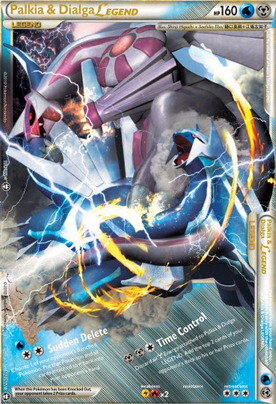
Dialga and Palkia are so awesome, not even their own trading cards can contain them, as these illustrations by Shinji Higuchi and Sachiko Eba attest.Although I hadn’t quite had it in mind originally, these entries on the Pokémon Power Bracket eventually evolved into something akin to a discussion of what I think legendary Pokémon should and should not be. Given the direction this project ended up taking, I suppose that I now ought to talk about these questions in more general terms and lay out, once and for all, what opinions I hold on these mysterious creatures and why.

So, what is a legendary Pokémon, anyway?

Put simply, a legendary Pokémon is one that breaks the rules. It is normally impossible to legally obtain more than one of the same species on a single game without trading. With the exception of Manaphy, none of them can breed in captivity; even Manaphy requires the aid of a Ditto. They don’t evolve, something Professor Rowan comments on in Diamond and Pearl; of more than six hundred Pokémon, about one hundred don’t evolve, and almost half of those are legendary. While most Pokémon are normally portrayed as partners (or at least potential partners) to humanity, legendary Pokémon are typically more aloof, appearing to hold humans in disdain, and will join their strength only to truly exceptional trainers. Most are figures of myth and legend; their existence is often difficult to verify. Many play roles in the balance of nature that are of global or even cosmic significance.

Let’s face it, though, you don’t care about any of that. You care about how good they are at bludgeoning your enemies into a bloody pulp.

Official Nintendo art of the cataclysmic three-way murder-off between Groudon, Kyogre and Rayquaza.Legendary Pokémon are significantly tougher and have more powerful attacks than the vast majority of ordinary Pokémon (Dragonite, Tyranitar, Salamence, Metagross, Garchomp and Hydreigon have stat totals that match or exceed those of some legendary Pokémon, and are often called ‘Pseudo-Legendary’ for this reason). Big numbers don’t make the Pokémon, of course: consider Articuno, whose type combination carries a number of crippling weaknesses and whose movepool is small and inflexible. Most members of the lowest ‘tier’ of legendary Pokémon are like this: theoretically powerful, but limited (there are also a couple, like Entei and Regigigas, who are just plain bad, but that’s really a topic for another day). That’s all well and good. It’s the really powerful ones that concern me: Mewtwo and Ho-oh and the like; Kyogre and Arceus most of all. These Pokémon clearly aren’t meant to be ‘balanced’ in any meaningful sense – possibly not even against each other. They don’t merely have a slight edge over mortal Pokémon; they can steamroll entire teams if played competently. Now, I’ve always contended that game balance has never really been a ‘thing’ in Pokémon anyway; I simply don’t believe it was ever part of the designers’ aims. However, it doesn’t take a genius to see that this legendary élite will quickly take over any context to which they are introduced; Nintendo themselves recognise this and ban most of them from official tournaments and in-game battle facilities. Outside of official contexts, however, any ban-list must be self-policing, which is a recipe for chaos – particularly since Nintendo’s ban-list, while a reasonable starting point, is riddled with flaws (they regularly ban Phione, for goodness’ sake). Some fan communities produce and regularly update tier lists to define which Pokémon should and should not be allowed, but one need only consider the vitriol directed against Smogon University for banning Blaziken to see that this is hardly a perfect solution. Some would consider it the height of lunacy to ban Celebi while allowing Excadrill (as Nintendo does); others would think it perfectly rational. As a result of all this, I cannot help but regard legendary Pokémon as a negative influence on the games’ ability to function as intended.
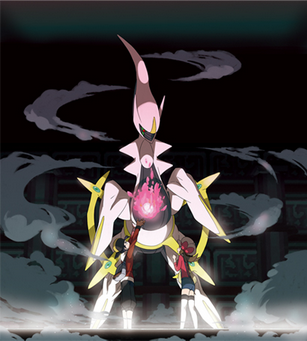
"What?  Create a godlike primordial being out of the celestial ether?  Sure, kids, I didn't have anything planned for this weekend anyway."It is partly for this reason that I expect rather a lot of them elsewhere. Legendary Pokémon are, well, legendary; that is, they are the subject of legends, myths, traditions and tales. As a result they are a fundamental part of the culture, history and philosophy of the Pokémon world and serve to expand our understanding of that world. Provided they do a good job of it, tell a good story, I am generally willing to give them some latitude to act as game-breakers when they take the field; they’ve ‘earned it,’ in a sense (especially ones that aren’t actually game-breaking, like Zapdos and Suicune). This is not always an easy thing to judge. I maintain that it was the second generation that got it right, with the story of Entei, Suicune and Raikou, who were killed in the fire that destroyed the Brass Tower and drove Lugia away from Ekruteak City, and then resurrected by Ho-oh with incredible new powers. These Pokémon all have a history that ties them in with the past of their home region and its visible remnants, while hinting at fantastic powers beyond what ordinary Pokémon can harness. Articuno, Zapdos and Moltres contribute to the general feel of the games with their aura of mystery, but don’t do so with the same eloquence or sophistication as their successors, while many later legendary Pokémon simply go too far. Ever since Ruby and Sapphire, Game Freak seem to have gotten it into their precious little heads that a good plot must be ‘epic’ and that one of the requirements of ‘epic’ is an impending apocalypse (neither of which is actually true), so naturally they’ve been designing legendary Pokémon to match – Kyogre and Groudon, Dialga and Palkia, Arceus, Reshiram and Zekrom – as though their games won’t be complete without Pokémon capable of destroying the nation, the world, or even the universe. This isn’t even a flawed concept, in principle. The flaw is in the way it interacts with the games’ premise and central tenet: “gotta catch ‘em all.” If these Pokémon truly were as remote and aloof as they are often portrayed, present in the game as forces to be deflected or mitigated, I would not have any major objections to them; many of them have interesting stories, and they could definitely add something to the setting’s cosmology. The problem is that once something exists in Pokémon, you have to be able to catch it; otherwise the whole mess falls apart.
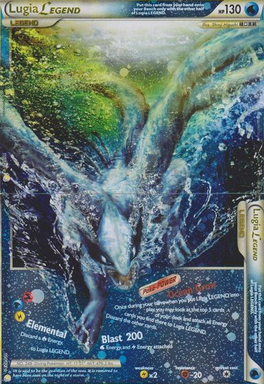
The mighty Lugia cares not for your pathetic human fourth wall!  (Artwork again by Shinji Higuchi)

As I’ve mentioned in recent weeks, Game Freak seem to have in their minds a sort of dual conception of many Pokémon like this, a disjunction that must eventually be resolved. When we hear about them through myth, there seems to be a tacit suggestion that these Pokémon are powerful, but not gods as they are depicted in the stories; it is implied that there is an element of exaggeration in what we are told, and we are clearly intended to have this in mind when we capture them and use them in battle. When we actually see what they are capable of, however, these caveats vanish. Kyogre and Groudon are treated, by characters we have no reason to doubt, as an utterly serious long-term threat to the stability of not just Hoenn but the entire world. Dialga and Palkia really are capable of unravelling the universe at Cyrus’ command. On my copy of Black version, all of these Pokémon are mine. I cannot command them to unleash their full powers and rewrite the universe in my image, because their Pokéballs cut them off from their cosmic abilities through mechanisms that are never explained, but I still own them in a legally binding sense. When, exactly, did this start being okay? And how can it possibly be reconciled with their established backstories and characterisation? Reshiram and Zekrom, for their part, are a step in the right direction since their entire point is to be partnered with humans, but the writers still feel this bizarre need to talk up their power to apocalyptic proportions, apparently heedless of the fact that the plot still works without the possibility of Unova being wiped off the map. In Black and White, the threat N presents is primarily an ideological one: that he will use his partner dragon to claim the necessary moral authority to command all the people of Unova to release their Pokémon. The fact that he could destroy the world if he wanted to is a ludicrous embellishment that only undercuts what the story is actually about (especially since N would never do that anyway). What I am trying to get at here is that I feel Game Freak’s desire for legendary Pokémon to have this degree of cosmic power is totally irrational, and does little to add to a series that is, fundamentally, about partnership and discovery. Their existence, again, is not a problem per se; the problem lies mainly in the need to shoehorn these cosmic beings into the standard format of the Pokémon games when they could be left on the periphery, contributing to the background, aesthetics, character and stories of the setting, perhaps as enemies or allies, but not as ‘partners’ in the sense that mortal Pokémon must be.

I can't believe I just wrote an entire entry about legendary Pokemon without mentioning how much I hated "Arceus and the Jewel of Life"!  I must be going soft...Which legendary Pokémon are effective additions to the world, in my view (aside from the second-generation ones I’ve mentioned)? Mewtwo is one; though the extent of his powers is difficult to gauge, his backstory was clearly written with ideas of morality and identity in mind, and he also allows us to ask interesting questions about the relationship between humans and Pokémon. This, I think, is the sort of thing that Pokémon is actually rather good at, simply because the basic premises of the franchise are so interesting from an ethical standpoint. Regirock, Regice and Registeel, though I’ve always felt they are distressingly emotionless, making them difficult to relate to, have a fascinating backstory that gives us a new perspective on the way people related to Pokémon in the past, and what that might mean for the future (arguably, the very thing that bugs me about them actually makes them more effective, their alien countenance emphasising how far they stand apart from humanity). They recognise, as well, that the power to shape worlds is not actually a requisite for winning the fear or adoration of an ancient civilisation. Tornadus, Thundurus and Landorus, too, have destructive and protective powers that function on a local rather than a regional or global scale; they are deities of folktale, not epic, a smaller scale of things to which Pokémon, by its very nature, is eminently better-suited.
These, then, are my thoughts on the class which includes the most powerful Pokémon in the game. They are, in essence, Pokémon of legend, and so it is by those legends that I try to judge them first: by their power as stories, and their capacity to expand our understanding of the Pokémon world. I fully expect, as always, that many readers will disagree with my priorities and conclusions. I don’t aim to be ‘right;’ that is a lost cause in anything so subjective. I aim, as ever, to make you think, and I can only hope you have enjoyed my latest attempt as much as I have.

Thank you for reading, and to all, a good night.

Incidentally,

I saw this on Pokémemes today, under the title “Technology Lent to More Design.”

The artist may have been trying to make a point, but I’m not entirely sure what it was.  Purely because it was on Pokémemes, I initially assumed it was an attempt to prove the superiority of either the first or the fourth generation as compared to the other, but if so it’s not clear which one the artist favours, so I’ve decided that this is unlikely.

As the picture illustrates, the newer designs are generally more detailed; the older ones are more likely to have large plain areas of block colour without ornamentation or patterning (broadly speaking – you might get the opposite impression by comparing, say, Jynx and Abomasnow).  Personally, this is something I like about the newer designs – I think, on balance, that I prefer the original Garchomp to this redesign, but I feel there’s a lot to be said for this Charizard (though I don’t like the way the flame’s been done; it looks more like a bristly tail than fire, which fits when you see that style of flame on, say, Emboar or Typhlosion, but not on Charizard).  I think the thing to take away from this, though, is that they both work.  There’s more than one way to interpret a design concept, and some people are going to like one way of doing it, and some people another.

What do you think?

– Do you like your Pokémon clean and simple, or detailed and elaborate?
– What are the advantages and disadvantages of these two extremes?
– Has the artist still managed to capture ‘Garchomp’ with this different aesthetic?
– How about Charizard?
– And what the hell is the title “Technology Lent to More Design” supposed to mean, anyway?

My Wish List for Black and White 2

So, Game Freak have thrown us a curve ball.  There is to be no “third game” to the Black and White series as is traditional (Yellow, Crystal, Emerald, Platinum) but rather a “Black Version 2” and a “White Version 2.”  I hope they know what they’re- oh, who am I kidding, of course they don’t but I hope it works anyway.  In hindsight this makes perfect sense.  The theme of dualism is so ubiquitous in Black and White that the standard pattern of “games 1 and 2 are identical, then game 3 has a whole ton of flashy extras” would have just broken the whole thing.  I never would have seen it coming, because the very idea of Game Freak breaking such a long-established formula is all but inconceivable, but nonetheless, here we are.  Despite being labelled as sequels, my suspicion is that these games will still follow the pattern of Yellow, Crystal and so on (essentially the same game but with cool new stuff added), just with more emphasis on continuation of the story past the point where it ends in Black and White.  So, what can we expect to see out of the sequels and what do I most want to see?

(If you’re not familiar with the story of Black and White, you should probably skim my entries on Team Plasma and Kyurem before reading this)

My first wish is just plain overoptimistic and it’s totally never going to happen but I’m putting it out there anyway: I wish for Black 2 and White 2 to be released as downloadable add-ons to Black and White, and priced as an expansion set.  I don’t know whether this is even possible with the current technology used by the Nintendo Wi-Fi Connection, and I don’t know whether Nintendo would care to do any such thing even if it were, but I’m wishing anyway because I CAN DREAM, DAMNIT!

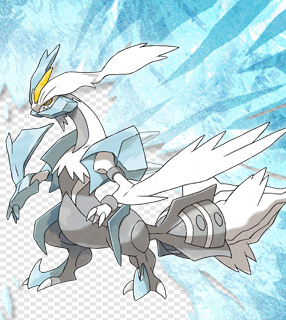
 Art of White Kyurem, by Ken Sugimori; copyright Nintendo 'n' stuff.

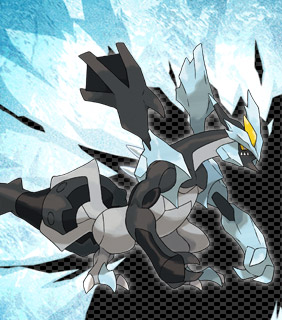
The weekend’s big reveal included artwork of the new games’ two mascots: two alternate forms of Kyurem, a Black Kyurem who looks like a fusion of Kyurem and Zekrom, and a White Kyurem who looks like a fusion of Kyurem and Reshiram.  These two are the mascots of the games of the same colour – contrast Reshiram and Zekrom, who were the mascots of the games of the opposite colour – which suggests to me that N is going to be partnered with each of these two Pokémon on their respective games, as he was paired with Zekrom on Black and Reshiram on White.  Now, this is the big one.  My other wishes are unimportant in comparison to this: I wish for Kyurem to take his place in the story in a way that makes sense.  I can only speculate as to what his role is actually going to be, and I won’t hazard a guess as to how well it will work.  I can talk about how I would do it, though – and what is this blog for if not to FEED MY MASSIVE EGO?  Here’s my version.

After Ghetsis escapes from prison with the help of the Shadow Triad, he travels to Kyurem’s lair in the Giant Chasm and takes control of the dragon.  He then lures N and his dragon partner there.  When N’s dragon confronts Kyurem, it is absorbed into the ice dragon (working off the speculation that Kyurem is the ‘shell’ of the original dragon who split into Reshiram and Zekrom), which makes Kyurem far more powerful, but also causes Ghetsis to lose control of it.  Reshiram and Zekrom represent powerful opposed forces, and Kyurem can’t handle having one of them inside itself without being balanced by the other, so it goes berserk, threatening to freeze all of Unova in an endless winter.  You and N then have to work together to find and subdue Kyurem – and defeat Ghetsis – to save the region.  In the end, your dragon partner is absorbed into Kyurem as well, bringing it back into balance and creating some kind of epic, glorious ultimate form – but only for an instant, during which Kyurem sets right all the damage it has done before releasing both dragons again.  Once you’ve caught Kyurem, you can fuse it with your dragon temporarily whenever you want, to access its more powerful form.

On the topic of Kyurem, I wish for Freeze Shock and Ice Burn not to suck.  These attacks are two absurdly powerful Ice attacks (one with a chance to paralyze, one with a chance to burn) that exist in the coding of Black and White but can’t be learned by anything.  They’re obviously intended to be the signature moves of Kyurem’s two new forms, but as written they’re pretty terrible because they have a charge-up turn, like Sky Attack or Solarbeam, which allows ample time to switch in a Pokémon that doesn’t care about Ice attacks (Walrein, anyone?) to take the hit, or just use Protect or Substitute if you happen to have them.  Reshiram and Zekrom enjoy awesome signature moves, Blue Flare and Bolt Strike, which are nearly as powerful as Freeze Shock and Ice Burn without any of this charge-up nonsense.  Assuming the attacks won’t just be completely rewritten for Black 2 and White 2, I think the most intuitive way to work with these would be to say that the charging turn is ignored during Hail, the way Solarbeam’s is in bright sunlight, and then give Kyurem’s new forms the Snow Warning ability so they create Hail by switching in (seeing as Kyurem wouldn’t be able to do much with an ability analogous to Reshiram’s Turboblaze and Zekrom’s Teravolt anyway).  Sounds dangerously powerful, but bear in mind that other Pokémon with weather-changing abilities, like Kyogre, could switch in, take away Kyurem’s Hail, and force it to sit there charging its attack while they plot revenge.

Getting back to story elements for a moment, there’s one big thing that I’d like added to the plot of these games: I wish for Team Rocket to show up (or an equivalent Pokémon gangster faction; Team Rocket have the advantage of familiarity and popularity, but would be difficult to justify since Black and White are set, pretty unambiguously, after the events of Gold and Silver).  I think it’s very unlikely this will actually happen, but I think it would work very well.  The reason I want Team Rocket involved, not as the main villains, but as the antagonists of a side-plot about halfway through the main storyline, is that I think the events of a Team Rocket storyline would provide a brilliant opportunity to showcase N’s character.  N is theoretically the bad guy in Black and White, but it stands to reason that he would hate Team Rocket more than anyone else on the planet, and would probably be happy to work with you to grind their operations in Unova into the dust.  He could probably rope some Team Plasma grunts into helping him with that, too, which could give us a closer look at the differences between his motives and theirs – and possibly give N himself a closer look as well, which would have to be interesting… even more so if Ghetsis became involved; how he would react to Team Rocket is something of a complicated question since he would probably profess a very different attitude towards them than the one he actually held.  N is something of an anti-villain in Black and White, with Ghetsis as the real but hidden antagonist, and I’d like to see that explored further in the sequels; this side-plot would do just that.

 Art of Black Kyurem, by Michaelangelo Buonarotti.  Nah, I'm just kidding; this one's Sugimori too.

I wish for the plot to continue in the eastern parts of Unova, with events and stories for Village Bridge, Lacunosa Town and Undella Town.  In Black and White these towns are kinda just… there; they add very little to the games other than to make the world look bigger.  I think it’s reasonable to assume that this will happen as part of the process of tying up the loose ends Game Freak left for themselves in Black and White when Ghetsis escaped.  I’m less hopeful for Anville Town, the hick town out in the middle of nowhere that you can only reach by train (seriously, you can’t even Fly there), not that you’d ever want to anyway because all you can do there is swap items for other items, and even that only on weekends.  I think it would be fun to look at the role of Pokémon trainers in society by having the player take an active role in helping to build up and expand Anville Town, helping the settlement to spread into the wilderness while protecting wild Pokémon from the impacts of the town’s growth, as a kind of mediator between civilisation and nature.  If I do say so myself, this would fit the themes of the game rather nicely, since civilisation/nature is one of the major dualities Black and White focus on, particularly through the version-exclusive areas of Black City and White Forest, but also through N’s desire to separate the natural world of Pokémon from the civilised world of humanity.  Where N supports total segregation of the two, we’re clearly supposed to support bringing them into harmony, so it would be beneficial, I think, to have quests that involve the player actively doing that.

Aside from story stuff, we can probably expect a lot of cool new toys in Black 2 and White 2: Emerald and Platinum set a precedent here, each adding multiple new move tutors to expand the options available to many Pokémon, as well as unveiling new Battle Frontier facilities where players could test their skills battling under unusual rules.  I’d put good money on both of these showing up in the sequels, but I’d particularly like to wish for is an expansion of the latter concept.  Before now, facilities like the Battle Factory (where players must choose from a selection of rental Pokémon) or Battle Pike (where you must cope with random events that help or hinder your Pokémon) are restricted to single-player and co-operative multi-player modes; what I would want to stick in if I were designing Black 2 and White 2 is the option to impose similar unconventional battle conditions and rule-sets on battles against friends and other players.  Not that these facilities aren’t challenging – they are – but the AI really isn’t all that good, and losses tend to come because it’s inevitable in Pokémon that you will sometimes lose just because you were unlucky.  When you’re playing against other people, you learn to accept that and move on, but in battle facilities it becomes frustrating because the game only cares about the length of your winning streaks, not your overall performance.  A single, full battle against an opponent of human intelligence would be a more interesting test of your ability to operate under unusual conditions than battles with a hundred of the relatively uninspired AI trainers (at least one of whom is bound to get lucky with some Brightpowder or a Focus Band or something).

Finally, I’d be really tickled if it turned out that Game Freak had been reading my blog all this time and decided to take my advice on improving the Pokémon from my Top Ten list.

Hey, no harm in wishing, right?