
Alright, internet, I just finished writing a goddamn master’s thesis and I am gonna learn you some things that I only just got done learning myself about the chemistry of ancient Roman glass. No, it has nothing to do with Pokémon, but it’s happening whether you like it or not, so buckle the f@&k up, kids.
Continue reading “Roman Glass”Tag: Not Pokémon
Was the Trojan War Really a Thing?
Apologies again for my absence, which has gone on a bit longer than I’d hoped, but I should hopefully be back semi-regular soon enough. In the mean time, let’s take a look at the question that has been consuming me and my free time during my absence: Was the Trojan War Really a Thing?
We all know the story.
Helen, the queen of Sparta and the most beautiful woman in the world, was abducted from Sparta by Paris, a prince of Troy – or perhaps they fell in love and eloped, or perhaps a goddess stole her away and sent an image of her to Troy instead; the details, as always with these things, are hazy. Helen’s husband Menelaus, with the help of his powerful brother Agamemnon, the king of Mycenae, raised a mighty army and an enormous fleet from all the great kingdoms of Greece. For ten years the Greeks besieged the walls of Troy, and for ten years the walls held as heroes of both sides fought and died on the battlefield. Even the gods took sides – Hera, Athena and Poseidon supporting the Greeks, while Aphrodite, Ares and Apollo helped the Trojans. Finally, with both sides’ greatest warriors – Achilles, the leader of the Myrmidons, and Hector, the eldest prince of Troy – dead, the cunning Ithacan king Odysseus and the architect Epeius came up with a plan to end the war once and for all. They crafted a huge wooden horse, claiming that it was an offering to appease the gods, left it outside the gates of Troy and sailed away with the rest of the Greek army, apparently in defeat and surrender. The ‘victorious’ Trojans brought the horse into the city and took it to the temple of Athena before spending the night in a drunken celebration of the war’s end. But the horse was not all it seemed – it was hollow, and a small contingent of the Greeks’ most elite warriors was hidden inside. In the dead of night, they slipped out of the horse, slaughtered dozens of the sleeping Trojan warriors, took control of Troy’s gates, and opened them wide for the returning Greek army. A few hours later, every member of the Trojan royal family was dead or in chains, Helen was back with her husband, the city was in flames, and the war was over. Yes, we all know the story.
But did any of it actually happen?
The common sense answer is “no.” We have, in the modern world, a very clear distinction between fiction and non-fiction, between myth and history. The battles of Alexander the Great are history, the sacrifice of the three hundred Spartans at Thermopylae, likewise – as solid and real as the conquests of Napoleon, or the Second World War. The Trojan War is a myth, an imagining of a great creative mind, captivating and important as a work of literature, but no more ‘real’ than the Titanomachy, the great war between the Olympians and the Titans at the beginning of time. Throughout the 18th century and for much of the 19th, it was broadly accepted that ‘Homer,’ the poetic genius of the Iliad and the Odyssey, whoever he really was, had made the whole thing up. A siege ten years in length – impossible! Gods and demigods running this way and that – pure fantasy! The fanciful ruse of the wooden horse – ridiculous! The ancient Greeks may have been deceived by their own patriotic spirit, but we moderns are cleverer than that. Obviously the whole thing belongs to the realm of fiction.
To the ancient Greeks themselves, though, myth and history were not so different. Myth was their way of recording the distant past and the deeds of their remote ancestors, and it held the authority of tradition and community, while history itself was a form of storytelling too, an art meant to convey moral lessons and uplift the human soul through exposure to great ideas. Even the most sceptical of them, the Athenian general and historian Thucydides, believed without question that the Trojan War had really happened. Perhaps the poet had been guilty of much elaboration and exaggeration, and perhaps some of the details had eluded him – after all, he lived hundreds of years after the war had ended – but surely some essential core of the narrative had truth to it. After all, it was the first and oldest story of their shared culture, known, told and repeated everywhere in Greece – how could they all be wrong?
The question suddenly became very interesting in the 1860s when we actually found Troy.
There is a place on the northwest coast of Anatolia, right at the west end of the Dardanelles, called Hisarlık. In the 1860s, the area was owned by Frank Calvert, an English diplomat who worked in the Ottoman Empire. Calvert, based on the descriptions given in the Iliad of the local geography of Troy, became convinced that Hisarlık was the location of the ancient city, buried beneath one of the huge mounds of earth that often cover ancient settlements. He attracted the attention of Heinrich Schliemann, a German archaeologist – though some archaeologists today would probably be uncomfortable sharing the title with him; professional archaeologists didn’t really exist in the 19th century, and archaeological work in that period was often… haphazard (in fact, Schliemann… kinda ruined the Iron Age strata of Troy a little bit; I mean, the Hellenistic Greek builders had already done that to some extent when they cleared the citadel to lay foundations for their new temples, but Schliemann certainly didn’t help). Schliemann conducted several excavations at the site between 1868 and his death in 1891, finding the remains of a Roman city, and the remains of a Hellenistic Greek city beneath that, and more and more the deeper he went. This was all to be expected; we already knew that there was a Classical Greek city which claimed, based on Homer’s descriptions, to have been built on the site of Troy, and that it widely and successfully publicised this idea as a source of cultural power. Where the story gets interesting is that seven layers of the city predated any sort of ‘historical’ record of ancient Greek civilisation. When he reached the second city from the bottom, Schliemann hit the jackpot: this period of the city had left behind all kinds of fantastic golden treasures. This, he thought, must surely be the fabled wealth of Troy’s legendary king, Priam. Finding the treasure only fuelled his obsession with Greece’s mythic past, and in 1878 he found and excavated the ancient city of Mycenae, the city the Greeks had linked with the great king Agamemnon – which, like Hisarlık, proved to have occupation layers that went back well before the dawn of recorded history. Today, we now know that almost all of the locations that are prominent in Homer – places like Mycenae, Pylos, Argos, the island of Crete – though many of them were relatively insignificant in the classical period, were in the Bronze Age the sites of huge stone buildings we call ‘palaces,’ the centres of powerful states with complex administrative practices and carefully regulated economies. We now call this proto-Greek civilisation “Mycenaean,” after the first site, though we don’t know what they called themselves, or even whether they considered themselves a single cultural group at all. Something of the political situation Homer described in the Iliad seemed, at last, to be grounded in reality – could the epic truly be a distorted memory of a Mycenaean assault on Troy?
The work of other scholars in subsequent decades curbed the initial wave of enthusiasm created by Schliemann somewhat – in particular, when we figured out how old the different levels of Troy were. It’s easy to tell in archaeology when one thing is older than another, because it will normally be buried deeper, but figuring out exactly how old an object is in calendar years is another matter entirely – until the advent of radiometric dating in the second half of the 20th century, the only way to do it was by the stylistic qualities of artefacts, particularly pottery. Styles and fashions change and develop over time, and if you have enough artefacts of a similar type, you can take note of the similarities and differences, and construct sequences from old to young. Finding two extremely similar artefacts at two different sites means that the levels you found them in are probably similar in age – and if an artefact manages to make it as far as Egypt or Mesopotamia, where we actually have historical records and inscriptions going all the way back to 3000 BC, you can connect that style of artefact with a calendar year (…more or less; personally I tend to place greater value on the more direct results we can get from radiometric dating, though it’s worth mentioning that these come with difficulties and pitfalls of their own). The point is, the Greeks of the classical period believed that the Trojan War had occurred some time between 1050 and 1200 BC. However, when Schliemann’s successor at Troy, Wilhelm Dörpfeld, actually sat down, put all the pottery in order and tried to figure out how old it all was, he realised that the second city on the site, the one with all the magnificent golden treasure – the level we now call Troy II – was more than a thousand years too old to have anything to do with Priam, Homer, or the Trojan War. The great Mycenaean cities of the Greek mainland were barely-civilised backwaters during Troy’s ‘golden age.’ The levels corresponding to the end of the Bronze Age when the Mycenaeans were powerful, the years in which the Greeks placed the war, were the sixth and seventh levels of the city – the levels Schliemann had dug straight through because they just weren’t impressive enough. Even in the 21st century there are still debates about whether Troy was really an important city during the Late Bronze Age or not. Given its position, though, it almost seems like it must have been – Troy controls the entrance to the Dardanelles and the Sea of Marmara; any trade routes through to the Black Sea have to pass through Troy’s territory. What’s more, the Dardanelles are unforgiving, and the wind and currents are strong – sailors hoping to reach the Black Sea might have had to wait for weeks at a time in order to obtain favourable conditions… in Troy’s harbours, paying Troy’s taxes.
The Mycenaeans themselves are silent on the matter. They spoke an ancestral dialect of Greek, and knew how to write in a script we call Linear B, which was deciphered in the 1950s, but precious little of their writing is preserved for us. Parchment and papyrus decay, so although they may have used these materials to write stuff down, we just don’t know. The Mycenaeans kept extensive administrative records – the palaces seem to have designated certain towns for the production of certain resources and goods, then collected everything together and redistributed all these goods on a regular basis according to what the different towns needed, and every step of the process was meticulously recorded by the palace scribes. This was apparently done on clay tablets, which could be smoothed over and reused (possibly when the records were transferred to another medium like parchment) – but, very occasionally, if a palace burned down, a collection of these tablets would be caught in the fire and baked hard, accidentally preserving these normally temporary records for us to read thousands of years later. They are… a bit of a dry read, to be honest. The information they contain – names and locations of Mycenaean towns, the goods they produced and consumed, the names and titles of various officials and servants, even the resources allocated for things like religious ceremonies (this last is how we know that they worshipped several of the Olympian gods) – is extremely valuable, but there is no hint of anything we would consider literature. If they wrote down the story of an expedition to Troy, it’s long gone now. They did write down the names they gave some of their slaves, and in many cases those names basically mean “man/woman from [place]” – including a number of locations in western Anatolia, so it seems likely, in theory, that they were capable of conducting raids against settlements in that region, but we learn little more than that.
Fortunately, there is another civilisation whose writing furnishes us with slightly more promising hints: the Hittite Empire. The Hittites were a central Anatolian people who were among the first civilisations in the world to smelt iron. During the Middle Bronze Age they built a large, powerful state in the regions that are now Turkey and Syria, and were regarded as an equal power by Egypt, with whom they fought several major wars. Like the Egyptian kings, the Hittite rulers often wrote official correspondance to other major leaders in the region like the kings of Assyria and Babylonia, and these letters were recorded by Hittite scribes on stone tablets, along with treaties and other documents of diplomatic import. Many of these documents describe places in the Hittite Empire or within their sphere of influence, and because place names are one of the things most likely to remain relatively constant between languages and across centuries, we can sometimes identify what these places are: Millawanda, for instance, is probably the same place as classical Greek city of Miletus, and Apasa is likely Ephesus. This is of interest to us because some of the names Homer uses for people and places in the Iliad sound suspiciously like certain names from the Hittite texts. For instance, he often calls the Greeks Achaioi and their homeland Achaia, a name which, so say the linguists (for reasons I won’t get into), is descended from an earlier form Achaiwia and may be related to a group of people called the Ahhiyawa whom the Hittites regarded as a persistent thorn in their side. Paris, the prince of Troy, is often called Alexander – which sounds awfully like Alaksandu, the name of a ruler allied with the Hittites in the 13th century BC. An Ahhiyawa commander who invaded Anatolia with a large chariot force in the 15th century was named Attarisiya, which could be a Hittite spelling of Atreus (the father of Menelaus and Agamemnon). “Troy” in Greek is Troia, which sounds a bit like a place the Hittites call Taruisa, but Homer actually more often calls the city Ilion, which comes from an older name Wilion or Wilios – and that, in turn, sounds like Wilusa, the name of the minor kingdom ruled by the aforementioned Alaksandu. The relationship between Wilusa and Taruisa (which seem to be two different things) has yet to be satisfactorily explained; if you want them to be Ilion and Troy, you can say that Wilusa is the kingdom and Taruisa is the city, but there isn’t actually a whole lot in the texts to support that. Anyway. The Ahhiyawa, according to the Hittite documents, lived across the sea but were particularly powerful in the area around Millawanda (which, if it really is Miletus, does look extremely Mycenaean in the archaeological record of the Late Bronze Age). Wilusa was a particular point of contention between the two powers – something that intrigues many people.
So, on to the practicalities. Troy VI was destroyed in the 13th century BC, possibly by an earthquake – the damage to the city’s buildings seems to have been particularly severe, and the area is known to be seismically active. At one point someone had the bright idea that the Trojan Horse might have been a distorted memory of “Poseidon destroying the city,” since Poseidon was a) god of both earthquakes and horses, and b) on the Greeks’ side in Homer’s Trojan War – essentially, a terrible earthquake leaves the city open to major Mycenaean raids. This explanation always struck most people as a bit fanciful though, especially since, although we know that some of the Olympian gods (including Poseidon) were worshipped in the Late Bronze Age, we don’t really know a whole lot about the nature and powers of their Bronze Age incarnations. Not everyone is convinced by the earthquake interpretation now anyway – it might have been destroyed in a battle after all. Even so, there’s no way to prove ‘Greek’ (that is, Mycenaean) involvement. The kicker is that Troy VII doesn’t quite fit either. That city was destroyed by fire in the early 12th century, which could easily have happened during a sack, and seemed to have been stockpiling food in the period immediately before that, as though preparing for a siege – the problem is that this happened shortly after the mysterious and still-unexplained total collapse of Mycenaean civilisation. The reason for the fall of the Mycenaean palaces is a whole debate of its own that would take just as long to explain as this one. Suffice to say that the entire eastern Mediterranean fell into total disarray at the end of the Bronze Age – the Hittite capital at Hattuşa was destroyed and their empire collapsed, the Egyptian New Kingdom lost control of its foreign territories, was wracked by internal conflicts and went into decline, and the Mycenaean citadels were all destroyed and abandoned within the space of a few decades. The chaos is often blamed on a group of marauders the Egyptians call ‘the Sea Peoples,’ but no one really knows who the Sea Peoples are – it’s actually been suggested more than once that they were Mycenaean refugees escaping the fall of their own civilisation, which leaves us just as mystified about what happened to them in the first place. It seems likely that the destruction of Troy VII had something to do with all this, and if the Sea Peoples really were Mycenaean then we do have another candidate for the Trojan War after all – but, again, we have no idea who was responsible for the city’s fall.
None of this really comes anything close to historical evidence for The Trojan War, as it is described in Homer’s Iliad and other works of Greek poetry, but it does start to look quite plausible that there was A Trojan War (possibly even more than one), and that its major players may have had a few things in common with some of Homer’s characters. Unfortunately, this doesn’t mean we can start taking the Iliad as a historical source – it would be really nice if we could; the trouble is that we can tell from his poems that Homer himself lived no earlier than the 10th century BC and probably much later, and that he was telling a story for people of his own time in a setting that blended elements of the present and the ancient past (the ‘Homeric Question’ – who ‘Homer’ really was and when he lived – is something I could spend another three or four paragraphs on, but I’ll spare you). Still, for people today reading the Iliad, imagining its world, and retelling the story for others – through prose, poetry, art, cinema, you name it – it’s pretty cool, and opens up a whole new world of inspiration that people who are only familiar with the standard fictional mish-mash of Classical Greece and Rome never get to hear much about. The knowledge that the whole thing is ‘based on a true story’ also has a certain allure in itself, as it certainly did for the Greeks. So, you know what? Go out there and tell those stories. Homer would have wanted it that way.
I submitted a thing to another thing
The premise of this blog is taking quotes from pop culture and tweaking them slightly so that they apply to characters from Homer’s Iliad (recently expanded to anything ‘classical’). It amuses me. You should totally follow it. Y’know, if you’re a classicist. The following is something that I actually wrote months ago and had hanging around uselessly until I discovered “OMG there is a Tumblr blog that is literally all about doing this.”
H’okay, so, here’s the Aegean. S’chilling. ”Dang, that is a sweet sea,” you might say. WRONG! All right; ruling out the Hittites invading, a huge barbarian horde becoming crashed into us, the gods leaving, and Thera exploding, we’re definitely all going to stab each other. H’okay. So basically we’ve got Troy, Crete, Lydia, Egypt, Ethiopia, Thrace, the Amazons and us with demigods. We’ve got about twenty-six hundred more than anybody else… whatever. H’anyway. One day we decides those Trojan sons of a bitches are going down, so we launch a thousand ships at Troy. While they’re on their way, Troy is like “shit, shit, who the fuck brought Helen here?” “Oh well, Hector will save us!” Then Helen is like “shit, Paris, that’s my husband; he’s coming! Fire our shit!” ”But I’m tired.” ”Well… have a nap. THEN FIRE YOUR ARROWS!” Meanwhile, Italy is over there like “mamma mia, WTF?” Lydia, Ethiopia and the Amazons send their guys, so now we’ve got heroes charging everywhere, passing each other. Achilles is like “PATROCLUS, NOOOOOOOOO!” Then Hector’s like “well, I’m dead. Better get on with it.” So now Greece is like “fuck, we’re dumbasses,” Philoctetes is like “wait, what the hell did I miss?” Italy is still like “mamma mia, WTF?” China is laughing at us, and some huge barbarian horde is like “well, fuck that.” So. Now we’ve got the fall of Troy. Everyone’s dead, except Aeneas, and he’s like “mamma mia, WTF?” And they’ll be in charge one day. Fucking Romans. But, assuming we don’t all stab each other, us Ithacans just have to work out Ithaca drifting away from the rest of Greece. To go hang with Scheria. Cyprus can come too.
– like, Homer or someone
Which is a reference to this, if you don’t recognise it.
The Etruscans
So I have just finished working on a long essay about gender roles in an ancient Italian people, the Etruscans. They have been occupying my brain almost totally, which is why I have not written much about Pokémon this week. Come and listen to me babble; you will learn a great many things, some of which may even be true.
So these people lived mainly in northern Italy, in the region now known as Tuscany. Their civilisation predates the glory days of Rome; they were most powerful between the 7th and 4th centuries BC, after which the Romans began to eclipse and dominate them. The Greeks called them the Tyrrhenoi, they probably called themselves the Rasna or Rasenna, but we know them mostly by their Latin name: Etrusci, or Tusci. They had writing, and probably literature, which we no longer possess; only inscriptions remain, for the most part. They had their own language, which we sort-of understand, and which does not seem to be related to any of the other languages spoken in ancient Italy – it doesn’t even seem to be from the Indo-European family at all, but has a closer affinity to the Semitic languages of the Near East. They were probably, like the Greeks, a vague coalition of autonomous city-states who would band together against common threats but otherwise did their own thing. The later Romans believed that the Etruscans had taught them everything they knew about irrigation, sanitation and construction, and also that people of Etruscan descent (they remained an important ethnic minority in Roman Italy long after losing their independence) were especially suited to being diviners and seers. Two of Rome’s last three semi-mythical kings were thought to have been Etruscan, and a lot of people think that their reign reflects a memory of a real period of Etruscan dominance over the Latins (the ethnic group that includes the Romans). Most of our ‘historical’ information about the Etruscans comes from Roman writers some three hundred years removed from the decline of Etruscan civilisation, or from Greeks talking sh*t about them. The fourth Emperor of Rome, Claudius, who was a historian, wrote a long and detailed history of the Etruscans called the Tyrrhenica, based (apparently) on the Etruscans’ own historical literature. That’s gone; we don’t have that. Would’ve been really nice, but no. We also don’t have much archaeological information about their towns, because most of them have Roman and modern towns on top of them, which makes it hard to dig (although there are one or two sites now that people are starting to open up). There are a few important religious sites that have been studied carefully, but mostly, what we know about the Etruscans comes from their graves and tombs. Hooray for grave robbing.
What I have to deal with this week is that Etruscan women seem to have been treated in a much more egalitarian fashion than their Roman or Greek counterparts. A lot of wall paintings in tombs show scenes of parties or banquets (they were a cheery bunch), and from this it looks like aristocratic women attended parties with their husbands and engaged in the merriment and conversation to a degree that would have been scandalous in Rome or Athens. In fact, it looks like the Romans and Greeks did find it scandalous, since the descriptions we have of Etruscan women portray them as licentious sex-crazed hussies with no self-control – the natural reaction of a strongly patriarchal society to meeting a civilisation that allows women to, like, leave the house. For a while there were people who though that the Etruscans were a matriarchal society, that women ruled their civilisation either alongside the men or above them entirely, and I don’t think anyone really believes that anymore because Etruscan men who had held political office in life regularly record that fact in funerary inscriptions, and there’s no evidence of women doing that (to be honest, the whole idea of an Etruscan matriarchy only had any traction in the 20th century for political reasons, not because it made sense). Also their iconography seems to show that the same division of labour that was traditional throughout the ancient Mediterranean also prevailed in Etruria – women are depicted running the domestic sphere, and particularly seem to be associated with spinning and weaving, while men are more often portrayed as warriors. Anthropologically the division kind of makes good sense; it’s easier for a community to recover from most of the men being killed than from most of the women being killed (just in terms of how many babies one man can produce versus how many one woman can produce), so it’s not smart to risk your women in battle. It’s not so much that the roles given to Etruscan women are different compared to women elsewhere, it’s more that they enjoy greater prominence while fulfilling them. Clever people whose business it is to know these things, like Larissa Bonfante, now tend to say that the contrast we’re actually seeing is between Roman or Athenian civilisation that values the adult male citizen as the basic unit of society (with everything else being under the power of one adult male or another) and Etruscan civilisation that values the married couple as the basic unit, because a lot of their art gives primacy to the pairing of male and female. They seem a lot more comfortable than the Athenians, for instance, with the idea of female nudity (which for a long time the Greeks only allow for goddesses), as well as with sexually explicit art featuring a man and a woman (most Athenian art of that kind involves two men). Other art stresses the male and female contributions to important processes like the manufacturing of textiles; there’s a famous relief carving that shows men herding goats, collecting their wool, gathering and dividing it in the centre of the town, and women spinning, weaving and dyeing the wool. Finally, we know from inscriptions that while Roman women tended to be known only by their family names, Etruscan women were known by their first names as well, and where Greeks and Romans would identify themselves by their fathers’ names, Etruscans would give the names of both of their parents (“Lucius Fabius, son of Marcus” or “Fabia, daughter of Marcus” vs. “Aranth Saties, son of Larth, born of Thanchvil” or “Rauntha Saties, daughter of Larth, born of Thanchvil”). The underlying ideology seems to be that men and women are different but equal (or should be).
And then there’s the goddamn Tomb of the Embroiderer.
The Tomb of the Embroiderer was discovered at the cemetery site of Tarquinia last September. It was reported, amidst great fanfare and sensation, that it was the tomb of a great Etruscan warrior prince – we knew this because, in addition to the various rich grave goods the body had a spear with it – and his wife (who had a jewellery box and was lying on a smaller, less prominent burial slab than her husband). Trouble is, when the osteologists did their thing, it turned out that the body with the spear was a woman, and the body with the jewellery box was a man. Now, the media reactions are interesting. Once the body’s sex was identified, the Italian news reports, for the most part, stopped focusing on the spear, which sometimes isn’t even mentioned, and started focusing on another artefact found with the body – a cylindrical bronze box believed to be a sort of embroidery kit (X-rays determined that it held sewing needles) – and the tomb started being called the Tomb of the Embroiderer. Hmm. The English news reports portray this as a comical mistake on the part of the archaeologists (headlines often contain the word “oops”). In part they have a point, because it is entirely reasonable to remind everyone that you can’t necessarily know the sex of a burial from grave goods – people used to think you could, until that idea was completely exploded by Anna-Maria Bietti Sestieri at Osteria dell’Osa in the 90’s, but even though we now know that it’s sometimes misleading, people still do it. On the other hand, the director of this dig, Alessandro Mandolesi, is one of the good ones – sure, he gave the media a preliminary interpretation that the body with the spear was male, but he also got his osteologists to check it! People have also lambasted Mandolesi for reinterpreting the spear as “a symbol of unity between the two deceased” and effectively denying that the spear is really hers (we seem interpret the same artefact differently depending on whether it’s associated with a man or a woman). It’s worth remembering, though, that no-one has yet said a single word in a professional, academic context – the excavation has not been published; interpretation is still in progress. Everything we’ve heard comes through the snippets that the Italian media have chosen to publish. Never take media quotations of archaeologists at face value.
So what does all that mean, anyway? We know that Etruscan women can be buried with weapons. If you say the words ‘female warrior’ you will be laughed at, and not without reason, because one way in which Etruscan art does follow the rest of the Mediterranean is that warriors are always men. I don’t want to say that it never happened, but I think we can certainly say that female warriors were never considered important or valuable in their culture. That’s not the only reason a person could be buried with a weapon, though. Etruscan men often seem to have been buried with useless ceremonial weapons or with more weapons than they could use, which demonstrates that these things can have symbolic character, and there’s no reason they couldn’t have the same symbolic properties for women – representing power, wealth and status. What does that mean for this particular woman? No idea. Maybe she was a priestess, or even some kind of magistrate? It’s hard to say, because we have so little explicit information about how this society worked. Later on, in the 4th century, men brag about the political positions they’ve held in their epitaphs, but we never see women do that. Whether they could own land is another question that we need to find ways of getting at; I suspect they could, but I don’t know what would prove it. It doesn’t seem like this is a society where women could do all the things men could do, but they certainly seem to have been a lot freer than Greek women. Probably. We think.
So yeah. I’ll get back to writing stuff you actually want to hear about now.
Okay, just one more on Final Fantasy VII: Character analysis
You’re probably getting sick of this by now, but since I still don’t have Pokémon X yet, I might as well do one more. Let’s talk about the characters of Final Fantasy VII. In no particular order…
Cloud
One of the big themes running through this story is Cloud becoming less of a jerk. Personally, I have something of an enduring fondness for Depressed Bastard Cloud, since he’s what makes the story interesting. Cloud is great at killing things, sure; on paper he’s pretty much the strongest member of the team. In terms of anything that doesn’t need killing, though, like his enduring miasma of depression or his glaring lack of social skills, he’s as helpless as any old average Joe. Cloud’s problem, undoubtedly, is that for a good chunk of the story he doesn’t actually know who he is – he thinks he’s an unbelievably badass super warrior who doesn’t need anything or anybody to get by (and… to be honest it’s kind of hard to fault him on that), an attitude which leaves him with something of a gaping hole where his sense of meaning in life would normally go. He has entirely forgotten that he’s actually a fairly average kid who really does need friends around him like anyone else. It’s Aeris, I think, who manages to hammer that point through his skull – she does this, initially, by being totally unashamed to ask for his help and totally insistent on helping him in return (also by forcing him to wear a dress). After Aeris dies, he just heads straight back into his old comfortable spiral of self-destruction, but Tifa helps him get back on track, and I like to think he’s in a good place after seeing Aeris at peace in the lifestream.
Aeris
I can see why people like Aeris; she’s pretty much the nicest person on the planet, which is quite an achievement considering that she’s the last living member of her race and grew up in a city made of garbage, but her inherent Cetra ability to invigorate life probably helps – she literally brings fertility and happiness with her wherever she goes. Aeris consistently denies that she’s anything special, and I don’t think she wants to be either, but on some level she clearly does feel that her powers come with a duty to serve life, especially once she gets to visit the Temple of the Ancients and commune with the spirits of the other Cetra. That sense of duty is ultimately her undoing, since it prompts her to try to stop Sephiroth on her own, something which is clearly beyond anyone. Still, even though Holy doesn’t work as advertised when push comes to shove, things turn out pretty well for her in the end – I remain convinced that the ‘Promised Land’ of Cetra myth really is just a metaphor for death at the end of a good life, and suspect that Aeris took ‘rejoining the lifestream’ to a whole new level. So I suppose ultimately she’s a pretty cool chick.
Tifa
Oh, Tifa… even when Aeris is dead Cloud’s more interested in her. I really feel like Tifa got the short end of the stick in this story. To an extent she does bring it on herself by being so adamant in the early part of the story that her feelings for Cloud are completely platonic, and by the time she manages to admit to herself that there’s something else going on there, Cloud has well and truly fallen for Aeris. Meanwhile, Tifa’s own developing friendship with Aeris is too important to her to be sacrificed over their love triangle. It’s a shame, because Tifa’s own relationship with Cloud is really something quite profound, as we can see when she enters his subconscious in the lifestream. It’s unfair to Tifa to talk about her solely in terms of her relationship with Cloud, though, because she’s pretty neat in her own right as well. She’s good with people, and isn’t above using that to get what she needs. She’s pretty self-sufficient when she has to be, and steps into a leadership role in Cloud’s absence without any difficulty (contrast, for instance, Barrett’s unease at filling her shoes when she decides to stay with Cloud through his illness – something which, incidentally, I think would have taken significant emotional fortitude). She also, at the ripe old age of 15, basically declared war on the most powerful organisation in the world and tried to stab Sephiroth with his own sword. Girl’s got serious guts.
Cait Sith
People don’t like Cait Sith, I think, which I can sort of understand – I mean, the whole ‘traitor’ angle doesn’t really do him any favours, obviously, and his whole introduction and character concept are pretty silly. His ‘death’ scene in the Temple of the Ancients also loses a lot of its impact from the fact that… y’know, he doesn’t actually die. He also has an astonishingly poor sense of tact. On the other hand, his real identity – the Shinra executive, Reeve – is easily the least evil person in the company’s leadership, consistently pushing for them to have a more positive impact on the community. As Cait Sith, he has to deal with genuine conflicting loyalties, and his betrayal of the party by stealing the Black Materia could very easily have been because he felt Shinra could handle Sephiroth and the Temple of the Ancients every bit as well as Cloud. And, of course, he’s perfectly willing to work against Shinra on the party’s behalf later. It’s also worth remembering that this guy initially would have seen Cloud, Tifa and Barrett as a group of extremely dangerous terrorists – and that this is an entirely accurate assessment. His diatribe to Barrett near the end of the game about how the world isn’t all black and white, calling Barrett out for the hundreds of civilian casualties he’d caused while attacking Shinra, is (to me, at least) nothing short of inspiring. So, in spite of myself, I actually think Cait Sith is a pretty neat character. So sue me.
Vincent
Eh. I’m kind of neither here nor there on Vincent. I know he’s ‘cool’ (I mean, hey, vampire gunslinger with a tortured past; what’s not to like?) and I really enjoy using him as an active party member because his limit break abilities are so unique, but I think he suffers a bit from being an optional character (I’m pretty sure you can actually complete the game without ever even meeting Vincent, so his involvement in plot-relevant scenes is, by necessity, limited). He joins the party to get revenge against Hojo for what happened to his ex-girlfriend, Lucrecia (Sephiroth’s biological mother), and then just… kinda stands in the corner being dark and brooding all the time. We actually met his (now immortal) ex-girlfriend at one point, but that scene didn’t really resolve anything; it just kind of stopped, leaving the whole thing kind of underdeveloped. I didn’t actually have Vincent with me when I fought and killed Hojo, so maybe I inadvertently cheated him out of an important character moment there. Hmm. I’ll have to remedy that if I ever play through this game again. So… yeah. Vincent.
Yuffie
Oh god f#$%ing damn it.
Five minutes after joining your party, without so much as helping in a single fight in the intervening time, Yuffie steals all of your magic,ditches you in the middle of f&$@ing feudal Japan, leads you on a wild goose chase around her home town, traps and humiliates your other party members, then gets kidnapped by the f&!#ing pimp king so you have to save her ungrateful b%!*# ass! Then Cloud lets her back in the party without even a real apology!
In fairness, I am given to understand that Yuffie can join your party at any of a wide range of times, and she joined mine very late, relatively speaking, so perhaps that sequence of events wouldn’t have seemed so jarring if she’d been with me longer. Or perhaps it would have been even worse because she would have felt like a trusted member of the team by then. Not sure. It’s also heavily implied that she turned to stealing materia as a career in order to keep her hometown from falling into poverty.
However, I don’t give a $#!t.
F$@% you, Yuffie. F#!$ you.
Barrett
Big scary black dude has a gun for an arm and blows up power plants for a living, but is also a devoted father. D’awwww. Marlene, I think, is Barrett’s primary motivation in everything. He blames himself for the fate of their hometown (which… is just objectively not his fault, but Barrett has something of an overactive sense of responsibility), and seems to see raising Marlene as a sort of penance. She’s also his reason for fighting Shinra – so she’ll grow up in a healthy world. Barrett recognises eventually that he’s not cut out for leadership – he’s just not a particularly inspiring figure, and doesn’t have a great deal of appreciation for moral nuance – but he’s the kind of person who never backs down from a fight. Basically, he’s a father who can only see one way of securing happiness for his daughter, and he is sure as hell going to do it. I think Barrett’s value as a character, ultimately, comes from being so grounded in the reality of what’s going on – most of the others in the group (particularly Cloud) are more wrapped up in their own personal problems than in dealing with the plot, but for Barrett the two are inextricably linked, so it’s through him that we get some sense of how the relatively vague and abstract forces of the overarching storyline impact the regular people on the ground. Perhaps not the most exciting role to play, but an important one nonetheless.
Red XIII/Nanaki
I like Red because he just refuses to be what you expect. He’s a hyena – but he’s also the most conventionally intelligent person in the party, the most intellectual in temperament, and one of the better spellcasters in the group. He’s thoughtful, focused and independent – and in terms of his own species’ lifespan, the equivalent of 15 or 16 years old. Once the others know his backstory, he opens up a little more and you can tell he’s not quite as confident as he seems at first and has his share of insecurities. To be honest, I don’t feel like he got all that many interesting character moments after the Cosmo Canyon storyline, but the scene where he finally learns that his father was a hero after all is pretty moving. Unlike Vincent, whose story feels distinctly unfinished, I feel like Red was wrapped up nicely – more certainly wouldn’t have hurt, but he’s a neat character the way he is.
Cid
So, throughout the game I’ve been assuming Cid was in, like, at least his late 50’s, because his character model has grey hair (although his portrait depicts him as blond) everyone else keeps referring to him as ‘old guy,’ and he’s just such an all-round cynical bastard. But no, it turns out that according to his bio on the FF VII website he’s thirty-two. Cid… if nothing else, is pretty entertaining. He just sort of stumbled drunkenly into the plot and refused to leave, at one point accidentally becoming leader of the entire party. To his credit, he certainly made the most of it – Cid’s tenure as leader is marked by a distinct rise in zany antics and snarkiness. Despite his somewhat callous exterior, Cid has a sentimental streak too – his dream of going to space seems at times to override his common sense, and he almost waxes poetic when he actually gets there. Cid is a quite bizarre combination of cynicism and wonder, apathy and dedication, selfishness and generosity – and I wouldn’t have him any other way.
And one last bonus one…
Sephiroth
I have something of a preference for sympathetic villains, in general, and it’s sort of difficult to claim that Sephiroth is, in any normal sense of the word, ‘sympathetic,’ but he certainly has an interesting start, and the events that lead to him initially becoming the villain of the story aren’t entirely his fault, arguably (his subsequent actions are another matter, of course). Sephiroth’s problem, in my view, is that he was raised to have a profound belief in the fact that he was ‘special,’ doubtless encouraged by Hojo, his biological father, to the point of developing some sort of messiah complex (incidentally, note the angelic shapes and imagery which Sephiroth incorporates into his combat forms – even his name is a biblical reference). I’m not sure whether he knew, in his childhood, that he was supposed to lead Shinra to the ‘Promised Land,’ but if he did – well, what would you take from an upbringing like that? Discovering exactly what it was that made him ‘special’ was bound to be a shock, and made worse by the fact that he came to the conclusion that humanity was responsible for the extinction of his species. From there, he just continues to escalate. Cloud kills him in Nibelheim, and he hasn’t fulfilled any kind of glorious destiny yet, which is simply more than his ego can handle, so he inflates his goals even further to “destroy civilisation and become a god.” Jenova’s influence doubtless has some effect on him here, but I have no idea who’s manipulating who, and I suspect that by the end there’s no longer much point in attempting to distinguish between ‘mother’ and ‘son’ in their motivations and beliefs (assuming Jenova had motivations and beliefs to begin with). As villains go, Sephiroth isn’t really the most compelling I’ve encountered, but the circumstances that went into his making and eventual ascension are interesting, the angel motif was a bold choice on the designers’ part (and especially curious given that Aeris has similar imagery associated with her), and I can understand his enduring appeal.
So, I guess that’s the end of this show. Thank you for putting up with me, and to all, a good night. Hopefully I’ll return soon and get to the new Pokémon games!
Final Fantasy VII: Entry 10 and wrap-up
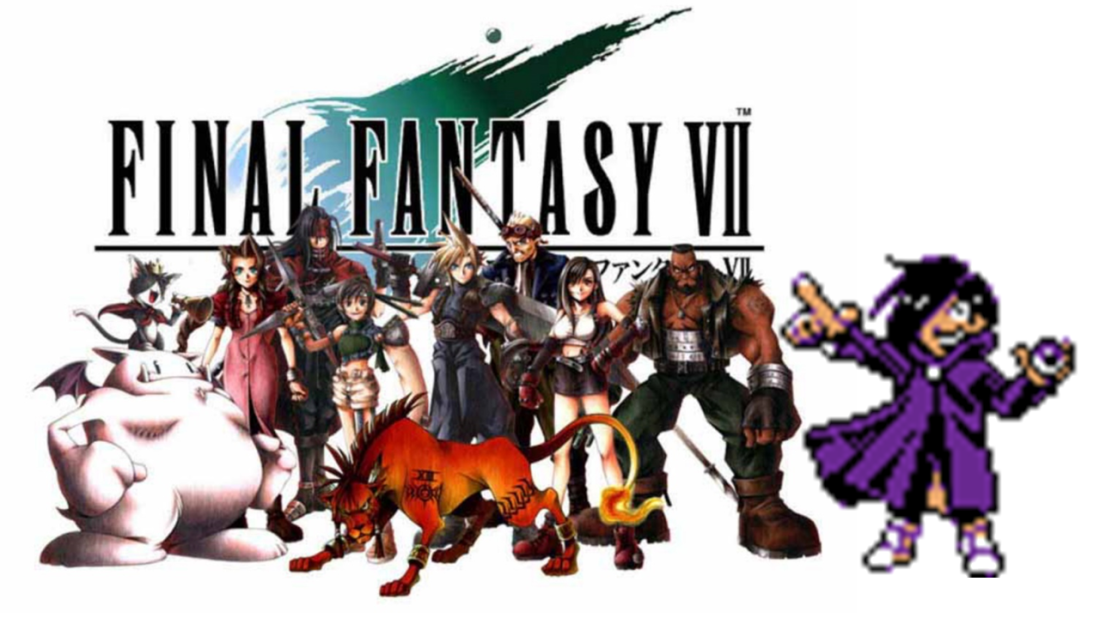
Basically all that’s left to cover now is the final boss sequence – there’s a big cave full of monsters to go through, but nothing of tremendous interest happens during that, so I’ll just cut to the chase. Cloud and his party reach the bottom of the old Jenova impact crater, which is now open to the lifestream beneath the planet’s surface. They fight Jenova herself, who is… anticlimactic, to be honest; she’s mostly just a great big sack of HP with a couple of slappy tentacles. I’m still not totally sure I ‘get’ Jenova. She’s some sort of alien, she created a plague that wiped out the Cetra, one assumes she’s quite intelligent, and this whole thing has been about her cells, which have been implanted into various humans like Sephiroth and Cloud as part of genetic experiments, trying to reassemble themselves… but what exactly does that have to do with what Sephiroth is now up to? Has he subordinated Jenova to the demands of his own power trip? If so, how? Or is Jenova just a destroyer by nature, and totally on board with anything that causes more death?
Anyway, once Jenova’s dead, it’s down into the lifestream to fight Sephiroth, who promptly turns into some kind of… giant floaty angel statue thing which has to be fought with two parties at once: one group to attack his left side and breach his defences, so Cloud’s group on the right can destroy his ‘core,’ which otherwise gives him sufficient healing power to recover from just about anything you throw at him. A bit of a pain, but throw all your summons at him and he’ll drop. And then turn into a radiant seraph-like creature with even greater powers. Joy. In this form, Sephiroth has a number of nasty abilities; he can shield himself from both physical and magic damage, he can attack with his one black wing, he can dispel your beneficial magic, he can blast you with magical energy, and he can turn your party members into frogs… but certainly the most devastating is his special attack, which is to blow up the sun. He can do this more than once, which makes me wonder how many solar systems this planet is part of. Equally, it makes me wonder why he didn’t do that earlier. It seems like a much more efficient way of traumatising the planet, and also probably not vulnerable to interference from Holy. He’s certainly happy to get rid of Cloud by blowing up suns left and right; it seems like it would make a useful all-purpose solution. Neighbour’s dog digging holes in your yard? Blow up the sun; that’ll teach ‘im.
Once Sephiroth falls and the party is about to leave, Cloud’s soul unexpectedly leaves his body and backflips into the lifestream for one final round against Sephiroth, but this seems to be unloseable; Cloud just kicks the cr@p out of him, then has a vision of Aeris before waking up – now certain that he’ll be able to meet her again in the promised land (I’m… still pretty sure the promised land is a Cetra metaphor for death, but whatever floats his boat, I guess). The party zeppelins out on the edge of a huge explosion as the power of Aeris’ final spell, Holy, is released at last. So, that should stop the meteor, right? Well… no. No, apparently not. It’s too close. Its proximity is already tearing the city of Midgar apart, and the Holy pulse only makes things worse, whipping up a vortex of doom across the entire massive city. Nice going, Aeris. GREAT plan. Just GREAT. At this point, countless tendrils of green light – the power of the lifestream – burst out of the ground from all across the landscape and converge on Midgar. For a moment, we see Aeris’ face, surrounded by the green light of the lifestream. And… then the credits roll.
…so what happened?
After the credits finish, there’s a short scene depicting Red XIII five hundred years later, along with two children (I guess he wasn’t quite the last of the last of his kind…) running through a canyon and cresting a ridge to see Midgar on the other side. The city is in ruins, but it’s been overgrown by beautiful, thriving jungle.
Hmm. Well, Sephiroth explained earlier that when the planet is wounded it uses the lifestream to heal itself. That was the whole purpose of his plan, except that he was supposed to be at the epicentre to absorb the energy. I guess that’s exactly what we saw happening. It sort of seems like the whole ‘Holy’ thing was kind of a bust, because in the end it only caused more damage instead of stopping the meteor, so I guess that was a terrible plan after all, Aeris, but at least we killed Sephiroth and prevented him from following through with his plan to take control of the lifestream. And anyway it’s all good because Aeris is… in the lifestream now. Possibly… directing it. Um… Aeris…? Did you… get yourself killed on purpose so that you could reach the ‘promised land’ first and do what he was trying to? Because if Aeris is seriously going to tell me that traumatising poor Cloud by being brutally murdered right in front of him was all part of the plan, then so help me, I- I-
…I really have to congratulate her. Sephiroth struck her down, and she became more powerful than he could possibly imagine (well, okay, that’s going a bit far; Sephiroth has an unusually vibrant imagination when it comes to power, but you take my meaning), because she just ‘got’ the whole ‘lifestream’ thing about ten times better than him. Go Aeris.
Speaking of Aeris, a couple of people have been wanting me to watch the Game Theory video on her death, which I have now done. I gotta say… I am extremely sceptical. Jim described it as “a waste of internet” and not “worth the megabytes taken to download it, let alone the time [we’ll] never get back,” and I don’t think I’d go that far, but I sort of have a hard time going along with it. In case you’re not in a position to watch the video, the argument is as follows: Aeris did not die when Sephiroth stabbed her in the Cetra shrine, but collapsed and went into shock when his sword severed her spinal cord, dying only as a result of Cloud’s touching but misguided water burial. The evidence presented is that Aeris does not visibly bleed when skewered (suggesting that the sword blow miraculously missed all her major blood vessels and internal organs) and that her body sinks like a stone when Cloud releases it (dead bodies are usually more buoyant than living ones). The video does anticipate the obvious counterargument to the absence of blood (i.e. the developers thought it would be too graphic and avoided it) by noting two prominent and deliberate uses of blood in other parts of the game (namely, the aftermath of the slaughter in the Shinra building, and streaked all over Sephiroth’s face after his final dream-duel with Cloud in the lifestream). I think there’s actually an even more obvious reason they forgot, though: the blood in the examples given by Game Theory is not moving; it’s texture, whereas blood spilling from Aeris’ perforated torso would necessarily have to be in motion. Flowing liquids are notoriously difficult to model in computer animation, and this game was made over a decade ago. Based on what I’ve seen of Final Fantasy VII’s graphical capabilities, I don’t think the game designers could have shown Aeris bleeding in a realistic manner even if they’d wanted to; in fact, I think any attempt would have appeared almost comical and seriously detracted from the gravity of the scene – as good a reason as any not to do it. For the water burial likewise, there is a perfectly good reason for Aeris’ body to sink: because it looks right. There are only so many ways to get rid of a dead body. Cloud could have buried Aeris, or cremated her, but somehow I just don’t think that seeing Cloud dig a grave for Aeris, or seeing her body burn, would have produced the same effect of serenity as seeing her body sink slowly into the clear water, with her hair fanning out around her. The water burial also fits with the marine motifs of the City of the Ancients (I still have no idea why the City of the Ancients has a marine theme, but given that it does…). In short, there are perfectly compelling artistic reasons for the anomalies noticed by Game Theory, and I think these are much more likely to have been on the developers’ minds than obscure anatomical trivia. I just don’t buy it.
Anyway, the game.
So, I liked this game. It was fun. And stuff.
For me, it wasn’t a big turning point in how I view games or anything, though perhaps it might have had a greater impact on me if I had played it in the 90’s when it was first released. The plot is intricate (at times a little too intricate for my taste, to be honest, and I feel like there are still loose ends there – which I guess is the reason this game has a movie sequel, Advent Children… which I guess I should watch… later…), the characters are compelling (even Cait Sith has his moments, I feel – though I think I’m in the minority on that one), and as I’ve said before this game has a really good handle on atmosphere; the music does a great job of backing up the action, there are a good number of very powerful moments in the story, and the game milks the extremely basic character models for all the expressiveness they can muster and then some. I mean… I certainly can’t say there’s nothing I would have done differently, but in terms of story and atmosphere it’s undoubtedly well put-together. I’m kind of neither here nor there about the battle system. Although it produces some interesting tactical considerations, I’m not a huge fan of the materia system, partly because it makes switching party members such a pain, but also because it makes it rather difficult to see what each character actually brings to the table in terms of skills and abilities. The characters have different stats, sure, which makes some better at certain roles than others, but even Barret and Tifa aren’t that bad at magic, even Aeris and Cait Sith aren’t that bad at hitting stuff, and most of the other characters are pretty competent at both. That just leaves their limit break powers, the vast majority of which are pretty straightforward: Aeris’ limit breaks heal and protect the party while Vincent’s allow him to transform into various horrifying monsters, but aside from them, most of everyone else’s skills basically amount to “I hit the monster lots of times really hard.” Of course, for most of the game, that’s all you really need – I thought Pokémon was generally pretty easy, but Final Fantasy VII was a walk in the park up until the last four or five boss battles, when things rather suddenly became much more interesting (and apparently my party was dramatically under-levelled compared to Jim’s normal experience of this game because I spent very little time training, finishing with no-one above level 60 except for Cloud). Is that a bad thing? I’m not really sure.
In short? I guess I have mixed feelings about this game. I can see why it’s considered a classic, though. It got a lot of things right – and, well, compare it to what Pokémon was doing in the same year. Obviously comparing gameplay and mechanical complexity isn’t entirely fair because the demands of their respective consoles are very different, and I’d still side with Pokémon on creature design and diversity, but in terms of story and characterisation… well, Yellow version made some important advances on its predecessors, but was still kinda ‘meh.’ I mean, Final Fantasy’s going to have to do a lot more than that to convert this Pokémaniac, but I’m still glad I played this game, I think. Beats the $#!t out of doing actual WORK, anyway…
Final Fantasy VII: Entry 9
Cloud and Red XIII drag the party back to Red’s hometown, Cosmo Canyon, to get advice on the whole “obliterative meteoric cataclysm” thing from his human grandfather, Borgenhorgen. Badenhoffen. Whatever. He feeds them a spiel about having to remember where they’ve been in order to figure out where to go next, or something like that, and they all just start thinking about poor dead Aeris, which is kind of a downer for everyone concerned (‘cept for Bosenhugen; I’m not sure he ever actually met her, so he just keeps doing his creepy “hoo hoo hoo!” laugh). It occurs to Cloud, though, that maybe Aeris actually had some kind of plan. That… huh. Y’know, I suppose if she had some kind of Cetra ace up her sleeve, that would explain why she was willing to go and face down Sephiroth alone… I mean, it was still dumb; there’s no reason she couldn’t have taken a few people with her and left Cloud behind, but if she legitimately had good reason to think she could end it right there, I can sort of understand wanting to keep her friends out of danger (well, except for Yuffie; I think Yuffie should be kept in as much danger as possible). Binglehopper suggests he accompany the party to the place of Aeris’ death and see if they can find any clues as to what her plan was, so it’s time to hit the road again.
Back in the City of the Ancients… well, the entrance to the hidden shrine where Aeris actually kicked the bucket is blocked by some kind of oversized ornamental clownfish (seriously, what is with the marine motifs in this place?), but Buglehorken does discover that Aeris’ plan was to use an artefact known as the White Materia to access the ultimate form of white magic, Holy (the opposite to Meteor, Sephiroth’s ultimate black magic), a spell which is said to wipe out everything that threatens the planet. Cloud, justifiably, finds this definition concerningly vague, but Borkahoogen insists it’ll work out fine. For a given value of “fine.” And “work.” They discover that Aeris has actually cast the spell already (so there’s no need to go and find the White Materia, which was in her possession when she died), but Sephiroth is blocking it from taking effect somehow. Remove Sephiroth from the equation in time, and Holy will take out the meteor. You know, I think this is the first time in this entire game we’ve actually had a plan! YES!
Things are… disrupted a little… when one of the Weapon-monsters, Diamond Weapon, decides to attack Midgar, the capital city of the world or whatever. Luckily, the Turkish electricity board have taken the giant cannon they used to destroy the first Weapon, moved it to Midgar and reconfigured it to run on pure life force, making it pretty much one step down from the Death Star as far as mass-mudering potential goes, but it’s not quite operational just yet (wait… how exactly did they move this thing to begin with? It’s bigger than a skyscraper and clearly not built to move under its own power; did they… like, roll it to Midgar, or…?). Cait Sith alerts the team to what’s going on, and actually gets a really awesome bit of dialogue where he calls Barrett out for only caring about his daughter’s safety and not being bothered with innocent people who just happen to live in Midgar or work for the evil power company (the kind of innocent people who were written off as collateral damage by Barrett’s eco-terrorists at the beginning of the story). Y’know, I initially found Cait Sith kinda boring, and then he was a massive douchebag by betraying the party to the Turkish police, but in spite of everything, he’s really growing on me. Even if he is a fortune-telling robot cat.
Cloud and the others go down and fight Diamond Weapon, keeping him busy long enough for the giant cannon (which, for some reason quite beyond my comprehension, is now called the ‘sister ray’) to fire. Before the beam actually hits him, Diamond Weapon fires off a massive barrage of sparkly things. End result: both Diamond Weapon and Midgar are wrecked, and Sephiroth’s great big energy shield, hundreds of kilometres further north and directly behind Diamond Weapon, takes a hit from the giant laser and collapses. Whoo! Let’s go stab him!
Only… the giant laser isn’t shutting down like it should. Actually it’s drawing even more power for another shot. It’s drawing levels of energy that are in fact hugely dangerous to the city. Um. It seems Hojo, the mad scientist, has decided that he can use the cannon to feed power to Sephiroth. Cait Sith convinces the party to enter Midgar and stop him from blowing up the city in the process. When we reach the giant laser to stop him, Hojo reveals that the reason he’s doing this is because he is, in fact, Sephiroth’s biological father. Wait, I thought Sephiroth was… like, a clone or something, with a surrogate human mother (Vincent’s ex-girlfriend) but no father… no, actually, Hojo used cell samples from Jenova to mutate his own child. Okay, I guess he thought he was making some kind of hybrid Cetra, which isn’t so bad, but still… WOW. Just… WOW, Hojo. Dad of the year. Seriously. And then once he’s finished explaining all of this he turns into a twisted purple fungus monster thing and tries to kill us. And then turns into some kind of sleek, colourful, flying humanoid tadpole and keeps trying to kill us. So, uh… good to see the gene therapy’s working out there, Hojo.
Hojo, after Diamond Weapon, is probably only the second fight in this game I’ve really had to think about, in terms of picking the right spells to use and managing my party’s actions and such. To be honest, there are moments when it sort of feels like most of the actual gameplay in Final Fantasy VII is really just a run-up to the ridiculously powerful optional bonus bosses, Ruby Weapon and Emerald Weapon, and everything else is deliberately a little on the easy side so it doesn’t get in the way of the story. I’m not sure how I feel about that.
Anyway, with all this happily resolved… well, okay, ‘happily’ is a bit of a stretch, but resolved, at any rate… there’s only one thing to do: go shank Sephiroth! (Okay, this being a Final Fantasy game there’s actually loads of stuff left to do but most of it I don’t find all that interesting).
Final Fantasy VII: Entry 8
Where I left off, Tifa and Barret were about to be executed, Cloud was missing, presumed dead (or… as good as), and the rest of the party was I don’t even know where. Luckily, an attack by one of the planet’s Weapons disrupts the execution, and they are rescued by an apparently headless fat man in a suit who turns out to be a disguised… Cait Sith!? Oh, Cait Sith, you magnificent bastard; I forgive you for everything! Despite complications, they all steal a zeppelin, to Cid’s inexpressible joy, and flee. Meanwhile, the Weapon monster is defeated by a blast from a cannon the size of a skyscraper (good thing there are more of them out there to mess things up!). With Tifa as the de facto party leader, the crew sets out to recover Cloud and defeat the numerous bad guys, with greater mobility and resources than ever before. I’m starting to feel like this game just really enjoys jerking you between “everything’s great” and “c^@p, we’re doomed.”
Speaking of which… Someone (Red XIII? I don’t recall) suggested that if Cloud fell into the lifestream when Sephiroth collapsed the impact crater, he might have been spat out onto the seafloor and washed up somewhere. Wait, that’s… weird; this whole time I’ve been assuming the lifestream was this sort of abstract, cosmic thing that had measurable effects but couldn’t be directly observed – apparently not. It turns out that it’s an actual, physical place; this planet’s mantle is literally made of pure life force… and Cloud’s fallen into it. Luckily, Red’s suspicion turns out to be totally correct: we stop by an island town we haven’t been to before, and lo and behold – they found Cloud on the beach a few days ago.
…and that’s where the good news ends.
To Tifa’s shock, Cloud is confined to a wheelchair, shows no sign of recognising anyone or even acknowledging their presence, can manage single words only with difficulty, and has only partial control of most of his muscles. WOW. I just… WOW. That is COLD, Final Fantasy VII. I’d already been sort of desensitised to the idea that Cloud might die (I mean, I doubted he would, but it wouldn’t exactly have been a shock), but this… it had never occurred to me that the game would do this to him, and that made it a pretty powerful, pretty gut-wrenching experience (possibly more so than Aeris’ death, if only because I knew that was coming), and Tifa’s reaction only makes it worse because you can’t help but see it from her perspective: her best friend and possible love interest, in what amounts to a coma, with no apparent hope of recovery… ouch. The doctors explain that, basically, he’s had a stroke due to massive overexposure to pure soul energy while floating in the lifestream, and that a normal person would certainly have died (I would here like to repeat my assertion that Sephiroth’s plan is probably not going to end well for him, no matter what we choose to do about it). Tifa, understandably, elects to leave the party and stay with Cloud. Barrett decides that they need a leader, but no longer feels up to the task, and selects… Cid, who initially declines the position, saying it sounds like a “pain in the ass,” but is eventually persuaded to accept.
So… Aeris is dead, Cloud’s a f$#&ing vegetable, Tifa’s on Florence Nightingale duty, and our new leader is a foul-tempered chain-smoking senior citizen who joined the party because he didn’t want to spend the rest of his life violently swearing at his girlfriend. That’s great odds.
Credit where it’s due, though, Cid’s leadership is… unorthodox, but effective. On the suggestion of Cait Sith, who has chosen to become a double agent, we decide to interfere with the evil power company’s latest plan: gather something called Huge Materia, build a bomb out of it, and launch it at the oncoming meteor in order to destroy it. Wait, that… actually sounds like a way more solid plan than anything we’ve got; I think I’m okay with this. Oh, whatever. The team prevents them from collecting two pieces of Huge Materia – in the process hijacking a train, saving Barrett’s hometown from destruction, commanding an army when the game suddenly tries to reinvent itself as real-time strategy, and hatching a giant phoenix egg (look, it was just that kind of Wednesday afternoon) – before going to visit Cloud and Tifa.
Then one of the other Weapon monsters attacks, causing an earthquake that plunges the entire town into the lifestream.
Well, $#!t.
Tifa winds up floating in Cloud’s subconscious, which is a pretty weird place to be but does give her a unique opportunity to fix him by rooting through their shared memories. They eventually establish that neither Cloud’s account of his life nor Sephiroth’s is correct, and settle on an entirely different third version. Basically… Cloud wasn’t a clone of anything after all; he did grow up in Nibelheim and did know Tifa, although they weren’t exactly ‘friends’ (Cloud didn’t really have friends because even as a kid he was a tremendous douchebag), but when he left to join the evil power company’s secret private army of magic cyborg knights, he found that he just didn’t make the cut. The initiation treatment (which includes direct exposure to pure magical energy and injection with cells from Jenova) left him a bit unstable, somewhat prone to hallucination, suggestion and memory modification, and generally unsuitable as a magic cyborg knight (though it did, as we know, enhance his abilities to the point that he’s the best fighter in this party, anyway). He instead joined the evil power company’s regular private army of faceless minion cannon fodder. He did come back home five years ago, but not as one of the two elite agents on the mission – he was just one of Sephiroth’s troops. He saw Tifa, but she didn’t see him. When Sephiroth went nuts, the other elite, Zack, challenged him and was quickly defeated – but Cloud took Zack’s sword, sneaked up on Sephiroth, and stabbed him. Sephiroth, wounded but alive, fled. When Cloud attempted to pursue him, Sephiroth stuck a sword through his shoulder and told him “don’t push it”… and Cloud countered by grabbing the sword, lifting Sephiroth up, and flinging him into the reactor core.
…well done, Cloud.
Now, I’m not sure whether this is true, or just sufficiently plausible and agreeable that Tifa and Cloud decided to run with it, but either way, this is enough to heal Cloud’s tortured psyche and wake him up. He and Tifa survive their dip in the lifestream and wash up on shore to be collected by the rest of the party (wait, why isn’t Tifa…? Oh, you know what, I’m not going to question it, I’m just going to be grateful). There’s another piece of Huge Materia to snag, but this one slips through their fingers (long story short, it winds up on the bottom of the ocean and we now own a submarine – it was just that kind of Thursday afternoon). One last piece is already being loaded onto Cid’s old rocket ship – so the party hijack the rocket so Cid will get to go to space, steal back the Huge Materia, and then bail in the escape pod before the rocket hits the oncoming meteor (with a little timely and Karmically-appropriate help from Cid’s much-despised girlfriend Shera).
Without the Huge Materia in its warhead, the rocket damages the meteor (quite severely, in fact – several chunks of it are blown off, and some kind of core is now visible) but fails to destroy it. Again… would it maybe have been a better idea just to give this plan a try?
Cloud and the others realise that, in fact, blowing up the meteor with a Materia bomb was pretty much the only solid plan anyone had, and, in the absence of any better ideas, decide to head for Red’s home town to consult Bogenhogen. Blegenhegen. Bargenhosen. Er… Grandpa Red XIII. He’ll know what to do!
Final Fantasy VII: Entry 7
Well, Aeris is dead.
I realise I should probably be more emotional about this, but I think the fact that I knew it was coming dampened the impact a little. I can imagine that for Jim, playing this game when it first came out at the ripe old age of 8 (what kind of sick mind does that to an eight-year-old? Hell, what kind of sick mind does that to my eight-year-old best friend?), it was probably a pretty nasty shock.
What happens, in short, is that Cloud and the others arrive at the City of the Ancients (which seems to have a very pronounced marine theme for some reason; I didn’t think the Cetra were an aquatic race…) and find Aeris praying alone in an underwater sanctuary. Apparently under Sephiroth’s influence, Cloud draws his sword and, slowly but surely, struggling every step of the way, raises it over his head, ready to slice Aeris in two. This, I think, is about as close as I got to the shock someone playing this game sans spoilers would have experienced because, although I’ve known from the start that Aeris’ life had a use-by date, I didn’t think the game would be cruel enough to make the player push the button. That was… well, honestly a little sickening. I briefly contemplated just turning the game off. In the end, though, Cloud snaps out of it, and instead Sephiroth drops out of nowhere and skewers her. As I said, probably quite a nasty shock for someone who doesn’t know it’s coming, especially after Cloud has just come to his senses and you think it’s safe.
After Aeris’ death, Cloud vows revenge, and the party continues following Sephiroth north, past another town (where we learn some interesting things about Aeris’ mother, Ifalna) and eventually to a crater in the middle of an ancient glacier where Sephiroth’s black-robed mind-slaves are gathering for the ’re-union.’ Cloud fights Sephiroth again and takes back the Black Materia, gives it to Barrett for safe keeping, and heads further in to settle things once and for all. Meanwhile, Rufus Shinra arrives at the head of the Turkish air force, believing that the materia-rich crater is the ‘Promised Land’ he has been searching for this whole time. This… is where things start to get a little bit screwy.
Backing up a bit. Ifalna left a few video recordings behind – interviews between her and a scientist studying the history of the Cetra. This man is Professor Gast, the former Turkish head of science, and apparently Aeris’ father (!!), who sacrificed himself to help Ifalna escape the Turkish police with their daughter. The substance of what she says is as follows: two thousand years ago, the planet was struck by an object falling from the sky (the last time Meteor was cast…?) – the impact crater is where we are now. The local Cetra clan attempted to help the planet heal itself, but they were deceived by the thing that fell from the sky: Jenova, who approached them in the guise of a Cetra and infected them with some kind of plague that drove them mad. Jenova destroyed all the Cetra clans in the same way, though a few survivors eventually defeated her. The planet itself had also been concocting some way of fighting back – a huge, powerful monster called simply ‘Weapon’ – but by the time it was grown, Jenova had already been subdued, so Weapon now sleeps in the impact crater along with Jenova’s remains… and Sephiroth.
Yeah, Sephiroth’s been here the whole time. In fact, as far as I can make out, he’s been here ever since he was supposedly killed five years ago. The Sephiroth we’ve been seeing, and chasing, and fighting, who killed Aeris, is… I guess a figment of Cloud’s overly active imagination? The real one is sealed in some kind of crystal at the centre of the crater. However, after he ‘died,’ Hojo tried to clone him, with mixed results – hence all the black-robed men with numbers tattooed on their faces… and hence Cloud. Yeah, Cloud is actually a clone of Sephiroth… somehow. Apparently the boy Tifa grew up with, who came back home five years ago and fought Sephiroth then, is a completely different person. Cloud, being a clone of Sephiroth, who is a clone of Jenova, was able to insert himself into her memories, without even realising it himself (kind of like how Jenova was able to appear to the ancient Cetra as members of their families). He, and all of the other clones, are drawn to “reunion” at the crater – they all contain cells from Jenova, who wants to reassemble herself. How exactly this fits into Sephiroth’s whole “nuke the planet so I can take control of the lifestream” plan, I have no idea. In fact, in the midst of all these revelations, I still don’t think we know what Jenova actually wants, or even whether ‘want’ is an applicable verb here, for that matter. Is it just in her nature to destroy things?
Anyway, while Cloud and Tifa are learning all these things, an image of Tifa, another of Sephiroth’s illusions, appears to Barrett outside, telling him Cloud is in trouble and he needs to come and help right away. Once Barrett arrives, Cloud asks him for the Black Materia, which he obligingly hands over, and Cloud promptly gives it to the real Sephiroth, suspended in his stasis crystal thingy. All hell breaks loose. Sephiroth brings down the whole structure of the crater, forcing everyone except Cloud to evacuate on Rufus’ airship, creates a magical barrier around his sanctum, and begins casting Meteor. The monster Weapon wakes up (Ifalna only mentioned one of these things, but I think I counted at least four leaving the crater – only one seems to be relevant right now, though) and, apparently heedless of its function to destroy Jenova, starts destroying everything but Jenova. This is where we stand now: Rufus Shinra, the evil power company, and the Turkish air force are trying to save the world from Weapon; Barrett and Tifa are prisoners on his airship, and are about to be executed as scapegoats for the whole ‘end of the world’ thing… oh, yeah, and Sephiroth is bringing an enormous flaming hunk of rock down upon the planet.
In short: it’s time to put on your war face, b!tches.
To be totally honest, the whole Cloud/Sephiroth thing is still making my head spin a little, but I think it may have some very worrying implications. If Sephiroth’s been up north in the Jenova crater the whole time, it seems like the Sephiroth we’ve been seeing is basically in Cloud’s head – only everyone else can see him too. Of course… as a descendent of Jenova, Cloud can alter people’s perceptions, without even necessarily realising that he’s doing it. He caused Tifa to recognise him as her childhood friend (who looked completely different, by the way), and inserted himself into all her memories. So maybe everything ‘Sephiroth’ has been doing this whole time is the work of the shuffling, mumbling clones… along with Cloud himself. What I’m getting at here is that it’s possible Cloud never actually gave the Black Materia to Sephiroth at the Temple of the Ancients at all, but was just subconsciously creating a narrative that would justify his drive to travel north so he could bring the Black Materia to the real Sephiroth at the crater. And, even worse… I think it’s possible Cloud actually did kill Aeris.
Final Fantasy VII: Entry 6
Where I left off, the party had just remembered that they were supposed to be looking for Sephiroth, who is supposedly heading for a place called the Temple of the Ancients. Questioning random members of the citizenry reveals that this temple is ‘way down south’ and cannot be entered without a special keystone – and, as luck would have it, we also happen to bump into the random weaponsmith who just sold this thing to, of all people, the owner of the exorbitantly pricey Golden Saucer amusement park, who even agrees to loan it to Cloud in exchange for a brief stint in his arena. Everything’s going according to plan! Now all we have to do is keep Sephiroth from getting his grubby mitts on this thing- and I guess maybe check out the temple too, just to be safe. The party chills for a while at the Golden Saucer’s haunted house, which doubles as a hotel, and Tifa drags Cloud out on a date, although I don’t think he ever quite realises that it is a date. He’s just… not a subtle person (as his taste in mêlée weaponry makes abundantly clear).
At this point, Cait Sith steals the keystone, hands it over to the Turkish police, and reveals that he’s been working for the evil power company all along, and GOD DAMN IT I knew it was a bad idea to trust a fortune-telling robot cat with a pet marshmallow demon but I just had to let myself be won over by his… his… I don’t know, I guess his blatant disregard for reality? And after pulling that $#!t, he then has the gall to ask that Cloud let him stick around like nothing had ever happened! Unfortunately, he has apparently taken Barrett’s daughter prisoner somehow (damnit, you had ONE JOB, Elmyria!), and his body is only a remote-controlled toy anyway (he’s really a power company employee, plugged into some sort of remote interface at their headquarters), so Cloud and Tifa reluctantly agree to let him stay rather than just filleting him on the spot as any reasonable person would.
Okay. New plan. We’re going to the Temple of the Ancients to fight the Turkish police. Cait Sith, for his part, is totally okay with this and even gives us the co-ordinates to the temple. Once we get there, it turns out that the Turkish police not only stole the keystone, they also failed to keep Sephiroth out of the temple after opening the damn thing. Nice going, boys. Good job. It’s not even like he’s that tough; one good stab and he just turns into a twenty-foot-tall alien angel monster, and we all know how to deal with those, right? Anyway. The moment Aeris gets near the temple, she starts hearing the voices of a group of Cetra who refused to rejoin the lifestream when they died, who give her pointers on getting through the temple, and also show us a vision of Sephiroth in a room with a striking mural of a large group of people watching a meteor fall from the sky. When we find the room, Sephiroth isn’t there, but it doesn’t take him long to put in an appearance and, like all good supervillains should, explain his diabolical plan: acquire the ultimate destruction spell, Meteor (a ‘calamity from the skies’… hmm…), from the Black Materia inside the temple, then use Meteor to cause such massive, horrific trauma to the planet that it will divert a significant portion of the lifestream to the epicentre of the blast in order to heal itself. Sephiroth will then use the knowledge he has already gained from the temple to absorb all that power and become, for all intents and purposes, a god. Honestly this sounds like a terrible plan and, if not for the part about “massive, horrific trauma to the planet,” I’d buy a truckload of popcorn, tell him to follow his dreams, and settle in to watch the show, ’cause I figure there’s better than even odds the lifestream will either take control of him somehow or just blow him up. It’s almost a shame we can’t afford to let him try. Oh well.
Anyway, Sephiroth messes with Cloud’s brain briefly and then vanishes. Aeris learns from the Cetra spirits that, actually, the Black Materia Sephiroth is looking for is the temple itself, which can be magically shrunk down to a nice convenient size by solving a puzzle model – but this can only be done from the inside, crushing whoever gets stuck with that job. Luckily, Cait Sith has a suggestion – he’ll do it! His body’s only a toy anyway. Before the others leave, he says farewell to the party by offering to read someone’s fortune, and Aeris asks him to check her romantic compatibility with Cloud (apparently, they’re astonishingly perfect for each other) – while Tifa is standing right there. Dick move, Aeris. Seriously, dick move. Cait Sith gets a nice scene in the temple core where he talks about how he’s happy that he gets to be a hero, and how there are lots of toys like him, but there’s only one of him, and anyway even if he’s going to die it was worth it to make Aeris smile, and y’know what? This would be really touching if not for the fact that the bastard comes straight back in an identical new body about five minutes later.
So we get the Black Materia… and Sephiroth shows up again, mind-rapes Cloud into handing it over, and leaves.
…y’know, I’m starting to think everyone in this party is going to betray everyone else at least once by the end of the game.
Cloud has a total breakdown and goes to sleep for about a week, waking up with a profound sense of total worthlessness, and contemplating abandoning the whole fight, since he clearly can’t let his teammates rely on him against Sephiroth. Tifa and Barrett convince him that it’s no biggie; they can always smack him upside the head and sort him out later if he flips again. There are bigger problems, though. While Cloud is sleeping, he sees Aeris in a dream, explaining to him something she has evidently told the party as well: Sephiroth is going to a place on the northern continent called the City of the Ancients to cast Meteor, and Aeris wants Cloud to just sit back, take some Cloud-time, and let her handle Sephiroth. Alone.
Wait, what? No. Aeris, no; that is a terrible idea. Do you remember what happened the last time you left the party without taking any materia, Miss Quarterstaff-and-a-pink-dress? I can understand wanting to leave Cloud behind; he’s just not in a good place at the moment, even if he is the best fighter in the group. You don’t need to leave everyone else behind to guard him,though! Even if you don’t want anyone else to get hurt, what did we just learn about Cait Sith? It’s okay if he dies. He doesn’t mind. By the way, as long as we’re on this train of thought, it’s also okay if Yuffie dies. She f#$%ing deserves it. I’m pretty sure with Cloud out of commission you’re pretty much the de facto protagonist anyway; no-one’s going to question you if you just want to lead the whole party in there. There’s no reason this has to be a…
…suicide mission.
…c^@p I just figured out how Aeris dies LET’S HAUL ASS, PEOPLE!
 Pokémaniacal