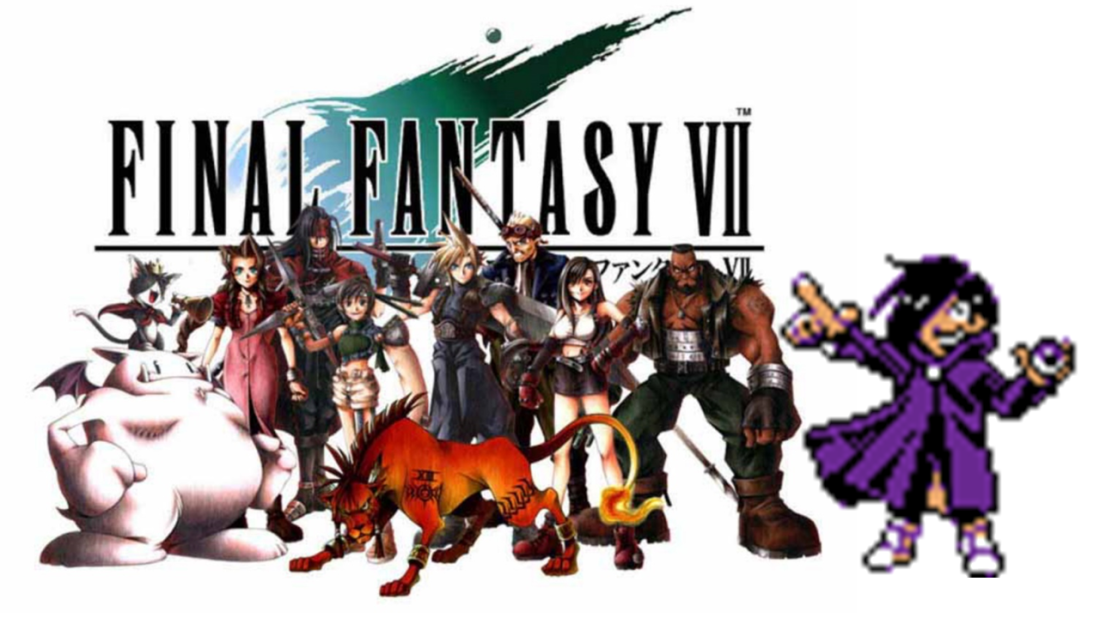
Final Fantasy VII: Entry 5

Where was I?

Oh yeah.  Nibelheim.

So, Cloud and Tifa’s hometown is still there, in flagrant defiance of its total destruction five years ago by Sephiroth, but is almost completely deserted.  There are two or three people, who claim to have lived there for decades but don’t know Cloud, and a large number of mysterious black-robed figures with different numbers tattooed on their faces (hmm – doesn’t Sephiroth have a 1 tattooed on his face?) who shuffle about murmuring about bringing something to “Great Sephiroth” for some kind of “reunion.”  We found Sephiroth himself in the old mansion at the edge of town.  He still doesn’t seem to remember who Cloud is, rambled incoherently about his ‘mother,’ Jenova, being a “calamity from the skies” (“not a Cetra?” Cloud asks, but Sephiroth isn’t keen to clarify – wait, if Jenova and Sephiroth aren’t Cetra, what the hell are they?  Is there some other ancient race out there intimately tied to the planet’s life force?), told us that he was going to nearby Mount Nibel for the “reunion,” and flew away.  Better follow him.  I took the party up Mount Nibel, to the old reactor where Cloud had confronted Sephiroth years ago, fully expecting a climactic boss battle… and found no-one there.  Hmm.

Did I… just get stood up by the villain?  Sephiroth sure knows how to make a guy feel inadequate.

Oh, yeah, and there was also a Turkish vampire named Vincent hanging out in the mansion – and by ‘hanging out’ I mean lying in his coffin sleeping through a perpetual nightmare to atone for his past failures.  He’s a cheery fellow.  Vincent was apparently in love with Sephiroth’s human surrogate mother, a woman named Lucrecia who, I am given to understand, died in childbirth or something.  Vincent has joined the gang in the hopes of getting revenge on Hojo, Sephiroth’s creator, for what happened to her.  Don’t know what I think of this guy.  I’m not generally a huge fan of the whole ‘life of revenge’ thing.  Then again, he’s a vampire with a red cape, a mechanical arm, and a pistol.  Dude has style.

Once down from the mountain, I ran into another new recruit: a passive-aggressive ninja chick named Yuffie who clearly wanted to join the party but wouldn’t say so, preferring instead to stalk and attack us, insulting us when she lost, then throwing a tantrum and leaving.  I have learnt that she can only be kept under control by paying her exactly the right amount of attention – don’t watch her carefully enough, and she’ll mug you and run away; watch her too closely, and she’ll decide she’s better than you, mug you and run away.  Mugging people and running away seems to be Yuffie’s schtick.  I despise her already.

The next town shows no sign of Sephiroth, but does yield a rusted old rocket ship (the remains of the evil power company’s defunct space program), a pink seaplane, and yet another new party member: a foul-mouthed, grumpy old aviator named Cid (rule #18 of Final Fantasy games: there is always a guy named Cid who owns a zeppelin).  Cid wanted to be the world’s first astronaut, as the pilot of the rocket that dominates the town’s scenery, but his dreams were crushed, entirely accidentally, by a woman named Shera, an assistant who took too long checking the oxygen tanks in the ship’s engine room during pre-flight preparations.  Shera would have been incinerated if the ship had taken off, and kept telling Cid she was totally okay with that as long as she could make absolutely sure the oxygen tanks were good, but Cid cancelled the launch at the last minute to save her life – thus missing a launch window that only came around twice a year.  The incident led to the shutdown of the space program, and Cid was left with nothing to live for but insulting Shera for the rest of his days.  Kind of a contrived story, if you ask me, but hey, whatevs.

Anyway, the events that lead to Cid joining Cloud’s group are as follows.  Rufus Shinra has turned up with one of his underlings, Palmer, to confiscate Cid’s seaplane for use in hunting Sephiroth, who is apparently heading for a place called the Temple of the Ancients (our next destination – now we just need to figure out where the damn thing is).  While Cid and Rufus argue, Palmer goes to snag the thing quietly – and so does Cloud.  This leads to what is absolutely, without question, the most bizarre boss fight I have ever endured: a battle against a dancing fat man with a magic handgun who keeps mooning the party and inexplicably will not die after being pummelled with several rounds of the most powerful spells we have on hand.  He eventually gives up the fight and goes to hop in the plane – only to be flattened by a passing truck.

…you win, Final Fantasy VII; I officially have no idea what you’re smoking.

The party flees town on the plane, taking heavy fire as they do so, pick up Cid along the way, and are forced to crash-land in the nearby sea.  Cid pronounces the plane irreparable, but Cloud decides it can still be used as a leaky boat, so we all sail over to the next island.

Then Yuffie f*#&s off with all our materia.

GOD F&*%ING DAMNIT YUFFIE you’ve been in this party for like FIVE MINUTES and the first thing you do is steal all our $#!t and run away!?

You know what?  I was totally being WAY TOO HARD on Cait Sith.  There was no spy in this party at all; it was probably just F$#^ING YUFFIE following us and blogging about us for everyone to read.

The party pursues Yuffie to her hometown, Feudal Japan, and chases her all over the city.  At one point, she pretends she’s been caught and starts crying, telling a story about how she needed the materia to save her town from poverty, in order to lure Cloud and the others into a trap. Eventually, though, the group winds up having to join forces with the Turkish police in order to rescue the conniving b!^@# from, of all people, the goddamn pimp king from way back at the start of the game.  Rescuing her, I can get behind, since she’s the only one who knows where the materia’s stashed.  But then Cloud just lets her back into the group because she gave it back and said she was sorry!  What the hell is going on with him?  I want Depressed Bastard Cloud back!  He would never have stood for this nonsense!  Seriously, she’s spent, like, ten times longer running us around in circles and stealing our $#!t than she has actually helping us and he lets her back in?

Jerk probably just wants to sleep with her.

Final Fantasy VII: Entry 4

In theory, the game is now about gallivanting around the world trying to hunt down Sephiroth.  In practice, I’m not sure when the last time was that we actually had a solid lead on where the bastard is, and the game is really about the characters going on a road trip and solving their personal problems.  They did actually encounter Sephiroth at one point, when both he and they stowed away on the same ship.  He doesn’t recognise Cloud, talks as though he has been asleep for a long time (since the events of Cloud’s long flashback five years ago?) and responded to aggression by turning into a six-metre-tall blue-grey fleshy angel-monster thing, which, as I’m sure I don’t need to inform you, is not a widely recommended conflict resolution tactic.  After that the plot mostly forgot about him, although I’m sure he will return with a vengeance later.  Mostly, we’ve been spending our time colliding with and resolving Barrett and Red XIII’s backstories.

Barrett apparently used to live in a coal-mining town in the middle of nowhere.  It’s now a dump and everyone hates him, because years ago he persuaded the rest of the town to give up coal and get one of those awesome new soul-consumption reactors instead, which indirectly led to the total destruction of the town by the Turkish army when an accident at the reactor was blamed on sabotage.  That… doesn’t particularly seem like his fault, really, but whatevs.  I guess that explains why he’s so angry at everything.  Anyway, the party went to an amusement park (because… just because), Barrett was blamed for a bunch of murders committed by ‘a man with a gun for an arm,’ which, let’s face it, is pretty damning under the circumstances, but it turned out to be his BFF from years ago who also has a gun for an arm and is now some kind of gang leader in the amusement park’s private prison (this, as of course you know, is something all amusement parks have).  Barrett’s friend, Dyne, has basically become disillusioned with the whole concept of existence and just wants to, in his words, ‘destroy everything,’ and eventually kills himself after losing a duel with Barrett, telling Barrett to take care of Marlene (who is actually Dyne’s biological daughter and was adopted after their hometown was destroyed, which… you know, I had been wondering about the whole black father/white daughter thing, but I just assumed Marlene was actually Cloud and Tifa’s illegitimate love-child, so hey, go figure).  I don’t think we actually managed to resolve anything and I’m pretty sure everyone in what used to be Barrett’s hometown still hates him, but he seems happier about it, so… yay?

Also, we found Red XIII’s hometown.  Now, I have been wondering about this ever since he mentioned it.  Is there a whole town of magic talking hyenas?  Well… no.  It turns out Red (whose real name is Nanaki, though he doesn’t seem to care what we call him) is, like Aeris, the last of his kind, although the village where he grew up, Cosmo Canyon, is still inhabited by humans, many of whom consider him family (also he’s 48 years old, but his species lives for a very long time, so he’s actually, like, the equivalent of a teenager).  The town is famous for its observatory, where Red’s (human) ‘grandfather,’ Bugenhagen, studies life-force.  He explains the metaphysics driving the plot for us: when living things die, their souls pass to something called the ‘lifestream,’ where they all get mixed up together and provide a source for the souls of new living things, and indeed non-living things too (he seems to say that the lifestream is important to the physical integrity of the planet itself).  This is a problem, since the lifestream is the fuel source being used by the evil power company’s reactors.  Another of the elders also told Cloud a little bit about the Cetra, saying that their ‘Promised Land’ probably isn’t an actual place, exactly, as the evil power company and Sephiroth seem to believe.  Rather, since the Cetra view life as a journey (which makes a lot of sense for a nomadic culture), the Promised Land is the ultimate destination of life – that is, death.  I guess that means the Promised Land is actually a metaphor for rejoining the lifestream?  So for the Cetra death is, like, no biggie?  Good news for Aeris, I guess (since, as we all know, Aeris dies).  Someone should probably explain that to Sephiroth; it might make him a bit less angsty and… y’know… genocidal.

Oh yeah, and also there was a thing where Red believed his father Seto was a coward who ran away from battle, but actually it turns out he was this really amazing war hero who kept fighting to protect the village even as his body was being turned to stone by poisoned arrows, and I’m not… quite sure exactly where Red managed to get his wires crossed there, but apparently his mother didn’t want anyone to speak about Seto’s last battle, or something?  But whether it makes sense or not I have to admit that the scene where Red finds out and pledges himself to honouring his father’s memory, causing his father’s petrified body to shed tears, is very touching.  So Red is now a happier, better-adjusted person… hyena… thing.  Yeah.

Also my party has been joined by some kind of… fortune-telling cat with a… cape, a megaphone, and a pet… marshmallow demon… or something.  He calls himself Cait Sith, which is rather a disappointment, because normally I expect anything with the word “Sith” in its name to come with a red lightsabre (note that, although I’m using masculine pronouns here, I have no idea whether Cait Sith is male or female, or indeed whether those concepts have any meaning for him… her… it).  This game is… a lot weirder than I had bargained for.  Touché, Final Fantasy VII.  Touché.  Honestly Cait Sith doesn’t seem to have much personality to him, he’s just… really weird, and kind of obsessed with food, and luck?  Then again, maybe we’ll go to his hometown someday and meet a whole race of fortune-telling cats with pet marshmallow demons and it will all make sense.  Somehow.  The possibility was raised at some point that there is a spy in the party, since our Turkish rivals seem to have information on our movements, and Cait Sith was like “aww, man, everyone’s going to blame me because I’m new,” and Cloud was like “but I trust everyone,” which… wait, Cloud, are you feeling all right?  That sounded almost nice.  I think maybe Aeris and Tifa have been slipping something in his drinks.  Only… hang on a second, Cloud, let’s think about this – Cait Sith joined the party, like, five minutes ago, for extremely flimsy reasons (he claims to be curious about Cloud’s destiny, since he wasn’t able to tell his fortune coherently – just produced some nonsense about his ‘lucky colour’ being blue), and is literally the only person in the group without a serious personal grievance against the bad guys.  I mean, on the other hand, he’s a friggin’ joke character, and I wouldn’t even be thinking about it if he’d just kept his mouth (or… his megaphone?) shut, but… you gotta admit, it looks suspicious.  I don’t know, it could just as easily be Cloud; he was pretty quick to stop anyone from asking questions with that ‘trust’ comment…

And now we have wandered into Cloud and Tifa’s hometown of Nibelheim.  The town which was burnt to the ground by Sephiroth five years ago, but now appears to be standing intact.  Hmm.

…I gotta say, this is not the strangest thing that has happened to the party today.

Final Fantasy VII: Entry 3

So, I’ve just had a whole bunch of information dumped on me about what’s going on in this story.  In terms of what’s actually happened since the last entry… well, we rescued Aeris from the evil Turkish power company (break into an office building?  Yeah, I’ve raided Silph Co., I know what I’m doing), picking up a talking hyena named Red XIII in the process, got captured again, were mysteriously released to find everyone in the building dead, had a brief stand-off with the tyrannical new President (the son of the more manageably evil old President), busted out of the place with Cloud on a tricked-out motorcycle and everyone else piled into a three-wheeled pickup truck (I have to admit, this game has style), blew up a tank, and then fled the scene, and now everyone’s chilling in some small town inn listening to Cloud’s war stories.  In terms of what we now know…

Okay, so Elmyria is not really Aeris’ mother, or not her birth mother anyway.  Aeris was orphaned at about 8 years old.  Elmyria happened to be present when her mother, Ifalna, died, and figured “eh, my husband’s off fighting in some war, I don’t have any kids, and I’m not getting any younger, know what I’m sayin’?”  Aeris and Ifalna were the last of a race called the Ancients, also known as the Cetra (etymology – possibly from Latin cetera, ‘other’?  If so it’s probably not what they called themselves), who are prophesied to lead the way to the ‘Promised Land,’ a beautiful and ever-fertile place which, logically, would be a great spot to set up a few hundred of those fertility-burning power plants.  The Turkish chief scientist, Dr. Hojo, seems to think it would take 120 years to actually use Aeris to find the way there, though, and thus wishes to ‘breed’ her (makes sense, although that doesn’t quite explain why his Plan A was to stick her in a cage with poor Red XIII…).  Apparently Ifalna was subjected to some kind of experimentation as well in her time (Hojo comments that she was a much better subject) – I’m guessing she and Aeris were on the run when she died.  Sephiroth, Cloud’s old boss whom everyone thought was dead, is a Cetra too, and seems to be at least partially responsible for the massacre in the power company’s headquarters.  He seems to regard the Promised Land as his birthright, and isn’t keen on letting anyone else get there first.

There’s a whole story behind that, too, which is the purpose of the war story Cloud is sharing with everyone.  Apparently when Cloud knew him Sephiroth was a pretty good dude (of course, apparently Cloud was a pretty good dude back then too, so what can I say, people change.  ZING!).  As part of their work in the evil power company’s secret private army of magic cyborg knights or whatever, Cloud and Sephiroth were both sent to Cloud and Tifa’s hometown to check out a malfunctioning reactor.  Turns out the reactor was malfunctioning because Hojo for some godawful reason had been using it to broil soldiers in pure life-force, causing them to mutate into horrible monsters (and that… I guess goes some way to explaining all the wild Pokémon in this world).  Sephiroth, who’d known all his life that he was somehow ‘special’ (dude is probably the greatest swordsman in the history of swords, and his aptitude for magic makes Aeris look like an idiot child), made the disconcerting connection that he may have been ‘grown’ in the same way, which would explain why he knew nothing about his parents but his mother’s name, ‘Jenova.’

‘Jenova,’ Sephiroth discovered through subsequent research, was a mostly-dead 2000-year-old Cetra found preserved underground.  The Cetra, according to legend, were a nomadic race who moved from planet to planet in search of the Promised Land, but were destroyed on this world by some sort of cataclysm, while humanity survived (from the sounds of it, the Cetra sacrificed themselves to save humanity – although, given Aeris, it would seem that not all of them died).  Hojo’s far more inspired predecessor, Professor Gast, had been attempting to clone Jenova, or at least use her DNA to create humans with Cetra powers.  Sephiroth put two and two together.  He also blamed humanity for the destruction of the Cetra, completely flipped his lid, and slaughtered everyone in the town except for Cloud and Tifa, claiming to hear his mother speaking to him telepathically and commanding him to take back the world for the Cetra (judging from Aeris’ case, telepathy does seem to be a notable trait of the Cetra – and possibly hearing the voices of one’s ancestors as well).  Cloud confronted Sephiroth, but doesn’t exactly remember what happened, except that he wasn’t turned into a shishkebob and Sephiroth was never seen again.  This, I’m guessing, is what led to Cloud quitting his job.  Understandable, given the circumstances.

There was a tank labelled ‘Jenova specimen’ inside Hojo’s lab, while we were breaking Aeris out – after we were released from our cells later, this tank was at one end of a trail of blood leading up several floors to the President’s office, where the President was slumped over his desk with Sephiroth’s sword in his back.  The tank had contained some sort of alien thing, which Barrett described as a ‘headless freak.’  When Sephiroth found the original Jenova in the power plant outside Cloud’s hometown, she was a weird blue tentacle-y humanoid with red fleshy wings and eyes in funny places.  Aeris’ example (and Sephiroth’s, for that matter) would suggest that this is not exactly what Cetra look like.  I’m sort of inclined to conclude that Aeris and Ifalna were actually human/Cetra hybrids – and hybridisation does seem like a fairly scenario, given that they’re still around even though their race was supposedly wiped out two thousand years ago.  As for the thing in the tank… the trail of blood leading to Sephiroth’s sword seems to suggest either that it was Sephiroth, and this is just what he looks like now, or that he let it loose and helped it kill everything in the building.  Either possibility is worrying.  Sephiroth definitely has some kind of messiah complex thing going; people told him he was ‘special’ while he was growing up, he believed them wholeheartedly, and coming to realise that he wasn’t the kind of ‘special’ he thought was such a shock to his worldview that he immediately had to make a new destiny for himself even more glorious than the one his creators had planned for him.  This guy is bad news.

And that just leaves one thing to talk about: Red XIII, the new team member.  Red is a talking hyena.  In fact, he’s a very well-spoken talking hyena (I can’t help but imagine him with an English accent), seems quite intelligent, and was even fairly well-acquainted with the workings of Hojo’s lab.  He was one of Hojo’s experiments, but I’m not sure whether or not his intelligence is the result of this; Hojo seemed as surprised as anyone else to learn that Red could talk.  He says he’ll stick with Cloud, Aeris, Tifa and Barrett until they get as far as his home, but I get the impression he has a certain intellectual curiosity about the whole Cetra business, and might well decide to stay on just to see what happens.  I quite like this character, as he is possibly the only sane member of the party at this point.  I hope to learn more about him as the story progresses.

Final Fantasy VII: Entry 2

So Cloud, Tifa and Barrett walked into a trap while attacking another power plant (considering that they tried to attack this plant, during business hours, only a day after attacking the last one, again during business hours, I’d say they got what was coming to them, but then again, they’re the terrorists and I’m not going to tell them how to do their jobs).  Long story short, Cloud fell off a building and landed in some chick’s garden inside a ruined church.  This is, like, just a regular work day for him, you understand.  Luckily, the girl says, the roof broke his fall.  Ha.  Ha.  Ha.  Still, after a fall like that, I suppose the five minutes or so of unconsciousness Cloud suffered are a fairly minor setback, all things considered, so maybe she has a point.  The church is a wreck anyway; everything is falling to pieces, and the gardener seems to have torn up the floor to make room for her flowerbed.

This girl is Aeris (which means that she is going to die).  Her thing is basically hanging out in this abandoned church growing flowers, which she then sells on the street.  Cloud has actually met her once before, hanging around near the first power plant we bombed, apparently totally oblivious to the chaos.  She strikes up a conversation with him as she tends her garden, prattling about nothing for a while, before asking him to escort her home, since he’s such a hotshot mercenary – in exchange for the promise of a date at some unspecified time in the future.  Aeris is being hunted by Turkish people from the evil power company who want to give her Cloud’s old job.  Cloud is a bit mean about Aeris’ combat skills when he learns this, although in fairness she does manage to kill a couple of trained soldiers with machine guns using only a long stick – she’s definitely much more effective as a spellcaster, though.  The Turks want Aeris because she is something called an Ancient – supposedly the last one.  Not entirely sure what that means, though I’m guessing her aptitude for magic has something to do with it.

Cloud is inexplicably nice to Aeris, possibly because he hopes to one day sleep with her, possibly because he enjoys being around someone who just flat out refuses to buy into his usual “I am the biggest jerk on the planet” persona.  Aeris, in turn, is inexplicably nice to Cloud, possibly because she also hopes to one day sleep with him, but probably more because she’s nice to everyone.  After he finishes escorting her home, Aeris attaches herself to Cloud, deciding that she will help him with his vaguely-defined quest – as far as I can tell, she does mainly because she’s bored of being a florist – and has been tagging along pretty much ever since, apparently always meaning to go home but never quite finding a moment at which she’s prepared to stop helping.  This works for me since, again, she seems to be the game’s designated spellcaster and is pretty damn good at it.

Meanwhile, Tifa has apparently become a prostitute to help make ends meet.  This does not seem like her at all, so Cloud decides to investigate – but the local pimp king’s mansion is only open to girls, and he isn’t willing to let Aeris go in alone.   Aeris devises a zany scheme to get Cloud inside by dressing him up as a girl, which works surprisingly well, they get inside, and they find Tifa, who is actually here for a chance to get the pimp on his own and interrogate him for information about the power company.  Tifa and Aeris seem to get along very well, all things considered, probably because Tifa likes being able to complain about Cloud to someone who ‘gets’ it (also because Aeris is a pretty difficult person to dislike).  Further zany antics ensue, culminating in Cloud, Aeris and Tifa confronting the pimp king in his bedroom and proposing increasingly gruesome threats to his vulnerable genitalia.  He confesses that the power company has decided to just drop a couple of suburbs on Tifa’s pub and blame it on the eco-terrorists.  Then he drops them through a trapdoor into the sewer.

To cut a long story short, Cloud and Tifa arrive home too late to prevent the destruction of the pub (along with, incidentally, a huge swathe of the city), while Aeris, who had gone off on her own to find Barrett’s daughter Marlene and get her to safety, runs afoul of her Turkish enemies and is kidnapped (when characters leave the party they don’t take any materia with them, and Aeris without materia is basically a girl with a big stick, so in retrospect it was probably a bad idea to send her off on her own).  Cloud, Tifa and Barrett escape unharmed, but the rest of the eco-terrorists are buried under thousands of tonnes of rubble.  A moment of silence for these three – Biggs, Wedge (named, I imagine, for Luke Skywalker’s friends and fellow pilots Wedge Antilles and Biggs Darklighter in the Star Wars films), and Jessie.  They weren’t remarkably competent, but they got their jobs done and they seemed like nice people.  They liked Cloud even though he was a total jerk to them most of the time, and Jessie the technician, I think, even had something of a crush on him.  Barrett loses it when he realises that they’re dead, but manages to calm down a little once Tifa explains that there’s a good chance Aeris was able to get Marlene out, at least.  He seems to be oscillating between the ‘denial’ and ‘anger’ stages of the grief process, although it’s hard to tell against his usual baseline anger.  Tifa has fast-forwarded to ‘depression’ and is no longer sure she can keep up the fight.  And Cloud… well, Cloud, as usual, doesn’t give a $#!t about anything; he wants to go see Aeris’ mother Elmyria and find out what the hell this ‘Ancient’ business is really all about.

I have to admit, this game knows a thing or two about atmosphere.  The graphics may be extremely clunky by today’s standards (it was made in 1997) but the character sprites are pretty expressive considering the level of detail they have to work with (basically substituting gesture and body language for facial expressions and vocal cues), I’m enjoying the music, which contributes nicely to the overall ‘feel’ of each area, and the cutscene of the huge chunk of city falling on the slums gives this wonderful impression of impending doom; it’s really quite powerful stuff.  Also – not going to lie, a lot of Aeris’ dialogue during the cross-dressing sequence made me giggle, especially the part where you’re asked to choose what kind of dress you want for Cloud, “something soft… that shimmers…”  Getting in touch with his feminine side is probably going to be good for him in the long run anyway.

Final Fantasy VII: Entry 1

Right, been playing for a couple of hours now.  I have established that we are definitely terrorists, and we are definitely fighting an evil power company that is providing cheap electricity by burning the soul of the planet as fuel, which seems like a mildly terrible long-term strategy to me, although I think I might detect perhaps a hint of allegorical political commentary in there?  Anyway.  The player character is a young man named Cloud, who used to work for the power company as part of their secret private army of magic cyborg knights (or something) but quit a while ago and now works for the eco-terrorists who are trying to blow up their power plants.  Cloud is a massive douchebag and doesn’t care who knows.  He’s a pretty abrasive guy, all around, and will make it clear to anyone speaking to him that, whatever they’re talking about, he doesn’t care.  This includes the loud angry black man who runs the eco-terrorists, Barrett, who is somewhat incredulous that Cloud can know about what’s happening to the world and still only be in it for the money (which is coming out of Barrett’s daughter’s college fund).  I can think of two explanations here.  One is that Cloud genuinely doesn’t buy into Barrett’s whole “they’re destroying the soul of the planet!” line, and doesn’t believe it ultimately matters who he works for – I don’t quite think I buy this, because he must have quit his old job for some reason.  The other is that Cloud is just fundamentally depressed and sincerely wouldn’t mind if the world ended, and at the moment this seems more likely, because he’s just not a happy person, and also seems prone to debilitating flashbacks reminiscent of PTSD.  I’m pretty sure his deal is that he’s just coming to realise he’s been a horrible person for most of his life, and further realising that he doesn’t actually want to change as much as he probably should, and the combination of those two realisations is basically sending him into a downward spiral of self-loathing.  Something like that.

Now, by emphasising that Cloud is a dick, I don’t mean to imply that Barrett isn’t, because he is also angry, abrasive, violent, and prone to taking his anger out on civilians or teammates (at one point physically throwing an ally across the room apparently for no greater crime than being in the fallout zone of an argument with Cloud).  However, Barrett at least has the redeeming features of his love for his daughter, Marlene, and his apparent sincerity in wanting to, y’know, stop the world from ending.  Also one of his arms ends in a machine gun, which makes him okay in my book.

The third member of the team so far is Tifa, who owns the local pub.  The eco-terrorists live under her pinball machine.  She seems to be an on-and-off member of their group.  She was also Cloud’s best friend when they were children, and I kinda think they have a ‘thing’ going on?  Or maybe they had a ‘thing’ and it ended badly?  Or maybe they both want to have a ‘thing’ but Cloud is too much of a douchebag to say anything and every time Tifa’s about to say something she remembers what a douchebag he is?  I’m kinda getting mixed signals on this one.  Tifa also has issues, because according to one of Cloud’s PTSD flashbacks her father was killed by an employee of the power company’s private army named Sephiroth, who was Cloud’s idol growing up (aside: I am familiar with the name ‘Sephiroth’, and it is definitely a name to run away from very very fast).

The city they all live in seems like a pretty awful place, all around – lots of smog and grime, all the buildings are falling apart, most of them seem to have been built from rubbish anyway, the power company owns the government and runs it like a police state, and people are just generally miserable.  Apparently there’s a nice part of the city where all the rich people live, but I haven’t seen it yet.  As crappy as things are, I’ve got to wonder about the wisdom of blowing up all the power generators to stop pollution – quite aside from the fact that, as various townspeople note, lots of innocent workers are dying in the blasts, I’m also not entirely sure leaving a city of that size completely without electricity is going to be a particularly good scenario either, especially as a lot of their transport infrastructure seems to be electrical.  Lots of people are probably going to die in the ensuing anarchy, and there’s a good risk that a fair few will starve after that.  On the other hand, I can’t say I’m qualified to predict the short- or long-term environmental and societal impacts of the soul of the planet dying, so this may be a case of “you can’t make an omelette without blowing up eight massive power generators in a sustained campaign of militant eco-terrorism.”

As far as the combat system goes – well, I’ve played other Final Fantasy games and so far it seems fairly straightforward but I’m still wrapping my head around this ‘materia’ business.  Apparently people use magic by collecting orbs of… stuff… and jamming it into their equipment?  And then there are some other ones that don’t seem to have anything to do with magic but I haven’t quite worked out what those do.  Cloud is an almighty badass who shakes off machine gun fire and lasers like water off a duck’s back, fights with a sword that’s bigger than he is, and also seems to be some kind of spellcaster, although again I’m not totally solid on the way magic works yet.  Barrett is big and tough and never dies and, again, has a machine gun for an arm, although somehow it doesn’t seem to be as effective at killing things as Cloud’s big-ass sword.  Tifa seems to be an all-rounder.  She punches things.  She must be very good at punching things, because although she’s not quite on the same level as Barrett’s machine gun, I’d say just being on the same order of magnitude is quite an achievement.  Also her special attack has something to do with a slot machine?  I don’t know.  The fights have been fairly straightforward so far, except for the first boss fight against a giant robot scorpion, which I blame entirely on Cloud.  When it raised its tail, Cloud shouted “Be careful, Barrett!  Attack when its tail’s up!  It’s going to counterattack with its laser!” which I took to mean “shoot the f&$#ing thing before it finishes charging its Solarbeam!”  Not a good idea, because every attack made against this thing, by either character, while its tail is up causes it to immediately blast both of them with a giant laser, so apparently when Cloud said “attack when its tail’s up!” he actually meant “DON’T attack when its tail’s up!” which strikes me as evidence of dangerously poor communication skills on his part.

Well, either that, or he’s so far gone that he’s open to enemy-assisted suicide and doesn’t much care whether he takes Barrett with him.  Hmm.

Classic cry for help, that.

Interlude: Final Fantasy VII

So, I’m not totally sure exactly how long it will be before I can actually play X or Y (could easily be a few weeks).  In the meantime… Final Fantasy VII, which Jim has been telling me for a long time that I must play, is on sale for $6 on Steam this weekend.

On the theory that writing something is better than writing nothing, let’s see what happens.

Jim says it’s among the most perfect games ever, and that I’ll laugh, I’ll cry, and it’ll change my life.  I’m a little vague on what the game is about – I think the main characters are terrorists, and the bad guys are an evil power company?  And I know that Aeris dies, although I’m not exactly sure who Aeris is, which I think is rather the reverse of the way one is normally supposed to approach this story.  Nonetheless, I shall press on.

These are going to be more reaction pieces than my usual polished commentary, but I’m sure I’ll be able to work in some analysis somewhere.  Think of it as a stylistic experiment on my part.

Here is how you make pizza muffins

So, update on the last entry – our team’s other script concept recovered and developed enough in time to be chosen over mine (the fools!) and the film is well on track to being finished by the 7pm Sunday deadline.  We cannot actually make any video available, since the competition rules state that any team whose film is released in any form before the official screening (some time in the next two weeks) will be disqualified.  I’ll give you a link when our director uploads the finished product later, though.

However, some of you have expressed an interest in my pizza muffin recipe, which is not restricted from public use at all, and which I will share with you now.  I have never actually tasted these, since one of my dietary peculiarities is that I don’t like cheese (not lactose intolerant or anything, I’m just not fond of the stuff) but I’ve had positive comments from everyone who’s ever tried them, so I must be doing something right.

Ingredients:
2 cups grated cheese (I use a commercial blend of mozzarella, cheddar and Parmesan marketed as being specially made for pizza)
2 cups plain white flour
3 tsp baking powder
1 tbs sugar
1 spring onion/leek, finely chopped
50g salami, finely chopped
½ tsp dried oregano
1 tbs tomato paste
3 tbs water
1 cup milk
1 egg

Method:
Mix cheese, flour, baking powder and sugar with a wooden spoon.
Add salami, spring onion and oregano and stir lightly.
In a separate bowl, mix tomato paste and water until smooth.
Beat in milk and egg.
Fold together the two mixtures.
Spoon into a greased muffin pan.
Bake for 12 minutes at 220 degrees C.

I often make it as a sort of loaf instead, in which case I line a loaf tin with baking paper and cook at 180 degrees C until the top is golden brown (I guess about 25-30 minutes, but use a skewer to make sure the inside is cooked before you take it out).  Also, I imagine you could vary the ‘toppings’ considerably if you had a mind to, though I’ve never tried it.

Makin’ Movies

I am currently being drowned in a flood of undergraduate Greek history essays, which is why I’m not rambling about Pokémon at the moment.  Can I not take time out of marking my clueless students’ misshapen diatribes against history, you may ask?  Is not my Pokémon blog more important than this?

Well, sort of.  The trouble is that I’m already taking time out of marking essays so I can make pizza muffins at five o’clock in the morning.

This is because I am participating in a short film competition.

You understand now that I am not merely affecting insanity when I write about Pokémon on the internet.  This is actually what my life is like.

Perhaps I should explain some of the context involved here.

Every year, myself and a group of friends, under the command of one of my high school friends who’s trying to make a name for himself as a director, participate in a skin-flayingly painful event euphemistically known as 48 Hours Furious Filmmaking.  The premise is really quite simple: make a short film of 7 minutes or less, within 48 hours (beginning at 7pm last night).  To ensure that everything really does happen within 48 hours, all teams in the country must use certain elements (a character, a prop, a line of dialogue, and a camera technique) revealed at the beginning of the competition, and each team is individually assigned one of ten film genres.  This year, every film must feature an insomniac named Vic Mayor (the names are always appropriate for either a male or a female character – in this case, Vic could be short for either Victor or Victoria), a card (a playing card, a credit card, a birthday card, whatevs), the line “did you hear that?” and… some camera technique I’ve forgotten because I don’t know a thing about camera techniques anyway.  My team has been assigned the “action adventure” genre.

None of this explains why I am making pizza muffins at five o’clock in the morning.

Although I normally do contribute something to the scriptwriting process, I have for some years now had a rather different role on our team.  Every team needs food to survive, and I happen to be a damn fine baker.  My pies and Cornish pasties have long been famous in our group, and every year on the Saturday of the competition I work hard all morning to bring our film crew a good solid lunch, then get back to the kitchen to start work on dinner.  Now, ordinarily I would have prepared my pie fillings in advance of the competition, to keep my workload manageable, but this year I have not been able to do this, due to the aforementioned torrent of undergraduate essays.  Thus, I stayed up all Friday night preparing them instead.  I also, as is my custom, submitted an idea for a script.  In nine years of competition I have never actually managed to write a script that has caught our director’s fancy.  This year (again, as is customary) my idea was good, but another was chosen to be taken to the development and writing stage.  I returned to my kitchen to get on with my real job.

However, at quarter to eleven, I received a rather panicked text message from the director, indicating that perhaps it might be useful to have a backup script.

By two o’clock, it had become clear that my backup script was, in fact, likely to be the primary script.  I dutifully continued working.

By four o’clock, my work was complete.  At this point, though, I reasoned that trying to sleep would just make me feel more tired and cranky when I had to get up again in a few short hours.  So I decided it would be a better idea just to keep cooking, hence the pizza muffins.  I believe my mind has become host to Dark Forces from Parts Unknown, which are now the source of all my power.  To be perfectly honest, it’s really quite exhilarating.  I now intend to enslave these Dark Forces and retain them for further use at a later date.  For now, though, I suspect they will abandon me if I go to sleep, so I will continue to produce delicious baked goods for my team.

Anyway, I have to go.  My first batch of muffins is ready.

On EFTPOS

So again I have been too busy to write Pokémon stuff for you this week, which is why there is no more playthrough journal at the moment, but I do want to take a moment to talk to you about what I had for lunch yesterday.

Yesterday for lunch I had two vegetarian samosas with vindaloo sauce from a takeaway curry place on the grounds of the university where I work and study.  They were delicious, but this is not as relevant as you might think.  What is relevant is that I paid for these delicious samosas and their vindaloo sauce by putting a plastic card in a slot and pressing some buttons.  I possessed nothing of worth which I could exchange for my lunch (well, except for my books, which I need to do my job properly), nor did I provide the staff of the Indian takeaway place with any useful service.  I just presented them with a bit of plastic (which I then took back afterwards!) and keyed a sequence of numbers into a pad (without even revealing what those numbers were!), and I think it is really quite astonishing that I live in the world where this is a totally legitimate way of obtaining delicious samosas with vindaloo sauce.

Let’s think about what’s happening here.  I’m talking, of course, about an EFTPOS transaction, whereby some money is transferred from my bank account to the bank account of the company which produces the delicious samosas.  As far as I know, this money exists only as numbers on a computer screen.  I suppose it’s possible that the bank actually has a bunch of little vaults and that the bank staff shuttle piles of coins from one to another whenever I buy samosas, but I find this unlikely.  At any rate I have never seen these coins if they exist, since the money was paid directly into my bank account by the university.  The university gives me this money because, four times every week, I stand up in front of a group of 20-odd undergrads and baffle them with nonsense like this, as well as reading the pieces of paper given to me by those same undergrads and explaining to them why everything they have just told me is not only wrong but potentially insane.  Since I perform these tasks diligently and with integrity, the university tells the bank to take some of the numbers next to its name and put them next to my name instead.  Most of the numbers next to the university’s name are derived from government funding, which in turn are derived from taxes collected each year from the people of New Zealand, as determined, planned and arranged by the duly elected magistrates of our democratic government.  As far as I am aware, the people who make my delicious samosas enjoy no benefit, themselves, from my duties, and I suspect it would not matter if they did.

As far as I can make out, then, the people of my country, acting through the person of their elected officials, have collectively decided that, by peddling befuddlement to my students in a misguided attempt to expand their minds, I am performing a useful service to my society, and that in recognition of this service, I have the right to consume delicious samosas on a regular basis, and furthermore, that anyone willing to provide me with these delicious samosas should be rewarded in turn, in a manner of their own choosing.  And all of this is represented by the action of a slim piece of plastic and the movement of a few digits.

I find it truly amazing the things people take for granted.

You’re all okay with being guinea pigs for my history class, right?

So, this week in the ancient history class I tutor, we’re studying Herodotus and Thucydides, the two first true historians in the Western world, which means looking at the origins and purpose of history as both a literary genre and a field of study.  The lecturer for the course has told me and the other two tutors (including Jim, whom you know from my Black 2/White 2 playthrough journals) that we have his permission to spend the entire week’s classes screwing with our students’ heads.  I’m going to practice on you, okay?

So.  What is history?

Some of you, no doubt, are thinking something along the lines of “the study of past events,” which is close but needs to be more specific, because there are lots of past events that clearly don’t fall under history.  The formation of mountains, oceans, and valleys, for instance, is the object of geology, while evolution and extinction come under the purview of palaeontology, and what I ate for dinner last night is of no special interest to anyone (but, just in case you’re wondering, it was a sort of Hungarian fried bread called langos, served with a herb paste and jalapenos).  Narrowing it to “the study of past events involving humans” doesn’t really get it either because that encompasses significant chunks of anthropology and archaeology as well as history (I mean, granted, there’s overlap, but they’re still distinct disciplines).  Strictly speaking, history is the study of past events for which a contemporary or near-contemporary (relatively speaking) written record exists – and that sounds like an awfully specific, restrictive definition but it’s really not, because history touches aspects of politics, war, economics, architecture, drama, sociology, mythology, philosophy, art and poetry.  A lot of the time, particularly when dealing with the distant past as I do (well, distant in terms of human civilisation, anyway), we have to rely on texts that weren’t written with ‘history’ in mind at all, but instead are more closely related to one of these spheres of human existence   Almost everything we know about the Mycenaean civilisation of the Greek Bronze Age, for instance, comes to us from the preserved clay tablets used by their capital sites to record all incoming and outgoing trade goods – basically, we have the last two months of their bank statements, and this, amazingly, is able to tell us all kinds of things about their political structure, society, diet, industry, infrastructure, and even religion, if you know how to look.  These tablets were reusable – they weren’t intended to provide long-term records, and they certainly weren’t meant for us, more than three thousand years later, but sometimes, if an archive room was destroyed by fire, the tablets would be baked hard and become permanent, so something that was never meant to be ‘historical’ in any sense of the word has become our primary source of historical information for an entire civilisation, which when you think about it is so absurd it’s wonderful, and vice versa.

So now that we’re agreed on all that, what is the past?

No, seriously; I’m asking.  What is the past?

Do you even know?

We often talk and think about the distant past as though it’s a place, like a foreign country where people speak a funny language and everyone does things a little bit differently and no-one has an iPhone.  We all ‘came from’ this foreign place, but none of us can ever ‘go back’ there, and we can’t see it or touch it.  It can only be observed by studying its effects on the present.  I can’t see or otherwise observe my last night’s dinner.  It’s gone.  I only know about it because I can remember it – because its image has been imprinted on my brain somehow.  You can’t observe it either.  You only know about it because I’ve told you.  But why did I tell you?  Was it just because I wanted you to know, or because I wanted to make a point about the nature of the past?  Is making that point important enough to me that I could have just made something up?

What is time?

If everything in the universe just… stopped… if all the molecules stopped reacting, and all the atoms stopped vibrating, and all the electrons froze in their orbitals, just for, say, ten seconds, how would we ever know about it?  Our thoughts would be frozen with everything else.  We wouldn’t need to breathe, because our cells wouldn’t be using up oxygen in respiration.  Our hearts would stop beating, but none of our organs would be doing anything that needed blood.  How would we know?  What if, maybe, there was one clock, one wristwatch or something, somewhere, that kept ticking, kept using energy, for those ten seconds? Would that wristwatch be the only thing in the universe that kept time ‘properly’?  Yes?  But we use clocks and watches to keep track of the earth’s movement around the sun.  If the earth and sun stop moving, along with everything else, and the watch keeps ticking, isn’t it doing something wrong?

We perceive time – we can only perceive time – through change.  Maybe that’s all time is.

When we study history and archaeology, we attempt to make observations and deductions about the past.  We do this by examining the present and extrapolating.  If there is a building, it must have been built.  If there is a pot, it must have been fired.  If there is a book, it must have been written.  But who wrote it?  It’s certainly a copy.  The number of original texts surviving from antiquity is minuscule.  In most cases, the version we have will have been copied by a mediaeval ascetic hunched over a desk in a dingy monastery in Scotland.  His version will have been copied out by a clergyman in France a few decades earlier.  Sometimes the monk will sneeze, or his pen will slip, or he’ll spill his water on the page he’s reading.  You see the difficulty here?  Eventually there would have been an original manuscript penned by the author (now lost, of course).  But why did he write it (in the cultures I study, it almost always is a ‘he,’ normally a rich, educated ‘he,’ which of course creates a whole slew of its own problems)?  Does it represent how he saw the world?  Or how he wanted others to see it?  Do either of those things resemble the way the world actually was?

Herodotus was the first person in the Western world ever to write history for the sake of history.  Or was he?  The ancient Greeks, his audience, don’t seem to have drawn much of a distinction between ‘history’ and mythology – both are stories about the past that explain the present.  Both Herodotus and Thucydides refer to Homer’s Iliad and Odyssey, along with other lesser-known poems, as though they represent fairly authoritative records of past events.  The Iliad is the story of a great war, the war against Troy – and so are Herodotus’ Histories, which tell the story of the wars between the Greek city-states and the Persian Achaemenid Empire, roughly a generation before Herodotus’ time.  We see them as different, because we think of the Persian Wars as something fixed, something that really happened, and the Trojan War as something vague and insubstantial, something that might have happened, but probably not exactly as Homer tells it.  But did Herodotus?  He definitely seems to recognise he’s doing something different – if he didn’t, surely he would have written an epic poem, rather than prose.  The only other major prose genre of this era, incidentally, is philosophy, which seems like it might say something interesting about what Herodotus thought he was doing.  He calls his work ἱστοριαι (historiai) – ‘inquiries’ or ‘researches’ – this is where our word ‘history’ comes from.  He says more than once that he writes down everything he hears, whether he believes it or not, allowing his readers to make up their own minds – he just inquires, and writes down his findings.  For heaven’s sake, at one point he tells a story about the giant ants that live in India building their nests out of golden sand.  So where does that leave us?  Clearly someone told him about the giant ants and, having never been to India, he didn’t know whether it was true or not, so he wrote it down for us to decide.  Was he doing something similar when he wrote about the Persian Wars, which we now treat as historical fact?  If so, it seems to have worked – archaeology has repeatedly backed him up on many important details.  The closer he is to Athens, the more accurate he seems to be – but what do we do when he’s using second- third- or fourth-hand information about something that happened two hundred years earlier, like the tyranny of the Cypselids at Corinth (for which he is also our major source)?

Then there’s Herodotus’ successor, Thucydides, who wrote about the war between Athens and Sparta at the end of the fifth century BC.  People think Thucydides is a ‘better’ historian than Herodotus, because he’s critical of his evidence; he weighs up the facts available to them, and he judges which interpretation is more likely to be correct, while Herodotus just uncritically writes down everything.  The trouble is that Thucydides is also very interested in causes and patterns in history.  He tells us that Athens lost the war (or rather, couldn’t win the war – he died before it actually ended) because, when their visionary statesman Pericles died in a plague, no-one stepped forward to replace him as the strong ‘guiding hand’ of the democracy (or at least, no-one half as good as Pericles was), leading to an indecisive mob rule that crippled the city’s ability to plan long-term strategies.  They could fight the war, but they couldn’t end it.  Because Thucydides tells us these things, this is the ‘standard’ interpretation of the Peloponnesian War, which is taught to first-year students.  But what if Thucydides wasn’t as impartial a writer as many believe?  What if, by choosing to emphasise certain factors and downplay others, he’s trying to persuade his readers to accept his own political views?  Let us not forget that Thucydides himself was an Athenian general, exiled for his failure to defend the city of Amphipolis from a Spartan attack (in no small part because the Assembly refused to send him reinforcements).  Could he maybe have an axe to grind?

People think history is about memorising facts, names, and dates, and it’s not.  It’s really not.  It’s about realising that there are no facts anymore.  There is only the book.  It was written.  Events occurred that caused it to be written.

That’s what history is.