creamCloud asks:

Something that i’ve noticed recently is that despite pikachu being technically weaker than all the other pika-clones in later generations [BST 320 as opposed to the others floating somewhere around 400-430, raichu 485 for reference] functionally it’s better due to having more toys to play with: a larger base movepool and various event moves, light orb and other unique items, eviolite, ect… and while some do have their own unique traits still get overshadowed by the original, So my question is this: what would you give the other pika-clones that would allow each to stand out in it’s own way? such as an evolution, signature move or item, higher stats, new ability?

Well… I’m not gonna design evolutions for half a dozen Pokémon right here, but maybe there are some things we can sketch out here.

I actually did put together rough ideas for evolutions for Plusle, Minun and Pachirisu as part of the “top 10 worst Pokémon ever” series I did way back in 2012; you can find that here: https://pokemaniacal.com/2012/02/06/the-top-ten-worst-pokemon-ever-6-plusle-minun/.  I’m pretty lukewarm on the actual details of these now, but I think the basic ideas (other than just “evolve them to justify much higher stats”) were sound: buff the Plus and Minus abilities to emphasise Plusle and Minun’s teamwork ideal, and give Pachirisu a lot more trickery- and theft-themed moves to go with its cleverness and collection themes.  I was also grudgingly convinced to do the same thing for Dedenne when I reviewed the Kalos generation: https://pokemaniacal.com/2014/07/28/dedenne-2/.  Here, the main thing I wanted was for Dedenne to have a powerful signature move to make up for its lack of any decent Fairy attacks (this obviated to some extent in Sword and Shield with the addition of Dazzling Gleam to its movepool, but… well, Dedenne could still use a bit more oomph).  I think the important thing is to emphasise what makes each Pokémon interesting (to the extent that there, uh… is anything interesting about them).

Continue reading “creamCloud asks:”

Ruby and Sapphire Revisited

Every month, in accordance with dark prophecies written in the stars, I am fated to write an article on a topic chosen by my Dark Council, the conspiratorial conclave of readers who support me for at least $10/month on Patreon.  This month, the decree of the Council was that I watch a video by Pokémon YouTuber Tama Hero (formerly Tamashii Hiroka) re-evaluating Pokémon: Ruby and Sapphire and use it as a springboard to revisit the characterisation of those games’ villains, Team Aqua and Team Magma.  The video can be found here; you don’t have to watch it to understand everything I’m about to say, but I do think it’s worth your time if you like thinking deeply about Pokémon and game design.  If you don’t know Ruby and Sapphire, the fifteen-second summary of Team Aqua and Team Magma is: Aqua likes the sea, Magma likes the land; they both want to wake up an ancient legendary Pokémon (Kyogre or Groudon, respectively) in order to “expand” the sea or land through floods or volcanic eruptions; they eventually succeed and very quickly wish they hadn’t; it’s now your job to clean up the mess.

So, I really liked this video.  Jim the Editor didn’t, because it’s framed as a review but doesn’t really succeed at being impartial, which… is true, but not in my opinion particularly relevant.  The way I see it, the ship has long since sailed on any kind of rating-oriented “review” of Ruby and Sapphire, but this discussion left me with a much clearer understanding of what those games were trying to do and a keener awareness of both their successes and failures in that attempt – and that, to me, is good media criticism, of the kind that I aspire to.  Honestly, to me it often feels like saying at the end of a piece “I liked this Thing” or “I didn’t like this Thing” or “here is how much I liked this Thing out of 10” obscures a lot of what you actually thought about the Thing, which may be a lot more nuanced than your conclusion captures.  I almost think there’s an argument for having no introduction or final summation at all, utterly refusing to give a condensed verdict just to force people to decide for themselves whether your analysis revealed more good points or bad points.

(There is a counterargument that this would needlessly cultivate an antagonistic relationship with one’s audience; however, the beauty of Pokémaniacal is that you bloodsuckers already know I plan to bring about the end of time so I can sacrifice you all to the dark gods I truly and ultimately serve, so really we have nothing to lose here.)

Continue reading “Ruby and Sapphire Revisited”

Galarian Ponyta and Rapidash

Galarian Ponyta

Back when Fairy Pokémon were first introduced in X and Y and several existing Pokémon had their types retconned to Fairy or part-Fairy, one of the things we talked about a little bit here was which Pokémon weren’t changed to Fairy-types although they justifiably could have been – and one of the Pokémon on that list was Rapidash.  Rapidash is a unicorn – a fairytale creature if ever there was one, full of mystery and magic.  But Rapidash itself is… weirdly not very unicorn-ish; all of its powers are related to either fire or speed, and all of its lore (not just in the games, but in other continuities like the anime) is pretty heavily focused on its legendary speed and competitiveness.  It’s not really a unicorn in the sense of Mediaeval European mythology – more of a horse that just happens to have a pretty vicious horn.  And is on fire.  But Galar has now given us an enchanted, divine Psychic-type Ponyta and Psychic/Fairy-type Rapidash, all pure white and sky blue and candy pink like a My Little Pony character, sweetness and light from head to hooves.  And we’re gonna dig into it and figure out what makes a unicorn unicorn-ish, because that is apparently the path I have chosen.

Continue reading “Galarian Ponyta and Rapidash”

Weird question time asks:

Really REALLY out of left field thought on my part… but I’m curious to see how you’ll respond or interpret my potentially mad rambling. Since USUM, I’ve never really gotten over the alien-humans from the Ultra recon squad. And as I have now been replaying Pokémon Platinum and stumbled across the ye olde Sinnoh myth of Pokémon and people being one in the same at one point. Which got me to think like “do humans in the various Pokémon multiverse have types?”. Which isn’t too far-fetched in some cases given normal and ghost for alive and dead people, or psychic for those few individuals like Sabrina. But now that there are technically canonical people that took a different offshoot of human evolution AND how some Pokémon types are based on humanesque myth critters. The idea of people in universe being like the fae or fair folk akin to Fairy types or other types could potentially be a viable canon thing given how darn big and infinite multiverse shenanigans actually are. Here’s hoping what I’m sending somewhat makes sense or isn’t too off the deep end!

So… to my mind that depends on what you think type actually is.  If they’re somehow baked into Pokémon biology specifically, then the answer is obviously “no, that doesn’t even make sense.”  Humans aren’t Pokémon, at least, not in any meaningful way; there are several things that all Pokémon have in common which humans don’t appear to share (I’m not convinced that we’re supposed to literally believe that Sinnoh myth; there are real-world cultures that have similar myths, and we don’t believe those; there are also compelling ideological reasons for a culture that relies on Pokémon training to create a myth like that).

Continue reading “Weird question time asks:”

Systema Pokémonum: Assessing Pokémon’s Place in the History of Science

well, it was only a matter of time before I found an excuse to talk about Pokémon for an academic conference

Trinity History Con is an annual conference on intersections of science and pop culture, run out of Trinity College Dublin. It’s been in-person previously, but is all online this year, for… obvious reasons… so the presentations are all on YouTube. And I submitted one! My co-writer and presenter here is Elena Romero Passerin, who’s doing a PhD at St. Andrews (where Jim the Editor did his PhD) on the history of biology in early modern Europe, specifically botanical gardens in the 17th and 18th centuries. We talk in this video about the “collector” mindset of enlightenment naturalists, the involvement of non-professionals in scientific research, the utopian ideals of western science, and Pokémon’s place as a cheerleader for environmentalism and life sciences. We put a lot of work into it, so I hope you enjoy it!

also, if you’ve watched any of Jim’s Final Fantasy streams you will have heard my voice by now, but for most readers this will be the first time you’ve seen my face (albeit in a tiny corner thumbnail), so get ready to be blown away by my sheer on-screen charisma

A Pokémon Trainer is You! XXVIII: Bouldered!

[Catch up on the story so far here!]

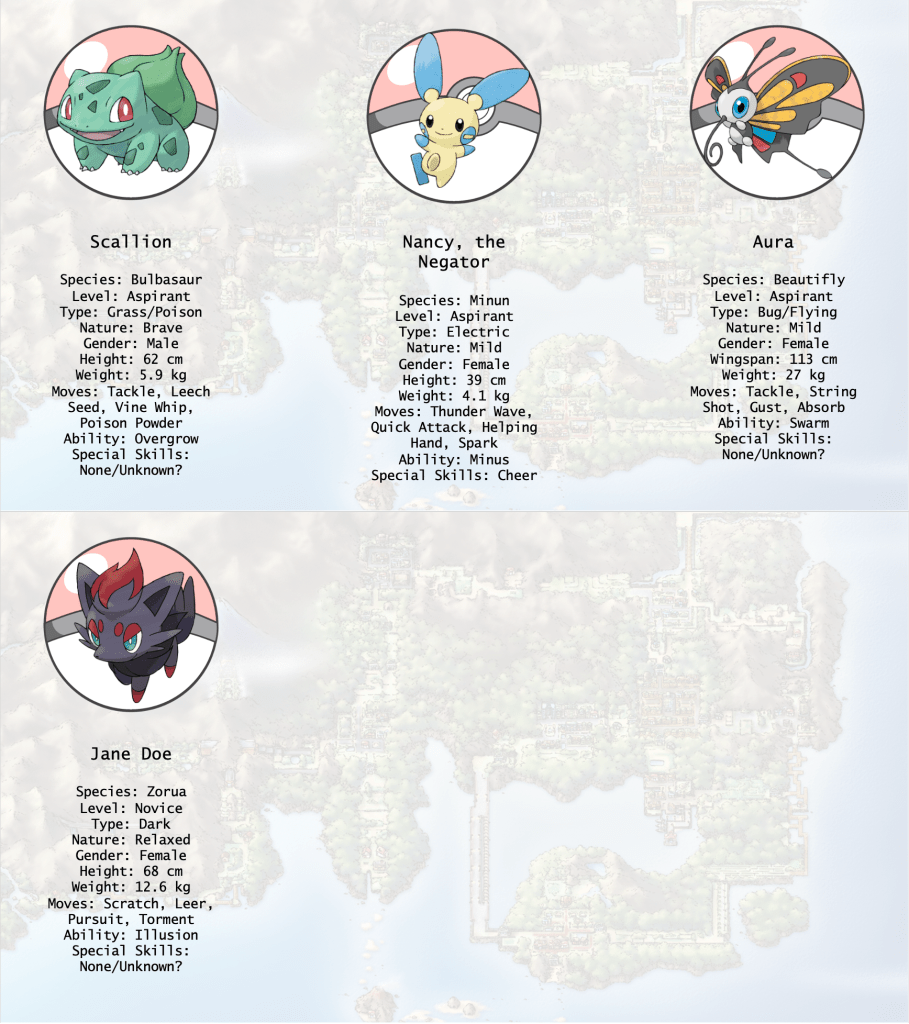
What should Scallion do?
– Just make it a straightforward fight – Scallion should be favoured.
– Brock’s tough; you should try to come up with something more creative.

[AUTHOR TIEBREAK: Well, it would really be a shame to waste all the interesting suggestions for option B that I got in the comments and my Q&A inbox…]

The next stage of the fight goes just as you predicted.  Geodude is already tiring, and after a few rounds of dodging, circling and jabbing, you spot it lowering its guard and call out.  With an almighty THWACK, Scallion springs a coiled Vine Whip forward and nails Geodude right between the eyes.  Geodude lurches back, lists in its formerly smooth hover, spins around drunkenly and crashes to the arena floor.
“Super effective, babyyy!” hollers Abner from the stands, tossing his Metapod up into the air and catching it in celebration.  The bug catchers all cheer, and out of the corner of your eye you even notice Lilac(?) slowly clapping, an enigmatic smirk dancing across his face.
Brock joins the applause as he strides out onto the field to help his Pokémon pick itself up. “Now that’s a Bulbasaur,” he exclaims approvingly, before crouching to take his Geodude’s hand.  “Good job as always, Geodude.”  He gives his Pokémon a quick once-over before recalling it to its Pokéball and returning to his end of the arena.  Scallion joins you back at your end of the field as well.  “Well, I guess that means it’s time to get serious.”  Brock suddenly has another Pokéball in his hand, and throws it high, higher, up towards the ceiling.  “Onix, go!”

Continue reading “A Pokémon Trainer is You! XXVIII: Bouldered!”

RandomAccess asks:

The new Dreepy evolutionary line, to me, brings up some pretty interesting questions about the Pokemon world’s evolutionary biology. They’re apparently aquatic Pokemon that lived in the ancient past that became spirits once they became extinct, and now fittingly have the “ghost/dragon” typing in the modern day. What’s interesting about this is you must wonder, why isn’t this more common, that being why isn’t there a ghost type variant of every existing Pokemon, since all Pokemon are living creatures that shed their mortal coil eventually all the same. This seems to imply that becoming a distinct ghost-type pokemon is something only some are capable of, while the rest just become normal wraiths like Pikachu did in the Pokemon Tower episode and presumably eventually pass on. Might there be some “metaphysical” (or possibly just physical, since this is just how things work in this world) laws that determine how adaptive a Pokemon’s spirit is? And judging what we know of Pokemon that are suspected to have once been the departed spirits of humans (such as Yamask and Gengar) and how different they look compared to humans, how many ghost type Pokemon might be the result of the ghost of a known or unknown species of Pokemon? Hell, if we could somehow find the spiritual version of “genes” would it be possible to trace common ancestry with their mortal relatives, and add ghostly branches to the Pokemon tree of life? The implications of this are both overwhelming and exciting.

Yeah, it’s an interesting problem.  I really love the idea of a Pokémon that’s not a fossilised prehistoric creature, like so many we’ve seen before, and instead the ghost of an extinct creature, but it does raise that question – why this Pokémon?  Why is Dreepy unique (well, not quite unique; Galarian Corsola seems similar, but they’re obviously unusual)?  I would not actually default to thinking that Dreepy became lingering spirits because of something inherent to them, though.  In folklore, people become ghosts because of something about the way they died – maybe they have “unfinished business,” or weren’t given the burial rites their culture requires, or were killed by a particular monster, or just died in a particularly unpleasant way that somehow damaged their soul and prevented them from moving on to wherever spirits are supposed to go.  In Pokémon, we often aren’t explicitly told where Ghost-types come from, but when we are, my impression is that it’s more often a magical or spiritual cause than a biological or scientific one (of course, then the follow-up question is whether we’re supposed to believe what we’re told about Phantump, Sandygast, etc. or just see it as a mystery yet to be solved).  Given what little we know, my first guess would be that Dreepy exist in their current ghostly form due to something about the nature of the event (or competing species, or predator) that drove them extinct.  Maybe their species was wiped out by something unusually sudden or traumatic, or maybe there was some Ghost-, Dark- or Psychic-type predator (now extinct itself as well) that could manipulate and damage souls, or maybe – just maybe – they were the victims of some kind of spiritual calamity, like an eruption of the spirit world into the “real” world.  That’s the sort of place my mind goes when you raise the question, at any rate. I think in the absence of anything more explicit from an official source, the “correct” answer is probably whatever you feel is the more potentially interesting.

Camper Smoke asks:

I know you have said India is ideal, but how would you feel if game freak made a Pokemon region out of scandinavia?

I guess predominantly “fine”?  Like, I have multiple preferences ahead of that, and particularly if we’re thinking generation IX – that is, immediately following another northern European region – I don’t think it makes a lot of sense in sequence.  But I’m not sure I can think of any place on Earth that I’d be offended or upset or even really disappointed to see as the setting of a Pokémon game.  Scandinavia’s got a lot of affluent multilinguals who are part of Pokémon’s global community, it’s got distinctive modern aesthetics that fit in well with Pokémon’s distinctive blend of tradition and techno-utopia, it’s got Vikings, it’s got fjords, and what else do any of us really need in life, when we’ve got fjords?

Jim the Editor remarked on this that it could be interesting to have a very cold region, and it certainly would.  On the other hand, the cynic in me says that Game Freak would shy away from creating a region with very few habitats for desert and tropical Pokémon, and especially from having to deal with the polar day-night cycle, in favour of just putting in a few more snowy areas than most games in the series, and otherwise keeping the climate mostly temperate.  Which… I think is an issue not just with this idea in particular but more generally.  There are things that the Pokémon games like to keep formulaic – say, having a variety of biomes to slot a large number of existing Pokémon into, or having a certain ratio of small towns to big urban centres – and if a region doesn’t obviously have those things, I kind of suspect they would get shoehorned in anyway, potentially at the expense of its unique character.  Not that it wouldn’t be great just to see Poké-Stockholm and Poké-Copenhagen, but… y’know, I think if you want to have a Scandinavian region, you want the northernmost areas to experience midnight sun and polar night, and you want that to be mechanically and narratively significant somehow; you want big parts of the map to be sparsely populated like the Crown Tundra, and you want the player spending a lot of time in those areas and thinking about them; you want the ocean to be important as something you explore and learn about, not just travel through.  Honestly, now that I’m saying all this, can we have, like… a sprawling Pokémon region based on the whole Arctic Ocean, something with big environmental themes, maybe some light survival mechanics?  Can we just put that one on the list, after India and Brazil?  I’ll just pop over and let Shigeru Ohmori know that I want that on the list.

Ty asks:

Over 10 years ago, there was a unique fan-made Pokemon project called “Pokemon Spirit Chronicles” that had a very unique concept and nice (but limited) concept art. It’s really hard to find anything related to the project these days since it eventually died out, but I was able to find this thread which contains a lot of the concept art from it: https://plus4chan.org/boards/coc/res/25552.html

The basic premise was an alternate world where Pokeballs were never developed, and you’d have to capture their spirits and forge those spirits into weapons and armor to survive in that world. I’m curious what your thoughts are from that concept and what limited fruits the project came to bare. Also if you could magically pick up those pieces and somehow create that concept in your own vision, what other details might you add to flesh out the concept, the world, and what direction would you take the story? This last part is only if you find the concept interesting enough to warrant a theoretical investment.

So… hmm.

Continue reading “Ty asks:”

A Pokémon Trainer is You! XXVII: School of Brock

[Catch up on the story so far here!]

Which Pokémon do you plan to open with against Brock?
– Jane Doe, the Zorua

Which Pokémon would you like to talk with?
– Jane

You’re a reasonably down-to-earth kid.  You’re not going to go charging into your first gym battle with a Pokémon on your team that, frankly, you barely know.  You’re going to figure out what Jane’s deal is.  As far as Jane herself is concerned, her deal is primarily rolling over and receiving belly rubs, and to be clear, you are 100% down for this.  She is a good girl and her fur is almost outrageously soft and silky.  You still want to know what her powers do, though.  Jane’s species isn’t even in your Pokédex, but the Pokémon Centre has a book room with a decent collection of field guides and textbooks.  With a little help from Jane herself, who yaps encouragingly whenever you find pictures of Pokémon from forested central Unova, you quickly find a profile in a recent trainer’s almanac.  Like I said, Jane Doe is a Zorua.  She’s a Dark-type and a fiercely intelligent ambush predator.  She should be able to learn a range of speed-based techniques, as well as attacks that strike at an opponent’s senses or mental state, and she has certain unique abilities that make your eyes pop out like an old cartoon character’s when you read the book’s description.  This definitely warrants a little practice before you go to bed.

Continue reading “A Pokémon Trainer is You! XXVII: School of Brock”