Xerneas and Yveltal

Xerneas.

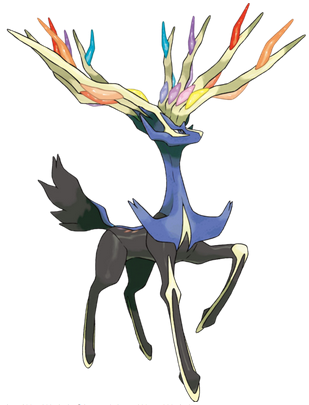
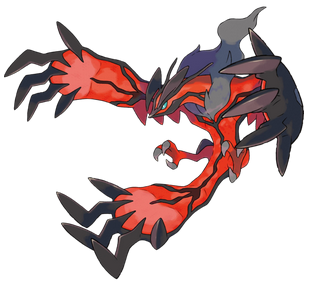
To my amazement, we’re already coming quite close to the end.  Only a handful of Pokémon from eastern Kalos remain, then I’ll have to think of something else to pass the time until I pick up Alpha Sapphire or Omega Ruby (at the moment it’s looking like I’ll finally do that series on the rival characters that I’ve been putting off forever).  Meanwhile, my unfathomable whims decree that now is the time to take on the flagship Pokémon of X and Y: the divine guardian of life and the terrifying shadow of death, Xerneas and Yveltal.  I’m not even going to bother talking about stats or moves or any of that nonsense; I know I usually do, but you really don’t need me to tell you that these things are godlike, right?  Stick some attacks on them and go commit brutal murder; whatever.  I’mma talk about themes and stuff.

I will admit, I was not terribly inspired by these two when they first appeared in the teaser trailer for X and Y last year.  “Wait, so they’re… based on the letters X and Y?” I asked myself.  “What?  Why would you- what does that add?  What is the point of that?”  I’m still not really sold on the alphabet thing, and only partly because it led to that ridiculous line where Professor Sycamore says the only thing he knows about Xerneas is that it “resembles the letter X.”  No, it doesn’t; it resembles a massive f#%$ing stag.  I suppose there doesn’t really need to be any point to it, though – there was no reason for Palkia to associated with pearls and Dialga with diamonds, and Xerneas and Yveltal have plenty of other significance to them.  It’s just rather strange, after the previous generation used the titles Black and White to tie in with the Yin-Yang ideas and the themes of balance and duality that those games were so insistently pushing, that the best anyone can come up with for X and Y is that Game Freak and Nintendo were just really proud of their 3D graphics.  It wouldn’t exactly surprise me, and it even makes some sort of sense with Y conventionally representing the vertical dimension (Yveltal can fly) while X and Z are the two horizontal dimensions (Xerneas and Zygarde have two different modes of earthbound movement), but it’s not really a satisfying conclusion.  Maybe it was just coincidence that the titles and associated legendary mascot themes of Black and White worked so well – or maybe there’s something tremendously dramatic planned for Alpha Sapphire and Omega Ruby (which, of course, also include letters of… well, an alphabet) that will make sense of everything; I don’t know.  In any case, that’s not what I most want to talk about here, and again, I don’t think it matters.  Their curious alphabetic structures do nothing to detract from Xerneas’ obvious majesty or Yveltal’s palpable malice.  These are Pokémon who know which notes they want to strike, and do so quite effectively.  What I really want to do with this entry, for the most part, is take apart the Norse mythology interpretation of Xerneas and Yveltal that seems to have so thoroughly convinced the internet.
 Yveltal.

At some point shortly after that first trailer, someone latched onto a variety of figures from Scandinavian myth, primarily inhabitants of the great ash Yggdrasil, as the most likely source of inspiration for Xerneas and Yveltal’s designs, and I think everyone’s just had trouble letting go of that idea – sometimes to the exclusion of all common sense.  Personally I struggle to find much merit in the interpretation.  It sounds really clever when you take it as a whole because it gives you an eagle, a stag and a snake that all have something in common (a tie to Yggdrasil), but the individual identifications make little to no sense.  The original argument seems to have wanted Xerneas to be based on a quartet of stags who live in the branches of the World Tree and feed on its leaves.  They are described in the Grimnismal (Sayings of Grimnir), one of the poems that make up the Poetic Edda, the major surviving body of pre-Christian Norse myth.  Nothing else is known about them aside from their names: Dain, “the Dead One,” Dvalin, “the Slumberer,” Duneyr, whose name’s exact meaning is uncertain but possibly something like “Murmur,” and Durathror, who is again obscure but perhaps means “Delay.”  These, of course, all make such perfect sense for a Pokémon whose raison d’être is to invigorate life, particularly “the Dead One,” that it’s hard to believe anyone could doubt there is a connection.  The idea also seems to have circulated that each stag had a different coloured gem in its horns – red, yellow, blue and purple, the colours of the glowing projections in Xerneas’ horns – but as far as I can find there’s actually… like… no evidence for that… anywhere… so yeah.  Yveltal, similarly, is linked to an eagle who roosts at the top of Yggdrasil, a figure to whom the Eddas do not even give a name, and spends his days insulting the dragon Nidhoggr (who lives at the bottom of the tree and gnaws on its roots), by way of a squirrel messenger named Ratatoskr.  Like the four stags, the eagle forms part of the scenery of the World Tree but is otherwise not a terribly important figure, and, also like the four stags, seems to be the subject of an erroneous detail that seems to have been concocted to make the whole concept seem more likely – namely, someone seems to have put it about at some point that the mythical eagle was blind (…it wasn’t) and suggested this as an explanation for Yveltal’s unsettling blue eyes.  Finally, again like the four stags, it’s difficult to see what the Yggdrasil eagle could have given to Yveltal other than simply being a mythical bird of prey.  He’s not really linked with death or destruction, any more than the stags are linked with life.

Bulbapedia offers related alternatives to each, which do little to improve my estimation of the idea.  Yveltal, in their view, might be based on Hraesvelgr, a giant who takes the form of an eagle and lives at the edge of the world; I think the main attraction is his badass name, which means ‘Corpse-Swallower.’  This guy is a seriously obscure character.  He’s attested in a poem called the Vafthrudnismal (or Sayings of Vafthrudnir), another part of the Poetic Edda, which is basically about Odin asking the giant Vafthrudnir stupid questions.  Odin’s ninth question is “where does wind come from?” and Vafthrudnir answers “there’s a huge f#$%ing eagle-giant at the edge of the world who flaps his wings really hard” (that is, of course, my own literal translation from the Old Norse, or whatever this stuff is supposed to be written in).  The later Prose Edda quotes this passage word-for-word, and that is the sum total of what Hraesvelgr does in the extant Norse texts; how he got his sinister name is never touched on.  You may as well just say Yveltal is based on a really big eagle.  Similarly tenuous links are drawn from Xerneas to the great stag Eikthyrnir, who stands on the roof of Valhalla chewing branches of Yggdrasil and distilling the sap into the water that supplies the world’s rivers.  This one, I will grant you, actually does make some degree of sense because Eikthyrnir, like Xerneas, is a sort of wellspring of life, in the form of fresh water, though I would rather expect Xerneas to have water-related powers if that were the case – I mean, it’s not like you need a lot of justification to put something in a legendary Pokémon’s movepool, and this is literally the only thing we know about the character being identified as the inspiration for Xerneas.
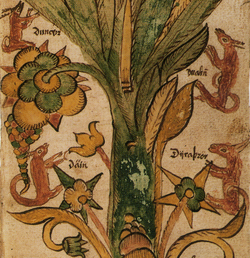
 The four stags, Dain, Dvalin, Duneyr and Durathror.

All of this was discussed ad nauseam before X and Y were ever actually released.  People thus inferred that the third legendary Pokémon, whom we now know as Zygarde, would be based on Nidhoggr, and successfully predicted that it would therefore be serpentine (seriously, though, it had to have a Z-shaped body; what else could it possibly have been?).  In some ways this is the most appealing identification to me because a terrible serpent who lives underground certainly sounds like Nidhoggr, and the –garde termination could well be a reference to Asgard and Midgard (though it could equally just refer to Zygarde’s position as, well, a guardian).  In other ways it actually makes the least sense of the lot because, rather than simply being generally nondescript like most of the other beings we’ve talked about, Nidhoggr has enough of a personality to be strongly opposed to the role Game Freak appear to have in mind for Zygarde.  He’s described as “the Order Pokémon” and is supposed to be a guardian of balance in Kalos’ ecosystem, which sounds as though he’s supposed to fill a Rayquaza-like role in checking the excesses of both Xerneas and Yveltal (since overabundant life and unchecked destruction could both devastate an ecosystem; the way his ability relates to theirs reinforces this idea).  Nidhoggr, by contrast, is a far more malevolent character than any of the minor figures suggested as an inspiration for Yveltal; he spends his time chewing on the corpses of the dishonoured dead in Hel, and seems to be one of the figures on the side of evil and chaos in Ragnarok, the Norse apocalypse.  If Zygarde is based on Nidhoggr, why isn’t he the Pokémon who symbolises death instead of Yveltal?  Similar attempts to locate Zygarde’s origins with the World Serpent Jormungandr – the arch-enemy of the universally loved and admired Thor, and a major player in bringing about the end of the world – are, if anything, even worse.  In any case, there will be more on Zygarde when he gets his own entry.

Finally, just to cap it all off, people point at Xerneas’ dormant form – a white tree – and say “ooh, look, it’s clearly a reference to Yggdrasil.”  Xerneas is a stag, for heaven’s sake; stags being associated with trees and forests is really nothing unusual; it’s certainly not specific to Norse myth.  Besides, where does that leave Yveltal’s cocoon?  There’s no reason Yveltal couldn’t have lain dormant as a black tree, and if Yggdrasil were really as important a unifier as this concept makes out, it would have made a great deal of sense, whereas a cocoon doesn’t give you anything to work with.
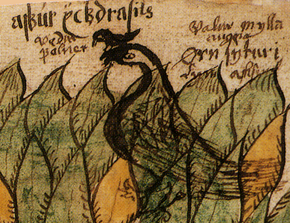
The Yggdrasil eagle, along with the hawk that inexplicably roosts between its eyes (the hawk, evidently, was important enough to be given a name - Vedrfolnir.).


So, now that I’ve spent all this time picking apart why I don’t think the currently popular mythological identifications work, am I now going to present something much cleverer that explains Xerneas and Yveltal perfectly?  No, actually, I’m not.  I’m really not sure there is one.  Legendary Pokémon are not usually based on specific mythological characters in this way; with a few notable exceptions, they more often tend to be the Pokémon world’s expression of generalised archetypes.  They may very well relate to mythological characters, but in most cases (again, with notable exceptions) I don’t think trying to pin them on specific characters from specific mythologies is a productive exercise.  In fact, you can count on one hand the number of specific mythological figures who are clearly identifiable in the designs of legendary Pokémon: the phoenix (Ho-oh), and the Japanese gods Fujin, Raijin and Inari (Tornadus, Thundurus and Landorus).  I suppose you can also argue the nine Muses for Meloetta, Nike for Victini, or the golem of Prague for Regigigas and friends, but I don’t think those are nearly as solid.  We don’t actually need an answer to this question.  There’s nothing that should lead us to expect that there is one.  If we have to find a mythological antecedent for them, I rather prefer the idea that the forces represented by Xerneas, Zygarde and Yveltal correspond to the three deities of the Hindu Trimurti, Brahma, Vishnu and Shiva – or, more accurately, not to the deities themselves but to the forces they represent, creation, preservation and destruction.The idea that Yveltal is a reference to the Black Death, I’m also fairly partial to; first of all, it’s got ‘death’ in the name, and although Game Freak shied away from actually calling Yveltal “the Death Pokémon” (going for “Destruction” instead), it’s pretty clear that that’s what it is, in opposition to Xerneas, “the Life Pokémon.”  The Black Death is generally understood to have been caused by the bacterium Yersinia pestis – starts with a Y, which is apparently one of Yveltal’s defining features.  Like Yveltal, the Black Death appeared mysteriously to ravage a huge region centuries ago, then vanished just as mysteriously (and, if certain current ideas about the Justinian Plague of 6th century Byzantium are to be believed, it had already done so once before).  Locating such a Pokémon in a European region would also make sense.  The physical designs of Xerneas and Yveltal, though, I think were dictated partly by the X/Y theme and partly by the general feeling the designers wanted to get across.  Stags appear in a lot of fiction as guardians and avatars of nature – look no further than the stag-like forest spirit from Princess Mononoke, whom I would accept as a possible influence on Xerneas far more readily than Eikthyrnir – and Xerneas’ rainbow horns evoke the vibrancy and diversity of life.  Birds of prey can descend from the sky to snatch life away without warning, an unsettling trait that is reflected in stories found around the world of giant birds that can prey on people, like the Roc and the Thunderbird.  Xerneas and Yveltal are best seen as the Pokémon universe’s take on these broader ideas, not as attempts to ape specific mythological animals whose stories don’t even fit them.

That isn’t exactly the way I envisioned this entry going; I suppose dissecting these mythological identifications was more important to me than I realised, and in fact I’m coming to realise I haven’t actually said much about Xerneas and Yveltal themselves.  A quick assessment to finish, then.  Life and death were bold choices, and I feel there’s a lot more room to play with this story than we saw in X and Y – Zygarde will doubtless complicate the relationship between these forces a great deal.  The designs are perhaps a little over-the-top, even in comparison to previous legendary Pokémon – I mean, Xerneas is almost literally “rainbow crystal stag Jesus” – but they certainly work.  They also led to the creation of an interesting kind of threat in Team Flare and Lysandre, although I’m on the record as believing that Lysandre isn’t nearly as morally ambiguous as the game seems to think he is.  In short – if you ask me, these Pokémon work.
Anonymous asks:

Some Pokemon like Eevee have evolutions that act like an actual evolution, some creature adapting to certain living conditions. However, most Pokemon don’t actually evolve, they just grow up; hence baby Pokemon. Bulbasaur isn’t adapting to a new environment or anything it’s just getting older, thus the bud on its back blooms and its body grows. Does this bother you at all, or do you not mind it?

Well, Pokémon evolution is sufficiently different to real-world evolution anyway that details like whether it’s ‘adaptation’ or not kind of go over my head.  Darwinian evolution has no effect on individuals.  Organisms cannot ‘evolve’ within their own lifetimes.  Only populations can evolve.  What Pokémon are doing – dramatic change within the lifetime of a single creature – is really metamorphosis; it makes more sense to compare Bulbasaur to, say, what a cicada or dragonfly does.  Evolution is a bit of a silly thing to call it, I suppose, but I think I’ve been desensitised to it over the sixteen years I’ve been playing Pokémon.

Bergmite and Avalugg

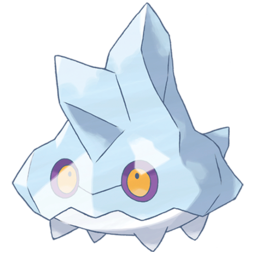
Bergmite.

Single-typed Ice Pokémon do not have a terribly good record on this blog.  Black and White produced three of them, and I condemned all three (for different reasons, of course); later on, Glaceon was partially responsible for my coming to the conclusion that we should just be done with Eeveelutions and move on to something else.  For some reason Game Freak’s designers seem to have trouble getting past “this Pokémon has ice powers” as the central feature of what these Ice-types are and do.  Bergmite and Avalugg… well, there’s something there… let’s take a look.

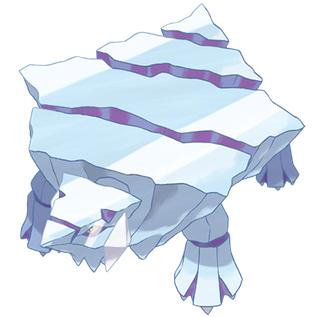
The Pokédex describes Avalugg, with a group of Bergmite huddled on its back, as resembling “an aircraft carrier made of ice.”  This would strike me as a rather uninteresting and honestly pretty silly comparison (which, let’s be honest, would not be atypical for the Pokédex), if not for the fact that there was in fact a time during World War II when the Allied Powers actually tried to build an aircraft carrier made of ice.  Well, to be more precise, due to the difficulties involved with working in ice it would have been more of a great big floating mass than a ‘ship’ in the traditional sense, and it wasn’t exactly ice, either; they tried to develop a new composite material for the purpose.  Known as pykrete, from the name of the man who first suggested the idea, Geoffrey Pyke, it was a tough, relatively lightweight and extremely cheap construction material made by freezing water mixed with sawdust or wood pulp.  The binding effect of the cellulose fibres in the wood makes the ice dramatically less brittle, comparable in strength to concrete, and because wood is a poor conductor of heat it also insulates the ice from temperature changes and makes it melt far more slowly than normal ice.  The material is – naturally – far, far cheaper than steel, as well as being naturally buoyant.  For obvious reasons, pykrete ships would have been most useful at fairly extreme latitudes, and a low surface area-to-volume ratio is also important (so the ship needs to be very large, preferably with an enclosed design).  Several promising tests were conducted and enthusiasm for the idea was high for a while.  Eventually though, the Allies started to win the war without it, and thought it was better just to keep doing what they were doing rather than rely on this bizarre experimental material, so the idea’s never really been properly tested (people like the Mythbusters have tried small pykrete ships, which just don’t have the thermal mass to survive above the freezing point of water for long; you need to think big with this stuff).  It’s a cool little bit of military history.  It’s entirely possible that Avalugg is just an iceberg Pokémon and nothing else, and that the “aircraft carrier made of ice” thing is just a really dumb simile, of course, but personally I think this is much more interesting.

One of many recent attempts to build a pykrete boat.

Anyway… so what?  There’s a reference in the Pokédex to a cool story about a wacky military experiment, which I like, but where does that leave us?  Avalugg, this reference seems to be telling us, is based on what is, essentially, a huge block of ice.  As a result, Avalugg is… well, a huge block of ice.  Other than a flat top and the fact that it can apparently swim – it can learn Surf – which makes sense since ice floats (though it’s a bit odd that it lives in the mountains), it doesn’t seem to have taken anything from being based on an aircraft carrier, although to be honest I’m not sure what else you could take from that.  Maybe a symbiotic relationship with Flying Pokémon – perhaps Wingull and Pelipper come to rest on their backs as they drift across the sea, or maybe land-dwelling Pokémon even spread between continents on the backs of Avalugg?  That might have been neat.  I’m reminded a little of Geodude, Graveler and Golem, who are living rocks and not much more; that’s not bad in itself because just the idea of a living rock creature or a living iceberg is cool on its own, but I’m also drawn to make unfavourable comparisons with Cryogonal and Glalie, who are basically living ice as well but have a bit more personality to them.  Having said that, the Pokédex’s references to Bergmite living in herds are nice, and the idea of a large group of them sitting on an Avalugg’s back is a nice image that ads a bit more to our impression of how these things live.  Maybe they bunch up like that for protection while sleeping, or whenever they have to travel long distances, perhaps by water?  Avalugg’s art is pleasing enough; it has a sort of reptilian, tortoise-like feel that creates an impression of tremendous mass and slow but overwhelming force, like the millennia-long advance of a glacier.  We’re a little short on Ice Pokémon that have tried to convey that sense.  Bergmite is a bit odd because it seems to have a body underneath the ice, which vanishes when it evolves, perhaps being completely absorbed into the ice over time somehow.  I guess it’s… kind of cute, though, in a weird, bug-eyed sort of way.  I wonder whether these things eat?  Possibly not, or very little; if their bodies are mostly made of ice they can probably survive on water for the most part.  Bergmite, apparently, can repair fissures in their frozen bodies using nothing more than cold air (or, presumably, the water in the air), so even drinking might be unnecessary for them.  They just keep going, oblivious to everything happening around them – like a glacier.

The Franz Josef Glacier, one of the reasons my home country is exactly what you've seen in Lord of the Rings.

Game Freak have tried to make defensive Ice Pokémon before.  It doesn’t usually end well, because Ice is almost indisputably the worse defensive type in the game; you get four weaknesses, three of them to very common and powerful attack types, and only one resistance, to Ice itself.  That’s not to say an Ice-type can’t do defence; it’s more that only Cloyster and Walrein have ever really been good enough at it to rise above the shortcomings of their element.  A defensive Ice-type, practically by definition, has to have some pretty impressive assets to succeed.  What does Avalugg have?  Well, for one thing, the fifth-highest defence stat in the game, behind Shuckle, Regirock, Steelix and Mega Aggron, and a good deal more HP than any of those four (awful, awful special defence, but hey, who’s counting?).  Recover, for another.  Being one of the slowest Pokémon in the game makes Recover a bit tricky to time correctly, but it lets Avalugg survive and heal off practically any physical damage that isn’t super-effective, and a good deal that is.  Excellent attack power and a solid physical movepool help too.  Avalugg’s primary attack is Avalanche, which is only powerful if Avalugg has already taken damage that turn and messes you up a bit if your opponent, say, uses Swords Dance or something, or switches out (it also forces Avalugg to move after its opponent, but that’s something Avalugg will usually be doing anyway), but is otherwise very nasty.  Earthquake combines well with Avalanche, giving you at least a neutral hit on everything except for Bronzong, Cryogonal, Shedinja, some of Rotom’s forms, and Surskit.  Stone Edge offers a few more super-effective hits.  Crunch gives good neutral coverage, which Avalugg has anyway.  Gyro Ball is attractive, since its power increases when used by a slower Pokémon against a faster one and Avalugg is one of the slowest there is, but there actually aren’t that many Pokémon who take significantly more damage from Gyro Ball than they do from Avalugg’s main attacks.  Any and all of these can mix with Curse to continue building up Avalugg’s defence and power, though I don’t think I’d really recommend that since it isn’t a difficult Pokémon to force out.  Unfortunately, if we use Avalugg as something of a tank, capitalising mainly on its physical power, the literal elephant in the room is Mamoswine.  Mamoswine lacks Avalugg’s obscene physical defence and ability to heal, but has much more powerful Earthquakes and can use Ice Shard to beat things that outrun it (and really, why doesn’t Avalugg get Ice Shard?  It’s made of ice!).  There’s no way Avalugg can compete with that kind of power – so what are its support options like?

Avalugg.

Rapid Spin is the main option to keep in mind.  Even with Defog available as an alternative means to clearing Stealth Rock, Spikes and Toxic Spikes, Rapid Spin is still important if you want to be able to do that without blowing away your own entry hazards, and there still aren’t all that many Pokémon who learn it.  It’s an important move to have.  Unfortunately, Avalugg’s not really a good Rapid Spinner, since it’s an Ice-type and takes fairly severe damage from switching in while your opponent has Stealth Rock up, which is exactly when you need Rapid Spin.  Other than that… well, I guess it can force switches with Roar, potentially ending an attempted sweep from a physical attacker who managed to power up.  It’s not the worst Pokémon to use Toxic.  That’s… kind of it.  Huh.  I was sort of expecting there would be more in there.  Avalugg’s abilities aren’t great either.  Own Tempo makes a Pokémon immune to confusion, which just doesn’t come up often because confusion is such a gamble anyway, but I suppose if you really hate Klefki it couldn’t hurt.  Ice Body, which heals the Pokémon every turn during hail, was the staple of Walrein’s defensive strategies in generations IV and V, but now that permanent weather effects are no longer a thing it just doesn’t work so well anymore.  What you probably want is Avalugg’s hidden ability, Sturdy.  Sturdy makes it impossible to knock a Pokémon out if its health is at maximum, which is slightly silly because if you’re using Avalugg for Rapid Spin you can almost assume it’ll take at least a little bit of damage as it switches in, and in any case, there’s a very clear and threatening line between things that can one-shot Avalugg (special attackers) and things that can’t (physical attackers).  On the other hand, thanks to Recover it can get back to full health after being damaged, so it’s not the worst Pokémon to have this ability, and it certainly beats the other two ability choices.  Also, bear in mind that Avalugg can learn Mirror Coat as a hereditary move from Corsola, via Squirtle, to reflect back twice the damage it just took from a special attack, provided it survives (which Sturdy can sometimes ensure it will).  It’s a risky way to play Avalugg that could easily backfire, but the possibility of turning the tables on special attackers seeking to take advantage of its weakness on that side is extremely attractive.

In order for a really defence-focused Ice Pokémon to work, either the Ice type itself needs to be seriously buffed so that it isn’t such a massive drag, or the Ice Pokémon in question needs a really spectacular unique advantage – an awesome signature move, a perfect stat distribution, a really mind-blowing support movepool, or a cool ability (maybe something really ridiculous like being able to absorb all physical attacks directed at friendly Flying-types – Talonflame and Gyarados, meet your new best friend), preferably more than one of those things.  Avalugg… well, Avalugg is a huge block of ice, and it has none of those things.  The design doesn’t suggest anything particularly remarkable that it should have, and so it doesn’t get anything.  It’s not really bad at what it does, nor is it a markedly uncreative or unoriginal design, it’s just… adequate.  It’s one of those Pokémon that makes me feel like it’s missing that little something extra to make it really awesome – maybe a mega evolution somewhere down the road.  At the moment, it’s not grievously flawed, just a little bit bland.

Goomy, Sliggoo and Goodra

Goomy

Let’s talk about dragons.

If there’s one thing Game Freak are good at, it’s thwarting English-speaking fans’ expectations of what a ‘dragon’ is (odd, considering that the Japanese name for the Dragon type in Pokémon is a transliteration of the English word ‘dragon’).  If I had a dollar for every time I’d ever heard someone complain about how cutesy Dragonite is a Dragon Pokémon but badass, firebreathing Charizard isn’t, I would have… like, eight, maybe nine dollars, easy.  Then of course there’s fluffy Altaria, the Eon Twins, Shelgon, Mega Ampharos (who owes her existence to a Japanese pun – Ampharos’ Japanese name, Denryu, can be taken to mean either “electric current” or “electric dragon”), and now Charizard actually is a Dragon (sort of), but we also have these adorable things: Goomy and Sliggoo, two blind swamp-dwelling molluscs whose most remarkable feature is their ability to constantly secrete disgusting slime.  One might be forgiven for thinking ‘Dragon’ now really just means ‘weird $#!t.’

…so, wouldn’t it be fun if I told you there are not one but two snail dragons this thing could be based on, one from Japanese folklore and one from southwestern France?

Continue reading “Goomy, Sliggoo and Goodra”

Hawlucha

Hawlucha.

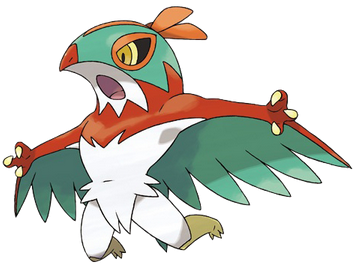
Right; I’m going to leave Carbink for now and do her with Diancie at the end, by which time I’ll hopefully be clearer on how they work, so that leaves only one Pokémon in the Coastal Kalos subregion: Hawlucha, the… lucha libre Pokémon… which is another one stricken from the list of phrases I never thought I would live to say.  Game Freak are responsible for a disconcerting number of those.  Funnily enough, though, Hawlucha’s been making more and more sense the more time I spend on this entry, and may even be one of my favourites of this generation now, which I didn’t really expect.  Let’s have a look.

Continue reading “Hawlucha”

Helioptile and Heliolisk

Helioptile.

Now that I think about it, it’s kind of strange that there aren’t really many Electric Pokémon based on real-world methods of electricity generation; for the most part they just conjure up electrical energy through – one presumes – a similar kind of biochemical process to that used by the electric eel, only turned up to eleven.  Well, either that or magic.  Let’s be honest; for at least some of them it’s probably magic.

Ladies and gentlemen, I give you Helioptile.

Continue reading “Helioptile and Heliolisk”

Skrelp and Dragalge

Skrelp.

I’ll be honest here; I’m not wild about these things.  My first impression of Skrelp during my X playthrough was ‘so, it’s a diseased Horsea?’ and I’ve not really moved past that in any major way (the fact that Dragalge is equally, at first glance, ‘a diseased Kingdra’ didn’t exactly help).  Nothing about them really offends me in any sense, but they’re not particularly ones for the ‘favourite’ pile either.  Still, may as well see what we can turn up.  Here we go.

Continue reading “Skrelp and Dragalge”

Binacle and Barbaracle

Binacle.

Well, this one’s just weird.  Don’t get me wrong, though – sometimes weird is really good, and this, I think, is the case with the latest additions to the stable of Rock/Water Pokémon, Binacle and Barbaracle.  I have to admit, when I idly dreamed in the lead-up to X and Y about what kinds of animals or plants I would have liked to see Pokémon based on, barnacles were not exactly top of the list.  But hey, whatever works.

Continue reading “Binacle and Barbaracle”