thephilosophicalsheep asks:

About the evolutionary stone thing, wouldn’t it make sense that pokemon were once able to naturally evolve into their “stone evolutions” simply because the world was brimming with primal energy?

Not quite sure which “evolutionary stone thing” we’re talking about, but it makes sense given some of the things that I like to believe, namely:

1) In the “Primal Age” described by Zinnia in Alpha Sapphire and Omega Ruby, the boundless life energy that allowed Groudon and Kyogre to achieve their Primal forms may have had similar effects for other Pokémon, and this may be where Mega Evolution and perhaps the giant Pokémon in The Ancient Puzzle of Pokémopolis come from.

2) Evolved forms that require evolutionary stones are vestigial, having disappeared from the natural world because they are no longer suited to changing environmental conditions – there could be a whole lot of species-specific explanations for this, or you could just attribute all of them to the waning life energy of the world after the end of the Primal Age.

It also fits rather nicely with the fact that, so far anyway, there are no Mega evolutions of Pokémon that have evolved using stones (except Gallade, but he needed one for symmetry).  This could still change in the future; I don’t think we have good reason to believe it’s a Rule, but as long as it stays true, I think we’re allowed to suspect that the two phenomena may be similar in other ways too.

The thing is, I don’t really have proof for either 1) or 2); 1) is just part of a lot of mad speculation I came up with while playing Alpha Sapphire for the first time as a result of being convinced that all our information was coming from incomplete and biased sources, while 2) is a consequence of trying to view Pokémon evolution in the light of how evolution works in the real world, which is dangerous territory at the best of times.  So I would like it if things worked that way, but I’m nervous about coming out and saying “yes, this is how it works.”  If that makes sense.

Godzillakiryu91 asks:

I don’t know if anyone’s asked you this, but how do you think the Dragon Type works, and why does it have the weaknesses it does?

Ehhhhhh… well, the thing is, I used to go by the description given by one of the trainers in the Blackthorn City Gym way back in Gold and Silver (‘cause, y’know, you’d expect Dragon Pokémon trainers to have some idea how Dragon-types work), and what they said was that Dragon Pokémon are “Pokémon that overflow with life energy,” or something like that.  Dratini’s assorted Pokédex entries have some similar lines.  So if you’re okay with some abstract “life force” being a real thing in the Pokémon world (which seems more or less fine), then we could understand Dragon-types as Pokémon who have access to a sort of internal “wellspring” of that power, granting them perks like long life and rapid healing.  This sort of fits generally with the holy status of dragons in East Asian mythology, the large number of legendary Dragon Pokémon with load-bearing positions in the Pokémon world’s cosmology, and whatever the hell the Dragon Force in the Victini and Reshiram/Zekrom movie is supposed to be.  Dragon-types’ attacks are strong against each other because Dragon attacks are among the only things that can directly attack that energy source and overwhelm it.  Steel-types resist Dragon attacks because, being partly mechanical, they are less reliant on life force than most other living things.  Ice attacks… honestly I’m unclear on this, but in the real world a lot of processes that are essential to life are slowed down by cold, so maybe in the Pokémon world life force itself can be slowed and congested by extreme cold?

The reason this suddenly becomes more complicated is that, as of X and Y, we now have Fairy-types, and Xerneas gives us fairly concrete reason to believe that it’s Fairy Pokémon who are most closely associated with life force, not Dragon Pokémon.  And you can maybe make some vague hand-wavey suggestions that get around that, like saying that Fairy Pokémon can manipulate and master life force while Dragon Pokémon can only tap into it by instinct, so that Fairy-types can block Dragon attacks effortlessly while also damaging the Dragons’ connection to the source of their power.  When I start to do that, though, I become worried that I’m just defending my own existing ideas rather than looking for the best possible explanation, and it also seems like Game Freak’s own ideas about what the Dragon type is have evolved since Gold and Silver – I mean, it’s hard to imagine Druddigon as holy, or having a special connection to some abstract life force.  So I don’t quite know.

Anime Time: Episode 72

The Ancient Puzzle of Pokémopolis

What happens when you get an actual real-live archaeologist to write a commentary on the episode of the Pokémon anime where they discover a bunch of artefacts from an ancient city?   Let’s find out.

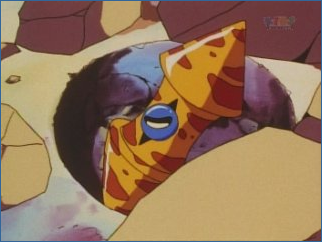
The artefact known as the 'Unearthly Urn.'
The artefact known as the ‘Unearthly Urn.’

At the beginning of this episode, Ash and Brock are having a training battle out in the wilderness when a couple of stray attacks blow a hole in a hillside, revealing a buried shrine.  Brock finds a mottled orange dumbbell-shaped object lying on an altar, which is immediately snatched away from him by a young, blue-haired and inexplicably French archaeologist named Eve, who has a whole team of khaki-clad excavators with her.  Eve immediately presents the mysterious object to a senior professor in her group, excited because it apparently confirms an extremely important hypothesis of hers.  Once Eve’s initial bubbling enthusiasm has subsided, she brings the kids to her dig team’s camp and shows them some of her recent finds.  She claims that these artefacts – particularly the dumbbell that the kids just found, and a spoon made of the same orange material – are the first archaeological evidence of the location of an ancient city called Pokémopolis, where humans worshipped Pokémon as symbols of the power of nature.  Eve, despite her young age, is apparently the world’s foremost expert on this lost civilisation.  Her doting professor tells the kids that she had earned her PhD by the time she was eight years old, and published a best-selling book on Pokémopolis a year later.  At the moment, Eve is trying to figure out what to make of a stone tablet with a cryptic and ominous inscription: “Beware the two great powers of destruction.  The shadow of the Dark Device will grapple with the prisoner of the Unearthly Urn.  The sacred city will be no more as day is swallowed up by night.  Darker still for you when they return to lay waste the world, but no human knows the secret to soothe the powers and guide them back to the shadow world.”

Continue reading “Anime Time: Episode 72”

Anonymous asks:

In regards to your Seven Types, how do you feel about adding Waste, Wind, and Sonic? Waste represents the trash side of Poison, something that would effect Pokemon heavily in-tune with Nature and Magic. Wind would have a greater effect on in-flight Pokemon and light weights while little to no effect on heavy weight or submerged Pokemon. Sonic would effect Pokemon differently based on how sensitive their hearing is. Can you see these three as having a fillable spot in your system?

In reference to this, where I outline a radical condensation of Pokémon’s type chart into just seven attack types (Might, Finesse, Nature, Water, Energy, Magic, Spirit), where Pokémon themselves have no type at all but have weaknesses and resistances by individual species.

So, in regard to these three suggestions – the point of what I was trying to do was have as few types as possible (well, actually, the real point was to think about how I would do a Pokémon game if I were starting completely from scratch, which I’m still thinking about, with a view to maybe writing a long screed of rambling nonsense at some point in the future, but let’s not go down that particular rabbit hole right now).  I wanted to see how little I could get away with.  So just on philosophical grounds, I don’t think any of these things need to be types.  I do think they can be effects that are attached to specific attacks.  Sonic I would probably deal with by putting in a Deafness status condition that, say, causes Pokémon to disobey (because they can’t hear your orders properly) and make a couple of Pokémon either especially vulnerable to it (e.g. Zubat, who ‘sees’ with sound) or resistant or outright immune to it (anything with the Soundproof ability, like Mr. Mime).  The attacks themselves, I think can just be typeless (which is a thing my system has; they just do normal damage to everything).  Wind is similar; I mostly imagined wind-based attacks as belonging mainly to Finesse, with some being dual-typed (another thing my system has – Hurricane as Finesse/Nature, Twister as Finesse/Magic), and all having effects much like the ones you describe; they’re not universally more effective against certain Pokémon, just more effective given certain environmental conditions.  Waste… waste is a weird one because one of the ways I wanted to flip things on their head was by having pollutant Pokémon like Koffing and Grimer be vulnerable to Nature attacks, not resistant (not all of the Pokémon that are “Poison” in the existing system, mind you, just those specific ones; other Poison-types could have different vulnerabilities).  Poison, like the others, doesn’t need to be a type in itself; just keep it as a status condition that can be worsened or prevented by the traits of certain Pokémon.