One lunatic's love-hate relationship with the Pokémon franchise, and his addled musings on its rights, wrongs, ins and outs. Come one, come all, and indulge my delusions of grandeur as I inflict my opinions on anyone within shouting distance.
Have you been watching the Pokémon Sun & Moon anime series? If so, what do you think of it?
Only a little, though I have been thinking about trying to remedy that soon (if only by making time for the episodes that feature whichever Pokémon I’m currently reviewing). I think the idea of abandoning the “Pokémon journey” premise in favour of Ash attending Professor Kukui’s school is a welcome bit of experimentation. I’m… not convinced by Ash’s new look, I’m afraid; it somehow feels to me as though his design has changed more than the show’s art style as a whole, and now he’s out of step with everything else.
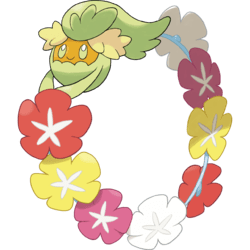
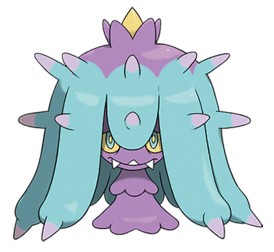
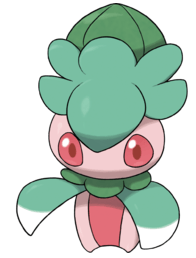
One of the most recognisable symbols of Hawaiian culture is the lei – a garland of flowers, worn around the neck on special occasions. If you’ve ever been to Hawai‘i, you might have been presented with one of these at some point; tourists love receiving lei, and Hawai‘i loves tourists. You can also see them in the stereotypical image of a traditional Hawaiian hula dancer. Lei are so well known as a distinctive element of Hawaiian ceremony and celebration that, really, it would be almost impossible for our Hawai‘i-inspired Pokémon region not to have a Pokémon that referenced them somehow. Enter: Comfey, the Posy Picker Pokémon. Continue reading “Comfey”→
How would you feel if us fans made a donation to help you purchase a switch and a let’s go game?
I’m not speaking for everyone obviously but I love your reviews and would like to help!
I appreciate the offer, but I think it’s better if I just skip Let’s Go and reassess my finances closer to the release of generation VIII. I’ll still be writing about Alola and Sun and Moon when Let’s Go comes out anyway, and there’s probably not a lot for me to say about it. I have the virtual console release of Red version to fuel my nostalgia trips (kinda thinking of writing something about that… but we’ll see what the timetable looks like when I’m done with Alola).
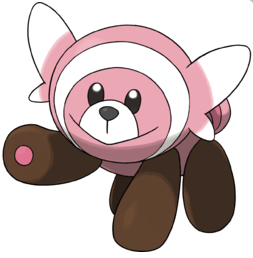
There are a lot of Grass Pokémon out there – it’s currently the fourth most common type in Pokémon, with almost one hundred representatives. It’s slightly curious, then, that there are so few Pokémon based on fruit. Tropius sort of counts, with fruit dangling off his neck, and Cherubi shifts into cherry blossom upon evolving, which has its own cultural significance in Japan, so arguably the only Pokémon wholeheartedly based on fruit are Ferroseed and Ferrothorn – assuming you do in fact classify the durian as a fruit and not as a sort of spiteful biological land mine. It’s possible that fruit Pokémon make Game Freak nervous since they draw attention to the old “do we eat Pokémon?” dilemma, but that doesn’t seem to stop them from cranking out mushrooms, or harvesting cast-off Crabrawler claws – or, for that matter, creating Swirlix and Vanillite. In any case, it’s time to break out your recipe books, because our next potentially edible Pokémon is here: Bounsweet, and her evolved forms Steenee and Tsareena. Continue reading “Bounsweet, Steenee and Tsareena”→
Today’s Pokémon is the weird spiky loofah that lives behind Kahuna Hala’s toilet-
wait
Today’s bathing accoutrement is the weird spiky Pokémon that-
okay, let me start again
Today’s Pokémon is the weird spiky sex toy that lives behind-
no, that’s even worse
Look, we’re talking about Pyukumuku, okay
Pyukumuku
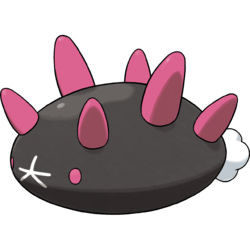
On account of its willingness to sit placidly between its trainer and certain death, Pyukumuku… is just barely a Pokémon, despite clearly being more closely related to the exfoliating bath sponge. It is, everyone is pretty much agreed, based on a sea cucumber. Sea cucumbers are soft-bodied echinoderms, distantly related to starfish and sea urchins. They’re essentially long, squishy tubes, with a mouth at one end and a multi-purpose respiratory/reproductive/excretory hole at the other. This is a body setup that makes for a pretty passive lifestyle. Continue reading “Pyukumuku”→
Before we begin, I want to point out, for the benefit of people who might not usually pay attention to this kind of thing, that Palossand has one of the best French names I’ve ever seen for a Pokémon: Trépassable. It’s a portmanteau of trépas, demise, and sable, sand, but it also sounds like très passable – “good enough,” which is a phrase that everyone who has ever built a sandcastle has uttered at least once.
Anyway. Haunted sandcastles!
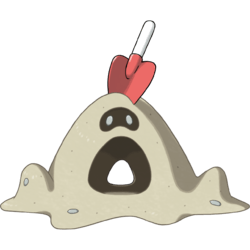
Haunted castles make perfect sense to anyone with even a vague familiarity with 19th century gothic horror or its 20th century cinematic inheritors. Beginning with Horace Walpole’s 1764 novel The Castle of Otranto, any gothic horror worth the name has a menacing castle on a windswept crag in the middle of a dark forest in Molvania or some similarly dismal place, and said castle is regularly infested with a range of “local colour” including but not limited to bats, vampires, mad scientists, werewolves and, of course, ghosts. Ghosts and castles go hand in hand right down to contemporary fiction, with the entertaining spiritual population of Hogwarts in the Harry Potter series, and ghosts in the haunting business are commonly depicted as pursuing “unfinished business” or grudges left over from their lives. But a haunted sandcastle might be something of a new one… Continue reading “Sandygast and Palossand”→
Let’s start with some simple, direct Pokédex quotes about Bewear.
“Many trainers,” Moon version tells us, “have left this world after their spines were squashed by its hug.”
…well.
Just in case we hadn’t gotten the message, Ultra Sun clarifies that after you’ve been faced with a Bewear intimidation display “life is over for anyone who doesn’t run away as fast as possible.”
Today we’ll be looking at some of Alola’s more passive-aggressive denizens, the Brutal Star Pokémon, Mareanie and Toxapex. Their physical designs are a little bit cryptic – Mareanie looks like a sort of spikey anemone, while Toxapex… Toxapex resembles nothing so much as a cancerous uvula glued to the inside of a dilapidated sea mine, with her twelve arms locking together to form an impenetrable dome that protects against not only predators but the force of waves, tides and ocean storms. In appearance, probably the closest animal to Toxapex would be something like a sea urchin, so bristling with spikes that its real body is essentially invisible, and probably not what you’re most worried about anyway. But it’s from their place in Alola’s ecology – specifically their relationship with one particular Pokémon, Corsola – that makes it clear that they’re probably supposed to be based on the dreaded crown-of-thorns starfish, Acanthaster planci, an unusual many-armed, spiny starfish found throughout much of the Pacific ocean. Continue reading “Mareanie and Toxapex”→
Today we’re talking about Fomantis and Lurantis, the “Sickle Grass Pokémon” and “Bloom Sickle Pokémon,” a pair of deceptive Grass-types that take on the appearance of insects, their names evoking the words “faux” and “lure.” According to the Pokédex, Lurantis is often called “the most glamorous Grass Pokémon,” which… well, I think Roserade, Lilligant, Virizion and fellow Alolan Grass-type Tsareena are all going to want a word with you about that one, Lurantis, but for now we’ll agree that you’re top 5 material. Let’s take a closer look. Continue reading “Fomantis and Lurantis”→
Jim the Editor and I had an American friend once who, while on an archaeological dig in Italy, famously infuriated an old Italian man to the point of explosive outrage by repeatedly addressing a dog “ciao, burro” – burro being (as our friend well knew) the Spanish word for donkey, and therefore already a rather silly thing to say to an Italian dog. Even worse, though, burro is also the Italian word for butter, so an onlooker could forgiven for thinking that someone saying “ciao, burro” to a dog is completely insane. Years later, this event has only two substantial legacies: first, that Jim now feels compelled to address all dogs “ciao, burro,” and second, that my Mudsdale now has the dreadful misfortune of being named “Butter.”
Let’s talk about Mudbray and Mudsdale.
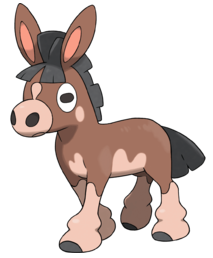
To start with the obvious: Mudbray is a donkey, and Mudsdale is a horse. The two species are actually about as distant from one another as horses are from zebras (which get to be their own Pokémon), but I suppose donkeys are not exactly among the most fascinatingly exotic animals in the world, so it’s understandable that for Pokémon’s purposes they would get lumped in with horses as a “close enough.” Donkeys are proverbially known as stubborn animals, because they have very different fear responses to horses – horses bolt when frightened, but donkeys freeze, and usually give very few external cues to express their discomfort, so someone who only knows horses will often think a startled or cautious donkey is being “stubborn” by refusing to move. You could probably ask, fairly, whether the same might be true of Mudbray, who merits a description by the Pokédex as “stubborn” and “individualistic” (unlike horses, donkeys are not naturally herd animals) – maybe that reputation comes from inexperienced trainers who haven’t been taught how to handle them. Mudbray’s… honestly quite disturbing… blank-looking round eyes are probably meant to reinforce this aspect of her personality, making her look a bit vacant and detached – although the unnerving oblong pupils seem to be based on the appearance of a real equine eye. On account of the rough terrain of their natural habitats, where strength matters more than speed, donkeys are actually stronger for their size than horses. In Mudbray’s case, this translates to a carrying capacity of “50 times its own body weight” – over 5 tonnes. As usual, it’s probably best to think of numbers in the Pokédex as more illustrative than literal – even if a Mudbray might not actually be able to support the weight of a fully grown African elephant, after seeing one in action you might believe it.


 Pokémaniacal