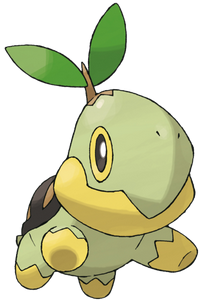
 Okay; Diamond and Pearl. The last three starters (since I’ve already covered Tepig, Snivy and Oshawott). I’ve always liked these three; the designs are quirky, they’re all pretty powerful (if I had to use a whole trio on a single team, this is probably the one I’d go for, although the Ruby/Sapphire ones give them a run for their money), and the way they interact with each other is pretty interesting in itself. Let’s take a look at Turtwig and see how he measures up.
As you’ve probably read by now, I love all the Grass-type starters. However, I think Torterra is the only one whose design potentially equals or betters Venusaur’s. Turtwig, Grotle and Torterra are based on the old mythological motif of the ‘world turtle,’ who appears in several places around the world, but most famously in Hindu legend as one of the avatars of Vishnu, his shell serving as a pivot when the gods and demons together churn the ocean of milk using an upturned mountain to produce the water of life (it… was just that kind of Friday night, okay?). The world turtle motif is directly referenced in the Pokémon world’s corresponding ancient myth that an enormous Torterra lived deep beneath the earth. The design includes elements of every part of the natural world – earth, water, plants and animals. Turtwig originally hosts a tiny sapling on his head, which grows into twin rows of bushes on Grotle’s shell of compacted soil, and finally into a huge tree on Torterra’s immense carapace, accompanied by great spikes of moss-covered stone. Grotle often carry smaller Pokémon around on their backs over long distances, and Torterra becomes so large, and his foliage so luscious, that entire communities of Pokémon can be found on a wild Torterra’s back, creating a pocket ecosystem in which some Pokémon spend their whole lives. Turtwig, Grotle and Torterra also have some minor powers related to water, completing their miniature world. All Grass Pokémon, logically, are very reliant on water, but the designers seem to have wanted to drive it home with these three; they always live by lakes and rivers, drinking causes their shells to harden and grow strong, they have the special ability to sense sources of pure water, which they use to lead other Pokémon there, and wild Grotle are said to protect hidden springs. These Pokémon aren’t just parts of ecosystems, they are ecosystems. I love this design. It’s detailed and fascinating, drawing on a well-known mythological motif combined with symbolically significant traits and powers to give Turtwig, Grotle and Torterra an interesting place in the world of Pokémon. I don’t think it would be at all bold to say that Torterra is one of the best-designed Grass Pokémon in the entire history of the game. My one minor gripe here is the scale; as Pokémon go, Torterra is pretty massive, more than two meters high and about five meters long, but I can’t help but feel that he (and perhaps Grotle as well) should be even bigger, to realistically fit their portrayal as supporters of whole communities. At some point, though, it would become ridiculous to talk about using these things in a battle in a stadium. Besides, we never see wild Torterra in the game; all of them are given out as starter Turtwig or hatched from eggs – who knows how old they get in the wild, or whether they ever stop growing?
The fact that they remind me of dinosaurs has nothing to do with why I like them. Honest.
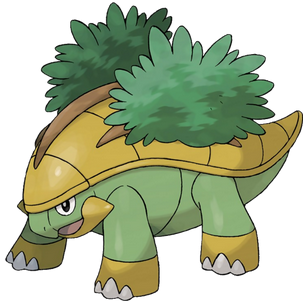
Turtwig is the only Grass-type starter who gains a second type upon evolving, becoming Grass/Ground, appropriately enough, upon reaching his final form (Bulbasaur is Grass/Poison to begin with, and the others stay pure-Grass all the way through). This is interesting because it’s part of the way Game Freak decided to play with the traditional Grass/Fire/Water paradigm in Diamond and Pearl. Normally, Grass drains Water, Fire burns Grass, and Water douses Fire, and this is the way Turtwig, Chimchar and Piplup work as well, but when they reach their adult forms, they mix up the usual strengths and weaknesses a little bit. Torterra is a Ground-type, so even though he’s still vulnerable to Fire attacks, he can smack Infernape with a pretty nasty Earthquake. Empoleon is a Steel-type, so he is no longer particularly weak against Grass attacks, but he’s almost as frightened of Earthquake as Infernape is. On the flip side, Torterra’s second element makes him even more vulnerable to Empoleon’s Ice Beam than most Grass-types, and strips him of his resistance to Water attacks. Finally, Empoleon can still hammer Infernape with Water attacks, but also has to be wary of Infernape’s Close Combat, since Steel Pokémon don’t like Fighting attacks one bit. Essentially, the game starts with a traditional Grass-beats-Water-beats-Fire-beats-Grass setup, but by the end of the game all three have some pretty devastating guns to level against each other. I suspect that quite a lot of thought went into this; it’s an interesting change to the usual dynamic and part of what I like about the fourth-generation starters. It’s sort of a shame Black and White didn’t continue this – Emboar can smack Samurott around with Grass Knot or Wild Charge, if you have the appropriate TMs, and Samurott can give Serperior a Megahorn to the face, but they seem to have forgotten to give Serperior anything to hurt Emboar (as usual, Grass-types Don’t Get Nice Things). Oh well…
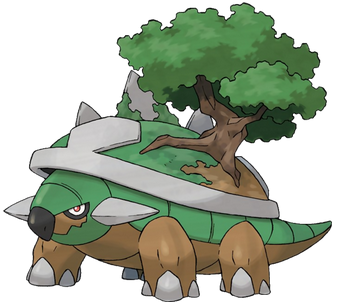
The mechanics changes of Diamond and Pearl opened up the possibility of physical Grass attacks, so why not kick things off with a Grass-type physical tank? Only two previous Grass Pokémon had ever shown a significant bias towards physical attacks over special attacks – Parasect and Breloom, whom, let’s face it, we use for Spore, not for their attacks (Breloom less and less as the generations passed, but Spore is still his biggest advantage) – so Torterra blazed new ground… and boy, did he blaze it. Torterra is the slowest of all the starters, but possibly the toughest, and also one of the most powerful. Curse is an obvious choice to emphasise those qualities since Torterra isn’t going to outrun anything that cares anyway, but if you want something a little less predictable you can try Rock Polish, to bring Torterra’s speed up to something resembling respectability, or even Swords Dance if you’re reckless enough. Torterra’s primary attack, of course, is Earthquake; sadly, Grass attacks don’t combine particularly well with Ground attacks, since they share all of Ground’s offensive weaknesses. If you do want one, you have two options; Wood Hammer is stronger than Seed Bomb, but Seed Bomb doesn’t cause recoil damage. Rock attacks, on the other hand, do mesh very well with Earthquake, so Stone Edge is a good place to go. Torterra’s other main offensive options are Crunch and Superpower; Superpower is much more useful for actually killing stuff, but the penalty it inflicts to the user’s physical attack and defence is particularly undesirable for a slow, bulky Pokémon like Torterra. Leech Seed gets you a trickle of healing, though Torterra, with his large HP total and relative inability to stay in control of a Leech Seed/Substitute scenario, is not really an ideal candidate for using it; Synthesis is weather-dependent but probably your best option. There are also a few support moves to mix things up if you feel so inclined; Reflect and Light Screen for team defence, the ever-present Stealth Rock is available from a TM on Diamond and Pearl if you don’t have a team member who can use it yet, Roar is always welcome on a slow, tough Pokémon for messing with your opponent’s strategies, and for a particularly defensive Torterra you might use Stockpile, a hereditary move from Carnivine or Victreebel, which boosts both defence and special defence together (it has other effects, but they are irrelevant and distracting).
It’s not all good news, of course. Grass/Ground is a fairly poor defensive typing, with two resistances and an immunity to four weaknesses – including a crippling double-weakness to Ice. Torterra is very easily dealt with using a good solid Ice Beam, and he’s too slow to do much about it. He also has difficulty handling other Grass-types, who are largely unperturbed by most of his offensive powers. In short, although he’s a perfectly respectable Pokémon, he has some crucial flaws, and is much less versatile than a Pokémon like Venusaur, which makes him a lot easier to stop. However, if you play him to his strengths, Torterra can flatten some powerful enemies, and with some of the coolest flavour I’ve ever seen in Pokémon, he’s easily one of my favourite starters.


 Pokémaniacal