
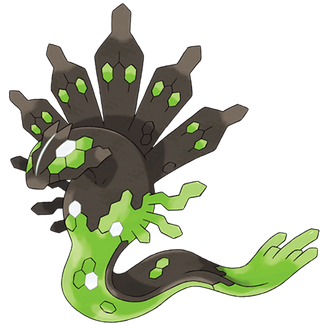
I’m down to the last few legendary Pokémon now (well, the last few legendary Pokémon… and Carbink, whom I’m still intending to do together with Diancie on account of their weird relationship). By necessity, these final four entries are going to be… more than a little speculative. There’s still a lot that we don’t know about Zygarde and Diancie, and heck, I don’t think we’re even supposed to know that Hoopa and Volcanion exist yet (I mean, we’ve all known about them for months, but no one dares tell Game Freak that, because it would hurt their feelings and they might cry, which would be awkward). I may have to make up a lot of stuff. Should be fun. Anyway, let’s do Zygarde.
I already spoke at some length in Xerneas’ and Yveltal’s entry about my reasons for being generally dismissive of the Norse mythology interpretation of this triad that’s become popular. Still, I suppose it’s worth quickly going back over my objections as they apply to Zygarde specifically. Zygarde, the great serpent of order, the internet would have us believe, is likely based at least partially on either the dragon Nidhoggr, the world serpent Jormungandr, or both. Certainly Nidhoggr makes a decent parallel, as a giant snake who lives underground; what I don’t like about this is that both of these creatures are very much on the side of chaos and destruction in the Old Norse cosmology, which doesn’t seem at all appropriate for the role that Game Freak appear to have in mind for Zygarde in whatever conflicts are yet to come. This role actually bothers me for other reasons as well – mainly, it seems almost too obvious. The Pokédex calls Zygarde the ‘Order Pokémon,’ and credits it with a “secret power” which it uses to protect the Kalosian ecosystem from disruption. Meanwhile, on the gameplay side of things, the mechanics of the Aura Break ability (which we’ll talk about later) seem intended to let Zygarde nullify the most dangerous powers of its two trio-mates. The analogy with Rayquaza’s Air Lock, which likewise nullifies the effects of Drought and Drizzle, should be obvious, and at that point it seems like Zygarde’s cosmological role is likely to be parallel too – a balancing force between Xerneas’ influence on life in Kalos and Yveltal’s influence on death, presumably coming into play to resolve whatever bastardry Lysandre attempts next. This makes a lot of sense. It’s kind of intuitively obvious to most of us why Kyogre and Groudon need to be kept in balance, but it’s not so immediately clear why we would want to balance Xerneas and Yveltal, who seem almost like “good and evil” – one of the themes X and Y deal with, though, particularly X and particularly through Diantha’s dialogue, is the idea that change, age and death are all parts of life. The reference to Zygarde as a protector of Kalos’ ecosystem also works well here – life, spreading without limit and unchecked by death or decay, would consume resources at an exponential rate and ultimately destroy itself, which is more or less what Lysandre believes is happening to humanity already. The whole thing could very easily be spun as a more nuanced and philosophical version of the same story we were originally told in Ruby and Sapphire… to which I would have no objection, if not for the fact that we are about to get remakes of Ruby and Sapphire anyway. If I were Game Freak, I would want to do something very different with Zygarde.
Probably the way I would spin Zygarde’s involvement in Z Version (assuming that is what they call it; after Black and White 2 I’m not prepared to rule out the possibility of another curveball) would be to have Lysandre know about Zygarde from the start and make it the main goal of Team Flare’s campaign. Lysandre might well believe that Zygarde, as a Pokémon who values order and balance in the ecosystem of Kalos, could potentially be won over to his side – after all, what Lysandre sees in X and Y is an ecosystem thrown out of balance by the reckless consumption of humans. What Maxie and Archie do by accident in Emerald is instead Lysandre’s whole gameplan: summon Zygarde by provoking a big enough fight between Yveltal and Xerneas that the serpent feels compelled to intervene. After that, even once the player is able to calm down the other legendary Pokémon, Zygarde still goes on a rampage because it’s been convinced by Lysandre that human civilisation is the real imbalance. At this stage, we could go one of two ways. The first is to have Zygarde abandon Lysandre and take matters entirely into its own… er… coils, I suppose, immediately destroying Team Flare and working its way towards Lumiose City but leaving Geosenge Town and Shalour City largely untouched, apparently in accordance with its own understanding of what constitutes ‘harmony’ in Kalos. The plot from there involves convincing Lysandre that modern civilisation shouldn’t be given up on, and him going on to earn his redemption by helping to show Zygarde the same thing. The other way I could see this going is for Zygarde and Lysandre to keep working in unison, Lysandre becoming visibly more irrational as events unfold and Zygarde being corrupted by his influence as well, until they can be defeated and convinced that destroying humanity and filling the gap with new life isn’t the way to achieve harmony. I’m not sure which of those two I like better; at the moment though I think probably the first.

Much like Kyurem in Black and White, Zygarde seems to have been left out in the cold a little bit when you compare him with the other two members of its triad, the almighty Xerneas and Yveltal. The most obvious reason for this is that, while Xerneas and Yveltal enjoy broadly applicable and extremely powerful passive abilities – Fairy Aura and Dark Aura, which give major damage bonuses to their already strong primary attacks – Zygarde is lumped with the decidedly underwhelming Aura Break. Aura Break reverses the effects of all other ‘Aura’ abilities… and there are only two of those, Xerneas’ and Yveltal’s, so if you happen to be fighting an opponent who is not Xerneas or Yveltal, it just doesn’t do anything. Even if you are, well, frankly Xerneas still murders Zygarde with Moonblast, in spite of the damage penalty imposed by the reversed Fairy Aura, and Yveltal is still in with a chance too thanks to his immunity to Ground attacks and the excessive healing provided by Oblivion Wing (which isn’t weakened by Aura Break). What else can Zygarde do? Well, something with legendary stats can’t be that bad; Zygarde is a perfectly solid physical attacker by almost anyone’s standards, with pretty good high-power type coverage from Earthquake and Outrage, Stone Edge for backup, and even a strong priority move in Extremespeed. Its stats also allow it to choose comfortably between very aggressive strategies with Dragon Dance to boost its power and more defensive ones with Glare (which is 100% accurate as of X and Y and thus unambiguously better than Thunder Wave, which can be blocked be Ground-types – Zygarde is also only the seventh Pokémon to get it, by the way) or Coil. As is by now tradition, Zygarde gets a signature move too: Land’s Wrath. It’s a bit of an odd one, in that it doesn’t appear to be all that good at first glance. In fact, in a single battle, it’s strictly worse than Earthquake; they’re both physical Ground-type attacks, and they have the same accuracy and PP, but Land’s Wrath does a little bit less damage. Like so many of X and Y’s signature moves and abilities, it only really has potential in doubles, where it acts as a ‘party-friendly’ version of Earthquake – which is kind of a big deal, since most Ground-types, if you want to avoid the possibility of friendly fire, don’t actually have any good alternative, or even any tolerable one. Still, there’s no way this competes with the amazing healing provided by Oblivion Wing or the ridiculousness that is Power Herb Geomancy.
Just comparing Zygarde to Xerneas and Yveltal, it seems almost certain that there’s more to it than we have yet seen. Giratina in Platinum was given a vastly expanded role in both the plot and the backstory, along with a new form and new powers. Kyurem in Black and White 2 got a whole new subsystem entirely unique to him, the unprecedented ability to fuse with another Pokémon and thus become one of the most powerful Pokémon in existence (well, in terms of raw stats, anyway), surpassed only by Arceus and, as of X and Y, both variants of Mega Mewtwo. There were also a couple of new signature moves; they were and are total garbage, but hey, it’s the thought that counts, right? These perks also came with an important place in the story’s mythology as a ‘remnant’ or ‘fragment’ of the original dragon that gave rise to both Zekrom and Reshiram. More to the point, like Black and White’s ‘ruined’ Kyurem, Zygarde has noticeably lower stats than the other two Pokémon who seem clearly intended to make up a trinity with him. Considering that Rayquaza is getting a Mega form in Alpha Sapphire and Omega Ruby, and that Groudon and Kyogre too are expecting a new toy in the form of this ‘primal’ nonsense, whatever that means, I would, frankly, be utterly floored if it turned out that Game Freak didn’t have something extremely dramatic planned for Zygarde’s eventual involvement with the plot of Generation VI. Exactly how that will happen, I wouldn’t like to guess, though I imagine Zygarde’s physical form will change quite a bit (maybe it will become the first sixth-generation Pokémon to get a Mega evolution [EDIT: the SECOND, after Diancie. Herp derp.]). As far as mechanical changes go, higher stats are practically a given, and I wouldn’t be surprised to see its ability upgraded, maybe to something that just nullifies all other abilities, or weakens all Fairy and Dark attacks around Zygarde, not just Xerneas’ and Yveltal’s. There are also two unused moves lurking in the game’s coding, in the same way as Kyurem’s Freeze Shock and Ice Burn were before the release of Black and White 2 – Thousand Arrows and Thousand Waves, both Ground attacks with the same power as Land’s Wrath. Thousand Arrows, apparently, can hit Flying and Levitating Pokémon despite being a Ground attack, and also knocks them to the ground in the same way as Smack Down; Thousand Waves, on the other hand, can trap the Pokémon it hits (for one turn? Until the user leaves play? Not sure). Those probably belong to Zygarde, and the fact that there are two of them could suggest that there are options involved in whatever power-up Zygarde will receive – possibly, like Kyurem, two different forms, each one associated in some way with one of the other two members of Zygarde’s triad. Thousand Arrows would certainly do a number on Yveltal, so maybe each move is supposed to help it defeat one of the others? Anything more than that is hard to say.
There was a lot you could say about Kyurem long before Black and White 2 were actually announced (and indeed I did), if you were willing to think about how exactly he could work with the Yin-Yang thing that Reshiram and Zekrom were apparently doing and how a third dragon would fit into what we knew about their origins. There isn’t, as far as I can see, any similar big tip-off for Zygarde (perhaps partly because the internet’s dominant interpretation for his design is one that has me utterly unconvinced). I’m perfectly fine with this. I’ve liked generation VI so far, and despite my usual cynicism about their abilities I’m confident that Game Freak have something interesting in mind for the serpent of order – and it’s the mystery that makes it worth the wait.
 Pokémaniacal