
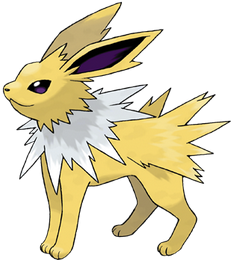
 Of Eevee’s original three evolutions, Jolteon is the tough guy, the cool kid, the badass. He appeals to a very different kind of player and a very different style of play to Vaporeon, emphasising speed and power in both his design and his skills. This kind of variation on the basic form of the Eevee evolutions is part of Eevee’s strength – there’s something for everyone. In Jolteon’s case, if you need a blazing-fast special attacker with serious attitude, look no further.
Like most Electric Pokémon, Jolteon’s thing is that he can hurl massive blasts of lightning at people. He is often ill-tempered, prone to volatile swings of emotion, and his electrical charge builds rapidly when he is agitated. His power is drawn from a rather unlikely source – his fur. Jolteon’s fur is made up of innumerable rigid bristles that rub together to create static electricity as he moves, charging him up for electrical attacks. The bristles also help him defend himself – they’re sharp and stiff, and stand out from his body because of the static charge, like a porcupine’s quills. He can even launch bunches of them at his enemies to skewer them – an ability represented in-game by the sadly useless Pin Missile attack. As Electric Pokémon go, Jolteon is a little generic, although the static fur is a nice touch to explain the source of his power while giving him a touch of character and some interesting abilities. It’s just a shame those interesting abilities are so useless. I’m pretty sure there’s no serious reason ever to use Pin Missile, which is a shame because, like Vaporeon’s Acid Armour, it was almost a signature move once (shared only with Beedrill). Anyway, the really nice thing about Jolteon’s prickly fur is that the spiky starburst profile it gives him is pleasingly evocative of a jagged lightning bolt, or the crash of thunder – a neat way of working his element into the design without actually scribbling lightning bolts all over him. Overall, I’m not terribly excited about Jolteon’s visual design, but it’s appropriate, it works, and it plays to a very different aesthetic to Vaporeon’s – sinuous and dynamic, harsh rather than elegant.

I mentioned last time, in relation to Vaporeon, that one of Eevee’s alleged themes is adaptation to the environment – her plethora of evolved forms supposedly reflects the development of features to cope with or exploit particular aspects of a variety of habitats. It’s a fitting enough theme to build around Eevee, since she’s supposed to be inspired by the workings of real-world evolution, which is really all about adapting to different environmental conditions; some organisms work well in one habitat, some in another, but it’s meaningless to talk about one being ‘better’ or ‘more evolved’ than another – just like Eevee’s evolutions. The adaptation thing was written into the Pokédex in Gold and Silver, and probably wasn’t actually on the designers’ minds when they originally created Vaporeon, Jolteon, and Flareon. This is probably why Jolteon and Flareon, quite clearly, aren’t associated with any specific habitat at all. I can’t blame them for this, naturally, but I can make some suggestions for fixing this and bringing them in line with what seems to be Eevee’s theme now. What kind of environment would suit Jolteon best? Well, he can run extremely quickly, so it would make sense if he were adapted for wide open spaces; that rules out forests, hills and mountains. Eevee and all of her evolutions sport long, broad ears which make me think of a jackrabbit or a fennec fox, who use their large ears to help dissipate excess heat and cope with life in desert climates; none of them (except, for obvious reasons, Glaceon) would look out of place in a tropical or subtropical climate, and Jolteon in particular, with his stiff, straight, bristly fur, doesn’t seem to be particularly concerned with heat retention. Perhaps most importantly, Jolteon’s primary means of attack, his lightning, is charged by the build-up of static electricity, which is much slower and weaker in humid conditions. Jolteon seems to be a Pokémon adapted for a hot, dry and relatively flat climate, somewhere like central Australia, or the Mojave desert in North America. Given that this is supposed to be a theme for Eevee, I’m going to look at all her other evolved forms in the same way when we come to them, and figure out which environments they seem to match. For now, though, let’s talk about Jolteon’s in-battle abilities.
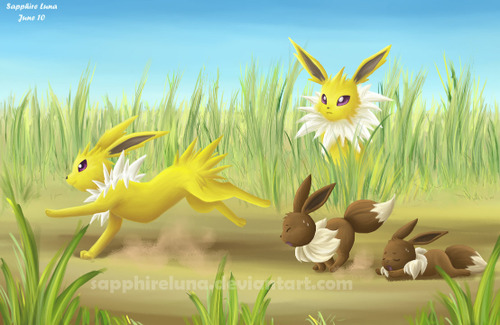
Jolteon’s greatest asset, the thing that sets him apart, is his speed. Most Electric Pokémon are fast, but Jolteon is a blur of motion; in Red and Blue, he drew even with Mewtwo and Aerodactyl, outrun only by Electrode. Even today, only a few more Pokémon can claim to be faster: Accelgor, Ninjask, and Deoxys, with Crobat just managing to keep up with him. His excellent speed makes him rather good at sniping opposing Pokémon with his spectacular Thunderbolts, and also makes him one of the better choices for taking advantage of a rare move that all of Eevee’s evolutions have in common: Baton Pass. This has given Jolteon a nice little niche since Baton Pass was introduced in Gold and Silver, and remains one of his most useful skills today. He doesn’t have a whole lot of buffs to pass – Agility, Charge Beam, Substitute and maybe Work Up are pretty much the extent of it – but his Thunderbolts are frightening enough that he can usually get the free turn he needs to pull it off, and his absurd speed ensures that he doesn’t stay in play any longer than he absolutely has to. Jolteon’s main weakness is that, like most of his siblings, he suffers from a rather small offensive movepool, which is what keeps him from being a really top-class sweeper despite having perfect stats for it. Any Ground-type with halfway decent special defence will stop him in his tracks unless, heaven help you, you have time to breed a Jolteon with the right Hidden Power element (and even then it’s not exactly airtight; Swampert, Gastrodon and their ilk murder you if you pick Ice, Landorus and Gliscor if you pick Grass). If you’re going to rely mainly on a single attack type, though, Electric is one of the better ones to be stuck with, and, thanks to Platinum, Jolteon can learn Signal Beam and doesn’t have to worry about Grass-types either. Shadow Ball is Shadow Ball, but it helps with a few Pokémon, mainly Ghost-types and Ground-types. Jolteon is relatively frail, and shouldn’t be expected to take much abuse, especially not from physical attacks, but with a bit of judicious switching and Baton Passing to keep him out of harm’s way, you should be able to nail a good few Pokémon with some Thunderbolts.
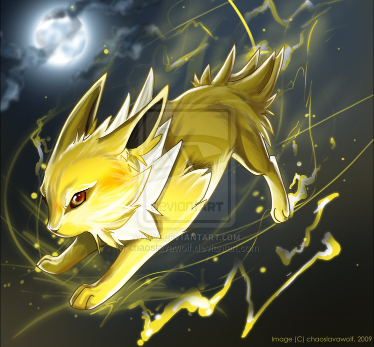
This is basically the core of Jolteon’s skillset, but he has a few other moves worth mentioning. Volt Switch, Black and White’s great gift to Electric-types, lets a Pokémon attack and then immediately switch out, avoiding the opponent’s counterattack, and is especially effective on a fast Pokémon like Jolteon, but many Jolteon are likely to have Baton Pass anyway, and you don’t really need both; they serve a similar purpose. Fake Tears might be interesting – catch one of those big Ground-types switching in to wreck their special defence, and they might feel less confident about eating a Shadow Ball and have to switch right back out again. Jolteon learns Thunder Wave, but doesn’t benefit much from it since he outruns everything important already, and isn’t tough enough to pull team support duty. Wish, likewise, is an excellent move but ill-suited to Jolteon’s capabilities. The final nice thing about Jolteon is his ability, Volt Absorb. In much the same way as Vaporeon’s Water Absorb, Volt Absorb negates Electric attacks and converts their energy into health, healing Jolteon by 25% of his maximum HP every time he takes one. This is significantly less useful for Jolteon because, unlike Vaporeon, he can’t take many hits anyway and may not survive long enough to heal up, but it does still let him switch into Electric attacks with impunity, which is very useful for a frail attacker. His Dream World ability, Quick Feet, is interesting but ultimately not worth much. It gives him a speed boost whenever he’s paralysed or poisoned or what have you – but, being Jolteon, he’s already so fast that this isn’t likely to do much for him. The biggest advantage to it is that it negates the massive speed penalty connected with paralysis, which makes Jolteon all but useless. However, a Jolteon with Volt Absorb is immune to the most common and effective paralysing attack anyway (Thunder Wave) so in the end Quick Feet is a dubious choice.
As you may have gathered, what I like best about Jolteon is how very differently he handles compared to Vaporeon. This is another of those themes I’m going to keep harping on throughout this series, and will probably talk about in some detail in the final entry on Eevee, so keep it in mind. For now, I’ll just say that Jolteon works. He’s not really my style, but he’s a very fun Pokémon to use, and won’t disappoint you – and, you have to admit, he’s pretty badass.

 Pokémaniacal