Since you recently discussed the new Fairy type and briefly talked about the defining factors of other Pokémon types in doing so, I’ve been wondering about your opinions on a couple of types. I have my own of course, but your thoughts are always so interesting. First, what do you make of the Flying type, specifically the fact that it exists almost solely as half of a dual typing (with the exception of one legendary)? And second, what do you think are the defining attributes of the Normal type?

Flying is weird, because it seems like it can consist of either being a bird or having the ability to fly – not necessarily both (see: Dodrio, Scyther).  In addition to the fact that there’s only one straight Flying-type (and even that in generation five), it might also be important that Flying is almost never the first of two types; there’s no functional distinction at all, but which element gets put first often seems to say something about which one is considered more important to the design (e.g. Water/Rock – Relicanth and Corsola – vs. Rock/Water – Kabutops and Omastar).  Noibat and Noivern, only just introduced with X and Y, are the only Pokémon to put Flying first.  What’s more, wind powers – which we now associate with Flying-types, and which are Tornadus’ main feature – originally seem to have been connected with Normal, not Flying, because Gust was a Normal-type attack in Red and Blue, while Whirlwind and Razor Wind, the other wind attacks that existed in the original game, still are Normal.  I think what all this adds up to is that Flying wasn’t originally considered a type, as such – it acts more like a trait or ability that certain Pokémon possess, which makes sense when you think about it, because that’s what flight is (Dodrio is explained by the fact that, as we know from Missingno., the type was originally called “Bird,” not “Flying”).  Tornadus shows that Game Freak’s conception of what the type means has changed significantly since Pokémon began, but some things about this game resist change.  Charizard, then, isn’t so much “a Fire/Flying-type” as “a Fire-type who can fly,” while Pidgeot – and this is important when we move into the next half of your question – isn’t “a Normal/Flying-type,” but “a Normal-type who can fly.”

Now, Normal-types.  They rely primarily on attacks of pure bodily strength, but without the complex motions and training that allow Fighting-types to overpower them hand-to-hand.  As such, they also find it difficult to harm the rigid, reinforced hides of Rock- and Steel-types, and cannot inflict any harm at all on the insubstantial Ghost-types.  However, being more aware than most Pokémon of the limitations of physical reality also makes them distant from the world of ghosts and spirits, rendering them invulnerable to harm from that direction.  So, what do I think are the defining attributes of the Normal-type?

None.  It doesn’t have any.

Normal is the “everything else” type, where we find Pokémon who have powers that either relate to none of the other elements (like Pigeotto’s wind powers, Jigglypuff’s song, or Chansey’s healing abilities), or that encompass all of them (like Ditto’s transformation skill).  This becomes difficult when we confront dual-typed Normal Pokémon… but other than Normal/Flying-types, whom we’ve discussed already, how many of those are there in the first three generations?  I count only Girafarig, who is something of a special case because his design focuses on his bifurcated nature; his front half has the more cerebral temperament associated with Psychic-types, while his back half is animalistic and has no special powers.  It’s not until Bibarel in generation four, then Sawsbuck and Meloetta in five, that this really starts to change, and only now, with the introduction of Diggersby, Heliolisk and Pyroar, and the retyping of Jigglypuff, that non-Flying Normal dual-types have become a significant element of Pokémon’s diversity.  What this says about those Pokémon, I think, is that their elemental powers are comparatively less developed than in the case of other Ground-, Electric-, Fire- or Fairy-types, and that they rely as much or more on their non-elemental abilities (sound-related powers are still unaligned, for instance – hence Jigglypuff, Meloetta and Pyroar, who has a sound-based signature move, Noble Roar).  It was difficult to give Normal-types abilities related to types other than Flying for a long time because the thing that made them Normal-types was their lack of any such abilities.  It’s only fairly recently that they’ve been able to reconcile this with their desire to use a greater variety of Normal dual-types.

How would you say will you go to prom with me in Greek?

Well, off the top of my head I can’t think of anything that would really be equivalent to a ‘prom’ in the ancient Greek world (or even the concept of dating, for that matter), but I guess you could just call it, like, the Dionysia or something; that’s probably as close as you can get.  In which case, something like:

ἆρα βούλει μετ᾽ἐμοῦ πρός την Διονύσιαν ἰέναι;
ara boulei met’emou pros ten Dionysian ienai?

(N.B. if you’re writing this out, standard Greek orthography uses a semicolon for a question mark.)

Chestnuts

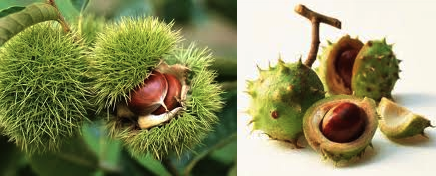
I meant to put images of true chestnuts (left) and horse chestnuts (right) into my last post about Chespin and his evolutions to illustrate the point I was making about their sources of inspiration, but it slipped my mind.  I’ve edited this into the original post as well, but I wanted people to see it, so here: these are what I was talking about.  Incidentally, horse chestnuts are poisonous – they won’t kill you, but they’re definitely not for eating (never let it be said that I don’t do my part to educate the global community).

Chespin, Quilladin and Chesnaught

All right; let’s get this catastrophic $#!t-show on the road.  Grass-type starter time!

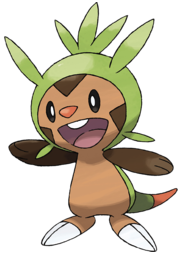
Official art of Chespin by Ken Sugimori.


Since I have shown no signs at all of becoming even slightly less infatuated with the Grass type in the three years since I started this blog, selecting Chespin as my starter was something of a foregone conclusion.  The little tyke eventually found himself overshadowed in my affections by the return of my one true love, Bulbasaur, but he nonetheless remained a faithful companion throughout my playthrough of X version and has always been ready to pull his weight.  Where else to begin but with my first Kalosian Pokémon?

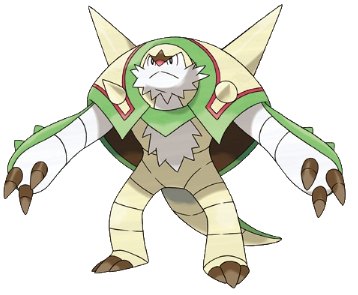
I begin with the Kalos Pokédex’s inaugural silly quote.  “Such a thick shell of wood covers [Chespin’s] head and back,” it faithfully explains, “that even a direct hit from a truck wouldn’t faze it.”  It is unlikely anyone will ever attempt to test this claim, Chespin being as adorable as he is, so we shall probably have to take the Pokédex’s word for it, but his sturdy spiked ‘helmet’ should at least afford solid protection from threats his own size.  I am a little readier to believe it of the human-sized Chesnaught, his final evolutionary stage – a bulky creature of uncertain mammalian extraction with a spiked tortoiseshell-like structure (presumably wood again) covering his back and shoulders, and spiny ‘gauntlets’ protecting the outsides of his forearms.  This guy’s shoulder-barges would surely be lethal.  So, Chespin nails ‘cute’ and Chesnaught nails ‘tough’ (particularly with the ‘come at me’ pose he adopts in both the official art and his battle stance), but as is often the case with Pokémon who have to make this transition, Quilladin is caught in a strange middle ground between the two; he seems to go for a little of both, mixed with a side of ‘impish.’  His long, pointed nose, the tuft of hair on his forehead, and his round sparkling eyes, together with his nigh-spherical body shape, all give me the disconcerting impression that Crash Bandicoot has seriously let himself go, and is disguising himself as a cactus to hide his shame and start building a new identity.  In some ways he doesn’t seem to fit smoothly as an intermediate between Chespin and Chesnaught; he’s more rotund than either of them, with short, stocky arms and legs, and the transition from Chespin’s helmet to Quilladin’s all-over body armour seems to go backwards again with Chesnaught, who seems to be more reliant on his tortoiseshell plate and armoured forearms.  None of that messes with the things I really like about these designs, though.

 Quilladin.

The inspiration for these designs is the spiny outer shell of the chestnut.  Nuts, berries and fruit have been underexploited by Grass Pokémon designs in the past, and chestnuts are distinctive and appropriate for a physical tank Pokémon.  There may even be a cultural allusion in play, to the horse chestnuts or ‘conkers’ beloved of British schoolchildren in the 19th and early 20th centuries – in traditional schoolyard games, the hard nuts are hung from strings and smashed together until the weaker one cracks and must be discarded, with veteran conkers that survive multiple such battles being especially prized (Roald Dahl gives a characteristically whimsical account of the game and its strategies in the book My Year).  Only the nuts themselves are used in the game, without the tougher but softer skins, but the nature of the game is so appropriate to Chespin’s physical bruiser battling style, as well as the habit Quilladin have of tackling each other in order to build their strength, that I can’t help but suspect a reference.  Chespin’s ‘helmet’ also resembles the tough, warty outer skin of the horse chestnut more closely than that of a true chestnut, with its dense thicket of bristly, almost needle-like spines.  What I particularly like about the way Chespin and his evolutions use chestnuts is that it ties together the Grass and Fighting elements.  They aren’t ‘chestnut Pokémon’ although that could very easily have been a workable starting point, since there are basically two ways to do a Grass Pokémon: ‘plant creature’ and ‘animal with plant characteristics,’ all Grass starters being the latter.  The Grass-type aspect of the design comes through in Chespin’s ‘helmet,’ Quilladin’s ‘armour,’ Chesnaught’s tortoiseshell plate, and their thorn shield signature move, which are also the things that convey their similarity to a human warrior or knight – in other words, the things that make them Grass-types are also the things that make Chesnaught a Fighting-type.  The combination of the two elements isn’t superficial; they work together.  It’s not always easy to make that happen, but I’m always fond of Pokémon who manage to pull it off.

True chestnuts on the left; horse chestnuts on the right.  Chespin and his evolutions, to me, are more of the latter.

Chesnaught handles in a similar manner to Torterra in battle, being a slow physical tank.  Probably his biggest problem is that he has rather a lot of weaknesses for a slow, defensive Pokémon, including a dangerous double-weakness to Flying attacks, but he does resist the powerful and popular Earthquake/Stone Edge combination, so it’s not all bad.  His biggest strength is the high power of his staple attacks, combined with a small but useful support movepool to keep opponents guessing.  His strongest Grass attack is Wood Hammer, which retains its 120 power rating in a generation where many of the strongest attacks in the game are being toned down; the recoil hurts, though, and doesn’t mesh well with the standard Grass-type ability Overgrow (because once you’re injured enough for the Grass-type damage boost to kick in, one or two more Wood Hammers have a good chance of dropping you), so Seed Bomb is also an option depending on what exactly you want to do with him.  Most Fighting-types have a wide selection of Fighting-type moves, but Chesnaught really only has two worth speaking of: Hammer Arm, which sacrifices speed for power (not that Chesnaught cares much about speed anyway) and Power-Up Punch, one of X and Y’s new moves, which boosts attack with every use (potentially a worthwhile choice for a more defensive Chesnaught who can afford to hang around for a couple of turns).  Grass with Fighting is not a particularly strong combination offensively – well, okay, let’s be fair, Grass with just about anything is not a particularly strong combination offensively, but Grass with Rock is one of the less bad ones, and Chesnaught can do that too, with Stone Edge.  Stone Edge is also important to make it a little bit harder for Flying Pokémon to walk all over him.  On the support side, there are basically two moves you can build sets around: Leech Seed, the eternal Grass-type favourite which also works well with Chesnaught’s signature move, discussed below, and Spikes, which is just universally useful.  Bulk Up and Swords Dance are both viable ways of increasing Chesnaught’s offensive presence, since he’s tough enough to take a neutral attack while setting up and scary enough to force some Pokémon to retreat.  Don’t count on a sweep, though; Chesnaught is just too slow.

Chesnaught.


All three Kalos starters have been blessed with a signature move to emphasise what is unique in their styles of fighting, and Chesnaught’s is Spiky Shield.  In mechanical terms, this thing is pretty neat.  It’s strictly an improvement over Protect, the standard option available to most Pokémon for blocking an incoming attack to stall for time; the advantage to Spiky Shield is that it additionally deals a small amount of damage if it blocks a ‘contact’ attack.  It’s a shame Spiky Shield damage can’t be stacked with the similar effect of a Rocky Helmet, because that would make Chesnaught a seriously daunting proposition for most physical attackers – perhaps not to the same extent as Ferrothorn, who can stack Rocky Helmet with his Iron Barbs ability, but then again, Ferrothorn actually has to take damage to cause recoil while Chesnaught doesn’t, so maybe that would have been too much ‘something for nothing.’  Besides, Protect is hardly a bad technique, particularly for Grass Pokémon who can use it to stall for damage and healing with Leech Seed, or in double battles where a Pokémon can potentially take two attacks in one turn, and Spiky Shield is, again, unambiguously better than Protect.

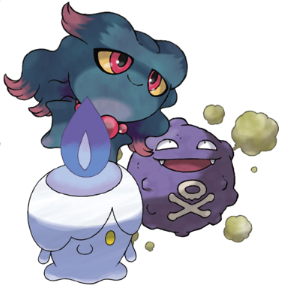
Some more typical users of Pain Split: Misdreavus, Litwick and Koffing.

Finally, you have two options for healing, besides Leech Seed.  Synthesis is the one you should use if you’re serious, because the sixth generation’s nerfing of Drizzle, Sand Stream and Snow Warning makes it much more likely you’ll be able to use the technique unobstructed.  I want to talk about Pain Split, though, because Pain Split is interesting from a flavour perspective.  Most of the Pokémon who learn Pain Split are Ghost- or Psychic-types, and of those who aren’t, most are in the Amorphous egg group and lack clearly defined anatomy, like Weezing and Swalot (even when it was available more widely, via move tutor, it was most prevalent among Pokémon with overtly magical powers or indistinct anatomy).  It seems to be implied that the attack normally functions on the literal sharing of pain with the opponent, usually through supernatural means, which makes it odd that Chesnaught can learn it at all, let alone as a level-up move.  Probably the intention here is to stress the retributive nature of Chesnaught’s defences, in line with Spiky Shield; the Pokédex is adamant that these Pokémon don’t start fights, but are happy to finish them.  This could possibly be pushed even further by suggesting that, since Pain Split is regularly associated with Pokémon who have mental powers, Chesnaught’s ability to use it stems from a deeply and firmly held belief in ‘eye-for-an-eye’-style justice.

Chesnaught also has an odd signature ability, Bulletproof, the in-game manifestation of his supposed ability to withstand bomb blasts, which grants total immunity to a select list of ball-, bomb- and bullet-themed attacks.  The most important of these are probably Shadow Ball, Sludge Bomb (which is super-effective against Chesnaught and more popular now that Poison attacks are strong against Fairy-types), Focus Blast and Aura Sphere, and to a lesser extent Seed Bomb, Energy Ball and Electro Ball (which Chesnaught resists anyway) and Gyro Ball (which does more damage to faster Pokémon, something Chesnaught is most definitely not).  Most of the others are either too weak or too rare to be major sources of concern.  Probably the main draw of this ability is that it makes him an unorthodox and somewhat risky but very interesting answer to Gengar, who relies heavily on Sludge Bomb, Shadow Ball and Focus Blast.  Aura Sphere immunity also makes him a good possible response to Clawitzer and Mega Blastoise – just watch out for Ice Beam – as well as special Lucario (though Lucario is more commonly a physical attacker).

In summary, then, Chespin and his evolutions have a pleasing design that take inspiration from an unusual place, and their most unique powers support that design well and create consistent characterisation.  They also combine Grass/Fighting more fluidly than the other representatives of that pair, Breloom and Virizion (though Breloom, it should be noted, is a kick-boxing dinosaur).  If I have complaints, they are mainly with Quilladin’s odd aesthetics – he could stand to be slimmed down, with more emphasis on his spines and perhaps more elaborate ‘armour’ to anticipate Chesnaught’s grand tortoiseshell plate – and with the more general problem that Grass is just a bad type and probably always will be.  That’s a complaint for another day, though…

Next Time on Pokémaniacal: the Kalos Pokédex

Right.

What am I doing?

Oh, yeah.  That thing that I do with the Pokémon and the stuff that I say and the other thing.  Gotcha.

Why am I doing that again?

Well, mostly it’s because I’m supposed to, right?  I reviewed all the Unova Pokémon in 2011, a little while after Black and White came out; I was on Blogspot at that time, of course, but the entries are all archived on here now.  I wanted to give a critical appraisal of all the new Pokémon, to stake for myself a middle ground between “ALL TEH NEW POKEMAN SUXX0RZ” (where “new” can mean anything from the second generation onward, really) on the one hand, and “all Pokémon are perfect just the way they are and we should love them all equally,” on the other.  Frightfully silly of me, in retrospect, because no one actually thinks like this (do they?  I hope not), but then I was writing mainly for my ex-trainer friends in the beginning, not for the Pokémon Master zeitgeist, as it were.  I always finished those with either “I hereby affirm this Pokémon’s right to exist,” or “I hereby deny this Pokémon’s right to exist” followed by some amusing hyperbole about what I thought should be done to punish it for existing.  That was supposed to be over the top, of course – all those entries were; I was just having fun – but it was also frightfully silly in retrospect because it wasn’t what I meant at all, really (well… at least, not most of the time).  What I meant was that those Pokémon needed work, and if time or money were a concern in doing that work, well, maybe it would have made more sense to cut some and lavish more attention on the rest, make a smaller generation of cleverer, better thought-out designs rather than a bigger one that ended up half filler.  If that meant having pre-fifth generation Pokémon in Unova, well, would it really have been so bad to give old favourites some time in the sun?  I’m a great fan of doing more with less, you see.  That hasn’t changed.  I’m not really in a critical mood anymore, though.  Maybe that’s because I’ve just gotten soft in the intervening three years, or maybe it’s because I feel the sixth generation designs are legitimately better, on the whole (and here I have to point out, smugly, that while the fifth generation was the largest yet, the sixth has been the smallest).  I’m happier now just to take it as read that Pokémon has some remarkably stupid things in it, and focus on the good bits, but more importantly on why they’re good.  I mean… it’s not that I’m going to stop bitching about things I don’t like, because where would be the fun in that?  But this idea that I’m setting myself up as judge, jury and executioner?  I feel like the tone of this blog has gotten more serious than that since I started, and I feel like my readers, for the most part, seem to appreciate it.  There’s barely shy of four hundred of you now, do you know that?  So Tumblr says, at any rate.  I was quite happily announcing three hundred as a milestone only in December.  I must be onto something here, though I confess I’m not quite sure what that is, and it would be a dreadful shame if I quit now.

So yeah.  I think I’d better do it, don’t you?

Dear Sir, What do you think of pokemon and trainer relationship overall? Negative? Positive? Mutual? A Need? A dependence evolved from something that was originally just business?

All of the above?

It’s sort of like asking “what do you think of cities?” or “what do you think of the ocean?”  If you can give a simple answer, you probably don’t understand it very well.  I mean, what can you say, ‘overall,’ about a concept that expresses the relationships between Ash and Pikachu, between Misty and Psyduck, between AZ and Floette, between Silver and his starter (whichever one it was), between the Gardevoir and the Gengar from Mystery Dungeon, and between Giovanni and Meowth?  It’s all of those things and more, to different people and different Pokémon, in different places and at different times.  Sometimes, maybe even a lot of the time, it’s not all it’s cracked up to be, but it’s also so utterly fundamental to the way the Pokémon world works that nothing else functions anymore without it.  It’s life.

Moves, Movepools and Flavour

Pokémon are, almost by definition, creatures with incredible abilities, often ones which exceed the boundaries of what we believe to be possible.  Normally I like to make a fuss of the aspects of the Pokémon world that have nothing to do with the powers, like history and ethics and society and culture and all the rest, but let’s face it, I’m at least partly in it for the thrill of having a flying murder-dragon with four different kinds of exploding death lasers.  What you can do and what you can’t is fundamentally a part of who you are, and what Pokémon can and can’t do is expressed in the games through their stats, their abilities, and in perhaps the greatest variety through their moves.  I like to say that Pokémon “should be good at the things they’re good at” – that is, they should possess the skills we would expect them to, based on their designs, and those skills should in turn contribute to the way we see them and use them.  Mechanics and flavour should work together – well, at least that’s what I think.  Let’s talk about how that works (or fails to).

As of the release of X and Y, there are 609 moves in the Pokémon games: 609 effects which are available in various combinations to different species.  Some are basic, and others are complicated.  Some are effective in a wide variety of situations, others require a great deal of forethought to be useful at all (with varying degrees of payoff).  Some are powerful, others are weak.  Some are available to many Pokémon, or to almost all of them, others to only one or two.  All of them say something about the Pokémon capable of using them – and that includes the ones that would never see any use competitively, or even in a normal playthrough!  Let’s take as our first example the unanimously agreed worst move of all: Splash, which has no effect whatsoever, and is useful only in the most contrived of situations (say, if your opponent is trying to stall you down to Struggle, and Splash’s 40 PP allow you to sit on your butt for longer without running out of moves, or something).  For all that, only a handful of Pokémon are actually able to learn this non-technique; indeed in Red and Blue it was unique to Magikarp, hailed in-universe as the weakest Pokémon of all – the only one so pathetic it had a move that allowed it to flop around doing absolutely nothing.  Since then the move has been bestowed (either as a level-up move or a hereditary one) upon Poliwag, Horsea, Hoppip, Cleffa, Delibird, Azurill, Wailmer, Spoink, Feebas, Wynaut, Luvdisc, Buneary, Finneon, Mantyke and Clauncher.  What is the common thread with these Pokémon?  Like Magikarp, some of them are portrayed as being particularly helpless, like Poliwag, who can barely walk on land, Hoppip, at the mercy of the breeze, Wynaut, whose evolved form is unable to take spontaneous action, or Spoink, whose heart actually stops if he doesn’t continually keep bouncing around uselessly.  Most of them are on the cute end of the spectrum as well, adding to the impression of vulnerability.  The enduring message is that these are Pokémon who require particular nurturing and attention in order to grow and succeed (although they won’t necessarily be helpless forever – Gyarados certainly proves that, as does Kingdra).  One of these things is not like the others, though – what’s Clauncher doing on this list?  To me, the fact that Clauncher starts with Splash conveys a certain weakness that would not otherwise be immediately apparent from his design – and it’s not entirely inappropriate, since he isn’t exactly a physically imposing Pokémon.  I would also suggest a link with the fact that Clauncher is incapable of learning many of Clawitzer’s most powerful attacks, like Dark Pulse and Aura Sphere; more than most Pokémon, he has a lot of growing to do, and is especially vulnerable in his infancy.

X and Y added a lot of moves with very specific uses; in particular, there are a number of support moves which seem like they would only be useful in a triple battle, and only then with a fair amount of planning.  Take Rototiller, for instance, which raises the attack and special attack of all Grass Pokémon in battle.  To begin with, only two Grass Pokémon – Paras and Cacnea – are capable of learning this move (and even them by chain-breeding via Buneary), so for most Pokémon it can only be useful in a double battle.  Even then, a Rototiller boost is functionally equivalent to the boost provided by Growth… which, y’know, most Grass Pokémon can learn… so really in order to get the proper bang for your buck you want to set things up in a triple battle so that two Grass Pokémon at once are getting the bonus.  As contrived a situation as it takes to make Rototiller useful (and believe me, as a card-carrying Grass Pokémon Master, my next project is to contrive the heck out of it for a Battle Maison triples team), as a move that expands what we know about the Pokémon who learn it, it’s solid gold, because it conveys the ecological function that the Pokémon who possess it – Sandshrew, Dugtrio, Onix, Rhyhorn, Linoone, Bibarel, Lopunny, Watchog, Excadrill, Dwebble and Diggersby – have in aerating soil and helping plants grow.  In the case of Dugtrio and Excadrill, we knew that already, but for the others it’s neat new information (although one does wonder how important a desert Pokémon like Sandshrew would be in that capacity).  For a Pokémon like Rhyhorn, who doesn’t really dig tunnels habitually, it even prompts me to imagine early human farmers hitching up their first rudimentary ploughs to domesticated Rhyhorn.  Another bizarre little trick is Vivillon’s signature move, Powder, a priority attack that causes a Pokémon to explode and take damage if it tries to use a Fire attack during that turn.  There are numerous disadvantages here – 1) you have to predict an incoming Fire attack, 2) it’s unlikely to work more than once in a battle, especially given that Vivillon’s defences are so bad it doesn’t really take a super-effective attack to bring her down, and 3) it requires you to actually use Vivillon in the first place.  On the other hand, I feel like all that is totally worth it to see an attack backfire in such a spectacular fashion, and it does establish Vivillon as a clever, tricky Pokémon who will take no $#!t from anyone.  Probably my single favourite ‘WTF’ attack in X and Y is Ion Deluge, another priority technique which turns all Normal attacks used that turn into Electric attacks.  Again, it seems like this could only be useful in double or triple battles, because although most of the Pokémon that learn it do have some kind of ability that lets them absorb Electric attacks, you still have to predict an incoming Normal attack, and even then the benefit you get is not huge.  Even in doubles or triples, I have difficulty imagining a situation (let alone thinking of a reliable way to set one up) where it would not be equally useful just to… y’know… use an Electric attack, something all Pokémon with Ion Deluge can do.  I’m not sure what kind of ‘characterisation’ Ion Deluge is supposed to create either, which is a shame.

Other times, we get Pokémon whose techniques conspicuously fail to express what they’re supposedly all about.  My favourite example is probably Gigalith, whose ‘thing’ is his ability to store, magnify and direct solar energy using the crystals on his body, creating devastating blast attacks that can destroy mountains.  Great, except that Gigalith needs a TM to learn Solar Beam, and has a very discouraging special attack stat to back it up.  Drowzee and Hypno, famously, still require human intervention to learn Dream Eater after all these years, despite the fact that eating dreams is literally how they survive.  In Red and Blue this almost made sense because the Dream Eater TM could only be used by Hypno, Gengar and Mew anyway, so it was sort of an unlockable signature move like Softboiled (which no Pokémon learned on its own, but could be taught to Chansey with TM 41).  Now, though, there are literally hundreds of Pokémon, including some who can’t even induce sleep like Ambipom, Lickilicky and Aurorus, who are just as good at eating dreams as the dream-eater Pokémon themselves.  Just as strange is Sceptile, introduced in the last generation before moves started to be assigned “physical” or “special” individually rather than by type.  By now, Game Freak had gotten the hang of the way their own system worked.  Sceptile seems like a physical Pokémon but, like poor Feraligatr, all his best flavour-appropriate attacks – Leaf Blade, Dragon Claw and Crunch – were special, so they made Sceptile a special attacker.  Things became very weird when Diamond and Pearl rolled around, though; all Sceptile’s favourite moves were suddenly keyed to the wrong stat.  As a result, he now favours Dragon Pulse, Focus Blast and Leaf Storm, and is actually quite bad at using his own signature move.  Would it not have made more sense if, when Sceptile’s entire movepool flipped from special to physical, he had flipped with it?  A happier example is Lickitung, whose key characteristic is his enormous tongue.  The obvious problem with Lickitung, in the mad old days of Red and Blue, was that he couldn’t actually learn Lick.  The interesting problem was that although he got Lick in Gold and Silver, it was much longer before he gained effective attacks that could be visualised as using his tongue.  Slam was his mainstay from the beginning, but Slam is terrible.  Wrap, which he got in Gold and Silver, is scarcely worth mentioning.  Knock Off in Ruby and Sapphire was an improvement, but it was really Diamond and Pearl that gave Lickitung and Lickilicky properly useful attacks that fit the way we’re supposed to imagine them fighting: Power Whip and Wring Out, which relatively few other Pokémon learn.  They’re not the best attacks around, but both can argue for a place on a serious moveset, and they provide a good example of updating an old Pokémon in an appropriate and interesting way.

Then there are attacks that everything learns, or almost everything, at any rate: Hyper Beam, the ultimate expression of a fully-evolved Pokémon’s might, Protect, the standard “no” technique, and Hidden Power, whose universal availability hints at a kind of soul energy that can be drawn upon by all living things.  There are also things which are… harder to explain or justify.  All Pokémon can learn Toxic.  What?  I’ve actually been asked to explain this before, and settled on the idea that since Toxic is supposed to be a ninja technique – that is, a human technique – it probably uses principles that are accessible to humans, and to all Pokémon.  Pokémon who’ve been taught Toxic can recognise, collect, store, and use poisonous substances that they might not actually be able to secrete on their own.  A bit unfortunate, perhaps, for the poor Poison-types, who have to live down the fact that their most powerful ability is available to nearly every Pokémon in existence, but at least X and Y threw them a bone by giving Toxic perfect accuracy when used by a Poison Pokémon.  It gets worse, though; most Pokémon can create illusionary duplicates of themselves, with varying degrees of substance – almost all can learn Double Team and Substitute.  Weather manipulation, too, is shockingly common; Sunny Day and Rain Dance are normally denied only to Pokémon who would specifically be disadvantaged by them in some way.  I have to imagine that, in all but a few cases, these techniques are more like prayers (to Groudon or Kyogre?) than actual exercises of a Pokémon’s own powers – think of the connotations that the phrase “rain dance” has in English, and the fact that Rain Dance’s Japanese name, Amagoi, refers to a prayer for rain – while the rarer and seemingly effortless Drought and Drizzle abilities imply a real connection with the weather on some level.

Other moves available by TM are not quite so universal, but in general they are still far more often seen than most Pokémon techniques.  Many of these are go-to attacks for competitive movesets – staples like Thunderbolt, Ice Beam, and Surf.  Being so widely available means that these moves don’t tell us all that much about the specific Pokémon who learn them, but their prominence in strategy means that they contribute something to how the types themselves are portrayed.  When we think of the Ground type, for instance, we don’t just think of Ground-type Pokémon – we think of the ubiquitous Earthquake, one of the best physical attacks in the game.  When we think of Fire, we think of Flamethrower, but also of Fire Blast, which, being more accurate than Thunder or Blizzard and often a better choice than Flamethrower, is much more likely to come to mind than its Ice or Electric equivalents, so that Fire becomes a type associated with overwhelming power (Overheat only adds to the effect – Grass has an equivalent attack, Leaf Storm, but very few Pokémon can learn it, while Overheat is widely available).  The closest thing Psychic has to a go-to physical attack isn’t a physical attack at all, but a special attack which hits the target’s physical defence, Psyshock, thus reinforcing the typical view that Psychic types do not rely on their bodily strength.  Conversely, Rock has no common special attack at all.  The popularity of U-Turn and Volt Switch, accessible to many Pokémon through TMs, links Bug and Electric with speed, cleverness and changeability.  Sometimes I am concerned that the steady proliferation of techniques with every generation will eventually erode the differences between the types completely; we’re moving steadily closer to a situation where every type has both a physical and a special attack with a power rating of 80-90 and 100% accuracy, which would rather be throwing the baby out with the bathwater as far as establishing balance.  On the other hand, if only a few Pokémon get to flout the stereotypes of their elements – like Lucario and Beartic do, like Gigalith could have – then what we’re really getting is opportunities for specific Pokémon to be awesome in specific ways, which is the primary virtue that should be kept in mind here.

Finally, since we’re talking about TMs, we inevitably come to my pet hate, a move that not everything can learn, by any stretch of the imagination, but available to a truly bizarre selection of Pokémon who seem as though they should have no business learning it: Aerial Ace.  I offer first the usual disclaimer: I know Aerial Ace in Japanese is called “Turning Swallow Cut” and is named after an old katana technique.  Fine.  I have no problem with this move being available to Pokémon who can’t fly.  However.  The move’s description implies that it involves great speed and agility, which is why it never misses.  Also, it’s a Flying-type move and the Pokémon who learn it on their own are mostly birds, continuing that theme (the exceptions being Heracross, who can fly, Honedge, who is a living sword, and Gogoat, who… um… yeah, I got nothing).  And indeed, many of the Pokémon who learn it out of TM 40, as well as favouring cutting or slashing attacks, possess either great speed or flight… but then there’s Slaking.  Bouffalant.  Tyranitar.  Shelgon.  Ferrothorn.  Mr. Mime.  Crustle.  Aggron.  Regigigas, of all things.

And, of course, my favourite: Slowbro, but not Slowking.

Mechanically, very little separates Slowbro and Slowking.  Slowking’s special defence is higher, and he can learn Nasty Plot, Swagger, Power Gem, Quash, and Dragon Tail.  Slowbro’s defence is higher, and he can learn (in addition to a few moves that Slowking could get as a Slowpoke by delaying his evolution) Aerial Ace.  That’s the one move Slowbro has that Slowking can’t mimic.  Think about this in the context of everything else I’ve talked about in this over-long entry, and it all adds up to one thing.

Someone over there has a very strange sense of humour.