Now You Shall Learn the Greek Alphabet

Okay, so, the first thing that always trips everyone up is the alphabet but DON’T PANIC; it’s actually not that different from the Roman alphabet (which is what English uses) – it’s sort of halfway between Roman and Cyrillic.  It was adapted from the alphabet which was used by Phoenician traders who visited Greece around 700 BC, maybe a little earlier, and is therefore a cousin of the Hebrew alphabet.  The Greeks reworked it quite a bit, though – the Phoenician alphabet had no vowels (the Greek alphabet was the first in the region to make that particular innovation) so they took some of the less important consonants and used them as vowels instead (for instance, aleph, the Phoenician equivalent to alpha, originally made a strange sort of choking noise that I’ve never quite been able to do).  Anyway, here we go…

Α α – Alpha.  You all know this one; it’s an “ah” sound, and can be either long – like in “Gengar” – or short – like in “Gyarados.”

Β β – Beta.  That’s right; it’s a “b” sound – but be careful because in modern Greek it makes a “v” sound and is pronounced “veeta" (that sound doesn’t exist in ancient Greek).

Γ γ – Gamma.  A "g” sound.  A double gamma – γγ – makes an “ng” sound, like in “Chingling."  Something similar happens with γκ, γξ and γχ; the gamma makes an "n” or “ng” sort of sound (as in, say, Shinx).

Δ δ – Delta.  The Greek “d."  The English word "delta” – meaning the area where a river forks just as it meets the sea, creating a whole lot of little islands – comes from the shape of a capital delta – Δ.

Ε ε – Epsilon.  A short “e,” like the sound in “Tangela” or “Shellder."  To be distingushed from eta, which I’ll come to in a bit.

Ζ ζ – Zeta.  This is not quite a "z” sound – it’s an “sd” or “zd" sound, like in "Misdreavus,” which means that the king of the Greek gods, Zeus, is actually pronounced something like “Zdyoos” in ancient Greek.

Η η – Eta.  This is the long “e," and in English we often use an "a” to make this sound; it’s the sound that you find in, say, “Wailmer,” “Banette,” or “Rayquaza."  Yes, the capital looks exactly like an H, but don’t let that fool you – there’s actually no letter in ancient Greek that makes the "h” sound.  More on that later.

Θ θ – Theta.  A “th” sound, but be careful; it’s not the soft “th” we have in English, it’s a hard sound like in “Hoothoot."  Beware modern Greek once again, where θ makes the soft English "th,” δ makes this hard “th” (and is known as “thelta”), and, having exhausted all the other letters, the Greeks are forced to use ντ to make a “d” sound.

Ι ι – Iota.  An “i” sound, which like α can be short – as in “Hitmonchan” – or long, which is a sound often made by “ee” in English – as in “Hitmonlee."  It’s the origin of the English phrase "it doesn’t matter one iota” – a story I’ll tell you some other time.

Κ κ – Kappa.  Exactly what it says on the tin.

Λ λ – Lambda. The “l” sound.  You might have seen this symbol on pictures of Greek hoplite shields.  As a matter of tradition, all Spartans had the same shield device: Λ, the first letter of Λακεδαιμων, which is the Spartans’ word for themselves.  So, yeah, while other Greeks have pictures of gorgons or thunderbolts or whatever, the Spartans go into battle waving a big capital L.  Now that’s confidence.

Μ μ – Mu.  The “m” sound (shockingly enough.)  This is the funny little symbol that appears in μm (micrometres), μg (micrograms) and so on.

N ν – Nu.  Yes, it’s an “n” but the little one looks like a “v.”  No, I don’t care.

Ξ ξ – Xi.  An “x” sound.  A lowercase xi is just about the fiddliest god-damn letter in the whole language and you would best avoid them.

Ο ο – Omikron.  A short “o,” like the sound in “Rhydon” or “Onix.” The name of this letter, omikron, literally means “the little o” – ο μικρον (think “micro” in English).

Π π – Pi.  You recognise this from your maths class, right?  I hope so, anyway.  Pi is a “p” sound (though it’s worth noting that the name of the letter, “pi,” is actually pronounced the same way as the English equivalent – “pee” – not “pie” as it’s usually pronounced in maths and physics).

Ρ ρ – Rho.  Yes, I know it looks like a p, but it’s actually an “r” sound – or, more accurately, an “rh” sound, since Greek r’s are always rolled and have a bit of breath behind them.

Σ σ ς – Sigma.  An “s” sound.  There are two variants to the lower-case sigma – the second one, ς, is used only at the end of a word, while the first is used everywhere else.

Τ τ – Tau.  It looks like a “t.”  It is a “t.” Praise the gods.

Υ υ – Upsilon.  This is the Greek “u,” and the sound it makes is a bit tricky to get right because it’s not exactly like an English u – it’s almost more like an “ew” sound, a little like the sound on the end of “Pachirisu” but not quite.  Best not to worry too much about it.

Φ φ – Phi.  This is the origin of the English “ph,” but like θ it’s not quite the same as our equivalent – it’s a harder sound.  No-one’s going to call you out if you just pronounce it like an “f,” though.

Χ χ – Chi.  This is NOT a “ch” sound.  Get that notion OUT of your head. That sound – the sound in, say, “Pikachu” – does not exist in Greek.  Chi is best pronounced as a sort of hacking noise in the back of your throat, but if you can’t manage that you should go with the hard “kh” sound in “Chimecho” or “Archeops.”  Incidentally, this letter is the reason why calling the abbreviation “Xmas” an “attack on Christmas,” as people sometimes do, is horrifyingly ignorant and fundamentally absurd – X has been used for more than a thousand years as an abbreviation for the Greek word Χριστος – Christ.

Ψ ψ – Psi.  This is probably the least-used letter in the whole alphabet, and makes a “ps” sound, like at the end of “Kabutops” and “Dusclops.”

Ω ω – Omega.  This is the twin to omikron, the “big O” (ω μεγα).  It makes a long “oh” sound, as in “Electrode” or “Tauros.”

There are also some combinations of vowels that are important to know:

αυ – this makes an “ow” sound, like in “Drowzee” or “Meowth.”

οι – this makes an “oy” sound, like in “Baltoy” or “Cloyster.”

αι – this makes the sound we think of in English as a long i, the sound in “Scyther” or “Mr. Mime.”

ει – this makes a long “e” sound which, to my ears, is indistinguishable from the sound of an eta, but supposedly there is a subtle difference.

ευ – this makes a “yu” sound like the sound in “Kyurem” or “Staryu.”

ηυ – this makes a weird sort of “eouw” sound that I don’t think we have in English, or in Pokémon for that matter.  It doesn’t turn up very often, so feel free to disregard it.

Next thing is accent marks.

Greek has three types of accent marks – the acute ά, the grave ὰ, and the circumflex ᾶ, and most words will have one of them somewhere.  However, accent in ancient Greek does not work the same way as it does in most European languages (or, for that matter, in modern Greek) – most European languages have a stress accent, meaning that we place heavier emphasis on one syllable in each word.  Ancient Greek, like Chinese, has a pitch accent – the speaker’s pitch rises and falls as he or she speaks.  The acute accent indicates a rising pitch, the grave a falling pitch, and the circumflex a brief rise followed immediately by a fall.  There are very few people who can speak Greek like this today; it has a beautiful melodic quality to it, as though the speaker is singing.  I can manage a few lines, given time to practice them beforehand.  You can probably ignore the accent marks without feeling too guilty about it (honestly, I never learned where the accents go on most words).

What you cannot ignore is breathing marks.  I mentioned earlier that Greek has no letter for the “h” sound.  Instead, any word that begins with a vowel will have a little apostrophe-like mark over the first letter (or the second letter, if the word begins with one of those double-letter sounds I listed above).  It looks like this: ἀ or ἁ, αἰ or αἱ.  If the mark curves inward, like ἀ, it’s a ‘smooth’ breathing, and the word does not begin with an h sound.  If it curves outward, like ἁ, it’s a ‘rough’ breathing, and the word does begin with an h sound.  Breathings only appear on words that begin with vowels – an ancient Greek word never has an h sound in the middle.  A word that begins with a rho – there are very few – will always have a rough breathing, like this ῥ, because the letter rho is always pronounced with some breath behind it.

The other little thing that pops up from time to time in Greek spelling is the iota subscript.  Alpha, eta and omega will occasionally have a little iota hanging out underneath, like this ᾳ, ῃ, ῳ.  This may have had a subtle impact on the pronunciation, we’re not sure, but you can probably just pronounce these as regular alphas, etas and omegas – just pay attention to them when reading and writing, because words and forms that have them are very easy to identify.  If a word is spelled with an iota subscript, it means that the word used to have an iota in it, in an older form of the language – or possibly in one of the other dialects. We normally teach and learn Attic Greek, the dialect spoken in and around Athens, but there were a number of other dialects used in other regions of Greece, such as Doric (the Spartan dialect), Ionic (the dialect spoken along the coast of Turkey) and Arcado-Cypriot (the dialect spoken in the two far-separated regions of Cyprus and Arcadia – based purely on its distribution, Arcado-Cypriot is probably the most similar to the ‘ancestral’ Greek from which all the dialects evolved). Attic is actually one of the most bizarre and demented dialects of the lot, but since the Athenians were the most prolific writers, most of the examples of written Greek that survive are in Attic, so we just have to deal with it.

More to follow.
So, what now?

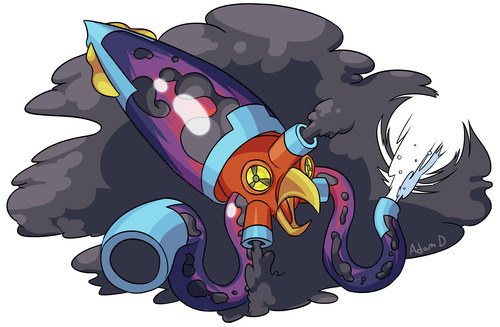
We have created a Pokémon!

So, what are we still missing?

We have art and a concept.

Art by Adam Dreifus.

Original concept brief, and a later update (both written by Chewiana Jones):

“What if we had an enormous squid/oil lamp hybrid that lived deep in arctic oceans, getting most of its nutrients from volcanic vents and small deep-sea Pokemon prey and burning oil (for warmth) in small amounts inside its body, which could look somewhat steampunk furnace-ish structure with more organic parts like the eyes and mouth mixed in and a body made of translucent, durable membrane with golden light shining through, supported by a skeletal framework. However, when it starts to run low on oil, it flares up its flames and rises like a hot air balloon to closer to the surface. There, it hunts pokemon like Walrein and Dewgong by expelling oil like squid ink and then lighting it on fire, then eats them and uses the oil for more power.”

“Yeah, I do think that Wailord might make more interesting prey for it. I only mentioned the seal Pokemon because unlike Wailord, they aren’t 
resistant to fire (well, unless they have Thick Fat, that is), so using 
fire attacks on them would make more sense. I suppose the whole point of
water’s resistance to fire is that water puts out flames, though, and 
it can’t put out oil fires, so I could see having it hunt Wailord and 
giving it an ability that lets it bypass the water-type resistance to 
fire, making it do neutral damage to most water types and be 
super-effective against Walrein and Empoleon and such.

Also, in regards to hunting, I have a few new ideas. Firstly, it 
wouldn’t necessarily be completely harmless when not hunting oily 
aquatic mammals. If it’s going to be generating heat and light anyways, 
it might as well put that to good use, and I like the idea of a school 
of deep-sea fish Pokemon seeing a strange, golden light shining from 
within a cave at the bottom of the continental shelf, swimming over to 
investigate, and promptly being ensnared and devoured by the squid 
thingy. Heck, since real cephalopods are fairly intelligent and it lives
in an area where there would probably be a fair number of shipwrecks 
due to all the icebergs (And possibly their own intervention as well. 
I’m not sure how they would sense a Wailord passing, but they might 
mistake a large ship for one, and, upon finding out that it isn’t, 
decide that since they already used up the oil to accelerate their rise 
to the surface and there has to be something edible on the strange 
wooden whale, they might as well tear it to bits anyways, in turn 
inspiring numerous sea monster stories), I can even see it picking up 
treasure that looks interesting to it and hoarding it in its cave-lair. 
I’m personally going with a sort of antique oil lantern made of heavily 
oxidized bronze as the better part of the main body to stick with that 
sort of theme.

As for the hunting for oil, I suppose it WOULD burn up all of the oil
that it was looking to consume if the squid just went and lit its prey 
on fire. Instead, it could trap a Wailord, weaken it it, and drive it to
the surface by surrounding it in burning, oil-filled water, then go in 
for the kill with its harpoon-like tentacles, which are so strong that 
it can sort-of stumble around on land with them for short periods of 
time, kind of like those War of the World tripod thingies except not 
quite as upright and at a risk of getting its barbed "feet” either stuck
in the ground or unable to penetrate, if used on something harder than 
ice. I’m not sure what the evolutionary advantage to being able to do 
this would be, but it looks cool.

Finally, while normally fairly solitary creatures, when a large group
(pod?) of Wailord passes through, a large number of oil-squid (lets 
call them Colosquiln (colossal/colossus – squid – kiln (best fire 
reference that I could work in smoothly)), for sake of argument) gather 
beneath them. The Colosquiln then rapidly ignite and release all of the 
oil in their bodies at once, firing themselves like giant, bronze-tipped
bullets straight through the air-filled bodies of the Wailord and 
killing them in massive numbers. It is only the bizarre breeding 
abilities of the Wailord that keeps them from extinction by over-hunting
by Colosquiln, and the Colosquiln often come into conflict with the 
local whalers in areas where Wailord-hunting is not illegal.“

We have stats:

Stats by Thatswhatbradsaid.

We do not have proper condensed Pokédex entries.  We do not have a name; Chewie suggests Colosquiln but I’d like to get more suggestions and do a poll on it (personally I am not particularly enamoured with ‘Colosquiln’ but that may be because I’m an archaeologist and I don’t necessarily think of the same things as most people when I hear the word ‘kiln’).  Come to think of it, we do not have sprites either; if there are any talented spriters out there it would be good to have something to fill that gap.  We do not have miscellaneous information like height and weight (I imagine the short answer is ‘big,’ but how big?), which experience curve it uses, and what effort points it provides when defeated.  All of this will need to be decided, and I’d like people to start talking about it in the comments section if there are any ideas, but the first thing I would like to do is take suggestions for any ‘tweaks’ to the stats and movepool.  I do not wish to deprecate any of the considerable work Thatswhatbradsaid put into this stat spread; however, I have come to feel that doing the stats and movepool is rather a lot to leave to one person and rather a lot to decide for one vote; trying to break it down more would have resulted in a crippling lack of direction, but doing it all as one vote leaves us without a lot of discussion on the details.  What I now want to do is create a whole series of polls, to be done all at once, along the lines of "does this Pokémon need this move?”, “should this Pokémon have a slightly lower/higher stat in this area?” or “does this ability seem right to you?”.  What I’d like, then, is to get people talking about what adjustments, if any, would be beneficial.

Just to get the Pokéball rolling, as it were: I don’t think there’s any real concern that this Pokémon will fail to be a useful high-speed attacker.  I have concerns that its extremely good speed and special attack, kitchen sink of attack moves, surprisingly varied support movepool, and Water-type V-Create are a bit much – however, it also has paper-thin defences and a weakness to Stealth Rock, and will remain highly vulnerable to priority attacks and Choice Scarf users.  So I ask: what do you think?  Does it really need to be toned down at all?  If so, what would you do?

I think I have an explanation for the Luxury Ball having a normal catch rate but making a Pokemon happy. The internal circuits are specifically designed to create a uniquely comfortable environment for whatever Pokemon gets caught in them. Thus, when a Pokemon gets sucked in, all it feels is the “default” environment. However, if it lets itself get caught, the internal circuits “read” the Pokemon’s preferences and arrange a uniquely satisfying environment for it.

(Note for readers: this question is in reference to an ongoing problem, raised by my belief that Pokémon can only be captured if they are willing to be partnered with humans and that the process of battling is more about winning a Pokémon’s respect than beating it into submission)

Well, it’s probably imagined to be something like that, yes, the reason that it doesn’t affect the capture effectiveness being that it works more slowly and can’t provide that nice environment instantly, while the Pokémon is being captured.  Working out what Luxury Balls seem to do isn’t the problem, though; the problem is working out why other Pokéballs don’t have the same effect on happiness – because presumably Ultra Balls work more effectively because they are more comfortable, all around, than Pokéballs, and Lure Balls are more comfortable for Water Pokémon specifically, and so on; they do the same thing as we imagine a Luxury Ball to be doing, only much faster since it’s all pre-set.  Maybe we could imagine that having a lesser effect on happiness, since the Pokéball isn’t ‘tailored’ (as it were) for the Pokémon, but surely it would still have some?

Of course, we could always revert to what would seem to be the default explanation, which is that Ultra Balls and the like introduce some element of compulsion into the whole business.  That does make perfect sense in itself; it’s more of a ‘is this the kind of theme we want our fiction to be portraying?’ question.

Here’s a mystery for you. Do you have any reasonable theories as to why every pokemon that can learn tms can also learn toxic? In the 1st generation games, when it was first given to you by Koga, he said it was some sort of secret technique that’s over 400 years old. Though I’m not sure what sort of ninja technique allows one to spew out a blob of incredibly poisonous goo, unless we’re getting into Naruto territory. It just kinda irks me is all.

Not really… I think you’re right to look to Koga’s description of Toxic; it is his signature move, after all.  The idea that ninjas use poison is also fairly uncontroversial.  Since it’s described as a ninja technique – that is, a technique used by human spies and assassins – I’d probably handwave it by saying that teaching Toxic to a Pokémon with no poison of its own involves teaching it to identify and gather parts of poisonous plants or mushrooms and somehow store them until they’re ready for use without actually suffering from their effects (maybe chewing two different components together creates the toxic effect, so you can keep them separate until the last minute and then spit them out as soon as they’re combined?).  I don’t know.  Something like that, anyway.  It probably varies from Pokémon to Pokémon.

White 2 Playthrough Journal, episode 13: An offer we can’t refuse

'Sir, Ah say sir, Ah have important business to attend to and you are wasting mah time; can we *please* wrap this up?'

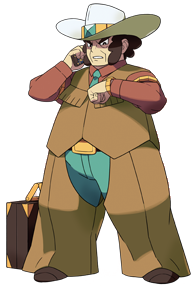
Clay has no time for frivolity.  He is a Serious Businessman who spends his days engaged in Serious Business.  Of course, since he owns a mining business, he undertakes this seriousness at the bottom of a mine shaft.  Clay is too industrious to take time off to run the Gym, and too cheap to buy separate premises for his official battles, so he’s just opened a section of his mines to trainers as the Driftveil Gym.  The maze of elevators, tunnels and walkways provides all the testing most challengers need.  We notice, upon entering, that much of his lighting has failed in the past two years and the miners now work mainly in the dark.  Many of them have lights in their helmets, and the rest know the mines like the backs of their hands anyway.  We are not so fortunate, and consult Clyde the Guide for assistance.  He explains, regretfully, that most of the electrical cables have been on the blink for months, and the Gym loses more with every power surge, plunging more and more of the mines into darkness, but because Clay himself doesn’t mind working in the dark, and most of the miners can muddle through as well, he’s never bothered to replace them.  We stare at Clyde wordlessly.  He shrugs and points to a pile of spare cables sitting in the lobby, suggesting that we rewire some of the lights ourselves.  With raised eyebrows and sighs, we gather up the cables, call out Sansa and Elisif, and get to work.  The mine is a veritable maze of platforms, bridges and conveyor belts, but our haphazard restoration of the Gym’s lighting serves as a trail of breadcrumbs, helping us to keep track of where we’ve been, and any task involving sparking cables or ungrounded wires is firmly delegated to our Ampharos.  Eventually, just as we’re about to run out of spare cables, we stumble into Clay’s arena and come face to face with the ‘Miner King.’

When questioned about the state of his Gym, Clay explains that he doesn’t have the time for- sorry, that he “ain’t got no tahm” for “messin’ about wit’ maintenance,” and that he prefers to let “y’all li’l trainers” take a crack at it when challenging the Gym, apparently to avoid paying an actual electrician to do the work.  At this point my understanding of his cringe-inducing accent breaks down as he makes an indecipherable comment about mangoes (I think) before barrelling right through our looks of disbelief to accept our challenges.  Nothing if not an opportunist, Clay decides I will open with the Pokémon I have out already – my Ampharos, Sansa.  Between Confuse Ray and Take Down, she proves to be more than Clay’s Krokorok bargained for, but predictably falls flat against his signature Pokémon, Excadrill.  As a matter of public service, I wish it to be known that Clay’s Excadrill is a bastard of Whitney’s-Miltank proportions, with tremendous excesses of speed and power which Clay exploits without mercy.  Even after being slowed and weakened by Daenerys’s Bulldoze and Intimidated by Barristan, Excadrill still manages to take the Growlithe down before being defeated by Jaime’s Razor Shell.  Luckily, Clay’s last Pokémon standing, Sandslash, is not nearly so thorny (well… I mean, literally it is, but not in the vaguer metaphorical sense) and quickly falls.  Clay grunts some manner of congratulation and hands me a Quake Badge before turning his attention to Jim, whose new Ducklett, Lydia, acquits herself admirably (y’know… for a Ducklett) as does Ulfric the Servine.  After being handed his second loss of the day, Clay looks at the two of us thoughtfully, the dollar signs that perpetually swirl in his eyes beginning to tick over slowly.  He tells us he has a proposition for us, and leads us out of the Gym.

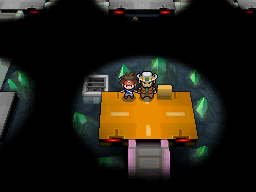
 Clay's lair deep within the Driftveil mines.

Over the past two years, Clay has been studiously building up both Driftveil City’s economic influence, and his own influence within it, by means of a dramatic new attraction: the Pokémon World Tournament, a permanent large-scale facility which hosts regular high-profile Pokémon battles.  It’s… not really a world tournament just yet, he admits sheepishly, but it’s already attracting powerful trainers from all over Unova, hence Driftveil’s recent tourism boom.  Of course, strong trainers instinctively seek other strong trainers – which is where we come in.  Attracting tough trainers has something of a snowball effect; the more there are, the hotter the battles will get, and the hotter the battles get, the more trainers will flock to the city, and the more money will flow into Cl- er… into Driftveil’s economy.  Yes.  All for the city.  Naturally.  He’s already started getting expressions of interest from a few of the other Gym Leaders – one of whom has already decided to make an appearance.  Cheren is waiting at the tournament grounds, talking to Hugh, who was presumably sent there after defeating Clay, just like us.  Clay makes a curt gesture to the staff, who sign up all four of us to take part in an upcoming eight-person singles tournament, and then quickly departs to take care of something else.  I frown and start up a conversation with Hugh, hoping to gauge his mental state after his meeting with Rood, while Jim quietly scopes out the other trainers milling around the lobby.  He manages to pick out three of the other competitors – presumably more of Clay’s recent successful challengers – but cannot immediately find the last one.  Suddenly, just as we’re about to file inside the arena, he notices the scientist Colress watching us from across the room.  Colress gives Jim a jaunty grin and a thumbs up before joining the three unknown trainers at the opposite entrance.  Hmm.

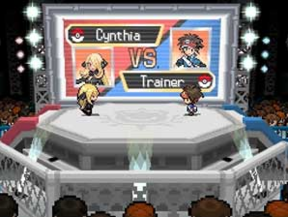
 The PWT building, in all its splendour.

Once we get through all the usual palaver of opening the tournament and introducing the competitors (Clay sure knows how to make a spectacle of things) I am paired with Cheren in the first round, and Jim is paired with Hugh.  Evidently fed up with having to tone things down for his Aspertia Gym challengers, Cheren is packing some serious firepower this time, in the form of one of my old enemies from Black and White – Stoutland, who hits like a truck and is built like one too.  Sansa, luckily, is tough enough to weather its hammer blows, paralyse it with a Thunder Wave, and finish it with an electrical onslaught.  Cheren’s remaining Pokémon, Cinccino and Watchog, are not nearly so menacing and fall relatively quickly to Sansa and Barristan.  Jim, meanwhile, seems to have soundly trounced Hugh, unsurprisingly.  The next round pits us against… each other.  Joy of joys.  Jim’s Lucario, Dovahkiin, is first up and gives Sansa a run for her money, weakening her severely, but eventually collapses under her assault.  When his Servine, Ulfric, appears, I seize my opportunity and switch in Barristan, whose fire is sure to wither the Grass-type.  My Growlithe closes in for a Flame Wheel, and-

Oh, god damn it, Zoroark!

Caught off guard by Jim’s newest Pokémon and on completely the wrong foot, I lose Barristan to Zoroark’s Foul Play, and Sansa, already weakened, doesn’t last long either.  The victories do not come without cost, and Zoroark is left too tired to defend against Jaime’s relentless Razor Shell… but now it’s all down to Jaime and Ulfric, not exactly a match made in heaven.  Though my Dewott fights valiantly as always, leaf against shell is one sword fight he isn’t going to win.  Pouting and sticking out my tongue, I vow revenge, but grudgingly wish Jim luck in the final round – against Colress.  Colress, when he appears, is as excited as ever for a battle, exhorting Jim to show him the strength of humans and Pokémon united.  Eyeing him warily, Jim calls on Dovahkiin to smite Colress’s Magneton, which has to spend the rest of the match trying to put itself back together.  Although he’s brought in a new Pokémon, the Psychic-type Elgyem, Colress fails to make any real headway against Jim’s Pokémon, and Dovahkiin and Zoroark manage to mop up his Elgyem and Klink without much trouble.  With much fanfare and glaringly bright stage lighting, Jim is proclaimed the victor and led triumphantly off the stage, where he is unceremoniously presented with a little ticket reading “1 BP” (fine print: “redeemable only at participating battle facilities; expires one year from date of issue; Miner King Enterprises will not accept torn, faded, burnt, soiled or partially digested BP; terms and conditions apply”) and dismissed.  Now that the battles are over, this is Clay’s show once again.

 Keep at it, and you'll even attract Champion-level trainers to the PWT - just THINK of the advertising revenue!

The Pokémon World Tournament is what we get instead of the Battle Frontier in Black 2 and White 2.  Much like the Battle Subway it awards Battle Points for each tournament victory, redeemable for a variety of useful battle items not available elsewhere, and like earlier versions of the Battle Frontier it collects a number of important services into one place – in this case, the move deleter, move reminder, and Hidden Power dude.  It also offers a couple of unusual battle formats; a rental tournament (just like the Battle Factory of old) and a ‘mix’ tournament, in which you borrow one of your opponent’s Pokémon in each battle – and your opponent borrows one of yours (this… can end badly)!  Perhaps a little washed-out in comparison to the fourth-generation Battle Frontier, with its tricky Battle Arcade and Battle Castle formats, or the even older and even more expansive Emerald Battle Frontier, but the weird formats aren’t the main draw of the Pokémon World Tournament – the true attractions, Clay notes, are the trainers themselves.  Once you progress further in the game, all kinds of famous trainers will start entering tournaments here, including just about every Gym Leader since forever.  Want to relive former glories with a battle against Winona’s Altaria or Jasmine’s Steelix, or just enjoy one last punch-up with Giovanni?  This is the place to do it.  Personally, I was something of a fan of the eclectic battle styles you had to learn in order to complete some of the old Battle Frontier challenges, and the fact that the Battle Points you earned from all of them were universally useful kept them from being too much of a pointless sideshow, but I have to admit there’s something to the ‘all-stars’ feeling of the higher-level tournaments in Driftveil City.  Challenging these people on their own turf is one thing, but entering tournaments with them finally puts the players on the same tier, which is a tremendously empowering thing for the game’s atmosphere – and nostalgia is certainly a factor (I have to admit, the designers do seem to know their audience… from time to time).  I also like the way the Pokémon World Tournament fits into what’s going on in Unova, because of course Clay is exactly the kind of person who would go to these lengths to boost Driftveil’s economy, and you can see the effect that it’s already had on the town, even in the early stages of the project.  Hey, I don’t often get to see sensible world-building from these people; let me enjoy it.  In short, while Clay’s latest project isn’t exactly my ‘vision’ of a perfect battle facility, I think it’s a pretty solid addition to Black 2 and White 2.

Discuss.

why do you not like weezing?

Like I said, my reasons are really kinda petty.  I just don’t like the change from happy, smiling Koffing to bloated, miserable, lung-cancer-y Weezing.  It actually is quite a creative design, and you could even interpret it as illustrating the accumulating detrimental effects of air pollution (or cigarettes?) on a person’s health, and I can easily understand why other people would like it.  It’s just not my cup of tea, personally.

I know you may have a lot of pressing requests by many on this grand website, however, I implore you to perhaps make a segment covering NPC’s that stand out, like your divine wisdom applied to those witty characters (…or witless fools) in a comedic fashion. For example: Ghetsis: a manipulative spawn of all horrors witnessed in the bowels of hell, who is also fanatically Intelligent (as opposed to those happy “i got a rattata who can kick your ass” NPC). Maybe cover Looker and Cynthia as well?

I actually covered Cynthia last year, if you want to take a look, along with Blue, Lance, Steven, Wallace and Alder.  I’m planning to do a series on the rivals as well (probably including Wally and N), but heaven knows how long it will take me to get around to it.  As for Looker… hmm.  Y’know, I’d never really thought about it, but I probably could spin out a piece about him.  I’ll see if I can wedge it in somewhere.