Grass monkey, that funky monkey, GRASS MONKEY! asks:

So, the Greek God Apollo, he is definitely bi right?

Well, there’s a bunch of caveats I have to rattle off whenever someone asks a question like this, ‘cause in ancient Greek culture there’s no such thing as “bi” or “gay” – and there’s definitely no such thing as “straight.”  The categories simply don’t exist; there are no words for them in the ancient Greek language.  Personally, I think we have reason to believe that the whole concept of being exclusively attracted to only one gender would have seemed a bit alien to the ancient Greeks.  It’s just… kind of normal for adult men – men who are married to women and happily participating in a strictly patriarchal and, weirdly, kind of heteronormative social structure – to also be attracted to younger men and teenage boys, and indeed to have sex with them.  What’s more, this is totally fine, because in general Greek marriage customs only require that a married woman should not have sex with any men other than her husband (and Sparta had exceptions to even that rule; I also kind of suspect that extramarital lesbian relationships might have been common as well, but that’s a lot harder to track, because almost all our written sources come from male perspectives and they just have an extremely rudimentary understanding of female sexuality).  Marriage is a very functional, utilitarian, transactional thing; you get married in order to produce legitimate male heirs who will inherit your property and your place in the social fabric of your city.  That’s a duty that you have not just to your family but to your entire community, because it ensures continuity of land ownership, and land is where the community lives and produces food.  The point I’m trying to make is that male/male romantic or sexual relationships are doing different things from male/female ones, in a way that wouldn’t have left much room for a modern conception of same-sex relationships, where we want to be seen as equal and equivalent to straight people.

Continue reading “Grass monkey, that funky monkey, GRASS MONKEY! asks:”
Son of Iris asks:

I know this blog is about Pokemon, but due to your recent chain on twitter about a Percy Jackson TV series, how would you rate & rank each of Riordan’s books, at least the ones you have read in full.

honestly, dude, I’ve had so many classics questions coming in lately I don’t actually know what this blog is anymore

I’m not going to do a whole rank-and-rate numbered list thing, because… frankly there’s a lot of them.  That just sounds like more work than I want to do, especially since it’s been a while since I read most of them; like, the original Percy Jackson and the Olympians books came out when I was a teenager and I don’t think I’ve reread any of them in full since then; I also haven’t read book 4 of Trials of Apollo yet.  I think the Magnus Chase books are probably my favourites in the Percy Jackson ‘verse, which is not entirely because of Alex Fierro but honestly that’s a pretty significant factor.  I think those books are also a really good example of how minority representation in fiction is good, not just for people who don’t often get to see characters like them in media, but because working with diverse perspectives can actually make a story just flat-out more interesting.  Riordan’s whole schtick is reinventing mythology as a presence in the modern world, and that just works better with the widest possible range of character backgrounds.

Continue reading “Son of Iris asks:”

Nothronychus asks:

What’s your favorite hellenistic Greek City-State and why?

So, even as a classicist it has never really occurred to me to have a favourite Hellenistic Greek city-state (because… why?).  Maybe this makes me a bad classicist.  But it really seems like a weird thing to have, because we usually think of the Hellenistic period as the era when the city states don’t particularly matter anymore; it’s all about empires and god-kings.  So I had this hour-long discussion with Jim the Editor about what possible valid answers this question could even have, because what still counts as a city-state in the Archaic-to-Classical Greek sense?  He doesn’t think anything that’s part of one of the big kingdoms counts, because city-states are supposed to have political autonomy – so we can’t pick the really big centres like Alexandria or Antioch, and Jim thinks Pergamon does still count, whereas I don’t think you can count Pergamon if you’re not also willing to count Alexandria (and anyway, can’t you be both a city state and the capital of an empire?  I mean… Athens and the Delian League, for fµ¢£’s sake).  And then what even counts as Greek, because all this stuff is, like… Greco-Macedonian(-Persian?) koine that doesn’t closely resemble classical Greece in its politics, society or culture; the only ones that you could reasonably argue aren’t a little Macedonian by this point are the western colonies (Syracuse, Neapolis, Tarentum, Massilia, etc.) and Sparta (and no one, at all, in the world cares about Hellenistic Sparta).  Or you can swing wildly in the other direction and argue with equal merit that everything is Greek, because I have definitely heard people suggest, only a little bit ironically, that Rome is in practice a Greek city-state up until basically the Punic Wars (especially if you buy into Dionysius’ “the Romans are totally Greek, guys!” bull$#!t).

So yeah, I dunno.  My actual favourite is probably Cyrene but they only barely make it into the Hellenistic period with their independence so maybe that’s not in the spirit of the thing.  Rhodes is cool.  Colossus of Helios, obviously.  Lots of good glasswork done on Rhodes in the Hellenistic period too, and I am nothing if not a glass nerd.  Syracuse has Archimedes’ giant death laser (I want to believe, okay???).  Hellenistic Athens is really interesting, actually; like, we all fixate on the Classical stuff in Athens but they get up to just as much Game of Thrones bull$#!t as any Hellenistic monarch in trying to preserve their independence and democratic traditions.  They also have this fascinating position as, like, the ex-cultural capital of the Greek world that they continue to leverage for political gain well into the time of the Roman Empire.  These are certainly some opinions that I have.

Dosidicus Giygas asks:

Can you recommend any good resources for learning about Aegean depictions of cephalopods?

That’s a… concerningly specific request

and this is coming from a guy whose thesis is on Roman window glass

So, uh… I mean, there’s nothing off the top of my head that isn’t ludicrously dry and technical; like, if you have JSTOR access or similar you could search for some of Penelope Mountjoy’s articles on the Late Minoan IB “Marine Style” but they’re, um… not exactly page-turners.  They probably won’t make a lot of sense without a fairly thorough grounding in Minoan archaeology, and honestly I’m not even sure they’ll tell you what you want to know, if you’re interested in, like, the accuracy of anatomical details.  Is the Marine Style what you mean?  Because that’s where my mind instantly goes on hearing “Aegean depictions of cephalopods,” but without context that phrasing is… kinda broad.  There’s a bunch of Attic black and red figure pots with octopuses(-pi/-podes) on them that you can find by searching the Beazley Archive database (type “octopus” into the “decoration description” field and hit “list” at the bottom of the page); I dunno if anyone’s ever written anything about them and at a glance it looks like a lot of them just have the octopus as a shield device or a generic ocean-themed ornament, but… I mean, they’re there if you want ‘em, I guess.

Leo M. R. asks:

Did the concept of cousinhood exist in Ancient Greece? I JUST learned that Jason and Odysseus were cousins on their mothers’ sides (side note: their grandfather was a master thief?!), and I was wondering if this ever translated into the concept of kinship to the Greeks back then, and if it ever influenced why the two of them had notable similarities (like being known for legendary naval journeys and having flings with powerful sorceresses).

So, on the specifics of Jason and Odysseus: a lot of minor characters in Greek mythology have very different family trees depending on who you ask, and the mothers of Odysseus and Jason are very minor characters.  Our main source for Odysseus is, of course, Homer, and Homer says that Odysseus’ mother Anticleia is the daughter of the legendary thief king Autolycus.  Now, Homer was probably alive in the 8th or 7th century BC (side note: Homer isn’t real, Google “the Homeric Question” some time; it’s wild, but this is 100% not the time to litigate that $#!tstorm).  Our main source for Jason, on the other hand, is Apollonius Rhodius’ Argonautica, which was written in the 3rd century BC, centuries after Homer was dead in the ground (if he was real, which he wasn’t), and Apollonius says that Jason’s mother was Alcimede, the daughter of Clymene, who was herself the daughter of Minyas, the legendary king of Orchomenos – no mention of Autolycus.  In addition, though, we have the scholia to Apollonius, which are basically the margin notes made on the text by scholars in the Early Byzantine period (like, 5th to 8th centuries AD), and they are the ones who, quoting other texts now lost to us, give her name as either Polypheme or Theognete and claim she was the daughter of Autolycus.  I think the only primary text we actually have that backs this up is a 2nd century BC encyclopaedia of myth attributed to Apollodorus, but he gives yet another name for the mother, Polymede, and he probably got that from Hesiod, who gives that name in his Catalogue of Women but doesn’t explain who she is (at least not in the bits we have, because there is no complete text of the Catalogue of Women and we have to rely on quotations in other authors; are you beginning to appreciate the scope of the insanity we have to deal with here?) (side note: Catalogue of Women is an awful, awful title in the 21st century; it sounds like what a pickup artist calls his diary).

Continue reading “Leo M. R. asks:”

jeffthelinguist asks:

So, as an archaeologist, can you answer the age old question of how much time needs to pass before grave robbing becomes archaeology? What’s the appropriate time period for looting the dead to become acceptable?

I’m assuming you’ve seen the screenshot of an archaeologist commenting, in answer to this question, that this is actually a super awkward and uncomfortable question?  I’m fortunate enough to work in an area where it doesn’t really come up much – we’re all pretty sure that two thousand years is comfortably in the safe zone.  Even then, though… it would be a mistake to think that archaeology can be a pure science, that our study of the past can remain detached from the present. It’s all grave robbing, in a way. The only difference is in how pure your motives are… which is a matter of perspective.

Continue reading “jeffthelinguist asks:”

A Dragonborn With a Trident On His Back Playing a Syrinx asks:

This is definitely Heracles https://drive.google.com/file/d/1dzvmPjWMKLaiNG6MOLkOgjcveh2lnEja/view?usp=drivesdk

…I mean, I can believe that it’s trying to be?  Heracles almost always has a club, though, and the ears of his lionskin aren’t usually that pointy; these look more doglike.  Honestly it kind of reminds me of an Age of Mythology Ulfsark.

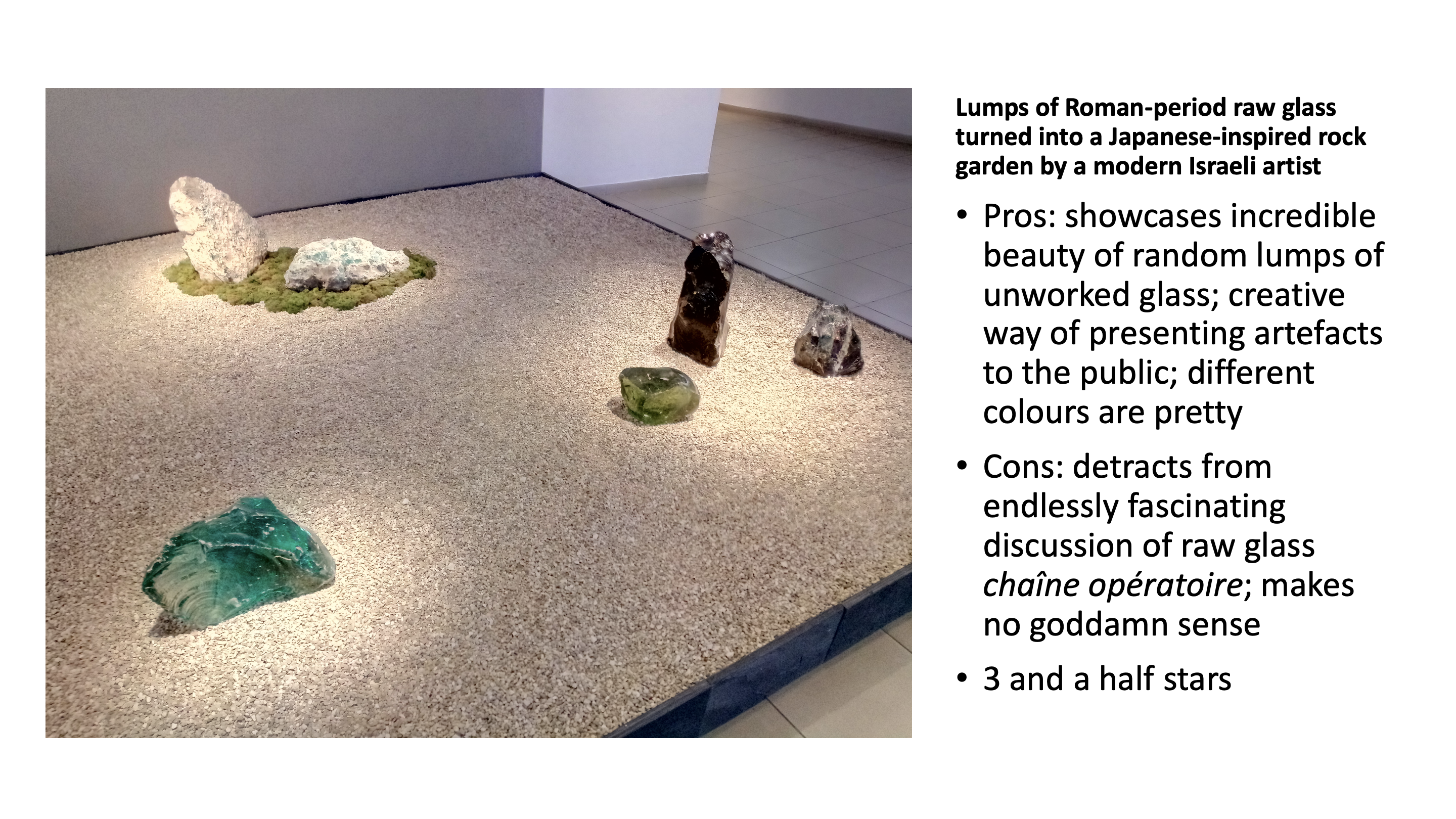
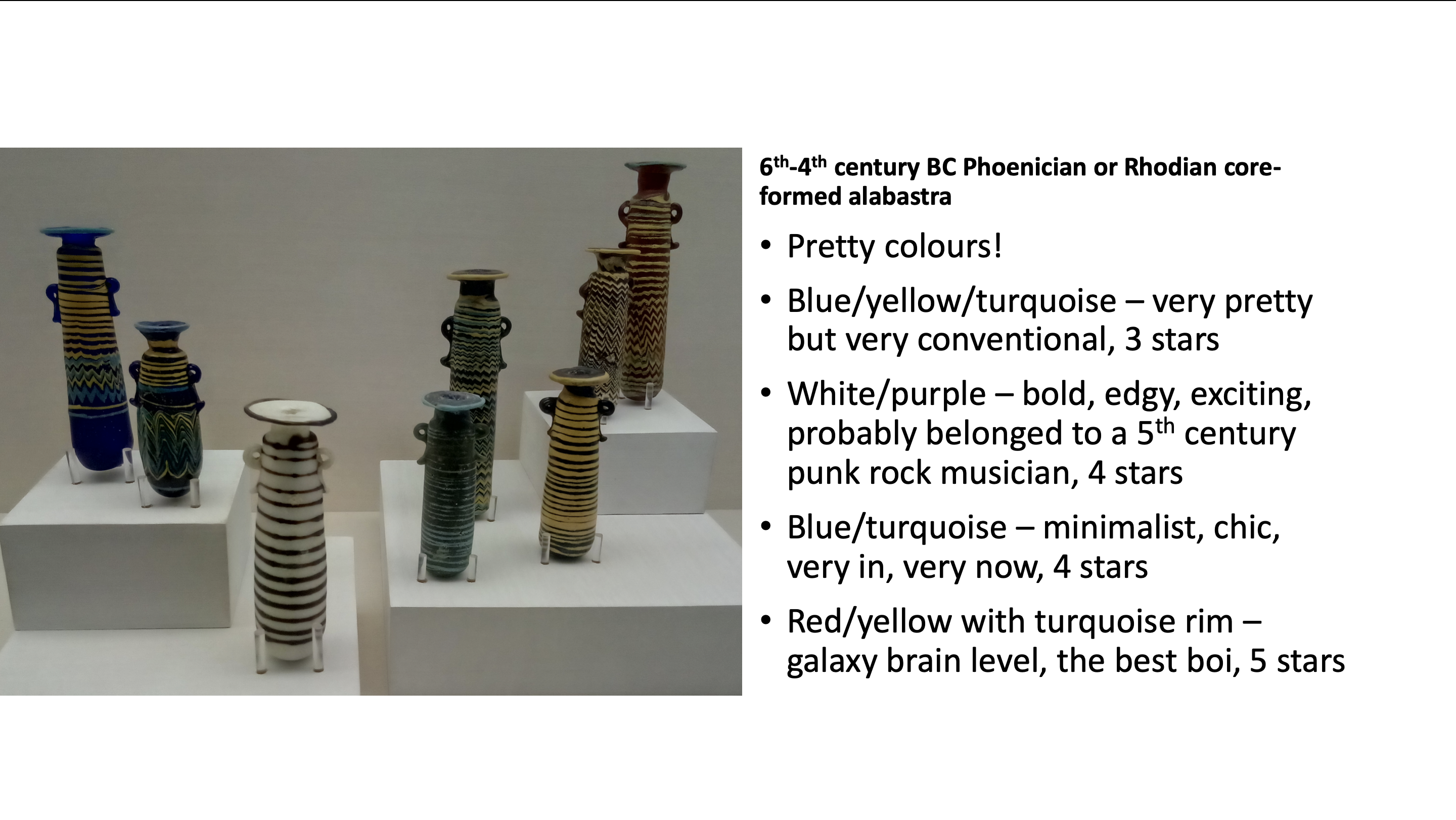
Reviewing the glass from the Eretz-Israel museum

On Thursday I went to the Eretz-Israel museum in Tel Aviv, and because I am a huge glass nerd (and, y’know, I’m doing tourist things as well but I am technically in this country to study ancient glass) I spent basically the entire time in their glass gallery ogling pretty Phoenician core-formed alabastra and Roman mould-blown bottles. So my reduced posting schedule this month doesn’t sting too much, here’s my definitive expert review of all the things there that most stuck out to me:

Continue reading “Reviewing the glass from the Eretz-Israel museum”

VikingBoyBilly asks:

Something’s been on my mind for a long time since I stopped lurking, but I need to say how I feel.

In our long argument about Odysseus, you ended it with “i know what I’m talking about; so there.”

No, you didn’t, because if you did, you wouldn’t have been a misanthrope. Reading mythology is what made me fall in love with humans, and it’s unsettling that you never acknowledged the irony of being a misanthropic archaeologist. The lessons the Oddessey taught me is that life is a journey full challenges and misery, but by keeping your wits and the strength to continue, you can reach your goals. Oddysseus’s goal was to reunite with the wife an son that he loved, and it’s so cynical to think he enjoyed having sex with women that kept him stranded on those islands, and it doesn’t mesh thematically when these are supposed to be a series of hardships. The optimist in me believes this was something to be overcome, either as a temptation like the lotus fruits and sirens, or a situation to get out of like the cyclops. His devotion and loyalty to his crew, his homeland, and family are values I live by, and I don’t like that being tarnished by accusations that he’s a scummy womanizer. I could just be satisfied with my own opinions and not be bothered by what anyone else thinks, but you know what the internet does to us.

I also was put off by your use of the vague buzz-word “western civilization.” It’s nonsensical to anyone with an understanding of geography, and condescending, as if any other civilization doesn’t count (and because I think an archaeologist/anthropologist would only use such a simplification of jargon when talking to a layman). Funny how people angry with the state of the world will defend “western civilization” as the best thing that ever happened.

I hope your outlook of your own species has changed since then, and if you want to reply non-publicly, my email is [REDACTED]

[This is what Billy is referring to – linking to the Tumblr version of the original question-and-answer post rather than the WordPress version because that’s where the relevant comment thread is, but I might actually move it over here for posterity’s sake]

Continue reading “VikingBoyBilly asks:”

Adventures in Baking the Entire Athenian Acropolis, part 4

okay this part was insane and took literally a whole day and is really kind of a succinct illustration of why I can never have a normal life, but here it goes

So, last time I left off with this:

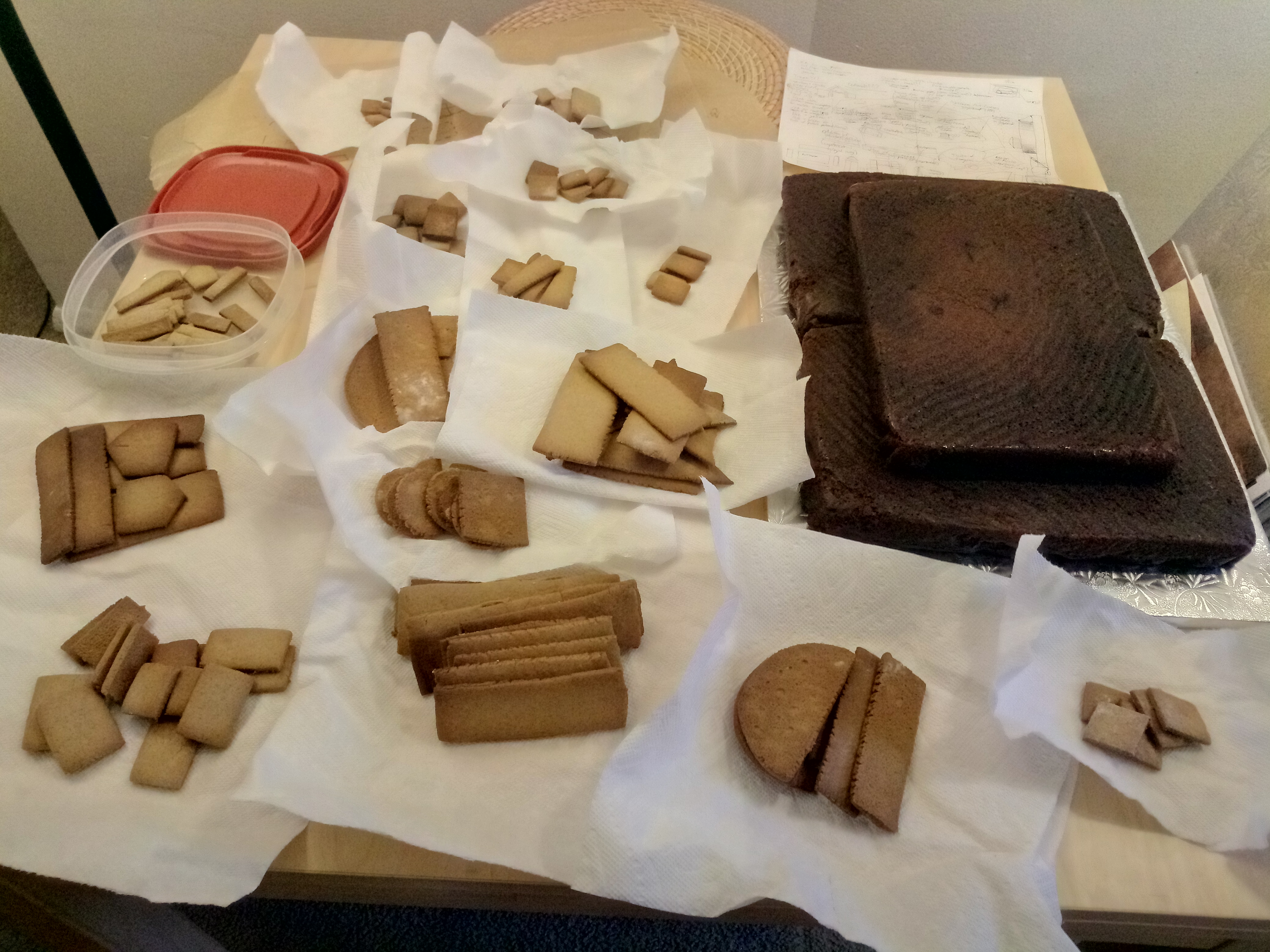
Three big slabs of chocolate cake, and all these piles of gingerbread that will turn into buildings.

Continue reading “Adventures in Baking the Entire Athenian Acropolis, part 4”