White 2 Playthrough Journal, episode 18: Chaos theory

Undella Town passes us in a blur.  Not literally, of course; we just weren’t paying attention.  There are a few new areas – the Marine Tube which supposedly leads to Humilau City, and the Seaside Cave which also supposedly leads to Humilau City, but neither is open to us at present.  We’re pretty sure Hugh turned up at some point and demanded some practice battles, but he said little of interest or relevance.  The road south to Black City and White Forest was much as it always has been, although the gatehouse at the end of the road is perhaps notable for being host to Game Freak’s most bizarre roadblock yet: a line of dancing fat men, who, when questioned, will explain that they are dancing for no reason, and will someday stop dancing, also for no reason.  I stare at them, transfixed, with an immovable look of “wha?” on my face, until Jim manages to drag me out of the gatehouse.  The road north towards Lacunosa Town, likewise, is largely unchanged and uninteresting – until we reach the point where it forks toward the Giant Chasm.  The Chasm itself is inaccessible, but there is someone at the junction waiting for us: Cobalion.

I tell Jim, insistently, to leave this to me.  He raises an eyebrow, but agrees.  I approach Cobalion and politely ask him whether we may continue our negotiations.  Cobalion lowers his head, ready to charge.  I smile, taking this as an affirmative, and open my mouth to begin an impassioned speech on the natural suitability of humans for command and Pokémon for obedience.  My plan, of course, is to moderate my position as the debate continues, thus creating the impression that I am a) reasonable (hah!) and b) receptive to Cobalion’s own arguments.  Unfortunately, Cobalion delivers a startlingly effective riposte in the form of a Sacred Sword attack, which neatly lops off one of my Princess Leia buns as I dodge to the side.  For a few moments I stare at Cobalion, dumbfounded.  Has this creature no conception of civility!?  I am collecting myself for a cutting remark on Cobalion’s parentage when he prepares to initiate an Iron Head attack.  The thought momentarily occurs to me that perhaps a somewhat more aggressive diplomatic strategy would have been apropos.  As I contemplate my imminent premature demise, a pair of thick green tendrils lash out of nowhere and snare Cobalion around his neck and one leg.  As he screams with rage, I spin around to see Jim’s Serperior, Ulfric, straining to keep a tight hold on the legendary Pokémon with his Vine Whips.  Jim orders Ulfric to hurl him into the air, and the Serperior obliges, flinging Cobalion roughly into a nearby tree.  The musketeer Pokémon recovers quickly, though, and within moments they are at each other’s throats, Leaf Blade against Sacred Sword.  I draw an Ultra Ball from my bag.  This has gone on long enough.  I lob the Ultra Ball with all my strength, chanting “up, down, A, B, up down, B, A” under my breath.  It strikes Cobalion and draws him in with a flash of light.  A few moments later, it’s all over.  Jim stares at me as though I’ve swiped a sandwich from his open mouth.  I poke my tongue out at him and dismiss Cobalion’s ball to the PC network.  I’ll deal with you later.

With that behind us, we arrive in the only walled city in all of Unova – Lacunosa Town.  I remember this place being kind of pointless, other than for providing some vague hints about- oh.  Ah.  Right.  Better look around.  We are soon met by Professor Juniper and Bianca, who have used Fly (i.e. cheated) to beat us here, and as usual have their own ideas about how our investigation should proceed.  Juniper drags us to the home of one of Lacunosa Town’s elders, explaining that the town has a legend we should hear.  The elder relates the familiar story to us: when the cold winds blow from the nearby Giant Chasm, a fearsome beast stalked the night, snatching away anyone who wandered outside after dark.  The town’s great stone wall was built to defend against this monster, but even to this day no-one in Lacunosa Town will leave home after dark.  Professor Juniper comments that the wall is probably what gives the town its name; lacunosus clouds are a type of cloud that are supposed to look like a fence or a net.  Jim and I have to conceal a snigger at this.  Lacunosa Town is named for its wall, but clearly the town’s founders were influenced by either an astonishing lack of confidence in their stonework or a distressingly poor command of Latin – lacunosus means “full of holes” (this, I should note, is its strictest, most literal sense; it could also be taken to mean “collapsed,” “sunken,” “waterlogged,” or just downright “inadequate”).  The more sobering thought then occurs to us that, if a legendary Pokémon as powerful as Kyurem were to attack the town, that name might turn out to be chillingly accurate.

As we go to leave for Opelucid City, we run into Hugh.  Damnit, how do all these idiots keep getting ahead of us!?  Hugh is following some rumours he’d heard about Team Plasma activity in the town, and is wondering if we’ve seen anything.  We are about to answer in the negative before switching the topic to something more conducive to Hugh’s mental stability, like hobbies or the weather, when – speak of the devil – none other than Zinzolin, the Sage leading the reborn Team Plasma, appears with two grunts in tow.  Hugh’s eyes flash and he reaches for his Pokéballs, but Jim and I interpose ourselves and attempt to negotiate.  What is Zinzolin after, anyway?  The other Sages abandoned Ghetsis when they realised he’d been manipulating them, so why is he still leading Team Plasma?  If he just wants to take over the world, couldn’t he, maybe, work with us instead?  Zinzolin laughs and explains his philosophy.  He’s actually not interested in power at all – from what I can understand, he’s mostly interested in chaos.  Zinzolin knows that Ghetsis means to tear the asunder the order of the world and the balance of nature and civilisation by forever separating humans from Pokémon, and he wants to watchThe crazy bastard wants to watch.

I am forced to concede that it does sound like a fascinating sociological experiment.

I offer, in the event of a Team Plasma victory, to co-author a paper with Zinzolin on the extent of human sociological dependence on Pokémon.  After all, just because I’m theoretically opposed to them doesn’t mean I can’t try to create a win-win situation for myself.   Zinzolin hesitates, but agrees to my proposition.  We shake hands on it, and then return to the matter at hand – Hugh is foaming to beat up Zinzolin and his attendants, and Jim and I have a mind to join him.  Zinzolin, it turns out, is quite a strange Pokémon trainer.  One of his persistent character traits, held over from the original Black and White (which Cheren noted when we first encountered him in Driftveil City), is that he hates the cold.  This is strange because Zinzolin is actually an Ice-type specialist – his Pokémon are Cryogonal and Sneasel.  Thinking out loud, I observe that this seems indicative of a level of self-loathing.  This gets Zinzolin so flustered that my Scolipede, Tyrion, is able to steamroll both of his Ice Pokémon before he can regain his composure.  I give the sage a cluck of disapproval as Jim and Hugh finish off his equally inept minions.  Zinzolin curses, mutters something about searching Opelucid City and departs with his grunts, Hugh close behind, waving his fist and shouting something unprintable about radishes.

So, Opelucid City sounds like the place to be.

The road to Opelucid City is nearly as boring as the road to Lacunosa Town was, with the exception of the Village Bridge.  As the surprisingly apt name suggests, this is a bridge with a village on it.  I don’t think anyone actually knows why the village was built on the bridge, as opposed to the more architecturally sound option of building it next to the bridge.  I mean, okay, yes, there was the mediaeval London Bridge, but that was a) in the middle of a massive and already overcrowded city, and b) a massive fire hazard.  Village Bridge, as it turns out, is guarded – in the middle stands an odd Gentleman by the name of Stonewall, who declares that he challenges anyone crossing the bridge.  He has won 999 straight victories, and is eager to win victory number 1000!  Well, we observe, if he’s won 999 straight victories he must be pretty str-oh no wait never mind.  Though comparable in skill to the sage Zinzolin, with a powerful Durant and Lucario, poor Stonewall soon finds himself twisted into knots by Jim’s Zoroark and its mind-bending illusions.  He collapses in defeat, mourning the winning streak he’d spent two years building up (y’know, with only two Pokémon, battling about three trainers every day is actually a pretty good effort), though he vows to try again.  Once across the bridge, the rest of our journey to Opelucid City is quick and without incident… until we reach the outskirts, and find none other than the legendary Virizion blocking our path.
Another game that people sometimes mention alongside Pokemon is Digimon. Have you ever playe a Digimon game, and if you have, what are your thoughts about it?

You know, I never have.  I watched the show when I was a kid but I never actually played a Digimon game.  I don’t think they were ever as popular in New Zealand as the anime was.

What kind of games should I be thinking of here?  Are we talking about the Tamagotchi-style thingies that Digimon was originally based on, or the stuff that was developed later as spin-offs of the anime?  Seriously, if anyone wants to recommend something so I can go and grab an emulator, I’m all ears.  The anime had some really nice characterisation and, although I don’t have as much fun with the themes as I do in Pokémon, it’s a cool world to play with.

Let’s see if we can wrap this up

image

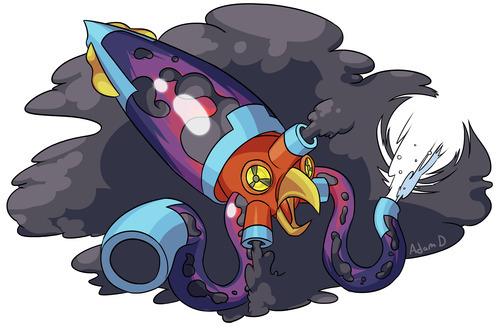
We now have art and a set of powers and skills for our Water/Fire deep sea lava lamp squid of doom.

I’ve had three sets of Pokédex entries submitted, as well as a number of names, so let’s get this done (I’ve decided to keep the submitters anonymous for now).

The sets of Pokédex entries we have to choose from are as follows:

Set number 1:

Black: It occasionally bites rocks and ignites them to scare prey. The explosions are often mistaken as underwater eruptions.
White: It absorbs heat by latching onto underwater vents. This makes it glow brighter, in turn attracting prey.
B2W2: They gather in groups and spew hot oil at Wailord pods. Then, the group emerges to feed on the remains.
Set number 2:
Black: They are filled with combustible oil that can ignite in a brilliant explosion, even under thousands of feet of water.
White: When the oil inside this Pokémon ignites, it becomes able to shoot through the water like a rocket.
B2W2: It is said that these Pokémon can communicate through the shining light of their mantles, even from miles away. 
Set number 3:

Black: It traps its foe in a thick cloud of oil, then sets it aflame. Oil-rich Pokemon like Walrein and Wailord are its preferred prey.
White: It lurks in shadowy caves on the Arctic seafloor, shining with an eerie, purplish light. By the time a curious Pokemon spots the golden glow of its eyes, it is already too late.
B2W2: By igniting their entire oil supply at once, a group of [Squiddy] can launch themselves like bullets, decimating a slow-moving pod of Wailord. Then, they feast on the remains.

Next order of business: a species designation.

Followed by height and weight.  I had three submissions here, but two of them were so similar I decided to take the average, rather than split the votes for two options that were basically the same (this is where the largest of the size options came from).  I’ve also added two more options to get a bit of choice in here.

Next: what is Squiddy’s base experience yield?  The amount of experience gained by a level 50 Pokemon defeating a wild level 50 Squiddy will be about 10 times this number.  For reference, the lowest base experience yield in the games is Sunkern’s, at 36, and the highest is Blissey’s, at 608.  Most fully-evolved Pokémon have a base yield between 150 and 250, increasing with relative power and rarity; legendary and pseudo-legendary Pokémon mostly fit into the 250-320 range.  For each option, I’ve given some examples of other Pokémon in the same bracket.

While we’re at it, what is his effort yield?  All Pokémon, you may be aware, confer ‘effort points’ as well as experience points when defeated, which accelerate the growth of individual stats.  Most Pokémon grant effort points in their own best stats, which makes this fairly self-explanatory, and no Pokémon grants more than 3.

Next is Squiddy’s base happiness.  I’m almost not sure this is even worth a poll, since almost all Pokémon have a base happiness of 70, but while we’re here we may as well.  Only 6 different levels of base happiness currently exist in the game: 0 is used by the most powerful legendary Pokémon, and also Buneary; 35 is used by the majority of legendary Pokémon, a large number of Dark- and Ghost-types, all pseudo-legendary Pokémon, and a couple of generically ‘antisocial’ Pokémon like Ralts and Aron; 90 is used only by Latias, Latios, Tornadus, Thundurus and Landorus; 100 is used by Heatran, Pachirisu, Ambipom, Luxio and Croagunk (but not, strangely, by Aipom, Shinx, Luxray or Toxicroak) and the ‘cute’ legendary Pokémon; 140 is used by a handful of ‘cute’ Pokémon like Clefairy, as well as the Sinnoh lake spirits; and 70 is used by everything else.

How long do Squiddy’s eggs take to hatch?  The game actually measures this not in an exact number of steps, per se, but in ‘cycles’ of 255 steps each.  Most Pokémon hatch after 21 cycles.  A large number of early-game Pokémon from all generations take only 16 cycles, and Caterpie, Weedle, Togepi, Azurill, Pachirisu, Croagunk and Munna take only 11.  Many rare or single-stage Pokémon take 26 cycles.  All the fossil Pokémon, as well as Spiritomb, Hippopotas, Drifloon and Druddigon, take 31.  Eevee and Aron take 36.  A handful of very rare Pokémon, including all the pseudo-legendaries, Phione, and (for some reason) Basculin take 41.  Magikarp is the only Pokémon in the game who takes just 6.

How hard is it to capture Squiddy?  All Pokémon have a catch rate – the higher this number, the easier they are to capture.  Many early-game or unevolved Pokémon have a catch rate of 255.  Almost all unevolved Pokémon have a rating of at least 170.  Many Pokémon in the middle of a three-stage evolutionary path are between 120 and 90, and a lot of evolved two-stage Pokémon are between 90 and 60.  The starter Pokémon and most pseudo-legendary Pokémon at all their stages have a catch rate of 45, along with a large number of fully-evolved Pokémon, as well as Zekrom and Reshiram (due to their plot-critical status).  Many rare Pokémon like Absol, Yanmega, Tangrowth, Porygon-Z, Klinklang, Steelix, Skarmory, Relicanth and Cryogonal, as well as Dialga and Palkia, have a catch rate of 30 or 25 (again, for plot reasons).  Volcarona’s is 15, Kyogre and Groudon’s is 5, and the vast majority of legendary Pokémon are at 3, along with Beldum, Metang and Metagross.

And last but not least: which experience curve does Squiddy use?  There are six different experience curves in Pokémon, three of which are straightforward and three of which are bizarre.  The Fast, Medium Fast and Slow curves have a direct linear relationship with the cube of the Pokémon’s level, and require 800,000, 1,000,000 and 1,250,000 Exp. to reach level 100, respectively.  A lot of ‘cute’ Pokémon use the Fast curve, as well as the Misdreavus, Dusclops and Banette lines, Lunatone and Solrock, and Ledian and Ariados.  Most legendary Pokémon use the Slow curve, as well as a lot of rarer Pokémon like Braviary, Heracross, and the Ralts and Slakoth lines.  The Medium Fast and Medium Slow curves are both very common, and between them account for almost two thirds of all Pokémon.  Medium Slow is the first weird one.  It’s the curve used by all the starter Pokémon, and is actually faster than the Fast curve at low levels, but gradually slows down as you progress.  Eventually these Pokémon require the rather odd amount of 1,059,860 Exp. to reach level 100.  The other two curves are really unusual and, with just four exceptions, are only used by third-generation Pokémon.  The Erratic curve starts off excruciatingly, punishingly slow, but gradually builds steam until these Pokémon actually require less Exp. to progress from level 90 to level 100 than they did to get from 80 to 90, with a final total of just 600,000.  Altaria, Milotic, Nincada, Clamperl and Volbeat all use this curve.  The Fluctuating curve is just the opposite; Pokémon that use this curve start off with extremely rapid growth, faster than any other curve, which slows down dramatically as they progress.  Hariyama, Breloom, Wailord and Illumise all use the Fluctuating curve, and it requires a grand total of 1,640,000 Exp. to reach level 100.

Phew.  That took a lot longer than I thought it would.  I’ll leave those polls open for about five days, and that should be the end of it!

So, I just read an article on Bulbagarden’s Tumblr, explaining the speculation of two possible new types: the Love and Sound types. Their arguments include Xerneas-Yveltal = Artemis-Apollo (Greco-Roman mythology; right up your alley there!), Sylveon being released on Valentine’s Day, etc. If I could include the link here, I would :( Anywho, what do you make of it? I think it’s looking too much into things, but always love to hear your opinion!

Found it!

http://bulbagarden.tumblr.com/post/46036478839/yesterday-when-we-asked-on-twitter-and-facebook

I’m sorry to disappoint, but in general my opinion on these things is “it’s possible but I don’t think there’s sufficient evidence to decide either way.”  I honestly don’t understand why people get so invested in speculating about something we’re all going to find out in a few months anyway.  I agree with many of the points the authors make:

– Adding a new type with so many Pokémon in existence already would be difficult, but by no means impossible (if it were me doing this, I would want to make as many as half of the new Pokémon members of at least one of the new types).
– There are many existing Pokémon and moves that could become Love- or Sound-typed, mostly by stripping down Normal to a saner volume.
–  The choice of revealing Sylveon on Valentine’s day is interesting.

The reason I’m still not convinced is that the affirmative evidence basically comes down to “it’s not impossible and we don’t know what type Sylveon and Xerneas are.”  Also, speaking as a classicist, I think that linking Artemis, a goddess of chastity, with a hypothetical Love type is fundamentally absurd.  Furthermore, no actual evidence for the existence of a Sound type is presented here, let alone any evidence for identifying Yveltal as a member of it.

The authors are correct that Apollo is in one story associated with a satyr, Marsyas, in a music competition.  What they do not mention is that Apollo subsequently flayed him.

h t t p : / / i . i m g u r . c o m / m b P D Z 9 4 . j p g Opinions?

Well, it’s a little simplistic, and there are a number of specific points I disagree with, but I suppose my ultimate opinion is really just “sure, why not?”  Might write up a more thorough reflection on this later.

P.S. A clickable link for other readers (Tumblr, for some inane reason, forbids the use of links in questions) http://i.imgur.com/mbPDZ94.jpg

Well, there’s official news of a new pokemon that’s just been revealed that’s stated to appear in the next movie. One that’s either a new form of Mewtwo, or an entirely different pokemon that’s related to mewtwo in some way. Some even say it might be Mewtwo fused with either Mew or Genesect. What are your individual thoughts if its either one of these things?

Well, I don’t really like speculating on this stuff, because I just don’t see the point of that.  Any of those ideas could be used well or badly. None of them are ‘safe,’ and none of them really set off alarm bells in my head.  I like that they appear to be doing something new with an old Pokémon, especially one as iconic as Mewtwo, and the possibility that, after all these years, there really is going to be a Mewthree is, if nothing else, amusing.  If they plan to work with the idea of Mewtwo going back to the technology that created him and using it for his own ends, that could be interesting.  Not sure how else I’d do it.

This might fall inside the lines of “future game” business that you’ve mentioned and everyone’s been asking… but each generation has introduced lots of “new.” For this questions, I want to ask about new moves… Are there any new moves you’d like to see and explore with? I mean in a thematic perspective, like how adding team battles added team moves and such.

Well, I’m sure there’s room to keep adding more and weirder effects, though I’m not really very interested in that.  I’ve always been rather taken with the idea of signature moves, myself; that’s something I’d like to see more of.  A move that’s unique to a single Pokémon means it will always have something to offer that can’t be usurped, and it also emphasises that Pokémon’s particular powers.  Better chances to be awesome, combined with a closer meshing of flavour and game mechanics – that’s win-win as far as I’m concerned.  I think a lot of Pokémon could benefit from this sort of thing, but especially ones with very unusual skills, like Kecleon (who would be so much more relevant if he had an attack that changed type with him).  Worth special mention is Delibird, who has a signature move which only makes him weaker…

You’re all okay with being guinea pigs for my history class, right?

So, this week in the ancient history class I tutor, we’re studying Herodotus and Thucydides, the two first true historians in the Western world, which means looking at the origins and purpose of history as both a literary genre and a field of study.  The lecturer for the course has told me and the other two tutors (including Jim, whom you know from my Black 2/White 2 playthrough journals) that we have his permission to spend the entire week’s classes screwing with our students’ heads.  I’m going to practice on you, okay?

So.  What is history?

Some of you, no doubt, are thinking something along the lines of “the study of past events,” which is close but needs to be more specific, because there are lots of past events that clearly don’t fall under history.  The formation of mountains, oceans, and valleys, for instance, is the object of geology, while evolution and extinction come under the purview of palaeontology, and what I ate for dinner last night is of no special interest to anyone (but, just in case you’re wondering, it was a sort of Hungarian fried bread called langos, served with a herb paste and jalapenos).  Narrowing it to “the study of past events involving humans” doesn’t really get it either because that encompasses significant chunks of anthropology and archaeology as well as history (I mean, granted, there’s overlap, but they’re still distinct disciplines).  Strictly speaking, history is the study of past events for which a contemporary or near-contemporary (relatively speaking) written record exists – and that sounds like an awfully specific, restrictive definition but it’s really not, because history touches aspects of politics, war, economics, architecture, drama, sociology, mythology, philosophy, art and poetry.  A lot of the time, particularly when dealing with the distant past as I do (well, distant in terms of human civilisation, anyway), we have to rely on texts that weren’t written with ‘history’ in mind at all, but instead are more closely related to one of these spheres of human existence   Almost everything we know about the Mycenaean civilisation of the Greek Bronze Age, for instance, comes to us from the preserved clay tablets used by their capital sites to record all incoming and outgoing trade goods – basically, we have the last two months of their bank statements, and this, amazingly, is able to tell us all kinds of things about their political structure, society, diet, industry, infrastructure, and even religion, if you know how to look.  These tablets were reusable – they weren’t intended to provide long-term records, and they certainly weren’t meant for us, more than three thousand years later, but sometimes, if an archive room was destroyed by fire, the tablets would be baked hard and become permanent, so something that was never meant to be ‘historical’ in any sense of the word has become our primary source of historical information for an entire civilisation, which when you think about it is so absurd it’s wonderful, and vice versa.

So now that we’re agreed on all that, what is the past?

No, seriously; I’m asking.  What is the past?

Do you even know?

We often talk and think about the distant past as though it’s a place, like a foreign country where people speak a funny language and everyone does things a little bit differently and no-one has an iPhone.  We all ‘came from’ this foreign place, but none of us can ever ‘go back’ there, and we can’t see it or touch it.  It can only be observed by studying its effects on the present.  I can’t see or otherwise observe my last night’s dinner.  It’s gone.  I only know about it because I can remember it – because its image has been imprinted on my brain somehow.  You can’t observe it either.  You only know about it because I’ve told you.  But why did I tell you?  Was it just because I wanted you to know, or because I wanted to make a point about the nature of the past?  Is making that point important enough to me that I could have just made something up?

What is time?

If everything in the universe just… stopped… if all the molecules stopped reacting, and all the atoms stopped vibrating, and all the electrons froze in their orbitals, just for, say, ten seconds, how would we ever know about it?  Our thoughts would be frozen with everything else.  We wouldn’t need to breathe, because our cells wouldn’t be using up oxygen in respiration.  Our hearts would stop beating, but none of our organs would be doing anything that needed blood.  How would we know?  What if, maybe, there was one clock, one wristwatch or something, somewhere, that kept ticking, kept using energy, for those ten seconds? Would that wristwatch be the only thing in the universe that kept time ‘properly’?  Yes?  But we use clocks and watches to keep track of the earth’s movement around the sun.  If the earth and sun stop moving, along with everything else, and the watch keeps ticking, isn’t it doing something wrong?

We perceive time – we can only perceive time – through change.  Maybe that’s all time is.

When we study history and archaeology, we attempt to make observations and deductions about the past.  We do this by examining the present and extrapolating.  If there is a building, it must have been built.  If there is a pot, it must have been fired.  If there is a book, it must have been written.  But who wrote it?  It’s certainly a copy.  The number of original texts surviving from antiquity is minuscule.  In most cases, the version we have will have been copied by a mediaeval ascetic hunched over a desk in a dingy monastery in Scotland.  His version will have been copied out by a clergyman in France a few decades earlier.  Sometimes the monk will sneeze, or his pen will slip, or he’ll spill his water on the page he’s reading.  You see the difficulty here?  Eventually there would have been an original manuscript penned by the author (now lost, of course).  But why did he write it (in the cultures I study, it almost always is a ‘he,’ normally a rich, educated ‘he,’ which of course creates a whole slew of its own problems)?  Does it represent how he saw the world?  Or how he wanted others to see it?  Do either of those things resemble the way the world actually was?

Herodotus was the first person in the Western world ever to write history for the sake of history.  Or was he?  The ancient Greeks, his audience, don’t seem to have drawn much of a distinction between ‘history’ and mythology – both are stories about the past that explain the present.  Both Herodotus and Thucydides refer to Homer’s Iliad and Odyssey, along with other lesser-known poems, as though they represent fairly authoritative records of past events.  The Iliad is the story of a great war, the war against Troy – and so are Herodotus’ Histories, which tell the story of the wars between the Greek city-states and the Persian Achaemenid Empire, roughly a generation before Herodotus’ time.  We see them as different, because we think of the Persian Wars as something fixed, something that really happened, and the Trojan War as something vague and insubstantial, something that might have happened, but probably not exactly as Homer tells it.  But did Herodotus?  He definitely seems to recognise he’s doing something different – if he didn’t, surely he would have written an epic poem, rather than prose.  The only other major prose genre of this era, incidentally, is philosophy, which seems like it might say something interesting about what Herodotus thought he was doing.  He calls his work ἱστοριαι (historiai) – ‘inquiries’ or ‘researches’ – this is where our word ‘history’ comes from.  He says more than once that he writes down everything he hears, whether he believes it or not, allowing his readers to make up their own minds – he just inquires, and writes down his findings.  For heaven’s sake, at one point he tells a story about the giant ants that live in India building their nests out of golden sand.  So where does that leave us?  Clearly someone told him about the giant ants and, having never been to India, he didn’t know whether it was true or not, so he wrote it down for us to decide.  Was he doing something similar when he wrote about the Persian Wars, which we now treat as historical fact?  If so, it seems to have worked – archaeology has repeatedly backed him up on many important details.  The closer he is to Athens, the more accurate he seems to be – but what do we do when he’s using second- third- or fourth-hand information about something that happened two hundred years earlier, like the tyranny of the Cypselids at Corinth (for which he is also our major source)?

Then there’s Herodotus’ successor, Thucydides, who wrote about the war between Athens and Sparta at the end of the fifth century BC.  People think Thucydides is a ‘better’ historian than Herodotus, because he’s critical of his evidence; he weighs up the facts available to them, and he judges which interpretation is more likely to be correct, while Herodotus just uncritically writes down everything.  The trouble is that Thucydides is also very interested in causes and patterns in history.  He tells us that Athens lost the war (or rather, couldn’t win the war – he died before it actually ended) because, when their visionary statesman Pericles died in a plague, no-one stepped forward to replace him as the strong ‘guiding hand’ of the democracy (or at least, no-one half as good as Pericles was), leading to an indecisive mob rule that crippled the city’s ability to plan long-term strategies.  They could fight the war, but they couldn’t end it.  Because Thucydides tells us these things, this is the ‘standard’ interpretation of the Peloponnesian War, which is taught to first-year students.  But what if Thucydides wasn’t as impartial a writer as many believe?  What if, by choosing to emphasise certain factors and downplay others, he’s trying to persuade his readers to accept his own political views?  Let us not forget that Thucydides himself was an Athenian general, exiled for his failure to defend the city of Amphipolis from a Spartan attack (in no small part because the Assembly refused to send him reinforcements).  Could he maybe have an axe to grind?

People think history is about memorising facts, names, and dates, and it’s not.  It’s really not.  It’s about realising that there are no facts anymore.  There is only the book.  It was written.  Events occurred that caused it to be written.

That’s what history is.

White 2 Playthrough Journal, episode 17: Sifting through the ashes

Lentimas Town, of course, wasn’t in the original Black and White; it’s a completely new area.  Perhaps the town was only founded recently?  As Skyla’s plane swoops in, we see dead trees, parched red soil, homes built from mud-brick, and a rickety wooden fence marking out the border of the town.  Even the airfield is strewn with boulders.  Charming little place.  ‘Rustic,’ I think to myself.  Yes, let’s call it rustic.  We later learn that Lentimas isn’t a new settlement at all – it’s just downright inaccessible.  Aside from the airfield, the only way into Lentimas Town is from the east – which is dominated by the imposing Reversal Mountain.  Why would anyone even want to come here, with such obstacles in their way?  We discover the answer not long after landing.  Lentimas is a pottery town – the area’s industry is centred on the production of fine ceramics and porcelain from the local volcanic clays.  Not exactly a matter of any great importance for Pokémon trainers, but towns have been founded on shakier grounds than that.  Professor Juniper explains that we can reach Undella Town through the recently-dug tunnels in Reversal Mountain, encourages us to travel that way to reach Opelucid City, and leaves us to it.  Her own reasons for coming to Lentimas Town remain obscure, and I assume she is here to purchase some of the local porcelain. Bianca departs to explore Reversal Mountain, while Jim and I check out the town.  It is, much as we surmised from our aerial survey, a grim place.  Still, I do find two very important things: a Fire Stone and a Move Tutor.  My Growlithe, Barristan, has been falling behind my other Pokémon for some time now, so with the Fire Stone in hand, I evolve him into an Arcanine and enlist the services of the local Move Tutor to teach him Dragon Pulse.  Thus equipped, I depart Lentimas Town with Jim, fully intending never to come back.

Lentimas reminds me a little of Fallarbor Town, in Hoenn, only much more depressing.  Fallarbor makes the most of Mount Chimney’s volcanic soils to produce thriving crops, and the nearby river keeps the place from drying out too much.  It’s recognisably a ‘desert,’ but as deserts go, it’s not so bad.  Not much of anything grows in Lentimas Town.  Clearly a forest surrounded the town at one point, but those trees look long dead.  I get the sense people only live there out of sheer obstinacy.  All of this, I think, is intentional on the part of the game designers, and provides a nice contrast to the fairly idealised cities we see in the rest of Unova, where everyone’s needs are easily met.  It’s sort of a shame that not much of anything actually happens in Lentimas Town, because it could make a pretty fun backdrop for a battle against Team Plasma or similar, or even a Gym battle.  Although there’s little of interest in the town itself, we do soon find something worth closer investigation just outside it…

The slopes of Reversal Mountain are inhabited by a variety of Pokémon that remind me again of Hoenn, since many of them are associated with the volcanic ecosystems around Mount Chimney – Numel, Spoink, and Skarmory, as well as a couple of desert Pokémon like Trapinch.  We hack our way through to the main tunnel entrance, but realise there’s more to explore outside the mountain.  Passing east through a long, overgrown defile, we find our way to a large, abandoned house, built in the same style as those in Lentimas Town.  We scratch our heads over the place for a moment.  It looks like it ought to be part of Lentimas Town, but it’s set so far away – whoever lived here didn’t want to be bothered.  What’s more, the owner must have been quite wealthy; the building is much larger than any of those in the town.  We consider ignoring it and getting on with our quest, until we remember that our quest is currently to find and talk to a couple of Dragon masters who probably aren’t going anywhere.  I give a disarming smile and suggest that Jim take point; after all, there’s no telling what might have caused this place to be abandoned.

The house is a wreck inside, with furniture strewn everywhere, and seems to be infested with Ghost Pokémon.  I call Barristan to keep them at bay, and we attempt to pick our way around the detritus to search for some clue to the owners’ fate.  Most of the rooms are blocked off, but we do find a library downstairs.  The reading material is surprisingly morbid – most of it details the sinister powers of a variety of Ghost- and Psychic-type Pokémon.  Who would collect books like this, and why?  When we emerge from the library, we find that almost all of the scattered furniture has been rearranged – by Ghost Pokémon trying to psych us out?  Maybe not.  We catch sight of what appears to be a human ghost, a little girl, muttering something about a dream of darkness and trying to find her parents and her Abra.  We try to follow her, but find our path blocked by more piles of rubbish.  We stumble across a couple of other Pokémon trainers hanging out – a backpacker simply exploring the place, and a decidedly nutty psychic who seems to be using the area’s latent energy as a power source.  Both are singularly unhelpful in figuring out anything about the house’s former occupants.  Every time we turn around, though, more debris has moved, and different rooms open up while others are sealed off.  We catch another glimpse of the dead girl, who talks about hearing her father’s voice in her dream, and mentions something about the Lunar Wing – the powerful dream talisman associated with the crescent moon Pokémon, Cresselia.  Hmm.  With only one room left unexplored, we consider calling on all our Pokémon to shove aside the immense, ugly credenza blocking the doorway, but think better of it.  Instead, we simply turn our backs on it and close our eyes.  A moment later, there is a thunk, and we turn back to see that the door is clear.  Entering the room, we find it rather differently furnished to all the other rooms in the building, and also substantially better lit.  The light, Jim soon points out, is coming from a sparkling golden feather lying in the centre of the room.  Gesturing to him to cover me in case something horrifying happens, I edge closer to the feather and pick it up.  The ghost of the little girl appears.  She explains to us that the Lunar Wing will be no help to her now, but urges us to return it to the Pokémon it came from, who will be waiting on a bridge.  She disappears before we can ask for clarification.

So what happened here?  It seems like the little girl must have fallen under Darkrai’s nightmare curse, prompting her family to research possible causes for her affliction and a way to cure it, hence the library.  Clearly, they succeeded and found the Lunar Wing – so why, then, is her ghost haunting the place?  Why was the house abandoned?  Why was the Lunar Wing left behind?  The only explanation I can think of is that the Lunar Wing didn’t work for some reason, and the girl died.  Maybe she was already too far gone by the time her family found the talisman – or, perhaps even more unsettling, maybe it wasn’t Darkrai’s curse at all but something else that had similar symptoms?

More could have been made of this place, but I like it – the atmosphere is suitably eerie, and unlike the Old Chateau of Diamond and Pearl, it gives you a mystery to investigate and think about.  If nothing else, it’s a heck of a lot more interesting than Lentimas Town proper.

I stash the Lunar Wing in my backpack.  I have no idea where I’m supposed to take it, but I figure it’s not too much effort to take it out and wave around it in the air whenever I’m on a bridge.  Jim and I put the abandoned house behind us and return to Reversal Mountain.  Almost immediately upon entering, we encounter Bianca.  She has a research project in the works here, and apparently needs our help with it.  Bianca is studying Reversal Mountain in the hopes of learning something about Heatran, the legendary volcano Pokémon whose life force is supposedly tied to its home’s volcanic activity.  She can’t get through the tunnels on her own, though – the Pokémon are too strong.  She offers us her services as a healer if we will agree to be her bodyguards, and promises that she and her Musharna will do their best to pull their weight.  We consent with a shrug.  Reversal Mountain turns out to be a bog standard cave, really – albeit with a little more lava.  We find the heart of the volcano, which is depressingly empty, and Bianca murmurs something about a Magma Stone (the item used in calling Heatran) to herself while taking some notes.  I think she had been hoping to find the stone here, or at least somewhere in Reversal Mountain, but although we scour every inch of the place, it doesn’t turn up.  Eventually, Jim and I grow bored and decide to leave through the eastern tunnels to Undella Town.  Bianca stays behind – doubtless she wants to keep trying to summon Heatran and take its power for herself – and gives us a cheery farewell as we leave the stifling tunnels of the volcano behind us.