Hrm. In order, and strictly on personal preference:
Vileplume.
Kingdra.
Milotic.
Torterra.
Mienshao.

One lunatic's love-hate relationship with the Pokémon franchise, and his addled musings on its rights, wrongs, ins and outs. Come one, come all, and indulge my delusions of grandeur as I inflict my opinions on anyone within shouting distance.
Hrm. In order, and strictly on personal preference:
Vileplume.
Kingdra.
Milotic.
Torterra.
Mienshao.
*shrug* Well, live action movie versions of anime franchises often don’t turn out well (witness the widespread rage against Shayamalan’s Avatar: the Last Airbender adaptation). Of course, there’s no reason it couldn’t be done well, but do we need that? As I understand it, in Japan cartoons aren’t considered culturally or intellectually ‘inferior’ to live action as they regularly are in the West, which I think makes it unlikely that anyone is going to recognise a need for live action Pokémon any time soon. Personally, I think they have a point.
Well, personally I assume they do have mouths (at the centre of the spiral, since that’s where their Water Guns originate in the anime) but that they’ve become smaller and less obvious, so we can’t actually see them in the art and sprites. Alternatively, they may adapt to absorb nutrients directly from the water around them, although this seems unlikely to me, since Poliwhirl is supposed to be more suited to life on land than Poliwag.
Ancient Greek verbs, just like ancient Greek nouns, have multiple different forms. This will all be familiar to you if you’ve studied just about any European language (even English has vestiges of this system, although they’re much reduced for most verbs). There are six forms, first person singular (I do), second person singular (you do), third person singular (he/she/it does), first person plural (we do), second person plural (y’all do – Greek, like just about every language on the planet except for English, makes a distinction between one ‘you’ and many ‘you’s), and third person plural (they do). For most English verbs, of course, only one of these forms varies at all – the third person singular, which typically has an -s on the end. In Greek though (as well as Latin, French, German, Spanish, Italian, Portuguese, etc) the six forms are markedly different. Here are the forms of the Greek verb λυω – to loosen, release, or free:
λυω – first person singular; I free
λυεις – second person singular; you free
λυει – third person singular; he/she/it frees
λυομεν – first person plural; we free
λυετε – second person plural; y’all free
λυουσι(ν) – third person plural; they free
N.B. The (ν) on the end of the third person plural form means that this form will end with a ν if the next word begins with a vowel, but will leave the ν off if the next word ends in a consonant – exactly like a(n) in English.
These endings can be transferred to any regular verb – so the word for ‘stop,’ παυω (where the English word ‘pause’ comes from) will be παυει if you’re saying “he stops” or “the farmer stops” or whatever, and παυουσι if you’re saying something like "they stop" or “the farmers stop." Because Greek has all of these forms, which are for the most part very easily distinguished, there are a lot of words which will often be left out of a Greek sentence. For example, Greek does have a word for "I” – ἐγω, whence the English ‘ego’ – but very rarely uses it, since a reader or listener can always tell from the -ω ending of the verb that the subject of a sentence is “I.”
It becomes rather more complicated if the ‘stem’ of the verb (the unchanging part) ends in a vowel. The vowels ε, α, and ο at the end of a verb’s stem will merge into the vowels of the suffix, changing the spelling and pronunciation.
ε is the weakest of those sounds, and is normally ‘swallowed up’ entirely by the sound of the verb ending, but does alter the first person plural and second person plural. The verb φιλεω, to love, for instance, goes like this:
φιλω – I love
φιλεις – you love
φιλει – he/she/it loves
φιλουμεν – we love – note the ου sound, where λυω just had an ο sound
φιλειτε – y’all love – again, note the ει where λυω had an ε
φιλουσι(ν) – they love
Verbs with stems ending in α, such as ὁραω, to see, go like this:
ὁρω – I see
ὁρᾳς – you see – note the iota subscript beneath the alpha, which is a ‘remnant,’ if you like, of the iota in the standard ending
ὁρᾳ – he/she/it sees – again with an iota subscript
ὁρωμεν – we see
ὁρατε – y’all see
ὁρωσι(ν) – they see
Finally, verbs with stems ending in ο, such as δηλοω, to show or reveal (there are very few of these), go like this:
δηλω – I show
δηλοις – you show
δηλοι – he/she/it shows
δηλουμεν – we show
δηλουτε – y’all show
δηλουσι(ν) – they show
Note that verbs like this will be listed in a dictionary as φιλεω, ὁραω, δηλοω, etc, with the end vowel present, even though none of these forms actually exist in practice because all three vowels get swallowed up completely by the omega of the first person singular ending (well… unless you’re speaking Ionic, but let’s not go there).
All of this covers present active indicative verbs. Present is a tense, of course, active is what we call a ‘voice,’ and indicative is what we call a ‘mood.’
You’re probably used to thinking that there are three tenses, right? Past, present, and future? Well, not exactly. Greek has six tenses – and before you protest that that’s way too complicated, English actually has twelve; it’s just that we normally don’t consciously think of them in that way. The English tenses are present, present perfect, past, past perfect, future, and future perfect, each of which comes in ‘simple’ and ‘continuous’ flavours – ‘I see’ and ‘I am seeing,’ for instance, are actually different tenses; one is present simple and the other is present continuous. “I will see” and “I will have seen,” likewise, are two different things – one is future simple, and the other is future perfect simple. The Greek tenses are present, future, imperfect (roughly equivalent to our past continuous tense – “I was seeing”), perfect (this is closest in meaning to our present perfect – “I have seen”), pluperfect (our past perfect, “I had seen”), and aorist. The aorist is the “timeless” tense (the term comes from a Greek word meaning “without boundaries”). It’s the closest thing Greek has to a simple past, which is what it most often means, but in many contexts it can in fact be used to express present or even future action. It’s also the tense used for statements of universal truth (which in English we would normally put into the simple present). The aorist tense is, hands down, the hardest thing about learning Greek; it is an utter bastard, and it is probably the most common tense in the language (more common, I suspect, than the present) so there’s no way you can avoid the damn thing.
Greek is packed full of verbs that have irregular ways of getting into the different tenses, but the more sensible ones look like this:
Future: add a sigma to the end of the stem, then use present tense endings: λυσω, λυσεις, λυσει, etc.
Imperfect: add an epsilon to the beginning of the stem, then use a new set of endings: ἐλυον, ἐλυες, ἐλυε(ν), ἐλυομεν, ἐλυετε, ἐλυον (notice similarities with corresponding present endings, and also that first person singular and third person plural are identical).
Perfect: repeat the first consonant, with an epsilon after it, and use another set of endings: λελυκα, λελυκας, λελυκε(ν), λελυκαμεν, λελυκατε, λελυκαν.
Pluperfect: add an epsilon to the beginning of the perfect stem, then use yet another set of endings (mostly similar to the perfect endings, with epsilons instead of alphas): ἐλελυκε, ἐλελυκες, ἐλελυκε(ν), ἐλελυκεμεν, ἐλελυκετε, ἐλελυκεσαν.
Aorist: add an epsilon to the beginning of the stem and a sigma to the end of the stem, then use more new endings: ἐλυσα, ἐλυσας, ἐλυσε(ν), ἐλυσαμεν, ἐλυσατε, ἐλυσαν. Or, alternatively… well, there are four kinds of aorist in Greek. I call them nice aorists (follow the nice rule that λυω follows), weird aorists (change the stem a little bit, in a more or less random fashion, then use the imperfect endings – μανθανω becomes ἐμαθον, πασχω becomes ἐπαθον, etc), dumb aorists (change the stem to something completely unrelated, just to fuck with you – τρεχω becomes ἐδραμον, ὁραω becomes εἰδον, etc), and retarded aorists (just give up and reduce the stem to one letter, then use whatever the hell endings you feel like – βαινω becomes ἐβην, γιγνωσκω becomes ἐγνων, etc).
You can see why the aorist tense is the trickiest part of this language.
Anyway. Voices.
You’ve all met voices before – English has two of them, active and passive. This is the distinction between “I see” and “I am seen." Easy, right? How complicated can this possibly get? Active. Passive. Done.
Well, the thing is, Greek has both of those things, but it also has something better: the ‘middle’ voice. This does not exist in English (in fact, I don’t know of any other languages that have a middle voice – Latin seems to have had it at one point, but has lost it almost completely by the classical period), and as a result it is rather difficult to explain succinctly. It’s best to think of it has having three different flavours of meaning. Where the active is "I see” and the passive is “I am seen,” the middle is something like “I see myself” or “I see for my own benefit” or “I cause to be seen." Middle verbs are a remnant of an ancestral Proto-Indo-European system whereby verbs, instead of being either active or passive, were instead ‘inward’ or ‘outward,’ if you will – one for actions which primarily affected oneself, the other for actions which primarily affected other things or people. For some verbs, you can easily see how this makes sense – for instance, the verb ἐγειρω means ‘to wake up,’ and its active form refers to waking someone else, while its middle form refers to just waking up in the morning. Others… not so much. Greek has two common verbs for wanting or being willing – ἐθελω and βουλομαι. The former is normally active, the latter is always middle. No clue why.
Middles, of course, have their own sets of endings in all the different tenses. Here are just the present indicative ones:
λυομαι
λυει (note that this looks just like the third person singular of the active form of the verb), alternatively sometimes λυῃ (note the iota subscript)
λυεται
λυομεθα
λυεσθε
λυονται
Finally, there’s moods. Whenever you make a simple statement, you are using an ‘indicative’ verb – a verb that ‘indicates’ the truth of something, if you like. There are four others you need to know. One is the imperative, the mood of command – whenever you tell someone to do something, you are using an imperative. The imperative forms of λυω are λυε (singular) and λυετε (plural – the plural imperative ending is always the same as the second person plural indicative ending, for every verb in Greek). The next mood is the infinitive. This is the form we mark with "to” in English – “to run,” “to see,” “to speak,” etc. It’s used a lot less in Greek than in English, because we tend to use infinitives to indicate purpose (“I went to London to see the Queen”), which Greek doesn’t, but it gets used for things like “I want to see” and “I seem to see.” The infinitive form of λυω is λυειν. Next is the subjunctive, the mood of possibility. Subjunctives indicate stuff that ‘might,’ ‘could’ or ‘would’ happen, among other things. Subjunctive endings normally lengthen their vowel sound, like so: λυω, λυῃς, λυῃ, λυωμεν, λυητε, λυωσι. Finally, you have optatives, which theoretically express wishes and desires, although in Greek the boundaries between situations that use subjunctives and situations that use optatives can become a little blurry at times. Present active optatives are characterised by an ‘oi’ sound in their endings: λυοιμι, λυοις, λυοι, λυοιμεν, λυοιτε, λυοιεν.
Now, here’s where it gets worse.
Every verb has a mood, a voice, and a tense – so all of those have to be multiplied together. Six basic forms, times three moods (indicative, subjunctive and optative), plus one infinitive and two imperatives, times three voices, times six tenses makes 378 different forms for each Greek verb (of course, some verbs don’t have active forms, and the perfect and pluperfect tenses are both very rare, but still) and that’s not even counting the schizophrenic ones like λεγω that have more than one aorist stem (in this case, a nice aorist – ἐλεξα – and a far more common dumb aorist – εἰπον). If it’s a nice verb like λυω or παυω, you can work out all of those forms from scratch using simple rules. If it’s a verb like ὁραω that does something crazy and unexpected in just about every tense (future ὀψομαι, aorist εἰδον, perfect οἰδα, pluperfect… hell, who am I kidding? I have no idea what the pluperfect of ὁραω is) then you’re in trouble. And then, of course, you have the verbs that just plain hate you, like εἰμι, the verb ‘to be,’ which is spectacularly irregular in just about every language in history (look at English: I am, you are, he/she/it is, I was, you were, I have been, to be – what the hell?). And don’t even get me started on the aorist passive.
Then, of course, once you successfully learn all of that, you discover that some authors (Homer, I’m looking at you) will blithely ignore rules, use all manner of obscure variant forms, add or drop syllables on a whim, and just generally make things up in order to have the words fit their poetic meter more effectively. And then you’re trekking through Aristophanes when you discover that the great man has decided to string four or five words together, in the style of modern German, to create a great superword like ἀρχαιομελισιδωνοφρυνιχηρατα, which takes up a whole line of iambic trimeter on its own and reduces the less able among us to fits of terror…
It’s enough to make one give up and stick to Latin.
So, the thing about ancient Greek is that it expresses relationships between words in a fundamentally different way to English. If you’ve ever studied Latin you can probably skip most of this.
In English, we might say, for instance,
“The farmer looks at the house.”
And that would be fine. There is a house, there is also a farmer, and he is looking at it. All is right with the world. But we could also rearrange the words, and say,
“The house looks at the farmer.”
What? There’s still a house, and there’s still a farmer, but now it is looking at him? Where does that start to work out? It gets even worse if we say,
“Looks at the farmer the house.”
What does that even mean? At least the last one was a proper sentence; it was bizarre and unsettling, but it did say something. This is just gibberish.
Now let’s do this with the same sentence in Greek.
“ὁ αὐτουργος τον οἰκον βλεπει." The farmer looks at the house. Fine.
"τον οἰκον ὁ αὐτουργος βλεπει." This still means "the farmer looks at the house.”
“βλεπει τον οἰκον ὁ αὐτουργος." Still means the same thing.
"ὁ τον βλεπει οἰκον αὐτουργος.” This one would sound really weird and people would probably look at you funny if you said it outside of poetry, but it still means “the farmer looks at the house.”
So how the hell do we say “the house looks at the farmer?” Assuming we ever want to, for whatever reason.
Like this:
“ὁ οἰκος τον αὐτουργον βλεπει." Can you see what the difference is between this and the second sentence? Look back and figure it out. I’ll wait.
…
So, you’ve worked it out? The ends of the words have changed – in the second sentence, the word for "farmer” ended with -ος (αὐτουργος) and the word for “house” ended with -ον (οἰκον). In the last sentence, those endings are reversed – the words became αὐτουργον and οἰκος. The order of the words has no signficance here, as it does in English. The different forms – what we call the inflection of the words – conveys that information instead.
In English, a simple sentence normally begins with its ‘subject,’ which is the technical term for the person or thing performing the action (or existing in the state) described by the sentence. Now, when you use the word ‘subject’ in a non-technical context, you might mean what the sentence is ‘about’ – if you see a sentence like “he sees the house,” you might think that sentence is ‘about’ the house, but that doesn’t make the house the ‘subject’ of the sentence in grammatical terms. The subject of that sentence is ‘he,’ because ‘he’ is the one doing the seeing, whereas the house is being seen. The person or thing on the receiving end of an action – ‘the house’ here – is called the ‘object,’ and in an English sentence the object normally comes after the verb. We determine which noun is the subject and which is the object based on where the words appear in the sentence. Ancient Greek does not work this way.
Nouns in Greek have five different forms called ‘cases,’ all of which have fancy names. We’ve just met two of them – the nominative and the accusative. When a noun is the subject of a sentence, it will appear in its nominative form, like ὁ αὐτουργος or ὁ οἰκος (this is the form that will be listed in a dictionary if you look the word up). When a noun is the object of a sentence it will appear in its accusative form, like τον αὐτουργον or τον οἰκον. You can tell from the words themselves which one is the subject and which one is the object.
The other cases get brought in for more complicated sentences. One is called the genitive, and it is used to show possession or origin – if I want to say, for instance, "the slave sees the farmer’s house,“ the word for farmer appears in its genitive form, to show that the farmer is the person to whom the house belongs, and that looks like this: "ὁ δουλος τον του αὐτουργου οἰκον βλεπει.” See how the word for farmer has changed again? The other commonly used case is called the dative, and it denotes what we call the ‘indirect object’ of a sentence. Some verbs naturally have two different objects – ‘give,’ for instance; think “he gives the farmer the rock." The subject of that sentence is ‘he’ – the one doing the giving – but what’s the object here? Is it ‘the farmer’ or ‘the rock’? Well, the rock is the thing being given, so it’s the regular sort of ‘object’ which goes into the accusative form. The person (or thing) to whom something is given, shown, or told, or for whose benefit something is done, is the ‘indirect object’ – not actually on the receiving end of the verb as such, but still somehow impacted by it – and this is what the dative form is for. The sentence we end up with is "τῳ αὐτουργῳ τον λιθον διδωσι." There’s the word for farmer again, in another form. The last case is called the vocative, and it’s not really very important, partly because it doesn’t come up as often as the others, partly because it’s very easy to recognise when it does. The vocative is the form used in direct speech for addressing a person – so if you’re talking to a farmer, he is "ὠ αὐτουργε." It’ll normally be obvious from context that a word is vocative, so you don’t really need to devote a whole lot of effort to learning the vocative forms of words.
These forms still exist in modern Greek, but have become less and less important over the last couple of centuries as people rely more on word order to convey grammatical information, in the English fashion. You don’t really need to know them to make yourself understood (…more or less) when speaking modern Greek, and they’ll probably drop out of the language completely, given time. The same thing is starting to happen in German, and actually happened to English as well at a much earlier stage of its development – we retained our cases only for some of our pronouns. ‘I,’ for instance, is nominative, while ‘me’ is accusative/dative and ‘my’ is genitive. Similarly, ‘who’ is nominative, ‘whom’ is accusative/dative and ‘whose’ is genitive – and now you know when it is and is not correct to use ‘whom’ ("I saw the farmer who gave me the rock” – ‘who’ is the subject of ‘gave’ – versus “I saw the man whom Achilles killed” – ‘whom’ is the object of ‘killed’).
All of these cases have separate forms for singular and plural as well – if you’re talking about multiple farmers, they could be οἱ αὐτουργοι (nominative – subject), τους αὐτουργους (accusative – object), των αὐτουργων (genitive – possessor) or τοις αὐτουργοις (dative – indirect object). To make matters worse, there are three different families of nouns in ancient Greek, known as ‘declensions’ – and each declension has its own set of case endings, as well as a few clusters of weird variations – but I’ve probably terrorised you all enough for one day.
Honestly, I actually like that this is what they’re doing. If you’ve got two very similar designs, then (in my opinion, anyway) the absolute worst thing you can do is avoid the issue, because then you’re just being lazy, everyone knows it, and you wind up with this irritating redundancy. I think throwing the two into conflict, in order to accentuate their similarities, make a point of it, and also throw any differences into relief, is actually one of the best ways I can imagine of handling Genesect.
I think they’re underused. Pokémon is very good at celebrating the dramatic variety of life, and how vastly different one animal can be from anything else around it, but I think it could do more to look at the little differences, things like subspecies and regional variations. I don’t think I’d really want to do things like make a whole bunch of different-typed variations of existing Pokémon; honestly part of me thinks it might be better to keep most form differences as a flavour thing (like Sawsbuck or Gastrodon, in contrast to Wormadam or Rotom) – and just let people have a bit of choice in their Pokémon that doesn’t have strategic ramifications for once. I’d also like more use of gender differences, which reflects the often dramatic instances of sexual dimorphism we see in the real world. Black and White have leaned towards having very few Pokémon with this kind of variation, but putting a lot into each one (Jellicent and Unfezant) – those are great, but I think it would be nice to have more, maybe with some minor differences in their skillsets (think Nidoking and Nidoqueen).
I’d like to draw attention also to Boltbeam’s Jaclant and Vegghoul, two fan-made Pokémon that make nice use of this kind of low-key variation.
Okay, so, the first thing that always trips everyone up is the alphabet but DON’T PANIC; it’s actually not that different from the Roman alphabet (which is what English uses) – it’s sort of halfway between Roman and Cyrillic. It was adapted from the alphabet which was used by Phoenician traders who visited Greece around 700 BC, maybe a little earlier, and is therefore a cousin of the Hebrew alphabet. The Greeks reworked it quite a bit, though – the Phoenician alphabet had no vowels (the Greek alphabet was the first in the region to make that particular innovation) so they took some of the less important consonants and used them as vowels instead (for instance, aleph, the Phoenician equivalent to alpha, originally made a strange sort of choking noise that I’ve never quite been able to do). Anyway, here we go…
Α α – Alpha. You all know this one; it’s an “ah” sound, and can be either long – like in “Gengar” – or short – like in “Gyarados.”
Β β – Beta. That’s right; it’s a “b” sound – but be careful because in modern Greek it makes a “v” sound and is pronounced “veeta" (that sound doesn’t exist in ancient Greek).
Γ γ – Gamma. A "g” sound. A double gamma – γγ – makes an “ng” sound, like in “Chingling." Something similar happens with γκ, γξ and γχ; the gamma makes an "n” or “ng” sort of sound (as in, say, Shinx).
Δ δ – Delta. The Greek “d." The English word "delta” – meaning the area where a river forks just as it meets the sea, creating a whole lot of little islands – comes from the shape of a capital delta – Δ.
Ε ε – Epsilon. A short “e,” like the sound in “Tangela” or “Shellder." To be distingushed from eta, which I’ll come to in a bit.
Ζ ζ – Zeta. This is not quite a "z” sound – it’s an “sd” or “zd" sound, like in "Misdreavus,” which means that the king of the Greek gods, Zeus, is actually pronounced something like “Zdyoos” in ancient Greek.
Η η – Eta. This is the long “e," and in English we often use an "a” to make this sound; it’s the sound that you find in, say, “Wailmer,” “Banette,” or “Rayquaza." Yes, the capital looks exactly like an H, but don’t let that fool you – there’s actually no letter in ancient Greek that makes the "h” sound. More on that later.
Θ θ – Theta. A “th” sound, but be careful; it’s not the soft “th” we have in English, it’s a hard sound like in “Hoothoot." Beware modern Greek once again, where θ makes the soft English "th,” δ makes this hard “th” (and is known as “thelta”), and, having exhausted all the other letters, the Greeks are forced to use ντ to make a “d” sound.
Ι ι – Iota. An “i” sound, which like α can be short – as in “Hitmonchan” – or long, which is a sound often made by “ee” in English – as in “Hitmonlee." It’s the origin of the English phrase "it doesn’t matter one iota” – a story I’ll tell you some other time.
Κ κ – Kappa. Exactly what it says on the tin.
Λ λ – Lambda. The “l” sound. You might have seen this symbol on pictures of Greek hoplite shields. As a matter of tradition, all Spartans had the same shield device: Λ, the first letter of Λακεδαιμων, which is the Spartans’ word for themselves. So, yeah, while other Greeks have pictures of gorgons or thunderbolts or whatever, the Spartans go into battle waving a big capital L. Now that’s confidence.
Μ μ – Mu. The “m” sound (shockingly enough.) This is the funny little symbol that appears in μm (micrometres), μg (micrograms) and so on.
N ν – Nu. Yes, it’s an “n” but the little one looks like a “v.” No, I don’t care.
Ξ ξ – Xi. An “x” sound. A lowercase xi is just about the fiddliest god-damn letter in the whole language and you would best avoid them.
Ο ο – Omikron. A short “o,” like the sound in “Rhydon” or “Onix.” The name of this letter, omikron, literally means “the little o” – ο μικρον (think “micro” in English).
Π π – Pi. You recognise this from your maths class, right? I hope so, anyway. Pi is a “p” sound (though it’s worth noting that the name of the letter, “pi,” is actually pronounced the same way as the English equivalent – “pee” – not “pie” as it’s usually pronounced in maths and physics).
Ρ ρ – Rho. Yes, I know it looks like a p, but it’s actually an “r” sound – or, more accurately, an “rh” sound, since Greek r’s are always rolled and have a bit of breath behind them.
Σ σ ς – Sigma. An “s” sound. There are two variants to the lower-case sigma – the second one, ς, is used only at the end of a word, while the first is used everywhere else.
Τ τ – Tau. It looks like a “t.” It is a “t.” Praise the gods.
Υ υ – Upsilon. This is the Greek “u,” and the sound it makes is a bit tricky to get right because it’s not exactly like an English u – it’s almost more like an “ew” sound, a little like the sound on the end of “Pachirisu” but not quite. Best not to worry too much about it.
Φ φ – Phi. This is the origin of the English “ph,” but like θ it’s not quite the same as our equivalent – it’s a harder sound. No-one’s going to call you out if you just pronounce it like an “f,” though.
Χ χ – Chi. This is NOT a “ch” sound. Get that notion OUT of your head. That sound – the sound in, say, “Pikachu” – does not exist in Greek. Chi is best pronounced as a sort of hacking noise in the back of your throat, but if you can’t manage that you should go with the hard “kh” sound in “Chimecho” or “Archeops.” Incidentally, this letter is the reason why calling the abbreviation “Xmas” an “attack on Christmas,” as people sometimes do, is horrifyingly ignorant and fundamentally absurd – X has been used for more than a thousand years as an abbreviation for the Greek word Χριστος – Christ.
Ψ ψ – Psi. This is probably the least-used letter in the whole alphabet, and makes a “ps” sound, like at the end of “Kabutops” and “Dusclops.”
Ω ω – Omega. This is the twin to omikron, the “big O” (ω μεγα). It makes a long “oh” sound, as in “Electrode” or “Tauros.”
There are also some combinations of vowels that are important to know:
αυ – this makes an “ow” sound, like in “Drowzee” or “Meowth.”
οι – this makes an “oy” sound, like in “Baltoy” or “Cloyster.”
αι – this makes the sound we think of in English as a long i, the sound in “Scyther” or “Mr. Mime.”
ει – this makes a long “e” sound which, to my ears, is indistinguishable from the sound of an eta, but supposedly there is a subtle difference.
ευ – this makes a “yu” sound like the sound in “Kyurem” or “Staryu.”
ηυ – this makes a weird sort of “eouw” sound that I don’t think we have in English, or in Pokémon for that matter. It doesn’t turn up very often, so feel free to disregard it.
Next thing is accent marks.
Greek has three types of accent marks – the acute ά, the grave ὰ, and the circumflex ᾶ, and most words will have one of them somewhere. However, accent in ancient Greek does not work the same way as it does in most European languages (or, for that matter, in modern Greek) – most European languages have a stress accent, meaning that we place heavier emphasis on one syllable in each word. Ancient Greek, like Chinese, has a pitch accent – the speaker’s pitch rises and falls as he or she speaks. The acute accent indicates a rising pitch, the grave a falling pitch, and the circumflex a brief rise followed immediately by a fall. There are very few people who can speak Greek like this today; it has a beautiful melodic quality to it, as though the speaker is singing. I can manage a few lines, given time to practice them beforehand. You can probably ignore the accent marks without feeling too guilty about it (honestly, I never learned where the accents go on most words).
What you cannot ignore is breathing marks. I mentioned earlier that Greek has no letter for the “h” sound. Instead, any word that begins with a vowel will have a little apostrophe-like mark over the first letter (or the second letter, if the word begins with one of those double-letter sounds I listed above). It looks like this: ἀ or ἁ, αἰ or αἱ. If the mark curves inward, like ἀ, it’s a ‘smooth’ breathing, and the word does not begin with an h sound. If it curves outward, like ἁ, it’s a ‘rough’ breathing, and the word does begin with an h sound. Breathings only appear on words that begin with vowels – an ancient Greek word never has an h sound in the middle. A word that begins with a rho – there are very few – will always have a rough breathing, like this ῥ, because the letter rho is always pronounced with some breath behind it.
The other little thing that pops up from time to time in Greek spelling is the iota subscript. Alpha, eta and omega will occasionally have a little iota hanging out underneath, like this ᾳ, ῃ, ῳ. This may have had a subtle impact on the pronunciation, we’re not sure, but you can probably just pronounce these as regular alphas, etas and omegas – just pay attention to them when reading and writing, because words and forms that have them are very easy to identify. If a word is spelled with an iota subscript, it means that the word used to have an iota in it, in an older form of the language – or possibly in one of the other dialects. We normally teach and learn Attic Greek, the dialect spoken in and around Athens, but there were a number of other dialects used in other regions of Greece, such as Doric (the Spartan dialect), Ionic (the dialect spoken along the coast of Turkey) and Arcado-Cypriot (the dialect spoken in the two far-separated regions of Cyprus and Arcadia – based purely on its distribution, Arcado-Cypriot is probably the most similar to the ‘ancestral’ Greek from which all the dialects evolved). Attic is actually one of the most bizarre and demented dialects of the lot, but since the Athenians were the most prolific writers, most of the examples of written Greek that survive are in Attic, so we just have to deal with it.
More to follow.
Unable to post at present; will return soon. Apologies to all concerned; will indulge in self-flagellation as necessary.
Will post basic introduction to Ancient Greek syntax if interest is sufficient.
So, what are we still missing?
We have art and a concept.
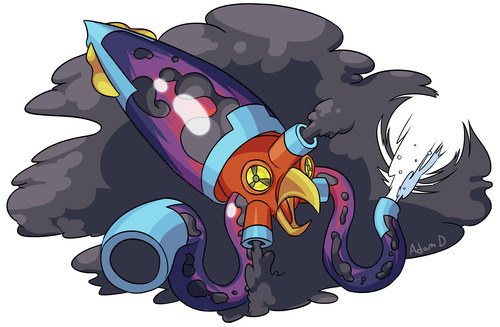
Original concept brief, and a later update (both written by Chewiana Jones):
“What if we had an enormous squid/oil lamp hybrid that lived deep in arctic oceans, getting most of its nutrients from volcanic vents and small deep-sea Pokemon prey and burning oil (for warmth) in small amounts inside its body, which could look somewhat steampunk furnace-ish structure with more organic parts like the eyes and mouth mixed in and a body made of translucent, durable membrane with golden light shining through, supported by a skeletal framework. However, when it starts to run low on oil, it flares up its flames and rises like a hot air balloon to closer to the surface. There, it hunts pokemon like Walrein and Dewgong by expelling oil like squid ink and then lighting it on fire, then eats them and uses the oil for more power.”
“Yeah, I do think that Wailord might make more interesting prey for it. I only mentioned the seal Pokemon because unlike Wailord, they aren’t
resistant to fire (well, unless they have Thick Fat, that is), so using
fire attacks on them would make more sense. I suppose the whole point of
water’s resistance to fire is that water puts out flames, though, and
it can’t put out oil fires, so I could see having it hunt Wailord and
giving it an ability that lets it bypass the water-type resistance to
fire, making it do neutral damage to most water types and be
super-effective against Walrein and Empoleon and such.
Also, in regards to hunting, I have a few new ideas. Firstly, it
wouldn’t necessarily be completely harmless when not hunting oily
aquatic mammals. If it’s going to be generating heat and light anyways,
it might as well put that to good use, and I like the idea of a school
of deep-sea fish Pokemon seeing a strange, golden light shining from
within a cave at the bottom of the continental shelf, swimming over to
investigate, and promptly being ensnared and devoured by the squid
thingy. Heck, since real cephalopods are fairly intelligent and it lives
in an area where there would probably be a fair number of shipwrecks
due to all the icebergs (And possibly their own intervention as well.
I’m not sure how they would sense a Wailord passing, but they might
mistake a large ship for one, and, upon finding out that it isn’t,
decide that since they already used up the oil to accelerate their rise
to the surface and there has to be something edible on the strange
wooden whale, they might as well tear it to bits anyways, in turn
inspiring numerous sea monster stories), I can even see it picking up
treasure that looks interesting to it and hoarding it in its cave-lair.
I’m personally going with a sort of antique oil lantern made of heavily
oxidized bronze as the better part of the main body to stick with that
sort of theme.
As for the hunting for oil, I suppose it WOULD burn up all of the oil
that it was looking to consume if the squid just went and lit its prey
on fire. Instead, it could trap a Wailord, weaken it it, and drive it to
the surface by surrounding it in burning, oil-filled water, then go in
for the kill with its harpoon-like tentacles, which are so strong that
it can sort-of stumble around on land with them for short periods of
time, kind of like those War of the World tripod thingies except not
quite as upright and at a risk of getting its barbed "feet” either stuck
in the ground or unable to penetrate, if used on something harder than
ice. I’m not sure what the evolutionary advantage to being able to do
this would be, but it looks cool.
Finally, while normally fairly solitary creatures, when a large group
(pod?) of Wailord passes through, a large number of oil-squid (lets
call them Colosquiln (colossal/colossus – squid – kiln (best fire
reference that I could work in smoothly)), for sake of argument) gather
beneath them. The Colosquiln then rapidly ignite and release all of the
oil in their bodies at once, firing themselves like giant, bronze-tipped
bullets straight through the air-filled bodies of the Wailord and
killing them in massive numbers. It is only the bizarre breeding
abilities of the Wailord that keeps them from extinction by over-hunting
by Colosquiln, and the Colosquiln often come into conflict with the
local whalers in areas where Wailord-hunting is not illegal.“
We have stats:

We do not have proper condensed Pokédex entries. We do not have a name; Chewie suggests Colosquiln but I’d like to get more suggestions and do a poll on it (personally I am not particularly enamoured with ‘Colosquiln’ but that may be because I’m an archaeologist and I don’t necessarily think of the same things as most people when I hear the word ‘kiln’). Come to think of it, we do not have sprites either; if there are any talented spriters out there it would be good to have something to fill that gap. We do not have miscellaneous information like height and weight (I imagine the short answer is ‘big,’ but how big?), which experience curve it uses, and what effort points it provides when defeated. All of this will need to be decided, and I’d like people to start talking about it in the comments section if there are any ideas, but the first thing I would like to do is take suggestions for any ‘tweaks’ to the stats and movepool. I do not wish to deprecate any of the considerable work Thatswhatbradsaid put into this stat spread; however, I have come to feel that doing the stats and movepool is rather a lot to leave to one person and rather a lot to decide for one vote; trying to break it down more would have resulted in a crippling lack of direction, but doing it all as one vote leaves us without a lot of discussion on the details. What I now want to do is create a whole series of polls, to be done all at once, along the lines of "does this Pokémon need this move?”, “should this Pokémon have a slightly lower/higher stat in this area?” or “does this ability seem right to you?”. What I’d like, then, is to get people talking about what adjustments, if any, would be beneficial.
Just to get the Pokéball rolling, as it were: I don’t think there’s any real concern that this Pokémon will fail to be a useful high-speed attacker. I have concerns that its extremely good speed and special attack, kitchen sink of attack moves, surprisingly varied support movepool, and Water-type V-Create are a bit much – however, it also has paper-thin defences and a weakness to Stealth Rock, and will remain highly vulnerable to priority attacks and Choice Scarf users. So I ask: what do you think? Does it really need to be toned down at all? If so, what would you do?
 Pokémaniacal