This may seem like an odd question, but how do *you* play Pokemon? I mean, we hear all of your philosophical and abstract stuff which of course is amazing, but when you actually sit down to play one of these games, what do you do? Do you like to catch everything you see, or are you selective? Does your play-style change if you are replaying a game? Do you take competitive strategies into account or do you just brawn your way through?

*shrug* Sorta depends what I’m doing.

The very first time I played Black version, I caught every new species I encountered because I wanted to figure out what made them tick.  I also chose Pokémon to use without really having any idea what I was looking at or how it would evolve (when I decided to train my Larvesta, Invicta, I knew she’d be worth it in the end, but had no idea what she’d actually become or how long that would take – turned out the answer was “a while” but at least I had an Eviolite).  You only get one chance to play like that, and I think it’s a lot of fun because it really pushes the theme of discovery that’s so important to the series.

When I replay a game, sometimes I like to impose rules on myself, because Pokémon is a lot of fun but (let’s face it) not all that difficult.  The ‘Nuzlocke Challenge’ is one set of rules, but there are other ways you can do it – sometimes I limit myself to using Pokémon of only one type, other times I get my best friend to pick out a team for me and provide me with a bunch of eggs.  The Pokémon he picks are invariably awful, because he is a sadistic bastard – on one memorable occasion, I played through Leaf Green with a Beedrill, a Farfetch’d, a Lickitung, a Primeape (easily the strongest member of my team), a Tangela, and a special attacker Rhydon.  And you know what?  That Farfetch’d kicked ass.  Relatively speaking, anyway.  Sometimes I’ll just limit myself to using Pokémon I’ve never seriously used before.  That led to an interesting Ruby version playthrough with a four-man team of Masquerain, Armaldo, Solrock and Kecleon (since Masquerain was going to be my only Pokémon for a while, I prepared for this one by breeding a Surskit with Hydro Pump, because seriously, it’s Surskit).

As for competitive strategies… well, the thing to realise is that a lot of stuff that you have to think about when you’re preparing for a Battle Tower run or a battle against another person just doesn’t apply to a playthrough.  Trying to EV-train your Pokémon is just a waste of time, you’ll have limited access to TMs, you probably won’t be breeding your Pokémon so egg moves are out, you won’t have access to move tutors, and your opponents will rarely switch, which means that moves like Spikes and Stealth Rock are much less useful unless you plan to spam Whirlwind.  The other thing is that, since the AI opponents’ Pokémon never have any EVs until you get to Battle Tower type facilities, later in the game your own Pokémon will almost always be faster than them unless they have a massive advantage in level (which, granted, the Elite Four and Champion often will), which drastically changes the value of fast and slow Pokémon.  In short, I think it’s good to be aware of good competitive strategy because a lot of the properties that make Pokémon competitively strong do still apply, but you also need to remember that you’re actually not playing the same game.

Now that it’s been a while since Black and White came out, have you realized that Garbodor is, in fact, lovable and awesome in every single way? I spend about a dozen paragraphs explaining why, point-by-point, over on Bogleech, if you haven’t been there. Also, did you know that your hated Kricketune isn’t even modeled on a cricket? It’s a violin beetle!

You know, funnily enough, someone sent me a link to that article just a few days ago.

For the benefit of readers, here is Bogleech’s take on Garbodor

http://bogleech.com/pokemon/trash.html

and my (admittedly over-the-top) article from last year.

http://pokemaniacal.tumblr.com/post/17760677860/trubbish-and-garbodor

I still think Garbodor is absurd and horrific.  What didn’t occur to me at the time was the point you make in your article that some people might actually like things that are absurd and horrific.  Honestly I still kinda have trouble wrapping my head around that one, but I suppose it is a valid position to take.  I do really like the point you make about Garbodor forming a land/water/air triad with Muk and Weezing, because that does alleviate my concern that Garbodor is just Muk 2.0 (personally I’m still not sure I give the designers that much credit, but it’s difficult to make an argument from that kind of assessment).  I guess the thing to take from this is that, as much as I try to be objective about things and excise my own personal taste from my assessments, I can never really get rid of it.

As for Kricketune…
Go go gadget Google images…
Huh.  That is now a thing that I know.
It doesn’t make me think Kricketune is any less dumb, ‘cause all the things I hate about Kricketune are still things that they’ve changed from the violin beetle, not copied from it.  Also, from what five minutes’ of Googling can determine, violin beetles don’t actually ‘sing’ the way Kricketune and some other insects do, so crickets are still important for the idea (hence the name).

EDIT: Bogleech’s response on Kricketune:
Yeah, while I like him well enough, I’m just adding that in addition to other criticisms, Kricketune lives a shameful taxonomic lie. Technically, we still have no cricket pokemon, or even a grasshopper or other true Orthopteran. Kricketune wouldn’t even be able to jump with those nub-feet, and jumping is even more integral to being a cricket than singing. There are mute crickets, but if any can’t jump, I haven’t heard of them, and a cricket I haven’t heard of is hardly a cricket at all. 

Rereading your entry on Stunfisk, a thought just hit me: you said “and it would actually make sense because he’d no longer be an aquatic Pokémon with a weakness to Water!” in regards to Stunfisk not having Water Absorb. This got me thinking: do you think ‘water’ is the same as ‘Water-type’? I mean, Water Pokémon damage from Water moves, but many live in the water nonetheless. So the question is this: is the water in Water attacks the same as the water in the oceans/rivers/lakes?

The entry, for those who are interested: http://pokemaniacal.tumblr.com/post/17760688728/stunfisk

Well, it’s true that most Water Pokémon do still take damage from Water attacks, but they do resist it.  In much the same way, all Pokémon take at least some damage from Gust and Air Slash.  I do think that Water attacks are, for the most part, using ordinary water (there are a few exceptions; clearly Bubblebeam is more than just bubbles, but trying to explain specific attacks is just asking for trouble) and that the damage is primarily in the force with which they fire it; for most Pokémon, it’s the impact of a Water Gun that’s doing the damage, not the water itself.  For Pokémon that are weak to Water, obviously there’s no reason the water should be physically hitting them harder, so it seems likely that they are in some sense vulnerable to water as a substance.  Fire Pokémon, obviously, do not take kindly to being dampened.  As to the other two types, Ground and Rock… I vaguely recall reading a fan-fic once which suggested that Ground- and Rock-types possess a sort of exoskeleton made of a porous ceramic material, which can absorb a lot of damage (hence their traditionally high physical defence) but can become waterlogged, slowing them down and taxing their energy.

In short, I think that a Pokémon who is neutral to Water attacks simply takes damage from the crushing force of the water hitting it, while a Pokémon who is actually weak to Water attacks is somehow harmed by water itself, and has no business living an aquatic lifestyle.

I remember you mentioning how you have big ideas for changing the Type system and wanted to hear your opinion on my idea for a new type mechanic. I have this idea into changing the big group of Types into Biological Type and Elemental Type. Bio types would be things like bug, dragon or ghost while element types would be the water, fire, poison, etc… each pokemon would have 1 of each, not 2 of one or the other. Pikachu for example would become a beast/electric or mammal/electric. Thoughts?

Tricky…

I think the difficulty is that a lot of Pokemon that already exist belong to two types that would fall under a single category in your system.  What happens to Shedinja?  It doesn’t make any sense for him to be not a Bug-type, or not a Ghost-type; the concept just doesn’t allow it.  Do you keep Grass an an elemental type, or use Plant as a biological one?  You’re in trouble with either Sawsbuck or Abomasnow.  Psychic causes similar problems.  And what about Pokémon that just plain don’t have any elemental powers, like Raticate?

Besides, the egg group system already provides something like this.  It doesn’t play into strategy at all, but why should it need to?  Why should a Pokémon’s strengths and weaknesses be different depending on whether it’s a mammal or a reptile?

I think that the biggest objection, though, is that it says “no” in advance to a lot of possible designs for no real reason.  Why can’t we have a Pokémon with both ice and electrical powers?  Why can’t we have a Pokémon that’s a fusion of a mammal and a bird (gryphons, anyone?)?  What reason is there to deny designers that option?

What do you think are the best and worst pokemon spinoffs?

Well, to be honest, I’ve only played three of them – Mystery Dungeon Blue, Pokémon Ranger, and the old Gameboy Colour version of the trading card game.  Er… I guess I thought the best of those was Pokémon Ranger, and the worst was the TCG?  I enjoyed all of them, though.  Ranger had some interesting game mechanics that the main series could learn a lot from, and made good use of the partner Pokémon, while Mystery Dungeon is just an inherently fun concept (could have done a lot more work on their world building, though).  I only put the TCG at the bottom because the premise was a little nonsensical – I mean, it was a game that was actually about playing the card game, and you could travel around the country challenging these, like, trading card gyms, and there was a professor in your home town who studied the trading card game in this huge lab full of expensive machines, and…

…I gotta get me an emulator of that s#!t.

I mean Aztecs, Mayans, and inca.

Again, this isn’t actually an idea.  It’s a starting point, and as a starting point there’s nothing wrong with it, but it could be done well or badly.  At this point all I can do is shrug and say “sure, those are interesting cultures, although I don’t know much about them myself.”

To put it another way, if you start from a design brief of “a Pokémon based on ancient Egypt,” one person might come up with Lucario and another might come up with Cofagrigus (as it happens, both of those are Pokémon I think are very well designed).  I have absolutely no clue what you have in mind or how well it would work.  If you’re asking “do I want more Pokémon based on ancient cultures?” then sure, I love those.

In my view I think a pokemon based off the early Americas religion would be awesome as well as something based off the mongals. Do you think it would work at all.

Xatu, anyone?

You’re going to need to be a lot more specific here.  As starting points, there’s nothing wrong with them, but either could be done extremely well or exceptionally badly – what exactly is the idea?  Also, “Early Americas” is very general – are we talking Great Plains?  Mexico?  Andes?  Amazon Basin?

If you got up one morning and you were a pokemon who would you want to be and why them.

Hmm…

Maybe it’s the historian in me, but I’m very tempted to pick Xatu.  The whole infinity of the past and the future, spread out before your eyes… on the other hand, there are a few hints that Xatu spend most of their lives paralysed with terror because of the things they’ve seen.

Hmm.

Maybe I’ll just play it safe and be a Druddigon.  I’ll live in a cave being grumpy and eat anyone who bothers me.  That’s pretty much my goal in life anyway.

Final Thoughts: Eevee

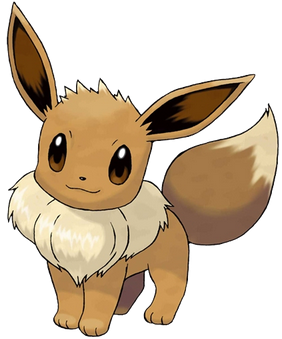
Official art of Eevee, by Ken Sugimori; image copyright by Nintendo, yaaay.All these entries on Vaporeon, Jolteon, Flareon, Espeon, Umbreon, Leafeon, Glaceon… what about little Eevee?  Doesn’t she deserve some love too?  When you think about it, Eevee is actually the most important of the lot.  Without her, all the rest are just generic Pokémon of their own types, for the most part; many of them are well-designed, but they’re not really all that interesting on their own.  To no small extent, the thing that makes them worth thinking about is their common origin – a tiny Normal Pokémon with limitless potential.

Eevee is called “the Evolution Pokémon” – indeed, the word ‘evolution’ is the origin of her name, in both English and Japanese (where she is Eievui).  She pioneered the idea of a branched evolution, a concept that was originally unique to her, with her split into Vaporeon, Jolteon, and Flareon in Red and Blue.  When other branching evolutions were introduced in Gold and Silver, Eevee continued to have more branches than anyone else with the addition of Espeon and Umbreon, and today she has a grand total of seven possible final forms.  Eevee wasn’t just the first Pokémon to have multiple evolved forms, though – I think she actually got the whole idea spectacularly right, to an extent that subsequent Pokémon haven’t.  Split evolutions typically develop different ideas of a single design, and gain their real significance when you view them together, as pairs of Pokémon, but few of them go in radically different directions the way Eevee does, and the differences between their powers and abilities are often minor.  Slowbro and Slowking are probably the worst offenders – Slowbro has better physical defence, Slowking has better special defence and access to a few extra moves, and the opposition in their flavour is basically that Slowking is smart and Slowbro is dumb, because Slowking is high on Shellder venom 24/7 or something.  Bellossom and Vileplume are another pair where the differences are very subtle; Bellossom isn’t a Poison-type, but they have basically the same combat roles, and although thematically they represent an interesting day-night duality, it’s not something that comes through a great deal in their designs (largely because Vileplume was created first and Bellossom added later).  What all of these splits have in common is that, for the younger Pokémon who has the potential to go either way, it’s not a significant design element.  Poliwhirl doesn’t care that he could evolve into either Politoed or Poliwrath.  It doesn’t matter to Clamperl that she could become either a Huntail or a Gorebyss.  It’s just incidental that these Pokémon happen to have a choice.  For Eevee, it’s very different.  For Eevee, the choice is the whole point.

 Another piece by the inimitable Diaris (http://diaris.deviantart.com/), this time of Eevee rolling around in an orchard.

I believe that this is the key to Eevee’s consistent popularity throughout the franchise’s life: she offers something for everyone.  Her multitude of evolved forms represent not just many elements but many ways of appealing to players; whether you like cute Pokémon or tough Pokémon, beautiful Pokémon or mysterious Pokémon, Eevee can make it happen (just about the only aesthetic type missing is a brutish Pokémon).  This is a huge potential strength for the idea of branched evolutions, which most of them don’t fully exploit, and I think future designs could do some wonderful things by building on this model.  One of my pet ideas, which some of you might remember from my wrap-up entry on the starter Pokémon earlier this year, is to have a game with only one choice of starter Pokémon, but to give that Pokémon a branching evolution dependent the way your relationship with it develops.  Storyline-dependent split evolutions would, I think, be a very fun concept to work with and could produce a lot of cool ideas with interesting impacts on the way the games feel… but let’s get back to Eevee.  The point I’m making about the versatility of Eevee’s aesthetic appeal is also at the heart of one of my problems with Leafeon and Glaceon – I think that by the time Game Freak got around to adding Grass and Ice versions of Eevee, most of the possibilities for aesthetic development had already been exhausted.  Leafeon’s wide, alien eyes and foliage-covered body produce an aura of mystery and otherworldliness similar to that cultivated by Espeon, while Glaceon’s sleek, beautiful form shares a great deal with Vaporeon in terms of design goals.  I don’t think adding Leafeon and Glaceon was necessarily a mistake.  They could have been done well.  The problem is that, traditionally, Eeveelutions don’t have a whole lot of variety or detail other than those basic design choices and their elemental affiliations – their powers are typically very standard fare, and most of them don’t have particularly interesting behavioural traits or personalities.  As a result, they’re interesting only within the context of their family, not as independent Pokémon themselves.  Even this doesn’t have to be a bad thing, I should emphasise – because, of course, we always will view them as a part of that family – but it does, in my view, place a limit on how effective any future additions can be.  There are enough of them now that the essential point has been made already.

Someone asked me a few days ago which of the remaining ten elements I would most like to see used for a new Eeveelution.  Honestly this is one of those times where I have to begin my answer with “actually, I wouldn’t, but since you ask…”  After Leafeon and Glaceon, I think that continuing to add more would be rather labouring the point.  Eevee has more evolutions than any other Pokémon in the game, allowing her to express interesting themes of adaptability and diversity.  Most of the evolutions themselves are not especially interesting in isolation, and are more valuable for being part of that wider idea.  Why add more?  Only if you can do something different, something that casts a whole new light on the themes established by the existing members of the family.  Let’s talk about those themes for a bit because they’re important.  Evolution, as defined in the Pokémon universe, is of course a very different thing from the kind of evolution we talk about in modern biology, but in Eevee the two are fortuitously united.  Real evolution, of the kind first outlined in Charles Darwin’s On the Origin of Species, is the barely perceptible change of species (not – and this is important – individuals) over the course of generations in response to environmental pressures.  It does not aim in any direction.  It doesn’t make species stronger or faster or smarter.  It only makes them better suited to specific sets of environmental conditions.  The contrast with Pokémon evolution, which operates within an individual’s lifetime and (with a few notable exceptions) normally does make them stronger, faster, smarter and (again, with a few notable exceptions) larger, is obvious.  Eevee acknowledges the real-world concepts of evolution with her great spread of possible evolved forms – none of them superior or inferior (well, yes, okay, we all know Flareon is rubbish and Espeon is ridiculous, but it doesn’t seem like the designers intended for things to work out that way), merely different, and better adapted to different roles and different lifestyles.  At the same time, though, Eevee is still ‘evolving’ like a Pokémon, changing within her own lifetime to reflect the environment around her (this is actually more similar to the alternative, now discredited, model of evolution once proposed by Jean-Baptiste Lamarck, and I am becoming convinced that species of Pokémon actually develop by Lamarckian evolution – Google it; it’s fascinating stuff).  This creates a fascinating contrast, which is why I’ve been so interested in probing the environmental conditions that lead to each of Eevee’s evolved forms, and why I think this is the aspect of the design that Game Freak should be focusing on in the future – it doesn’t just have the potential to tell us some fascinating things about all Pokémon, it could even be educational too!
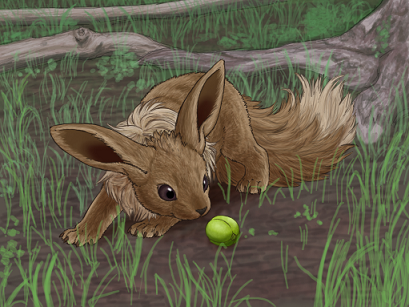
 A more realistic take on Eevee by RacieB (http://racieb.deviantart.com/).

The problem – and it’s one I’ve been trying to work around as I go – is that the designers’ level of commitment to this concept doesn’t seem to have been constant all the way through.  In particular, their use of the theme of environmental adaptation is rather haphazard.  As I mentioned in Glaceon’s entry, it makes sense to us on a certain level that Pokémon in hot places should fight with fire, and Pokémon in cold places should fight with ice, and Pokémon that live in forests should act like plants, and so on, because we expect them to take on the traits of the things around them.  When you think of it from an ecological standpoint, though, it starts to get quite odd.  It makes sense for Glaceon to resist cold, because she lives in cold places, but does it make sense for her to use the cold, when everything around her will resist cold as well?  Conversely, it makes sense for Leafeon to be able to use the plants around him, since he’s a jungle Pokémon, but does it make sense for him to adopt a lifestyle that leads him into direct competition with all those plants?  This is the reason I don’t place Flareon in a volcanic environment, even though this is something of a standard choice for Fire Pokémon – of course the fire-based creatures that live there already, like Slugma or Magmar, would innately be able to use fire, but if you were a Normal-type moving into a place like that, what survival advantage would be conferred by gaining fire abilities?  In the end, of course, a complete ecology of the Pokémon world is a long way off – if there’s even any possibility it will ever happen at all – but I think looking at Eevee in a more critical light might be a good place for any such project to start.
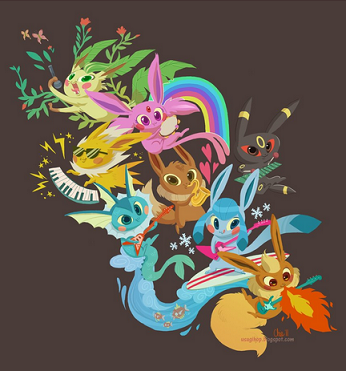
 Before today, you all had to trudge through the endless dreariness of your dull and unfulfilling lives without the awesomeness that is an Eeveelution rock band.  Now, thanks to Tinysnail (http://tinysnail.deviantart.com/), you no longer have to!

Let’s return to that question I was supposed to be answering.  What else could you evolve Eevee into?  Ground, Rock, or Fighting?  They would be obvious choices for filling that one remaining aesthetic niche, but I’m not sure the idea of a brutish Eevee is necessarily one that would achieve any particular appeal.  Poison?  What thematic aims would be served by creating a poisonous Eevee?  Flying, Bug or Dragon would be… odd, put it that way.  They would make our new Eeveelution very much an odd one out in the Field egg group, since those three types are some of those that map most closely onto corresponding breeding groups, and they also raise some concerns about what environmental stimulus, exactly, would prompt Eevee to sprout wings or additional legs.  Ghost could potentially bring up some points about Eevee’s interaction with humans, but I’m not convinced you could do anything with it that Espeon and Umbreon didn’t.  I’d prefer to leave Steel out of it, because that’s getting perilously close to drawing human modification into things, which I worry would rather miss the point.  In fact I think there’s really only one type you could do anything interesting with if you wanted to make an eighth evolved form for Eevee.  It’s Normal.  All the other forms focus on shedding Eevee’s flexibility in exchange for becoming supremely well-adapted to a particular environment; a Normal-type evolution could instead look at the idea of retaining that adaptability; instead of having the narrow movepools that signify the specialisation of the other forms, she could use a wide selection of moves to act as a ‘jack of all trades, master of none’ type character (something like, say, Clefable or Mesprit, except that it would be the whole point of the design rather than an unintended result).  I might abandon the traditional Eeveelution stat spread as well, and give it flat average stats across the board, just to ram the point home.  This is a Pokémon that travels widely and can live anywhere.  It can’t settle down and really force other species out of their permanent niches, but it can get by in just about any environment.  As a result, it’s both adventurous and capricious, preferring not to stay in one place for too long, and, like humans, prizes wide knowledge and varied experiences.  The unfortunate weakness to this design is that I really have no idea where I would take its art – all my concerns about retreading old ground still stand, and I’m not especially wild about the obvious route of just creating a bigger, fluffier Eevee either.

The point I am by slow degrees trying to make here is that Eevee, in my opinion, is a fascinating Pokémon, who can provide some interesting lessons in design that haven’t really been appreciated or explored, even by her own more recent family members.  Her massive popularity (and that of her older siblings) isn’t just a question of cuteness, because of course Eevee is cute, but there’s nothing really to recommend her over the legions of other cute Pokémon out there.  She succeeds because she can be many things to many people.  If you love your Eevee, she will grow with you, reflecting your own ambitions and your own choices – and that, when it comes right down to it, is what Pokémon is all about.

I read the question you answered about making your own legendaries and it made me wonder what non-legendary pokemon you would make if you could make 1 evolutionary line. For me I’d either go with a line of Dolphin pokemon using sonar or a Capybara line that’s Water/Ground and has Sap Sipper as their name means “leaf eater”. What kind of pokemon would you make?

Someone actually asked me this a couple of weeks ago.

http://pokemaniacal.tumblr.com/post/35556857166/if-the-creature-design-department-at-pokemon-studios

The result was a Pokémon I’m tentatively calling Scribis.

http://pokemaniacal.tumblr.com/post/35617975056/ibises

It’s a stand-alone Pokémon, but I suppose it could do with a junior form – something that just scratches doodles in the sand with its beak without really knowing what they mean, and can see into the spirit world but can’t communicate with or understand other spirits.  Maybe the evolution could even be tied to the Unown, since they were supposed to be connected with Scribis in the first place – he evolves once they’ve taught him how to use their script.  That’d need a name… Scribblet?  Eh; that sounds kinda dumb…

As for yours – the dolphins could work, but they’d need something to distinguish them from all the other Pokémon with sonar (e.g. Golbat) or sonic powers (e.g. Exploud).  Not sure I see the point of the capybara except as an excuse to produce a powerful type combination.