Heya, loyal reader here! So you’ve repeatedly stated your opinion that at this point in the franchise, Game Freak should stop adding new Pokémon that doesn’t add anything new and start improving the ones they already have (your Top Ten Worst Pokémon comes to mind). If you were chosen to spearhead such a project, how would you do so? Would you create a pair of games that introduce a new region without adding new Pokémon, or revisit a previous region and add a whole slew of new mechanics?

Some of both, really.  I feel I should say again that I’m not actually against new Pokémon, and I would continue to add them, but I wouldn’t have a specific target number and I’d reject any that appeared to overlap significantly with existing species.  I just don’t think 100-150 new ones in a generation is necessary, and I don’t think the designers can maintain the standard of their best designs over such a large number; 30 or 40 would be more reasonable, in my view, and leave more time for everythig else I’d want to tackle.

As for what I would do… I’m sort of leaning towards the latter, but it doesn’t have to be a choice, really.  Fixing all the old ones would be a hell of a job, and I don’t think it would ever be possible to really achieve anything resembling game balance with so many factors in play, but a lot of them have obvious problems that could be fixed quite easily.  Minor stat adjustments, evolutions, more signature moves, new growth mechanics, and so on… and of course I would rip out great chunks of the type chart and reconfigure everything.

That’s only half of it, though; I’d want to work with the Pokémon as characters as well – include side stories and mini-quests and puzzles and the like that show off the particular abilities of specific Pokémon in ways that we don’t necessarily see in battles, the way the anime does.  Basically, I’d want players to feel just how important and how omnipresent Pokémon are in the game world, and place more focus on learning about their powers and ways of life (which, remember, is supposedly the whole point).

I actually want to do a whole series of entries on how I would go about creating a new Pokémon game (or pair of games) if I had the chance – I’ve sort of been meaning to do this all year, but other stuff kept happening, and now I don’t want to do it until I’ve had a look at Black/White 2 to see what they’ve done with everything (it has been strongly hinted that I will get one for my birthday in December).  Er… first thing next year, maybe?

Vaporeon

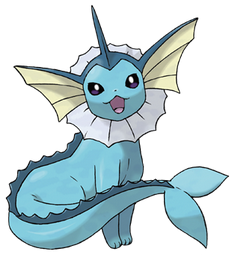
Official art of Vaporeon, by Ken Sugimori; all hail Nintendo, etc.Eevee’s enigmatic and mesmerising aquatic evolution, Vaporeon is not only the form of choice for players who are fans of elegant, beautiful Pokémon, she’s also one of the most dependable of the seven, with surprisingly good defensive skills and useful support powers.  Personally, I think she’s one of the better-designed Pokémon of the original 150 – kind of a hard act for the other six to follow, but hey, it’s not her fault she comes first in the Pokédex, so let’s see what makes her tick.

Vaporeon is an Eevee who has adapted to life in the water – her fur has been replaced by smooth, shiny skin, her fluffy mane with a webbed frill, and her puffy tail with a long, sleek dolphin-like one.  People who have seen just the tail have apparently been known to mistake Vaporeon for a mermaid.  Vaporeon is more than just an aquatic-adapted Pokémon, though.  She can actually control water to a degree that few other Water-types can match, can predict the approach of rain, and can even dissolve her own body into water in order to move unseen (this ability is represented in-game by the Acid Armour technique, which is not quite a signature move, but is restricted to only a handful of Pokémon who have similar powers, like Muk and Cryogonal).  The official explanation for how Vaporeon does this strikes me as a little bit suspect – apparently her “body’s cellular structure is similar to the molecular composition of water,” which is fundamentally absurd on a number of levels – but I’m willing to chalk this one up to the Pokédex being written by ten-year-olds who don’t know any better.  I’m tempted just to call it “magic” and move on, but then again, I suppose if all living things are mostly made of water anyway, it’s not all that impossible for Vaporeon to be able to flood her system with water in such quantities that she appears to dissolve into the water around her, even while the solid structures of her cells actually remains intact.  At least, it’s no more impossible than any of the other stuff that Pokémon do on a daily basis (actually, I think that in order to do this Vaporeon would need to have rigid-walled cells like a plant’s, in order to stop all her cells from bursting with the osmotic pressure… but let’s face it; now I’m just using fancy words to sound clever). 
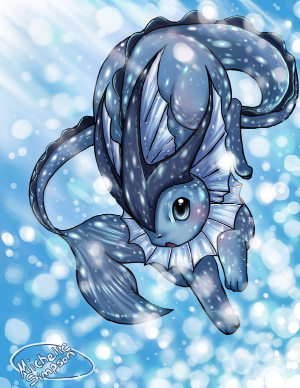
 An adorable leaping Vaporeon, by Michelle Simpson (http://michellescribbles.deviantart.com/ - if you like what you see, she does commissions).

Vaporeon succeeds at her design goals in a number of ways.  Her aquatic characteristics are smoothly blended with the basic Eevee shape she evolves from, resulting in something that isn’t just a rehash of a real water animal, the way so many Water Pokémon are, but a new and elegant combination of attributes.  Her unique water powers are also a neat point of difference from the zillions of other Water-types out there, even today with so many more to compete with than when she first took the stage.  She also fits very well with an aspect of Eevee’s design that developed a bit later, something I’m probably going to come back to a few times in this series: the idea that Eevee’s split evolution is all about adapting to the environment.  As far as I can tell, this idea isn’t present in Red, Blue or Yellow version, or the early seasons of the anime for that matter, where the presence of radiation from the elemental stones is all that’s necessary for any change.  Obviously, in the games, the stones prompt the change; there’s no question of evolving your Eevee into a Vaporeon by getting her to spend a lot of time in the swimming pool.  I do like the possibility that Eevee is able to grow in so many different directions because she’s evolved to be adaptable to many different environments, though.  Jolteon and Flareon, notably, aren’t good fits for the idea.  I can’t blame them for that, clearly, since they were designed before anyone ever suggested that adaptation to the environment was key to Eevee’s growth.  It is a nagging little inconsistency, though, which I’ll address as I move on through this project.  For now, it’s just good to note that Vaporeon fits the pattern so nicely, as an aquatic Eevee.  Moving on, then; Vaporeon is a very well-designed Pokémon, but how does she measure up in a fight?

A quick aside on the Eeveelutions’ stat spreads – all seven of them have the same absolute values for their six stats, just rearranged.  They all have three stats that are average to poor, one that’s very good, one that’s excellent, and one that’s amazing.  Vaporeon’s particular specialty is endurance; she has a ridiculous amount of hit points, enough to compensate for her poor physical defence (especially with a bit of focussed training), as well as a good special defence score.  What’s more, Black and White gave her (along with most of the other Water-types in the game) one of the nicest gifts a special tank could ask for – the ability to burn physical attackers with Scald, crippling their offensive capabilities.  Vaporeon’s support movepool is not wide – mostly, she can force switches and occasionally put things to sleep with Yawn, or kill them slowly with Toxic.  If you want to boost her physical defence (or someone else’s, by way of Baton Pass), there’s always Acid Armour, but using defence boosts is generally just begging to take a critical hit in the face.  The real kicker is Wish.  All seven of Eevee’s evolutions get Wish, a healing spell that kicks in one turn after it’s used, potentially allowing other Pokémon on the user’s team to receive the healing in place of the user.  Vaporeon, however, is by far the best at it, because the amount healed by Wish is equal to half of the user’s maximum HP – and Vaporeon’s HP is massive.  She can deliver some of the strongest Wishes in the game – surpassed only by Wigglytuff and Alomomola – making her brilliant for giving a wounded Pokémon a second bite at the apple, or helping a healthy Pokémon to switch in with impunity by healing any damage it takes as it comes in.  The other side to Vaporeon is what makes her so much better than Alomomola; unlike the sunfish Pokémon, she can actually fight.
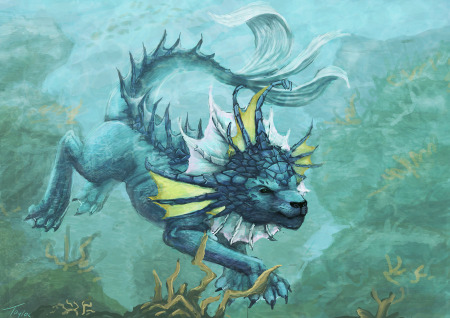
 A more realistic take on Vaporeon, by Ruth Taylor (http://ruth-tay.deviantart.com/ - she has more Pokémon fanart in the same style, and it is glorious), drawing inspiration from wolves, turtles and otters.

This is where another brief aside on the Eeveelutions in general might be a good idea.  Just about all of them have very poor offensive movepools.  Most of them have a powerful attack from their own types, plus Shadow Ball and Signal Beam, two fairly weak attacks from fairly weak elements.  None of them are suited to all-out assault.  Vaporeon, however, has one major advantage over her brothers and sisters: almost all Water Pokémon have power over ice as well.  What’s more, Water/Ice is actually a fairly strong combination.  Between Scald, Ice Beam, her excellent special attack, and Toxic, Vaporeon is pretty dangerous for a defensive Pokémon.  Most Pokémon with strong special defence that don’t mind Toxic can still ignore her fairly safely, but unlike Alomomola she isn’t just an invitation for a hyper-offensive Pokémon to jump in and start setting up, and if she’s in trouble, she can always drop a Wish and switch out.  The icing on the cake for Vaporeon is her choice of two wonderful abilities.  Her Dream World ability, Hydration, allows her to heal instantly from status problems during rain, which isn’t really as brilliant for her as it is for some of the other Pokémon who like to use it, since its major benefit is one-turn Rests, and Vaporeon relies heavily on Wish for healing anyway.  Water Absorb, on the other hand, is wonderful; by converting incoming Water attacks into a source of healing, it gives Vaporeon opportunities to switch in for free against some of the most common attacks in the game (Surf and Scald) as well as bonus healing, which a defensive Pokémon will always appreciate.  All in all, Vaporeon did very well in the great lottery of Pokémon, with everything she needs to back up her excellent stats.  Ever since Ruby and Sapphire introduced Wish and Water Absorb, she’s had an easy life; before then she was a fairly unspectacular but still above-average Water-type.  Some Eevee forms, despite having equally high stats… did not do so well.

As a matter of personal taste, Vaporeon isn’t actually my favourite Eevee evolution – that honour goes to Espeon – but as an objective assessment of her design and powers, I’m rather tempted to say that she is the ‘best’ of the seven.  Again, a hard act to follow, since it seems that, for some of the others, I’ll be talking partly in terms of how they fail to measure up to Vaporeon.  Still, at least she was a good beginning, her position among the original trio helping to establish Eevee as the universally adored Pokémon she is today.

Next Time on Pokémaniacal: Eeveelutions

I’m back, b*tches.

Okay, so, one of the things a few people have asked me to do is a study on the Eeveelutions (that’s Eevee’s rainbow of evolved forms, for anyone who isn’t familiar with the term).  Honestly it feels like a bit of a come-down after some of the far-out crazy stuff I produced while I was supposedly on hiatus, but then again, trying to produce articles like that regularly every three days would probably drive me completely mad, so maybe it’s best I go back to discussing something I can be relatively objective about for a little while.  Eevee, with her deep, sparkling eyes, perky ears, and adorable fluffy mane, is one of the most consistently popular Pokémon in the history of the franchise.  This is no coincidence – quite apart from the fact that Eevee is one of the cuter Pokémon out there, she possesses limitless potential.  Even if you don’t like Eevee herself all that much, chances are that one of her seven evolutions will tickle your fancy at least a little.  A number of them are top-notch battlers as well (others… not so much).  In many respects, I suppose they’re a lot like the starters, whom I reviewed earlier in the year.  In short, they’re definitely something that’s worth a closer look.

I’ll be covering all seven evolved forms of Eevee in national Pokédex order, starting from Vaporeon – and maybe finishing with an entry on Eevee herself, with some concluding remarks on the whole set.  I guess I’d better start writing…

Alright so this question is a little hard to describe, but I think you’re the best person to answer it. Let me construct a scenario. Say you have two rattata, a pokeball, and a master ball[.]You toss the master ball, the rattata gets caught, as the master ball can never fail. You toss the pokeball, and while you’re unsure, let’s say the rattata got caught in this instance. Now, both rattata were caught. But a pokeball’s defining factor for its quality is its chance of success. (cont. ->)

This question continues:

And in that instance, both balls were equally successful. But here’s the rub, in that you can’t re-use a pokeball. So how would you know if the master ball were really as perfect as advertised, (i[.]e. it will catch any pokemon without fail) if in that instance it was just as effective as a pokeball? If you caught a rattata with a pokeball, then doesn’t that mean you might have used a master ball? My question is, how can we know the master ball is really effective?

Oh! And another question, springboarding off of the one about what the pokeball means to the world in this series.

What would a master ball mean to your theory that pokemon battle trainers to test worthiness? That despite its resolve to test the trainer, it can be captured no matter what kind of fight it puts up, if it gets the chance to do so?”

 My answer is as follows:

Well, in the instance of the Rattata, you can’t tell.  That’s why you wouldn’t test a Master Ball against something like a Rattata; you’d test it against something a Pokéball probably isn’t going to catch, like a Dragonair or a Rhydon.  Testing a Pokéball and a Master Ball against a pair of Rattata is a little like testing a Roman Candle and a tactical nuke by strapping bits of paper to each one and seeing what happens.  Either way, the paper is reduced to ashes, but you wouldn’t conclude based on this test that a Roman Candle is equivalent in firepower to a nuclear bomb.

I’m not sure that actually resolved your question, but you might be better off consulting a statistician for a more thorough answer.

Anyway, your other question.  Assuming I’m right about what battling and capturing a wild Pokémon actually means, a Master Ball is a terrible, terrible thing to use.  It basically destroys the idea of a partnership between a trainer and a Pokémon and relegates the Pokémon to the position of a passive subordinate.  This really isn’t entirely above board, and it lends an interesting perspective to the ways Master Balls turn up in some of the games: in Red and Blue, the Master Ball is the object of Team Rocket’s whole Silph Co. campaign; in Gold and Silver, Professor Elm remarks that they’re only given to trusted researchers; in Ruby and Sapphire, it’s in Archie/Maxie’s office in the Team Aqua/Magma lair; in Diamond and Pearl it’s given to you by Cyrus, of all people, and if that doesn’t send up red flags then I don’t know what does!  Oh, yeah, and in Black and White, Professor Juniper is like “hey, look what I got you!  Isn’t it shiny?” so whatevs.

What you haven’t asked me, and the point where my model currently falls down, is how other kinds of Pokéball like Ultra Balls, Lure Balls, Dusk Balls and so on fit into the scheme of things.  At present, I simply don’t know.  Clearly they influence the Pokémon somehow, but how they do it – and what the implications for the series’ internal morality might be – is beyond me.  For now.

Reading the latest question and also your past entries made me wonder. What would pokemon view tournaments or gyms as such? Pokemon do enjoy battling at least most of them do, I suppose at least some would relish a tougher competition. But in essence how would they see gyms or tournaments or such since they are cater more for human enjoyment. Thanks.

That’s the crux of the matter, isn’t it?  Some Pokémon, presumably, are as hungry for glory as their human masters and relish the opportunity to show off their powers in front of a cheering crowd… but not all of them will be like that.  My ideas about trainers and Pokémon suggest that many (perhaps most) Pokémon are in it to gain broader experience and a range of skills that they would never develop in the wild, ultimately with the goal of returning to a wild community as powerful leaders.  Tournament-style battles are a very artificial set-up, though, with limited relevance to developing that wider knowledge base, and are mostly about prestige and entertainment.  I think for a lot of Pokémon this is just ‘their end of the deal’ so to speak – they certainly don’t dislike the attention, and  any who have good relationships with their trainers will probably benefit from the prize in some way, so why not?  Unless they’re particularly committed to the whole trainer-and-Pokemon lifestyle, it’s probably just business as usual for most of them.

You may remeber a fake picture rolling around the internet a while back claiming there was going to be a generation zero. (Google “pokemon generation zero” and you’ll be set). Although it was announced as fake. There was one idea i found truly facinating. The idea of using baby formes of the Articuno, Zapdos and Moltres, although that exact idea is a bit silly. Am i the only one who would like to see a game which focuses on you raising a legendary suchas Zekrom or Reshiram?

Hmm.  Go go gadget Google.

Oh, RIGHT; I remember this!

Yes; okay.  So, for everyone who hasn’t seen this – ‘Generation Zero’ is an idea for a prequel to the existing Pokémon games, in which the player takes on the role of a young Professor Oak or Agatha, writing the first Pokédex, inventing new Pokéballs from apricorns, using the DS touch screen to sketch Pokémon you catch for the Pokédex… and with an infant Articuno, Zapdos or Moltres as the starter.

Anyway, as to that question… Personally I have rather different views on legendary Pokémon to most people; in particular I actually don’t think they should be obtainable by players at all (with some exceptions).  If you wanted to make a whole storyline out of it, on the other hand, that could become quite fun.  I would rather like to see a game in which your relationship with your starter Pokémon takes centre stage, building on the way Yellow handled Pikachu with the more advanced storytelling that the games have been developing since then – raising a legendary Pokémon would be an interesting way to do that.  Naturally, you would have villains – possibly multiple factions of villains – trying to claim your partner for themselves.  The law-abiding citizens and police of your region might be on your case too – it’s dangerous for anyone to have that kind of power, let alone a kid!  Meanwhile your Pokémon is getting stronger and stronger – as a legendary Pokémon it might need to assume an important place in the order of nature, but it has to learn to control its powers first.  You could do some interesting things with the game mechanics too, having your interaction with your partner affect the way it learns and gains new powers.  Reshiram and Zekrom might be particularly good choices for a game like this, because the most important theme of their story is partnership with a human ‘hero’ (and, of course, if you have one of them, the immediate question arises… who has the other?).

So yeah, if you actually built the story around it, rather than ham-fistedly pasting a legendary Pokémon into a standard Pokémon plot, I think it would be fascinating!

In the Pokemon world, it seems that kids tend to leave home once they’re out of primary school. I’m wondering what your take on that is. Does every kid go on a journey at that age, or just those who are particularly motivated? Do kids who don’t leave home keep attending regular school, to obtain pokemon related jobs? What about university? The entire educational system of their world has always left me baffled, so I’d like to know what your thoughts are.

Strange, isn’t it?  I suspect what keeps the whole system from falling apart is that “Pokémon Trainer,” aside from being a sport, is also a perfectly legitimate occupation.  Pokémon are integral to many aspects of their society and you can find Pokémon workers in almost any major sector; without their powers, several industries would have to be reinvented from the ground up.  Given this kind of reliance on Pokémon, I think perhaps the benefits of having a large class of readily available specialists in dealing with Pokémon might outweigh the need for universal high-school education.  I doubt all or even most kids become full-time trainers; in fact I suspect that most Pokémon trainers come from families with a history of working closely with Pokémon (Ash’s father was a powerful trainer, Gary’s grandfather is a researcher, Misty’s sisters are all trainers, Brock’s parents are both trainers, May and Max are the children of a Gym Leader, and so on and so forth).  Hundreds of years ago, these people would have been a wealthy aristocracy who were responsible for creating this Pokémon-centric society in the first place, made up of the people who had enough land and money to support large numbers of Pokémon who were trained solely for combat.  Today anyone can enter this class, though people with the family traditions are more likely to do so.

How do you think the pokeball would be viewed in the pokemon perspective and the human perspective? Its a very simple question but I believe it may have its complications particularly for the former.

As a symbol, you mean?  Hmm.  Well, for humans it seems to be hugely important; they splatter Pokéball logos all over the place.  A Pokéball is the symbol of the Pokémon League, for heaven’s sake.  As the tool of a Pokémon trainer, it represents the foundation of the partnership between humans and Pokémon that sustains many important aspects of their society.  For many people, it doubtless has another meaning: security, and the subordination of nature to humanity.  This is something you could take in a number of directions, and different people would probably view it in very different ways – the rank and file of Team Plasma, for instance, would probably view Pokéballs much as we view shackles, as symbols of slavery.  The fact is, for humans, partnerships with Pokémon lead to almost infinite possibilities, and the ways in which people react to the image of a Pokéball logo would be similarly varied.

For Pokémon, the image is likely to be just as complex, and largely dependent on their personal experience of humanity.  Some Pokémon who have suffered at human hands would, like Team Plasma, view Pokéballs as tools of slavery and cruelty.  I suspect Pikachu has something like this in his past – consciously, he knows that Ash’s Pokéballs aren’t harmful in and of themselves, so he’s okay with Ash’s other Pokémon climbing in, but the idea of using one himself triggers bad memories and irrational fear, making the very idea unthinkable.  For other Pokémon, a Pokéball is a place of security for when they’re tired or injured.  For still others, the beginning of a dramatic change in their lives, something that changes their fate forever – whether for good or ill.

In short, the image of a Pokéball encapsulates everything you believe about trainers and Pokémon, whatever that may be.  It’s an incredibly powerful symbol but, much like the swastika (for thousands of years a symbol of good fortune, but for much of the last century the dark signature of a regime of hatred and oppression), it doesn’t necessarily mean the same thing to everyone.

So, in an episode of the Sinnoh anime, there is an episode where Dawn’s Piplup is seeming sickly and tired all of the time, and disappears during the night. It turns out that Piplup is about to evolve, however, it uses the move Bide to keep itself from doing so. When the evolution process finally starts in battle, Dawn is at first very excited, but then confused when Piplup bides the evolution away. Do you think this raises some interesting questions on a Pokemon’s control of evolution?

Hmm.  Interesting.  I will note that I’ve seen hardly any of the Sinnoh series and don’t really know anything about Piplup’s portrayal as a character, but putting that aside…

In some ways it’s a similar situation to what Bulbasaur faced in Bulbasaur’s Mysterious Garden, except that here the pressure to evolve is internal, not external.  My usual position on evolution is that it’s triggered at least partially by a state of psychological readiness (with certain exceptions, such as the use of evolutionary stones or the evolution ritual in the Mysterious Garden) so on the one hand, it makes sense for Piplup to be able to hold it off by an act of will, but on the other hand, in the absence of any obvious external stimulus, I have to wonder what was causing Piplup to evolve in the first place.  Maybe a subconscious desire for growth and strength was prompting the change in body chemistry that triggers evolution, but on a conscious level Piplup didn’t actually want to evolve – he wanted to get stronger in his current form.  The conflict would be enough to forestall evolution indefinitely, but at the cost of maintaining a heightened state of stress which would normally be associated with a short burst of rapid growth, hence Piplup’s weakened state.

What I seem to be saying here is that Pokémon don’t normally ‘choose’ when to evolve, per se; although it will usually happen partly because they want it to, it’s triggered by psychological factors outside of their conscious control.  Normally evolution takes place in moments of heightened emotion – it might be a rush of adrenaline that pushes them over.  A Pokémon who understands the process might be able to cultivate deliberately the kind of mental state that prompts evolution – or, in Piplup’s case, force himself to calm down and slow the process.

Are pokemon able to understand human speech innately or much trainers train them much in the way people train real animals?

I suspect if you were to ask someone from the Pokémon universe, they would respond that this is one of the ‘wondrous mysteries of Pokémon’ which Professor Oak and his ilk are doing such a rubbish job of pursuing.

The anime certainly seems to imply that they understand human speech; people regularly talk to Pokémon, and the Pokémon seem to react appropriately to the words they’re hearing, even wild Pokémon who’ve had no previous exposure to English, or Japanese, or whatever language these people supposedly use.  You could argue that Pokémon have adapted to be able to respond effectively to human orders since it allows them to work with humans more efficiently, but their comprehension seems to go beyond that; Ash regularly talks to his Pokémon about subjects that go well beyond simple tactical commands, and they clearly understand him.  On the other hand, when Meowth first attempts to learn human speech in Go West, Young Meowth and tries to read words out of a book, it’s clear that he doesn’t initially understand the meaning of what he’s saying – he just knows they’re words used by humans.

I think the key to making sense of this is that Pokémon can understand each other as well, and can communicate relatively complex information between different species despite having very few phonemes to work with and almost nonexistent syntax.  Clearly the actual sounds involved in communication are of secondary importance to them; they’re receiving and understanding something else.  I think Pokémon are capable of this kind of universal comprehension because they’re excellent at interpreting nonverbal cues – things like gestures, posture, tone, and eye movement.  When Pokémon speak to each other, this is how they get most of their meaning across.  The actual vocalisations are used mainly for emphasis.  Likewise, when they listen to humans, they’re not actually listening to the words – they’re listening for shifts in tone and inflection, watching your eyes and the way you hold your weight, and so on.  Because this is how they communicate all the time, they’re extremely good at it.  The kind of conversation Ash most often has with his Pokémon – conversations about emotions and relationships – are very easy for them to understand.  Learning to recognise specific attack commands is a little harder, though distinguishing between ‘attack,’ ‘defend,’ and ‘dodge’ is basic.  Creating complex strategies in advance is difficult at first, but gets easier as the relationship between a trainer and a Pokémon develops.  Making heavy use of gestures can make this much easier.  Many, perhaps most Pokémon are intelligent enough to understand any concept you could possibly want to explain to them, but getting the message across may be difficult for more complex ideas.