
All right; time to put last entry’s… unpleasantness… behind me! Today I’m looking at a Pokémon based on one of Earth’s most awesome animals: the polar bear, the largest land carnivore of the modern world. Game Freak have rendered this powerful, dangerous creature as…
…a little teddy bear with a runny nose.
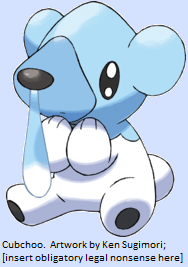 Heh. I can never resist an anticlimax. Truth be told, I think Cubchoo’s cute, and if we like polar bears for being the savagery of the Arctic personified, we love polar bear cubs for being cute as buttons. I don’t know whether I’d call him well-designed or not… “cute baby bear” is really easy and Pokémon’s done it before – see Teddiursa – so I guess the uniqueness of Cubchoo’s design is in the weird snot thing. I assume Cubchoo’s nose is constantly runny because it’s one of the classic symptoms of a cold, and he’s an Ice-type, which is… at once almost clever and a little contradictory because no Ice Pokémon would ever actually get sick from being in the cold. Continue reading “Cubchoo and Beartic”
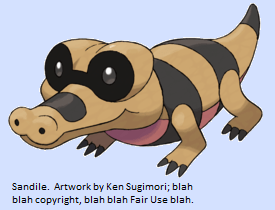 Today I’ll be talking about the desert crocodile Pokémon, Sandile, Krokorok and Krookodile. They are… well… crocodiles that live in the desert. That’s a good start, but it does seem to me like the designers have been reusing a formula again – and I’m not talking about the older crocodile Pokémon, Totodile, Croconaw and Feraligatr. What Game Freak have done is take a North African river animal, shift it a few hundred kilometres west, turn it into a Ground-type with a wave of their magic wand and said “eh; good enough.” Sound familiar?
 Meet Litwick, Lampent and Chandelure, the candle Pokémon. These guys are Ghost/Fire-types: another new combination, which is practically a guarantee that what we’re going to get will at least be interesting even if it’s not strong. The fact that they’re Ghost Pokémon is also, oddly, a good omen in itself because Ghost Pokémon are inherently fascinating; I for one am still trying to figure out what exactly they are. In the Pokémon world, Ghost-types are generally feared and seen as malevolent spirits, but in many cases this is actually unjustified – Gastly, Haunter and Gengar, famously, are not actually evil but have a very disturbing sense of humour that can easily cause playfulness to be misinterpreted as aggression; Sableye’s predicament is similar. Some, notably Mismagius, Dusknoir and Drifblim, have mysterious powers that could be used for good or evil, and where they fall on that axis is extremely ambiguous.
 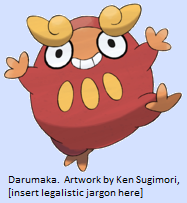 For reasons I’ll get to later, this one’s a bit of an odd duck (I mean this figuratively, of course, in contrast to Psyduck, who actually is an odd duck). Allow me to introduce the Zen Charm Pokémon, Darumaka, and his evolved form Darmanitan… two Pokémon that I personally find tremendously annoying, because if you fail to deal with them promptly they can and will leave huge smoking holes in your team. Most Fire Pokémon are very active but these guys are turned up to eleven, their internal fires producing enormous quantities of energy that they will burn up by any means necessary – and I do mean any; they even use their droppings as a way of offloading excess heat; I know this because the Pokédex tells us that people used to carry Darumaka droppings in their pockets to keep themselves warm (Pokémon: it’s kind of like that). Heaven help you if you get into a fight with a Darumaka while it’s fired up, so to speak – but, that said, they’re not by nature aggressive Pokémon, just overwhelmingly energetic.
 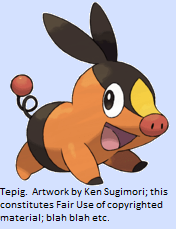 Yes, I’ve finally gotten around to the second of Unova’s three starters, the Fire-type Tepig… and so far it doesn’t look so bad. Tepig is pretty cute, I have to admit, and while it’s not the first time we’ve had a pig Pokémon, it is very different from the previous one – Grumpig is a manipulative Psychic-type that specialises in soaking up elemental attacks, while Tepig is intended as a physically-inclined heavy hitter with a bit of survivability. The only major gripe I have with Tepig is that his name is a little bit daft. I don’t know whether Tepig had a fan nickname before the English release of Black and White came out like Snivy and Oshawott (a.k.a. Smugleaf and Wotter) did, but if he had one it has to have been better than Tepig. I understand Game Freak must be running out of fire puns by now – they’ve already used char, magma, flare, molten, cinder, lava, explosion, torch, combust, blaze, erupt, coal and heat – but was tepid really the best word they had left? It makes me think of warm water – not even hot or boiling water, because tepid is basically a synonym for lukewarm. I’ll let Tepig pass on that, though, because he’s cute, generally nicely put together, and actually almost convinced me, for the first time ever, not to pick the Grass-type starter for my first play-through. So, let’s see what he evolves int-
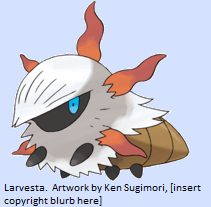 Visit an island near Nuvema Town, the starting location in Black and White, and you might meet a Pokémon Ranger with a mysterious egg to give away. This mysterious egg will hatch into a fascinating insect, which will probably set you on fire. With any luck this, like that regrettable incident between Ash and Pikachu, will signify the beginning of a lifelong friendship. Unless you just decide to squash it. Meet Larvesta, the torch Pokémon!
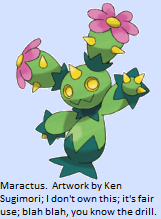 Maractus is a dancing cactus. It could be worse; in much the same way that destitution could be worse, because at least you don’t have the plague yet. We’ve had “dancing plant” before, and we’ve had “cactus” before, but Maractus is so different from the last cactus that I’m sort of willing to let her off on that one. Cacturne, her predecessor, was a sinister nocturnal hunter whose purpose in existence is to remind you what a scary place the desert is – and in my opinion, he did that pretty well. Maractus is a bright, happy diurnal performer, and on some level I can’t help but be annoyed by making a desert Pokémon so unrelentingly cheerful.
 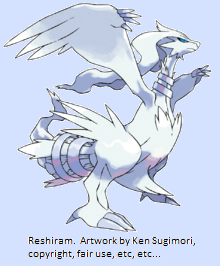 Seeing as I just finished talking about the story of Black and White, I may as well take the opportunity to look a little more closely at the two Pokémon that are central to that story: the dragons of truth and idealism, Reshiram and Zekrom. The design for these two has its roots in the Taoist concept of yin-yang, which I believe states (forgive me; I’m a little hazy on exactly how Taoism works) that the world and everything in it come into being through the interaction and harmonisation of opposites. In much the same way, Unova, the region in which Pokémon Black and White are set, is said to have been created by Reshiram and Zekrom working in harmony, as a single being (and then devastated when the two split apart and fought). To play into this theme of dualism, Reshiram is graceful, avian and feminine, with a soft-sounding name, while Zekrom is dynamic, saurian and masculine, with a hard-sounding name. This is all wonderful and I love the way the designs complement each other and develop the theme and all that, and it’s very nicely done… but there’s one thing nagging at me. They’re the wrong way around.
 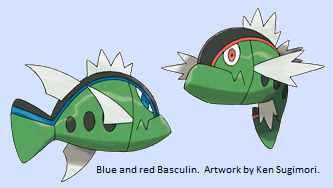 Today on Pokémaniacal I have the dubious pleasure of discussing Basculin. There are red Basculin and blue Basculin, and they hate each other. That’s really all there is to it, and to be honest even that seems to be open to interpretation; the Pokédex entry for Basculin on Black version says that red and blue ones will start fighting the instant they meet, but the entry on White version contends that Basculin sometimes do mingle with schools of the opposite colour, despite normally hating each other. So, to make this clear… the only vaguely amusing thing about these Pokémon is that they hate each other… and they don’t even hate each other all that much! We don’t know why they hate each other – well, actually, they seem to hate just about everything, but we don’t know why they hate each other particularly – nor do we have any reason to care since there’s nothing else interesting about them.
  Pokémaniacal