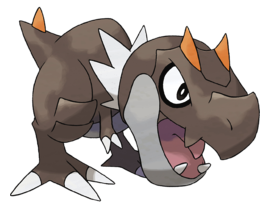
DID SOMEONE SAY MORE DINOSAURS OH BY THE GODS I HOPE THEY DID
F#$% YES
*Ahem*
…where were we?
Continue reading “Tyrunt and Tyrantrum”
One lunatic's love-hate relationship with the Pokémon franchise, and his addled musings on its rights, wrongs, ins and outs. Come one, come all, and indulge my delusions of grandeur as I inflict my opinions on anyone within shouting distance.
DID SOMEONE SAY MORE DINOSAURS OH BY THE GODS I HOPE THEY DID
F#$% YES
*Ahem*
…where were we?
Continue reading “Tyrunt and Tyrantrum”Well, “less is more” is very much a core belief of mine in picking apart this franchise. I don’t think it’s so much a matter of ‘more clearly delineated roles,’ because most Pokémon do have that down pretty well anyway; the problem is how easy it is to be outclassed by things that have a similar roles, and making moves less widely available might help with that. The presence of TMs in some ways is a little unfortunate, because the increasing ease with which we’ve been able to teach those moves over the years (first breeding to recycle them, then just outright reusable TMs) sort of devalues the Pokémon lucky enough to actually get some of those awesome moves in their level-up lists. Panpour is the only Pokémon in the game who naturally learns Scald! Did you know that? I sure didn’t. Do you care? I sure don’t, because just about every other Water Pokémon who isn’t also an Ice-type gets it too!
This is sort of part of the messed-up incomplete charm of the original Red and Blue – a lot of Pokémon just don’t have access to very good techniques, and with single-use TMs and no breeding, you have to think long and hard about what to do with those precious discs (well… except for the part where the games are so horribly glitchy that you can basically turn them inside out and make them your bitches without any special equipment or expertise whatsoever, but I’m a theoretical kind of guy, so sue me). It was a little unfortunate that this ‘feature’ of Red and Blue came with little, if any, thought for game balance (something that I doubt was a major fixture in Game Freak’s mind at the time), so some of its victims are Pokémon like poor Sandslash, who will never get any Ground attacks at all unless you spend your Earthquake TM on him, and remains lacklustre even if you do. Maybe today, though, it’d be a neat balancing factor on a really powerful Ground-type like (say) Excadrill if Game Freak were willing to arbitrarily say “yeah no Earthquake for you lol use the goddamn signature move we gave you” (and, in that particular case, it encourages Excadrill to be more like Excadrill too). Might also give more of a point to some moves that look and sound cool but just have no reason to be used, ever, like Aurora Beam – every Pokémon that learns it also gets Ice Beam, with the exception of one (Xerneas, who has better things to do with his time).
On the other hand, can you imagine the backlash from the fanbase if that were implemented in a future game and hundreds of Pokémon lost many of their best tricks? People get annoyed enough by the obsolescence of move tutors and the occasional TM. I sure wouldn’t want to be the one to announce that. Accumulating more and more skills and abilities for Pokémon just seems to be the way this franchise typically operates, and I don’t think that’s likely to change any time soon, whatever I might think of it.
Well, if I’m understanding you correctly, you can use two moves in one turn. You have to give up a moveslot to do it, which is a big sacrifice, fair enough, but in return you’re getting probably about 50% more attack power (being conservative because your second attack might be made without STAB, or be resisted or something). People happily give up the ability to switch attacks for that kind of power (by using a Choice Band or Choice Specs). That’s also without getting into the kind of combos you can pull. You can use Dragon Dance and Outrage in a single turn, potentially giving your opponent no chance to respond if you were already faster than whatever they had out. Ghost-types can paralyse you with Thunder Wave and follow up with Hex. Dream Eater is finally viable against human players for the first time in Pokémon’s history. Basically, you get one attack, which would otherwise be a perfectly good use of your turn, and then you get a second attack with some kind of bonus which would normally require careful set-up or big risks. It also magnifies the number of possibilities your opponent has to be able to prepare for on any given turn.
I think this would be a very fun signature move on a specific Pokémon, something with lacklustre stats, but an interesting movepool with lots of neat support techniques (something like Spinda, maybe?). The idea of making it widely available sets off a series of very loud and insistent alarm bells in my head, though.
I do not.
That seems unavoidable to me. Some Pokémon are very used to teamwork and cooperation in nature, like Mightyena or Beedrill. Taking orders in service to a larger goal just makes sense to them. Other Pokémon are inherently very individualistic, like Charizard, or used to manipulating others, like Malamar. That doesn’t necessarily mean they dislike humans, but they might be more likely to come to that relationship from the perspective that they know better than you do, or be more concerned with making sure they’re getting something specific in return for their help.

DINOSAURS
YES
I think everyone has a dinosaur phase, right? Mine was… longer and more educationally rigorous than most, put it that way (my parents claim to this day that my first words as a baby were not the traditional ‘mama’ and ‘papa’ but the often tongue-twisting names of dinosaur species). There actually aren’t all that many Pokémon who seem to be based primarily on dinosaurs, funnily enough, although several of the big superstar ones are represented: we have ceratopids (Shieldon and Bastiodon), pachycephalosaurs (Cranidos and Rampardos), sauropods (Bayleef and Meganium, Tropius), and of course the famous birdlike theropod Archaeopteryx (Archen and Archeops). There are also a bunch of Pokémon that are probably influenced by dinosaurs, like Tyranitar, who seems to be a tyrannosaur via Godzilla, Charmeleon, who has shades of a small theropod, Torterra, who owes as much to ankylosaurs as to tortoises, and Bulbasaur, who… well, to be honest I don’t think even Game Freak really know exactly what Bulbasaur is but the –saur suffix definitely strikes a particular note. X and Y give us two more fossils: the brutal tyrannosaurs Tyrunt and Tyrantrum, and these two loveable goofs. I probably wouldn’t have chosen another sauropod, myself – I kind of want to see a hadrosaur – but I’m not about to complain about more dinosaurs, so here we go.
Continue reading “Amaura and Aurorus”
I’m not sure what to think of these two. Clawitzer, beyond a doubt, is an extraordinarily badass name (he has a howitzer claw; what more could you even want?) for an extraordinarily badass creature. He has a metre-long cannon shaped like a dragon head for an arm, for heaven’s sake, and I suppose for many purposes that should really be more than enough. The question I’m left asking of Clauncher and Clawitzer, though, is this: what do we do when a Pokémon is based on a real animal so astonishingly badass that even awesome elemental powers fail to make a comparable impact on my jaded psyche? “Real animal?” you cry. “What is this sorcery?” Well, I’m glad I pretended that you asked…
Continue reading “Clauncher and Clawitzer”Oh, do I have to?
Fiiiine. But be warned; marking university students’ essays is actually part of what I do for a living, so I’m not going easy on him.
Well, the prose could certainly stand a fair bit of polishing, and if I were marking this essay for a class then I would probably scribble “reference?” in the margins next to a couple of sentences, but I like the point of it. It’s not often you see people actually put up an internally consistent definition of slavery based on primary sources before assigning the label to Pokémon training. It’s very easy to demonise Pokémon by saying “look, slavery” but most of the worst things associated with slavery in the mind of a non-specialist don’t apply to Pokémon training at all – and, in fact, calling it that trivialises actual slavery, which is still very much a thing in some parts of the world.
Having said that, I think that he actually concedes a few points to which you can come up with objections, and that there are in turn obvious parries to his own arguments which remain unaddressed (although in fairness this is rather a short essay to deal with such a difficult topic). In particular one of my principle reasons for rejecting the ‘slavery’ thing has always been that I actually believe capture is consensual – partly because that’s just the way the anime presents it much of the time (the battle is about winning respect, not rendering the Pokémon unable to resist), partly because it very neatly explains why unconscious Pokémon can never be captured (something which is otherwise difficult to deal with convincingly), partly because the characters consistently treat physically restraining or abducting a Pokémon as being completely different to capturing it in a Pokéball from a moral standpoint (the former is unequivocally not okay).
Some people actually do object to pet ownership on moral grounds, and in particular the statements that pets “do not display levels of intelligence and self awareness” and that these are “defining traits of humanity” are actually not self-evident or uncontested. I can certainly understand refraining from discussion in a piece of this length, but I would want one of my students to footnote that.
There’s an odd paragraph in there where he talks about using one Pokémon to catch another, and about the respect accorded to the Professors who initiate new trainers; he seems to be bringing these up as a point of similarity between Pokémon training and either slavery or pet ownership, but he doesn’t actually explain what the link is (his definition of slavery didn’t say anything about the acceptance of the practice in wider society, so it’s difficult to see how it’s supposed to fit into the overall argument). You can extrapolate what he seems to be getting at in this part, but you shouldn’t have to; the argument should stand on its own.
Ash cares deeply for his Pokémon; this is beyond contestation to anyone with even a cursory knowledge of the anime, and it’s a perfectly fair point, and an important one – to which the perfectly fair and important answer, I think, is that Ash himself is indoctrinated in the system. The kid’s supposed to be ten, for heaven’s sake; he may have (in fact, it’s Ash; he almost certainly has) a very limited grasp of the history and ethics of Pokémon training. He wants the best for his Pokémon, beyond a doubt, but we really have to question whether he’s the best judge of what that is, or fully understands the impact his lifestyle has on his companions. Ash himself isn’t naturally inclined to spend a lot of time on these questions (although, to his credit, he does recognise when he’s made a mistake), because he’s grown up believing that he has that right, and his society supports him in that belief. He’s a good kid – it’s hard to deny that – but these are questions about the society Ash lives in, not Ash himself.
By the same token, Ash’s apology to Butterfree for the ill-considered trade and obvious remorse over that doesn’t change the fact that he was able to do it in the first place. The conspicuous benevolence of the way the system seems to operate shouldn’t conceal the very real inequality in the power dynamic here, because to my mind that’s actually part of what makes the relationship so interesting. Pokémon give up a lot to travel with humans, and although I continue to believe that they can abandon their trainers if they choose, that’s not always going to be an easy or practical option for them if they’ve travelled far from any suitable habitat. Meanwhile, humans can give up their Pokémon with very little difficulty, and may even receive a new one more to their tastes in return. Bear in mind that the Gentleman seems to have given up his Raticate with as little consideration as Ash gave up Butterfree, and with none of Ash’s remorse – the tone of the episode makes it obvious who we’re supposed to empathise with, but both exist.
Desiring the happiness of one’s slaves is not incompatible with the idea of slavery or ownership of another being – for me, as a classicist, what comes to mind is the Roman philosopher Seneca, who (like all wealthy Romans) owned numerous slaves. He never argued for an end to slavery (I, at least, don’t think any such idea would have been conceivable to him, though that’s certainly debatable and I don’t know Seneca as well as perhaps I should), but he does speak at some length about treating them well, because he believes we should value people according to their moral fibre and not their social standing, and in fact argues that (say) an alcoholic or an adulterer is even lower than a slave because these people choose slavery for themselves (Seneca’s particular brand of Stoicism basically teaches, among other things, that we are all slaves to the circumstances of our own lives, which is an… interesting perspective, when you look at the circumstances of his life and his complicity in the Imperial administration of Nero, but let’s not go there today). So, yeah – you can wholeheartedly commit to the idea of owning people while still making an effort to treat them kindly (although it bears mentioning that Seneca is, by his own admission, not really representative of his culture, class or era, and that his portrayal of his own relationship with his slaves could easily be distorted – we lack any testimony of the slaves themselves). The legality of a slave’s status and the emotional nature of a slave’s relationship with his or her master do not necessarily go hand in hand – although personally, I think a society where such benevolent master/slave relationships were the norm rather than the exception would be so unusual that we might have trouble recognising it as slavery. Having said all that, this is a very American debate, and in conversations with Americans ‘slavery’ tends to mean the slavery of the Antebellum South, which is not a period I know well (whereas, in conversations with me, ‘slavery’ tends to mean the slavery of the Classical Mediterranean – regular readers may have noticed that this is a theme), so perhaps it’s better to let this slide.
So… yeah. I don’t think I would call it a terribly original piece, and the arguments themselves are fairly superficial and miss a few things that I, at least, think are important (make of that what you will), but he’s done his homework, all right. I know I’ve never gone to the effort of presenting a formal definition of slavery for talking about this stuff, which is an important step. B/B+.

One of my companions for much of my X playthrough, Malamar is one of the more eccentric Pokémon out there. Inkay has one of the weirdest evolution methods yet – reach at least level 30 while holding the 3DS upside down (heaven knows what that means from an in-universe perspective – possibly that Inkay’s evolution is, appropriately enough, completely unpredictable). Add to that several unusual and subversive skills, a unique type combination, and a personality midway between Niccolò Machiavelli and Oscar the Grouch, and this Pokémon is anything but typical. Let’s take a look.
Continue reading “Inkay and Malamar”Happy, like, freedom day or whatever to the Americans in the audience.
 Pokémaniacal