Anime Time: Episodes 36, 48, and 53

The Bridge Bike Gang – Holy Matrimony – The Purr-fect Hero

Ash’s location: San Francisco.  I assume.

We’re more than thirty episodes into this series and I haven’t had an entry about the villains yet.  Clearly this will not do.  Jessie, James and Meowth of Team Rocket are quite possibly the least threatening villains ever.  They certainly manage to cause the heroes harm from time to time, but they never accomplish anything.  I don’t think a single one of their plots ever bears fruit.  Luckily, the show’s writers understood that, gods bless them, and wrote Team Rocket as comic relief characters.  We often see them in brief asides, discussing how desperately they need to get something right, and they frequently break the fourth wall for comedic effect.  Anyhow, that’s enough of their general portrayal – these episodes all reveal things about the specifics of their characters, so let’s take a look.
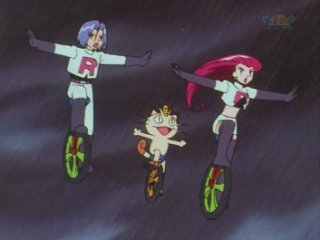
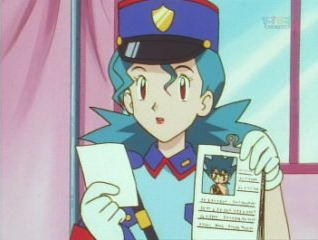
 Admit it: you wish you could be half this badass.  And/or ridiculous.  Screenshots from filb.de/anime.

In The Bridge Bike Gang, Ash, Misty and Brock come across an epic bridge leading across an inlet to a place called Sunnytown, but sadly the bridge is not complete and they can’t walk across… only the cycle track is finished.  Because bicycles are by far the most valuable objects in the entire Pokémon universe, they can’t just go out and buy one, let alone three… but, luckily, Nurse Joy #148 needs someone to deliver some medicine to Sunnytown, and is willing to let her couriers borrow some bicycles.  The kids immediately agree and race off down the cycle track.  On the bridge, they are accosted by a gang of miscreant cyclists, who demand a Pokémon battle.  During the fight, Team Rocket arrive in their usual dramatic style to mix things up… and it turns out that the gang leader, Tyra, recognises them.  Apparently Jessie and James were once members of this very bicycle gang, after flunking out of Pokémon Tech, and were known as “Big Jess,” who would always swing a chain around her head as she rode, and “Little Jim,” the only member of the gang who still used training wheels.  They were, and are, regarded as the absolute height of badass.  For some reason.  Anyway, the gang members think they’re even more awesome now that they’re hardened criminals, so they’re more than happy to help Jess and Jim fight Ash and his friends… until Officer Jenny #270 arrives and scatters them.  The kids keep riding, even as a terrible storm gathers.  Meanwhile, Tyra encourages Jessie and James to ride out themselves, to renew their… er… legend… and show the gang what real riding is.  They do so on unicycles, because this will earn them unimaginable street cred.  Team Rocket and the kids, coming from opposite sides, both reach a drawbridge being raised to allow a ship to pass beneath.  Ash, being Ash, decides to jump it, in the middle of a violent storm, at the same moment as Team Rocket.  The kids… somehow bounce off their heads and narrowly make the jump, while Jessie and James plummet into the water below.

To be honest, all things considered I thought this was kind of a ‘meh’ episode, but it does have certain bright points; notably, we get a little bit of insight into what motivates Jessie and James in their life of crime.  They crave respect, anything to let themselves forget what failures they normally are, and will do blatantly insane things to cultivate the worship of Tyra and the others.  More importantly their dialogue in this episode suggests that they, like the bike gang, resent rules and value freedom above all else.  Jessie and Meowth can be genuinely spiteful at times, but Jessie at least often seems to be driven at least as much by a burning desire to flip off ‘the system,’ probably on account of her childhood spent in poverty.  Ironically she’s now part of a system anyway, being ‘evil’ apparently for no better reason than because it’s her job, making her something of a ‘punch-clock villain’ (James plays up this aspect a great deal more than she does, but Jessie has her moments too; when things are going particularly badly for them they seem like nothing so much as downtrodden nine-til-five office workers).  She claims to enjoy being villainous, but like James it takes precious little to distract her, and she takes to honest work surprisingly quickly in the episodes where she’s given the opportunity.  Left to her own devices, she would probably remain self-centred, arrogant and superficial, but not outright evil.  James, of course, has baggage of his own… and that’s what Holy Matrimony is all about.
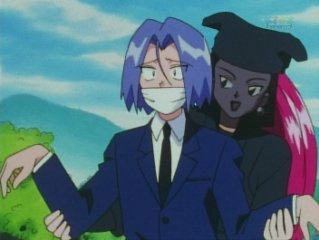
 Okay... I think I actually know what this whole 'invisible costume' thing is about.  In Kabuki theatre, stagehands wear all black clothing.  The audience, by convention, ignores anyone wearing this kind of costume.  Incidentally, assassin characters in Kabuki plays would wear the same costume, so that the audience would think they were just stagehands until they struck, which is where the familiar image of the black-clad ninja comes from.  Isn't learning FUN!?

I love Holy Matrimony, because from the perspective of Ash, Brock and Misty the whole episode is one great big long “WTF?”  It all begins when they stop to look at a “missing person” sign by the road, and an elderly gentleman in a suit pulls up in a limousine to ask whether they recognise the boy in the picture (I presume he has been monitoring the sign in case anyone showed an interest in it).  The picture is years old, but it’s unmistakably James, so the butler piles them into the limo and drives them to an enormous mansion, which, according to the butler, is just the doghouse.  He leads them into the even more opulent actual mansion and explains that the master and his wife have just passed away, and that if their son, James, does not marry his betrothed within twenty-four hours, he will lose his inheritance.  Team Rocket, as usual, have been watching.  James is reluctant to get married, but Jessie and Meowth like the sound of this “fortune” business, so they dress up in ‘invisible costumes’ – flimsy black gauzy things – so they can manoeuvre James like a puppet.  These… seem to work on the butler, and they drag James inside, where his insane parents promptly spring from their coffins, very much alive, and reveal his fiancée, Jessiebelle – a terrifying Southern Belle version of Jessie, from whom James had fled as a youngster.

The psychological implications are nothing short of mind-boggling.

Jessiebelle brings James downstairs into what she claims is the family’s vault, but is actually some kind of exercise dungeon in which she plans to whip James into shape.  James’ parents reveal that they could see Jessie and Meowth the whole time, so they drop smoke bombs and flee while Jessiebelle calls out her Vileplume and drowns James and the kids in Stun Spore.  At this point, James’ childhood Pokémon, Growly the Growlithe, manages to break out of the ‘doghouse’ and charges in to save him.  The group retreats to the doghouse, where James explains everything to Ash, and when Jessiebelle and Vileplume arrive, Pikachu and Growly attack them together and chase them off.  James rejoins Jessie and Meowth, leaving Growly behind to take care of his parents, and Ash, Brock and Misty leave the mansion with Jessiebelle hot on their tail, begging them for help in finding James.
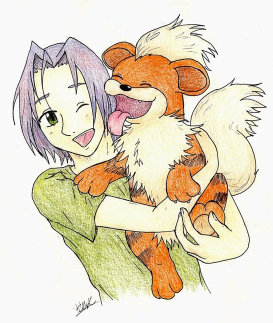
James and Growly being ludicrously adorable, by Bandotaku (http://bandotaku.deviantart.com/).

When James fills Ash in on his backstory, we learn that his parents arranged his engagement to Jessiebelle because they wanted her to teach him how to behave like a proper aristocrat, something he had absolutely no interest in doing.  He ran away from home rather than marry her, and eventually fell in with Team Rocket.  James likes wealth and luxury well enough but, as his final scene with Jessie makes clear, he’d rather be free than rich any day – presumably he hopes to get money and power as a member of Team Rocket, but even once Jessiebelle has been scared off, he’d rather stay a criminal than go home, where he could have those things, just for the asking.  It seems likely that he joined Team Rocket as a gesture of rebellion against the order of society as much as anything else.  As the same time, though, he does care for his parents in a somewhat neurotic way; although he professes to hate them and their upper-crust lifestyle, he would rather leave Growly at home to protect them than bring his loyal friend along on his journey.  What’s really interesting about Holy Matrimony, I think, is that it seems to take a broadly positive view of James and his life choices.  We’re almost certainly supposed to sympathise with him in his arranged marriage to Jessiebelle, whom he doesn’t love and can’t even tolerate, his relationship with Growly presents him as a genuinely decent trainer, and the final scene between him and Jessie on their hot air balloon even seems to suggest that the life they live really is the choice that makes the most sense for them.  As in The Bridge Bike Gang, they affirm that their freedom is more important to them than anything, and the episode seems to be okay with that.

Finally for today… in The Purr-fect Hero, Ash, Misty and Brock stumble into a primary school that’s been expecting some Pokémon trainers to visit, but the other trainers have cancelled at the last minute.  Brock immediately volunteers the group to replace them because he thinks the teacher is hot, and they let all their Pokémon out to play with the children.  Most of them have fun but one, Timmy, seems disappointed because the only Pokémon he wants to meet is a Meowth – the Pokémon that once saved him from a wild Beedrill.  Appearing just when we needed them, Team Rocket show up with their latest plan to steal Pikachu: present a Pokémon Magic Show and make him disappear, replacing him with Meowth and then escaping before Ash realises that they’re not really performers.  This they do, but unfortunately Timmy is so excited to run up and meet a Meowth that, in the confusion created by Weezing’s Smokescreen, he gets caught up in Team Rocket’s magic box and Pikachu is left behind.  When Jessie and James take him out and realise their mistake, Timmy is convinced that their Meowth is the same wild one who saved him long ago.  Jessie and James convince Meowth to play along, because “we’re not in the business of destroying children’s dreams!  Well, not yet…”  Meowth ‘saves’ Timmy and returns with him to the school, where Timmy’s classmates crowd around him excitedly, but the adoration goes to his head and a “that’s right!” slips past his lips.  Misty hears him and becomes suspicious, and Meowth flees back to Jessie and James.  Timmy follows, so Ash has to go as well… right into an ambush in a dead-ended rocky valley.  The ensuing battle starts a rockslide, which forces Team Rocket to retreat and nearly flattens Ash and Timmy, but at the last moment a wild Meowth appears and Mega Kicks a boulder in two, saving them.  Everyone returns to the school safe, and Timmy declares his intention to become a trainer one day, with Meowth as his partner.  Team Rocket’s Meowth tells Jessie and James that being a ‘hero’ was nice, but they need him more, so it’s for the best.
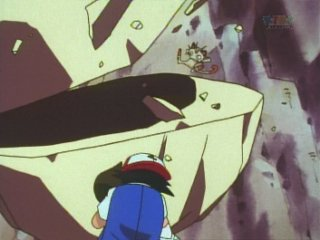
 Best.  Meowth.  Ever.

Meowth, distressingly enough, is the brains of the operation.  He’s normally extremely cynical, and quite honestly is probably more evil than either of his human compatriots.  Meowth gets a whole episode devoted to his backstory, Go West Young Meowth, much later in the series, and that will probably get an entry all to itself, so I’ll try to keep this short. The Purr-fect Hero brings out one of Meowth’s most important character traits: his desire for attention, affection, and adoration.  Meowth is incredibly prideful but also rather insecure; whenever he speaks directly to the Boss (whom he seems to regard as being formally his trainer), he is reminded, painfully, that he has fallen out of favour with Giovanni and been replaced by a Persian.  It’s hardly surprising, then, that he finds the prospect of being treated as a hero – deservedly or not – rather attractive.  After returning to Jessie and James, though, he seems somewhat exhausted and glad to have gotten away from it all, and his comment at the episode seems to suggest that he’s happiest being with people who actually need him, rather than the kids, who have only been tricked into viewing him as a hero.  Although traditionally ‘noble’ ideas like honesty and charity tend to make Meowth gag, his pride demands, in the end, that he earn the admiration he feels he deserves – besides which, he does seem to care for Jessie and James as well, though he rarely admits it and would generally prefer them to think he looks down on them.

Honestly, I’m beginning to wonder whether calling Team Rocket ‘villains’ is entirely warranted.  They’re antagonists, certainly, but their villainous actions typically serve as ‘spanners in the works’ rather than anything critical to the story, and although they appear in every episode, I imagine most of the plots could be reconstructed without them fairly easily.  Moreover, when an episode does focus on them, Jessie, James and even Meowth are normally portrayed in a fairly positive light, all things considered.  To cut a long story short (or at least, as short as I am apparently capable of making these things) I think the most natural designation for Team Rocket is ‘anti-villains’ – they have a villainous streak, but are in many respects genuinely sympathetic, and would probably live a much easier life if they just gave up and started backing the other team.
Anime Time: Episodes 33-34

The Flame Pokémonathon – The Kangaskhan Kid

Ash’s location: The wilderness sometimes euphemistically referred to as “Fuchsia City.”

These two episodes aren’t really all that interesting, and the second is one of those ones that pops up now and again to make me wonder what the writers were smoking, but they’re chronologically the first ones after the Ninja Poké-Showdown so I suppose I’d better get them out of the way… here we go.

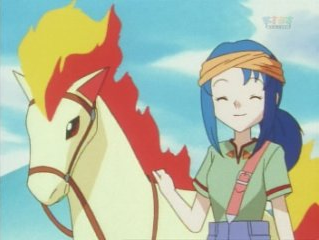
 Lara Laramie and her Ponyta.  Screenshots from filb.de/anime.

So, anyway, the set-up of The Flame Pokémonathon is that Ash, shortly after winning his Soul Badge, is caught by a girl named Lara Laramie trying to capture a Tauros on land he thinks is the Safari Zone but is actually a Pokémon ranch owned by Lara’s family.  Though she’s initially annoyed, once the mistake is cleared up Lara is happy to show Ash and friends around the enormous ranch and even invites them to stay for a Pokémon race the next day, a fantastic competition with honorary membership in the Laramie clan as the prize.  According to Brock, the Laramie dynasty is world-famous, and all breeders know and respect their name and the quality of their Pokémon, so this is no small thing.  Lara will be riding her Ponyta in the race to uphold her family’s honour, and one of her toughest opponents will be another breeder who works on the ranch, an obnoxious fellow named Dario who works with Dodrio.  Unfortunately, Team Rocket also have a horse in this race – figuratively speaking.  Jessie and James want a way in with the Laramie clan, so they’ve made a deal with Dario to help him win the race in exchange for the influence he will soon gain.  That night, Meowth spooks the Tauros herd, then snipes Lara’s Ponyta from afar with a slingshot when she comes to calm them down, making Ponyta throw Lara off and break her arm.  Lara asks Ash to ride in her place the next day, gambling on Ash being able to win Ponyta’s trust with his experience as a trainer so she won’t burn him.  Ash duly enters the race, along with – just for the hell of it – Misty and Starmie, Brock and Onix… and Pikachu and Squirtle, who plod steadily along in last place, Pikachu practically having to push Squirtle up the hills in the course.  Team Rocket follow, sabotaging other racers with slingshots and pit traps, and Onix glumly surrenders when the course crosses a river.  Jessie and James have to attack directly at one point to delay Ash and Misty, when Dodrio’s heads start squabbling over food at a pit stop, and Misty, Squirtle and Pikachu stay behind to deal with them as Ash and Ponyta try to catch up with Dario.  For all Ponyta’s speed, she can’t quite keep up with Dodrio… at least, not in her current form.  Ponyta eventually decides that enough is enough, evolves into Rapidash, and streaks ahead to beat Dodrio by a nose.  The race is won, Ash becomes an honorary Laramie, and there is much rejoicing.

 The contestants assemble.

The next episode, the Kangaskhan Kid, is one of those episodes that really make you wonder who writes this stuff.  The initial set-up is a bit lazy in that it recycles what happened in the last episode: once again, Ash sees a rare Pokémon (a Chansey) in what he thinks is the Safari Zone, but it turns out to be Officer Jenny #74 wearing a ridiculous hat and she arrests him for poaching.  Again, Ash is immediately forgiven, and Jenny deputises the kids when an alert sounds to warn her of actual poachers (Team Rocket, of course) attacking a herd of Kangaskhan.  When they arrive in Jenny’s jeep, they narrowly avoid the stampeding herd, which Jessie and James soon trap beneath a net.  Luckily, the Kangaskhan have a far more competent protector than Jenny on hand, in the form of an eight-year-old boomerang-wielding wild child dressed in animal skins, who frees the Kangaskhan and sics them on Team Rocket before swinging back into the jungle yelling “kanga-kangas-KHAN!” at the top of his lungs.  While the kids are trying to figure out what on earth has just happened, a helicopter lands nearby a young woman and her ugly midget husband disembark.  The pair are searching for their son Tommy, whom the moron of a husband dropped out of the helicopter as a toddler.  It has apparently taken them several years to remember where they dropped him and come looking.  Jenny takes one look their photo of Tommy and says “Oh!  You must mean Tomo!  His address is listed right here in the Safari Zone directory!  Yeah, he’s totally in my carpool!”

 We all get together at his place for poker on Wednesday nights.  I'm sorry, how is this weird?

…okay, the carpool part was a lie but she actually says the rest of it.

Anyway, they build a makeshift litter for Tommy’s parents, who are far too rich to be expected to walk, and go off into the jungle to find him.  When the kids find an injured baby Kangaskhan and try to help it out, its cries draw Tomo/Tommy, who attacks them and demands to know whether they are people or Pokémon.  The kids try to explain who his parents are, and he temporarily goes mad trying to decide whether his mother is the human who gave birth to him or the Kangaskhan who raised him, then flees into the jungle.  The kids have no time to chase them, because Jenny has been alerted that Team Rocket are attacking the Kangaskhan herd again, this time using a… a giant robot Kangaskhan that uses a fake roar to attract the real Kangaskhan – all but one of whom fall for it – and then subdues them with tranq darts.  Tommy attacks with his boomerang, which predictably does absolutely nothing, and Charmander sets the robot on fire, which doesn’t help either, but Tommy’s parents arrive in their helicopter and perform a kamikaze strike that destroys the robot.  As Tommy mourns his parents, they crawl out of the wreckage, battered but miraculously alive, clad entirely in animal skins, and announce that they have decided to live with Tommy and the Kangaskhan in the jungle so that he can keep both of his families.  So… yeah.

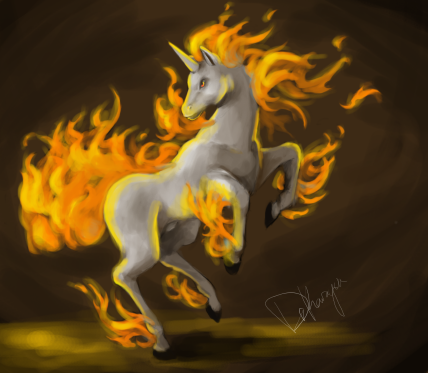
 Rapidash being awesome, by Dr. Karayua (http://dr-karayua.deviantart.com/).

In a misguided attempt to have this entry make sense, I have decided that these episodes do in fact have a theme in common, though the link is somewhat tangential: Pokémon and family.  The Flame Pokémonathon isn’t the first episode that’s made me think Pokémon are often a family business, but boy, it’s a big one.  Being made an honorary Laramie seems to be the only prize to be had in the Pokémon race, but just becoming associated with the Laramie name is apparently enough incentive for Dario to deal with notorious criminals in order to beat Lara.  Conversely, the prospect of being owed a favour by someone inside the Laramie clan is attractive enough to Jessie and James that they don’t ask Dario to give them anything else in exchange for their help, even though they don’t really stand to gain anything from the mission itself.  All of this is over a name – Dario already works with the Laramie family on their ranch, so it’s not even like it’s about getting him into the ‘company’ or anything.  He just wants to be able to call himself a Laramie.  Clearly these people have one heck of a reputation, and possibly some serious clout in Pokémon breeding circles.  One imagines that all this goes back generations.  Practically everyone in this world has something to do with Pokémon, one way or another, but it’s been my observation that a lot of the Pokémon trainers we know best are part of families whose history is closely tied up with Pokémon – Ash’s father is a trainer and his mother, from what we see of her relationship with Mr. Mime later in the series, easily could have been if she’d wanted; Gary’s grandfather is Professor Oak (come to think of it, the wording of Gary’s boast in Pokémon, I Choose You – “it’s good to have a grandfather in the Pokémon business” – seems to suggest an interesting line of thought); Misty’s sisters are all trainers; Brock’s parents are both trainers; and of course my all-time favourite example are the Dragon Masters of Blackthorn City, a family of fantastically powerful trainers who go back centuries.  Obviously this doesn’t mean that big, old families have a monopoly on Pokémon training and breeding in general, but it seems likely that becoming a skilled trainer or breeder is often strongly influenced by one’s upbringing and the way one was taught to view Pokémon as a child.

Speaking of the way children view Pokémon growing up…

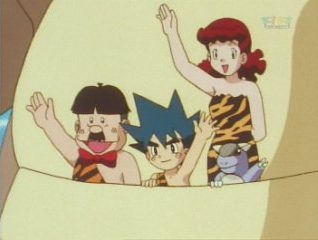
 Yabba dabba doo.

Tomo was raised by Kangaskhan and, of course, is the series’ interpretation of the old ‘wolf child’ type; a human raised from a very young age by wild animals, the most notable literary portrayal being Tarzan.  In the real world we don’t actually know a whole lot about kids like this, purely because so many reports turn out to be hoaxes, but it’s believed that they normally have great difficulty learning how to speak and are incapable of grasping many of the basic concepts of human society.  Now, in Tomo’s case, the speech thing raises some interesting questions.  Although very few Pokémon can actually produce human speech, most of them seem to understand it, and since Tomo can speak in pidgin English, he was clearly old enough to have started talking already when his moron father dropped him out of the helicopter.  Presumably he could address his ‘family’ in human speech and they would understand him.  The thing is, though… he doesn’t.  He speaks to the Kangaskhan in their own language (and by the end of the episode has started teaching it to his human parents).  The fact that he even remembers how to speak English at all suggests to me that he must have had regular human contact during his time in the Pokémon preservation, I assume with Officer Jenny, since she apparently knows him and even seems to have a file on him, complete with a photograph.  This brings up a nagging little question: why the hell hasn’t she told anyone about him?  Unless this particular Jenny is somewhat unhinged (which, let’s be fair, is a possibility), the only reasonable answer is that Kanto doesn’t consider it entirely unreasonable for human children to be raised by Pokémon (extreme, clearly, but not unthinkable).  And why not?  Tomo clearly has a happy life with his adoptive family and seems to make a meaningful contribution to the wellbeing of the herd.  Most Pokémon seem to possess intelligence, self-awareness and social complexity that only a few animals can match, and unlike, say, chimpanzees or dolphins they also seem to be naturally predisposed to cooperating with humans.  Humans, by their own nature, prefer to take control and assimilate Pokémon into their society, but Tomo (and, later, his human parents) demonstrates that the reverse can and does happen, even in the face of contact with normal human societies.

I am gradually building up a very strange view of this universe…

Incidentally,

I saw this on Pokémemes today, under the title “Technology Lent to More Design.”

The artist may have been trying to make a point, but I’m not entirely sure what it was.  Purely because it was on Pokémemes, I initially assumed it was an attempt to prove the superiority of either the first or the fourth generation as compared to the other, but if so it’s not clear which one the artist favours, so I’ve decided that this is unlikely.

As the picture illustrates, the newer designs are generally more detailed; the older ones are more likely to have large plain areas of block colour without ornamentation or patterning (broadly speaking – you might get the opposite impression by comparing, say, Jynx and Abomasnow).  Personally, this is something I like about the newer designs – I think, on balance, that I prefer the original Garchomp to this redesign, but I feel there’s a lot to be said for this Charizard (though I don’t like the way the flame’s been done; it looks more like a bristly tail than fire, which fits when you see that style of flame on, say, Emboar or Typhlosion, but not on Charizard).  I think the thing to take away from this, though, is that they both work.  There’s more than one way to interpret a design concept, and some people are going to like one way of doing it, and some people another.

What do you think?

– Do you like your Pokémon clean and simple, or detailed and elaborate?
– What are the advantages and disadvantages of these two extremes?
– Has the artist still managed to capture ‘Garchomp’ with this different aesthetic?
– How about Charizard?
– And what the hell is the title “Technology Lent to More Design” supposed to mean, anyway?

Next Time on Pokémaniacal: Anime Time!

Right… where was I?

So, Ash has just won his Soul Badge.  This marks the beginning of a stretch of nearly 30 episodes in which, as far as I can tell, he achieves nothing whatsoever.  In fact I’m not even totally sure where he is for most of that time.  I know they go to Las Vegas at one point, but for all I know they spend the rest of the time wandering around Belgium.  I will do my best to track Ash’s party as they weave across the face of the planet during that time.  Anyway, I’m not bothered by having no idea where they are this whole time, because this block also happens to include some of the most interesting episodes of the Kanto series, which I’m really looking forward to reviewing.

The other thing about this chunk of the series is that the order of the episodes is a little confused for some of it.  This is because of episode 38, the infamous Porygon episode (which, no, I have not seen and will not be reviewing… this time…), which caused the show to be cancelled in Japan for a brief period and seriously mucked up the episode schedule.  As a result, Jessie claims at least once to have a Lickitung several episodes before she actually catches it, Togepi is conspicuously absent from Princess vs. Princess, and no-one is completely sure when Snow Way Out is supposed to have happened.  I’m not going to fight it; I’m just going to accept it.  I plan to jump around a lot more in this block of episodes than I have in the past, so I can put episodes together that seem to have themes in common (or, in one or two cases, entirely at random).

This round of Anime Time is going to cover everything up to episode 63, the Battle of the Badge, when Ash returns to Viridian City to earn his Earth Badge… so, tune in tomorrow and we’ll jump right into these suckers!

You’ve said before that you’re an archaeology student, so I’m assuming that you enjoy the subject (otherwise you’d be insane for studying a subject you don’t like) so would you be interested in seeing more pokemon such as Lucario, who seems to be ancient Egyptian based, or other such pokemon that are based on ancient greek, mayan or egyptian mythology, seeing as it is largely japanese mythology that makes it into the games (ie. Yamata No Orochi being Hydreigon’s inspiration)

If there’s one thing I want more of, it’s myth- and folklore-inspired Pokémon.  They are The Best Ones.  I don’t even care whether we’re talking about Japanese stuff, or wider Asian stuff, or anywhere else.  I think one of the designers has said that there have been no Pokémon so far who are based on Greco-Roman mythology, which is the particular cultural milieu I’m interested in (though there are definitely some who are based on ideas that have Greco-Roman counterparts).  I would like to see some of that.  Again, though, it’s all good.  Myths and folktales last for a reason; they express powerful, evocative ideas.  Designs based on them have a certain inexpressible dignity… or, so I feel.

(Incidentally: at my university there is a long-standing rivalry between the Egyptian historians and the Greco-Roman historians, but I must still concede that Lucario is beyond epic)

So, in a word: Yes.

You find Sam Oak incompetent? I mean I guess that depends on which context we’re looking in. Cartoon and game style, yes I can agree, certain manga he’s a bit of a badass. And then with Gary Oak turning Professor in later episodes, I don’t find him too incompetent, but that’d just be my opinion.

I’m afraid I don’t really know the manga, so I can’t comment on that, and as far as the anime goes, there’s a massive gap in my knowledge between Johto and Unova.  I’m mainly going off the games (the anime version of Professor Oak is a fun character; I’ll give you that).  To the best of my memory, Aurea Juniper is the only one who ever actually *discovers* anything over the course of the game in which she features.  Also Oak apparently spent his *entire career* creating a totally blank Pokédex and is now too old to go out and fill it.  He doesn’t actually know anything about Pokémon; he’s a glorified computer programmer.

Break Time

In case you missed it when I mentioned this at the end of the Empoleon entry, this’ll be my last post for a couple of weeks ‘cause I totally have SERIOUS SCHOLARLY RESEARCH that I need to do and I swear it’s important even though it’s not about Pokémon.  I could post extracts from some of my coursework essays if you like but that might be even more boring than just posting nothing, so I’m just going to shut up for a little while; I’ll be back on… let’s see… the 15th of June.  Promise!

Starter Pokémon: Final Thoughts

WARNING: This entry is clearly too long and I have no idea why I wrote it.

Let’s talk about starter Pokémon.

Your starter Pokémon is your partner, a bird of your feather, a pea in your pod, the cheese to your macaroni.  It is like a huge feathery pea covered in melted parmesan.

…yeah, that metaphor got away from me a little.

 Today's pictures are a set of three, the joint creations of Finni (http://finni.deviantart.com/) and Zimmay (http://zimmay.deviantart.com/).  In this one, we see the Grass starters relaxing in the woods.

My point is, this is supposed to be the Pokémon that defines your experience of Pokémon training, what Pokémon mean to you personally, and your own style as a trainer… so it had better be good.  These are the most important designs in the game to get right, barring maybe plot-relevant legendary Pokémon, and there’s even more to get right than when you’re just working on any old filler Pokémon.  For one thing, you have to be sure – at least, as far as humanly possible – that there will be at least one starter Pokémon in each trio that appeals to everyone.  Obviously that battle’s over before it even starts because there are always going to be a few people who think that all three are terrible, but there are a couple of ways to minimise that, and Game Freak do seem to try their best.  Of course, many of us will just accept the Grass/Fire/Water paradigm and take what we’re given from our favourite elements, but for a lot of people, including a lot of new players, other factors are going to be important.  It’s good to give a choice of personality types and aesthetic styles – often these are divided along elemental stereotypes, so we generally get an aggressive Fire-type, a stoic Water-type and a laid-back Grass-type.  This isn’t always the case, though; Black and White, for instance, have a stoic Grass-type, a laid-back Fire-type and an aggressive Water-type (forgetting for the moment that Oshawott’s art and sprites are terrible and should never have seen the light of day).  I think you can argue that it’s probably better, in general, for starter Pokémon to be exemplars of their elements’ defining traits, rather than exceptions, because many people are going to choose starters according to element and won’t necessarily want Pokémon that are radically different from the norm.  Obviously, that’s not a hard-and-fast rule, but this is probably not the place to get experimental and create a Grass Pokémon with the power to drain and kill plants or something weird like that.  Anyway… the other important thing is that these Pokémon have to be strong, or at least decent (bearing in mind, of course, that the things that make a Pokémon good for high-powered competitive play are often quite different to the things that make a Pokémon good for in-game storyline play).  If your starter Pokémon is weak, you’re either going to ditch the thing as soon as possible or keep it around as a sort of mascot while vaguely resenting it the whole time. You can find accounts of exactly this kind of thing happening in Yellow Version – although later games have made an effort to help him out, an unevolved Pikachu is, let’s be fair here, a pretty terrible Pokémon.  A lot of people just stuff him in the PC and never look back (and, heck, why not?  Yellow gives you all three of the original starters anyway); others accept that he’s terrible and use him anyway because why else would you play Yellow Version, damnit, and a few people just never notice that he’s terrible because they’re also using Raticate and Butterfree.

Yellow Version gives you no choice in your starter Pokémon, so if you don’t like Pikachu, you’re out of luck, and it sticks you with a starter Pokémon who is demonstrably weaker than almost any other Pokémon you could possibly pick.  For these reasons, it is an example of a really terrible way of handing out starter Pokémon.  It works anyway because 1) Pikachu can get away with anything, 2) we all wanted to re-enact Ash’s journey, 3) if you didn’t like Pikachu you wouldn’t have bought Yellow anyway, and 4) let’s face it, the real reason we were playing Yellow was because we wanted Bulbasaur, Charmander and Squirtle.  All that said, Yellow is the only game so far that actually makes an effort to treat your starter Pokémon as special and emphasise your relationship with that Pokémon by introducing, just for Pikachu, the forerunner of the happiness mechanic that has been part of the game since Gold and Silver, as well as having Pikachu follow you around in the overworld.  He may be just a mascot, but a fair bit of effort went into making him the best mascot possible, and as a result the game works.  Well, it does if you like Pikachu.  If not then you dump him in the PC and forget about him; he’ll hate you when you take him out, but it’s not like you were planning on doing that anyway.  None of the other main series games has ever done anything like what Yellow did, probably because no other Pokémon can really compare to Pikachu for widespread popular appeal.  The original Pokémon Ranger, like Yellow, gave you no choice of partner, sticking you with Plusle (if you’re a girl) or Minun (if you’re a boy), which is a little painful if you despise Plusle and Minun as much as I do, but aside from having powers that no other Pokémon in the game possesses, your partner actually plays an active role in the storyline, which seems only appropriate.  According to Bulbapedia, Guardian Signs gives you a Pichu with a ukulele, however I am convinced that this is some sort of misinformation because not even Nintendo is that ridiculous.  I think Gale of Darkness starts you off with an Eevee, who is sort of the ideal choice for a single starter because her split evolution ensures that most anyone will be able to evolve her into something that appeals (how many Yellow version players wish that your douchebag rival hadn’t swiped the Eevee that Professor Oak meant for you?).  However, I digress.

 In the second of Finni and Zimmay's set of starter fanart, the Fire starters roast marshmallows together one warm evening.

One of the uncomfortable little problems with the Pokémon games that we don’t like to talk about is the severe disconnect between the series’ persistent and often heavy-handed theme of partnership and the way the games actually play.  This has come up in my reviews of the anime a couple of times: we’re clearly meant to want to imitate Ash, who has only a handful of Pokémon and loves them like his family, but in practice I (and, I’ll bet, most other players) are more like Gary – if I take a quick look through my PC on Black Version, for instance, I find a couple of dozen Pokémon I use for battles, perhaps another dozen I use for various utility purposes like swimming and flight, and literally hundreds that I never use at all; they just sit there gathering dust because, having earned their Pokédex entries, I no longer have any particular need of them.  I keep them around because I might someday need them to produce children for serious training.  Does that seem right to you?  A game that placed a great deal of importance on players’ relationships with every individual Pokémon would, of course, be vastly impractical if it were based on anything like the game’s current structure, with its monolithic Pokédex quest and the notable disadvantages associated with continuing to use your in-game team after completing the storyline.  Just one Pokémon, though, for whom the player is assumed to care particularly deeply, as with Pikachu in Yellow… that, I feel, would make gameplay and message hang together a touch less haphazardly.

 There’s a few ways this could be done.  Having the starter follow you around, as Pikachu in Yellow, is an obvious starting point; having it react to events in the storyline, as Plusle and Minun do in Ranger, is a logical continuation.  Something that has tempted me for a long time is the idea of evolution triggered by plot events (with some alternative method available post-Elite Four so you can evolve other starter Pokémon you obtain later); possibly even a single starter Pokémon with a split evolution determined by the way the player tends to react to in-game events, or the way the player treats the starter – which isn’t necessarily a strict contrast between ‘well’ and ‘badly,’ but more a contrast between different but valid and potentially overlapping types of relationship, like ‘intellectual,’ ‘emotional,’ ‘competitive,’ ‘protective’ and so on.  To keep this working without hiccups, it might be wise to include an option for the starter to stay with the player at all times, even when there are six other Pokémon in the party, but become ‘inactive’ and unusable until a space opens up – some people just don’t like using their starters, while others may want to branch out after several playthroughs.  Perhaps the starter’s presence even grants some kind of bonus to the rest of the party.  I could go on.  All of this, of course, ups the ante on creating starters that no one will strongly object to (or picking some from the ranks of existing Pokémon – Eevee seems to be universally adored) or offering a wider variety of starters (BLASPHEMY!) to ensure that there’s something for everyone.  Personally, if I were aiming for this kind of effect, I would probably base the design around something associated with partnership in the real world somehow, like a dog or horse, just to hammer in the point.  Assuming new Pokémon were being created, I would imagine rejecting dozens of designs (perhaps reworking some into regular Pokémon) before deciding on the final set; after all, this is not something to be done by halves.

 The Water starters splash around in a pool in the last piece of this set by Finni and Zimmay.

The other main topic I want to address today is the Grass-Fire-Water paradigm.  A lot of people want a change; I remember there was a great deal of excited speculation prior to the release of Diamond and Pearl that Game Freak were going to try experimenting with a Dark-Fighting-Psychic trio instead.  This trio doesn’t have quite the same relationships between the types as Grass, Water and Fire, because Dark-types are strictly immune to Psychic attacks rather than simply resistant.  In fact, it’s very difficult to construct a trio that works in just the same way as Grass-Fire-Water without using at least one of those three types, since so many elemental relationships aren’t reciprocal (for instance, Ice attacks are strong against Ground-types, but Ice-types don’t resist Ground attacks).  The only one I can think of is Fighting-Flying-Rock, which is somewhat problematic because of Game Freak’s apparent distaste for pure Flying-types.  It’s not immediately obvious why this should be a point against a change, but the big advantage of Grass-Fire-Water is its potential for easing new players into the system; the way the three types interact is quite simple compared to other possible trios, and the reasons for those interactions are also fairly intuitive (Grass-drains-Water is a little out there, but Fire-burns-Grass and Water-douses-Fire are much easier to understand than, say, Dark-mindfucks-Psychic or however that one is supposed to work).  However, Game Freak have shown by way of the Striaton Gym and its triplet Gym Leaders that they are open to more sophisticated ways of indoctrinating new players into Pokémon’s vast and convoluted game of Rock-Paper-Scissors-Lizard-Spock, so it’s possible to imagine a game where the starters are no longer the primary vehicle for introducing the mechanic.  Arguably, it would actually help to have a starter trio with more complicated relationships, since new players are going to have to deal with stuff like immunities, mutual resistances, and the Dragon- and Ghost-types’ strengths against themselves sooner or later, and at present the games make no real effort to introduce any of that; they just encourage a vague (incorrect) belief that all elemental advantages are reciprocal.  I spent much of my childhood assuming that Steel attacks must be strong against Dark-types, Ghost-types, and goodness knows what else because Steel Pokémon were resistant to those attack types.  Again, I could bring up my favourite game mechanic of the day, the split evolution; in this case, the potential advantage is in allowing new players to delay their choice of element until after they understand the ramifications of that choice.  Two other ideas I’ve toyed with are having a set of starters that all become Dragon-types upon reaching their final evolutions, so that all three are strong against each other, or having a set of starters who shift into each other’s elements (so the Grass-type becomes Grass/Water, the Water-type becomes Water/Fire, and the Fire-type becomes Fire/Grass)… not because these would necessarily be good ideas, you understand, but because they would be different and strange and would probably force the designers to come up with some really weird, quirky stuff.

We’ve seen an impressive variety of starter Pokémon over the years; tough, proud, gentle, courageous, reclusive, wise… for the most part, these are – as they very well should be – quite good designs.  Like so much else in Pokémon, however, this is one place where I wish that, once in a while, Game Freak would dare to be different.  Give them another year or two, and they’ll be announcing the approach of generation six… and goodness knows, none of us want another Fire/Fighting-type…

Piplup, Prinplup and Empoleon

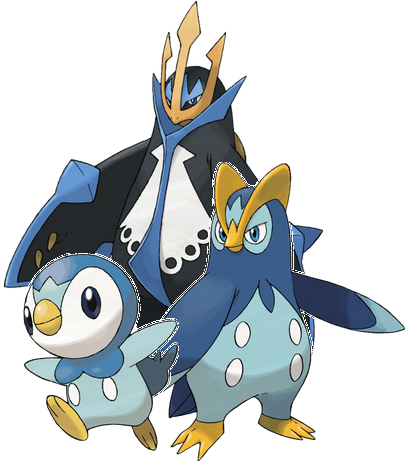
Piplup, Prinplup and Empoleon.  Artwork by Ken Sugimori; at Nintendo, no-one can hear you scream.I love penguins.  So clumsy on land, so graceful the moment they hit the water, and adorable to boot… Who doesn’t think Piplup is cute?  Seriously, who doesn’t?  I certainly do, although I have the same sort of problem with him and his evolved form, Prinplup, as I did with Totodile, Croconaw and Feraligatr; namely that they’re just penguins.  Those capelike flaps they have down their backs are a nice touch, beginning the line’s background nobility-and-royalty aesthetic by making them look like little princes or dukes without seeming too out-of-place.  That’s hardly at the centre of the design, though, and overall they’re a little bit unremarkable.  Luckily, unlike with poor Totodile, Game Freak actually seem to have put some thought into this Pokémon’s personality.  Cute though they may be, Piplup are also filled with stubborn pride; they ignore orders, quickly brush off any failures, and seem to find charity and kindness offensive, caring only to prove that they don’t need any help to survive.  Prinplup, likewise, have an incredibly strong arrogant streak.  In a major departure from the way real penguins behave, Prinplup are incapable of living together in colonies because, like monarchs, they cannot stand to look upon others as equals (or, heaven forbid, superiors).  As Empoleon, the ‘Emperor Pokémon,’ they remain extremely proud and lash out at anyone or anything offensive, however they do seem to gain a measure of self-control; they’re said to avoid squabbles if they can, and it’s implied that they can live in groups, led by the Empoleon with the biggest horns (presumably Piplup live in colonies led by Empoleon, leave when they evolve into Prinplup, and return only once they have evolved again and learned to keep their pride under control).  Now, those horns… The designers really do seem to have made an effort to make sure that Empoleon isn’t ‘just a big penguin,’ with the clawed hands on the insides of his bladed flippers, and his sharp-edged dorsal and ventral fins, but the big, obvious thing is that set of three horns.  Empoleon’s horns spring from the upper surface of his beak and form a kind of visor over his face, in the shape of a trident.  It looks a bit strange, and probably implies that his beak works more like a mammalian jaw than most birds’ do (since the upper part would be more or less fixed in place and wouldn’t be able to flex upwards) but that’s not inherently a problem.  It protects his face, and the trident is a good strong symbol of power and the ocean (in fact, now that I come to think of it, it forms a nice symbolic connection between his two elements, Water and Steel).  I can’t help but think that Piplup and Prinplup are missing something in their art to give them uniqueness and focus, some extra detail or adornment; Empoleon does have that, though, and the heavy emphasis placed on their character traits is quite refreshing.
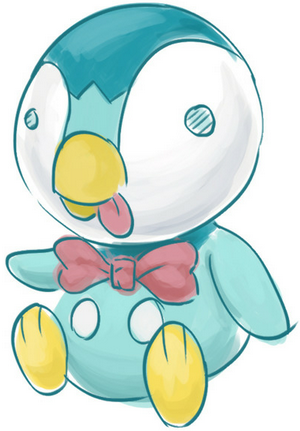
Shiny Piplup with a bowtie, by Adam Dreifus, who may or may not be a mantis shrimp (http://adamdreifus.tumblr.com/).  Bowties are cool.

So, what do you do with Empoleon?  Well… he’s a pretty weird Pokémon.  He’s the only Water/Steel dual-type in the game, which is a big plus; his unique set of weaknesses and resistances leaves him with unfortunate vulnerabilities to three of the stronger offensive types, Fighting, Ground and Electric, but eleven resistances and a Poison immunity is nothing to sniff at (Steel-types have all the luck…).  In spite of all the talk in his Pokédex entries about being able to cleave apart icebergs with his bladed wings, Empoleon is actually a special attacker – one of the most powerful Water-type special attackers in the game, in fact, behind Omastar, Gorebyss and a couple of legendary Pokémon.  Unless you teach him Agility, he’s far too slow to be a sweeper, but with solid defences and all those resistances, he might do okay as a sort of tanky thing.  I know that what people used to like doing with Empoleon was this one absurdly specific moveset that only he could do properly, which involves using Substitute to slowly drop Empoleon’s HP until he’ll eat a Petaya Berry to boost his special attack, then using Agility and going nuts.  Thanks to Empoleon’s Torrent ability, his low health causes his Water attacks to enjoy a further damage bonus, so very little can stand up against his Surf at that point, and Ice Beam cleans up most everything else.  Petaya Berries aren’t available on Black and White yet, though, and the synergy between the berry and Torrent is kind of the lynchpin of the whole tactic.  That’s not to say you can’t still use Empoleon as a sweeper, of course.  He doesn’t have a whole lot of special attacks outside the Water-type standbys of Surf and Ice Beam, but with Grass Knot to handle other Water-types, that doesn’t leave all that many blind spots (refrain from using Flash Cannon unless you really hate Ice Pokémon; Steel attacks are silly).  If you can be bothered importing an Empoleon from Platinum and desperately need help with Dark- and Psychic-types, Signal Beam is an option, but you’re probably better off with Grass Knot.  If you really want to confuse people, you could slap Swords Dance on your Empoleon, since his physical attack stat isn’t terrible and his physical movepool is decent (you’ve got Waterfall, Earthquake, Rock Slide, Drill Peck, and Brick Break) and he does have Aqua Jet to compensate for his appalling speed.  Like I said, though… only if you really want to confuse people.

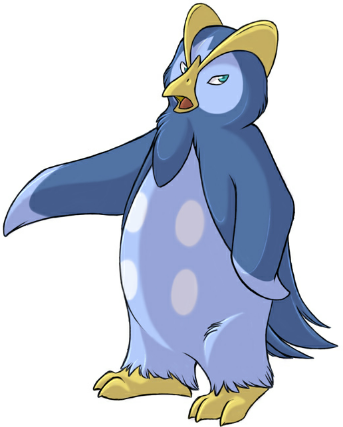
A Prinplup by Rainbow Cemetery (http://rainbow-cemetery.deviantart.com/), looking exactly as arrogant and dismissive as Prinplup ought to be.Personally I think I’d go with the tank-style Empoleon; he has to rely on Rest or Aqua Ring for healing, which is a pain, but then again, eleven resistances… as with most bulky Water Pokémon, you’ll want to go with Black and White’s great gift to Water, Scald, over Surf – it’s less powerful, but burns will make life hell for opposing physical attackers (and, what do you know, physical is Empoleon’s weaker defensive side).  I’m pretty sure Empoleon’s only real ‘support’ moves are Stealth Rock and Roar (and Stealth Rock requires importing him from a fourth-generation game), but being able to lay the rocks down for yourself and then send Pokémon running into them with Roar isn’t too shabby.  And yeah, I guess technically Empoleon does have a Dream World ability – Defiant, which responds to any reduction in Empoleon’s stats by doubling his attack score – but unless you’re going with the confusing Swords Dance Empoleon route, this is just plain useless, so if you haven’t got a Dream World Empoleon, don’t worry; you’re not missing much.

The more I think about it, the weirder it seems that Empoleon isn’t a physical attacker; he certainly looks imposing enough, it fits his flavour, his physical movepool is, to be honest, probably better than his special movepool, and he gets Swords Dance and Defiant (in fact, Swords Dance is technically on his level-up list, so he doesn’t even need a TM).  I mean, it’s not like it’s central to the design, but “wings that can cleave through an ice floe” sort of suggests physical attacks are his primary fighting style, and also that he would, y’know, learn Steel Wing (okay, he can, but only by using an obsolete TM).  Some days though, I just don’t care, because Empoleon is still a pretty badass Pokémon – come on, an imperial armoured war-penguin?  Why the hell not?  Some of the artists seem to have a slight tendency to abuse him in the sprites and the anime, he gets very fat in some portrayals and it just doesn’t look right; penguins are meant to be sleek, and even if this is a bulky armoured penguin he still needs to swim.  Prinplup annoys me a little because he’s given up Piplup’s cuteness but hasn’t yet picked up the details that make Empoleon more than just a penguin; honestly, if he weren’t a starter Pokémon, I would be totally happy just to ditch Piplup and Prinplup and keep Empoleon as a stand-alone.  Again, though, I’m pleased that Game Freak have given these Pokémon psychological traits (because that’s the sort of thing we don’t learn about just by using them), and I like that those traits seem to develop as they evolve… even though it’s anyone’s guess whether that’s by coincidence or design.  On the whole, Mudkip, Marshtomp and Swampert are probably better designed, but as we know by now, I have an irrational dislike for Swampert, so Empoleon is probably my favourite Water-type starter Pokémon.

And that’s a wrap!  Twelve starter Pokémon, and all their evolved forms, done and dusted.  I want to do a sort of wrap-up for my next entry, talk about trends and ideas that have been thrown up by these entries, and maybe talk about my take on what’s important for a starter Pokémon.  After that, well, I’m sorry to say that real life has been catching up with me to some extent, so I’m going to take a break for, say, two weeks to work on my dissertation on archaeometry and the Greco-Roman pottery trade; then it’s right back to another thirty-odd episodes of the anime.  Should be fun!