
Well, I would certainly prefer that. And I think Samurott would work as a Water/Fighting dual-type. Would Emboar still make sense as a straight Fire-type? Maybe? Might need to be redesigned a bit.
Chimchar, Monferno and Infernape
 OH DEAR GODS IT’S INFERNAPE RUN YOU FOOLS
These are Pokémon to inspire terror. You wouldn’t know it to look at them, but trust me, they are. Not because of sheer power – Charizard, Typhlosion and Blaziken are more powerful than Infernape – but because of two things that, in Pokémon, are often far more important: speed and versatility. I’m getting ahead of myself, though. Ladies and gentlemen: Chimchar, Monferno and Infernape.
The first thing you notice about these Pokémon is that they don’t really have a lot of heft to them. Charmander, Cyndaquil and even Torchic are more solidly built than Chimchar, and that doesn’t change as they evolve. This is because Chimchar marks a (small) divergence, at last, from the fire-as-destroyer archetype and focuses on a closely related quality of fire – its speed. Like Rapidash and Arcanine, Chimchar, Monferno and Infernape are Fire Pokémon whose element manifests not as huge destructive power but as phenomenal agility. They are among the few Fire-types who are not described as fighting primarily with their fire; one assumes that they do, and they do learn attacks like Ember and Fire Spin, but they seem to prefer using fire to intimidate enemies rather than to incinerate them directly (Monferno and Infernape’s bright facial markings, blue and red respectively, likewise seem meant for intimidation, as in mandrills and similar species). There’s actually something of a disconnect here, in that Infernape is really just as good at special attacks as at physical attacks, but this bothers me far less than all the Pokémon who aren’t good at the things they are supposed to be, so I’ll leave it. Rather than using fire, Chimchar and his evolutions use flurries of lightning-quick blows from all of their limbs simultaneously and from every possible direction to batter foes into submission – as might well be expected from anthropomorphic monkeys with prehensile limbs and tails (or a practitioner of ‘monkey’ style kung fu). This kind of acrobatic, literally off-the-wall combat style, familiar to us all from martial arts films, has few other exponents in the world of Pokémon; before Infernape, I can think of maybe Hitmontop, and after him, Mienshao. Is it especially clever creating a monkey Pokémon based on monkey kung fu? Perhaps not, but it makes sense, and it’s pretty damn kickass. Aesthetically speaking… aesthetically Chimchar bugs me; his proportions seem off, his head too big for his scrawny body and limbs – it’s a common feature of most primates, I think, that infants have disproportionately large heads, but you can go too far (the effect is reduced in the in-game sprites, but it’s still there). I suspect they may have made him too human; his hands, eyes and hair remind me, disconcertingly, of a human baby, but then he has no nose… if you’re familiar with the ‘uncanny valley’ effect, this is what Chimchar makes me feel. Monferno and Infernape lose that, though, so I suppose I’m okay with it. It’s also a little strange that Infernape loses his flaming tail and gains a crown of flames instead, but I can’t deny it does look cool, as does the spiral motif that develops out of the swirls visible on Chimchar and Monferno’s chests, adding to the overall impression of fluidity.
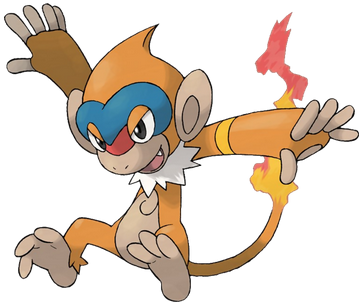
As we learned in Blaziken’s entry, however, Infernape has committed a fairly serious sin: he pretty much stole her schtick, in the process becoming the nexus of just about the biggest balance clusterfuck this franchise has ever seen (or would have seen, if game balance had ever been a thing in Pokémon anyway). Blaziken, when she was introduced, was the only Fire/Fighting type, and a powerful and terrifying mixed attacker with a wide range of dangerous attacks. Come Diamond and Pearl, she was still a powerful and terrifying mixed attacker with a wide range of dangerous attacks… but Infernape had all that, and blinding speed to back it up. Most offensive Pokémon are best used by focussing solely on either physical or special attacks; likewise, you’ll get the most mileage out of many defensive Pokémon by focussing solely on one type of defence. You can use Infernape and Blaziken this way, and they will perform wonderfully. However, they also perform wonderfully as mixed attackers, called ‘wallbreakers’ for their ability to consistently pick on the weaker defensive sides of powerful defensive Pokémon like Weezing and Snorlax. Now, yes, Blaziken’s attack and special attack stats are higher than Infernape’s. However, we’re talking here about two Pokémon whose job is to use some of the most powerful attacks in the game (Fire Blast, Flare Blitz, Earthquake, Close Combat, Focus Blast, Hi Jump Kick) to hammer Pokémon who are specialised in the wrong kind of defence. At this point, extra power isn’t all that big a deal. Speed, on the other hand, is the only all-or-nothing stat in Pokémon – you’re either faster than your opponent or you aren’t – and as such, a few points of speed can be disproportionately useful or useless depending on exactly how fast you are. In this case, extra speed means outrunning some of the most powerful Pokémon in the game and potentially landing a fatal hit where you might otherwise wind up sprawled on the ground. With access to both Swords Dance and Nasty Plot, Infernape can buff either of his offensive stats to ridiculous levels anyway, should you so desire. To add insult to injury, Infernape gets U-Turn, which Blaziken lacks, the so-called ‘best move in the game,’ for its ability to switch a Pokémon out after seeing whether your opponent will do the same, and if so, what’s being switched in (the fact that it does damage as well is the icing on the cake). It’s hard to think of a reason to use Blaziken over Infernape… or at least, it was in Diamond and Pearl, before part two of that balance clusterfuck happened and Blaziken got Speed Boost, and you can read all about that in her entry.

So, assuming no Speed Boost for Blaziken (and Dream World abilities for starter Pokémon aren’t exactly easy to get; all of the released Dream World starters are male, which makes breeding them impossible) Infernape is, essentially, ‘Blaziken, only better.’ Swampert had a similar thing going on with Feraligatr, but Feraligatr later staked out his own territory, and the fact that Blaziken and Infernape share the same specific type combination, Fire/Fighting, accentuates our natural impulse to compare the two. If Infernape existed in a vacuum, so to speak, I would regard this as a job well done. He’s one of those Pokémon that can swing matches very quickly, but he’s also quite delicate and has a couple of nasty common weaknesses, so I don’t think I’d say he’s too strong, taken in isolation. Infernape doesn’t exist in a vacuum, though. I don’t think the designers necessarily realised that Infernape is better (or, more adequately, has more potential) than Blaziken, since it’s pretty clear they don’t think about individual Pokémon in the same way or under the same conditions as studied competitive players, but it must surely have occurred to them that the two Pokémon have very similar sets of powers, and that their position as successive Fire starters would encourage comparison. My default stance is that it’s bad form to design one Pokémon that usurps another, whether successfully or not, and while Infernape and Blaziken definitely have very distinct flavour they have the same type combination, the same strong points, and similar tactics. If this were my last year’s Unova Pokédex series, when I was dealing with a whole new generation, I would either shout incoherently for a while and slam a big heavy “I hereby deny this Pokémon’s right to exist” on Infernape’s head, or sheepishly admit that the second attempt really was better and maybe recommend some additions to the older Pokémon. The trouble is Game Freak already did try improving Blaziken, bless their little hearts, and totally failed to comprehend the enormity of what they were giving her, so now I have no idea where to go with this; I have a fairly solid doctrine in place for complaining about new mistakes, but I’m still not totally sorted on how to handle old ones.

Infernape is an awesome Pokémon; I love his aesthetic qualities, his concept, while not as clever as Torterra’s, is still at the very least amusing, and he’s one of the best non-legendary Pokémon in the game. And… frankly, Game Freak shouldn’t have made him. I guess I’m feeling paradoxical today. I think that, for Blaziken’s sake, this design should have been worked into something quite different. For a primate design, I would be very tempted to work with fire as a symbol of creativity and inspiration, particularly focussing on Infernape’s crown of fire, and make him a Fire/Psychic-type, focusing on special attacks, although that doesn’t work with the whole ‘monkey kung fu’ thing, and would imply a total art redesign, so a more practical suggestion would be to go with the old monkey-as-trickster archetype and turn Infernape into something more like what Mienshao later became – a hard-hitting Pokémon whose greatest strength isn’t actually hitting hard, but spreading disruption and chaos. Basically, since the flavour side of things is where Infernape really is quite different from Blaziken, I’d want to work with that to create mechanical distinctions as well. In the end the resulting Pokémon probably wouldn’t be as powerful… whether that’s a bad thing or not, I leave up to you.
Turtwig, Grotle and Torterra
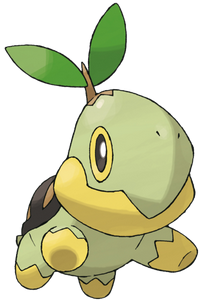 Okay; Diamond and Pearl. The last three starters (since I’ve already covered Tepig, Snivy and Oshawott). I’ve always liked these three; the designs are quirky, they’re all pretty powerful (if I had to use a whole trio on a single team, this is probably the one I’d go for, although the Ruby/Sapphire ones give them a run for their money), and the way they interact with each other is pretty interesting in itself. Let’s take a look at Turtwig and see how he measures up.
As you’ve probably read by now, I love all the Grass-type starters. However, I think Torterra is the only one whose design potentially equals or betters Venusaur’s. Turtwig, Grotle and Torterra are based on the old mythological motif of the ‘world turtle,’ who appears in several places around the world, but most famously in Hindu legend as one of the avatars of Vishnu, his shell serving as a pivot when the gods and demons together churn the ocean of milk using an upturned mountain to produce the water of life (it… was just that kind of Friday night, okay?). The world turtle motif is directly referenced in the Pokémon world’s corresponding ancient myth that an enormous Torterra lived deep beneath the earth. The design includes elements of every part of the natural world – earth, water, plants and animals. Turtwig originally hosts a tiny sapling on his head, which grows into twin rows of bushes on Grotle’s shell of compacted soil, and finally into a huge tree on Torterra’s immense carapace, accompanied by great spikes of moss-covered stone. Grotle often carry smaller Pokémon around on their backs over long distances, and Torterra becomes so large, and his foliage so luscious, that entire communities of Pokémon can be found on a wild Torterra’s back, creating a pocket ecosystem in which some Pokémon spend their whole lives. Turtwig, Grotle and Torterra also have some minor powers related to water, completing their miniature world. All Grass Pokémon, logically, are very reliant on water, but the designers seem to have wanted to drive it home with these three; they always live by lakes and rivers, drinking causes their shells to harden and grow strong, they have the special ability to sense sources of pure water, which they use to lead other Pokémon there, and wild Grotle are said to protect hidden springs. These Pokémon aren’t just parts of ecosystems, they are ecosystems. I love this design. It’s detailed and fascinating, drawing on a well-known mythological motif combined with symbolically significant traits and powers to give Turtwig, Grotle and Torterra an interesting place in the world of Pokémon. I don’t think it would be at all bold to say that Torterra is one of the best-designed Grass Pokémon in the entire history of the game. My one minor gripe here is the scale; as Pokémon go, Torterra is pretty massive, more than two meters high and about five meters long, but I can’t help but feel that he (and perhaps Grotle as well) should be even bigger, to realistically fit their portrayal as supporters of whole communities. At some point, though, it would become ridiculous to talk about using these things in a battle in a stadium. Besides, we never see wild Torterra in the game; all of them are given out as starter Turtwig or hatched from eggs – who knows how old they get in the wild, or whether they ever stop growing?
The fact that they remind me of dinosaurs has nothing to do with why I like them. Honest.
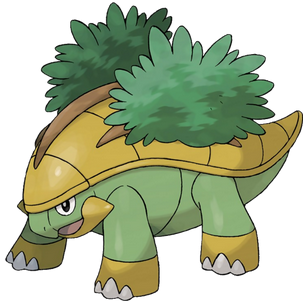
Turtwig is the only Grass-type starter who gains a second type upon evolving, becoming Grass/Ground, appropriately enough, upon reaching his final form (Bulbasaur is Grass/Poison to begin with, and the others stay pure-Grass all the way through). This is interesting because it’s part of the way Game Freak decided to play with the traditional Grass/Fire/Water paradigm in Diamond and Pearl. Normally, Grass drains Water, Fire burns Grass, and Water douses Fire, and this is the way Turtwig, Chimchar and Piplup work as well, but when they reach their adult forms, they mix up the usual strengths and weaknesses a little bit. Torterra is a Ground-type, so even though he’s still vulnerable to Fire attacks, he can smack Infernape with a pretty nasty Earthquake. Empoleon is a Steel-type, so he is no longer particularly weak against Grass attacks, but he’s almost as frightened of Earthquake as Infernape is. On the flip side, Torterra’s second element makes him even more vulnerable to Empoleon’s Ice Beam than most Grass-types, and strips him of his resistance to Water attacks. Finally, Empoleon can still hammer Infernape with Water attacks, but also has to be wary of Infernape’s Close Combat, since Steel Pokémon don’t like Fighting attacks one bit. Essentially, the game starts with a traditional Grass-beats-Water-beats-Fire-beats-Grass setup, but by the end of the game all three have some pretty devastating guns to level against each other. I suspect that quite a lot of thought went into this; it’s an interesting change to the usual dynamic and part of what I like about the fourth-generation starters. It’s sort of a shame Black and White didn’t continue this – Emboar can smack Samurott around with Grass Knot or Wild Charge, if you have the appropriate TMs, and Samurott can give Serperior a Megahorn to the face, but they seem to have forgotten to give Serperior anything to hurt Emboar (as usual, Grass-types Don’t Get Nice Things). Oh well…
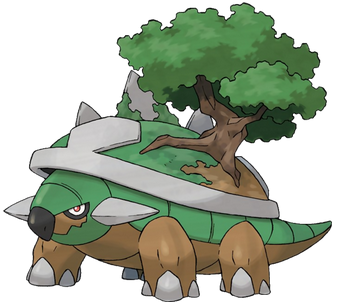
The mechanics changes of Diamond and Pearl opened up the possibility of physical Grass attacks, so why not kick things off with a Grass-type physical tank? Only two previous Grass Pokémon had ever shown a significant bias towards physical attacks over special attacks – Parasect and Breloom, whom, let’s face it, we use for Spore, not for their attacks (Breloom less and less as the generations passed, but Spore is still his biggest advantage) – so Torterra blazed new ground… and boy, did he blaze it. Torterra is the slowest of all the starters, but possibly the toughest, and also one of the most powerful. Curse is an obvious choice to emphasise those qualities since Torterra isn’t going to outrun anything that cares anyway, but if you want something a little less predictable you can try Rock Polish, to bring Torterra’s speed up to something resembling respectability, or even Swords Dance if you’re reckless enough. Torterra’s primary attack, of course, is Earthquake; sadly, Grass attacks don’t combine particularly well with Ground attacks, since they share all of Ground’s offensive weaknesses. If you do want one, you have two options; Wood Hammer is stronger than Seed Bomb, but Seed Bomb doesn’t cause recoil damage. Rock attacks, on the other hand, do mesh very well with Earthquake, so Stone Edge is a good place to go. Torterra’s other main offensive options are Crunch and Superpower; Superpower is much more useful for actually killing stuff, but the penalty it inflicts to the user’s physical attack and defence is particularly undesirable for a slow, bulky Pokémon like Torterra. Leech Seed gets you a trickle of healing, though Torterra, with his large HP total and relative inability to stay in control of a Leech Seed/Substitute scenario, is not really an ideal candidate for using it; Synthesis is weather-dependent but probably your best option. There are also a few support moves to mix things up if you feel so inclined; Reflect and Light Screen for team defence, the ever-present Stealth Rock is available from a TM on Diamond and Pearl if you don’t have a team member who can use it yet, Roar is always welcome on a slow, tough Pokémon for messing with your opponent’s strategies, and for a particularly defensive Torterra you might use Stockpile, a hereditary move from Carnivine or Victreebel, which boosts both defence and special defence together (it has other effects, but they are irrelevant and distracting).
It’s not all good news, of course. Grass/Ground is a fairly poor defensive typing, with two resistances and an immunity to four weaknesses – including a crippling double-weakness to Ice. Torterra is very easily dealt with using a good solid Ice Beam, and he’s too slow to do much about it. He also has difficulty handling other Grass-types, who are largely unperturbed by most of his offensive powers. In short, although he’s a perfectly respectable Pokémon, he has some crucial flaws, and is much less versatile than a Pokémon like Venusaur, which makes him a lot easier to stop. However, if you play him to his strengths, Torterra can flatten some powerful enemies, and with some of the coolest flavour I’ve ever seen in Pokémon, he’s easily one of my favourite starters.
I really liked your posts about every region’s champions and teams. They were interesting and made me think (ex: realizing that Steven could have been so much more). Could you analyze more humans of the pokeverse?
Hmm. Maybe? The trouble is that there are relatively few human characters that get a lot of decent characterisation in the games. I don’t think I could come up with enough material for a full entry on a Gym Leader or Elite Four member, for instance. Maybe the Professors…? Or rivals…? Yeah… yeah, I could probably do a series on the rivals. At some point. I can’t remember at the moment what I was planning to do after my next thirty-odd anime episodes; it can’t have been that important…
TL;DR – suggestion noted. I’ll think about it.
Mudkip, Marshtomp and Swampert
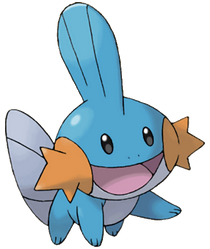 So i herd u liek Mudkipz?
…eheh. Sorry. I couldn’t resist.
…caelicolae immortales, I hate that meme…
Today’s cute little bundle of utter nonsense is Mudkip, the… swampy… fishy… thing. Now, as for me personally, I’m sorry to say that, no, I don’t liek Mudkipz. His evolutions, Marshtomp and Swampert, belong to an archetype that I’m simply not very fond of. However, that doesn’t mean this is a bad design. Maybe Game Freak realised on their own how boring Feraligatr was, or maybe someone pointed out to them, or maybe (far more likely) Mudkip just happened to get lucky, because he is anything but a simple cartoon of an ordinary animal. He’s probably based on something like an axolotl – a curious species of salamander that, although it does have an ‘adult’ form, never actually metamorphoses under natural conditions, and retains the gills of a larval salamander for its whole life (you can force an axolotl to metamorphose and become a land animal, but the stress will either drastically shorten the poor thing’s lifespan or kill it outright – I’m sure there’s a metaphor in that somewhere…). Axolotls are fully aquatic, but Mudkip is more an amphibious creature; he has fins to help him move through the water, but his legs can support him on land, and while he still has functioning gills, he seems to have air-breathing lungs as well. He retains this mixture of traits as he evolves into a veritable ‘creature from the black lagoon.’ Well, eventually. I’ve always thought Marshtomp looked a little bit gormless, and to be honest Swampert does too, in Sugimori’s art, but most of his sprites are much better, and it doesn’t take a great deal of imagination anyway to picture this froglike behemoth as a pretty terrifying opponent. As I said, I don’t liek Mudkipz – in general, I’m simply not a fan of brutish, physically imposing Pokémon, which is what he eventually becomes (Mudkip himself, I admit, is pretty cute). As brutish, physically imposing Pokémon go, however, Swampert is a keeper. Pure boulder-crushing power isn’t all there is to him; the whole line also has impressive sensory abilities. Mudkip, Marshtomp and Swampert can use their fins to detect pressure differences and ‘feel’ objects and Pokémon moving around them – most effectively in water, but in air as well – and have extremely good vision, allowing them to see through murky water with ease. Swampert can even predict storms well in advance by sensing air currents, and will pile up boulders to protect his coastal territory. I find it odd that they apparently live on beaches, since they seem to be based on a freshwater animal and are linked with swamps and marshes; in particular they like to dig burrows in mud and damp soil, not sand. I think they must live in estuaries, mangroves and salt marshes, intersections of terrain types, which implies a fair degree of hardiness and adaptability – and, to look at these Pokémon, I can certainly believe that.

Swampert is a great big bulky physical attacker, and in that respect he does a pretty good job of stealing what little of importance Feraligatr ever had to his name. Like Sceptile, he shows that Game Freak did, in fact, learn from their mistakes with Feraligatr, but unlike Sceptile he takes every possible opportunity to rub Feraligatr’s face in it by being better at everything ever. Both of them were mainly reliant on Earthquake in Ruby and Sapphire, but Swampert was by choice and Feraligatr by necessity; since Swampert is a Water/Ground dual-type his Earthquakes are significantly stronger than Feraligatr’s and actually make a good primary attack. Swampert got just about every important attack Feraligatr did except for Swords Dance, and was better at all of them. In fact, his stat distribution makes him better than Feraligatr at pretty much everything. He’s slower, but Feraligatr isn’t fast enough for speed to matter a whole lot anyway; all his attacks are more powerful, he’s significantly better at taking special attacks, and thanks to his higher HP they’re actually pretty similar in terms of physical bulk. To cap it all off, Swampert’s type combination doesn’t just make his Earthquakes stronger; it also grants immunity to Electric attacks, leaving him with only one weakness (Grass – a type not exactly known for its powerful attacks or formidable sweepers). He also steps on Wooper and Quagsire’s toes a great deal; they have very different design aims, since Quagsire is clearly supposed to be cute, but they’re both big amphibious swamp-dwelling Water/Ground Pokémon that act as physical tanks, which Swampert is much better at doing than poor Quagsire. Don’t get me wrong, it’s good that Swampert is effective; it just hammers home how much of a lottery Pokémon’s ‘game balance,’ if you really want to call it that, can be. The differences between Feraligatr and Swampert appear to suggest that Game Freak knew, by this point, that a Water-type couldn’t be a top-notch physical attacker under the rules of Ruby and Sapphire without some kind of extra sparkle, and the combination of Quagsire’s excellent typing with Feraligatr’s high stats provide Swampert with just that. Kind of a shame about his predecessors, though. In general, my stance is that making a new Pokémon that totally supersedes an old one, when you could just make the old one good, is Bad Design. They did eventually start being nice to the older Pokémon; Feraligatr’s a sweeper now, and Quagsire is potentially useful if oddly specific, though at the time of Swampert’s introduction, Quagsire could practically have evolved into Swampert. In the end, I want to forgive Game Freak this time – in Feraligatr’s case, anyway – because I think Feraligatr is an unimaginative gob of mindless sputum hocked up by a dying frog, and that Swampert is a far superior design anyway.
Yes. That entire paragraph was only in there so I could bash Feraligatr some more.
Let us move on.
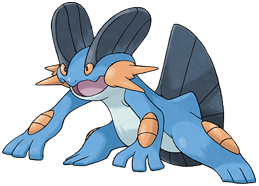
So, like I was saying, Swampert is tough. Unlike Feraligatr, who by this point had Swords Dance and was pretending to be fast enough to be a sweeper, Swampert’s buff of choice was Curse, which acts to turn him into a slow but powerful behemoth of a Pokémon capable of taking, and dishing out, physical attacks ‘til the Miltank come home. To back up his terrifying Earthquake attack, Swampert picked up Rock Slide with the release of Leaf Green and Fire Red – not a powerful attack, but good for punishing Flying-types. Surf and Ice Beam worked off his weaker special attack stat, but he was still better at them than Feraligatr, and didn’t actually have to rely on them, thanks to Earthquake. If you like paralysis, Body Slam was an option, and he could turn his bulk and lack of weaknesses into formidable weapons with Counter or Mirror Coat. Roar, finally, is a handy toy for a tough Pokémon to have; Swampert can often afford to wait for his opponent to attack first if it means throwing a spanner in the works by forcing a switch. In short, Swampert was a highly effective physical tank from the moment of his release, and Diamond and Pearl only made things better – the introduction of physical Water attacks, obviously, being the main benefit. With them came Hammer Arm, a strong and reliable Fighting attack, and eventually Ice Punch. His support options also expanded to include the time-delayed sleep attack, Yawn, but for all practical purposes Yawn is mostly for forcing switches, since switching out a drowsy Pokémon will keep it from falling asleep, and Swampert can already force switches very effectively with Roar. Finally, of course, Diamond and Pearl gave Swampert the oh-so-delightful Stealth Rock, so now he can damage whichever Pokémon comes in to replace one he Roars away. And that… well, that is pretty much the end of Swampert’s development. Black and White didn’t really change him at all. His Dream World ability, Damp, prevents Pokémon from using Explosion or Selfdestruct – amusing, but ultimately very situational, especially since Black and White drastically reduced the effectiveness of both attacks. Like most Water Pokémon, he can now burn opponents with Scald to weaken their physical attacks, but Scald is a special attack, and Swampert isn’t exactly bad at taking physical attacks anyway, so sticking with Waterfall is fine too.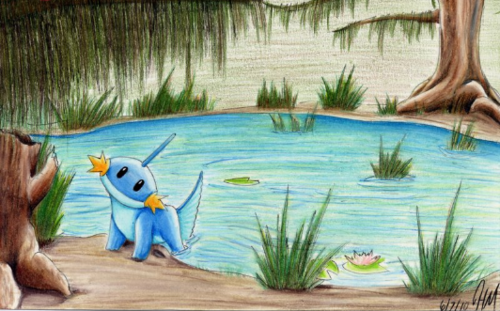
Although Black and White seem to have largely forgotten about him, Swampert is still a perfectly solid Pokémon with a small but useful support movepool and wonderful all-around endurance. Be careful of Black and White’s sleep mechanics if you want to use him – switching a Pokémon out now resets the number of turns it will take to wake up, which means that Rest is no longer a reliable form of healing, and Swampert doesn’t have anything else. Don’t expect him to take too many hits… and, as always, avoid Grass attacks like the plague. If you can find it in your heart to love a monstrous swamp-thing, though, you could do far worse than Swampert.
Bah
Okay, so, I was busy all weekend and I told Tumblr to put my next post up at 10pm on Saturday, but I see now that it hasn’t because it is dumb. I’ll fix that now. Next post will be on Tuesday night as it should be.
So far, ( apart from both protagonist’s hairstyles) what do you think of Black and White 2? I quite like it, and as much as I wish it, I sorely doubt we’ll be going back to Hoenn in this game.
Honestly? Too soon to say. Game Freak are clearly putting way more effort into them than I thought they would (I’d expected something similar to Crystal, Emerald and Platinum, only paired instead of alone), so I’m just going to keep my mouth shut until I see the finished product. This entry might amuse you, although much of it has been superseded by newer information. I tend to avoid spoilers as far as possible going into a new Pokémon game, so you probably shouldn’t expect any comment from me until they’re released in New Zealand (normally happens at the same time as the European release).
If you had the chance, how would you recalibrate the Pokemon typing chart to make it more balanced? For example, Ice is probably the worst defensive type, and Poison and Normal are probably the worst offensive types. I was thinking Poison should be super-effective on Water, Water should resist Fighting, Ice should resist Dragon, etc.
Oy vey. Okay, I don’t pretend to have thought through this in any great detail and I promise I will someday do a whole entry on this, but I don’t believe any of these changes would break anything…
– I probably would throw in Poison-beats-Water and Ice-resists-Dragon; maybe not Water-resists-Fighting, though, since Water is a pretty good defensive type already.
– Some of Steel’s resistances need to be eliminated; I think Ghost and Psychic are reasonable.
– Bug used to be super-effective against Poison; I don’t think it would hurt to make it neutral now. Grass has more offensive weaknesses than any type in the game and I don’t think it would be unreasonable to make Grass attacks neutral to Bug or Flying types (or both).
– I’m tempted to say Normal should be super-effective against *something* but I’m not sure what yet…
Torchic, Combusken and Blaziken
 Our next starter is a chicken? Really, Game Freak? A chicken?
It’s… well, not as odd as it sounds. A good friend of mine grew up on a farm and had a number of pet chickens over the course of her childhood. Not only are they actually quite good pets, each with distinct personalities as interesting as any dog or cat’s, the brighter ones can be taught tricks (my friend won prizes at her primary school for doing just that). Chickens may not have the same kind of awesomeness potential as more conventional pet animals, but they’re really quite underrated. So, there you have it. Setting off from home accompanied only by a firebreathing chicken is… admittedly still not a very good idea, but not a markedly worse idea than leaving with a magic frog or a perfectly ordinary baby crocodile. Torchic basically has generic Fire Pokémon characteristics, other than a note that she doesn’t like darkness and, to my knowledge, this really is a noticeable trait of real chickens; they have poor night vision, so they don’t like to move around when it’s dark. That seems a little odd for a Fire Pokémon (especially one whose name is derived from “torch”), since Torchic can presumably just produce flames to light up a dark area, but I guess I’ll go with it. She becomes more interesting when she evolves into Combusken, and then Blaziken: battle-chickens that pummel their foes with flaming punches and kicks, and can clear huge obstacles with their powerful legs. This fits well enough; after all, how do flightless birds defend themselves? They kick you, and some of the bigger ones, like cassowaries, can and do kill people this way; Blaziken wouldn’t be much bigger than a cassowary. Their take on Fire abilities – why just kick things when you can kick things with fire? – is not especially brilliant but it’s also not really something any Fire Pokémon had ever done before (except for Magmar, to a limited extent) so it’s a good variation on the traits of the element. In short, six foot tall flaming chicken that explosion-kicks you to death: sort of offbeat but in a good way I guess?
What’s more worrying is the fact that when these Pokémon were designed someone almost certainly had the unsavoury sport of cockfighting in mind – the practice of training chickens, specially bred to have aggressive temperaments, to attack each other with vicious metal spurs tied to their legs. Given that, when people are making moralistic complaints about the Pokémon franchise, the accusation that it glorifies blood sports (and, in particular, sports that pit animals against each other in a ring or arena) is something of a chart-topper, the decision to make a literal cockfighter Pokémon seems not so much ill-advised as potentially suicidal. Considering the drama that once surrounded Jynx, leading to her disappearance from the anime and subsequent recolouring with purple skin, it’s sort of bizarre that no-one seems to have picked up on this. I don’t know; maybe animal cruelty just isn’t as touchy a subject as racism in the US? Anyway… like any fan, I’m sceptical of the idea that Pokémon as a whole promotes blood sports; the franchise’s internal ethical framework is a lot more complex than that, but even I have to wonder about the message that a fighting chicken Pokémon sends. It’s not even that it’s inherently a bad idea, because you could totally write flavour text or even whole episode plots for Combusken and Blaziken that tackle this thing head-on, and it would be really interesting to see how that turned out. Just casually tossing it out there, though? That, I have to question. People aren’t wrong to be concerned about a game that, on the face of it, is all about forcing wild animals to beat each other’s brains out. Pokémon isn’t supposed to be about violence or animal abuse; it’s supposed to be about partnership and discovery, but that isn’t necessarily obvious until you get into it, especially if you’re initially exposed to the games rather than to some other medium – so why design a Pokémon that draws attention to real-world instances of the former unless you’re deliberately trying to create a contrast that promotes the latter?
This is starting to make my head hurt. Let’s talk about something less complicated.

Blaziken is the first of three Fire/Fighting starter Pokémon; she did it before it was cool. Infernape and Emboar would subsequently come in and steal her schtick, but until then, she was a totally unique and quite dangerous mixed attacker. Blaziken’s not really fast, and she’s not really tough but, boy, can she hit hard. With Sky Uppercut, Earthquake, Rock Slide, and a downright terrifying physical attack stat, Blaziken could throw punches no-one wanted to be on the receiving end of. However, she also came with an excellent special attack stat to back up her Fire techniques, so just having massive physical defence wouldn’t necessarily keep you safe from her (in particular Skarmory, one of the most reliable ways of saying “no” to physical attackers at the time, is helpless against Blaziken’s Fire Blast). Fire, Rock, Ground and Fighting are four of the strongest offensive types in the game, and Blaziken knew how to use all of them. Things just kept getting better when Fire Red and Leaf Green gave her access to Swords Dance, and she got Thunderpunch on Emerald just to keep the Water-types guessing. She was still a little sluggish, of course, but it took a pretty big, mean Pokémon to absorb one of her attacks. Then came Diamond and Pearl. Diamond and Pearl gave Blaziken some cool new stuff – physical Fire attacks like Flare Blitz, Focus Blast in case she wanted a special Fighting attack, Brave Bird since her offensive movepool clearly wasn’t big enough already, Stone Edge if Rock Slide just wasn’t powerful enough, Agility if she didn’t feel like being slow anymore, and even Baton Pass if for some reason she felt someone else would make better use of her boosts than she could. Unfortunately Diamond and Pearl also made Blaziken largely obsolete, since they introduced Infernape. Infernape will get an entry of his own soon enough, so for now we’ll just say that he’s much faster than Blaziken, and doesn’t care that he’s even more fragile and not quite as strong because Fire Blast, Flare Blitz, Focus Blast and Close Combat (the last of which Blaziken doesn’t get) are so powerful that, realistically, if Infernape isn’t one-shotting his targets before going down in a blaze of glory he’s doing it wrong. Infernape could also learn Nasty Plot, the special equivalent to Swords Dance. Basically, he did Blaziken’s job, only better.
…so Blaziken retreated to the Dream World to plot her revenge…

Dream World Blaziken is an unholy terror who can rip entire teams to shreds singlehandedly if you’re not prepared with a sure-fire way to kill her immediately. She really only has two qualities of any importance that she didn’t in the previous generation. One is Hi Jump Kick, which gives her a much stronger replacement for Sky Uppercut to stand opposite Infernape’s Close Combat. The other is her Dream World ability, Speed Boost. A Pokémon with Speed Boost gets faster every turn (note that you can use Protect to get what amounts to a free turn in most cases). Speed, realistically, was the only thing that ever truly held Blaziken back – and, unlike Agility, she gets it for free; she doesn’t have to spend a turn using it. If you’re particularly skilful and/or lucky, you might even be able to do without spending a moveslot on Protect. You can stop her; Jellicent and Slowbro are probably decent bets, Gyarados, Salamence or Dragonite could take a fair crack at it if she doesn’t have a Rock attack, and anything with a strong Aqua Jet should do the trick if she isn’t on a sun team (which, let’s face it, she probably is), but under sunlight it’s very difficult to do anything about her. Smogon University declared Blaziken ‘uber’ (unsuitable for standard rules of engagement) as a result of this lunacy, and it’s rather difficult to argue with them on this one. If you’re lucky enough to have a Dream World Blaziken, it’s probably best to refrain from using it unless your opponent has agreed to an ‘anything goes’ match, simply as a matter of courtesy.
Things were going so well with Blaziken. Not a bizarre design, but an odd one; powerful, but not obscene, with a unique combat style. Then along came Infernape to steal her schtick, and the developers went and overcompensated… Speed Boost is one of those abilities that you absolutely do not hand out on a whim, Game Freak! I mean, yes, now she has something Infernape can’t take from her; on the other hand she is now, effectively, a faster, stronger and tougher version of Infernape, who is a pretty damn top-notch Pokémon himself! I… just… I…
…please excuse me; I have to go and shoot myself in the head.
Treecko, Grovyle and Sceptile
 Sometimes it’s good to have trends within a Pokémon type. They add a sense of identity, a feeling that these Pokémon are defined by more than just an arbitrarily assigned set of elemental powers. Of course, half of the joy in having trends and stereotypes is in finding fun ways to break them, and so it is that the third Grass-type starter was something quite unusual indeed; a highly mobile, aggressive Grass Pokémon. Treecko, Grovyle and Sceptile belong to the inherently badass jungle fighter archetype, which is appealing because Grass Pokémon don’t normally go for ‘badass’ – their power is typically of a very understated sort. Ruby and Sapphire were the beginning of a shift towards more diversity in that respect, introducing Grass-types like Shiftry, Cacturne, Breloom… and these guys. They’re geckos, of course, and as geckos their padded feet can grip onto just about any surface; they can climb walls and walk on ceilings, no problem, which means they can come at you from any direction they damn well please. They’re also difficult to spot in their natural habitat, so they can come at you from any direction they damn well please without you knowing about it. Unlike geckos, they’re also ridiculously agile; so they can come at you from any direction they damn well please without you knowing about it and then be back in the canopy again before you even know what you’re fighting. The sharp-edged leaves that sprout from Grovyle’s wrists are the icing on the cake. You can’t beat these Pokémon in the jungle, short of burning the jungle down (the major tragic weakness of the jungle fighter archetype, as revealed time and again throughout history). In short, they’re very unusual among Grass-types for exploiting speed as their greatest asset; the only older Pokémon with comparable speed was Jumpluff, who’s a supporter through and through. Accordingly, while Venusaur and Meganium channelled ‘wise forest sage’ and ‘gentle natural healer’ in their designs, Treecko, Grovyle and Sceptile take on far more militant roles as the guardians of the forest. Treecko is said to nest deep in the heart of old forests and protect them from intruders, while Sceptile uses his powers to grow and nurture trees. These are good things to know; ultimately, “this Pokémon is fast and good at stabbing things” is something we should be able to figure out from the way Sceptile handles in a fight, so telling us about their role in a forest ecosystem is far more valuable to developing a complete and detailed picture of what they’re really like.
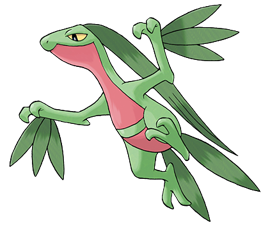
I wouldn’t call these Pokémon perfectly designed. In particular, I’ve never been totally happy with the progression from Grovyle to Sceptile. I remember thinking, when I first played Sapphire, that Grovyle might evolve into a Flying-type; it seemed like it would be the logical extension of the progression from Treecko, and part of me still thinks so (and he wouldn’t be the only Hoenn starter without a dual-type). Maybe it’s just me, but although Sceptile is clearly stronger physically, I have trouble accepting that he’s as quick and accurate as Grovyle. That enormous leafy tail seems it would just get in the way leaping from branch to branch. Moreover, it gives the wrong impression of how Sceptile stands and moves; a tail like that is surely a counterweight for standing upright on the ground, not a high priority for a creature who spends most of his time in the canopy, relying as much on his hands for support as on his feet. You could link this with Sceptile’s emerging role as a caretaker of the plants more than a combative defender, as symbolised by the seed pods growing on his back, but he’s still supposed to be a lightning-quick fighter mainly reliant on agility. I think Grovyle’s art is a better expression of the concept than Sceptile’s, which is an unfortunate blemish on an otherwise pleasing and unconventional design. From an artistic perspective, Sceptile definitely could have used a bit more emphasis on speed, and less on strength. He’s still as composed, confident and dangerous as Treecko and Grovyle, but perhaps not as practical, or as directly intimidating.
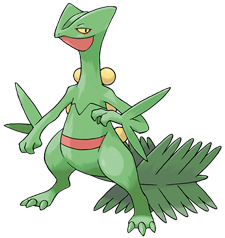
Sceptile is the second-fastest Grass Pokémon in the game, after the legendary Shaymin in Sky form. He also has one of the higher special attack stats among Grass-types. Everything comes at a price, though, and Sceptile is just about the most fragile of all the starter Pokémon. Sceptile’s major selling point in Ruby and Sapphire, when he was first released, was his signature move, Leaf Blade, which at the time was just about the best Grass attack in the game (it wasn’t even particularly good; it’s just that the other Grass attacks weren’t much competition). Still, it cemented Sceptile’s position as one of the better Grass-type attackers, with Crunch, Dragon Claw and (on Emerald) Thunderpunch for backup. Clearly Game Freak had learned from their mistake with Feraligatr, since they made Sceptile best at using special attacks when his flavour suggests he should be a physical attacker – Leaf Blade, weirdly, was a special attack at the time (like all Grass attacks), and the most important thing was making him good at using his own signature move. Of course, what happened next was that Diamond and Pearl started classifying attacks individually instead of by type and suddenly all of Sceptile’s best moves were physical attacks. You just can’t win with these people. Diamond and Pearl did also give him Dragon Pulse and Focus Blast (something many Grass-types would kill for – a powerful, if unreliable, way of dealing with Steel-types), as well as, finally, better Grass attacks, like Grass Knot, Energy Ball and Leaf Storm, and that’s pretty much where Sceptile is today; he doesn’t have enough attacks to score many super-effective hits, but between Dragon Pulse and Focus Blast he can manage neutral damage against most anything, and those Leaf Storms hurt. Sceptile does get Swords Dance, too, so you can make a physical attacker of him, between his decent attack stat, his excellent speed, and his wider physical movepool (which has always included Earthquake, and gained X-Scissor and Rock Slide in Diamond and Pearl and Acrobatics in Black and White). Leaf Blade got a damage buff too in Diamond and Pearl, probably to compensate Sceptile for switching it to physical.
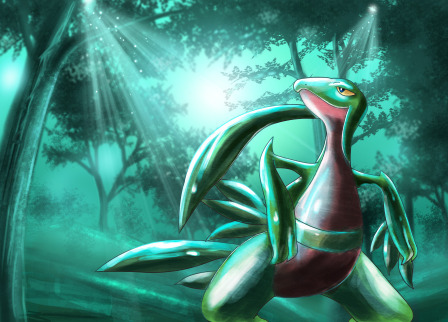
Of course, just because you can use Sceptile as an attacker doesn’t mean you have to. Sceptile lacks the huge support movepool of a typical Grass-type, but he does get Leech Seed, which means the old standby of Leech Seed/Substitute is open to him. The way this works is that you slap a Leech Seed on something with a lot of hit points and sacrifice your health to create Substitutes that block attacks while the seed keeps you healthy and steadily weakens your opponent, leading to slow and painful death. This is tricky to pull off, but – somewhat counterintuitively – speed actually helps much more than toughness, because being able to move before your opponent is crucial to staying in control of the situation if something unexpected happens, so Sceptile is extremely good at it (not as good as Whimsicott, thanks to her lovely ability, but still good). Pretty sure the only other thing left to talk about it abilities… Sceptile is one of the few starters who’s probably better off with the generic starter ability, Overgrow, than with his Dream World ability, Unburden. Unburden gives Sceptile a free speed boost when he loses or consumes an item he’s holding and, well, honestly speed is the least of Sceptile’s worries. I’m sure you can turn Unburden to your advantage with a bit of thought because in general it’s quite a useful ability in combination with berries and the like, but most of the time you’ll likely be better off with Overgrow; the devastating power of Sceptile’s Leaf Storm is possibly his biggest selling point, so anything that can potentially add to that is probably a good idea.
I can’t help but feel that what should have happened with Sceptile is for Game Freak to swap around his attack and special attack stats with the advent of Diamond and Pearl. Tinkering with a Pokémon’s stats like that is admittedly very unorthodox; apart from the splitting of special into special attack and special defence in Gold and Silver, Game Freak have never done anything even remotely similar. Still, the reason for Sceptile’s current stat distribution is Leaf Blade’s former status as a special attack – surely it makes sense that when practically his entire offensive movepool, including his signature move, flipped to physical, he should have flipped with it? Personally I place a great deal of value on Pokémon being good at the things that they’re good at. Still, Sceptile’s a solid Pokémon, and even if I think Treecko and Grovyle did a much better job of conveying the point of the design, Sceptile’s regal bearing makes him a decent “lord of the forest.”
 Pokémaniacal